INTELLIGENCE TESTS
 Modern Intelligence tests are divided into two types:
Individual Tests
Group Tests
 Individual test : one individual is tested at a time
 Group test : group of individuals tested at a time
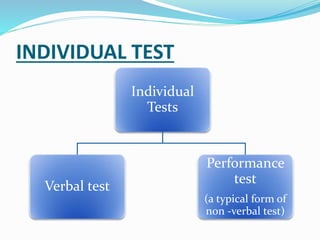
INDIVIDUAL TEST
Individual
Tests
Verbal test
Performance
test
(a typical form of
non -verbal test)
Verbal or Language tests :
 These tests make use of language. Here the
instructions are given in words (either in
written or oral form or both). Individuals are
required to use language as well as paper or
pencil for giving the responses. The test
content is loaded with verbal material
Non-Verbal or Non-Language tests
 These tests involve such activities in which
the use of language is not necessary. The use
of language is eliminated from the test
content and response expect in giving
directions.
INDIVIDUAL TESTS:
 Two Individual tests stand out in the measurement of
intelligence
Stanford-Binet Intelligence test
Wechsler Bellevue Intelligence Scales
Stanford-Binet Intelligence Test
 Stanford-Binet test(1916) is a new version of Binet-
Simon test
 In the year 1905, two French Psychologist Binet and
Simon discover the Intelligence test.
 After that in 1916 it was modified by American
Psychologist Lewis Terman with Binet At Stanford
University for current use of Intelligent assessment.
 Afterwards, it is known as Stanford-Binet Intelligence
Test
 Age Group: 2-23 years
 Total time : 30 to 90 minutes
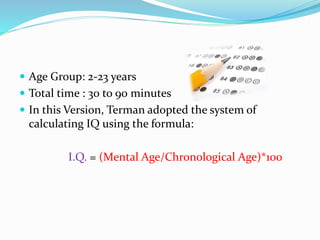
 In this Version, Terman adopted the system of
calculating IQ using the formula:
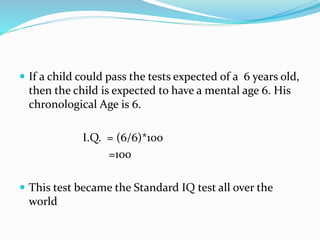
I.Q. = (Mental Age/Chronological Age)*100
 If a child could pass the tests expected of a 6 years old,
then the child is expected to have a mental age 6. His
chronological Age is 6.
I.Q. = (6/6)*100
=100
 This test became the Standard IQ test all over the
world
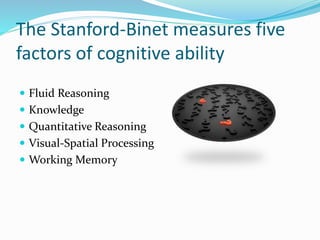
The Stanford-Binet measures five
factors of cognitive ability
 Fluid Reasoning
 Knowledge
 Quantitative Reasoning
 Visual-Spatial Processing
 Working Memory
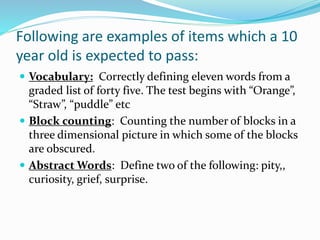
Following are examples of items which a 10
year old is expected to pass:
 Vocabulary: Correctly defining eleven words from a
graded list of forty five. The test begins with “Orange”,
“Straw”, “puddle” etc
 Block counting: Counting the number of blocks in a
three dimensional picture in which some of the blocks
are obscured.
 Abstract Words: Define two of the following: pity,,
curiosity, grief, surprise.
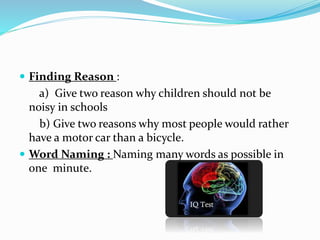
 Finding Reason :
a) Give two reason why children should not be
noisy in schools
b) Give two reasons why most people would rather
have a motor car than a bicycle.
 Word Naming : Naming many words as possible in
one minute.
 Repeating digits: Repeating in order at least one of
the following sequence:
a) 4-7-3-8-5-9
b) 5-2-9-7-4-6
 Detailed scoring instructions are given for each of
them. A list of acceptable and unacceptable answers
are also given
 Majority of the items of this test are verbal.
 They Measure crystallized ability more than Fluid
Ability.
Individual Performance test
 As said earlier, the complete non-verbal or non-
language tests of intelligence for testing an
individual at a time come into this classification.
In these tests the contents and responses are in the
form of performance and language is not used at
all. In these tests the items which require
responses in terms of motor activities are included.
 Block building or cube construction:
Where the subject is asked to make a
structure or design by means of blocks or cubes
supplied to him
Examples are
Merril Palmer Block Building
Koh’s Block Design Test
Alexander’s pass-along test
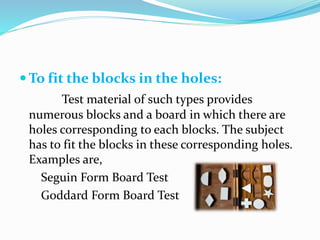
 To fit the blocks in the holes:
Test material of such types provides
numerous blocks and a board in which there are
holes corresponding to each blocks. The subject
has to fit the blocks in these corresponding holes.
Examples are,
Seguin Form Board Test
Goddard Form Board Test
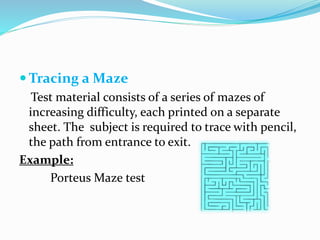
 Tracing a Maze
Test material consists of a series of mazes of
increasing difficulty, each printed on a separate
sheet. The subject is required to trace with pencil,
the path from entrance to exit.
Example:
Porteus Maze test
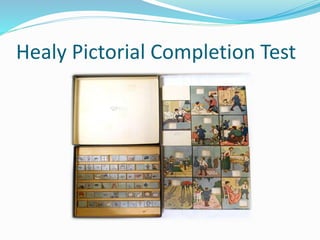
 Picture Arrangement
In picture arrangement test the task is to arrange
in series the given pictures whereas in picture
completion test the subject is required to complete
the pictures with the help of given pieces cut of
each picture.
Example
Healy pictorial completion Test
Healy Pictorial Completion Test
 As seen above, these tests try to lay stress on one or the
other types of performance. Istead of using one or two
tests a group of performance tested, organized either
into a scale or battery, are used for a comprehensive
picture of an Individual's mental ability
Examples are,
The Pinter Patterson Scale
The Arthur Point Scale
Alexander’s Battery of Performance Test
WECHSLER SCALE
 The first popular individual test is the Wechsler
Bellevue scale (1938).
 Developed by Dr. David Wechsler, a clinical
psychologist
 The test measures one’s ability to adapt and
constructively solve problems in the environment
 Consists of three scales :
1) WAIS -Wechsler Adult Intelligence Test
2) WISC –Wechsler Intelligence Scale for Children
3) WPPSI –Wechsler Preschool and Primary Scale
of Intelligence
 WAIS : to measure intelligence and Cognitive ability in
adults and older Adolescents (16-74 years)
 WISC : intelligence test for children between the ages
of 6 to 16 years
 WPPSI : intelligence test for children between the ages
4-6 years
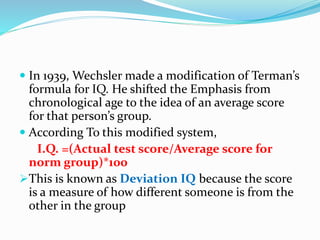
 In 1939, Wechsler made a modification of Terman’s
formula for IQ. He shifted the Emphasis from
chronological age to the idea of an average score
for that person’s group.
 According To this modified system,
I.Q. =(Actual test score/Average score for
norm group)*100
This is known as Deviation IQ because the score
is a measure of how different someone is from the
other in the group
 Wechsler intelligence test consists of ELEVEN sub-sets
 SIX of them are in VERBAL INTELLIGENCE
 FIVE of them are PERFORMANCE INTELLIGENCE
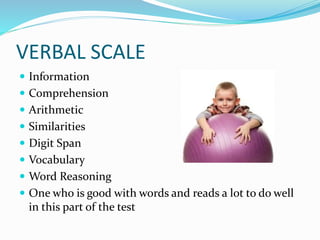
VERBAL SCALE
 Information
 Comprehension
 Arithmetic
 Similarities
 Digit Span
 Vocabulary
 Word Reasoning
 One who is good with words and reads a lot to do well
in this part of the test
PERFORMANCE SCALE
 Digit symbol
 Picture completion
 Block Design
 Picture Arrangement
 Object Assembly
 Matrix reasoning
 Mazes
 A person has to do as many as these in one and a
half minutes.
 Some clinical Psychologists have used these sub
sets to identify brain disorders
 It has been found that the verbal test measure
essentially crystallized ability and performance
tests the fluid ability.
A Brief description of the subscales of the WISC used
for used for the range of 5 to 15 is given below:
 VERBAL SCALE:
a) Information : Answering questions like “What
is steam made of?” or “what is a pepper?”
b)Comprehension: What would you do if you see
someone forget his book when he leaves his seat in
a restaurant?
c) Arithmetic : Solving typical school text book
problems in a given time
d) Similarities: Describe how things are alike?
eg. Lion & Tiger
e) Digit Span : Repeating of numbers
f) Vocabulary : Defining words
PERFORMANCE SCALE
 Picture completion : Identify the missing part in
complex pictures.
 Block Design : Pictures of block structure to be
produced by arranging coloured blocks
 Picture arrangement : arranging pictures in proper
order so that they may tell a story.
 Object Assembly : Making a picture out of scrambled
Jigsaw like pieces.
CONCLUSION
 The WISC and Stanford- Binet are the most popular
tests
 They are regularly used by educational Psychologists
 Individual tests which can be administrated only by
highly trained persons.
Intelligent tests

Intelligent tests

  • 2.
    INTELLIGENCE TESTS  ModernIntelligence tests are divided into two types: Individual Tests Group Tests  Individual test : one individual is tested at a time  Group test : group of individuals tested at a time
  • 3.
  • 4.
    Verbal or Languagetests :  These tests make use of language. Here the instructions are given in words (either in written or oral form or both). Individuals are required to use language as well as paper or pencil for giving the responses. The test content is loaded with verbal material
  • 5.
    Non-Verbal or Non-Languagetests  These tests involve such activities in which the use of language is not necessary. The use of language is eliminated from the test content and response expect in giving directions.
  • 6.
    INDIVIDUAL TESTS:  TwoIndividual tests stand out in the measurement of intelligence Stanford-Binet Intelligence test Wechsler Bellevue Intelligence Scales
  • 7.
    Stanford-Binet Intelligence Test Stanford-Binet test(1916) is a new version of Binet- Simon test  In the year 1905, two French Psychologist Binet and Simon discover the Intelligence test.  After that in 1916 it was modified by American Psychologist Lewis Terman with Binet At Stanford University for current use of Intelligent assessment.  Afterwards, it is known as Stanford-Binet Intelligence Test
  • 8.
     Age Group:2-23 years  Total time : 30 to 90 minutes  In this Version, Terman adopted the system of calculating IQ using the formula: I.Q. = (Mental Age/Chronological Age)*100
  • 9.
     If achild could pass the tests expected of a 6 years old, then the child is expected to have a mental age 6. His chronological Age is 6. I.Q. = (6/6)*100 =100  This test became the Standard IQ test all over the world
  • 10.
    The Stanford-Binet measuresfive factors of cognitive ability  Fluid Reasoning  Knowledge  Quantitative Reasoning  Visual-Spatial Processing  Working Memory
  • 11.
    Following are examplesof items which a 10 year old is expected to pass:  Vocabulary: Correctly defining eleven words from a graded list of forty five. The test begins with “Orange”, “Straw”, “puddle” etc  Block counting: Counting the number of blocks in a three dimensional picture in which some of the blocks are obscured.  Abstract Words: Define two of the following: pity,, curiosity, grief, surprise.
  • 12.
     Finding Reason: a) Give two reason why children should not be noisy in schools b) Give two reasons why most people would rather have a motor car than a bicycle.  Word Naming : Naming many words as possible in one minute.
  • 13.
     Repeating digits:Repeating in order at least one of the following sequence: a) 4-7-3-8-5-9 b) 5-2-9-7-4-6  Detailed scoring instructions are given for each of them. A list of acceptable and unacceptable answers are also given  Majority of the items of this test are verbal.  They Measure crystallized ability more than Fluid Ability.
  • 14.
    Individual Performance test As said earlier, the complete non-verbal or non- language tests of intelligence for testing an individual at a time come into this classification. In these tests the contents and responses are in the form of performance and language is not used at all. In these tests the items which require responses in terms of motor activities are included.
  • 15.
     Block buildingor cube construction: Where the subject is asked to make a structure or design by means of blocks or cubes supplied to him Examples are Merril Palmer Block Building Koh’s Block Design Test Alexander’s pass-along test
  • 16.
     To fitthe blocks in the holes: Test material of such types provides numerous blocks and a board in which there are holes corresponding to each blocks. The subject has to fit the blocks in these corresponding holes. Examples are, Seguin Form Board Test Goddard Form Board Test
  • 17.
     Tracing aMaze Test material consists of a series of mazes of increasing difficulty, each printed on a separate sheet. The subject is required to trace with pencil, the path from entrance to exit. Example: Porteus Maze test
  • 18.
     Picture Arrangement Inpicture arrangement test the task is to arrange in series the given pictures whereas in picture completion test the subject is required to complete the pictures with the help of given pieces cut of each picture. Example Healy pictorial completion Test
  • 19.
  • 20.
     As seenabove, these tests try to lay stress on one or the other types of performance. Istead of using one or two tests a group of performance tested, organized either into a scale or battery, are used for a comprehensive picture of an Individual's mental ability Examples are, The Pinter Patterson Scale The Arthur Point Scale Alexander’s Battery of Performance Test
  • 21.
    WECHSLER SCALE  Thefirst popular individual test is the Wechsler Bellevue scale (1938).  Developed by Dr. David Wechsler, a clinical psychologist  The test measures one’s ability to adapt and constructively solve problems in the environment
  • 22.
     Consists ofthree scales : 1) WAIS -Wechsler Adult Intelligence Test 2) WISC –Wechsler Intelligence Scale for Children 3) WPPSI –Wechsler Preschool and Primary Scale of Intelligence
  • 23.
     WAIS :to measure intelligence and Cognitive ability in adults and older Adolescents (16-74 years)  WISC : intelligence test for children between the ages of 6 to 16 years  WPPSI : intelligence test for children between the ages 4-6 years
  • 24.
     In 1939,Wechsler made a modification of Terman’s formula for IQ. He shifted the Emphasis from chronological age to the idea of an average score for that person’s group.  According To this modified system, I.Q. =(Actual test score/Average score for norm group)*100 This is known as Deviation IQ because the score is a measure of how different someone is from the other in the group
  • 25.
     Wechsler intelligencetest consists of ELEVEN sub-sets  SIX of them are in VERBAL INTELLIGENCE  FIVE of them are PERFORMANCE INTELLIGENCE
  • 26.
    VERBAL SCALE  Information Comprehension  Arithmetic  Similarities  Digit Span  Vocabulary  Word Reasoning  One who is good with words and reads a lot to do well in this part of the test
  • 27.
    PERFORMANCE SCALE  Digitsymbol  Picture completion  Block Design  Picture Arrangement  Object Assembly  Matrix reasoning  Mazes
  • 28.
     A personhas to do as many as these in one and a half minutes.  Some clinical Psychologists have used these sub sets to identify brain disorders  It has been found that the verbal test measure essentially crystallized ability and performance tests the fluid ability.
  • 29.
    A Brief descriptionof the subscales of the WISC used for used for the range of 5 to 15 is given below:  VERBAL SCALE: a) Information : Answering questions like “What is steam made of?” or “what is a pepper?” b)Comprehension: What would you do if you see someone forget his book when he leaves his seat in a restaurant? c) Arithmetic : Solving typical school text book problems in a given time
  • 30.
    d) Similarities: Describehow things are alike? eg. Lion & Tiger e) Digit Span : Repeating of numbers f) Vocabulary : Defining words
  • 31.
    PERFORMANCE SCALE  Picturecompletion : Identify the missing part in complex pictures.  Block Design : Pictures of block structure to be produced by arranging coloured blocks  Picture arrangement : arranging pictures in proper order so that they may tell a story.  Object Assembly : Making a picture out of scrambled Jigsaw like pieces.
  • 32.
    CONCLUSION  The WISCand Stanford- Binet are the most popular tests  They are regularly used by educational Psychologists  Individual tests which can be administrated only by highly trained persons.