Pathology of Cardiovascular Disease Cardiovascular disease (CVD) is the general name given to diseases which affect the heart and blood vessels.  Coronary heart disease (CHD) refers to diseases affecting the heart and coronary blood vessels.  Examples of CVD are:  thrombosis, angina pectoris, myocardial infarction (heart attack), stroke The main processes involved in cardiovascular and coronary heart disease are  ATHEROSCLEROSIS  and  HYPERTENSION
Hypertension Hypertension  is said to occur when the blood pressure is greater than 160/95 mm Hg  Nearly 20% of the adult population in the UK suffer from hypertension (high blood pressure) which often goes undetected until a heart attack or stroke occurs Therefore, it is important to have blood pressure checked on a regular basis and to adopt a healthy lifestyle to prevent hypertension
What complications are caused by high blood pressure? Atherosclerosis:  narrowing of the arteries. Stroke:  haemorrhage or blood clot in the brain Aneurysm:  dangerous expansion of the main artery either in the chest or the abdomen,which becomes weakened and may rupture Heart attack Heart failure:  reduced pumping ability Kidney failure Eye damage
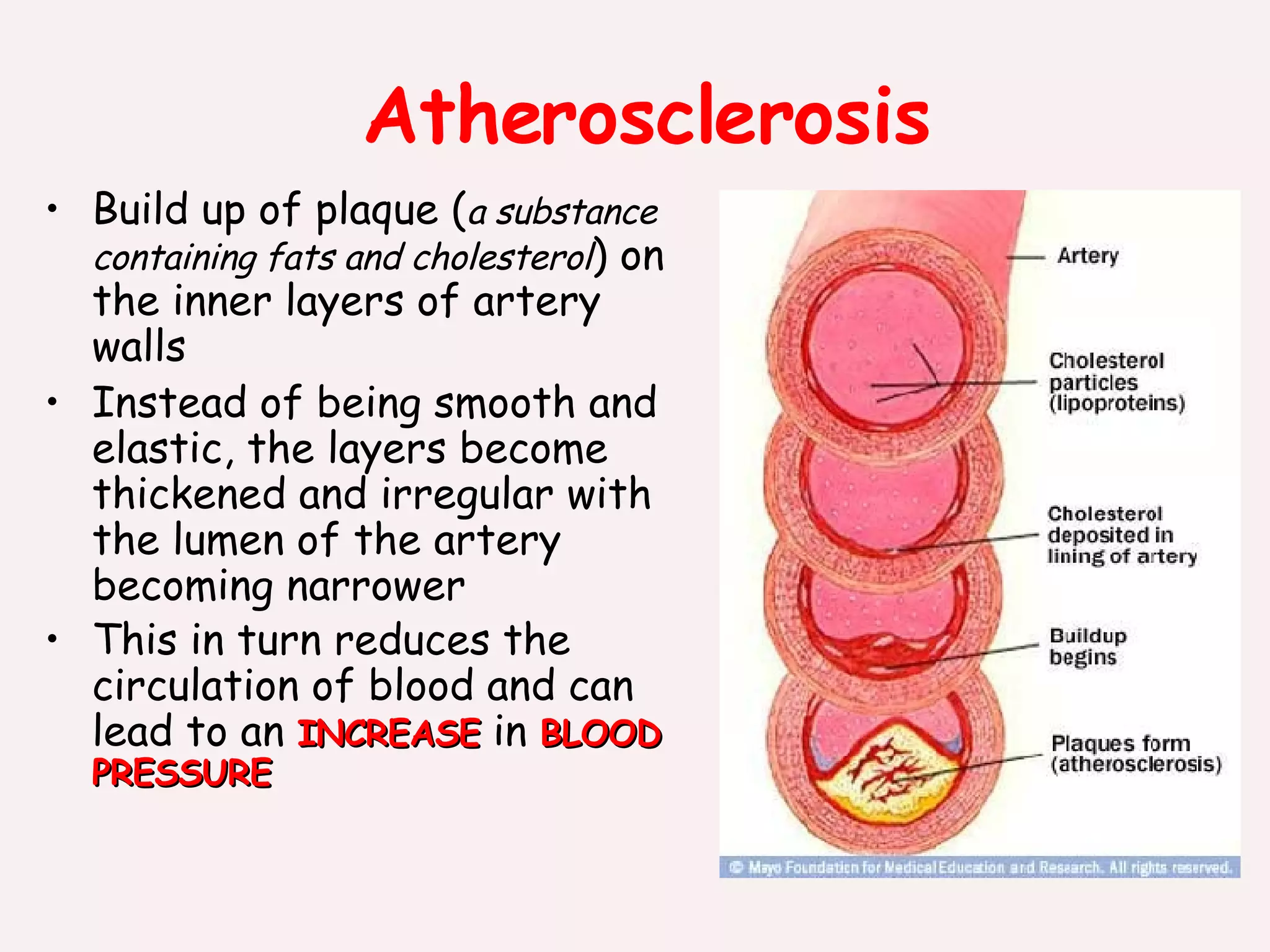
Atherosclerosis Build up of plaque ( a substance containing fats and cholesterol ) on the inner layers of artery walls Instead of being smooth and elastic, the layers become thickened and irregular with the lumen of the artery becoming narrower This in turn reduces the circulation of blood and can lead to an  INCREASE  in  BLOOD PRESSURE
Thrombosis A thrombosis occurs when a blood clot forms in a artery, completing blocking the flow of blood If this happens in one of the coronary arteries in the heart it causes a  HEART ATTACK  or  MYOCARDIAL INFARCTION If it occurs in an artery in the brain it causes a  STROKE
Angina pectoris Angina pectoris occurs when the blood vessels in the heart are partially blocked due to  ATHEROSCLEROSIS During exercise blood flow cannot increase to meet the needs of the heart muscle and  chest pain  results The pain disappears when the exercise stops
Myocardial infarction A heart attack (MI) occurs when an area of heart muscle dies or is permanently damaged because of an  INADEQUATE SUPPLY OF OXYGEN  to that area Most MIs are caused by a  CLOT  that blocks one of the coronary arteries (the blood vessels that bring blood and oxygen to the heart muscle)  The clot usually forms in a coronary artery that has been previously narrowed from changes related to  ATHEROSCLEROSIS The atherosclerotic plaque (buildup) inside the arterial wall sometimes cracks, and this triggers the formation of a clot, also called a  thrombus
A clot in the coronary artery interrupts the flow of blood and oxygen to the heart muscle, leading to the death of heart cells in that area The damaged heart muscle loses its ability to contract, and the remaining heart muscle needs to compensate for that weakened area Occasionally, sudden overwhelming  STRESS  can trigger a heart attack
Stroke A stroke is an interruption of the blood supply to any part of the brain A stroke can happen when: A blood vessel carrying blood to the brain is blocked by a  blood clot A blood vessel breaks open, causing  blood to leak  into the brain If blood flow is stopped for longer than a few seconds, the brain cannot get blood and oxygen. Brain cells can die, causing permanent damage
Incidence of CHD Coronary heart disease (CHD) is more common in countries with  HIGH FAT  diets,  HIGH SMOKING RATES  and  SEDENTARY LIFESTYLES  (such as the UK & USA) Developing countries tend to have lower incidences of CHD but numbers there are increasing
CHD MORTALITY INCIDENCE
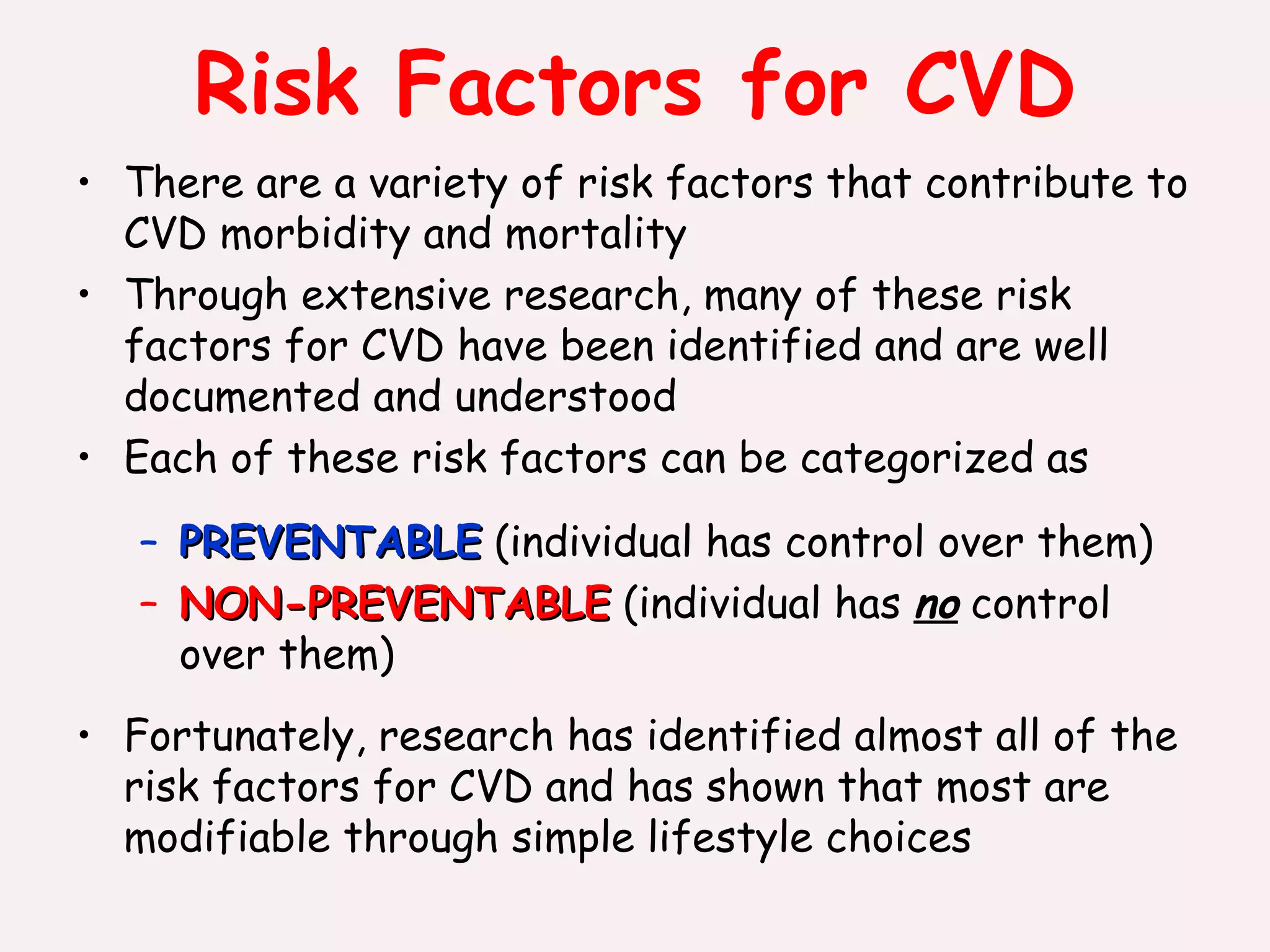
Risk Factors for CVD There are a variety of risk factors that contribute to CVD morbidity and mortality Through extensive research, many of these risk factors for CVD have been identified and are well documented and understood Each of these risk factors can be categorized as PREVENTABLE  (individual has control over them) NON-PREVENTABLE  (individual has  no  control over them) Fortunately, research has identified almost all of the risk factors for CVD and has shown that most are modifiable through simple lifestyle choices
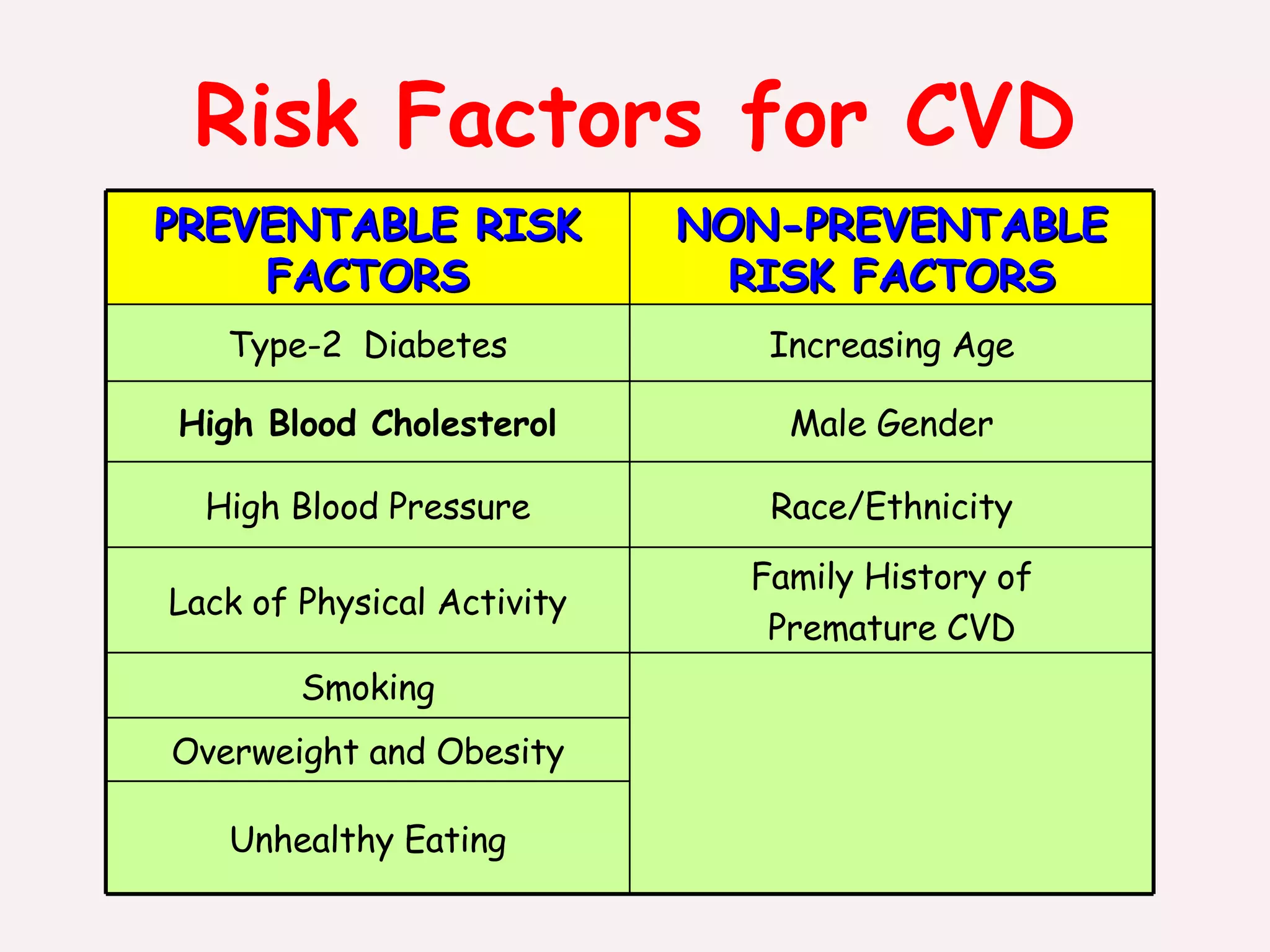
Risk Factors for CVD Unhealthy Eating Overweight and Obesity Smoking Family History of Premature CVD Lack of Physical Activity Race/Ethnicity High Blood Pressure Male Gender High Blood Cholesterol Increasing Age Type-2  Diabetes NON-PREVENTABLE RISK FACTORS PREVENTABLE RISK FACTORS
Risk Factors for Hypertension SMOKING  DIET  [high fat / high salt] OBESITY GENETIC PREDISPOSITION  STRESS Most cases of hypertension can be controlled by lifestyle changes alone, however  antihypertensive  medications can help control the condition and keep the heart healthy.
Role of cholesterol in CHD Cholesterol is a major component of cell membranes and is needed to make  STEROID HORMONES But because the body makes all the cholesterol it needs, the extra fat and cholesterol that you eat sit in the walls of arteries that carry blood to the heart These fatty deposits cause the arteries to narrow, less blood gets to the heart, and the risk for  coronary heart disease  INCREASES There are 2 important types of cholesterol-carrying proteins in the blood:   High-density lipoprotein (HDL)  - known as  "good"  cholesterol because it removes cholesterol from the blood and protects the heart Low-density lipoprotein (LDL)  -known as  " bad"  cholesterol
HDL : LDL Ratios As LDL level  INCREASES  [bad], the heart-disease risk  INCREASES In contrast, as the HDL level  INCREASES , the heart-disease risk  DECREASES The risk of developing CHD can be predicted by measuring the ratio of HDL : LDL in the blood High Ratio  =  High  HDL/  Low  LDL levels =  HEALTHY Low Ratio  =  Low  HDL/  High  LDL levels =  UNHEALTHY

Pathology of CVD

  • 1.
    Pathology of CardiovascularDisease Cardiovascular disease (CVD) is the general name given to diseases which affect the heart and blood vessels. Coronary heart disease (CHD) refers to diseases affecting the heart and coronary blood vessels. Examples of CVD are: thrombosis, angina pectoris, myocardial infarction (heart attack), stroke The main processes involved in cardiovascular and coronary heart disease are ATHEROSCLEROSIS and HYPERTENSION
  • 2.
    Hypertension Hypertension is said to occur when the blood pressure is greater than 160/95 mm Hg Nearly 20% of the adult population in the UK suffer from hypertension (high blood pressure) which often goes undetected until a heart attack or stroke occurs Therefore, it is important to have blood pressure checked on a regular basis and to adopt a healthy lifestyle to prevent hypertension
  • 3.
    What complications arecaused by high blood pressure? Atherosclerosis: narrowing of the arteries. Stroke: haemorrhage or blood clot in the brain Aneurysm: dangerous expansion of the main artery either in the chest or the abdomen,which becomes weakened and may rupture Heart attack Heart failure: reduced pumping ability Kidney failure Eye damage
  • 4.
    Atherosclerosis Build upof plaque ( a substance containing fats and cholesterol ) on the inner layers of artery walls Instead of being smooth and elastic, the layers become thickened and irregular with the lumen of the artery becoming narrower This in turn reduces the circulation of blood and can lead to an INCREASE in BLOOD PRESSURE
  • 5.
    Thrombosis A thrombosisoccurs when a blood clot forms in a artery, completing blocking the flow of blood If this happens in one of the coronary arteries in the heart it causes a HEART ATTACK or MYOCARDIAL INFARCTION If it occurs in an artery in the brain it causes a STROKE
  • 6.
    Angina pectoris Anginapectoris occurs when the blood vessels in the heart are partially blocked due to ATHEROSCLEROSIS During exercise blood flow cannot increase to meet the needs of the heart muscle and chest pain results The pain disappears when the exercise stops
  • 7.
    Myocardial infarction Aheart attack (MI) occurs when an area of heart muscle dies or is permanently damaged because of an INADEQUATE SUPPLY OF OXYGEN to that area Most MIs are caused by a CLOT that blocks one of the coronary arteries (the blood vessels that bring blood and oxygen to the heart muscle) The clot usually forms in a coronary artery that has been previously narrowed from changes related to ATHEROSCLEROSIS The atherosclerotic plaque (buildup) inside the arterial wall sometimes cracks, and this triggers the formation of a clot, also called a thrombus
  • 8.
    A clot inthe coronary artery interrupts the flow of blood and oxygen to the heart muscle, leading to the death of heart cells in that area The damaged heart muscle loses its ability to contract, and the remaining heart muscle needs to compensate for that weakened area Occasionally, sudden overwhelming STRESS can trigger a heart attack
  • 9.
    Stroke A strokeis an interruption of the blood supply to any part of the brain A stroke can happen when: A blood vessel carrying blood to the brain is blocked by a blood clot A blood vessel breaks open, causing  blood to leak into the brain If blood flow is stopped for longer than a few seconds, the brain cannot get blood and oxygen. Brain cells can die, causing permanent damage
  • 10.
    Incidence of CHDCoronary heart disease (CHD) is more common in countries with HIGH FAT diets, HIGH SMOKING RATES and SEDENTARY LIFESTYLES (such as the UK & USA) Developing countries tend to have lower incidences of CHD but numbers there are increasing
  • 11.
  • 12.
    Risk Factors forCVD There are a variety of risk factors that contribute to CVD morbidity and mortality Through extensive research, many of these risk factors for CVD have been identified and are well documented and understood Each of these risk factors can be categorized as PREVENTABLE (individual has control over them) NON-PREVENTABLE (individual has no control over them) Fortunately, research has identified almost all of the risk factors for CVD and has shown that most are modifiable through simple lifestyle choices
  • 13.
    Risk Factors forCVD Unhealthy Eating Overweight and Obesity Smoking Family History of Premature CVD Lack of Physical Activity Race/Ethnicity High Blood Pressure Male Gender High Blood Cholesterol Increasing Age Type-2 Diabetes NON-PREVENTABLE RISK FACTORS PREVENTABLE RISK FACTORS
  • 14.
    Risk Factors forHypertension SMOKING DIET [high fat / high salt] OBESITY GENETIC PREDISPOSITION STRESS Most cases of hypertension can be controlled by lifestyle changes alone, however antihypertensive medications can help control the condition and keep the heart healthy.
  • 15.
    Role of cholesterolin CHD Cholesterol is a major component of cell membranes and is needed to make STEROID HORMONES But because the body makes all the cholesterol it needs, the extra fat and cholesterol that you eat sit in the walls of arteries that carry blood to the heart These fatty deposits cause the arteries to narrow, less blood gets to the heart, and the risk for coronary heart disease INCREASES There are 2 important types of cholesterol-carrying proteins in the blood: High-density lipoprotein (HDL) - known as "good" cholesterol because it removes cholesterol from the blood and protects the heart Low-density lipoprotein (LDL) -known as " bad" cholesterol
  • 16.
    HDL : LDLRatios As LDL level INCREASES [bad], the heart-disease risk INCREASES In contrast, as the HDL level INCREASES , the heart-disease risk DECREASES The risk of developing CHD can be predicted by measuring the ratio of HDL : LDL in the blood High Ratio = High HDL/ Low LDL levels = HEALTHY Low Ratio = Low HDL/ High LDL levels = UNHEALTHY