-: PRESENTED BY :-
ASSISTANT PROF. NATHANI ZEESHAN
MUNAF
Dept. Of pharmacology
BY :- NATHANI ZEESHAN M. 1
PROF. RAVINDRA NIKAM COLLEGE OF
PHARMACY
Morane – Gondur By-Pass Road, Near Punam
Petrol Pump, Gondur, Tal. dist. Dhule- 424001
CONTENTS
 WHAT IS ATHEROSCLEROSIS
 WHAT IS PLAQUE
 PATHOPHYSIOLOGY OF ATHEROSCLEROSIS
 SIGNS AND SYMPTOMS
 DIAGNOSIS
 TREATMENT
 PREVENTION
BY :- NATHANI ZEESHAN M. 2
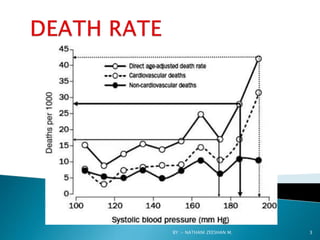
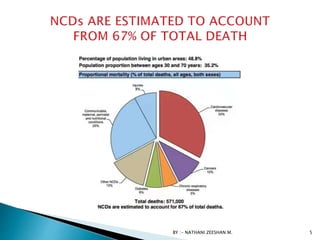
 DEATH RATE
BY :- NATHANI ZEESHAN M. 3
BY :- NATHANI ZEESHAN M. 4
BY :- NATHANI ZEESHAN M. 5
BY :- NATHANI ZEESHAN M. 6
BY :- NATHANI ZEESHAN M. 7
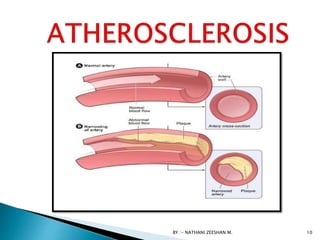
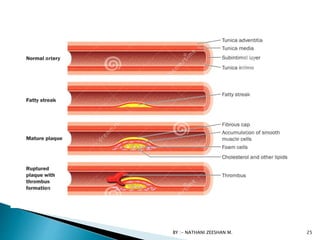
Atherosclerosis is a disease in
which plaque builds up inside human
arteries. Arteries are blood vessels
that carry oxygen-rich blood to heart
and other parts of human body.
Atherosclerosis can lead to
serious problems, including heart
attack, stroke, or even death.
BY :- NATHANI ZEESHAN M. 8
BY :- NATHANI ZEESHAN M. 9
BY :- NATHANI ZEESHAN M. 10
BY :- NATHANI ZEESHAN M. 11
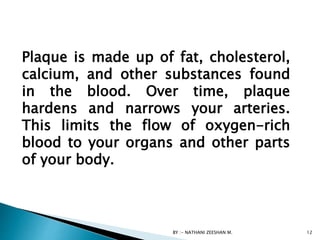
Plaque is made up of fat, cholesterol,
calcium, and other substances found
in the blood. Over time, plaque
hardens and narrows your arteries.
This limits the flow of oxygen-rich
blood to your organs and other parts
of your body.
BY :- NATHANI ZEESHAN M. 12
BY :- NATHANI ZEESHAN M. 13
BY :- NATHANI ZEESHAN M. 14
About one-third or one-fourth of all
cholesterol is high-density lipoprotein
cholesterol. High levels of HDL,
nicknamed "good" cholesterol,
decrease the risk of atherosclerosis.
<5 low risk, >8 High Risk.
BY :- NATHANI ZEESHAN M. 15
BY :- NATHANI ZEESHAN M. 16
Low-density lipoprotein cholesterol is
the primary cholesterol molecule.
High levels of LDL, nicknamed "bad"
cholesterol, increase the risk of
atherosclerosis.
< 130 mg/dl Low Risk.
>160 mg/dl High Risk.
BY :- NATHANI ZEESHAN M. 17
BY :- NATHANI ZEESHAN M. 18
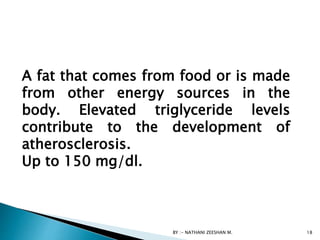
A fat that comes from food or is made
from other energy sources in the
body. Elevated triglyceride levels
contribute to the development of
atherosclerosis.
Up to 150 mg/dl.
BY :- NATHANI ZEESHAN M. 19
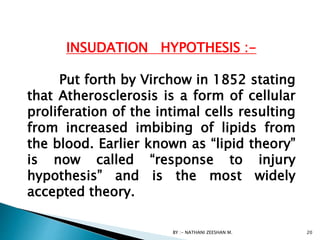
INSUDATION HYPOTHESIS :-
Put forth by Virchow in 1852 stating
that Atherosclerosis is a form of cellular
proliferation of the intimal cells resulting
from increased imbibing of lipids from
the blood. Earlier known as “lipid theory”
is now called “response to injury
hypothesis” and is the most widely
accepted theory.
BY :- NATHANI ZEESHAN M. 20
ENCRUSTATION HYPOTHESIS :-
Put forth by Rokitansky in 1852
stating that atheroma represented a form
of encrustation on the arterial wall from
the components in the blood forming
thrombi composed of platelets, fibrin and
leucocytes, and was earlier named as
“thrombogenic theory”.
BY :- NATHANI ZEESHAN M. 21
BY :- NATHANI ZEESHAN M. 22
• Original theory put forth in 1973 modified
in 1993.
• Original Theory : Initial event in
atherogenesis is endothelial injury followed by
smooth muscle cell proliferation. As per this
theory early lesions mainly consist of smooth
cells.
• Modified theory describes lipoprotein entry
into the intima as the initial event followed by
lipid accumulation in the macrophages (now
foam cells) which according to modified theory
are the dominant cells in early lesions.
BY :- NATHANI ZEESHAN M. 23
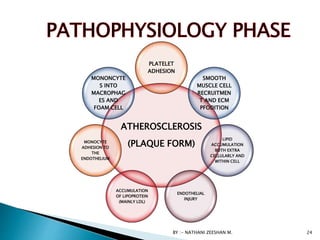
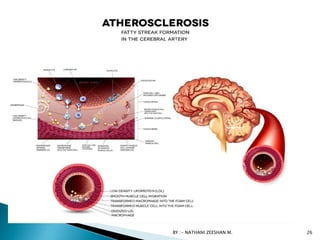
ATHEROSCLEROSIS
(PLAQUE FORM)
PLATELET
ADHESION
SMOOTH
MUSCLE CELL
RECRUITMEN
T AND ECM
PFODITION
LIPID
ACCUMULATION
BOTH EXTRA
CELLULARLY AND
WITHIN CELL
ENDOTHELIAL
INJURY
ACCUMULATION
OF LIPOPROTEIN
(MAINLY LDL)
MONOCYTE
ADHESION TO
THE
ENDOTHELIUM
MONONCYTE
S INTO
MACROPHAG
ES AND
FOAM CELL
BY :- NATHANI ZEESHAN M. 24
BY :- NATHANI ZEESHAN M. 25
BY :- NATHANI ZEESHAN M. 26
BY :- NATHANI ZEESHAN M. 27
• CORONARY ARTERIES (DISEASES)
• PERIPHERAL ARTERIES (DISEASES)
• RENAL ARTERIES (DISEASES)
BY :- NATHANI ZEESHAN M. 28
BY :- NATHANI ZEESHAN M. 29
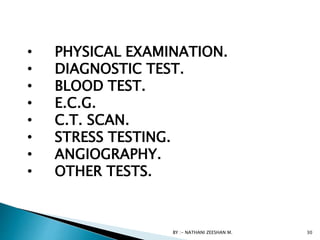
• PHYSICAL EXAMINATION.
• DIAGNOSTIC TEST.
• BLOOD TEST.
• E.C.G.
• C.T. SCAN.
• STRESS TESTING.
• ANGIOGRAPHY.
• OTHER TESTS.
BY :- NATHANI ZEESHAN M. 30
BY :- NATHANI ZEESHAN M. 31
BY :- NATHANI ZEESHAN M. 32
BY :- NATHANI ZEESHAN M. 33
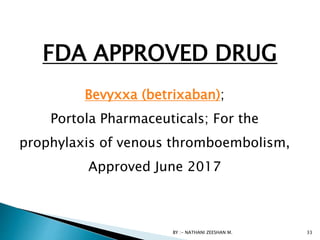
Bevyxxa (betrixaban);
Portola Pharmaceuticals; For the
prophylaxis of venous thromboembolism,
Approved June 2017
FDA APPROVED DRUG
BY :- NATHANI ZEESHAN M. 34
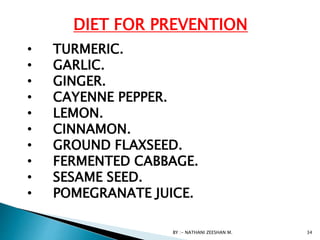
• TURMERIC.
• GARLIC.
• GINGER.
• CAYENNE PEPPER.
• LEMON.
• CINNAMON.
• GROUND FLAXSEED.
• FERMENTED CABBAGE.
• SESAME SEED.
• POMEGRANATE JUICE.
DIET FOR PREVENTION
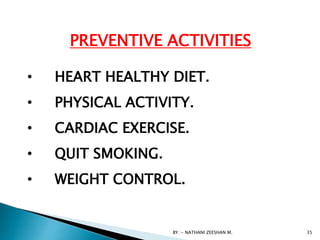
• HEART HEALTHY DIET.
• PHYSICAL ACTIVITY.
• CARDIAC EXERCISE.
• QUIT SMOKING.
• WEIGHT CONTROL.
BY :- NATHANI ZEESHAN M. 35
PREVENTIVE ACTIVITIES
BY :- NATHANI ZEESHAN M. 36

Atherosclerosis

  • 1.
    -: PRESENTED BY:- ASSISTANT PROF. NATHANI ZEESHAN MUNAF Dept. Of pharmacology BY :- NATHANI ZEESHAN M. 1 PROF. RAVINDRA NIKAM COLLEGE OF PHARMACY Morane – Gondur By-Pass Road, Near Punam Petrol Pump, Gondur, Tal. dist. Dhule- 424001
  • 2.
    CONTENTS  WHAT ISATHEROSCLEROSIS  WHAT IS PLAQUE  PATHOPHYSIOLOGY OF ATHEROSCLEROSIS  SIGNS AND SYMPTOMS  DIAGNOSIS  TREATMENT  PREVENTION BY :- NATHANI ZEESHAN M. 2  DEATH RATE
  • 3.
    BY :- NATHANIZEESHAN M. 3
  • 4.
    BY :- NATHANIZEESHAN M. 4
  • 5.
    BY :- NATHANIZEESHAN M. 5
  • 6.
    BY :- NATHANIZEESHAN M. 6
  • 7.
    BY :- NATHANIZEESHAN M. 7
  • 8.
    Atherosclerosis is adisease in which plaque builds up inside human arteries. Arteries are blood vessels that carry oxygen-rich blood to heart and other parts of human body. Atherosclerosis can lead to serious problems, including heart attack, stroke, or even death. BY :- NATHANI ZEESHAN M. 8
  • 9.
    BY :- NATHANIZEESHAN M. 9
  • 10.
    BY :- NATHANIZEESHAN M. 10
  • 11.
    BY :- NATHANIZEESHAN M. 11
  • 12.
    Plaque is madeup of fat, cholesterol, calcium, and other substances found in the blood. Over time, plaque hardens and narrows your arteries. This limits the flow of oxygen-rich blood to your organs and other parts of your body. BY :- NATHANI ZEESHAN M. 12
  • 13.
    BY :- NATHANIZEESHAN M. 13
  • 14.
    BY :- NATHANIZEESHAN M. 14 About one-third or one-fourth of all cholesterol is high-density lipoprotein cholesterol. High levels of HDL, nicknamed "good" cholesterol, decrease the risk of atherosclerosis. <5 low risk, >8 High Risk.
  • 15.
    BY :- NATHANIZEESHAN M. 15
  • 16.
    BY :- NATHANIZEESHAN M. 16 Low-density lipoprotein cholesterol is the primary cholesterol molecule. High levels of LDL, nicknamed "bad" cholesterol, increase the risk of atherosclerosis. < 130 mg/dl Low Risk. >160 mg/dl High Risk.
  • 17.
    BY :- NATHANIZEESHAN M. 17
  • 18.
    BY :- NATHANIZEESHAN M. 18 A fat that comes from food or is made from other energy sources in the body. Elevated triglyceride levels contribute to the development of atherosclerosis. Up to 150 mg/dl.
  • 19.
    BY :- NATHANIZEESHAN M. 19
  • 20.
    INSUDATION HYPOTHESIS :- Putforth by Virchow in 1852 stating that Atherosclerosis is a form of cellular proliferation of the intimal cells resulting from increased imbibing of lipids from the blood. Earlier known as “lipid theory” is now called “response to injury hypothesis” and is the most widely accepted theory. BY :- NATHANI ZEESHAN M. 20
  • 21.
    ENCRUSTATION HYPOTHESIS :- Putforth by Rokitansky in 1852 stating that atheroma represented a form of encrustation on the arterial wall from the components in the blood forming thrombi composed of platelets, fibrin and leucocytes, and was earlier named as “thrombogenic theory”. BY :- NATHANI ZEESHAN M. 21
  • 22.
    BY :- NATHANIZEESHAN M. 22
  • 23.
    • Original theoryput forth in 1973 modified in 1993. • Original Theory : Initial event in atherogenesis is endothelial injury followed by smooth muscle cell proliferation. As per this theory early lesions mainly consist of smooth cells. • Modified theory describes lipoprotein entry into the intima as the initial event followed by lipid accumulation in the macrophages (now foam cells) which according to modified theory are the dominant cells in early lesions. BY :- NATHANI ZEESHAN M. 23
  • 24.
    ATHEROSCLEROSIS (PLAQUE FORM) PLATELET ADHESION SMOOTH MUSCLE CELL RECRUITMEN TAND ECM PFODITION LIPID ACCUMULATION BOTH EXTRA CELLULARLY AND WITHIN CELL ENDOTHELIAL INJURY ACCUMULATION OF LIPOPROTEIN (MAINLY LDL) MONOCYTE ADHESION TO THE ENDOTHELIUM MONONCYTE S INTO MACROPHAG ES AND FOAM CELL BY :- NATHANI ZEESHAN M. 24
  • 25.
    BY :- NATHANIZEESHAN M. 25
  • 26.
    BY :- NATHANIZEESHAN M. 26
  • 27.
    BY :- NATHANIZEESHAN M. 27
  • 28.
    • CORONARY ARTERIES(DISEASES) • PERIPHERAL ARTERIES (DISEASES) • RENAL ARTERIES (DISEASES) BY :- NATHANI ZEESHAN M. 28
  • 29.
    BY :- NATHANIZEESHAN M. 29
  • 30.
    • PHYSICAL EXAMINATION. •DIAGNOSTIC TEST. • BLOOD TEST. • E.C.G. • C.T. SCAN. • STRESS TESTING. • ANGIOGRAPHY. • OTHER TESTS. BY :- NATHANI ZEESHAN M. 30
  • 31.
    BY :- NATHANIZEESHAN M. 31
  • 32.
    BY :- NATHANIZEESHAN M. 32
  • 33.
    BY :- NATHANIZEESHAN M. 33 Bevyxxa (betrixaban); Portola Pharmaceuticals; For the prophylaxis of venous thromboembolism, Approved June 2017 FDA APPROVED DRUG
  • 34.
    BY :- NATHANIZEESHAN M. 34 • TURMERIC. • GARLIC. • GINGER. • CAYENNE PEPPER. • LEMON. • CINNAMON. • GROUND FLAXSEED. • FERMENTED CABBAGE. • SESAME SEED. • POMEGRANATE JUICE. DIET FOR PREVENTION
  • 35.
    • HEART HEALTHYDIET. • PHYSICAL ACTIVITY. • CARDIAC EXERCISE. • QUIT SMOKING. • WEIGHT CONTROL. BY :- NATHANI ZEESHAN M. 35 PREVENTIVE ACTIVITIES
  • 36.
    BY :- NATHANIZEESHAN M. 36