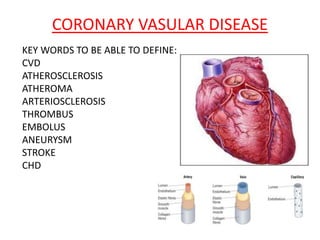
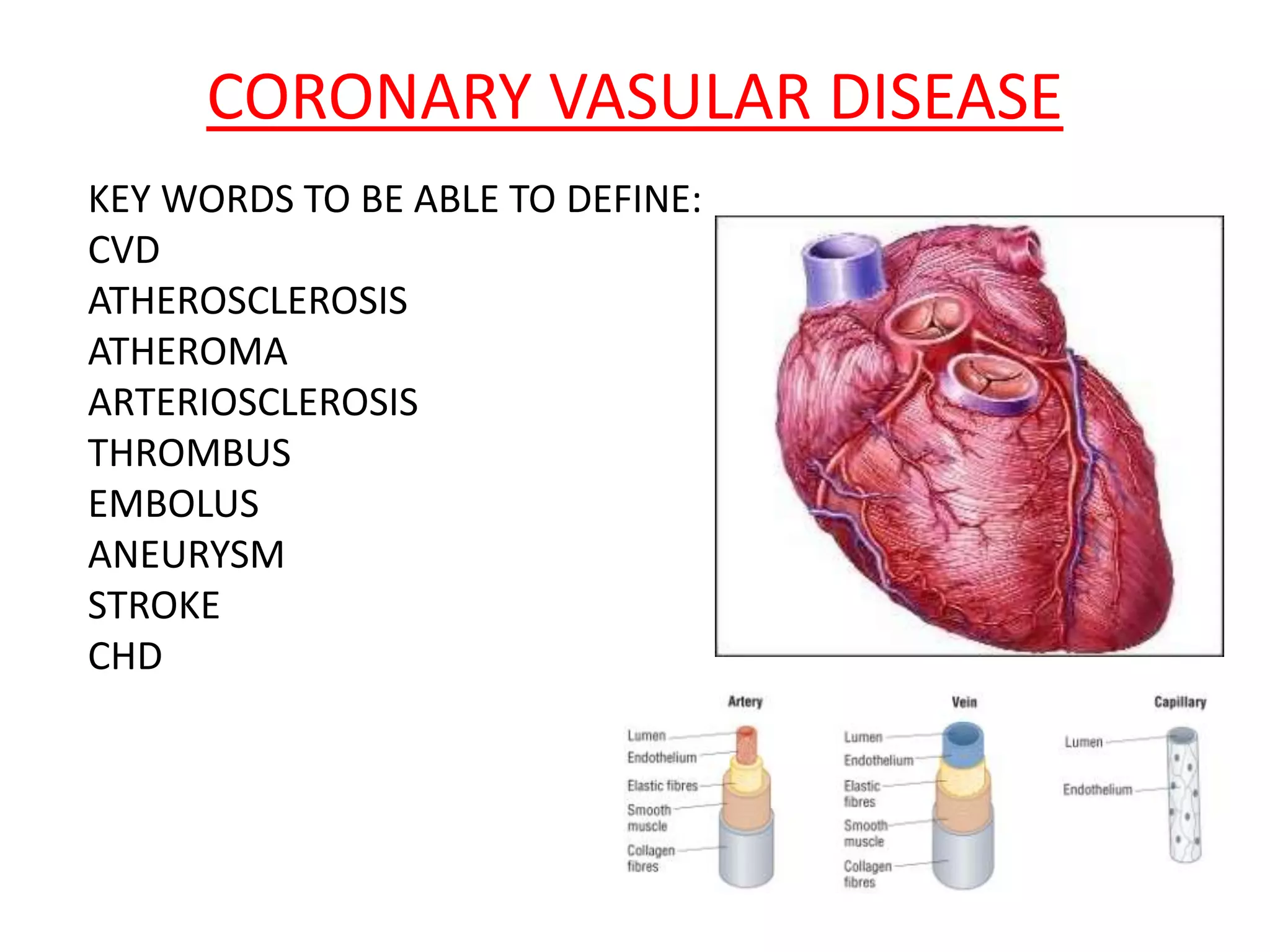
CORONARY VASULAR DISEASE
KEY WORDS TO BE ABLE TO DEFINE:
CVD
ATHEROSCLEROSIS
ATHEROMA
ARTERIOSCLEROSIS
THROMBUS
EMBOLUS
ANEURYSM
STROKE
CHD
From the EDEXCEL specification:
โ€ข
Describe the blood clotting process
thromboplastin release, conversion of prothrombin to thrombin and fibrinogen to fibrin and its role in cardiovascular disease (CVD).

โ€ข
Explain the course of events that leads to atherosclerosis
endothelial damage, inflammatory response, plaque formation, raised blood pressure
โ€ข
Describe the factors that increase the risk of CVD
genetic,diet, age, gender, high blood pressure, smoking and inactivity
โ€ข
Describe the benefits and risks of treatments for CVD
antihypertensives, plant statins, anticoagulants and platelet inhibitory drugs
โ€ข

Analyse and interpret data on the possible significance for health of blood cholesterol levels and levels of high-density lipoproteins
(HDLs) and low-density lipoproteins (LDLs).

โ€ข

Describe the evidence for a causal relationship between blood cholesterol levels (total cholesterol and LDL cholesterol) and CVD.

โ€ข

Discuss how people use scientific knowledge about the effects of diet (including obesity indicators), exercise and smoking to reduce
their risk of coronary heart disease.
โ€ข In 2011, almost 160,000 people in the UK died from
CVD.
โ€ข 74,000 of these deaths were caused by coronary
heart disease - the UK's single biggest killer.
โ€ข Other types of cardiovascular disease include heart
valve disease and cardiomyopathy.
http://www.bhf.org.uk/heart-health/conditions/cardiovascular-disease.aspx
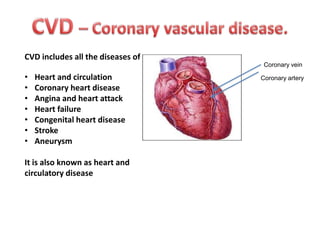
CVD includes all the diseases of
Coronary vein

โ€ข
โ€ข
โ€ข
โ€ข
โ€ข
โ€ข
โ€ข

Heart and circulation
Coronary heart disease
Angina and heart attack
Heart failure
Congenital heart disease
Stroke
Aneurysm

It is also known as heart and
circulatory disease

Coronary artery
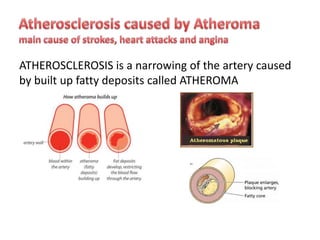
ATHEROSCLEROSIS is a narrowing of the artery caused
by built up fatty deposits called ATHEROMA
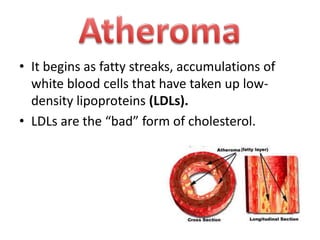
โ€ข It begins as fatty streaks, accumulations of
white blood cells that have taken up lowdensity lipoproteins (LDLs).
โ€ข LDLs are the โ€œbadโ€ form of cholesterol.
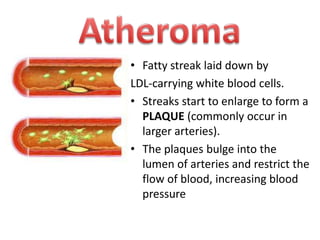
โ€ข Fatty streak laid down by
LDL-carrying white blood cells.
โ€ข Streaks start to enlarge to form a
PLAQUE (commonly occur in
larger arteries).
โ€ข The plaques bulge into the
lumen of arteries and restrict the
flow of blood, increasing blood
pressure
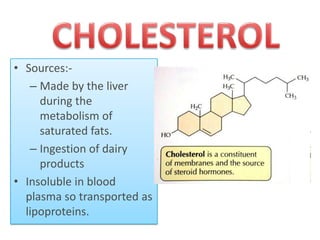
โ€ข Sources:โ€“ Made by the liver
during the
metabolism of
saturated fats.
โ€“ Ingestion of dairy
products
โ€ข Insoluble in blood
plasma so transported as
lipoproteins.
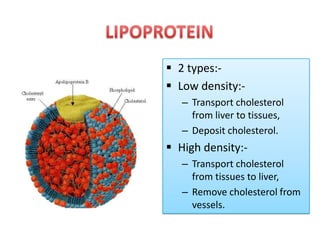
๏‚ง 2 types:๏‚ง Low density:โ€“ Transport cholesterol
from liver to tissues,
โ€“ Deposit cholesterol.

๏‚ง High density:โ€“ Transport cholesterol
from tissues to liver,
โ€“ Remove cholesterol from
vessels.
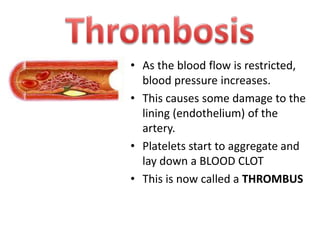
โ€ข As the blood flow is restricted,
blood pressure increases.
โ€ข This causes some damage to the
lining (endothelium) of the
artery.
โ€ข Platelets start to aggregate and
lay down a BLOOD CLOT
โ€ข This is now called a THROMBUS
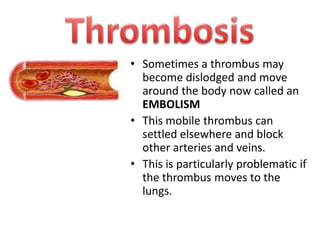
โ€ข Sometimes a thrombus may
become dislodged and move
around the body now called an
EMBOLISM
โ€ข This mobile thrombus can
settled elsewhere and block
other arteries and veins.
โ€ข This is particularly problematic if
the thrombus moves to the
lungs.
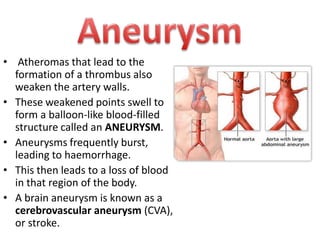
โ€ข Atheromas that lead to the
formation of a thrombus also
weaken the artery walls.
โ€ข These weakened points swell to
form a balloon-like blood-filled
structure called an ANEURYSM.
โ€ข Aneurysms frequently burst,
leading to haemorrhage.
โ€ข This then leads to a loss of blood
in that region of the body.
โ€ข A brain aneurysm is known as a
cerebrovascular aneurysm (CVA),
or stroke.
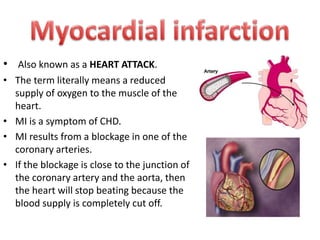
โ€ข Also known as a HEART ATTACK.
โ€ข The term literally means a reduced
supply of oxygen to the muscle of the
heart.
โ€ข MI is a symptom of CHD.
โ€ข MI results from a blockage in one of the
coronary arteries.
โ€ข If the blockage is close to the junction of
the coronary artery and the aorta, then
the heart will stop beating because the
blood supply is completely cut off.
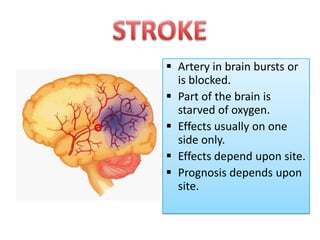
๏‚ง Artery in brain bursts or
is blocked.
๏‚ง Part of the brain is
starved of oxygen.
๏‚ง Effects usually on one
side only.
๏‚ง Effects depend upon site.
๏‚ง Prognosis depends upon
site.
โ€ข
โ€ข
โ€ข
โ€ข

Atheroma
Thrombosis
Aneurysm
Myocardial infarction
ANGINA- In time, your arteries may become so narrow that they cannot
deliver enough oxygen-rich blood to your heart. This can cause chest a pain or
discomfort.
THROMBUS- If a piece of the atheroma in your arteries breaks away it may
cause a blood clot to form.
EMBOLISM- If the blood clot moves to other parts of the body causing
blockage
MYOCARDIAL INFARCTION/HEART ATTACK- If the blood clot blocks your
coronary artery and cuts off the supply of oxygen-rich blood to your heart
muscle, your heart muscle may become permanentlydamaged
STROKE- When a blood clot blocks an artery that carries blood to your brain
โ€ข
โ€ข
โ€ข
โ€ข

Smoking
High blood pressure
Blood cholesterol
Diet
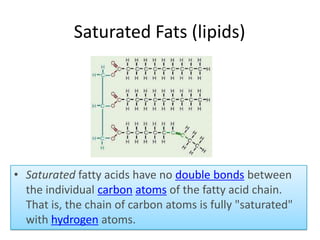
Saturated Fats (lipids)

โ€ข Saturated fatty acids have no double bonds between
the individual carbon atoms of the fatty acid chain.
That is, the chain of carbon atoms is fully "saturated"
with hydrogen atoms.
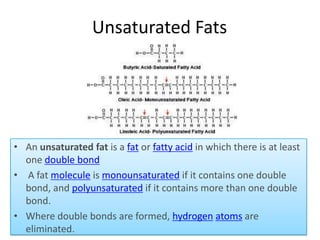
Unsaturated Fats

โ€ข An unsaturated fat is a fat or fatty acid in which there is at least
one double bond
โ€ข A fat molecule is monounsaturated if it contains one double
bond, and polyunsaturated if it contains more than one double
bond.
โ€ข Where double bonds are formed, hydrogen atoms are
eliminated.
โ€ข
โ€ข
โ€ข
โ€ข

Smoking
High blood pressure
Blood cholesterol
Diet
There are two main constituents of tobacco
smoke which increase likelihood of heart
disease:
Carbon monoxide
Nicotine
โ€ข Combines irreversibly with Hb of RBCs.
โ€ข This means that the oxygen carrying capacity
of the blood is reduced.
โ€ข This will remain throughout the whole lifespan
of the RBC (~120 days).
โ€ข This could lead to insufficient supply of oxygen
to the heart during exercise.
โ€ข Stimulates the production of adrenaline which
increases heart rate and blood pressure.
โ€ข This increases the risk of CHD or CVA.
โ€ข Nicotine also makes RBCs more โ€œstickyโ€ โ€“
leading to a higher risk of thrombosis.
โ€ข As there is already pressure in the arteries, the
heart must work harder to pump blood into them
and is therefore more prone to failure.
โ€ข Higher blood pressure within the arteries means
that they are more likely to develop an aneurysm
and burst.
โ€ข To resist the higher blood pressure within them,
the walls of the arteries may become hardened
and thickened โ€“ leading to restricted flow of
blood.
Cholesterol is an essential component of
membranes. As such, it is an essential
biochemical which must be transported in the
blood. It is carried in the plasma in tiny
spheres of lipoprotein (lipid and protein).
There are two main types:
High-density liproprotein (HDLs)
Low-density liprorotein (LDLs)
โ€ข These remove cholesterol from tissues and
transport it to the liver for excretion. They
help protect arteries against disease.
โ€ข These transport cholesterol from the liver to
the tissues, including the artery walls, which
they infiltrate, leading to the development of
atheroma and hence heart disease.
There are a number of aspects of diet which
increase the risk of heart disease, both
directly and indirectly:
โ€ข High levels of salt raise blood pressure.
โ€ข High levels of fat increase LDL level and hence
blood cholesterol concentration.

Chd edexcel

  • 1.
    CORONARY VASULAR DISEASE KEYWORDS TO BE ABLE TO DEFINE: CVD ATHEROSCLEROSIS ATHEROMA ARTERIOSCLEROSIS THROMBUS EMBOLUS ANEURYSM STROKE CHD
  • 2.
    From the EDEXCELspecification: โ€ข Describe the blood clotting process thromboplastin release, conversion of prothrombin to thrombin and fibrinogen to fibrin and its role in cardiovascular disease (CVD). โ€ข Explain the course of events that leads to atherosclerosis endothelial damage, inflammatory response, plaque formation, raised blood pressure โ€ข Describe the factors that increase the risk of CVD genetic,diet, age, gender, high blood pressure, smoking and inactivity โ€ข Describe the benefits and risks of treatments for CVD antihypertensives, plant statins, anticoagulants and platelet inhibitory drugs โ€ข Analyse and interpret data on the possible significance for health of blood cholesterol levels and levels of high-density lipoproteins (HDLs) and low-density lipoproteins (LDLs). โ€ข Describe the evidence for a causal relationship between blood cholesterol levels (total cholesterol and LDL cholesterol) and CVD. โ€ข Discuss how people use scientific knowledge about the effects of diet (including obesity indicators), exercise and smoking to reduce their risk of coronary heart disease.
  • 3.
    โ€ข In 2011,almost 160,000 people in the UK died from CVD. โ€ข 74,000 of these deaths were caused by coronary heart disease - the UK's single biggest killer. โ€ข Other types of cardiovascular disease include heart valve disease and cardiomyopathy. http://www.bhf.org.uk/heart-health/conditions/cardiovascular-disease.aspx
  • 4.
    CVD includes allthe diseases of Coronary vein โ€ข โ€ข โ€ข โ€ข โ€ข โ€ข โ€ข Heart and circulation Coronary heart disease Angina and heart attack Heart failure Congenital heart disease Stroke Aneurysm It is also known as heart and circulatory disease Coronary artery
  • 5.
    ATHEROSCLEROSIS is anarrowing of the artery caused by built up fatty deposits called ATHEROMA
  • 6.
    โ€ข It beginsas fatty streaks, accumulations of white blood cells that have taken up lowdensity lipoproteins (LDLs). โ€ข LDLs are the โ€œbadโ€ form of cholesterol.
  • 7.
    โ€ข Fatty streaklaid down by LDL-carrying white blood cells. โ€ข Streaks start to enlarge to form a PLAQUE (commonly occur in larger arteries). โ€ข The plaques bulge into the lumen of arteries and restrict the flow of blood, increasing blood pressure
  • 8.
    โ€ข Sources:โ€“ Madeby the liver during the metabolism of saturated fats. โ€“ Ingestion of dairy products โ€ข Insoluble in blood plasma so transported as lipoproteins.
  • 9.
    ๏‚ง 2 types:๏‚งLow density:โ€“ Transport cholesterol from liver to tissues, โ€“ Deposit cholesterol. ๏‚ง High density:โ€“ Transport cholesterol from tissues to liver, โ€“ Remove cholesterol from vessels.
  • 10.
    โ€ข As theblood flow is restricted, blood pressure increases. โ€ข This causes some damage to the lining (endothelium) of the artery. โ€ข Platelets start to aggregate and lay down a BLOOD CLOT โ€ข This is now called a THROMBUS
  • 11.
    โ€ข Sometimes athrombus may become dislodged and move around the body now called an EMBOLISM โ€ข This mobile thrombus can settled elsewhere and block other arteries and veins. โ€ข This is particularly problematic if the thrombus moves to the lungs.
  • 12.
    โ€ข Atheromas thatlead to the formation of a thrombus also weaken the artery walls. โ€ข These weakened points swell to form a balloon-like blood-filled structure called an ANEURYSM. โ€ข Aneurysms frequently burst, leading to haemorrhage. โ€ข This then leads to a loss of blood in that region of the body. โ€ข A brain aneurysm is known as a cerebrovascular aneurysm (CVA), or stroke.
  • 13.
    โ€ข Also knownas a HEART ATTACK. โ€ข The term literally means a reduced supply of oxygen to the muscle of the heart. โ€ข MI is a symptom of CHD. โ€ข MI results from a blockage in one of the coronary arteries. โ€ข If the blockage is close to the junction of the coronary artery and the aorta, then the heart will stop beating because the blood supply is completely cut off.
  • 14.
    ๏‚ง Artery inbrain bursts or is blocked. ๏‚ง Part of the brain is starved of oxygen. ๏‚ง Effects usually on one side only. ๏‚ง Effects depend upon site. ๏‚ง Prognosis depends upon site.
  • 15.
  • 16.
    ANGINA- In time,your arteries may become so narrow that they cannot deliver enough oxygen-rich blood to your heart. This can cause chest a pain or discomfort. THROMBUS- If a piece of the atheroma in your arteries breaks away it may cause a blood clot to form. EMBOLISM- If the blood clot moves to other parts of the body causing blockage MYOCARDIAL INFARCTION/HEART ATTACK- If the blood clot blocks your coronary artery and cuts off the supply of oxygen-rich blood to your heart muscle, your heart muscle may become permanentlydamaged STROKE- When a blood clot blocks an artery that carries blood to your brain
  • 18.
  • 19.
    Saturated Fats (lipids) โ€ขSaturated fatty acids have no double bonds between the individual carbon atoms of the fatty acid chain. That is, the chain of carbon atoms is fully "saturated" with hydrogen atoms.
  • 20.
    Unsaturated Fats โ€ข Anunsaturated fat is a fat or fatty acid in which there is at least one double bond โ€ข A fat molecule is monounsaturated if it contains one double bond, and polyunsaturated if it contains more than one double bond. โ€ข Where double bonds are formed, hydrogen atoms are eliminated.
  • 21.
  • 22.
    There are twomain constituents of tobacco smoke which increase likelihood of heart disease: Carbon monoxide Nicotine
  • 23.
    โ€ข Combines irreversiblywith Hb of RBCs. โ€ข This means that the oxygen carrying capacity of the blood is reduced. โ€ข This will remain throughout the whole lifespan of the RBC (~120 days). โ€ข This could lead to insufficient supply of oxygen to the heart during exercise.
  • 24.
    โ€ข Stimulates theproduction of adrenaline which increases heart rate and blood pressure. โ€ข This increases the risk of CHD or CVA. โ€ข Nicotine also makes RBCs more โ€œstickyโ€ โ€“ leading to a higher risk of thrombosis.
  • 25.
    โ€ข As thereis already pressure in the arteries, the heart must work harder to pump blood into them and is therefore more prone to failure. โ€ข Higher blood pressure within the arteries means that they are more likely to develop an aneurysm and burst. โ€ข To resist the higher blood pressure within them, the walls of the arteries may become hardened and thickened โ€“ leading to restricted flow of blood.
  • 26.
    Cholesterol is anessential component of membranes. As such, it is an essential biochemical which must be transported in the blood. It is carried in the plasma in tiny spheres of lipoprotein (lipid and protein). There are two main types: High-density liproprotein (HDLs) Low-density liprorotein (LDLs)
  • 27.
    โ€ข These removecholesterol from tissues and transport it to the liver for excretion. They help protect arteries against disease.
  • 28.
    โ€ข These transportcholesterol from the liver to the tissues, including the artery walls, which they infiltrate, leading to the development of atheroma and hence heart disease.
  • 29.
    There are anumber of aspects of diet which increase the risk of heart disease, both directly and indirectly: โ€ข High levels of salt raise blood pressure. โ€ข High levels of fat increase LDL level and hence blood cholesterol concentration.

Editor's Notes

  • #22ย Discuss with the students. Was prev. Covered in the lifestyle section so they should have some ideas.