Atherosclerosis
Department Of Pharmaceutical Sciences
Rashtrasant Tukadoji Maharaj Nagpur University
Nagpur-440 033
Presented by
Suraj N. Wanjari
Pharmaceutical Chemistry
Content
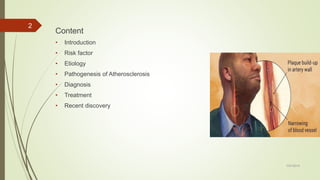
• Introduction
• Risk factor
• Etiology
• Pathogenesis of Atherosclerosis
• Diagnosis
• Treatment
• Recent discovery
7/27/2019
2
 Introduction
• It is the hardening and thickening of arterial wall primarilly intima of muscular
arteries characterized by presence of plague or atheromas .
Atherosclerosis = athero+ sclerosis
Athero= Porridge ( lipid rich material )
sclerosis = scarring ( referring to connective tissue in the plaques)
• Most commonly affected arteries by atherosclerosis include large and medium
sized arteries like aorta, coronary artery and cerebral arteries.
• Major Complication is ischemia .
• Minor complication is peripheral vascular disease like , ischaemic encephalopathy
7/27/2019
3
Risk Factors
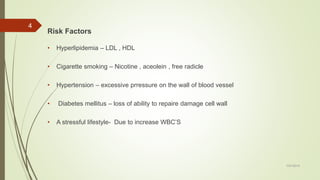
• Hyperlipidemia – LDL , HDL
• Cigarette smoking – Nicotine , aceolein , free radicle
• Hypertension – excessive prressure on the wall of blood vessel
• Diabetes mellitus – loss of ability to repaire damage cell wall
• A stressful lifestyle- Due to increase WBC’S
7/27/2019
4
• Obesity
• Infections (C. pneumoniae, Herpes virus, CMV)
• Homocystinuria – Disorder of methionine metabolism
• Role of Alcohol – Due to generation of free radicles
• Constitutional risk factor – 1-Age
2- Sex
3-Genetic Factor
4-Familial and racial factors
7/27/2019
5
ETIOLOGY -
Atherosclerosis starts with damage or injury to the inner layer of an artery. The damage
may be caused by
• High blood pressure
• High cholesterol
• An irritant, such as nicotine
• Certain diseases, such as diabetes
7/27/2019
6
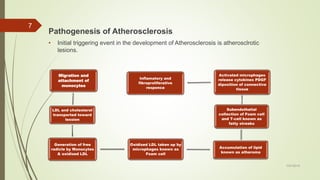
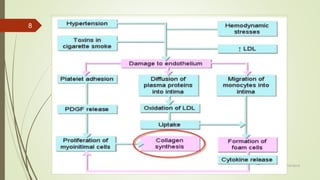
Pathogenesis of Atherosclerosis
• Initial triggering event in the development of Atherosclerosis is atherosclrotic
lesions.
7/27/2019
7
Migration and
attachment of
monocytes
LDL and cholesterol
transported toward
lession
Generation of free
radicle by Monocytes
& oxidised LDL
Oxidised LDL taken up by
microphages known as
Foam cell
Accumulation of lipid
known as atheroma
Subendothelial
collection of Foam cell
and T-cell known as
fatty streaks
Activated microphages
release cytokines PDGF
diposition of connective
tissue
Inflamatory and
fibroproliferative
responce
7/27/2019
8
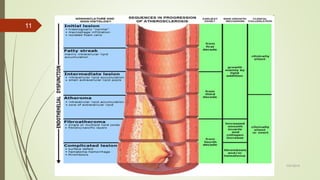
• The lesions associated with atherosclerosis are of three types:
1. The fatty streak
2. The fibrous atheromatous plaque
3. Complicated lesion
• The latter two are responsible for the clinically significant manifestations of the
disease.
1. The fatty streak
• Fatty streaks are thin, flat yellow intimal discolorations that progressively enlarge by
becoming thicker and slightly elevated as they grow in length.
• They consist of macrophages and smooth muscle cells that have become distended
with lipid to form foam cells.
• These occurs regardless of geographic setting, gender, or race.
• They increase in number until about age 20 years, and then they remain static or
regress.
• There is controversy about whether fatty streaks, in and of themselves, are precursors
of atherosclerotic lesions.
7/27/2019
9
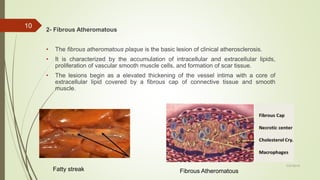
2- Fibrous Atheromatous
• The fibrous atheromatous plaque is the basic lesion of clinical atherosclerosis.
• It is characterized by the accumulation of intracellular and extracellular lipids,
proliferation of vascular smooth muscle cells, and formation of scar tissue.
• The lesions begin as a elevated thickening of the vessel intima with a core of
extracellular lipid covered by a fibrous cap of connective tissue and smooth
muscle.
7/27/2019
10
Fatty streak Fibrous Atheromatous
7/27/2019
11
 DAIGNOSIS
Doctors may find signs of narrowed, enlarged or hardened arteries during a
physical exam. These include:
• A weak or absent pulse below the narrowed area of the artery.
• Decreased blood pressure in an affected limb .
• Whooshing sounds (bruits) over the arteries, heard with a stethoscope .
• Evidence of poor wound healing in the area where blood flow is restricted .
Depending on the results of the physical exam, doctors may suggest one or more
diagnostic tests, as follows- 7/27/2019
12
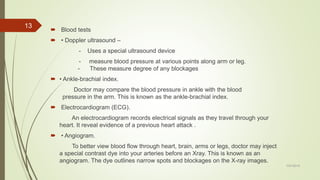
 Blood tests
 • Doppler ultrasound –
- Uses a special ultrasound device
- measure blood pressure at various points along arm or leg.
- These measure degree of any blockages
 • Ankle-brachial index.
Doctor may compare the blood pressure in ankle with the blood
pressure in the arm. This is known as the ankle-brachial index.
 Electrocardiogram (ECG).
An electrocardiogram records electrical signals as they travel through your
heart. It reveal evidence of a previous heart attack .
 • Angiogram.
To better view blood flow through heart, brain, arms or legs, doctor may inject
a special contrast dye into your arteries before an Xray. This is known as an
angiogram. The dye outlines narrow spots and blockages on the X-ray images.
7/27/2019
13
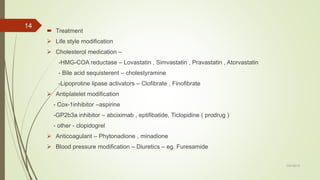
 Treatment
 Life style modification
 Cholesterol medication –
-HMG-COA reductase – Lovastatin , Simvastatin , Pravastatin , Atorvastatin
- Bile acid sequisterent – cholestyramine
-Lipoprotine lipase activators – Clofibrate , Finofibrate
 Antiplatelet modification
- Cox-1inhibitor –aspirine
-GP2b3a inhibitor – abciximab , eptifibatide, Ticlopidine ( prodrug )
- other - clopidogrel
 Anticoagulant – Phytonadione , minadione
 Blood pressure modification – Diuretics – eg. Furesamide
7/27/2019
14
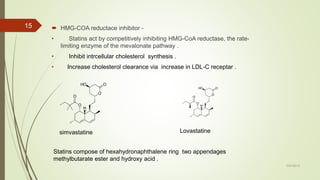
 HMG-COA reductace inhibitor -
• Statins act by competitively inhibiting HMG-CoA reductase, the rate-
limiting enzyme of the mevalonate pathway .
• Inhibit intrcellular cholesterol synthesis .
• Increase cholesterol clearance via increase in LDL-C receptar .
7/27/2019
15
Lovastatine
Statins compose of hexahydronaphthalene ring two appendages
methylbutarate ester and hydroxy acid .
simvastatine
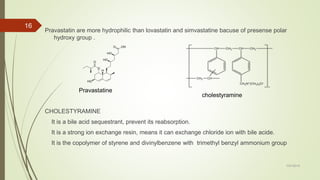
Pravastatin are more hydrophilic than lovastatin and simvastatine bacuse of presense polar
hydroxy group .
CHOLESTYRAMINE
It is a bile acid sequestrant, prevent its reabsorption.
It is a strong ion exchange resin, means it can exchange chloride ion with bile acide.
It is the copolymer of styrene and divinylbenzene with trimethyl benzyl ammonium group
7/27/2019
16
Pravastatine
cholestyramine
 Lipoprotine lipase activators
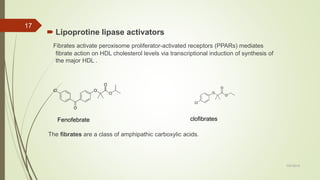
Fibrates activate peroxisome proliferator-activated receptors (PPARs) mediates
fibrate action on HDL cholesterol levels via transcriptional induction of synthesis of
the major HDL .
The fibrates are a class of amphipathic carboxylic acids.
7/27/2019
17
Fenofebrate clofibrates
 Antiplatelet drug
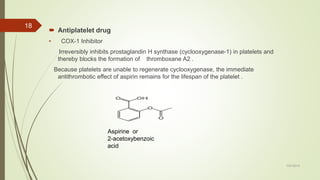
• COX-1 Inhibitor
Irreversibly inhibits prostaglandin H synthase (cyclooxygenase-1) in platelets and
thereby blocks the formation of thromboxane A2 .
Because platelets are unable to regenerate cyclooxygenase, the immediate
antithrombotic effect of aspirin remains for the lifespan of the platelet .
7/27/2019
18
Aspirine or
2-acetoxybenzoic
acid
 Anticoagulant
Phytonadione
2-methyl-3-[(2E)-3,7,11,15-tetramethylhexadec-2-en-1-yl]naphthoquinone
It was used as the anticoagulat
it activate the the clotting factors 7 , 10 .
7/27/2019
19
 Diuretics
Furosemide, like other loop diuretics, acts by inhibiting the luminal Na-K-Cl
cotransporter in the thick ascending limb of the loop of Henle, by binding to the
chloride transport channel, thus causing sodium, chloride, and potassium loss in
urine.
7/27/2019
20
Furesamide
4-Chloro-2-[(furan-2-ylmethyl)amino]-5-sulfamoylbenzoic acid
 Other treatment
• Angioplasty
• Endarterectomy-
7/27/2019
21
 Current Discoveries
• The diagnosis of atherosclerosis is a major issue , for this purpose the newly
developed biomarker was used that is C-reactive protein (hsCRP) & N-terminal pro-
brain natriuretic peptide for the detection of of atherosclerosis.
• An abdominal aortic aneurysm (AAA) is an enlargement of the abdominal aorta. As the
AAA grows, the aortic wall becomes progressively thin, and the risk of rupture
increases; AAA rupture causes severe intra-abdominal haemorrhage and has a very
high mortality.
• Improvement of vascular dysfunction by argirein through inhibiting endothelial cell
apoptosis associated with ET-1/Nox4 signal pathway in diabetic rats .
• Approval for Xarelto (rivaroxaban) to reduce the risk of major cardiovascular (CV)
events, such as CV death, myocardial infarction (MI) and stroke, in people with chronic
coronary or peripheral artery disease (CAD/PAD). Xarelto is now the first and only
Factor Xa inhibitor approved for patients living with these conditions. ( Johnson &
Johnson )
7/27/2019
22
REFRENCES
 Text book of pathophysiology by Atlas
 Harsh Mohan, Text book of pathophysiology, sixth edition, Jaypee brothers medical
publication Pvt. Ltd. Page no. 390-409, 427-459.
 Kuba M., Kubova Z. Book of Pathophysiology page no. 71
 https://scholar.google.com date of search 28/09/2018
 https://en.wikipedia.org date of search 27/09/2018
 https://www.google.com date of search 27/09/2018
 https://www.slideshare.net date of search 27/09/2018
7/27/2019
23
7/27/2019
24

Atherosclerosis

  • 1.
    Atherosclerosis Department Of PharmaceuticalSciences Rashtrasant Tukadoji Maharaj Nagpur University Nagpur-440 033 Presented by Suraj N. Wanjari Pharmaceutical Chemistry
  • 2.
    Content • Introduction • Riskfactor • Etiology • Pathogenesis of Atherosclerosis • Diagnosis • Treatment • Recent discovery 7/27/2019 2
  • 3.
     Introduction • Itis the hardening and thickening of arterial wall primarilly intima of muscular arteries characterized by presence of plague or atheromas . Atherosclerosis = athero+ sclerosis Athero= Porridge ( lipid rich material ) sclerosis = scarring ( referring to connective tissue in the plaques) • Most commonly affected arteries by atherosclerosis include large and medium sized arteries like aorta, coronary artery and cerebral arteries. • Major Complication is ischemia . • Minor complication is peripheral vascular disease like , ischaemic encephalopathy 7/27/2019 3
  • 4.
    Risk Factors • Hyperlipidemia– LDL , HDL • Cigarette smoking – Nicotine , aceolein , free radicle • Hypertension – excessive prressure on the wall of blood vessel • Diabetes mellitus – loss of ability to repaire damage cell wall • A stressful lifestyle- Due to increase WBC’S 7/27/2019 4
  • 5.
    • Obesity • Infections(C. pneumoniae, Herpes virus, CMV) • Homocystinuria – Disorder of methionine metabolism • Role of Alcohol – Due to generation of free radicles • Constitutional risk factor – 1-Age 2- Sex 3-Genetic Factor 4-Familial and racial factors 7/27/2019 5
  • 6.
    ETIOLOGY - Atherosclerosis startswith damage or injury to the inner layer of an artery. The damage may be caused by • High blood pressure • High cholesterol • An irritant, such as nicotine • Certain diseases, such as diabetes 7/27/2019 6
  • 7.
    Pathogenesis of Atherosclerosis •Initial triggering event in the development of Atherosclerosis is atherosclrotic lesions. 7/27/2019 7 Migration and attachment of monocytes LDL and cholesterol transported toward lession Generation of free radicle by Monocytes & oxidised LDL Oxidised LDL taken up by microphages known as Foam cell Accumulation of lipid known as atheroma Subendothelial collection of Foam cell and T-cell known as fatty streaks Activated microphages release cytokines PDGF diposition of connective tissue Inflamatory and fibroproliferative responce
  • 8.
  • 9.
    • The lesionsassociated with atherosclerosis are of three types: 1. The fatty streak 2. The fibrous atheromatous plaque 3. Complicated lesion • The latter two are responsible for the clinically significant manifestations of the disease. 1. The fatty streak • Fatty streaks are thin, flat yellow intimal discolorations that progressively enlarge by becoming thicker and slightly elevated as they grow in length. • They consist of macrophages and smooth muscle cells that have become distended with lipid to form foam cells. • These occurs regardless of geographic setting, gender, or race. • They increase in number until about age 20 years, and then they remain static or regress. • There is controversy about whether fatty streaks, in and of themselves, are precursors of atherosclerotic lesions. 7/27/2019 9
  • 10.
    2- Fibrous Atheromatous •The fibrous atheromatous plaque is the basic lesion of clinical atherosclerosis. • It is characterized by the accumulation of intracellular and extracellular lipids, proliferation of vascular smooth muscle cells, and formation of scar tissue. • The lesions begin as a elevated thickening of the vessel intima with a core of extracellular lipid covered by a fibrous cap of connective tissue and smooth muscle. 7/27/2019 10 Fatty streak Fibrous Atheromatous
  • 11.
  • 12.
     DAIGNOSIS Doctors mayfind signs of narrowed, enlarged or hardened arteries during a physical exam. These include: • A weak or absent pulse below the narrowed area of the artery. • Decreased blood pressure in an affected limb . • Whooshing sounds (bruits) over the arteries, heard with a stethoscope . • Evidence of poor wound healing in the area where blood flow is restricted . Depending on the results of the physical exam, doctors may suggest one or more diagnostic tests, as follows- 7/27/2019 12
  • 13.
     Blood tests • Doppler ultrasound – - Uses a special ultrasound device - measure blood pressure at various points along arm or leg. - These measure degree of any blockages  • Ankle-brachial index. Doctor may compare the blood pressure in ankle with the blood pressure in the arm. This is known as the ankle-brachial index.  Electrocardiogram (ECG). An electrocardiogram records electrical signals as they travel through your heart. It reveal evidence of a previous heart attack .  • Angiogram. To better view blood flow through heart, brain, arms or legs, doctor may inject a special contrast dye into your arteries before an Xray. This is known as an angiogram. The dye outlines narrow spots and blockages on the X-ray images. 7/27/2019 13
  • 14.
     Treatment  Lifestyle modification  Cholesterol medication – -HMG-COA reductase – Lovastatin , Simvastatin , Pravastatin , Atorvastatin - Bile acid sequisterent – cholestyramine -Lipoprotine lipase activators – Clofibrate , Finofibrate  Antiplatelet modification - Cox-1inhibitor –aspirine -GP2b3a inhibitor – abciximab , eptifibatide, Ticlopidine ( prodrug ) - other - clopidogrel  Anticoagulant – Phytonadione , minadione  Blood pressure modification – Diuretics – eg. Furesamide 7/27/2019 14
  • 15.
     HMG-COA reductaceinhibitor - • Statins act by competitively inhibiting HMG-CoA reductase, the rate- limiting enzyme of the mevalonate pathway . • Inhibit intrcellular cholesterol synthesis . • Increase cholesterol clearance via increase in LDL-C receptar . 7/27/2019 15 Lovastatine Statins compose of hexahydronaphthalene ring two appendages methylbutarate ester and hydroxy acid . simvastatine
  • 16.
    Pravastatin are morehydrophilic than lovastatin and simvastatine bacuse of presense polar hydroxy group . CHOLESTYRAMINE It is a bile acid sequestrant, prevent its reabsorption. It is a strong ion exchange resin, means it can exchange chloride ion with bile acide. It is the copolymer of styrene and divinylbenzene with trimethyl benzyl ammonium group 7/27/2019 16 Pravastatine cholestyramine
  • 17.
     Lipoprotine lipaseactivators Fibrates activate peroxisome proliferator-activated receptors (PPARs) mediates fibrate action on HDL cholesterol levels via transcriptional induction of synthesis of the major HDL . The fibrates are a class of amphipathic carboxylic acids. 7/27/2019 17 Fenofebrate clofibrates
  • 18.
     Antiplatelet drug •COX-1 Inhibitor Irreversibly inhibits prostaglandin H synthase (cyclooxygenase-1) in platelets and thereby blocks the formation of thromboxane A2 . Because platelets are unable to regenerate cyclooxygenase, the immediate antithrombotic effect of aspirin remains for the lifespan of the platelet . 7/27/2019 18 Aspirine or 2-acetoxybenzoic acid
  • 19.
     Anticoagulant Phytonadione 2-methyl-3-[(2E)-3,7,11,15-tetramethylhexadec-2-en-1-yl]naphthoquinone It wasused as the anticoagulat it activate the the clotting factors 7 , 10 . 7/27/2019 19
  • 20.
     Diuretics Furosemide, likeother loop diuretics, acts by inhibiting the luminal Na-K-Cl cotransporter in the thick ascending limb of the loop of Henle, by binding to the chloride transport channel, thus causing sodium, chloride, and potassium loss in urine. 7/27/2019 20 Furesamide 4-Chloro-2-[(furan-2-ylmethyl)amino]-5-sulfamoylbenzoic acid
  • 21.
     Other treatment •Angioplasty • Endarterectomy- 7/27/2019 21
  • 22.
     Current Discoveries •The diagnosis of atherosclerosis is a major issue , for this purpose the newly developed biomarker was used that is C-reactive protein (hsCRP) & N-terminal pro- brain natriuretic peptide for the detection of of atherosclerosis. • An abdominal aortic aneurysm (AAA) is an enlargement of the abdominal aorta. As the AAA grows, the aortic wall becomes progressively thin, and the risk of rupture increases; AAA rupture causes severe intra-abdominal haemorrhage and has a very high mortality. • Improvement of vascular dysfunction by argirein through inhibiting endothelial cell apoptosis associated with ET-1/Nox4 signal pathway in diabetic rats . • Approval for Xarelto (rivaroxaban) to reduce the risk of major cardiovascular (CV) events, such as CV death, myocardial infarction (MI) and stroke, in people with chronic coronary or peripheral artery disease (CAD/PAD). Xarelto is now the first and only Factor Xa inhibitor approved for patients living with these conditions. ( Johnson & Johnson ) 7/27/2019 22
  • 23.
    REFRENCES  Text bookof pathophysiology by Atlas  Harsh Mohan, Text book of pathophysiology, sixth edition, Jaypee brothers medical publication Pvt. Ltd. Page no. 390-409, 427-459.  Kuba M., Kubova Z. Book of Pathophysiology page no. 71  https://scholar.google.com date of search 28/09/2018  https://en.wikipedia.org date of search 27/09/2018  https://www.google.com date of search 27/09/2018  https://www.slideshare.net date of search 27/09/2018 7/27/2019 23
  • 24.