*Arteriosclerosis
BY: SYED MASOOD RUBANI
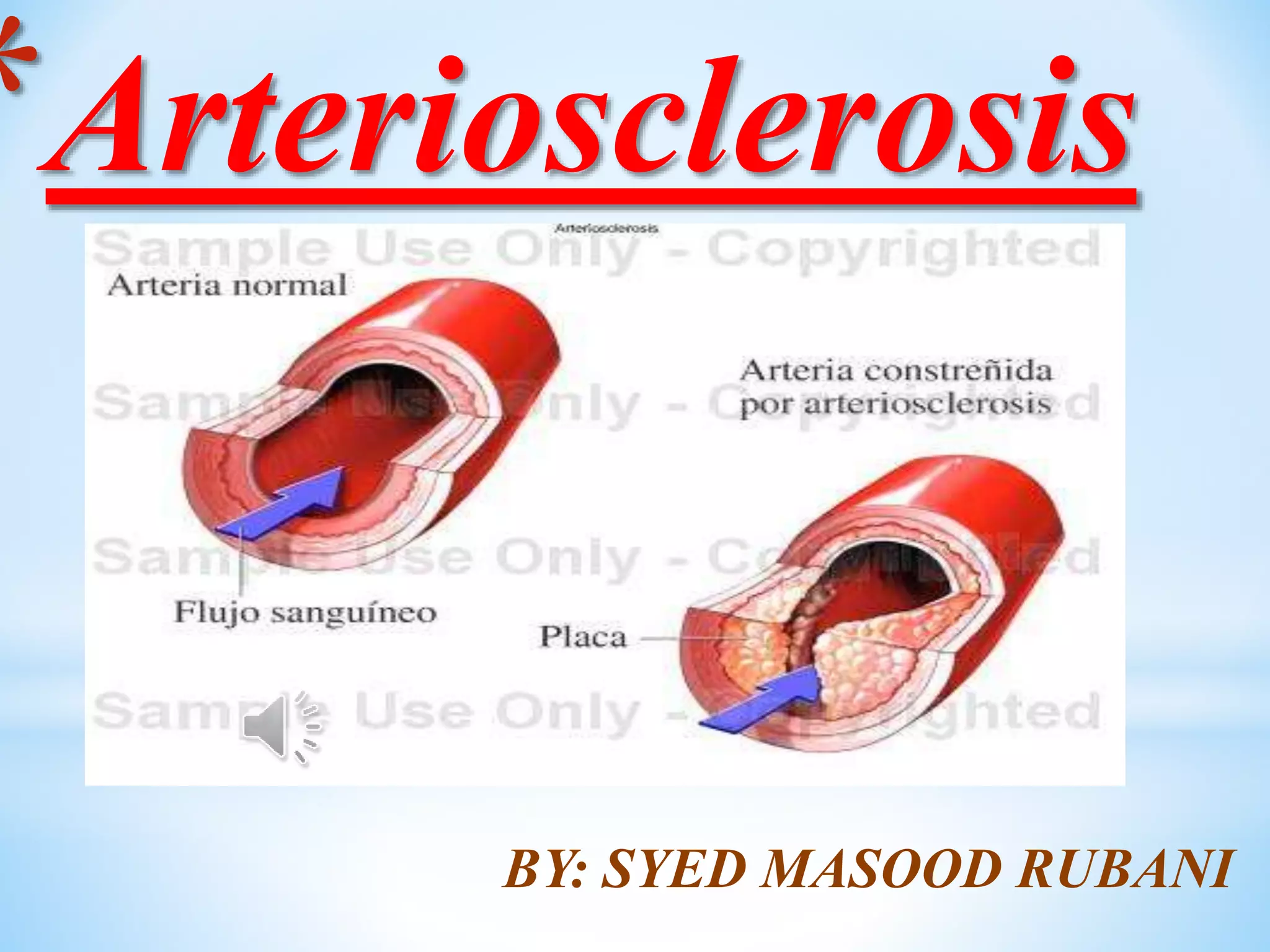
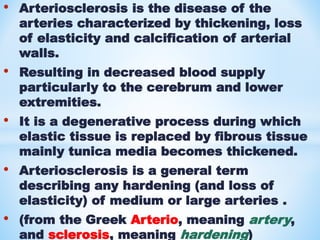
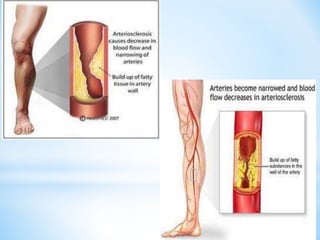
• Arteriosclerosis is the disease of the
arteries characterized by thickening, loss
of elasticity and calcification of arterial
walls.
• Resulting in decreased blood supply
particularly to the cerebrum and lower
extremities.
• It is a degenerative process during which
elastic tissue is replaced by fibrous tissue
mainly tunica media becomes thickened.
• Arteriosclerosis is a general term
describing any hardening (and loss of
elasticity) of medium or large arteries .
• (from the Greek Arterio, meaning artery,
and sclerosis, meaning hardening)
*
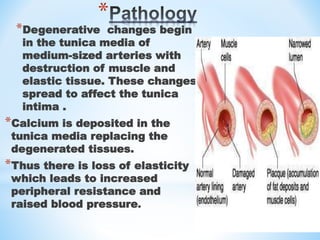
*Degenerative changes begin
in the tunica media of
medium-sized arteries with
destruction of muscle and
elastic tissue. These changes
spread to affect the tunica
intima .
*Calcium is deposited in the
tunica media replacing the
degenerated tissues.
*Thus there is loss of elasticity
which leads to increased
peripheral resistance and
raised blood pressure.
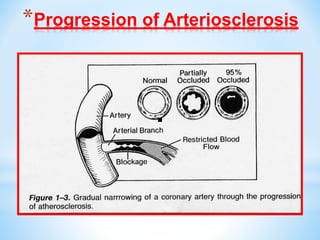
*Progression of Arteriosclerosis
*
arteries in the:-
*brain,
*kidneys,
*heart,
*abdominal aorta,
*or legs
*
*These depend on the site of affected artery.
*Coronary artery disease cause angina and leads to
ischaemia of the cardiac muscle .
*Cerebral artery disease causes ischaemia of the
brain and clinical features depend on the area of
the brain affected .
*Vertebral artery disease may cause dizziness ,
faintness or impaired vision.
*The iliac, femoral and popliteal arteries are
commonly affected, and the clinical features r as
follows:
*
1. Intermittent claudication.
2. Rest pain.
3. Cold limbs.
4. Sensory changes.
5. Skin changes.
6. Loss of pulses.
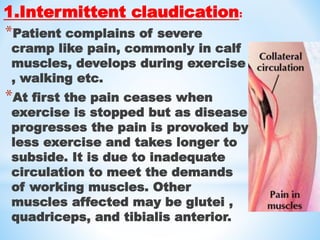
1.Intermittent claudication:
*Patient complains of severe
cramp like pain, commonly in calf
muscles, develops during exercise
, walking etc.
*At first the pain ceases when
exercise is stopped but as disease
progresses the pain is provoked by
less exercise and takes longer to
subside. It is due to inadequate
circulation to meet the demands
of working muscles. Other
muscles affected may be glutei ,
quadriceps, and tibialis anterior.
2 Rest pain
*Severe burning pain in foot and toes occurs mostly
in night.
*Patient is frequently wakened by the pain which
may be relieved to a certain by the leg being
suspended over side of the bed.
3 cold limbs
*The toes and feet feel cold both to touch and to
the patient.
4 loss of pulses
*There may be partial or complete loss of one or
more pulses depending on the severity of
condition and the site of occlusion.
5 sensory changes
*Pin, needle , tingling or complete
anaesthesia may be present especially
in the hands or feet and is increased by
exercise.
6 skin changes
*Owing to ischaemia there may be dryness, scaling,
brittle nails and loss of hair.
*Skin may have white shiny appearance or be
discolored after blanching.
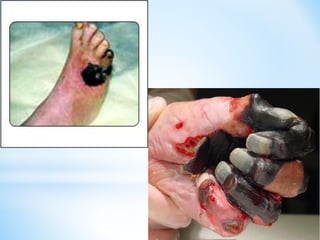
*Gangrenous changes resulting in death of tissue
may be present in toes or heels n tropic ulcers
may develop on skin.
*
*Increasing age
*Family history
*Smoking
*High cholesterol
*Diabetes
*High blood pressure
*In activity
*Over-weight
*Stress
*Diagnostic tests.
• A number of imaging tests may be used to see
how well blood moves through your arteries.
• Doppler tests use ultrasound or sound waves.
• Magnetic resonance arteriography (MRA) is
a special type of MRI scan
• Special CT scans called CT angiography
• Arteriograms or angiography use x-rays to
see inside the arteries
Treatment
*To help prevent hardening of the arteries, make the following lifestyle
changes:
*Avoid fatty foods. Eat well-balanced meals that are low in fat and
cholesterol.
*Include several daily servings of fruits and vegetables.
*Limit alcohol intake.
*Exercise daily.
*Quit smoking -- this is the single most important change you can make to
reduce your risk of heart disease and stroke.
*Get your blood pressure checked every 1 - 2 years before age 50 and yearly
after age 50. Have your blood pressure checked more often if you have high
blood pressure, heart disease, or you have had a stroke.
*If your blood pressure is high, it is important for you to lower it and keep it
under control.
*Blood pressure should be kept below 140/90 mmHg
*Diabetic, kidney disease, or have had a stroke or heart attack, your blood
pressure should probably be less than 130/80 mm/Hg
*Wear warm loose clothes.
*Keep skin clean & free from infection or pressure.
*Avoid
1. cold
2. using hot bottles,
3. tight shoes, socks, belts.
4. Sitting with cross legs.
*Analgesics are prescribed to relieve pain.
*Anticoagulants to prevent blood coagulation.
*Medicine for high cholesterol levels if lifestyle changes do not work. This
will depend on:
1. Age
2. Heart disease or other blood flow problems
3. Smoker or overweight
4. High blood pressure or diabetes.
*Antiplatelet drugs.like
* Aspirin or another drug called clopidogrel (Plavix) to help prevent blood
clots from forming in your arteries.
Complications
• Aneurysm – especially in the arc of aorta.
• Rupture of artery from a trivial cause such as a slight
blow or injury or a sudden rise in blood pressure.
• Coronary artery disease
• Kidney disease
• Mesenteric artery ischemia
• Peripheral artery disease
• Renal artery stenosis
• Stroke
Expectations (prognosis)
 Hardening of the arteries cannot be reversed or turned
back once it has occurred. However, lifestyle changes and
treating high cholesterol levels can prevent or slow the
process from becoming worse.
*
*Given usually postopratively.
*Some patients on medicine may be referred
for physiotherapy. This means teaching
patient the walking pattern.
*Buerger’s exercises may be indicated.
*This is the pattern of positions designed to
encourage the development of a collateral
circulation in the legs. Procedure is as
follows
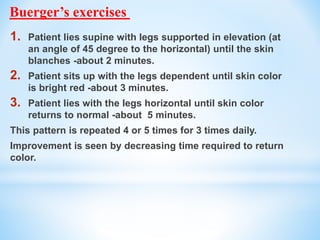
1. Patient lies supine with legs supported in elevation (at
an angle of 45 degree to the horizontal) until the skin
blanches -about 2 minutes.
2. Patient sits up with the legs dependent until skin color
is bright red -about 3 minutes.
3. Patient lies with the legs horizontal until skin color
returns to normal -about 5 minutes.
This pattern is repeated 4 or 5 times for 3 times daily.
Improvement is seen by decreasing time required to return
color.
Buerger’s exercises
Arteriosclerosis.ppt

Arteriosclerosis.ppt

  • 1.
  • 2.
    • Arteriosclerosis isthe disease of the arteries characterized by thickening, loss of elasticity and calcification of arterial walls. • Resulting in decreased blood supply particularly to the cerebrum and lower extremities. • It is a degenerative process during which elastic tissue is replaced by fibrous tissue mainly tunica media becomes thickened. • Arteriosclerosis is a general term describing any hardening (and loss of elasticity) of medium or large arteries . • (from the Greek Arterio, meaning artery, and sclerosis, meaning hardening)
  • 3.
    * *Degenerative changes begin inthe tunica media of medium-sized arteries with destruction of muscle and elastic tissue. These changes spread to affect the tunica intima . *Calcium is deposited in the tunica media replacing the degenerated tissues. *Thus there is loss of elasticity which leads to increased peripheral resistance and raised blood pressure.
  • 4.
  • 5.
  • 6.
    * *These depend onthe site of affected artery. *Coronary artery disease cause angina and leads to ischaemia of the cardiac muscle . *Cerebral artery disease causes ischaemia of the brain and clinical features depend on the area of the brain affected . *Vertebral artery disease may cause dizziness , faintness or impaired vision. *The iliac, femoral and popliteal arteries are commonly affected, and the clinical features r as follows:
  • 7.
    * 1. Intermittent claudication. 2.Rest pain. 3. Cold limbs. 4. Sensory changes. 5. Skin changes. 6. Loss of pulses.
  • 8.
    1.Intermittent claudication: *Patient complainsof severe cramp like pain, commonly in calf muscles, develops during exercise , walking etc. *At first the pain ceases when exercise is stopped but as disease progresses the pain is provoked by less exercise and takes longer to subside. It is due to inadequate circulation to meet the demands of working muscles. Other muscles affected may be glutei , quadriceps, and tibialis anterior.
  • 9.
    2 Rest pain *Severeburning pain in foot and toes occurs mostly in night. *Patient is frequently wakened by the pain which may be relieved to a certain by the leg being suspended over side of the bed. 3 cold limbs *The toes and feet feel cold both to touch and to the patient. 4 loss of pulses *There may be partial or complete loss of one or more pulses depending on the severity of condition and the site of occlusion.
  • 11.
    5 sensory changes *Pin,needle , tingling or complete anaesthesia may be present especially in the hands or feet and is increased by exercise. 6 skin changes *Owing to ischaemia there may be dryness, scaling, brittle nails and loss of hair. *Skin may have white shiny appearance or be discolored after blanching. *Gangrenous changes resulting in death of tissue may be present in toes or heels n tropic ulcers may develop on skin.
  • 13.
    * *Increasing age *Family history *Smoking *Highcholesterol *Diabetes *High blood pressure *In activity *Over-weight *Stress
  • 14.
    *Diagnostic tests. • Anumber of imaging tests may be used to see how well blood moves through your arteries. • Doppler tests use ultrasound or sound waves. • Magnetic resonance arteriography (MRA) is a special type of MRI scan • Special CT scans called CT angiography • Arteriograms or angiography use x-rays to see inside the arteries
  • 15.
    Treatment *To help preventhardening of the arteries, make the following lifestyle changes: *Avoid fatty foods. Eat well-balanced meals that are low in fat and cholesterol. *Include several daily servings of fruits and vegetables. *Limit alcohol intake. *Exercise daily. *Quit smoking -- this is the single most important change you can make to reduce your risk of heart disease and stroke. *Get your blood pressure checked every 1 - 2 years before age 50 and yearly after age 50. Have your blood pressure checked more often if you have high blood pressure, heart disease, or you have had a stroke. *If your blood pressure is high, it is important for you to lower it and keep it under control. *Blood pressure should be kept below 140/90 mmHg *Diabetic, kidney disease, or have had a stroke or heart attack, your blood pressure should probably be less than 130/80 mm/Hg
  • 16.
    *Wear warm looseclothes. *Keep skin clean & free from infection or pressure. *Avoid 1. cold 2. using hot bottles, 3. tight shoes, socks, belts. 4. Sitting with cross legs. *Analgesics are prescribed to relieve pain. *Anticoagulants to prevent blood coagulation. *Medicine for high cholesterol levels if lifestyle changes do not work. This will depend on: 1. Age 2. Heart disease or other blood flow problems 3. Smoker or overweight 4. High blood pressure or diabetes. *Antiplatelet drugs.like * Aspirin or another drug called clopidogrel (Plavix) to help prevent blood clots from forming in your arteries.
  • 17.
    Complications • Aneurysm –especially in the arc of aorta. • Rupture of artery from a trivial cause such as a slight blow or injury or a sudden rise in blood pressure. • Coronary artery disease • Kidney disease • Mesenteric artery ischemia • Peripheral artery disease • Renal artery stenosis • Stroke Expectations (prognosis)  Hardening of the arteries cannot be reversed or turned back once it has occurred. However, lifestyle changes and treating high cholesterol levels can prevent or slow the process from becoming worse.
  • 18.
    * *Given usually postopratively. *Somepatients on medicine may be referred for physiotherapy. This means teaching patient the walking pattern. *Buerger’s exercises may be indicated. *This is the pattern of positions designed to encourage the development of a collateral circulation in the legs. Procedure is as follows
  • 19.
    1. Patient liessupine with legs supported in elevation (at an angle of 45 degree to the horizontal) until the skin blanches -about 2 minutes. 2. Patient sits up with the legs dependent until skin color is bright red -about 3 minutes. 3. Patient lies with the legs horizontal until skin color returns to normal -about 5 minutes. This pattern is repeated 4 or 5 times for 3 times daily. Improvement is seen by decreasing time required to return color. Buerger’s exercises