Protective Effects of Exercise Being physically fit reduces the risk of cardiovascular disease, with people who do not exercise being  TWICE  as likely to develop heart disease Exercise is thought to decrease the many of the risk factors for CHD by: strengthens the  heart muscle  (myocardium) so that it can pump more blood with each beat   therefore   improving  efficiency  of the heart lowering resting  heart rate improves  blood lipid profile  by decreasing LDL and increasing HDL levels  lowers  blood pressure  by maintaining the elasticity of the arteries helps weight loss by  decreasing % body fat decreasing development of  atheroma controlling  stress Even a small amount of moderate exercise, such as walking, can improve the quality of life and increase life expectancy
How does the CVS respond to exercise? During exercise the CVS must  INCREASE  delivery of  O 2  and  nutrients  to the exercising muscle and remove waste effectively This is done by: INCREASING   Cardiac Output REDISTRIBUTING  Blood Circulation
Increasing Cardiac Output During exercise  SYSTOLIC BP  can increase from 120 to 200 mm Hg, showing that the walls of the ventricles are working much harder; diastolic pressure remains fairly constant As a result the volume of blood pushed out of the heart with every beat ( STROKE VOLUME )  INCREASES Since  HEART RATE  and  STROKE VOLUME  both increase during exercise, it follows that cardiac output is also greatly increased CO = HR x SV
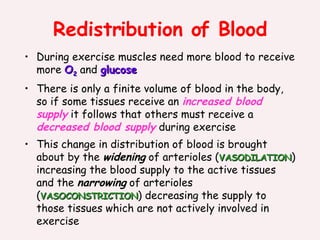
Redistribution of Blood During exercise muscles need more blood to receive more  O 2  and  glucose There is only a finite volume of blood in the body, so if some tissues receive an  increased blood supply  it follows that others must receive a  decreased blood supply  during exercise This change in distribution of blood is brought about by the  widening  of arterioles ( VASODILATION ) increasing the blood supply to the active tissues and the  narrowing  of arterioles ( VASOCONSTRICTION ) decreasing the supply to those tissues which are not actively involved in exercise
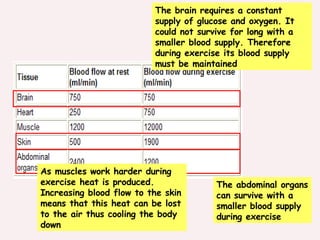
The brain requires a constant supply of glucose and oxygen. It could not survive for long with a smaller blood supply. Therefore during exercise its blood supply must be maintained The abdominal organs can survive with a smaller blood supply during exercise As muscles work harder during exercise heat is produced. Increasing blood flow to the skin means that this heat can be lost to the air thus cooling the body down
The ‘Athletic Heart’ Athletes are people who are fitter than most people because they undergo a regime of training - involves exercising at more extreme levels and for greater periods of time than most people can maintain Athletic heart syndrome refers to the normal changes that the heart undergoes in very well conditioned athletes: heart is  LARGER  and its  VENTRICLE   WALLS THICKER  than in nonathletes  [CARDIAC HYPERTROPHY] The chambers inside the heart enlarge  This is due to  an increase in protein synthesis in the muscle fibres of the heart and thus  allows the heart  increase its  stroke volume   without much increase in heart rate When an athlete stops training, the athletic heart syndrome slowly disappears — that is, heart size and heart rate tend to return gradually to that of the nonathlete
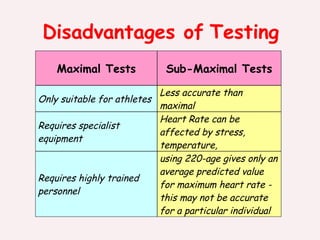
Principles of Exercise Testing There are many reasons why it may be necessary to assess the physiological fitness of a person Monitor effectiveness of exercise program Rehabilitation of cardiac patients Testing can be  MAXIMAL  or  SUB-MAXIMAL Measures the MAXIMUM RATE at which the body is able to take up and use OXYGEN  [V O2 max]   The greater the V O2 max the fitter the individual A less extreme form of testing to predict V O2 max  Relies on two assumptions:  1) that there is a linear correlation between V O2 max, heart rate and intensity of exercise, and  2) individual's maximum heart rate = 220 - age Individual's pulse rate and oxygen uptake are measured at various levels of activity. These results are used to construct a graph of pulse rate against oxygen uptake. A straight line is drawn through the points on the graph and extrapolated to the maximum heart rate to predict V O2 max
Disadvantages of Testing
A  STRESS TEST  (or exercise ECG test) records an individual's  ECG  traces before, during and after exercise  e.g.   walking on treadmill, pedalling on stationary bike The exercise is gradually increased in intensity until the individual is too tired to go on or until symptoms such as chest pain or breathlessness are felt The results are used to establish exercise limits and to develop a fitness programme for the rehabilitation of cardiac patients  [no longer bed rest!] The stress test is repeated periodically to monitor the individual's progress  A programme of medically supervised exercise leads to better recovery and survival rates Exercise Stress Testing
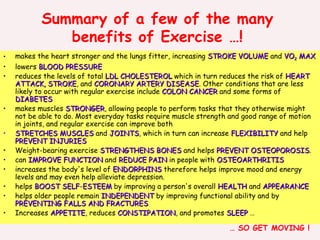
Summary of a few of the many benefits of Exercise …! makes the heart stronger and the lungs fitter, increasing  STROKE VOLUME  and  VO 2  MAX lowers  BLOOD PRESSURE   reduces the levels of total  LDL CHOLESTEROL  which in turn reduces the risk of  HEART ATTACK, STROKE , and  CORONARY ARTERY DISEASE . Other conditions that are less likely to occur with regular exercise include  COLON CANCER  and some forms of  DIABETES makes muscles  STRONGER , allowing people to perform tasks that they otherwise might not be able to do. Most everyday tasks require muscle strength and good range of motion in joints, and regular exercise can improve both STRETCHES MUSCLES  and  JOINTS , which in turn can increase  FLEXIBILITY  and help  PREVENT INJURIES Weight-bearing exercise  STRENGTHENS   BONES  and helps  PREVENT   OSTEOPOROSIS .  can  IMPROVE   FUNCTION  and  REDUCE   PAIN  in people with  OSTEOARTHRITIS increases the body's level of  ENDORPHINS  therefore helps improve mood and energy levels and may even help alleviate depression.  helps  BOOST   SELF - ESTEEM  by improving a person's overall  HEALTH  and  APPEARANCE helps older people remain  INDEPENDENT  by improving functional ability and by  PREVENTING   FALLS   AND   FRACTURES Increases  APPETITE , reduces  CONSTIPATION , and promotes  SLEEP  … …  SO GET MOVING !
WARNING !!! The benefits of exercise diminish  within months  after a person stops exercising  Heart strength, muscle strength, and the level of high-density lipoprotein (HDL) cholesterol (the good cholesterol)  decrease , whereas blood pressure and body fat  increase Even former athletes who stop exercising do not retain measurable long-term benefits. They have no greater capacity to perform physical activities and no fewer risk factors for heart attacks those who have never exercised, nor do they regain fitness any faster!

Exercise and CVD

  • 1.
    Protective Effects ofExercise Being physically fit reduces the risk of cardiovascular disease, with people who do not exercise being TWICE as likely to develop heart disease Exercise is thought to decrease the many of the risk factors for CHD by: strengthens the heart muscle (myocardium) so that it can pump more blood with each beat therefore improving efficiency of the heart lowering resting heart rate improves blood lipid profile by decreasing LDL and increasing HDL levels lowers blood pressure by maintaining the elasticity of the arteries helps weight loss by decreasing % body fat decreasing development of atheroma controlling stress Even a small amount of moderate exercise, such as walking, can improve the quality of life and increase life expectancy
  • 2.
    How does theCVS respond to exercise? During exercise the CVS must INCREASE delivery of O 2 and nutrients to the exercising muscle and remove waste effectively This is done by: INCREASING Cardiac Output REDISTRIBUTING Blood Circulation
  • 3.
    Increasing Cardiac OutputDuring exercise SYSTOLIC BP can increase from 120 to 200 mm Hg, showing that the walls of the ventricles are working much harder; diastolic pressure remains fairly constant As a result the volume of blood pushed out of the heart with every beat ( STROKE VOLUME ) INCREASES Since HEART RATE and STROKE VOLUME both increase during exercise, it follows that cardiac output is also greatly increased CO = HR x SV
  • 4.
    Redistribution of BloodDuring exercise muscles need more blood to receive more O 2 and glucose There is only a finite volume of blood in the body, so if some tissues receive an increased blood supply it follows that others must receive a decreased blood supply during exercise This change in distribution of blood is brought about by the widening of arterioles ( VASODILATION ) increasing the blood supply to the active tissues and the narrowing of arterioles ( VASOCONSTRICTION ) decreasing the supply to those tissues which are not actively involved in exercise
  • 5.
    The brain requiresa constant supply of glucose and oxygen. It could not survive for long with a smaller blood supply. Therefore during exercise its blood supply must be maintained The abdominal organs can survive with a smaller blood supply during exercise As muscles work harder during exercise heat is produced. Increasing blood flow to the skin means that this heat can be lost to the air thus cooling the body down
  • 6.
    The ‘Athletic Heart’Athletes are people who are fitter than most people because they undergo a regime of training - involves exercising at more extreme levels and for greater periods of time than most people can maintain Athletic heart syndrome refers to the normal changes that the heart undergoes in very well conditioned athletes: heart is LARGER and its VENTRICLE WALLS THICKER than in nonathletes [CARDIAC HYPERTROPHY] The chambers inside the heart enlarge This is due to an increase in protein synthesis in the muscle fibres of the heart and thus allows the heart increase its stroke volume without much increase in heart rate When an athlete stops training, the athletic heart syndrome slowly disappears — that is, heart size and heart rate tend to return gradually to that of the nonathlete
  • 7.
    Principles of ExerciseTesting There are many reasons why it may be necessary to assess the physiological fitness of a person Monitor effectiveness of exercise program Rehabilitation of cardiac patients Testing can be MAXIMAL or SUB-MAXIMAL Measures the MAXIMUM RATE at which the body is able to take up and use OXYGEN [V O2 max] The greater the V O2 max the fitter the individual A less extreme form of testing to predict V O2 max Relies on two assumptions: 1) that there is a linear correlation between V O2 max, heart rate and intensity of exercise, and 2) individual's maximum heart rate = 220 - age Individual's pulse rate and oxygen uptake are measured at various levels of activity. These results are used to construct a graph of pulse rate against oxygen uptake. A straight line is drawn through the points on the graph and extrapolated to the maximum heart rate to predict V O2 max
  • 8.
  • 9.
    A STRESSTEST (or exercise ECG test) records an individual's ECG traces before, during and after exercise e.g. walking on treadmill, pedalling on stationary bike The exercise is gradually increased in intensity until the individual is too tired to go on or until symptoms such as chest pain or breathlessness are felt The results are used to establish exercise limits and to develop a fitness programme for the rehabilitation of cardiac patients [no longer bed rest!] The stress test is repeated periodically to monitor the individual's progress A programme of medically supervised exercise leads to better recovery and survival rates Exercise Stress Testing
  • 10.
    Summary of afew of the many benefits of Exercise …! makes the heart stronger and the lungs fitter, increasing STROKE VOLUME and VO 2 MAX lowers BLOOD PRESSURE reduces the levels of total LDL CHOLESTEROL which in turn reduces the risk of HEART ATTACK, STROKE , and CORONARY ARTERY DISEASE . Other conditions that are less likely to occur with regular exercise include COLON CANCER and some forms of DIABETES makes muscles STRONGER , allowing people to perform tasks that they otherwise might not be able to do. Most everyday tasks require muscle strength and good range of motion in joints, and regular exercise can improve both STRETCHES MUSCLES and JOINTS , which in turn can increase FLEXIBILITY and help PREVENT INJURIES Weight-bearing exercise STRENGTHENS BONES and helps PREVENT OSTEOPOROSIS . can IMPROVE FUNCTION and REDUCE PAIN in people with OSTEOARTHRITIS increases the body's level of ENDORPHINS therefore helps improve mood and energy levels and may even help alleviate depression. helps BOOST SELF - ESTEEM by improving a person's overall HEALTH and APPEARANCE helps older people remain INDEPENDENT by improving functional ability and by PREVENTING FALLS AND FRACTURES Increases APPETITE , reduces CONSTIPATION , and promotes SLEEP … … SO GET MOVING !
  • 11.
    WARNING !!! Thebenefits of exercise diminish within months after a person stops exercising Heart strength, muscle strength, and the level of high-density lipoprotein (HDL) cholesterol (the good cholesterol) decrease , whereas blood pressure and body fat increase Even former athletes who stop exercising do not retain measurable long-term benefits. They have no greater capacity to perform physical activities and no fewer risk factors for heart attacks those who have never exercised, nor do they regain fitness any faster!