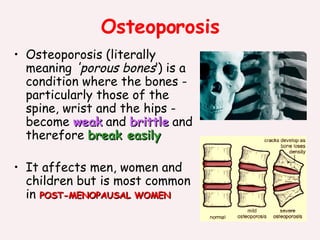
Osteoporosis Osteoporosis (literally meaning  'porous bones ‘)  is a condition where the bones - particularly those of the spine, wrist and the hips - become  weak  and  brittle  and therefore  break easily It affects men, women and children but is most common in  POST-MENOPAUSAL WOMEN
Bone Growth Bones are made from a honeycomb of strands formed by the protein collagen and hardened by  CALCIUM SALTS  and other minerals This honeycomb is filled with bone marrow and blood vessels and protected by a dense outer shell. Scattered throughout are millions of living bone cells, which continually break down and replace old bone Bones reach maximum strength and density at 25 to 30 years, known as  peak bone density . However, from the age of 35 onwards more bone cells are lost than replaced and the holes of the honeycomb become larger, leaving bones weaker and more likely to break. This causes the bone density to  DECREASE
Risk factors for Osteoporosis There are many factors which  increase  the risk of developing osteoporosis in later life including:   AGE:  Peak bone density occurs between 25 and 35 years of age, after which mineral loss from bone increases as a natural consequence of aging   SEX :   Men tend to have a higher peak bone density and so it takes men longer to reach the level of bone loss which will make their bones brittle  MENOPAUSE :   In women, oestrogen contributes to bone density by promoting the absorption of calcium from the digestive system and preventing its removal from bone. After the menopause oestrogen levels drop, causing more calcium to be lost from bone DIET :  Calcium from the diet is laid down in bones and teeth, making them strong and hard and vitamin D is needed for the absorption of calcium from the digestive system FAMILY HISTORY SMOKING AND EXCESSIVE ALCOHOL CONSUMPTION :  both increase the rate of bone loss EXERCISE:   Both insufficient and excessive exercise can increase the risk of osteoporosis
Effect of Exercise The most important thing you can do to prevent osteoporosis developing is to keep your bones strong and healthy by  maximising peak bone density  while you're  young Bone becomes stronger and denser when it is subjected to  mechanical stress . This happens during  WEIGHT BEARING EXERCISES  such as brisk walking, jogging  etc . Tennis players, for example, have a 30 per cent higher bone density in their serving arm than in their non-serving arm Therefore, in order to reduce the risk of osteoporosis, it is vital to carry out weight bearing exercise on a  regular basis  during adolescence and beyond, so that peak bone density is maximised

Osteoporosis

  • 1.
    Osteoporosis Osteoporosis (literallymeaning 'porous bones ‘) is a condition where the bones - particularly those of the spine, wrist and the hips - become weak and brittle and therefore break easily It affects men, women and children but is most common in POST-MENOPAUSAL WOMEN
  • 2.
    Bone Growth Bonesare made from a honeycomb of strands formed by the protein collagen and hardened by CALCIUM SALTS and other minerals This honeycomb is filled with bone marrow and blood vessels and protected by a dense outer shell. Scattered throughout are millions of living bone cells, which continually break down and replace old bone Bones reach maximum strength and density at 25 to 30 years, known as peak bone density . However, from the age of 35 onwards more bone cells are lost than replaced and the holes of the honeycomb become larger, leaving bones weaker and more likely to break. This causes the bone density to DECREASE
  • 3.
    Risk factors forOsteoporosis There are many factors which increase the risk of developing osteoporosis in later life including: AGE: Peak bone density occurs between 25 and 35 years of age, after which mineral loss from bone increases as a natural consequence of aging SEX : Men tend to have a higher peak bone density and so it takes men longer to reach the level of bone loss which will make their bones brittle MENOPAUSE : In women, oestrogen contributes to bone density by promoting the absorption of calcium from the digestive system and preventing its removal from bone. After the menopause oestrogen levels drop, causing more calcium to be lost from bone DIET : Calcium from the diet is laid down in bones and teeth, making them strong and hard and vitamin D is needed for the absorption of calcium from the digestive system FAMILY HISTORY SMOKING AND EXCESSIVE ALCOHOL CONSUMPTION : both increase the rate of bone loss EXERCISE: Both insufficient and excessive exercise can increase the risk of osteoporosis
  • 4.
    Effect of ExerciseThe most important thing you can do to prevent osteoporosis developing is to keep your bones strong and healthy by maximising peak bone density while you're young Bone becomes stronger and denser when it is subjected to mechanical stress . This happens during WEIGHT BEARING EXERCISES such as brisk walking, jogging etc . Tennis players, for example, have a 30 per cent higher bone density in their serving arm than in their non-serving arm Therefore, in order to reduce the risk of osteoporosis, it is vital to carry out weight bearing exercise on a regular basis during adolescence and beyond, so that peak bone density is maximised