![Plant Tissue Culture One major problem in plant breeding is that crosses can only be made between closely related parental types. This makes it very difficult to introduce new genes into a plant species. The solution to this problem is PROTOPLAST FUSION - protoplasts of different plants are mixed and fused together. These form a binucleate cell containing a nucleus from both parental types Protoplast = actively metabolising part of cell minus cell wall [cell wall digested by enzymes]](https://image.slidesharecdn.com/plant-culture-27654/85/Plant-Culture-1-320.jpg)
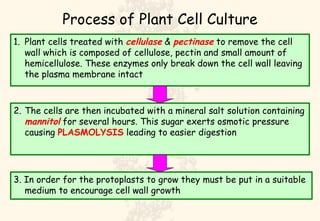
Plant protoplast fusion allows for the introduction of new genes into plant species by mixing and fusing the protoplasts, or plant cells without cell walls, from different plant types. The process involves digesting the cell walls of plant cells with enzymes to create protoplasts, incubating the protoplasts in a solution with mannitol to cause plasmolysis and easier digestion of the cell wall, and placing the protoplasts in a medium that encourages cell wall growth and the fusion of protoplasts from different plant species.


