By- Dr. Armaan SinghBy- Dr. Armaan Singh
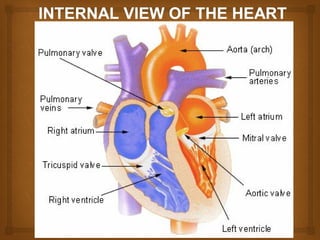
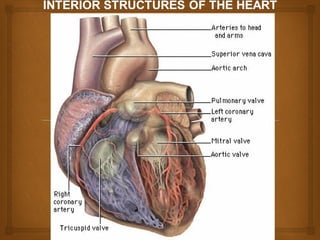
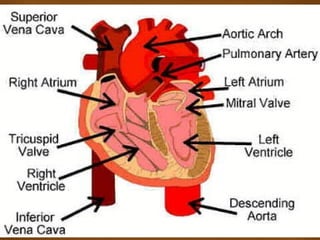
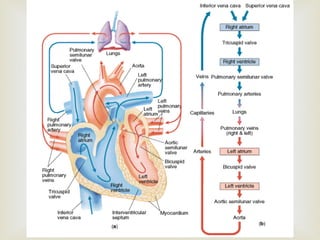
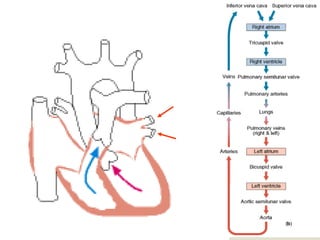
Chambers:Chambers:
The heart is divided by a septum into two halves. The halvesThe heart is divided by a septum into two halves. The halves
are in turn divided into chambers. The upper two chambersare in turn divided into chambers. The upper two chambers
of the heart are calledof the heart are called atriaatria and the lower two chambers areand the lower two chambers are
calledcalled ventriclesventricles.. ValvesValves allow blood to flow in one directionallow blood to flow in one direction
between the chambers of the heart.between the chambers of the heart.


 The diseases and conditions affecting the heart areThe diseases and conditions affecting the heart are
collectively known as heart disease.collectively known as heart disease.
 The heart consists of a muscle that pumps blood, arteriesThe heart consists of a muscle that pumps blood, arteries
that supply blood to the heart muscle, and valves thatthat supply blood to the heart muscle, and valves that
ensure that the blood within the heart is pumped in theensure that the blood within the heart is pumped in the
correct direction.correct direction.
 Problems can arise in any of these areas.Problems can arise in any of these areas.
 Like cardiovascular disease, heart disease is a term that'sLike cardiovascular disease, heart disease is a term that's
somewhat loose and broad, and it's often used that way.somewhat loose and broad, and it's often used that way.
Heart disease is an umbrella term for a number of differentHeart disease is an umbrella term for a number of different
diseases which affect the heart. The most common heartdiseases which affect the heart. The most common heart
diseases are:diseases are:
 Coronary artery disease.
 Coronary heart disease.
 Ischaemic heart disease.
 Cardiovascular disease
 Pulmonary heart disease.
 Hereditary heart disease.
 Hypertensive heart disease.
 Inflammatory heart disease.
 Valvular heart disease.
 Pericardial disease
 Congenital heart disease
 Heart failure
 Coronary artery disease (CAD), These are
diseases of the arteries that supply the heart
muscle with blood. CAD is one of the most
common forms of heart disease and the
leading cause of heart attacks. It generally
means that blood flow through the coronary
arteries has become obstructed. The most
common cause of such obstructions is a
condition called atherosclerosis, a largely
preventable type of vascular disease.
Coronary artery disease can lead to other heart
problems, such as chest pain (angina) and
heart attack (myocardial infarction).
 Coronary heart disease, a disease of the heart itself
caused by the accumulation of atheromatous plaques
within the walls of the arteries that supply the
myocardium
 Ischaemic heart disease, another disease of the heart
itself, characterized by reduced blood supply to the
organ.
 Cardiovascular disease, a sub-umbrella term for a
number of diseases that that affect the heart itself and/or
the blood vessel system, especially the veins and
arteries leading to and from the heart. Causes of
cardivascular disease include diabetes mellitas,
hypertension and hypercholesterolemia.
 Pulmonary heart disease, a failure of the right
side of the heart.
 Hereditary heart disease, heart disease caused
by inavoidable genetic factors
 Hypertensive heart disease, heart disease
caused by high blood pressure, especially
localised high blood pressure
 Inflammatory heart disease, heart disease that
involves inflamation of the heart muscle
and/or the tissue surrounding it.
 Valvular heart disease, heart disease that
affects the valves of the heart.
 Pericardial disease, These are diseases of the
sac that encases the heart (pericardium).
Pericardial disorders include inflammation
(pericarditis), fluid accumulation (pericardial
effusion) and stiffness (constrictive
pericarditis). These can occur alone or
together. The causes of pericardial disease
vary, as do the problems they may lead to. For
instance, pericarditis can occur after a heart
attack and, as a result, lead to pericardial
effusion or chest pain.
 Congenital heart disease, These are forms of
heart disease that develop before birth
(congenital). Congenital heart disease is a
broad term and includes a wide range of
diseases and conditions. These diseases can
affect the formation of the heart muscle or its
chambers or valves. They include such
conditions as narrowing of a section of the
aorta (coarctation) or holes in the heart (atrial
or ventricular septal defect). Some congenital
heart defects may be apparent right at the time
of birth, while others may not be detected
until later in life.
 Heart failureHeart failure, often called congestive heart failure, is a, often called congestive heart failure, is a
condition in which the heart can't pump enough blood to thecondition in which the heart can't pump enough blood to the
body's organs and tissues. It doesn't mean the heart has failedbody's organs and tissues. It doesn't mean the heart has failed
and can't pump blood at all. With this less effective pumping,and can't pump blood at all. With this less effective pumping,
vital organs don't get enough blood, causing such signs andvital organs don't get enough blood, causing such signs and
symptoms as shortness of breath, fluid retention and fatigue.symptoms as shortness of breath, fluid retention and fatigue.
Congestive heart failure is technically reserved for situations inCongestive heart failure is technically reserved for situations in
which heart failure has led to fluid buildup in the body. Not allwhich heart failure has led to fluid buildup in the body. Not all
heart failure is congestive, but the terms are often usedheart failure is congestive, but the terms are often used
interchangeably. Heart failure may develop suddenly or overinterchangeably. Heart failure may develop suddenly or over
many years. It may occur as a result of other cardiovascularmany years. It may occur as a result of other cardiovascular
conditions that have damaged or weakened the heart, such asconditions that have damaged or weakened the heart, such as
coronary artery disease or cardiomyopathy.coronary artery disease or cardiomyopathy.
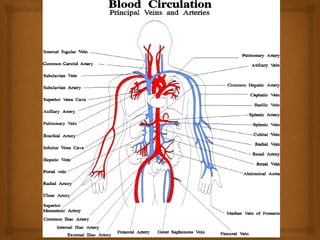
 Arteries:Arteries: These blood vessels carry blood away from theThese blood vessels carry blood away from the
heart and out to the body, delivering oxygen andheart and out to the body, delivering oxygen and
nutrients. The aorta is the largest blood vessel of all.nutrients. The aorta is the largest blood vessel of all.
 Veins:Veins: These blood vessels carry deoxygenated bloodThese blood vessels carry deoxygenated blood
back to the heart. Lacking oxygen, they have a bluish castback to the heart. Lacking oxygen, they have a bluish cast
on the skin.on the skin.
Blood vessels are essentially hollow tubes that
carry blood to the organs and tissues throughout
the body.
 Blood vessels have many layers and a complexBlood vessels have many layers and a complex
mechanism of action to keep blood flowing to all of themechanism of action to keep blood flowing to all of the
vital organs.vital organs.
 Despite that big responsibility – probably don't payDespite that big responsibility – probably don't pay
much attention to the blood vessels – until somethingmuch attention to the blood vessels – until something
goes wrong, that is.goes wrong, that is.
 Capillaries: These tiny vessels connect
arteries and veins.
 Lymphatics: Fluid leaks out of capillaries to
bathe cells. Lymphatics are delicate vessels
that carry this fluid back into the body's central
circulation.
 Arteriosclerosis and atherosclerosis.
 High blood pressure (hypertension).
 Stroke.
 Aneurysm.
 Peripheral arterial disease and claudication.
 Vasculitis.
 Venous incompetence.
 Venous thrombosis.
 Varicose veins.
 Lymphedema.
 Arteriosclerosis and atherosclerosis, are conditions
in which the walls of the arteries become thick and
stiff. This can sometimes restrict blood flow to the
organs and tissues. The process of this thickening
and stiffening is arteriosclerosis. Atherosclerosis is
the most common form of arteriosclerosis.
Although the two terms are often used
interchangeably, atherosclerosis refers to hardening
of the arteries caused by accumulation of fatty
deposits (plaques) and other substances. The heart
is one of the organs commonly affected by
atherosclerosis. When the arteries of the heart
(coronary arteries) narrow – may experience chest
pain or a heart attack.
 High blood pressure (hypertension), is the
excessive force of blood pumping through the
blood vessels. It's perhaps the most common
form of cardiovascular disease in the Western
world, affecting about one in four Americans.
Although potentially life-threatening, it’s one
of the most preventable and treatable types of
cardiovascular disease. High blood pressure
also causes many other types of
cardiovascular disease, such as stroke and
heart failure.
 Stroke, is a sudden loss of brain function. It occurs
when blood flow to the brain is interrupted (ischemic
stroke) or when blood vessels in the brain rupture
(hemorrhagic stroke). These, in turn, cause the death
of brain cells in the affected areas. Stroke is often
thought of as a neurological disorder because of the
many complications it causes.
 Aneurysm, is a bulge or weakness in the wall of an
artery or vein. Aneurysms usually enlarge over time.
Because of that, they have the potential to rupture
and cause life-threatening bleeding. Aneurysms can
occur in arteries in any location in the body. The
most common sites include the abdominal aorta and
the arteries at the base of the brain.
 Peripheral arterial disease and claudication, may be more
familiar with claudication — pain in the arms or legs during
exercise — than the term "peripheral arterial disease."
Strictly speaking, claudication is a symptom of peripheral
arterial disease. However, claudication is often referred to
as a disease itself. Peripheral arterial disease is a disorder in
which the arteries supplying blood to the limbs — usually
the legs — become clogged or partially blocked. When this
happens, the arms and legs are left with less blood than they
need to keep up with demand. Claudication symptoms may
then develop. When the obstruction is mild, may have such
symptoms as pain in the legs during strenuous exercise. As
the disease progresses and arteries become more obstructed,
may have pain or cramping in the legs even when not
active.
 Vasculitis, This is an inflammation of the
blood vessels. It usually involves the arteries
but may also affect veins and capillaries. The
inflammation may damage the wall of the
artery or vein and impair blood flow to the
region of the body supplied by that vessel.
Sometimes vasculitis occurs along with a
generalized disorder, such as lupus or
rheumatoid arthritis, but it may also occur on
its own.
 Venous incompetence, This is a condition in which
blood flows the wrong way in the veins. Veins
have tiny valves that are designed to promote
blood flow in a forward direction, back to the
heart. But if such conditions as infection,
inflammation, abnormal blood clotting, or even
high-back pressure in pregnancy, the valves may
become damaged and incompetent. That allows
blood to flow backward and pool in the legs when
sitting or standing. May develop such
complications as prominent and painful varicose
veins, skin changes, ulcers and swelling in the legs.
When venous incompetence occurs in the arms,
may experience pain and swelling in the arms and
prominent veins.
 Venous thrombosis, This is the formation of a
blood clot (thrombus) in a vein. This
condition may damage the vein and its valves.
In addition, clots that break off and travel in
the bloodstream can lodge in the lungs, a
condition known as pulmonary embolism. In
some cases, this type of clot can also cause a
stroke. May be more familiar with deep vein
thrombosis, in which a clot develops deep
within a muscle, such as one in the calf.
 Varicose veins, This is a condition in which the
veins become twisted and enlarged. The veins are
usually located on the backs of the calves or on
the inside of the legs, from the groin to the ankle.
When valves in the veins don't function properly,
blood can accumulate in the legs, causing the
veins to bulge and twist. The veins appear blue
because they contain less oxygen.
 Lymphedema, This is an obstruction of the
lymphatic vessels. It results in an excessive
buildup of fluid, which can cause swelling and
pain. It can be caused by infections, trauma,
tumors, surgery and radiation treatment. In rare
cases, someone may be born with lymphedema.
Arrhythmia / DysrhythmiaArrhythmia / Dysrhythmia
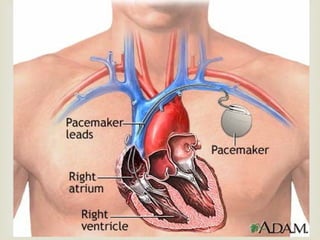
Heart blockHeart block // Atrio ventricular block:Atrio ventricular block: Failure ofFailure of
conduction of impulses through the A.V.Node.conduction of impulses through the A.V.Node.
Damage to the S.A.Node causes week impulses failingDamage to the S.A.Node causes week impulses failing
to reach the ventricles.to reach the ventricles. Cardiac pacemakerCardiac pacemaker establishesestablishes
normal rhythm.normal rhythm. It is a small, battery-operated electronicIt is a small, battery-operated electronic
device. It is inserted under the skin. It has leadsdevice. It is inserted under the skin. It has leads
that travel through a large vein to the heart, where thethat travel through a large vein to the heart, where the
wires are anchored, which send the electrical impulseswires are anchored, which send the electrical impulses
to the heart.to the heart.
FlutterFlutter:: Rapid,Rapid, regular contractionregular contraction of atria or ventricleof atria or ventricle
reaching upto 250/300 beats per minute.reaching upto 250/300 beats per minute.
FibrillationFibrillation:: Rapid, random,Rapid, random, irregular contractionirregular contraction
reaching upto 350-400 beats per minute.reaching upto 350-400 beats per minute.
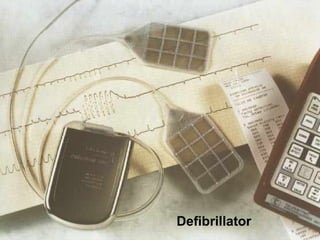
DefibrillatorDefibrillator is applied to the chest wall to help inis applied to the chest wall to help in
cardioversioncardioversion..
DefibrillationDefibrillation is a technique used to counter the onset ofis a technique used to counter the onset of
ventricular fibrillationventricular fibrillation, a common cause of, a common cause of cardiac arrest.cardiac arrest.
Defibrillation is part of anDefibrillation is part of an advanced cardiac life supportadvanced cardiac life support. It. It
applies a controlled electric shock.applies a controlled electric shock.
Defibrillator
Cardiac ArrestCardiac Arrest:: Sudden stoppage of heart.Sudden stoppage of heart.
PalpitationPalpitation:: Uncomfortable sensation in the chestUncomfortable sensation in the chest
associated with arrhythmia. This causesassociated with arrhythmia. This causes
1. Premature atrial contraction (PAC)1. Premature atrial contraction (PAC)
2. Premature ventricular contraction (PVC).2. Premature ventricular contraction (PVC).
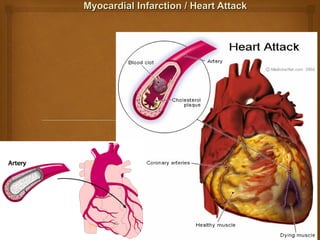
Myocardial Infarction / Heart AttackMyocardial Infarction / Heart Attack
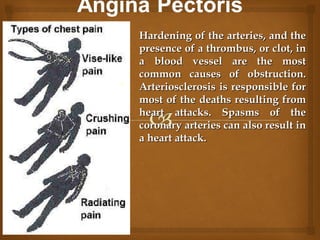
Hardening of the arteries, and theHardening of the arteries, and the
presence of a thrombus, or clot, inpresence of a thrombus, or clot, in
a blood vessel are the mosta blood vessel are the most
common causes of obstruction.common causes of obstruction.
Arteriosclerosis is responsible forArteriosclerosis is responsible for
most of the deaths resulting frommost of the deaths resulting from
heart attacks. Spasms of theheart attacks. Spasms of the
coronary arteries can also result incoronary arteries can also result in
a heart attack.a heart attack.
 Electrocardiogram (ECG)
 Nuclear stress testing
 Echocardiogram (ECHO)
 Coronary angiogram
 CT scan
 PET/CT scan
 Magnetic resonance imaging (MRI)
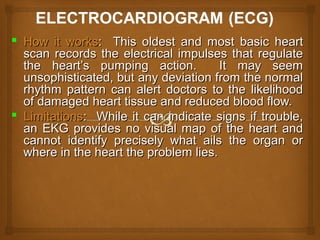
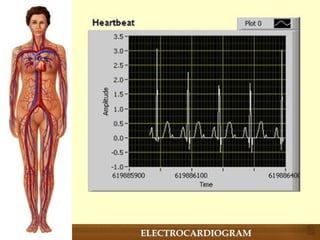
 How it worksHow it works: This oldest and most basic heart: This oldest and most basic heart
scan records the electrical impulses that regulatescan records the electrical impulses that regulate
the heart’s pumping action. It may seemthe heart’s pumping action. It may seem
unsophisticated, but any deviation from the normalunsophisticated, but any deviation from the normal
rhythm pattern can alert doctors to the likelihoodrhythm pattern can alert doctors to the likelihood
of damaged heart tissue and reduced blood flow.of damaged heart tissue and reduced blood flow.
 LimitationsLimitations: While it can indicate signs if trouble,: While it can indicate signs if trouble,
an EKG provides no visual map of the heart andan EKG provides no visual map of the heart and
cannot identify precisely what ails the organ orcannot identify precisely what ails the organ or
where in the heart the problem lies.where in the heart the problem lies.
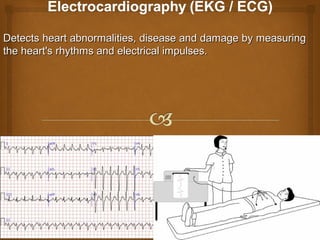
Detects heart abnormalities, disease and damage by measuringDetects heart abnormalities, disease and damage by measuring
the heart's rhythms and electrical impulses.the heart's rhythms and electrical impulses.
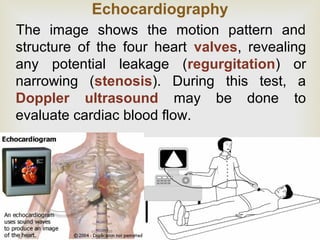
Echocardiography
The image shows the motion pattern and
structure of the four heart valves, revealing
any potential leakage (regurgitation) or
narrowing (stenosis). During this test, a
Doppler ultrasound may be done to
evaluate cardiac blood flow.
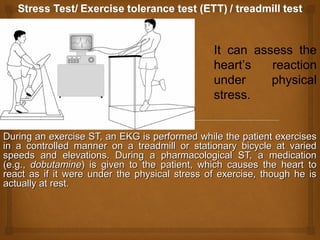
During an exercise ST, an EKG is performed while the patient exercisesDuring an exercise ST, an EKG is performed while the patient exercises
in a controlled manner on a treadmill or stationary bicycle at variedin a controlled manner on a treadmill or stationary bicycle at varied
speeds and elevations. During a pharmacological ST, a medicationspeeds and elevations. During a pharmacological ST, a medication
(e.g.,(e.g., dobutaminedobutamine) is given to the patient, which causes the heart to) is given to the patient, which causes the heart to
react as if it were under the physical stress of exercise, though he isreact as if it were under the physical stress of exercise, though he is
actually at rest.actually at rest.
It can assess the
heart’s reaction
under physical
stress.
 How it worksHow it works: Doctors inject a radioactive: Doctors inject a radioactive
substance into the blood, then use gamma-raysubstance into the blood, then use gamma-ray
cameras to see how the blood moves through thecameras to see how the blood moves through the
heart. The test shows how well the heart is doingheart. The test shows how well the heart is doing
at keeping itself saturated with oxygen-rich blood.at keeping itself saturated with oxygen-rich blood.
The test is often done twice, to check cardiacThe test is often done twice, to check cardiac
performance at rest and under physical stress.performance at rest and under physical stress.
 LimitationsLimitations: Carrying out two scans can take as: Carrying out two scans can take as
long as five hours. The test also exposes thelong as five hours. The test also exposes the
patient to small amounts of radiation.patient to small amounts of radiation.
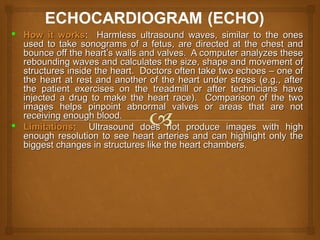
 How it worksHow it works: Harmless ultrasound waves, similar to the ones: Harmless ultrasound waves, similar to the ones
used to take sonograms of a fetus, are directed at the chest andused to take sonograms of a fetus, are directed at the chest and
bounce off the heart’s walls and valves. A computer analyzes thesebounce off the heart’s walls and valves. A computer analyzes these
rebounding waves and calculates the size, shape and movement ofrebounding waves and calculates the size, shape and movement of
structures inside the heart. Doctors often take two echoes – one ofstructures inside the heart. Doctors often take two echoes – one of
the heart at rest and another of the heart under stress (e.g., afterthe heart at rest and another of the heart under stress (e.g., after
the patient exercises on the treadmill or after technicians havethe patient exercises on the treadmill or after technicians have
injected a drug to make the heart race). Comparison of the twoinjected a drug to make the heart race). Comparison of the two
images helps pinpoint abnormal valves or areas that are notimages helps pinpoint abnormal valves or areas that are not
receiving enough blood.receiving enough blood.
 LimitationsLimitations: Ultrasound does not produce images with high: Ultrasound does not produce images with high
enough resolution to see heart arteries and can highlight only theenough resolution to see heart arteries and can highlight only the
biggest changes in structures like the heart chambers.biggest changes in structures like the heart chambers.
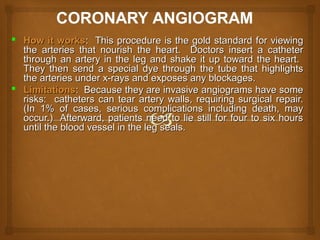
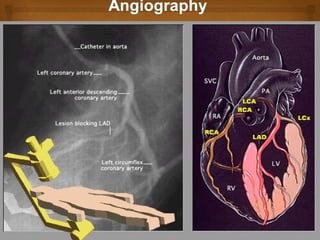
 How it worksHow it works: This procedure is the gold standard for viewing: This procedure is the gold standard for viewing
the arteries that nourish the heart. Doctors insert a catheterthe arteries that nourish the heart. Doctors insert a catheter
through an artery in the leg and shake it up toward the heart.through an artery in the leg and shake it up toward the heart.
They then send a special dye through the tube that highlightsThey then send a special dye through the tube that highlights
the arteries under x-rays and exposes any blockages.the arteries under x-rays and exposes any blockages.
 LimitationsLimitations: Because they are invasive angiograms have some: Because they are invasive angiograms have some
risks: catheters can tear artery walls, requiring surgical repair.risks: catheters can tear artery walls, requiring surgical repair.
(In 1% of cases, serious complications including death, may(In 1% of cases, serious complications including death, may
occur.) Afterward, patients need to lie still for four to six hoursoccur.) Afterward, patients need to lie still for four to six hours
until the blood vessel in the leg seals.until the blood vessel in the leg seals.
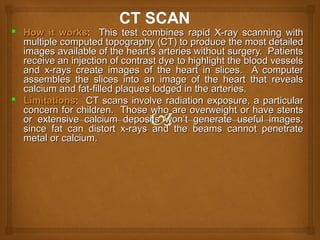
 How it worksHow it works: This test combines rapid X-ray scanning with: This test combines rapid X-ray scanning with
multiple computed topography (CT) to produce the most detailedmultiple computed topography (CT) to produce the most detailed
images available of the heart’s arteries without surgery. Patientsimages available of the heart’s arteries without surgery. Patients
receive an injection of contrast dye to highlight the blood vesselsreceive an injection of contrast dye to highlight the blood vessels
and x-rays create images of the heart in slices. A computerand x-rays create images of the heart in slices. A computer
assembles the slices into an image of the heart that revealsassembles the slices into an image of the heart that reveals
calcium and fat-filled plaques lodged in the arteries.calcium and fat-filled plaques lodged in the arteries.
 LimitationsLimitations: CT scans involve radiation exposure, a particular: CT scans involve radiation exposure, a particular
concern for children. Those who are overweight or have stentsconcern for children. Those who are overweight or have stents
or extensive calcium deposits won’t generate useful images,or extensive calcium deposits won’t generate useful images,
since fat can distort x-rays and the beams cannot penetratesince fat can distort x-rays and the beams cannot penetrate
metal or calcium.metal or calcium.
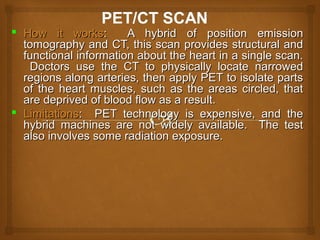
 How it worksHow it works: A hybrid of position emission: A hybrid of position emission
tomography and CT, this scan provides structural andtomography and CT, this scan provides structural and
functional information about the heart in a single scan.functional information about the heart in a single scan.
Doctors use the CT to physically locate narrowedDoctors use the CT to physically locate narrowed
regions along arteries, then apply PET to isolate partsregions along arteries, then apply PET to isolate parts
of the heart muscles, such as the areas circled, thatof the heart muscles, such as the areas circled, that
are deprived of blood flow as a result.are deprived of blood flow as a result.
 LimitationsLimitations: PET technology is expensive, and the: PET technology is expensive, and the
hybrid machines are not widely available. The testhybrid machines are not widely available. The test
also involves some radiation exposure.also involves some radiation exposure.
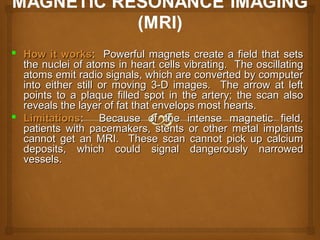
 How it worksHow it works: Powerful magnets create a field that sets: Powerful magnets create a field that sets
the nuclei of atoms in heart cells vibrating. The oscillatingthe nuclei of atoms in heart cells vibrating. The oscillating
atoms emit radio signals, which are converted by computeratoms emit radio signals, which are converted by computer
into either still or moving 3-D images. The arrow at leftinto either still or moving 3-D images. The arrow at left
points to a plaque filled spot in the artery; the scan alsopoints to a plaque filled spot in the artery; the scan also
reveals the layer of fat that envelops most hearts.reveals the layer of fat that envelops most hearts.
 LimitationsLimitations: Because of the intense magnetic field,: Because of the intense magnetic field,
patients with pacemakers, stents or other metal implantspatients with pacemakers, stents or other metal implants
cannot get an MRI. These scan cannot pick up calciumcannot get an MRI. These scan cannot pick up calcium
deposits, which could signal dangerously narroweddeposits, which could signal dangerously narrowed
vessels.vessels.
 Coronary arteries are only a small part of the heart. MRI isCoronary arteries are only a small part of the heart. MRI is
better at telling how well the heart is pumping how healthy itsbetter at telling how well the heart is pumping how healthy its
walls are and what shape the valves and chambers are in.walls are and what shape the valves and chambers are in.
MRI has the potential to do everything.MRI has the potential to do everything.
 MRI is also ideal for scanning children with congenital heartMRI is also ideal for scanning children with congenital heart
problems, since repeated radiation exposure in youngstersproblems, since repeated radiation exposure in youngsters
leads to an increased risk of developing cancer as adults.leads to an increased risk of developing cancer as adults.
But again there are drawbacks. MRI scans are much moreBut again there are drawbacks. MRI scans are much more
expensive than CT scans, and generating and interpretingexpensive than CT scans, and generating and interpreting
them require lots of training.them require lots of training.
 Echocardiogram machines are getting smallerEchocardiogram machines are getting smaller
and smaller, and their output is increasinglyand smaller, and their output is increasingly
being digitized, which allows doctors tobeing digitized, which allows doctors to
calculate more accurately the ability of thecalculate more accurately the ability of the
heart to function. And new radioactive markersheart to function. And new radioactive markers
are making nuclear perfusion scans shorterare making nuclear perfusion scans shorter
and more precise.and more precise.
 The further, however, may belong to whoeverThe further, however, may belong to whoever
can figure out how to make all these imagingcan figure out how to make all these imaging
technologies work together. One approachtechnologies work together. One approach
combines the anatomical accuracy of CTcombines the anatomical accuracy of CT
imaging with the functional informationimaging with the functional information
provided by a type of nuclear scan calledprovided by a type of nuclear scan called
positron-emission tomography (PET).positron-emission tomography (PET).
 Still in its early days in the clinic, PET/CT couldStill in its early days in the clinic, PET/CT could
help doctors see how much of the cardiachelp doctors see how much of the cardiac
muscle is still alive after a heart attack andmuscle is still alive after a heart attack and
whether a bypass operation, balloonwhether a bypass operation, balloon
angioplasty or stent surgery would helpangioplasty or stent surgery would help
damaged areas recover.damaged areas recover.
 Not all plaques that form inside a coronaryNot all plaques that form inside a coronary
artery’s walls are dangerous. Some appear toartery’s walls are dangerous. Some appear to
be stable and do not grow much, whereasbe stable and do not grow much, whereas
others contain an explosive combination ofothers contain an explosive combination of
hardened fat and inflammatory proteins thathardened fat and inflammatory proteins that
make them likely to brust, triggering a heartmake them likely to brust, triggering a heart
attack. Neither CT nor MRI scans can reliablyattack. Neither CT nor MRI scans can reliably
distinguish between the two sorts of lesions.distinguish between the two sorts of lesions.
 Researchers are developing compounds thatResearchers are developing compounds that
are chemically attracted to the inflammatoryare chemically attracted to the inflammatory
components of an unstable plaque with thecomponents of an unstable plaque with the
hope of someday tagging trouble spots thathope of someday tagging trouble spots that
need to be treated. But that could take a while.need to be treated. But that could take a while.
 There is a lot of evidence that loweringThere is a lot of evidence that lowering
cholesterol levels in those patients withcholesterol levels in those patients with
moderate arterial blockage greatly reduces themoderate arterial blockage greatly reduces the
risk of suffering a heart attack or stroke. So arisk of suffering a heart attack or stroke. So a
growing number of cardiologists are using thegrowing number of cardiologists are using the
new cardiac scans to determine which of therenew cardiac scans to determine which of there
otherwise asymptomatic patients need moreotherwise asymptomatic patients need more
intense medical treatment with statins andintense medical treatment with statins and
other drugs.other drugs.
Mild coronary artery disease, then, in addition to trying to getMild coronary artery disease, then, in addition to trying to get
the LDL cholesterol level under 70 mg/dL, he or she isthe LDL cholesterol level under 70 mg/dL, he or she is
probably going to put on a daily aspirin regimen and makeprobably going to put on a daily aspirin regimen and make
sure the Risk factors for heart diseasesure the Risk factors for heart disease
 Family history.
 High blood pressure.
 Age 55 or older.
 Low HDL or smoking
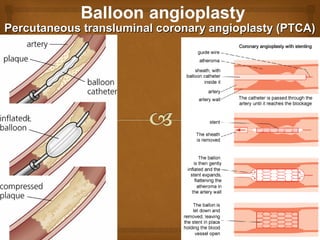
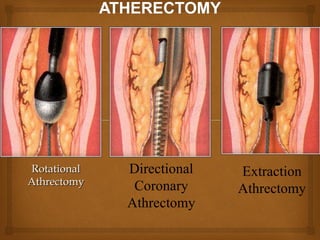
Percutaneous transluminal coronary angioplasty (PTCA)Percutaneous transluminal coronary angioplasty (PTCA)
RotationalRotational
AthrectomyAthrectomy
Directional
Coronary
Athrectomy
Extraction
Athrectomy
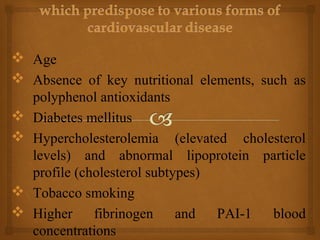
 Age
 Absence of key nutritional elements, such as
polyphenol antioxidants
 Diabetes mellitus
 Hypercholesterolemia (elevated cholesterol
levels) and abnormal lipoprotein particle
profile (cholesterol subtypes)
 Tobacco smoking
 Higher fibrinogen and PAI-1 blood
concentrations
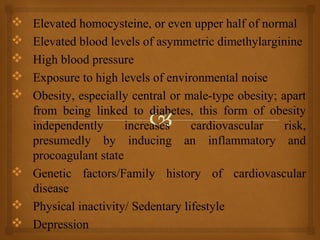
 Elevated homocysteine, or even upper half of normal
 Elevated blood levels of asymmetric dimethylarginine
 High blood pressure
 Exposure to high levels of environmental noise
 Obesity, especially central or male-type obesity; apart
from being linked to diabetes, this form of obesity
independently increases cardiovascular risk,
presumedly by inducing an inflammatory and
procoagulant state
 Genetic factors/Family history of cardiovascular
disease
 Physical inactivity/ Sedentary lifestyle
 Depression
 Men have a higher rate of cardiovascular
disease than women, it is also the number one
health problem for women in industrialized
countries.
 After menopause, the risk for women
approaches that of men.
 Hormone replacement therapy alleviates a
number of post-menopausal problems, but
appears to increase the risk of cardiovascular
disease.
 Attempts to prevent cardiovascular disease take
the form of modifying risk factors.
 Some, such as sex (male or female), age, and
family history, cannot be modified.
 Smoking cessation (or abstinence) is one of the
most effective and easily modifiable changes.
 Regular cardiovascular exercise (aerobic
exercise) complements the healthful eating
habits.
 Sometimes, the combination of diet and exercise willSometimes, the combination of diet and exercise will
improve lipoprotein (cholesterol) levels; if not, a physicianimprove lipoprotein (cholesterol) levels; if not, a physician
may prescribe "cholesterol-lowering" drugs like themay prescribe "cholesterol-lowering" drugs like the
statins.statins.
 These medications have additional protective benefitsThese medications have additional protective benefits
aside from their lipoprotein profile improvement.aside from their lipoprotein profile improvement.
 Aspirin may also be prescribed, as it has been shown toAspirin may also be prescribed, as it has been shown to
decrease the clot formation that may lead to myocardialdecrease the clot formation that may lead to myocardial
infarctions and strokes; it is routinely prescribed forinfarctions and strokes; it is routinely prescribed for
patients with one or more cardiovascular risk factors.patients with one or more cardiovascular risk factors.
 One little known or discussed, but powerfulOne little known or discussed, but powerful
way to almost eliminate risk of cardiovascularway to almost eliminate risk of cardiovascular
disease is keep the total cholesterol below 150.disease is keep the total cholesterol below 150.
 In the heart study, those with total cholesterolIn the heart study, those with total cholesterol
below 150 only very rarely got coronary heartbelow 150 only very rarely got coronary heart
disease.disease.
 Eating oily fish at least twice a week may helpEating oily fish at least twice a week may help
reduce the risk of sudden death andreduce the risk of sudden death and
arrhythmias.arrhythmias.
 Olive oil is said to have the greatest benefits.Olive oil is said to have the greatest benefits.
 Studies of individual heart cells showed thatStudies of individual heart cells showed that
the fatty acids blocked excessive sodium andthe fatty acids blocked excessive sodium and
calcium currents in the heart, which couldcalcium currents in the heart, which could
 Treatment of cardiovascular disease depends
on the specific form of the disease in each
patient, but effective treatment always includes
preventive lifestyle changes discussed above.
 Medications, such as blood pressure reducing
medications, aspirin and the statin cholesterol-
lowering drugs may be helpful.
 In some circumstances, surgery or angioplasty
may be warranted to reopen, repair, or replace
damaged blood vessels.
Explore heart disease treatments for specific types of heartExplore heart disease treatments for specific types of heart
disease.disease.
 Cardiovascular diseases
 Arrhythmias
 Heart failure
 Pericardial disorders
 Heart valve disease
 Congenital heart disease
Types of heart diseaseTypes of heart disease
 Arteriosclerosis/Arteriosclerosis/
AtherosclerosisAtherosclerosis
 Chest painChest pain
 Coronary arteryCoronary artery
diseasedisease
 Heart attackHeart attack
Types of circulatory disorders
 Aortic aneurysm
 Aortic dissection
 Claudication: When
circulation problems cause
leg pain
 Lymphedema
 Peripheral arterial disease
 Raynaud's disease
 Takayasu's arteritis
 Varicose veins
 Angiotensin II receptor blockersAngiotensin II receptor blockers
 Angiotensin-converting enzyme (ACE) inhibitorsAngiotensin-converting enzyme (ACE) inhibitors
 Beta blockersBeta blockers
 Cholesterol medications: Consider the optionsCholesterol medications: Consider the options
 Nitrates— Oral (Systemic)Nitrates— Oral (Systemic)
 Nitrates— Sublingual, Chewable, or Buccal (Systemic)Nitrates— Sublingual, Chewable, or Buccal (Systemic)
 Nitrates— Topical (Systemic)Nitrates— Topical (Systemic)
 Statins: Are these cholesterol-lowering drugs right?Statins: Are these cholesterol-lowering drugs right?
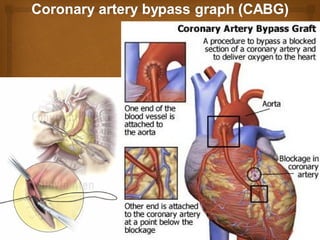
 Coronary angioplasty and stenting: Opening cloggedCoronary angioplasty and stenting: Opening clogged
arteriesarteries
 Coronary artery bypass surgeryCoronary artery bypass surgery
 Cardiac rehabilitation: Building a better life after heartCardiac rehabilitation: Building a better life after heart
diseasediseaseCARDIAC REHABILITATION
Types of arrhythmias (rhythm disorders)Types of arrhythmias (rhythm disorders)
 Atrial fibrillationAtrial fibrillation
 Bundle branch blockBundle branch block
 Heart arrhythmiasHeart arrhythmias
 Long QT syndromeLong QT syndrome
 Implantable cardioverter-defibrillator: After the ICD isImplantable cardioverter-defibrillator: After the ICD is
implantedimplanted
 Implantable cardioverter-defibrillators: Controlling aImplantable cardioverter-defibrillators: Controlling a
chaotic heartchaotic heart
 Pacemakers: Generating regular heartbeatsPacemakers: Generating regular heartbeats
Types of heart failureTypes of heart failure
 CardiomyopathyCardiomyopathy
 Heart failureHeart failure
 Left ventricular hypertrophyLeft ventricular hypertrophy
 MyocarditisMyocarditis
 Pulmonary edemaPulmonary edema
 Angiotensin II receptor blockersAngiotensin II receptor blockers
 Angiotensin-converting enzyme (ACE) inhibitorsAngiotensin-converting enzyme (ACE) inhibitors
 Beta blockersBeta blockers
 Digitalis Medicines (Systemic)Digitalis Medicines (Systemic)
 DiureticsDiuretics
 Heart transplant: A treatment for end-stage heart failureHeart transplant: A treatment for end-stage heart failure
 Organ transplant: Replacing diseased organs withOrgan transplant: Replacing diseased organs with
healthy oneshealthy ones
 Biventricular pacemaker: Cardiac resynchronizationBiventricular pacemaker: Cardiac resynchronization
therapy for heart failuretherapy for heart failure
 Heart failure: Heart pumps help keep the beatHeart failure: Heart pumps help keep the beat
 Biventricular pacingBiventricular pacing
DEVICES
TOOL
Understanding pericarditisUnderstanding pericarditis
 Dressler's syndromeDressler's syndrome
 PericarditisPericarditis
Types of heart valve diseaseTypes of heart valve disease
 Aortic valve stenosisAortic valve stenosis
 EndocarditisEndocarditis
 Mitral valve prolapseMitral valve prolapse
 Mitral valve regurgitationMitral valve regurgitation
 Mitral valve stenosisMitral valve stenosis
 Pulmonary valve stenosisPulmonary valve stenosis
Congenital heart disease causes and treatmentsCongenital heart disease causes and treatments
 Atrial septal defect (ASD)Atrial septal defect (ASD)
 Atrioventricular canal defectAtrioventricular canal defect
 Coarctation of the aortaCoarctation of the aorta
 Congenital heart defects: When the baby's born with aCongenital heart defects: When the baby's born with a
heart malformationheart malformation
 Ebstein's anomalyEbstein's anomaly
 Hypoplastic left heart syndromeHypoplastic left heart syndrome
 Patent ductus arteriosus (PDA)Patent ductus arteriosus (PDA)
Common types of congenital heart defectsCommon types of congenital heart defects
Congenital heart disease causes and treatments
 Patent foramen ovale
 Tetralogy of Fallot
 Transposition of the great arteries
 Tricuspid atresia
 Truncus arteriosus
 Strategies to keep heart disease at bay.
 Heart disease diet and weight loss
 Supplements for heart disease
 Exercise and heart disease
 Smoking and heart disease
 Stress relief
 Heart disease first aid
Choose heart-healthy foods
 Alcohol and the health: Weighing the pros and
cons
 Heart-healthy eating to help prevent
cardiovascular disease
 Mediterranean diet for heart health
 Menus for heart-healthy eating
Weight-loss strategies
Tool
 BMI calculator
Antioxidants
 Ascorbic Acid (Vitamin C) (Systemic)
 Beta-carotene— (Systemic)
 Coenzyme Q10
 Lycopene
B-vitamins
 Folic Acid (Vitamin B 9) (Systemic)
 Niacin (Vitamin B3, Nicotinic acid), Niacinamide
 Pyridoxine (Vitamin B 6) (Systemic)
 Vitamin B12 (Systemic)
Fish oil and garlic
 Garlic (Allium sativum L.)
 Omega-3 fatty acids, fish oil, alpha-linolenic acid
Loosening Exercises
 Loosening of fingers
 Shoulder rotation
 Drill walking
 Instant relaxation
technique (IRT)
INTEGRATED YOGA MODULE FOR
HEART DISEASES
Breathing practices
 Hands stretch breathing
 Ankle stretch breathing
 Rabbit breathing
 Straight leg raise breathing
(alternating)
 Side bending, each
 Quick relaxation
technique (QRT)

Yogasanas
Standing
 Ardhakati
cakrasana
 Garudasana
 Bhujangasana
 Vakrasana
 Gomukhasana
 Deep relaxation
technique (DRT)
Pranayama
 Nadisuddi pranayama
 Sitali pranayama
 Bhramari pranayama
Meditation
 Nadanusandhana
 OM-Dhyana (meditation)
 Acute attack - chair breathing
 Vamanadhouti + DRT – Once a week
 Laghu Sankapraksalana + DRT - Daily
 Millions of people in the world suffer from theMillions of people in the world suffer from the
diseases of the heart and blood vessels.diseases of the heart and blood vessels.
 The heart, which is muscular pump, keeps theThe heart, which is muscular pump, keeps the
blood circulation of blood going.blood circulation of blood going.
 But when there is a break down of thisBut when there is a break down of this
complicated mechanism, blood supply to a part ofcomplicated mechanism, blood supply to a part of
the body may be affected leading to what isthe body may be affected leading to what is
known as heart attack.known as heart attack.
 But with yoga the cardiovascular diseases can beBut with yoga the cardiovascular diseases can be
cured. Diseases that can be cured are:cured. Diseases that can be cured are:
Arteriosclerosis - hardening of arteriesArteriosclerosis - hardening of arteries
Coronary Thrombosis - sudden blocking ofCoronary Thrombosis - sudden blocking of
 Yoga helps coping with this stress so that do not needYoga helps coping with this stress so that do not need
to depend on smoking or eating unhealthy food.to depend on smoking or eating unhealthy food.
 It also helps to find contentment from within.It also helps to find contentment from within.
 Smoking should be completely stopped as it constrictsSmoking should be completely stopped as it constricts
the arteries.the arteries.
For daily practice :For daily practice :
 Keep self relaxed and free from anxiety , nervousness,Keep self relaxed and free from anxiety , nervousness,
tension and restlessness.tension and restlessness.
 Meditation - has been scientifically proven to be beneficialMeditation - has been scientifically proven to be beneficial
for hypertensive people.for hypertensive people.
 Ujjayi Pranayama - can be done while lying for about 3-4Ujjayi Pranayama - can be done while lying for about 3-4
minutes, if the blood pressure rises very high.minutes, if the blood pressure rises very high.
 Nadi Shodak Pranayama - It can be done 10 times.Nadi Shodak Pranayama - It can be done 10 times.
 General considerationsGeneral considerations: Consultation with: Consultation with
patient’s doctor is advisable because thepatient’s doctor is advisable because the
limitation may differ substantially according tolimitation may differ substantially according to
various heart diseases and their stages. Somevarious heart diseases and their stages. Some
heart abnormalities require no or little restraint.heart abnormalities require no or little restraint.
 ContraindicationsContraindications: No practices with internal: No practices with internal
breath retention. No physically demandingbreath retention. No physically demanding
physical exercises exceeding trainee’s tolerance.physical exercises exceeding trainee’s tolerance.
Practices like Agnisara Dhauti or ShankhaPractices like Agnisara Dhauti or Shankha
Prakshalana may be too risky even in personsPrakshalana may be too risky even in persons
with heart problems whose condition is fairlywith heart problems whose condition is fairly
good.good.
 RecommendationsRecommendations: Patients shortly after: Patients shortly after
myocardial infarction are advised to practicemyocardial infarction are advised to practice
Savasana, full yoga breath and later some easySavasana, full yoga breath and later some easy
Recommended Asana :Recommended Asana :
 Suryanamaskara (Sun salutation) - activates the wholeSuryanamaskara (Sun salutation) - activates the whole
body.body.
 Pavanmuktasana (Relieving the flatus) - wind reliever,Pavanmuktasana (Relieving the flatus) - wind reliever,
corrects malfunctioning of the abdomen. Make 4-6corrects malfunctioning of the abdomen. Make 4-6
rounds.rounds.
 Uttanpadasana (Raising the legs) - Helps reduce fat.Uttanpadasana (Raising the legs) - Helps reduce fat.
 Santulanasana - normalizes blood circulation.Santulanasana - normalizes blood circulation.
 Shavasana (Corpse pose) - should be done twice or thriceShavasana (Corpse pose) - should be done twice or thrice
daily as it normalizes the blood pressure.daily as it normalizes the blood pressure.
THANKTHANK
YOUYOU

Heart diseases

  • 1.
    By- Dr. ArmaanSinghBy- Dr. Armaan Singh
  • 3.
    Chambers:Chambers: The heart isdivided by a septum into two halves. The halvesThe heart is divided by a septum into two halves. The halves are in turn divided into chambers. The upper two chambersare in turn divided into chambers. The upper two chambers of the heart are calledof the heart are called atriaatria and the lower two chambers areand the lower two chambers are calledcalled ventriclesventricles.. ValvesValves allow blood to flow in one directionallow blood to flow in one direction between the chambers of the heart.between the chambers of the heart.
  • 6.
  • 7.
  • 9.
     The diseasesand conditions affecting the heart areThe diseases and conditions affecting the heart are collectively known as heart disease.collectively known as heart disease.  The heart consists of a muscle that pumps blood, arteriesThe heart consists of a muscle that pumps blood, arteries that supply blood to the heart muscle, and valves thatthat supply blood to the heart muscle, and valves that ensure that the blood within the heart is pumped in theensure that the blood within the heart is pumped in the correct direction.correct direction.  Problems can arise in any of these areas.Problems can arise in any of these areas.  Like cardiovascular disease, heart disease is a term that'sLike cardiovascular disease, heart disease is a term that's somewhat loose and broad, and it's often used that way.somewhat loose and broad, and it's often used that way.
  • 10.
    Heart disease isan umbrella term for a number of differentHeart disease is an umbrella term for a number of different diseases which affect the heart. The most common heartdiseases which affect the heart. The most common heart diseases are:diseases are:  Coronary artery disease.  Coronary heart disease.  Ischaemic heart disease.  Cardiovascular disease  Pulmonary heart disease.  Hereditary heart disease.  Hypertensive heart disease.  Inflammatory heart disease.  Valvular heart disease.  Pericardial disease  Congenital heart disease  Heart failure
  • 11.
     Coronary arterydisease (CAD), These are diseases of the arteries that supply the heart muscle with blood. CAD is one of the most common forms of heart disease and the leading cause of heart attacks. It generally means that blood flow through the coronary arteries has become obstructed. The most common cause of such obstructions is a condition called atherosclerosis, a largely preventable type of vascular disease. Coronary artery disease can lead to other heart problems, such as chest pain (angina) and heart attack (myocardial infarction).
  • 12.
     Coronary heartdisease, a disease of the heart itself caused by the accumulation of atheromatous plaques within the walls of the arteries that supply the myocardium  Ischaemic heart disease, another disease of the heart itself, characterized by reduced blood supply to the organ.  Cardiovascular disease, a sub-umbrella term for a number of diseases that that affect the heart itself and/or the blood vessel system, especially the veins and arteries leading to and from the heart. Causes of cardivascular disease include diabetes mellitas, hypertension and hypercholesterolemia.
  • 13.
     Pulmonary heartdisease, a failure of the right side of the heart.  Hereditary heart disease, heart disease caused by inavoidable genetic factors  Hypertensive heart disease, heart disease caused by high blood pressure, especially localised high blood pressure  Inflammatory heart disease, heart disease that involves inflamation of the heart muscle and/or the tissue surrounding it.  Valvular heart disease, heart disease that affects the valves of the heart.
  • 14.
     Pericardial disease,These are diseases of the sac that encases the heart (pericardium). Pericardial disorders include inflammation (pericarditis), fluid accumulation (pericardial effusion) and stiffness (constrictive pericarditis). These can occur alone or together. The causes of pericardial disease vary, as do the problems they may lead to. For instance, pericarditis can occur after a heart attack and, as a result, lead to pericardial effusion or chest pain.
  • 15.
     Congenital heartdisease, These are forms of heart disease that develop before birth (congenital). Congenital heart disease is a broad term and includes a wide range of diseases and conditions. These diseases can affect the formation of the heart muscle or its chambers or valves. They include such conditions as narrowing of a section of the aorta (coarctation) or holes in the heart (atrial or ventricular septal defect). Some congenital heart defects may be apparent right at the time of birth, while others may not be detected until later in life.
  • 16.
     Heart failureHeartfailure, often called congestive heart failure, is a, often called congestive heart failure, is a condition in which the heart can't pump enough blood to thecondition in which the heart can't pump enough blood to the body's organs and tissues. It doesn't mean the heart has failedbody's organs and tissues. It doesn't mean the heart has failed and can't pump blood at all. With this less effective pumping,and can't pump blood at all. With this less effective pumping, vital organs don't get enough blood, causing such signs andvital organs don't get enough blood, causing such signs and symptoms as shortness of breath, fluid retention and fatigue.symptoms as shortness of breath, fluid retention and fatigue. Congestive heart failure is technically reserved for situations inCongestive heart failure is technically reserved for situations in which heart failure has led to fluid buildup in the body. Not allwhich heart failure has led to fluid buildup in the body. Not all heart failure is congestive, but the terms are often usedheart failure is congestive, but the terms are often used interchangeably. Heart failure may develop suddenly or overinterchangeably. Heart failure may develop suddenly or over many years. It may occur as a result of other cardiovascularmany years. It may occur as a result of other cardiovascular conditions that have damaged or weakened the heart, such asconditions that have damaged or weakened the heart, such as coronary artery disease or cardiomyopathy.coronary artery disease or cardiomyopathy.
  • 17.
     Arteries:Arteries: Theseblood vessels carry blood away from theThese blood vessels carry blood away from the heart and out to the body, delivering oxygen andheart and out to the body, delivering oxygen and nutrients. The aorta is the largest blood vessel of all.nutrients. The aorta is the largest blood vessel of all.  Veins:Veins: These blood vessels carry deoxygenated bloodThese blood vessels carry deoxygenated blood back to the heart. Lacking oxygen, they have a bluish castback to the heart. Lacking oxygen, they have a bluish cast on the skin.on the skin. Blood vessels are essentially hollow tubes that carry blood to the organs and tissues throughout the body.
  • 18.
     Blood vesselshave many layers and a complexBlood vessels have many layers and a complex mechanism of action to keep blood flowing to all of themechanism of action to keep blood flowing to all of the vital organs.vital organs.  Despite that big responsibility – probably don't payDespite that big responsibility – probably don't pay much attention to the blood vessels – until somethingmuch attention to the blood vessels – until something goes wrong, that is.goes wrong, that is.  Capillaries: These tiny vessels connect arteries and veins.  Lymphatics: Fluid leaks out of capillaries to bathe cells. Lymphatics are delicate vessels that carry this fluid back into the body's central circulation.
  • 19.
     Arteriosclerosis andatherosclerosis.  High blood pressure (hypertension).  Stroke.  Aneurysm.  Peripheral arterial disease and claudication.  Vasculitis.  Venous incompetence.  Venous thrombosis.  Varicose veins.  Lymphedema.
  • 20.
     Arteriosclerosis andatherosclerosis, are conditions in which the walls of the arteries become thick and stiff. This can sometimes restrict blood flow to the organs and tissues. The process of this thickening and stiffening is arteriosclerosis. Atherosclerosis is the most common form of arteriosclerosis. Although the two terms are often used interchangeably, atherosclerosis refers to hardening of the arteries caused by accumulation of fatty deposits (plaques) and other substances. The heart is one of the organs commonly affected by atherosclerosis. When the arteries of the heart (coronary arteries) narrow – may experience chest pain or a heart attack.
  • 21.
     High bloodpressure (hypertension), is the excessive force of blood pumping through the blood vessels. It's perhaps the most common form of cardiovascular disease in the Western world, affecting about one in four Americans. Although potentially life-threatening, it’s one of the most preventable and treatable types of cardiovascular disease. High blood pressure also causes many other types of cardiovascular disease, such as stroke and heart failure.
  • 22.
     Stroke, isa sudden loss of brain function. It occurs when blood flow to the brain is interrupted (ischemic stroke) or when blood vessels in the brain rupture (hemorrhagic stroke). These, in turn, cause the death of brain cells in the affected areas. Stroke is often thought of as a neurological disorder because of the many complications it causes.  Aneurysm, is a bulge or weakness in the wall of an artery or vein. Aneurysms usually enlarge over time. Because of that, they have the potential to rupture and cause life-threatening bleeding. Aneurysms can occur in arteries in any location in the body. The most common sites include the abdominal aorta and the arteries at the base of the brain.
  • 23.
     Peripheral arterialdisease and claudication, may be more familiar with claudication — pain in the arms or legs during exercise — than the term "peripheral arterial disease." Strictly speaking, claudication is a symptom of peripheral arterial disease. However, claudication is often referred to as a disease itself. Peripheral arterial disease is a disorder in which the arteries supplying blood to the limbs — usually the legs — become clogged or partially blocked. When this happens, the arms and legs are left with less blood than they need to keep up with demand. Claudication symptoms may then develop. When the obstruction is mild, may have such symptoms as pain in the legs during strenuous exercise. As the disease progresses and arteries become more obstructed, may have pain or cramping in the legs even when not active.
  • 24.
     Vasculitis, Thisis an inflammation of the blood vessels. It usually involves the arteries but may also affect veins and capillaries. The inflammation may damage the wall of the artery or vein and impair blood flow to the region of the body supplied by that vessel. Sometimes vasculitis occurs along with a generalized disorder, such as lupus or rheumatoid arthritis, but it may also occur on its own.
  • 25.
     Venous incompetence,This is a condition in which blood flows the wrong way in the veins. Veins have tiny valves that are designed to promote blood flow in a forward direction, back to the heart. But if such conditions as infection, inflammation, abnormal blood clotting, or even high-back pressure in pregnancy, the valves may become damaged and incompetent. That allows blood to flow backward and pool in the legs when sitting or standing. May develop such complications as prominent and painful varicose veins, skin changes, ulcers and swelling in the legs. When venous incompetence occurs in the arms, may experience pain and swelling in the arms and prominent veins.
  • 26.
     Venous thrombosis,This is the formation of a blood clot (thrombus) in a vein. This condition may damage the vein and its valves. In addition, clots that break off and travel in the bloodstream can lodge in the lungs, a condition known as pulmonary embolism. In some cases, this type of clot can also cause a stroke. May be more familiar with deep vein thrombosis, in which a clot develops deep within a muscle, such as one in the calf.
  • 27.
     Varicose veins,This is a condition in which the veins become twisted and enlarged. The veins are usually located on the backs of the calves or on the inside of the legs, from the groin to the ankle. When valves in the veins don't function properly, blood can accumulate in the legs, causing the veins to bulge and twist. The veins appear blue because they contain less oxygen.  Lymphedema, This is an obstruction of the lymphatic vessels. It results in an excessive buildup of fluid, which can cause swelling and pain. It can be caused by infections, trauma, tumors, surgery and radiation treatment. In rare cases, someone may be born with lymphedema.
  • 28.
    Arrhythmia / DysrhythmiaArrhythmia/ Dysrhythmia Heart blockHeart block // Atrio ventricular block:Atrio ventricular block: Failure ofFailure of conduction of impulses through the A.V.Node.conduction of impulses through the A.V.Node. Damage to the S.A.Node causes week impulses failingDamage to the S.A.Node causes week impulses failing to reach the ventricles.to reach the ventricles. Cardiac pacemakerCardiac pacemaker establishesestablishes normal rhythm.normal rhythm. It is a small, battery-operated electronicIt is a small, battery-operated electronic device. It is inserted under the skin. It has leadsdevice. It is inserted under the skin. It has leads that travel through a large vein to the heart, where thethat travel through a large vein to the heart, where the wires are anchored, which send the electrical impulseswires are anchored, which send the electrical impulses to the heart.to the heart.
  • 30.
    FlutterFlutter:: Rapid,Rapid, regularcontractionregular contraction of atria or ventricleof atria or ventricle reaching upto 250/300 beats per minute.reaching upto 250/300 beats per minute. FibrillationFibrillation:: Rapid, random,Rapid, random, irregular contractionirregular contraction reaching upto 350-400 beats per minute.reaching upto 350-400 beats per minute. DefibrillatorDefibrillator is applied to the chest wall to help inis applied to the chest wall to help in cardioversioncardioversion.. DefibrillationDefibrillation is a technique used to counter the onset ofis a technique used to counter the onset of ventricular fibrillationventricular fibrillation, a common cause of, a common cause of cardiac arrest.cardiac arrest. Defibrillation is part of anDefibrillation is part of an advanced cardiac life supportadvanced cardiac life support. It. It applies a controlled electric shock.applies a controlled electric shock.
  • 31.
  • 32.
    Cardiac ArrestCardiac Arrest::Sudden stoppage of heart.Sudden stoppage of heart. PalpitationPalpitation:: Uncomfortable sensation in the chestUncomfortable sensation in the chest associated with arrhythmia. This causesassociated with arrhythmia. This causes 1. Premature atrial contraction (PAC)1. Premature atrial contraction (PAC) 2. Premature ventricular contraction (PVC).2. Premature ventricular contraction (PVC).
  • 33.
    Myocardial Infarction /Heart AttackMyocardial Infarction / Heart Attack
  • 34.
    Hardening of thearteries, and theHardening of the arteries, and the presence of a thrombus, or clot, inpresence of a thrombus, or clot, in a blood vessel are the mosta blood vessel are the most common causes of obstruction.common causes of obstruction. Arteriosclerosis is responsible forArteriosclerosis is responsible for most of the deaths resulting frommost of the deaths resulting from heart attacks. Spasms of theheart attacks. Spasms of the coronary arteries can also result incoronary arteries can also result in a heart attack.a heart attack.
  • 35.
     Electrocardiogram (ECG) Nuclear stress testing  Echocardiogram (ECHO)  Coronary angiogram  CT scan  PET/CT scan  Magnetic resonance imaging (MRI)
  • 36.
     How itworksHow it works: This oldest and most basic heart: This oldest and most basic heart scan records the electrical impulses that regulatescan records the electrical impulses that regulate the heart’s pumping action. It may seemthe heart’s pumping action. It may seem unsophisticated, but any deviation from the normalunsophisticated, but any deviation from the normal rhythm pattern can alert doctors to the likelihoodrhythm pattern can alert doctors to the likelihood of damaged heart tissue and reduced blood flow.of damaged heart tissue and reduced blood flow.  LimitationsLimitations: While it can indicate signs if trouble,: While it can indicate signs if trouble, an EKG provides no visual map of the heart andan EKG provides no visual map of the heart and cannot identify precisely what ails the organ orcannot identify precisely what ails the organ or where in the heart the problem lies.where in the heart the problem lies.
  • 37.
    Detects heart abnormalities,disease and damage by measuringDetects heart abnormalities, disease and damage by measuring the heart's rhythms and electrical impulses.the heart's rhythms and electrical impulses.
  • 39.
    Echocardiography The image showsthe motion pattern and structure of the four heart valves, revealing any potential leakage (regurgitation) or narrowing (stenosis). During this test, a Doppler ultrasound may be done to evaluate cardiac blood flow.
  • 40.
    During an exerciseST, an EKG is performed while the patient exercisesDuring an exercise ST, an EKG is performed while the patient exercises in a controlled manner on a treadmill or stationary bicycle at variedin a controlled manner on a treadmill or stationary bicycle at varied speeds and elevations. During a pharmacological ST, a medicationspeeds and elevations. During a pharmacological ST, a medication (e.g.,(e.g., dobutaminedobutamine) is given to the patient, which causes the heart to) is given to the patient, which causes the heart to react as if it were under the physical stress of exercise, though he isreact as if it were under the physical stress of exercise, though he is actually at rest.actually at rest. It can assess the heart’s reaction under physical stress.
  • 41.
     How itworksHow it works: Doctors inject a radioactive: Doctors inject a radioactive substance into the blood, then use gamma-raysubstance into the blood, then use gamma-ray cameras to see how the blood moves through thecameras to see how the blood moves through the heart. The test shows how well the heart is doingheart. The test shows how well the heart is doing at keeping itself saturated with oxygen-rich blood.at keeping itself saturated with oxygen-rich blood. The test is often done twice, to check cardiacThe test is often done twice, to check cardiac performance at rest and under physical stress.performance at rest and under physical stress.  LimitationsLimitations: Carrying out two scans can take as: Carrying out two scans can take as long as five hours. The test also exposes thelong as five hours. The test also exposes the patient to small amounts of radiation.patient to small amounts of radiation.
  • 42.
     How itworksHow it works: Harmless ultrasound waves, similar to the ones: Harmless ultrasound waves, similar to the ones used to take sonograms of a fetus, are directed at the chest andused to take sonograms of a fetus, are directed at the chest and bounce off the heart’s walls and valves. A computer analyzes thesebounce off the heart’s walls and valves. A computer analyzes these rebounding waves and calculates the size, shape and movement ofrebounding waves and calculates the size, shape and movement of structures inside the heart. Doctors often take two echoes – one ofstructures inside the heart. Doctors often take two echoes – one of the heart at rest and another of the heart under stress (e.g., afterthe heart at rest and another of the heart under stress (e.g., after the patient exercises on the treadmill or after technicians havethe patient exercises on the treadmill or after technicians have injected a drug to make the heart race). Comparison of the twoinjected a drug to make the heart race). Comparison of the two images helps pinpoint abnormal valves or areas that are notimages helps pinpoint abnormal valves or areas that are not receiving enough blood.receiving enough blood.  LimitationsLimitations: Ultrasound does not produce images with high: Ultrasound does not produce images with high enough resolution to see heart arteries and can highlight only theenough resolution to see heart arteries and can highlight only the biggest changes in structures like the heart chambers.biggest changes in structures like the heart chambers.
  • 43.
     How itworksHow it works: This procedure is the gold standard for viewing: This procedure is the gold standard for viewing the arteries that nourish the heart. Doctors insert a catheterthe arteries that nourish the heart. Doctors insert a catheter through an artery in the leg and shake it up toward the heart.through an artery in the leg and shake it up toward the heart. They then send a special dye through the tube that highlightsThey then send a special dye through the tube that highlights the arteries under x-rays and exposes any blockages.the arteries under x-rays and exposes any blockages.  LimitationsLimitations: Because they are invasive angiograms have some: Because they are invasive angiograms have some risks: catheters can tear artery walls, requiring surgical repair.risks: catheters can tear artery walls, requiring surgical repair. (In 1% of cases, serious complications including death, may(In 1% of cases, serious complications including death, may occur.) Afterward, patients need to lie still for four to six hoursoccur.) Afterward, patients need to lie still for four to six hours until the blood vessel in the leg seals.until the blood vessel in the leg seals.
  • 45.
     How itworksHow it works: This test combines rapid X-ray scanning with: This test combines rapid X-ray scanning with multiple computed topography (CT) to produce the most detailedmultiple computed topography (CT) to produce the most detailed images available of the heart’s arteries without surgery. Patientsimages available of the heart’s arteries without surgery. Patients receive an injection of contrast dye to highlight the blood vesselsreceive an injection of contrast dye to highlight the blood vessels and x-rays create images of the heart in slices. A computerand x-rays create images of the heart in slices. A computer assembles the slices into an image of the heart that revealsassembles the slices into an image of the heart that reveals calcium and fat-filled plaques lodged in the arteries.calcium and fat-filled plaques lodged in the arteries.  LimitationsLimitations: CT scans involve radiation exposure, a particular: CT scans involve radiation exposure, a particular concern for children. Those who are overweight or have stentsconcern for children. Those who are overweight or have stents or extensive calcium deposits won’t generate useful images,or extensive calcium deposits won’t generate useful images, since fat can distort x-rays and the beams cannot penetratesince fat can distort x-rays and the beams cannot penetrate metal or calcium.metal or calcium.
  • 46.
     How itworksHow it works: A hybrid of position emission: A hybrid of position emission tomography and CT, this scan provides structural andtomography and CT, this scan provides structural and functional information about the heart in a single scan.functional information about the heart in a single scan. Doctors use the CT to physically locate narrowedDoctors use the CT to physically locate narrowed regions along arteries, then apply PET to isolate partsregions along arteries, then apply PET to isolate parts of the heart muscles, such as the areas circled, thatof the heart muscles, such as the areas circled, that are deprived of blood flow as a result.are deprived of blood flow as a result.  LimitationsLimitations: PET technology is expensive, and the: PET technology is expensive, and the hybrid machines are not widely available. The testhybrid machines are not widely available. The test also involves some radiation exposure.also involves some radiation exposure.
  • 47.
     How itworksHow it works: Powerful magnets create a field that sets: Powerful magnets create a field that sets the nuclei of atoms in heart cells vibrating. The oscillatingthe nuclei of atoms in heart cells vibrating. The oscillating atoms emit radio signals, which are converted by computeratoms emit radio signals, which are converted by computer into either still or moving 3-D images. The arrow at leftinto either still or moving 3-D images. The arrow at left points to a plaque filled spot in the artery; the scan alsopoints to a plaque filled spot in the artery; the scan also reveals the layer of fat that envelops most hearts.reveals the layer of fat that envelops most hearts.  LimitationsLimitations: Because of the intense magnetic field,: Because of the intense magnetic field, patients with pacemakers, stents or other metal implantspatients with pacemakers, stents or other metal implants cannot get an MRI. These scan cannot pick up calciumcannot get an MRI. These scan cannot pick up calcium deposits, which could signal dangerously narroweddeposits, which could signal dangerously narrowed vessels.vessels.
  • 48.
     Coronary arteriesare only a small part of the heart. MRI isCoronary arteries are only a small part of the heart. MRI is better at telling how well the heart is pumping how healthy itsbetter at telling how well the heart is pumping how healthy its walls are and what shape the valves and chambers are in.walls are and what shape the valves and chambers are in. MRI has the potential to do everything.MRI has the potential to do everything.  MRI is also ideal for scanning children with congenital heartMRI is also ideal for scanning children with congenital heart problems, since repeated radiation exposure in youngstersproblems, since repeated radiation exposure in youngsters leads to an increased risk of developing cancer as adults.leads to an increased risk of developing cancer as adults. But again there are drawbacks. MRI scans are much moreBut again there are drawbacks. MRI scans are much more expensive than CT scans, and generating and interpretingexpensive than CT scans, and generating and interpreting them require lots of training.them require lots of training.
  • 49.
     Echocardiogram machinesare getting smallerEchocardiogram machines are getting smaller and smaller, and their output is increasinglyand smaller, and their output is increasingly being digitized, which allows doctors tobeing digitized, which allows doctors to calculate more accurately the ability of thecalculate more accurately the ability of the heart to function. And new radioactive markersheart to function. And new radioactive markers are making nuclear perfusion scans shorterare making nuclear perfusion scans shorter and more precise.and more precise.  The further, however, may belong to whoeverThe further, however, may belong to whoever can figure out how to make all these imagingcan figure out how to make all these imaging technologies work together. One approachtechnologies work together. One approach combines the anatomical accuracy of CTcombines the anatomical accuracy of CT imaging with the functional informationimaging with the functional information provided by a type of nuclear scan calledprovided by a type of nuclear scan called positron-emission tomography (PET).positron-emission tomography (PET).
  • 50.
     Still inits early days in the clinic, PET/CT couldStill in its early days in the clinic, PET/CT could help doctors see how much of the cardiachelp doctors see how much of the cardiac muscle is still alive after a heart attack andmuscle is still alive after a heart attack and whether a bypass operation, balloonwhether a bypass operation, balloon angioplasty or stent surgery would helpangioplasty or stent surgery would help damaged areas recover.damaged areas recover.  Not all plaques that form inside a coronaryNot all plaques that form inside a coronary artery’s walls are dangerous. Some appear toartery’s walls are dangerous. Some appear to be stable and do not grow much, whereasbe stable and do not grow much, whereas others contain an explosive combination ofothers contain an explosive combination of hardened fat and inflammatory proteins thathardened fat and inflammatory proteins that make them likely to brust, triggering a heartmake them likely to brust, triggering a heart attack. Neither CT nor MRI scans can reliablyattack. Neither CT nor MRI scans can reliably distinguish between the two sorts of lesions.distinguish between the two sorts of lesions.
  • 51.
     Researchers aredeveloping compounds thatResearchers are developing compounds that are chemically attracted to the inflammatoryare chemically attracted to the inflammatory components of an unstable plaque with thecomponents of an unstable plaque with the hope of someday tagging trouble spots thathope of someday tagging trouble spots that need to be treated. But that could take a while.need to be treated. But that could take a while.  There is a lot of evidence that loweringThere is a lot of evidence that lowering cholesterol levels in those patients withcholesterol levels in those patients with moderate arterial blockage greatly reduces themoderate arterial blockage greatly reduces the risk of suffering a heart attack or stroke. So arisk of suffering a heart attack or stroke. So a growing number of cardiologists are using thegrowing number of cardiologists are using the new cardiac scans to determine which of therenew cardiac scans to determine which of there otherwise asymptomatic patients need moreotherwise asymptomatic patients need more intense medical treatment with statins andintense medical treatment with statins and other drugs.other drugs.
  • 52.
    Mild coronary arterydisease, then, in addition to trying to getMild coronary artery disease, then, in addition to trying to get the LDL cholesterol level under 70 mg/dL, he or she isthe LDL cholesterol level under 70 mg/dL, he or she is probably going to put on a daily aspirin regimen and makeprobably going to put on a daily aspirin regimen and make sure the Risk factors for heart diseasesure the Risk factors for heart disease  Family history.  High blood pressure.  Age 55 or older.  Low HDL or smoking
  • 53.
    Percutaneous transluminal coronaryangioplasty (PTCA)Percutaneous transluminal coronary angioplasty (PTCA)
  • 55.
  • 56.
     Age  Absenceof key nutritional elements, such as polyphenol antioxidants  Diabetes mellitus  Hypercholesterolemia (elevated cholesterol levels) and abnormal lipoprotein particle profile (cholesterol subtypes)  Tobacco smoking  Higher fibrinogen and PAI-1 blood concentrations
  • 57.
     Elevated homocysteine,or even upper half of normal  Elevated blood levels of asymmetric dimethylarginine  High blood pressure  Exposure to high levels of environmental noise  Obesity, especially central or male-type obesity; apart from being linked to diabetes, this form of obesity independently increases cardiovascular risk, presumedly by inducing an inflammatory and procoagulant state  Genetic factors/Family history of cardiovascular disease  Physical inactivity/ Sedentary lifestyle  Depression
  • 58.
     Men havea higher rate of cardiovascular disease than women, it is also the number one health problem for women in industrialized countries.  After menopause, the risk for women approaches that of men.  Hormone replacement therapy alleviates a number of post-menopausal problems, but appears to increase the risk of cardiovascular disease.
  • 59.
     Attempts toprevent cardiovascular disease take the form of modifying risk factors.  Some, such as sex (male or female), age, and family history, cannot be modified.  Smoking cessation (or abstinence) is one of the most effective and easily modifiable changes.  Regular cardiovascular exercise (aerobic exercise) complements the healthful eating habits.
  • 60.
     Sometimes, thecombination of diet and exercise willSometimes, the combination of diet and exercise will improve lipoprotein (cholesterol) levels; if not, a physicianimprove lipoprotein (cholesterol) levels; if not, a physician may prescribe "cholesterol-lowering" drugs like themay prescribe "cholesterol-lowering" drugs like the statins.statins.  These medications have additional protective benefitsThese medications have additional protective benefits aside from their lipoprotein profile improvement.aside from their lipoprotein profile improvement.  Aspirin may also be prescribed, as it has been shown toAspirin may also be prescribed, as it has been shown to decrease the clot formation that may lead to myocardialdecrease the clot formation that may lead to myocardial infarctions and strokes; it is routinely prescribed forinfarctions and strokes; it is routinely prescribed for patients with one or more cardiovascular risk factors.patients with one or more cardiovascular risk factors.
  • 61.
     One littleknown or discussed, but powerfulOne little known or discussed, but powerful way to almost eliminate risk of cardiovascularway to almost eliminate risk of cardiovascular disease is keep the total cholesterol below 150.disease is keep the total cholesterol below 150.  In the heart study, those with total cholesterolIn the heart study, those with total cholesterol below 150 only very rarely got coronary heartbelow 150 only very rarely got coronary heart disease.disease.  Eating oily fish at least twice a week may helpEating oily fish at least twice a week may help reduce the risk of sudden death andreduce the risk of sudden death and arrhythmias.arrhythmias.  Olive oil is said to have the greatest benefits.Olive oil is said to have the greatest benefits.  Studies of individual heart cells showed thatStudies of individual heart cells showed that the fatty acids blocked excessive sodium andthe fatty acids blocked excessive sodium and calcium currents in the heart, which couldcalcium currents in the heart, which could
  • 62.
     Treatment ofcardiovascular disease depends on the specific form of the disease in each patient, but effective treatment always includes preventive lifestyle changes discussed above.  Medications, such as blood pressure reducing medications, aspirin and the statin cholesterol- lowering drugs may be helpful.  In some circumstances, surgery or angioplasty may be warranted to reopen, repair, or replace damaged blood vessels.
  • 63.
    Explore heart diseasetreatments for specific types of heartExplore heart disease treatments for specific types of heart disease.disease.  Cardiovascular diseases  Arrhythmias  Heart failure  Pericardial disorders  Heart valve disease  Congenital heart disease
  • 64.
    Types of heartdiseaseTypes of heart disease  Arteriosclerosis/Arteriosclerosis/ AtherosclerosisAtherosclerosis  Chest painChest pain  Coronary arteryCoronary artery diseasedisease  Heart attackHeart attack Types of circulatory disorders  Aortic aneurysm  Aortic dissection  Claudication: When circulation problems cause leg pain  Lymphedema  Peripheral arterial disease  Raynaud's disease  Takayasu's arteritis  Varicose veins
  • 65.
     Angiotensin IIreceptor blockersAngiotensin II receptor blockers  Angiotensin-converting enzyme (ACE) inhibitorsAngiotensin-converting enzyme (ACE) inhibitors  Beta blockersBeta blockers  Cholesterol medications: Consider the optionsCholesterol medications: Consider the options  Nitrates— Oral (Systemic)Nitrates— Oral (Systemic)  Nitrates— Sublingual, Chewable, or Buccal (Systemic)Nitrates— Sublingual, Chewable, or Buccal (Systemic)  Nitrates— Topical (Systemic)Nitrates— Topical (Systemic)  Statins: Are these cholesterol-lowering drugs right?Statins: Are these cholesterol-lowering drugs right?
  • 66.
     Coronary angioplastyand stenting: Opening cloggedCoronary angioplasty and stenting: Opening clogged arteriesarteries  Coronary artery bypass surgeryCoronary artery bypass surgery  Cardiac rehabilitation: Building a better life after heartCardiac rehabilitation: Building a better life after heart diseasediseaseCARDIAC REHABILITATION
  • 67.
    Types of arrhythmias(rhythm disorders)Types of arrhythmias (rhythm disorders)  Atrial fibrillationAtrial fibrillation  Bundle branch blockBundle branch block  Heart arrhythmiasHeart arrhythmias  Long QT syndromeLong QT syndrome
  • 68.
     Implantable cardioverter-defibrillator:After the ICD isImplantable cardioverter-defibrillator: After the ICD is implantedimplanted  Implantable cardioverter-defibrillators: Controlling aImplantable cardioverter-defibrillators: Controlling a chaotic heartchaotic heart  Pacemakers: Generating regular heartbeatsPacemakers: Generating regular heartbeats
  • 69.
    Types of heartfailureTypes of heart failure  CardiomyopathyCardiomyopathy  Heart failureHeart failure  Left ventricular hypertrophyLeft ventricular hypertrophy  MyocarditisMyocarditis  Pulmonary edemaPulmonary edema
  • 70.
     Angiotensin IIreceptor blockersAngiotensin II receptor blockers  Angiotensin-converting enzyme (ACE) inhibitorsAngiotensin-converting enzyme (ACE) inhibitors  Beta blockersBeta blockers  Digitalis Medicines (Systemic)Digitalis Medicines (Systemic)  DiureticsDiuretics
  • 71.
     Heart transplant:A treatment for end-stage heart failureHeart transplant: A treatment for end-stage heart failure  Organ transplant: Replacing diseased organs withOrgan transplant: Replacing diseased organs with healthy oneshealthy ones  Biventricular pacemaker: Cardiac resynchronizationBiventricular pacemaker: Cardiac resynchronization therapy for heart failuretherapy for heart failure  Heart failure: Heart pumps help keep the beatHeart failure: Heart pumps help keep the beat  Biventricular pacingBiventricular pacing DEVICES TOOL
  • 72.
    Understanding pericarditisUnderstanding pericarditis Dressler's syndromeDressler's syndrome  PericarditisPericarditis
  • 73.
    Types of heartvalve diseaseTypes of heart valve disease  Aortic valve stenosisAortic valve stenosis  EndocarditisEndocarditis  Mitral valve prolapseMitral valve prolapse  Mitral valve regurgitationMitral valve regurgitation  Mitral valve stenosisMitral valve stenosis  Pulmonary valve stenosisPulmonary valve stenosis
  • 74.
    Congenital heart diseasecauses and treatmentsCongenital heart disease causes and treatments  Atrial septal defect (ASD)Atrial septal defect (ASD)  Atrioventricular canal defectAtrioventricular canal defect  Coarctation of the aortaCoarctation of the aorta  Congenital heart defects: When the baby's born with aCongenital heart defects: When the baby's born with a heart malformationheart malformation  Ebstein's anomalyEbstein's anomaly  Hypoplastic left heart syndromeHypoplastic left heart syndrome  Patent ductus arteriosus (PDA)Patent ductus arteriosus (PDA)
  • 75.
    Common types ofcongenital heart defectsCommon types of congenital heart defects Congenital heart disease causes and treatments  Patent foramen ovale  Tetralogy of Fallot  Transposition of the great arteries  Tricuspid atresia  Truncus arteriosus
  • 76.
     Strategies tokeep heart disease at bay.  Heart disease diet and weight loss  Supplements for heart disease  Exercise and heart disease  Smoking and heart disease  Stress relief  Heart disease first aid
  • 77.
    Choose heart-healthy foods Alcohol and the health: Weighing the pros and cons  Heart-healthy eating to help prevent cardiovascular disease  Mediterranean diet for heart health  Menus for heart-healthy eating Weight-loss strategies Tool  BMI calculator
  • 78.
    Antioxidants  Ascorbic Acid(Vitamin C) (Systemic)  Beta-carotene— (Systemic)  Coenzyme Q10  Lycopene B-vitamins  Folic Acid (Vitamin B 9) (Systemic)  Niacin (Vitamin B3, Nicotinic acid), Niacinamide  Pyridoxine (Vitamin B 6) (Systemic)  Vitamin B12 (Systemic) Fish oil and garlic  Garlic (Allium sativum L.)  Omega-3 fatty acids, fish oil, alpha-linolenic acid
  • 79.
    Loosening Exercises  Looseningof fingers  Shoulder rotation  Drill walking  Instant relaxation technique (IRT) INTEGRATED YOGA MODULE FOR HEART DISEASES Breathing practices  Hands stretch breathing  Ankle stretch breathing  Rabbit breathing  Straight leg raise breathing (alternating)  Side bending, each  Quick relaxation technique (QRT)
  • 80.
     Yogasanas Standing  Ardhakati cakrasana  Garudasana Bhujangasana  Vakrasana  Gomukhasana  Deep relaxation technique (DRT) Pranayama  Nadisuddi pranayama  Sitali pranayama  Bhramari pranayama Meditation  Nadanusandhana  OM-Dhyana (meditation)  Acute attack - chair breathing  Vamanadhouti + DRT – Once a week  Laghu Sankapraksalana + DRT - Daily
  • 81.
     Millions ofpeople in the world suffer from theMillions of people in the world suffer from the diseases of the heart and blood vessels.diseases of the heart and blood vessels.  The heart, which is muscular pump, keeps theThe heart, which is muscular pump, keeps the blood circulation of blood going.blood circulation of blood going.  But when there is a break down of thisBut when there is a break down of this complicated mechanism, blood supply to a part ofcomplicated mechanism, blood supply to a part of the body may be affected leading to what isthe body may be affected leading to what is known as heart attack.known as heart attack.  But with yoga the cardiovascular diseases can beBut with yoga the cardiovascular diseases can be cured. Diseases that can be cured are:cured. Diseases that can be cured are: Arteriosclerosis - hardening of arteriesArteriosclerosis - hardening of arteries Coronary Thrombosis - sudden blocking ofCoronary Thrombosis - sudden blocking of
  • 82.
     Yoga helpscoping with this stress so that do not needYoga helps coping with this stress so that do not need to depend on smoking or eating unhealthy food.to depend on smoking or eating unhealthy food.  It also helps to find contentment from within.It also helps to find contentment from within.  Smoking should be completely stopped as it constrictsSmoking should be completely stopped as it constricts the arteries.the arteries.
  • 83.
    For daily practice:For daily practice :  Keep self relaxed and free from anxiety , nervousness,Keep self relaxed and free from anxiety , nervousness, tension and restlessness.tension and restlessness.  Meditation - has been scientifically proven to be beneficialMeditation - has been scientifically proven to be beneficial for hypertensive people.for hypertensive people.  Ujjayi Pranayama - can be done while lying for about 3-4Ujjayi Pranayama - can be done while lying for about 3-4 minutes, if the blood pressure rises very high.minutes, if the blood pressure rises very high.  Nadi Shodak Pranayama - It can be done 10 times.Nadi Shodak Pranayama - It can be done 10 times.
  • 84.
     General considerationsGeneralconsiderations: Consultation with: Consultation with patient’s doctor is advisable because thepatient’s doctor is advisable because the limitation may differ substantially according tolimitation may differ substantially according to various heart diseases and their stages. Somevarious heart diseases and their stages. Some heart abnormalities require no or little restraint.heart abnormalities require no or little restraint.  ContraindicationsContraindications: No practices with internal: No practices with internal breath retention. No physically demandingbreath retention. No physically demanding physical exercises exceeding trainee’s tolerance.physical exercises exceeding trainee’s tolerance. Practices like Agnisara Dhauti or ShankhaPractices like Agnisara Dhauti or Shankha Prakshalana may be too risky even in personsPrakshalana may be too risky even in persons with heart problems whose condition is fairlywith heart problems whose condition is fairly good.good.  RecommendationsRecommendations: Patients shortly after: Patients shortly after myocardial infarction are advised to practicemyocardial infarction are advised to practice Savasana, full yoga breath and later some easySavasana, full yoga breath and later some easy
  • 85.
    Recommended Asana :RecommendedAsana :  Suryanamaskara (Sun salutation) - activates the wholeSuryanamaskara (Sun salutation) - activates the whole body.body.  Pavanmuktasana (Relieving the flatus) - wind reliever,Pavanmuktasana (Relieving the flatus) - wind reliever, corrects malfunctioning of the abdomen. Make 4-6corrects malfunctioning of the abdomen. Make 4-6 rounds.rounds.  Uttanpadasana (Raising the legs) - Helps reduce fat.Uttanpadasana (Raising the legs) - Helps reduce fat.  Santulanasana - normalizes blood circulation.Santulanasana - normalizes blood circulation.  Shavasana (Corpse pose) - should be done twice or thriceShavasana (Corpse pose) - should be done twice or thrice daily as it normalizes the blood pressure.daily as it normalizes the blood pressure.
  • 86.