By Sayanta Mitra
CONTENT
 Concept of enzyme
 Effect of Temperature
 Effect of pH
 Substrate concentration
 Enzyme concentration
 Temperature coefficient
 Isoenzymes
 Rate limiting enzymes
 Conclusion
 What is Enzyme?
 Proteins that act as biological catalysts.
 Increase the rate of a reaction without being used up or changed
themselves.
 Enzymes act upon the molecules are known as substrates.
 Effects of Temperature:
 Enzyme shows highest activity of optimum temperature. It's activity
decline progressively both above & below this temperature.
 The optimum temperature of an enzyme at or above the temperature of
the cell where it is naturally present.
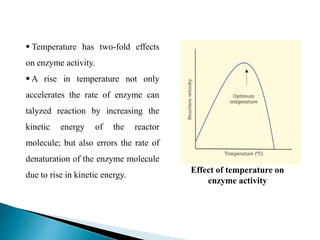
 Temperature has two-fold effects
on enzyme activity.
 A rise in temperature not only
accelerates the rate of enzyme can
talyzed reaction by increasing the
kinetic energy of the reactor
molecule; but also errors the rate of
denaturation of the enzyme molecule
due to rise in kinetic energy.
Effect of temperature on
enzyme activity
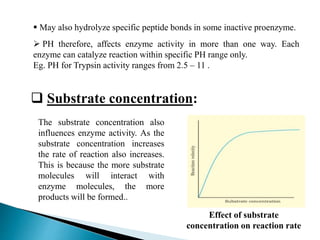
 Effects of pH:
Each enzyme acts best at a
particular PH called it optimum PH. Its
activity declines both above and below
that PH.
 Changes in pH
 May alter the ionization of groups at
the active site of enzyme and also in the
substrate.
 May dissociate the apoenzyme from
prosthetic group.
 May change the three-dimensional
conformation of enzyme
Effect of pH on enzyme activity
 Substrate concentration:
 May also hydrolyze specific peptide bonds in some inactive proenzyme.
 PH therefore, affects enzyme activity in more than one way. Each
enzyme can catalyze reaction within specific PH range only.
Eg. PH for Trypsin activity ranges from 2.5 – 11 .
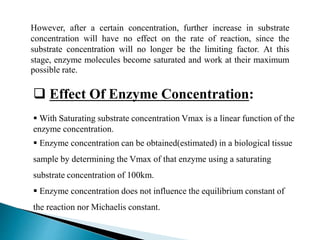
The substrate concentration also
influences enzyme activity. As the
substrate concentration increases
the rate of reaction also increases.
This is because the more substrate
molecules will interact with
enzyme molecules, the more
products will be formed..
Effect of substrate
concentration on reaction rate
 Effect Of Enzyme Concentration:
 With Saturating substrate concentration Vmax is a linear function of the
enzyme concentration.
 Enzyme concentration can be obtained(estimated) in a biological tissue
sample by determining the Vmax of that enzyme using a saturating
substrate concentration of 100km.
 Enzyme concentration does not influence the equilibrium constant of
the reaction nor Michaelis constant.
However, after a certain concentration, further increase in substrate
concentration will have no effect on the rate of reaction, since the
substrate concentration will no longer be the limiting factor. At this
stage, enzyme molecules become saturated and work at their maximum
possible rate.
 Temperature coefficient:
The rise in reaction rate average 2-3 times to enzyme catalyzed changes of
covalent bonds in substrate with 10°c rise in temperature , while in weak
non-covalent bond the reaction rate rises approximately 100 times with
10°c rise in temperature.
Isoenzymes:
 Being different protein, isozymes of a enzyme differs from each other
in their primary and higher orders of structure and physio-chemical
properties such as electrophoretic mobility, isoelectric pH, solubility,
thermolability, resistance to specific denaturating agents and
sedimentation coefficient.
 They also differ in biological properties such as substrate affinity,
Optimum pH and temperature allosteric modulation and immunological
reaction.
 Different isozymes of an enzyme may occur in different tissues and also at
different locations in a cell.
 There are five Lactate dehydrogenase (LDH):
• LDH-I1
- predominates in cardiac muscle and red straited muscle.
• LDH-I2
- in brain, kidney and RBC
• LDH-I3
- in lungs
• LDH-I4
- in muscles
• LDH-I5
- in liver and white striated muscles
 Four hexokinase isozymes :
• Hexokinase I, I and III - occur in muscles, brain and other extrahebatic
tissues.
• Hexokinase 4 - occur in liver
Rate limiting Enzyme:
The rate of limiting or commitment stop of a metabolic pathway reaction
which determines the rate and direction of the entire pathway. By
regulating the activity and or the synthesis of the enzyme for this step by
which such as allosteric modulation, competitive and non competitive
inhibition ,reversible covalent modification. The rate of relevant
metabolic pathway may be regulated .
Conclusion :
 Enzyme kinetics finds its usefulness in various reactions mediate by
enzyme , which include biochemical reactions.
 Enzymes work best in their optimum condition .
 Enzyme are used in Foods and beverages processing, animal nutrition,
textile, etc.

Factors affecting enzyme activity SlideShare

  • 1.
  • 2.
    CONTENT  Concept ofenzyme  Effect of Temperature  Effect of pH  Substrate concentration  Enzyme concentration  Temperature coefficient  Isoenzymes  Rate limiting enzymes  Conclusion
  • 3.
     What isEnzyme?  Proteins that act as biological catalysts.  Increase the rate of a reaction without being used up or changed themselves.  Enzymes act upon the molecules are known as substrates.  Effects of Temperature:  Enzyme shows highest activity of optimum temperature. It's activity decline progressively both above & below this temperature.  The optimum temperature of an enzyme at or above the temperature of the cell where it is naturally present.
  • 4.
     Temperature hastwo-fold effects on enzyme activity.  A rise in temperature not only accelerates the rate of enzyme can talyzed reaction by increasing the kinetic energy of the reactor molecule; but also errors the rate of denaturation of the enzyme molecule due to rise in kinetic energy. Effect of temperature on enzyme activity
  • 5.
     Effects ofpH: Each enzyme acts best at a particular PH called it optimum PH. Its activity declines both above and below that PH.  Changes in pH  May alter the ionization of groups at the active site of enzyme and also in the substrate.  May dissociate the apoenzyme from prosthetic group.  May change the three-dimensional conformation of enzyme Effect of pH on enzyme activity
  • 6.
     Substrate concentration: May also hydrolyze specific peptide bonds in some inactive proenzyme.  PH therefore, affects enzyme activity in more than one way. Each enzyme can catalyze reaction within specific PH range only. Eg. PH for Trypsin activity ranges from 2.5 – 11 . The substrate concentration also influences enzyme activity. As the substrate concentration increases the rate of reaction also increases. This is because the more substrate molecules will interact with enzyme molecules, the more products will be formed.. Effect of substrate concentration on reaction rate
  • 7.
     Effect OfEnzyme Concentration:  With Saturating substrate concentration Vmax is a linear function of the enzyme concentration.  Enzyme concentration can be obtained(estimated) in a biological tissue sample by determining the Vmax of that enzyme using a saturating substrate concentration of 100km.  Enzyme concentration does not influence the equilibrium constant of the reaction nor Michaelis constant. However, after a certain concentration, further increase in substrate concentration will have no effect on the rate of reaction, since the substrate concentration will no longer be the limiting factor. At this stage, enzyme molecules become saturated and work at their maximum possible rate.
  • 8.
     Temperature coefficient: Therise in reaction rate average 2-3 times to enzyme catalyzed changes of covalent bonds in substrate with 10°c rise in temperature , while in weak non-covalent bond the reaction rate rises approximately 100 times with 10°c rise in temperature. Isoenzymes:  Being different protein, isozymes of a enzyme differs from each other in their primary and higher orders of structure and physio-chemical properties such as electrophoretic mobility, isoelectric pH, solubility, thermolability, resistance to specific denaturating agents and sedimentation coefficient.  They also differ in biological properties such as substrate affinity, Optimum pH and temperature allosteric modulation and immunological reaction.
  • 9.
     Different isozymesof an enzyme may occur in different tissues and also at different locations in a cell.  There are five Lactate dehydrogenase (LDH): • LDH-I1 - predominates in cardiac muscle and red straited muscle. • LDH-I2 - in brain, kidney and RBC • LDH-I3 - in lungs • LDH-I4 - in muscles • LDH-I5 - in liver and white striated muscles  Four hexokinase isozymes : • Hexokinase I, I and III - occur in muscles, brain and other extrahebatic tissues. • Hexokinase 4 - occur in liver
  • 10.
    Rate limiting Enzyme: Therate of limiting or commitment stop of a metabolic pathway reaction which determines the rate and direction of the entire pathway. By regulating the activity and or the synthesis of the enzyme for this step by which such as allosteric modulation, competitive and non competitive inhibition ,reversible covalent modification. The rate of relevant metabolic pathway may be regulated .
  • 11.
    Conclusion :  Enzymekinetics finds its usefulness in various reactions mediate by enzyme , which include biochemical reactions.  Enzymes work best in their optimum condition .  Enzyme are used in Foods and beverages processing, animal nutrition, textile, etc.