MEMBRANE
TRANSPORT
Biology
Cells & Biomolecules
Mr Goodwin
Selective Permeability
• The phospholipid bilayer is selectively permeable.
• Some molecules can pass through easily (diffusion)
• Others use a ‘tunnel’ (facilitated diffusion)
• Others need energy to cross the membrane (active
transport)
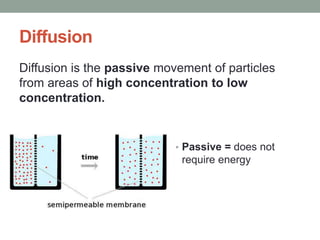
Diffusion
• Passive = does not
require energy
Diffusion is the passive movement of particles
from areas of high concentration to low
concentration.
Animation
• http://highered.mheducation.com/sites/0072495855/stude
nt_view0/chapter2/animation__how_diffusion_works.html
Factors affecting diffusion
There are 3 main factors that affect the rate of diffusion:
1. Concentration gradient
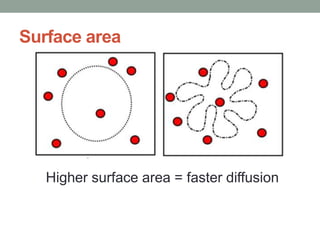
2. Surface area
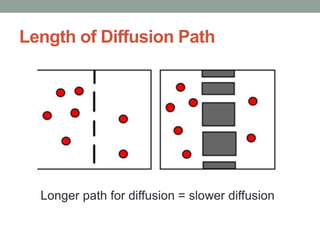
3. Length of diffusion path
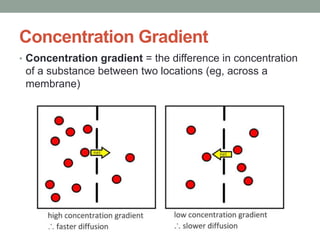
Concentration Gradient
• Concentration gradient = the difference in concentration
of a substance between two locations (eg, across a
membrane)
Surface area
Higher surface area = faster diffusion
Length of Diffusion Path
Longer path for diffusion = slower diffusion
Adaptations in Nature
Find 3 examples of how nature maximises the rate of
diffusion. Use diagrams to explain how each example
works.
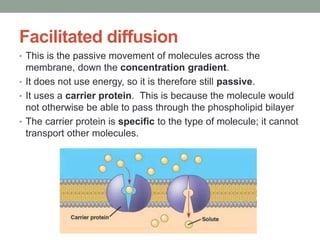
Facilitated diffusion
• This is the passive movement of molecules across the
membrane, down the concentration gradient.
• It does not use energy, so it is therefore still passive.
• It uses a carrier protein. This is because the molecule would
not otherwise be able to pass through the phospholipid bilayer
• The carrier protein is specific to the type of molecule; it cannot
transport other molecules.
Animation
• http://highered.mheducation.com/sites/0072495855/stude
nt_view0/chapter2/animation__how_facilitated_diffusion_
works.html
Questions
1. Explain how facilitated diffusion is different from simple
diffusion.
2. Explain why some molecules require transport proteins
to cross the cell membrane, despite having a strong
concentration gradient.
3. Find and describe two examples of facilitated diffusion.
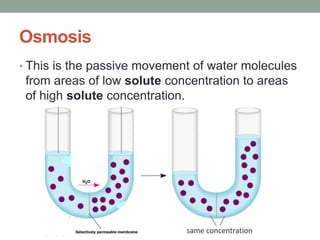
Osmosis
• This is the passive movement of water molecules
from areas of low solute concentration to areas
of high solute concentration.
Osmosis
• Water moves by osmosis from an area of low solute
concentration (more water) to high solute concentration
(less water).
• The solute particles cannot move to balance the
concentrations as they are too large to fit through the
pores of the selectively permeable membrane.
Animations
• http://education.uoit.ca/lordec/ID_LORDEC/diffusion_osm
osis/garib_diffusion_osmosis.swf
Summary Questions
1. Construct a table to compare the 3 types of passive
transport.
2. Explain why the term “passive” transport is used.
3. Identify 3 ways of increasing the rate of diffusion.
4. Compare osmosis and simple diffusion. What are the
similarities and differences?

Passive transport