Cellular Transport
      Notes
About Cell Membranes
1.All cells have a cell
  membrane
2.Functions:
  a.Controls what enters
     and exits the cell to
     maintain an internal
     balance called
     homeostasis
                                TEM picture of a
  b.Provides protection and   real cell membrane.
     support for the cell
About Cell Membranes (continued)
3.Structure of cell membrane
Lipid Bilayer -2 layers of
 phospholipids
  a.Phosphate head is polar
    (hydrophilic or water        Phospholipid
    loving)
  b.Fatty acid tails non-polar
    (hydrophobic or water
    fearing)
  c.Proteins embedded in         Lipid Bilayer
    membrane
Polar heads Fluid Mosaic
             love water   Model of the
             & dissolve. cell membrane


              Non-polar
                               Membrane move
              tails hide
              from water.
           Carbohydrate cell
           markers


Proteins
About Cell Membranes (continued)
• 4. Cell membranes have pores (holes) in it
   a.Selectively permeable: Allows some
     molecules in and keeps other molecules out
   b.The structure helps it be selective!


            Pores
About Cell Membranes (continued)
• 5. Size (macro or micro), charge (+ or -) and
  solubility (lipid-soluble or not) affect a
  molecule’s ability to cross the cell membrane.
 In general, small noncharged, lipid-soluble
  molecules easily cross the cell membranes


             Pores
Structure of the Cell Membrane
                         Outside of cell
                                               Carbohydrate
                                Proteins       chains
  Lipid
  Bilayer

                  Transport
                  Protein                  Phospholipids
                              Inside of cell
     Animations
                               (cytoplasm)
    of membrane
Go to structure
Section:
•Animations of Active
Types of Cellular Transport            Transport & Passive
                                            Transport
                                      Weeee!!
•    Passive Transport                  !

     cell doesn’t use energy
    1. Diffusion               high
    2. Facilitated Diffusion
    3. Osmosis                            low

      Tonicity
      Water Potential                           This is
                                                 gonna
•    Active Transport                           be hard
                                                 work!!
                               high
     cell does use energy
                                          low
Types of Cellular Transport
•   Bulk Transport
    1. Endocytosis
       Phagocystosis
       Pinocytosis
       Receptor-mediated
    2. Exocytosis
Passive Transport
•   cell uses no energy
•   molecules move randomly
•   Molecules spread out from an area of
    high concentration to an area of low
    concentration.
• (HighLow)
•   Three types:
3 Types of Passive Transport

1. Diffusion
2. Facilitative Diffusion – diffusion with
   the help of transport proteins ,
3. Osmosis – diffusion of water
Passive Transport:
                                       Simple Diffusion A
         1. Diffusion
1. Diffusion: random movement
   of particles from an area of
   high concentration to an
   area of low concentration.
          (High to Low)
•   Diffusion continues until all
    molecules are evenly spaced
    (equilibrium is reached)-Note:
    molecules will still move around
    but stay spread out.
                                       http://bio.winona.edu/berg/Free.htm
Passive Transport:
             1. Diffusion
• Occurs in liquid or gas medium
Diffusion of a solute within a solvent is
   affected by several factors:
 Temperature
 Pressure
 Density of the solvent
 Concentration Gradient
 Solubility of the solute
                                     http://bio.winona.edu/berg/Free.htm
Passive Transport:
  2. Facilitated Diffusion
2. Facilitated diffusion: diffusion of specific particles
  through membrane transport proteins to help them move
  through the cell membrane
   a. Transport Proteins are specific – they “select” only
      certain molecules to cross the membrane
   b. Transports larger or charged molecules
   c. Concentration gradient required – can’t transport from
      low to high concentration
   d. Energy not needed
   e. Rate of transport reaches a maximum when all
      membrane transport proteins are used up (saturated)
   f. Membrane transport proteins are sensitive to inhibitors
      that can cause them not to function
Passive Transport:
 2. Facilitated Diffusion A                             B
There are 2 types of
  membrane transport
  proteins involved:
Channel proteins – contain
  tunnels/openings that serve
  as passageways of                Facilitated
  molecules                                         Diffusion
                                    diffusion        (Lipid
Carrier proteins – undergo         (Channel        Bilayer)
  temporary binding to the           Protein)
  molecule it carries resulting
  in conformational change
  that moves the molecule
  through the membrane

                                  Carrier Protein
Passive Transport: 2. Facilitated Diffusion
                                      Glucose
                                      molecules
Cellular Transport From a-
                               High
        High Concentration
                                                   • Channel Proteins
                                                     animations

           Cell Membrane


                                         Protein
           Low Concentration
                                       Low
                                         channel


                         Transport
           Through a 
Go to
                         Protein
Section:
Passive Transport:                Osmosis
      3. Osmosis                       animation

• 3.Osmosis: diffusion of
  water through a
  selectively permeable
  membrane


                            •Water moves freely
                            through pores.
                            •Solute (green) to large
                            to move across.
The water molecules will continue to cross the semi-permeable
membrane until an equilibrium is reached, where the two solutions
are of equal concentration.
Passive Transport:
      3. Osmosis
Water is found inside and outside of the cell,
  separated by a semi-permeable membrane
The presence of different solutes in the water
  solutions in and out of the cell means concentration
  of water on both sides is different.
Water Potential – term for movement of water
  molecules as it undergoes osmosis
- The measure of the difference between the “force”
  that pushes water molecules and the “force” exerted
  by the membrane
Passive Transport:
        3. Osmosis
Water solution with less solute (more diluted solution because of more water) =
  higher water potential
Water solution with more solute (more concentrated solution) = lower water
  potential
Water Potential Gradient - when 2 solutions of different water potentials are
  separated by a semipermeable membrane, thus allowing osmosis to occur
Osmotic Pressure – “force” that moves water molecules through a semi-
  permeable membrane
Passive Transport:
   3. Osmosis
 Tonicity – strength
 of a solution in
 relation to osmosis

 3 Types:

 Isotonic
 Hypotonic
 Hypertonic
   Remember: Salt is a solute, when it is concentrated inside or outside
     the cell, it will draw the water in its direction. This is also why you
     get thirsty after eating something salty.
If the concentration of solute (salt) is equal on both sides, the water will
move back in forth but it won't have any result on the overall amount of
water on either side.

"ISO" means the same
"HYPO" means less
                                           In this case there are less solute
                                           (salt) molecules outside the cell,
                                           since salt sucks, water will move
                                           into the cell, causing it to swell.
                                           The cell will gain water and grow
                                           larger. As osmosis continues,
                                           osmotic pressure builds up inside
                                           the cell causing cell lysis.


In plant cells, the vacuoles will fill and the plant becomes stiff and rigid.
The pressure exerted by the water molecule is called TURGOR
PRESSURE, and the phenomenon TURGIDITY. The turgor pressure in
plants will not result in cell lysis as the cell wall keeps the plant from
bursting.
TURGIDITY is important in maintaining the firm and erect position of a
plant.
"HYPER" means more


In this case there are more solute (salt) molecules outside the cell, which
causes the water to be sucked in that direction.
Causes cells to shrink and lose shape because of water loss.
In plant cells, the central vacuole loses water and the cells shrink, causing
wilting (plasmolysis). In animal cells, the cells also shrink.
In both cases, the cell may die.
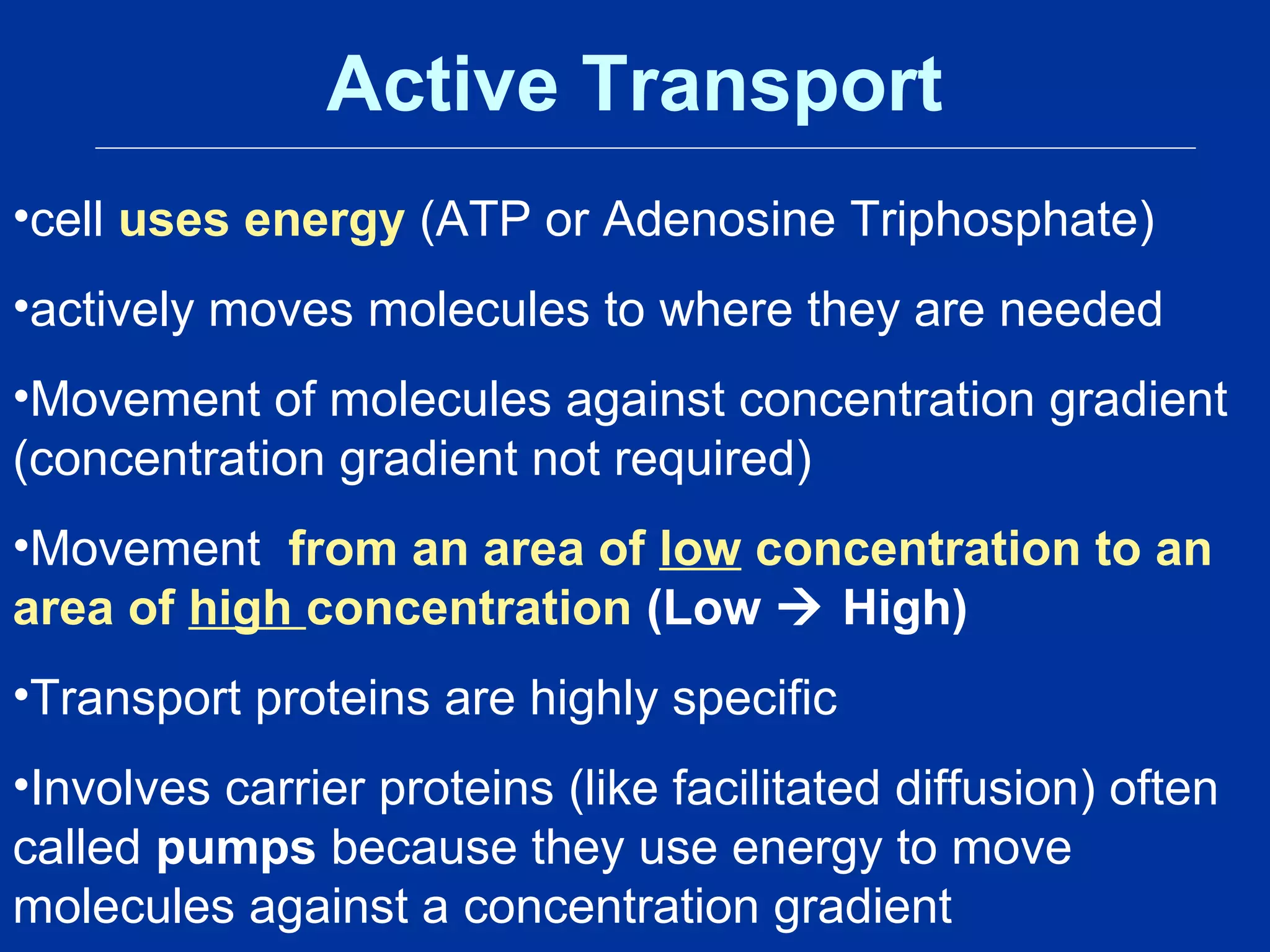
Active Transport
•cell uses energy (ATP or Adenosine Triphosphate)
•actively moves molecules to where they are needed
•Movement of molecules against concentration gradient
(concentration gradient not required)
•Movement from an area of low concentration to an
area of high concentration (Low  High)
•Transport proteins are highly specific
•Involves carrier proteins (like facilitated diffusion) often
called pumps because they use energy to move
molecules against a concentration gradient
Sodium
Example: Sodium                    Potassium Pumps
-Potassium Pumps                   (Active Transport
                                   using proteins)
are important in nerve
responses. They
transfer Na and K
ions in and out of the
nerve and muscle
cells.


                         Protein changes
                          shape to move
                         molecules: this
                         requires energy!
Types of Bulk Transport
1. Endocytosis:    taking bulky
   material that can’t use transport
   proteins (like macromolecules)
   into a cell
  • Uses energy
  • Cell membrane in-folds
      around the macromolecule to
      be transported
  • 3 Types:
      Phagocytosis
      Pinocytosis
      Receptor-mediated
       Endocytosis
Types of Bulk Transport


 Phagocytosis – “cell eating”
 -   Process by which cells take in large particles by
     infolding the cell membrane to form endocytotic
     vesicles
 Ex. WBC capture and kill invading bacteria
Types of Bulk Transport


 Pinocytosis – “cell drinking”
 -   Process of taking in fluids into the cell by invagination
     of the cell membrane. Any solute or small particles
     in the fluid will be moved into the cell.
Types of Bulk Transport


Receptor-mediated Endocytosis – “cell drinking”
-   Compared to pinocytosis, is very specific. The plasma membrane
    becomes indented and forms a pit. The pit lined with receptor proteins
    picks specific molecules from its surroundings. The pit will close and pinch
    off to form a vesicle which will carry the molecules inside the cytoplasm.
Types of Active Transport

2. Exocytosis: Forces          Endocytosis &
                                Exocytosis
  material out of cell in       animations
  bulk
  • membrane surrounding the
    material fuses with cell
    membrane
  • Cell changes shape –
    requires energy
  • EX: Hormones or
    wastes released from
    cell
Effects of Osmosis on Life
• Osmosis- diffusion of water through a
  selectively permeable membrane


• Water is so small and there is so much
  of it the cell can’t control it’s movement
  through the cell membrane.
•    Osmosis
                                                Animations for
         Hypotonic Solution                  isotonic, hypertonic,
                                                and hypotonic
                                                   solutions

Hypotonic: The solution has a lower concentration of
solutes and a higher concentration of water than
inside the cell. (Low solute; High water)


Result: Water moves from the solution to inside the
cell): Cell Swells and bursts open (cytolysis)!
•    Osmosis
                                                Animations for
         Hypertonic Solution                 isotonic, hypertonic,
                                                and hypotonic
                                                   solutions

Hypertonic: The solution has a higher concentration
of solutes and a lower concentration of water than
inside the cell. (High solute; Low water)


                                                  shrinks

Result: Water moves from inside the cell into the
solution: Cell shrinks (Plasmolysis)!
•    Osmosis
                                                   Animations for

           Isotonic Solution                    isotonic, hypertonic,
                                                   and hypotonic
                                                      solutions

Isotonic: The concentration of solutes in the solution
is equal to the concentration of solutes inside the cell.


Result: Water moves equally in both directions and
the cell remains same size! (Dynamic Equilibrium)
What type of solution are these cells in ?


             A          B           C


         Hypertonic   Isotonic   Hypotonic
How Organisms Deal                       •   Paramecium
                                                  (protist) removing
                                                  excess water
     with Osmotic Pressure                        video


•Bacteria and plants have cell walls that prevent them
from over-expanding. In plants the pressure exerted on
the cell wall is called tugor pressure.

•A protist like paramecium has contractile vacuoles that
collect water flowing in and pump it out to prevent them
from over-expanding.

•Salt water fish pump salt out of their specialized gills so
they do not dehydrate.

•Animal cells are bathed in blood. Kidneys keep the
blood isotonic by remove excess salt and water.
This powerpoint was kindly donated to
www.worldofteaching.com


http://www.worldofteaching.com is home to over a
thousand powerpoints submitted by teachers. This is a
completely free site and requires no registration. Please
visit and I hope it will help in your teaching.

Cell Transport 1

  • 1.
  • 2.
    About Cell Membranes 1.Allcells have a cell membrane 2.Functions: a.Controls what enters and exits the cell to maintain an internal balance called homeostasis TEM picture of a b.Provides protection and real cell membrane. support for the cell
  • 3.
    About Cell Membranes(continued) 3.Structure of cell membrane Lipid Bilayer -2 layers of phospholipids a.Phosphate head is polar (hydrophilic or water Phospholipid loving) b.Fatty acid tails non-polar (hydrophobic or water fearing) c.Proteins embedded in Lipid Bilayer membrane
  • 4.
    Polar heads FluidMosaic love water Model of the & dissolve. cell membrane Non-polar Membrane move tails hide from water. Carbohydrate cell markers Proteins
  • 5.
    About Cell Membranes(continued) • 4. Cell membranes have pores (holes) in it a.Selectively permeable: Allows some molecules in and keeps other molecules out b.The structure helps it be selective! Pores
  • 6.
    About Cell Membranes(continued) • 5. Size (macro or micro), charge (+ or -) and solubility (lipid-soluble or not) affect a molecule’s ability to cross the cell membrane.  In general, small noncharged, lipid-soluble molecules easily cross the cell membranes Pores
  • 7.
    Structure of theCell Membrane Outside of cell Carbohydrate Proteins chains Lipid Bilayer Transport Protein Phospholipids Inside of cell Animations (cytoplasm) of membrane Go to structure Section:
  • 8.
    •Animations of Active Typesof Cellular Transport Transport & Passive Transport Weeee!! • Passive Transport ! cell doesn’t use energy 1. Diffusion high 2. Facilitated Diffusion 3. Osmosis low Tonicity Water Potential This is gonna • Active Transport be hard work!! high cell does use energy low
  • 9.
    Types of CellularTransport • Bulk Transport 1. Endocytosis Phagocystosis Pinocytosis Receptor-mediated 2. Exocytosis
  • 10.
    Passive Transport • cell uses no energy • molecules move randomly • Molecules spread out from an area of high concentration to an area of low concentration. • (HighLow) • Three types:
  • 11.
    3 Types ofPassive Transport 1. Diffusion 2. Facilitative Diffusion – diffusion with the help of transport proteins , 3. Osmosis – diffusion of water
  • 12.
    Passive Transport: Simple Diffusion A 1. Diffusion 1. Diffusion: random movement of particles from an area of high concentration to an area of low concentration. (High to Low) • Diffusion continues until all molecules are evenly spaced (equilibrium is reached)-Note: molecules will still move around but stay spread out. http://bio.winona.edu/berg/Free.htm
  • 13.
    Passive Transport: 1. Diffusion • Occurs in liquid or gas medium Diffusion of a solute within a solvent is affected by several factors:  Temperature  Pressure  Density of the solvent  Concentration Gradient  Solubility of the solute http://bio.winona.edu/berg/Free.htm
  • 14.
    Passive Transport: 2. Facilitated Diffusion 2. Facilitated diffusion: diffusion of specific particles through membrane transport proteins to help them move through the cell membrane a. Transport Proteins are specific – they “select” only certain molecules to cross the membrane b. Transports larger or charged molecules c. Concentration gradient required – can’t transport from low to high concentration d. Energy not needed e. Rate of transport reaches a maximum when all membrane transport proteins are used up (saturated) f. Membrane transport proteins are sensitive to inhibitors that can cause them not to function
  • 15.
    Passive Transport: 2.Facilitated Diffusion A B There are 2 types of membrane transport proteins involved: Channel proteins – contain tunnels/openings that serve as passageways of Facilitated molecules Diffusion diffusion (Lipid Carrier proteins – undergo (Channel Bilayer) temporary binding to the Protein) molecule it carries resulting in conformational change that moves the molecule through the membrane Carrier Protein
  • 16.
    Passive Transport: 2.Facilitated Diffusion Glucose molecules Cellular Transport From a- High High Concentration • Channel Proteins animations Cell Membrane Protein Low Concentration Low channel Transport Through a  Go to Protein Section:
  • 17.
    Passive Transport: Osmosis 3. Osmosis animation • 3.Osmosis: diffusion of water through a selectively permeable membrane •Water moves freely through pores. •Solute (green) to large to move across.
  • 18.
    The water moleculeswill continue to cross the semi-permeable membrane until an equilibrium is reached, where the two solutions are of equal concentration.
  • 19.
    Passive Transport: 3. Osmosis Water is found inside and outside of the cell, separated by a semi-permeable membrane The presence of different solutes in the water solutions in and out of the cell means concentration of water on both sides is different. Water Potential – term for movement of water molecules as it undergoes osmosis - The measure of the difference between the “force” that pushes water molecules and the “force” exerted by the membrane
  • 20.
    Passive Transport: 3. Osmosis Water solution with less solute (more diluted solution because of more water) = higher water potential Water solution with more solute (more concentrated solution) = lower water potential Water Potential Gradient - when 2 solutions of different water potentials are separated by a semipermeable membrane, thus allowing osmosis to occur Osmotic Pressure – “force” that moves water molecules through a semi- permeable membrane
  • 21.
    Passive Transport: 3. Osmosis Tonicity – strength of a solution in relation to osmosis 3 Types: Isotonic Hypotonic Hypertonic Remember: Salt is a solute, when it is concentrated inside or outside the cell, it will draw the water in its direction. This is also why you get thirsty after eating something salty.
  • 22.
    If the concentrationof solute (salt) is equal on both sides, the water will move back in forth but it won't have any result on the overall amount of water on either side. "ISO" means the same
  • 23.
    "HYPO" means less In this case there are less solute (salt) molecules outside the cell, since salt sucks, water will move into the cell, causing it to swell. The cell will gain water and grow larger. As osmosis continues, osmotic pressure builds up inside the cell causing cell lysis. In plant cells, the vacuoles will fill and the plant becomes stiff and rigid. The pressure exerted by the water molecule is called TURGOR PRESSURE, and the phenomenon TURGIDITY. The turgor pressure in plants will not result in cell lysis as the cell wall keeps the plant from bursting. TURGIDITY is important in maintaining the firm and erect position of a plant.
  • 24.
    "HYPER" means more Inthis case there are more solute (salt) molecules outside the cell, which causes the water to be sucked in that direction. Causes cells to shrink and lose shape because of water loss. In plant cells, the central vacuole loses water and the cells shrink, causing wilting (plasmolysis). In animal cells, the cells also shrink. In both cases, the cell may die.
  • 26.
    Active Transport •cell usesenergy (ATP or Adenosine Triphosphate) •actively moves molecules to where they are needed •Movement of molecules against concentration gradient (concentration gradient not required) •Movement from an area of low concentration to an area of high concentration (Low  High) •Transport proteins are highly specific •Involves carrier proteins (like facilitated diffusion) often called pumps because they use energy to move molecules against a concentration gradient
  • 27.
    Sodium Example: Sodium Potassium Pumps -Potassium Pumps (Active Transport using proteins) are important in nerve responses. They transfer Na and K ions in and out of the nerve and muscle cells. Protein changes shape to move molecules: this requires energy!
  • 28.
    Types of BulkTransport 1. Endocytosis: taking bulky material that can’t use transport proteins (like macromolecules) into a cell • Uses energy • Cell membrane in-folds around the macromolecule to be transported • 3 Types:  Phagocytosis  Pinocytosis  Receptor-mediated Endocytosis
  • 29.
    Types of BulkTransport Phagocytosis – “cell eating” - Process by which cells take in large particles by infolding the cell membrane to form endocytotic vesicles Ex. WBC capture and kill invading bacteria
  • 30.
    Types of BulkTransport Pinocytosis – “cell drinking” - Process of taking in fluids into the cell by invagination of the cell membrane. Any solute or small particles in the fluid will be moved into the cell.
  • 31.
    Types of BulkTransport Receptor-mediated Endocytosis – “cell drinking” - Compared to pinocytosis, is very specific. The plasma membrane becomes indented and forms a pit. The pit lined with receptor proteins picks specific molecules from its surroundings. The pit will close and pinch off to form a vesicle which will carry the molecules inside the cytoplasm.
  • 32.
    Types of ActiveTransport 2. Exocytosis: Forces Endocytosis & Exocytosis material out of cell in animations bulk • membrane surrounding the material fuses with cell membrane • Cell changes shape – requires energy • EX: Hormones or wastes released from cell
  • 33.
    Effects of Osmosison Life • Osmosis- diffusion of water through a selectively permeable membrane • Water is so small and there is so much of it the cell can’t control it’s movement through the cell membrane.
  • 34.
    Osmosis Animations for Hypotonic Solution isotonic, hypertonic, and hypotonic solutions Hypotonic: The solution has a lower concentration of solutes and a higher concentration of water than inside the cell. (Low solute; High water) Result: Water moves from the solution to inside the cell): Cell Swells and bursts open (cytolysis)!
  • 35.
    Osmosis Animations for Hypertonic Solution isotonic, hypertonic, and hypotonic solutions Hypertonic: The solution has a higher concentration of solutes and a lower concentration of water than inside the cell. (High solute; Low water) shrinks Result: Water moves from inside the cell into the solution: Cell shrinks (Plasmolysis)!
  • 36.
    Osmosis Animations for Isotonic Solution isotonic, hypertonic, and hypotonic solutions Isotonic: The concentration of solutes in the solution is equal to the concentration of solutes inside the cell. Result: Water moves equally in both directions and the cell remains same size! (Dynamic Equilibrium)
  • 37.
    What type ofsolution are these cells in ? A B C Hypertonic Isotonic Hypotonic
  • 38.
    How Organisms Deal • Paramecium (protist) removing excess water with Osmotic Pressure video •Bacteria and plants have cell walls that prevent them from over-expanding. In plants the pressure exerted on the cell wall is called tugor pressure. •A protist like paramecium has contractile vacuoles that collect water flowing in and pump it out to prevent them from over-expanding. •Salt water fish pump salt out of their specialized gills so they do not dehydrate. •Animal cells are bathed in blood. Kidneys keep the blood isotonic by remove excess salt and water.
  • 39.
    This powerpoint waskindly donated to www.worldofteaching.com http://www.worldofteaching.com is home to over a thousand powerpoints submitted by teachers. This is a completely free site and requires no registration. Please visit and I hope it will help in your teaching.