ASSERTIVENESS
Assertiveness  Saying What You Mean  and  Meaning What You Say
Three Patterns of Communication Aggressive Communication Passive Communication Assertive Communication
A Challenge Please write a One Sentence Definition of A S S E R T I V E N E S S.
Definition of Assertiveness An honest, direct, and appropriate expression of one's feelings, thoughts, and beliefs.
Do you have the confidence to ask for what is rightfully yours? Can you accept criticism without being defensive? Do you feel comfortable accepting compliments? Are you able to stand up for  your rights?
Can you express negative feelings about other people and their behaviors  without using abusive language? Are you able to exercise and express your strengths? Can you easily recognize and compliment other people’s achievements?
Are you able to refuse unreasonable requests from friends, family, or co-workers? Can you comfortably start and carry on a conversation with others? Do you ask for assistance when  you need it ? A “yes” response to the questions indicates an assertive approach.
Why Assertiveness Is Important? Effective communication brings about the achievement of individual and/or shared goals. Assertiveness increases your ability to reach these goals while maintaining your rights and dignity.
What’s Keeping You From Being Assertive? Fear of change. Refusal to admit their submissiveness. Fear of ruining relationships if you speak your mind. Lack confidence in your ability.
Aggressiveness Is Inappropriately expressing your thoughts, feelings, and beliefs in a way that violates other people’s rights. Achieving your goal by not allowing others the freedom to choose. Completely disrespecting others whether it be in  an active or  passive method.
Aggressive Behavior Directly standing up for personal rights and expressing thoughts and beliefs in a way which is often dishonest, usually inappropriate, and always violates the rights of the other person
Aggressive Behavior Goals of Aggressive Behavior : domination and winning forcing  others  to lose Winning is insured by  humiliating, degrading, belittling, or overpowering other people so that they become weaker and less able to express and defend their needs and rights
Reasons People Act Aggressively To get your point across Don’t know another way to get your point across For personal gain, control To  avoid your own personal responsibility Low self esteem Anger related to previous  non assertion Don’t have other coping mechanisms Reacting to another’s aggression
Consequences of Aggression The other person gets defensive Get rid of anger or other emotions Lose friendships, other intimate relationships,  damage relationships Affect  work, lose job Lose respect
A Passive Person Passive people   usually : Speak softly and hesitantly. Is confused. Avoid eye contact. Allow other people in their personal space.
Passive Behavior Violating your own rights by failing to express honest feelings, thoughts, and beliefs and consequently permitting others to  violate  you
Passive Behavior Goals of nonassertive behavior: to appease others to avoid conflict at any cost Message communicated: My thoughts aren’t important;  I don’t count I’m nothing;  you are superior I don’t respect your ability to take disappointments, handle your own problems. . .
Consequences of Passive Behaviour Not getting your point across Nothing changes, problems can get worse Damages self esteem Can lead to aggressive behavior Other people  can take advantage of you
 
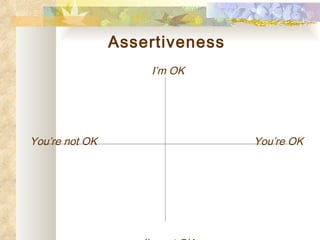
Assertiveness I’m OK You’re not OK   You’re OK I’m not OK                                                                                                         
Assertiveness I’m OK   AGGRESSIVE   ASSERTIVE You’re not OK   You’re OK   PASSIVE /   PASSIVE   AGGRESSIVE I’m not OK                                                                                                         
Assertive Rights You have the right to be assertive. You have the right to request that others change their behavior if they are infringing on your rights. You have the right to use your own time  to answer questions. You have the right to express your needs even if they are illogical. Be aware that there are responsibilities attached to all these rights!
Assertive Behavior  Non verbals  are congruent with verbals Voice is appropriately loud to the situation Eye contact is firm but not a stare down Body gestures denote strength Speech pattern is fluent, expressive, clear, and emphasizes key words
Assertive Communication I language Communication--3 parts: I feel . . . (describe your feelings) when . . .(objectively describe the other person’s behavior) It’s tangible effects on you . . .(describe how the other person’s behavior concretely effects your life or feelings)
Making the First Move Overcoming   the   Fear   of   Being   Assertive : Concentrate. Remember who you’re with and tailor your discussion. Be tactful and honest. Make eye contact.
Assertiveness is More Than  Courage
Taking the First Step If you don ’ t like the way you feel when you behave a certain way, know that you have the power to change it! Remember, the only behavior you can control is your own.
He was asked to complete his engineering project in 4 days , which he completed in just one and half days..working nonstop and asked assertively for scholarship to be continued.
He started dealing people so assertively even being dyslexic,that he had made 5 successful business ventures at the age of 17.
You Can Change Your Habits 1.  Identify what you want to change about yourself. 2.  Set a goal. 3.  Control your fears and anxieties. 4.  Aim for a success that is manageable at first. 5.  Keep a record to monitor your progress. 6.  Practice, practice, practice! Don’t lose sight of your goal, and  remember that upkeep is a life-long commitment.

ASSERTIVENESS

  • 1.
  • 2.
    Assertiveness SayingWhat You Mean and Meaning What You Say
  • 3.
    Three Patterns ofCommunication Aggressive Communication Passive Communication Assertive Communication
  • 4.
    A Challenge Pleasewrite a One Sentence Definition of A S S E R T I V E N E S S.
  • 5.
    Definition of AssertivenessAn honest, direct, and appropriate expression of one's feelings, thoughts, and beliefs.
  • 6.
    Do you havethe confidence to ask for what is rightfully yours? Can you accept criticism without being defensive? Do you feel comfortable accepting compliments? Are you able to stand up for your rights?
  • 7.
    Can you expressnegative feelings about other people and their behaviors without using abusive language? Are you able to exercise and express your strengths? Can you easily recognize and compliment other people’s achievements?
  • 8.
    Are you ableto refuse unreasonable requests from friends, family, or co-workers? Can you comfortably start and carry on a conversation with others? Do you ask for assistance when you need it ? A “yes” response to the questions indicates an assertive approach.
  • 9.
    Why Assertiveness IsImportant? Effective communication brings about the achievement of individual and/or shared goals. Assertiveness increases your ability to reach these goals while maintaining your rights and dignity.
  • 10.
    What’s Keeping YouFrom Being Assertive? Fear of change. Refusal to admit their submissiveness. Fear of ruining relationships if you speak your mind. Lack confidence in your ability.
  • 11.
    Aggressiveness Is Inappropriatelyexpressing your thoughts, feelings, and beliefs in a way that violates other people’s rights. Achieving your goal by not allowing others the freedom to choose. Completely disrespecting others whether it be in an active or passive method.
  • 12.
    Aggressive Behavior Directlystanding up for personal rights and expressing thoughts and beliefs in a way which is often dishonest, usually inappropriate, and always violates the rights of the other person
  • 13.
    Aggressive Behavior Goalsof Aggressive Behavior : domination and winning forcing others to lose Winning is insured by humiliating, degrading, belittling, or overpowering other people so that they become weaker and less able to express and defend their needs and rights
  • 14.
    Reasons People ActAggressively To get your point across Don’t know another way to get your point across For personal gain, control To avoid your own personal responsibility Low self esteem Anger related to previous non assertion Don’t have other coping mechanisms Reacting to another’s aggression
  • 15.
    Consequences of AggressionThe other person gets defensive Get rid of anger or other emotions Lose friendships, other intimate relationships, damage relationships Affect work, lose job Lose respect
  • 16.
    A Passive PersonPassive people usually : Speak softly and hesitantly. Is confused. Avoid eye contact. Allow other people in their personal space.
  • 17.
    Passive Behavior Violatingyour own rights by failing to express honest feelings, thoughts, and beliefs and consequently permitting others to violate you
  • 18.
    Passive Behavior Goalsof nonassertive behavior: to appease others to avoid conflict at any cost Message communicated: My thoughts aren’t important; I don’t count I’m nothing; you are superior I don’t respect your ability to take disappointments, handle your own problems. . .
  • 19.
    Consequences of PassiveBehaviour Not getting your point across Nothing changes, problems can get worse Damages self esteem Can lead to aggressive behavior Other people can take advantage of you
  • 20.
  • 21.
    Assertiveness I’m OKYou’re not OK You’re OK I’m not OK                                                                                                         
  • 22.
    Assertiveness I’m OK AGGRESSIVE ASSERTIVE You’re not OK You’re OK PASSIVE / PASSIVE AGGRESSIVE I’m not OK                                                                                                         
  • 23.
    Assertive Rights Youhave the right to be assertive. You have the right to request that others change their behavior if they are infringing on your rights. You have the right to use your own time to answer questions. You have the right to express your needs even if they are illogical. Be aware that there are responsibilities attached to all these rights!
  • 24.
    Assertive Behavior Non verbals are congruent with verbals Voice is appropriately loud to the situation Eye contact is firm but not a stare down Body gestures denote strength Speech pattern is fluent, expressive, clear, and emphasizes key words
  • 25.
    Assertive Communication Ilanguage Communication--3 parts: I feel . . . (describe your feelings) when . . .(objectively describe the other person’s behavior) It’s tangible effects on you . . .(describe how the other person’s behavior concretely effects your life or feelings)
  • 26.
    Making the FirstMove Overcoming the Fear of Being Assertive : Concentrate. Remember who you’re with and tailor your discussion. Be tactful and honest. Make eye contact.
  • 27.
  • 28.
    Taking the FirstStep If you don ’ t like the way you feel when you behave a certain way, know that you have the power to change it! Remember, the only behavior you can control is your own.
  • 29.
    He was askedto complete his engineering project in 4 days , which he completed in just one and half days..working nonstop and asked assertively for scholarship to be continued.
  • 30.
    He started dealingpeople so assertively even being dyslexic,that he had made 5 successful business ventures at the age of 17.
  • 31.
    You Can ChangeYour Habits 1. Identify what you want to change about yourself. 2. Set a goal. 3. Control your fears and anxieties. 4. Aim for a success that is manageable at first. 5. Keep a record to monitor your progress. 6. Practice, practice, practice! Don’t lose sight of your goal, and remember that upkeep is a life-long commitment.