Dealing with Conflict
Matthew L. Eisenhard, Psy.D.
Week 6: Psychology for Business & Industry
Main Topics
◦ TRANSACTIONAL ANALYSIS
 A way for determining how people interact.
 It is common for people to disagree.
 Dealing with emotions - your own and others – is
part of Emotional Intelligence.
◦ ASSERTIVENESS
 Is standing up for your own rights – without pushing
others around.
◦ CONFLICT MANAGEMENT
 Is a critical skill in being successful and productive.
Transactional Analysis (T/A)
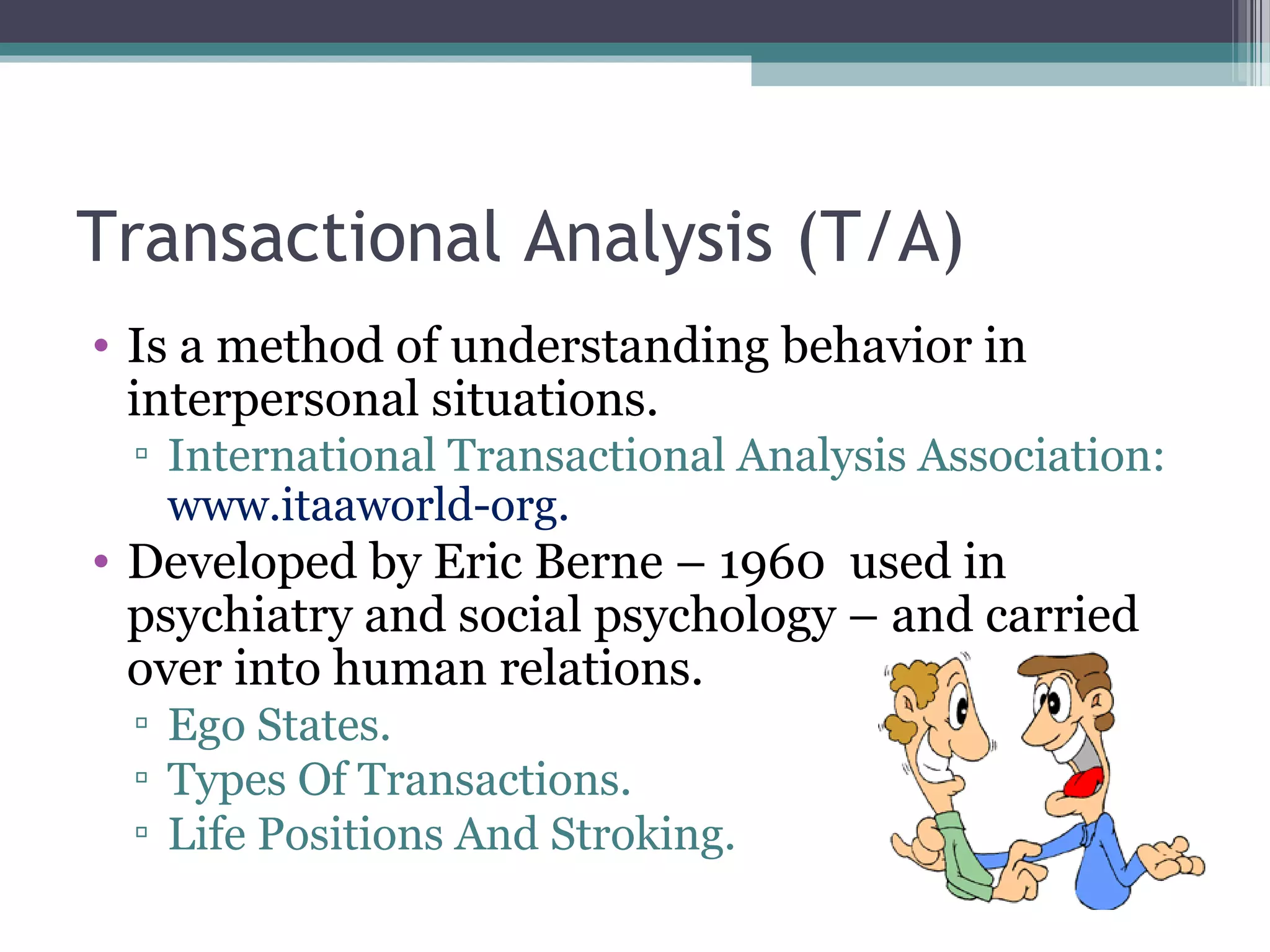
• Is a method of understanding behavior in
interpersonal situations.
▫ International Transactional Analysis Association:
www.itaaworld-org.
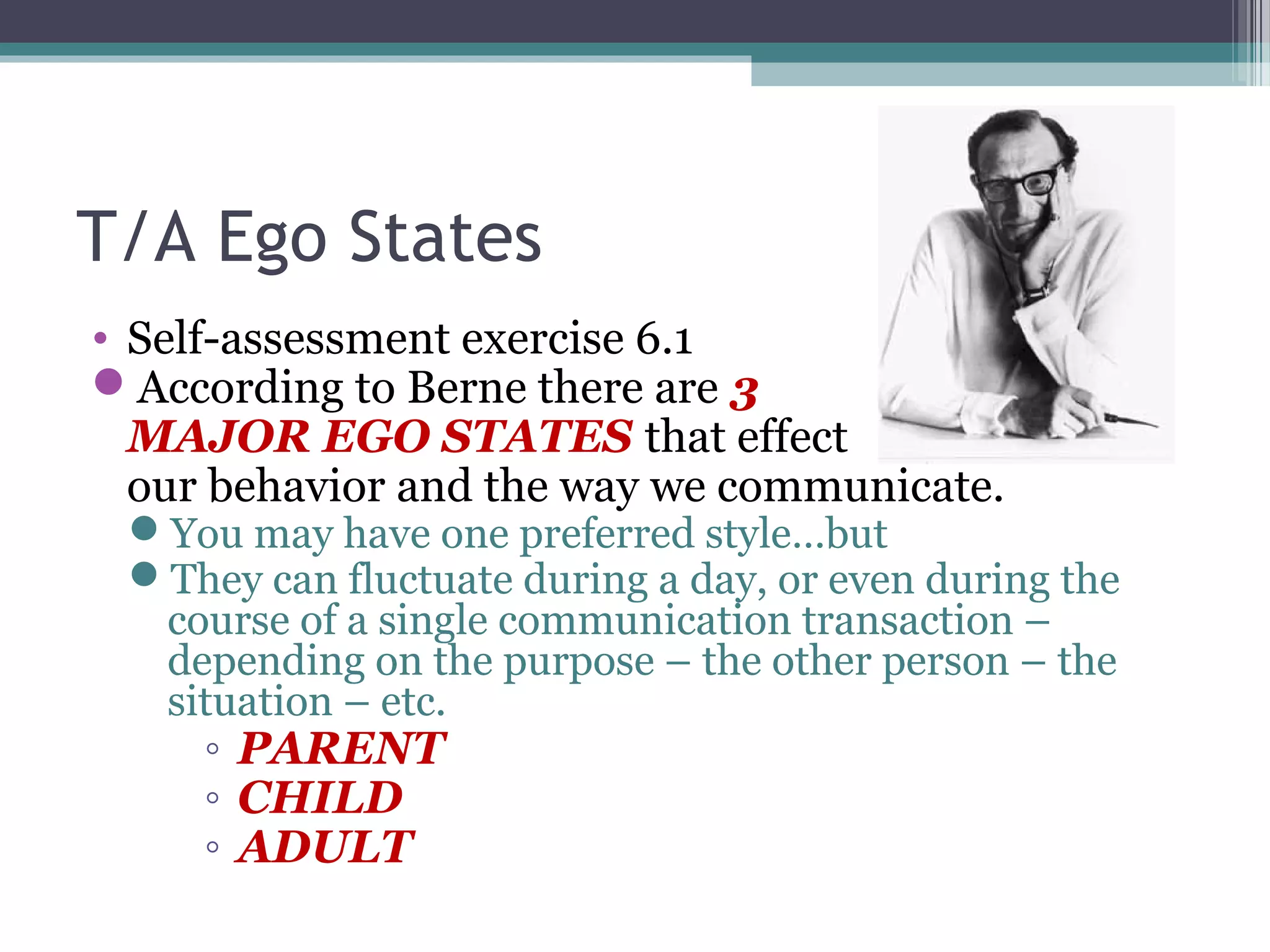
• Developed by Eric Berne – 1960 used in
psychiatry and social psychology – and carried
over into human relations.
▫ Ego States.
▫ Types Of Transactions.
▫ Life Positions And Stroking.
T/A Ego States
• Self-assessment exercise 6.1
According to Berne there are 3
MAJOR EGO STATES that effect
our behavior and the way we communicate.
You may have one preferred style…but
They can fluctuate during a day, or even during the
course of a single communication transaction –
depending on the purpose – the other person – the
situation – etc.
◦ PARENT
◦ CHILD
◦ ADULT
T/A – Ego States
PARENT EGO STATE
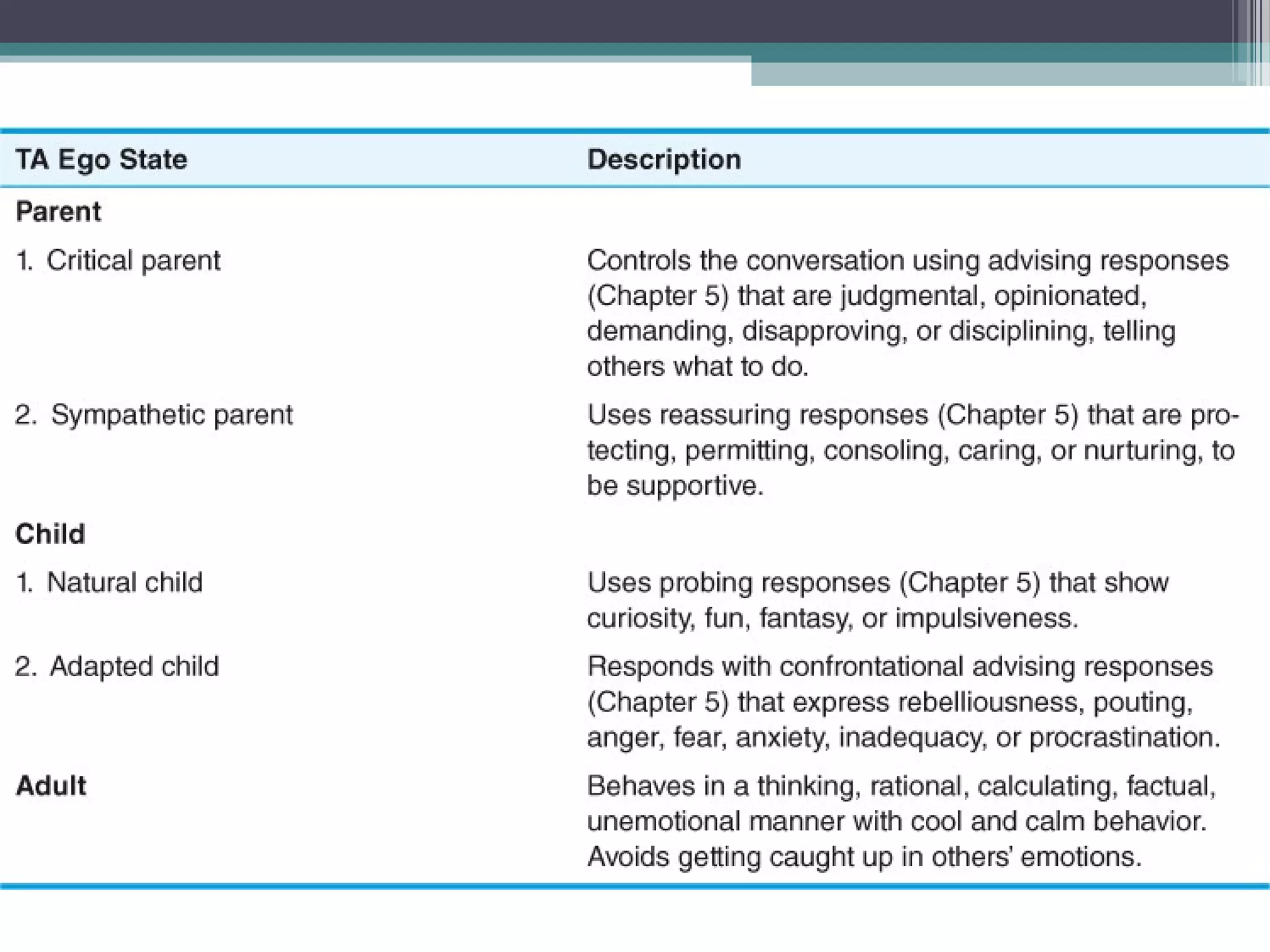
◦ CRITICAL PARENT
 Makes responses that are critical, judgmental,
opinionated, demanding, disapproving, etc.
 Use lots of “dos and don’ts” in conversations.
 Autocratic managers use this style because they are high
in task-directive communication.
◦ SYMPATHETIC PARENT
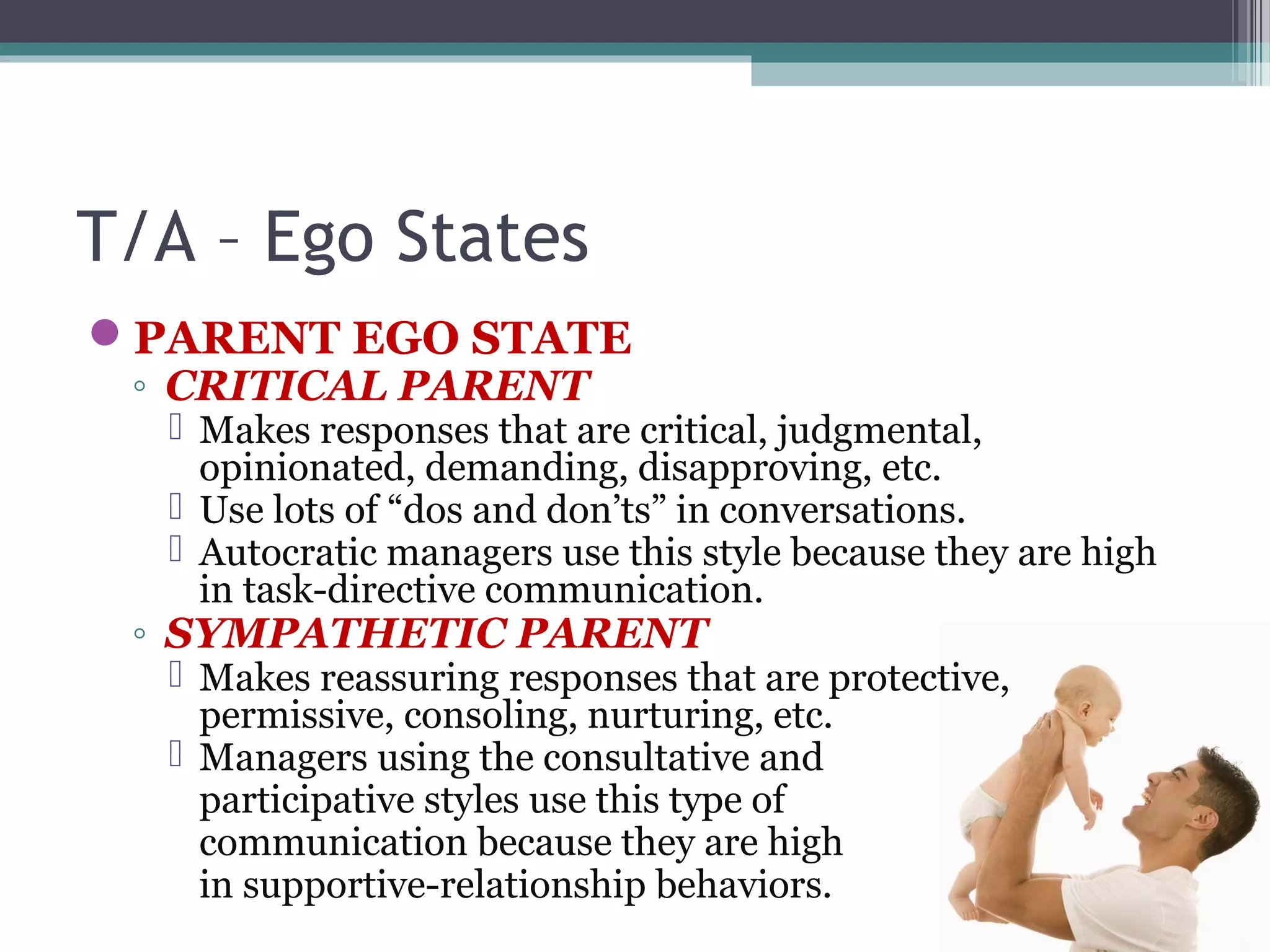
 Makes reassuring responses that are protective,
permissive, consoling, nurturing, etc.
 Managers using the consultative and
participative styles use this type of
communication because they are high
in supportive-relationship behaviors.
T/A – Ego States
CHILD EGO STATE
◦ NATURAL CHILD
 Responds with probing style showing
curiosity, intimacy, fun, joy, fantasy,
impulsiveness, etc.
 Successful managers tend not to operate
from this state on a regular basis.
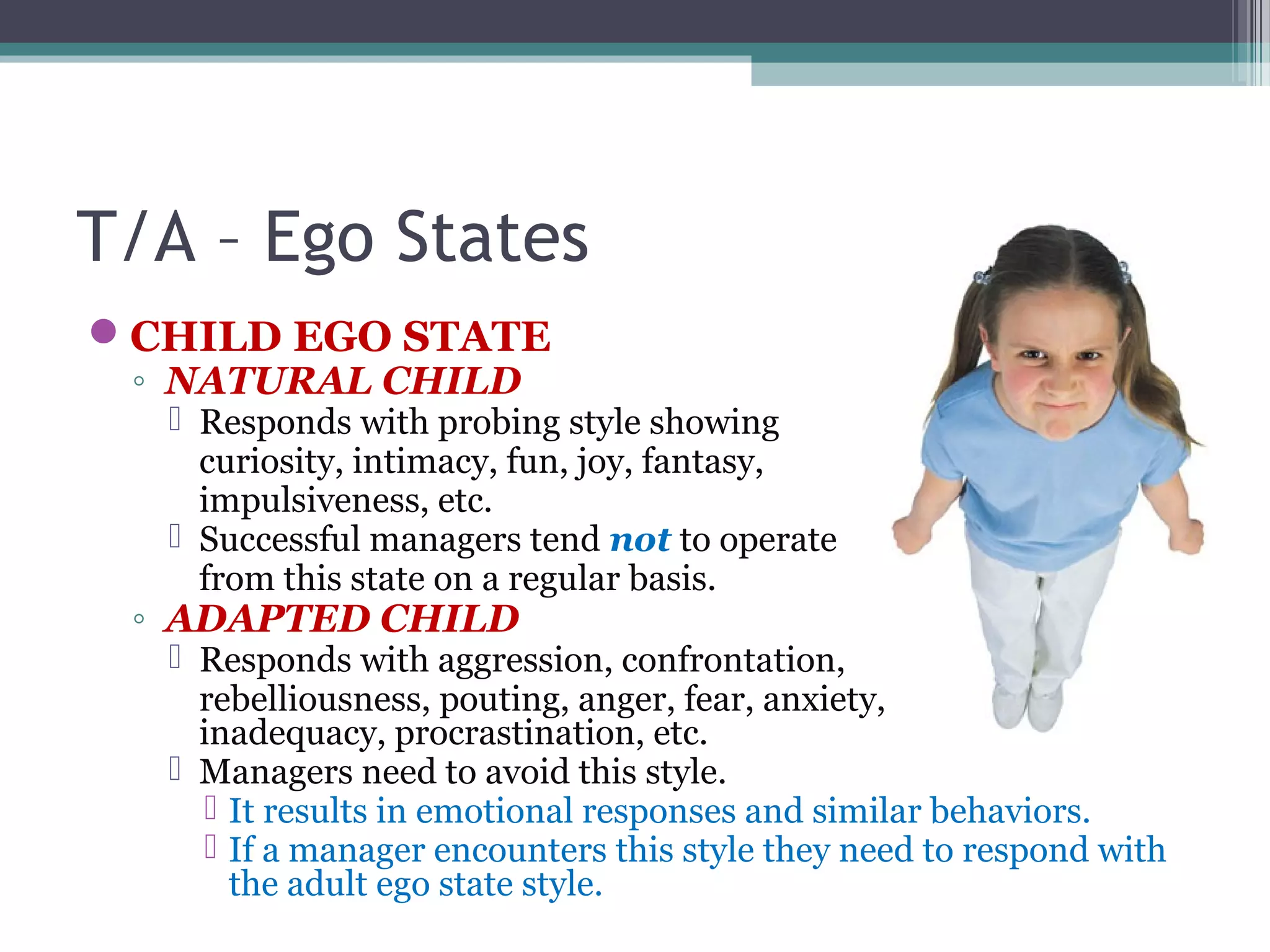
◦ ADAPTED CHILD
 Responds with aggression, confrontation,
rebelliousness, pouting, anger, fear, anxiety,
inadequacy, procrastination, etc.
 Managers need to avoid this style.
 It results in emotional responses and similar behaviors.
 If a manager encounters this style they need to respond with
the adult ego state style.
T/A – Ego States
ADULT EGO STATE
◦ Responses are rational, logical, and unemotional.
◦ Adults gather information, use critical thinking skills.
◦ Remains calm, cool, and collected.
◦ Adults avoid becoming the victim by controlling the situation
◦ This is generally the most effective style of communication.
◦ It is always good to assess the style of others when
communicating with them – it will help you understand their
actions – and make the right type of response accordingly.
 Adult = adult.
 Child = parent.
 Sometimes it’s okay to let go and have fun from the child ego
state – it depends on the situation!
Types of Transactions
 Within The Ego States There Are 3 Types Of Transactions
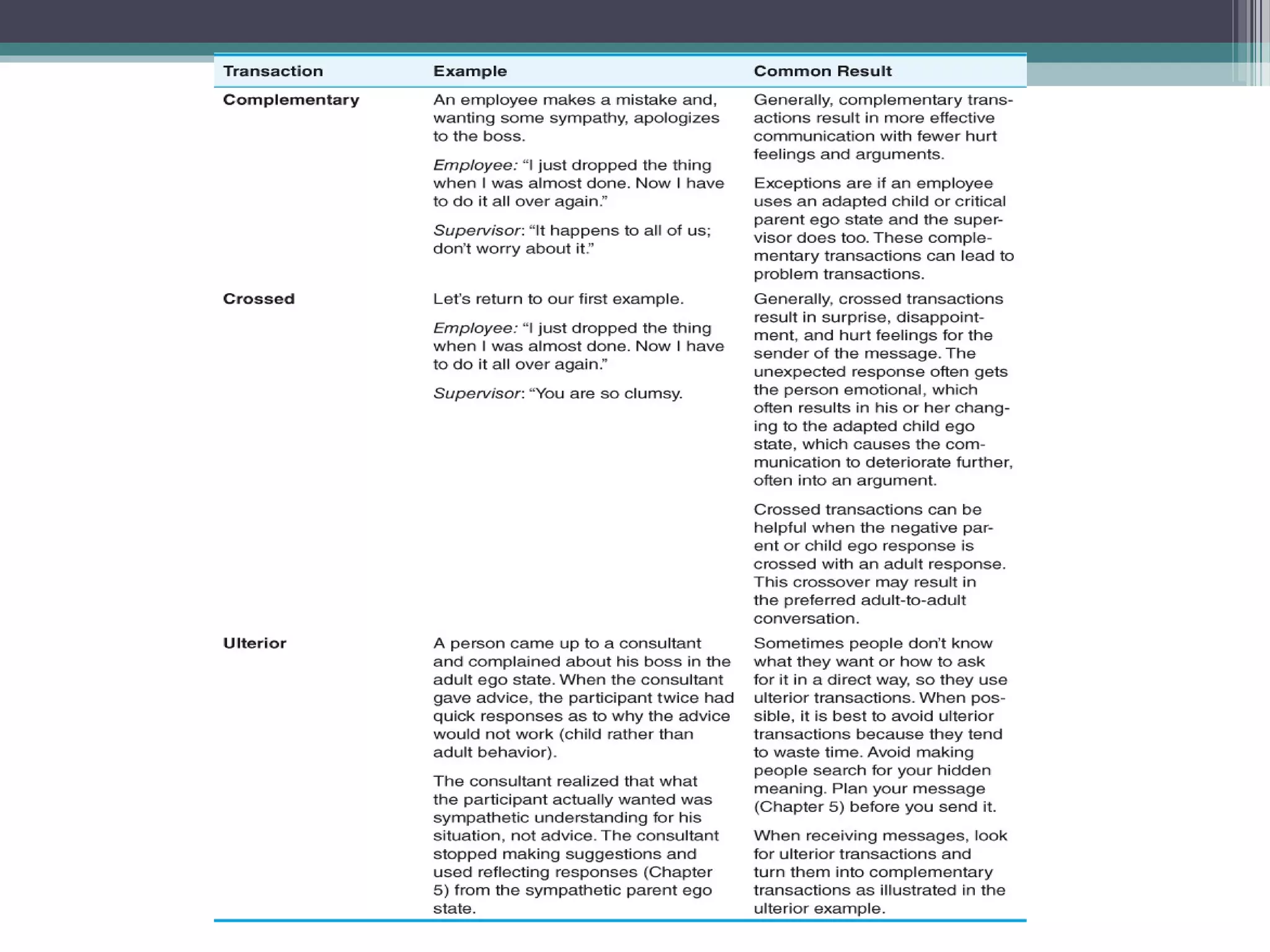
◦ COMPLEMENTARY (SUPPORT EACH OTHER)
 When the sender of the message gets the intended response from the
receiver.
 Generally the most effective communication with less hurt feelings and
confrontations.
◦ CROSSED (MISSES THE MARK)
 When the sender does not get the expected response from the receiver.
 Generally result in surprise, disappointment, and hurt feelings for the
sender.
◦ ULTERIOR (HIDDEN AGENDAS)
 Hidden messages – the words seem to come from one ego state, but in
reality they are coming from another.
 Sometimes people don’t know how to ask for what they want directly, so
they use ulterior methods to get their message across.
 Usually best to avoid this style – they waste time and cause problems.
T/A – Life Positions
& Stroking
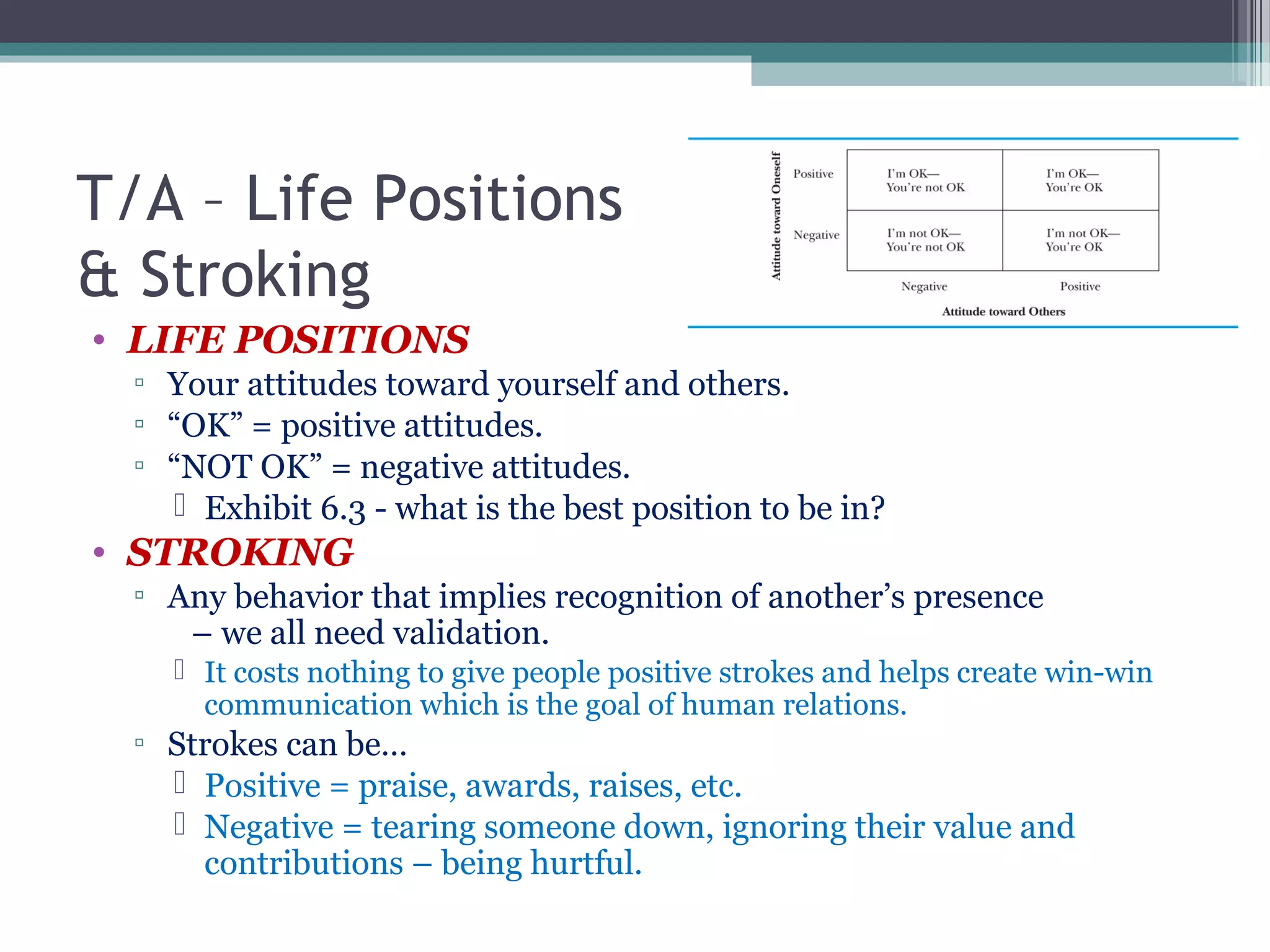
• LIFE POSITIONS
▫ Your attitudes toward yourself and others.
▫ “OK” = positive attitudes.
▫ “NOT OK” = negative attitudes.
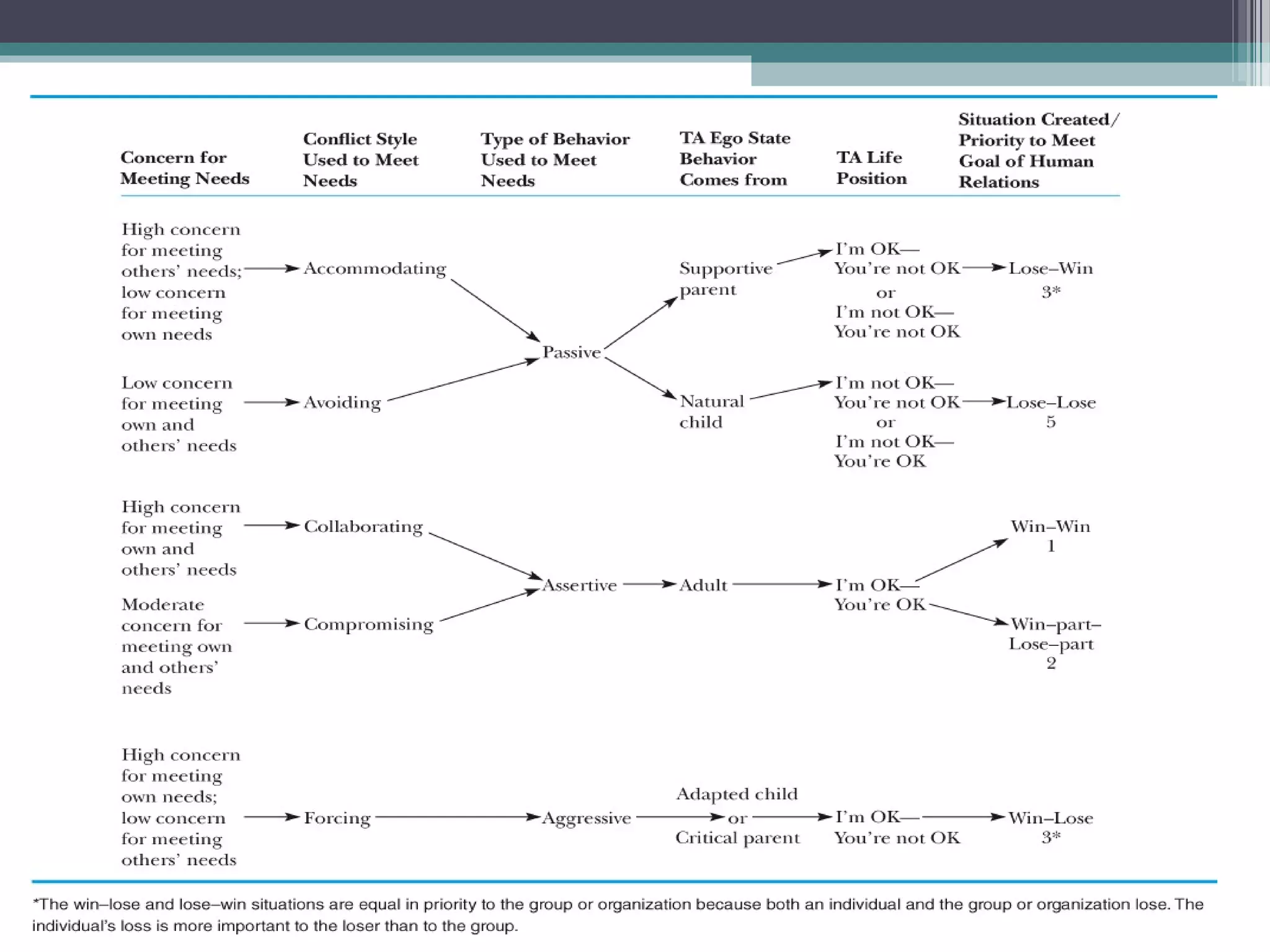
 Exhibit 6.3 - what is the best position to be in?
• STROKING
▫ Any behavior that implies recognition of another’s presence
– we all need validation.
 It costs nothing to give people positive strokes and helps create win-win
communication which is the goal of human relations.
▫ Strokes can be…
 Positive = praise, awards, raises, etc.
 Negative = tearing someone down, ignoring their value and
contributions – being hurtful.
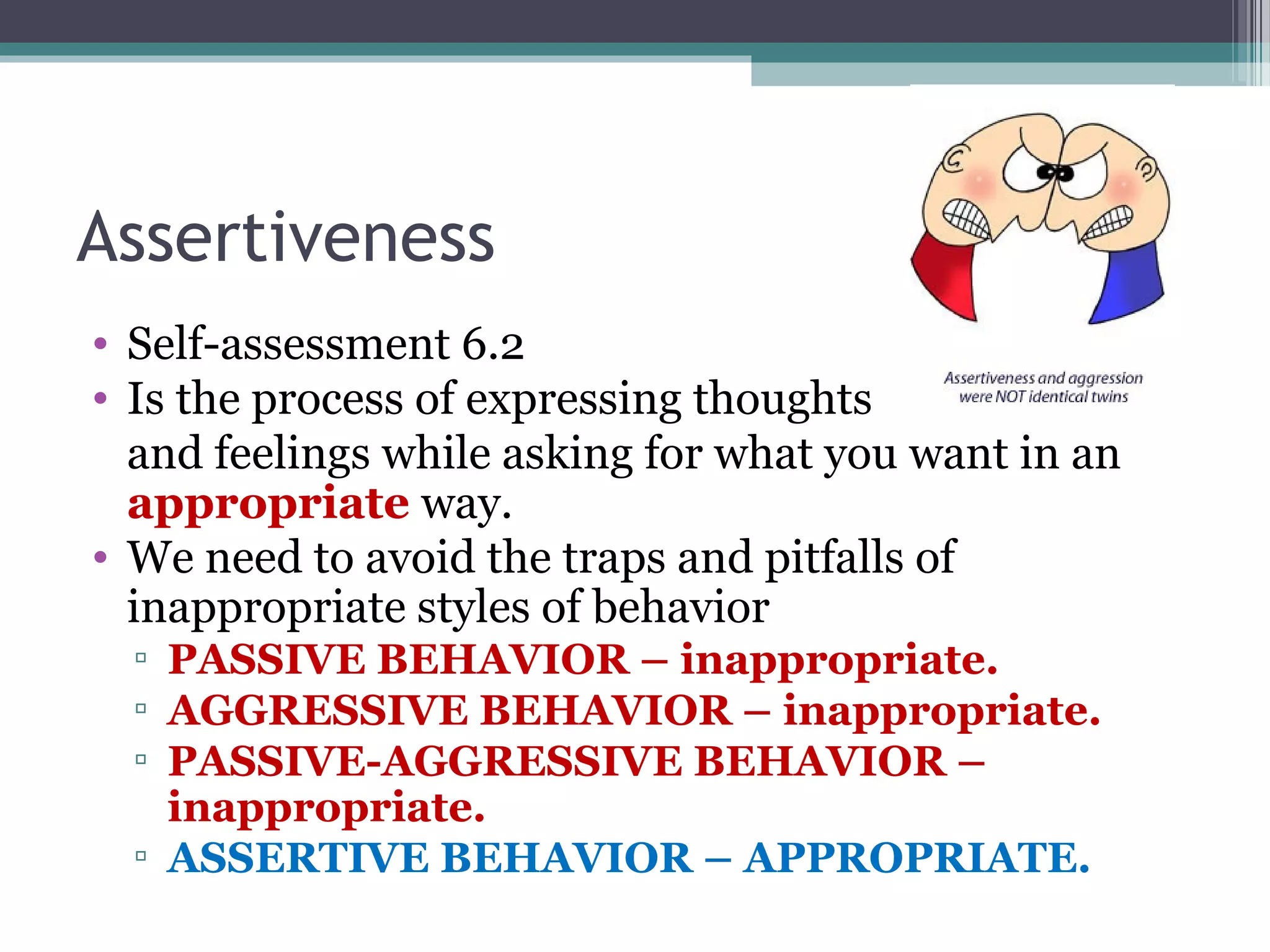
Assertiveness
• Self-assessment 6.2
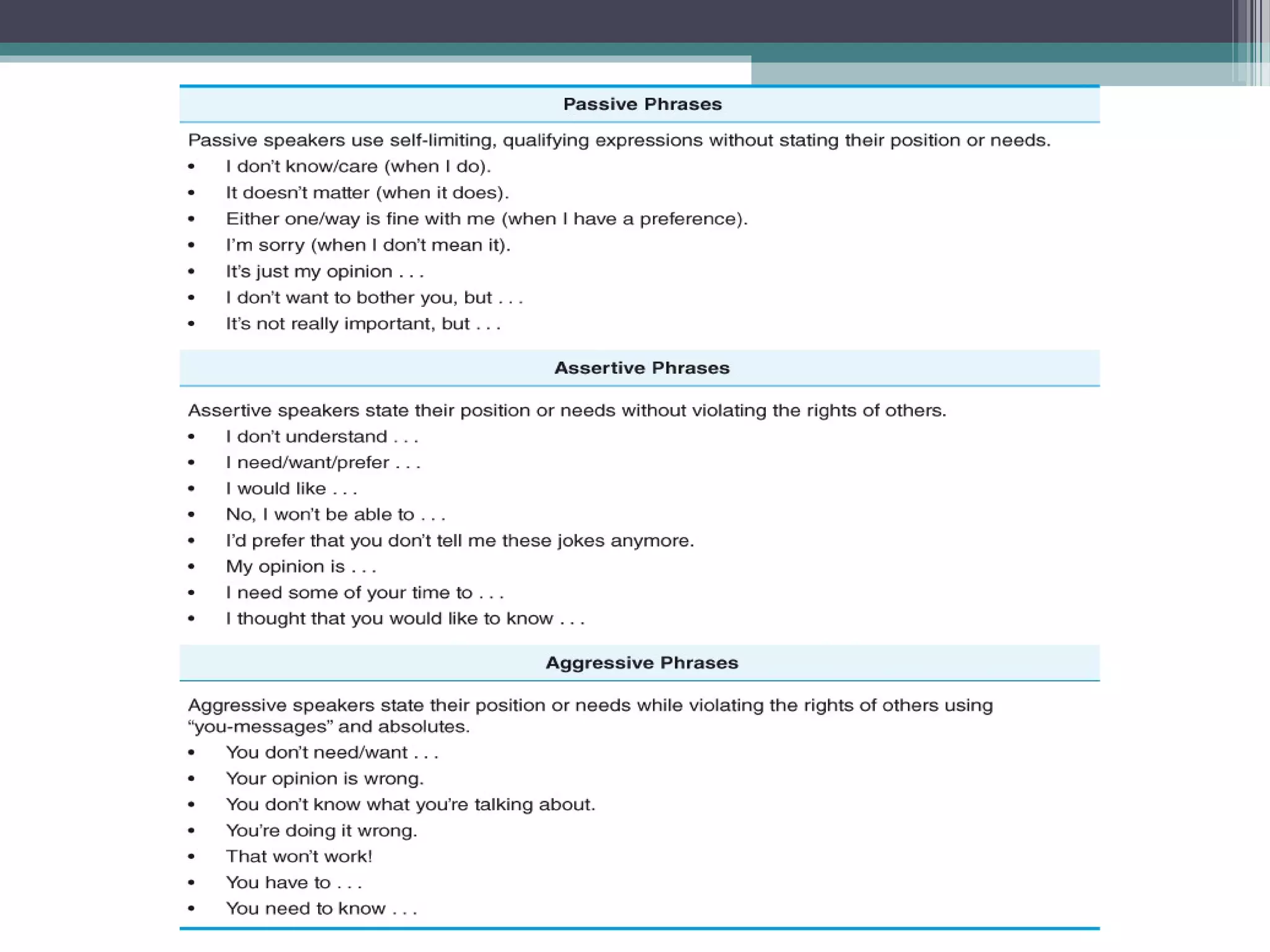
• Is the process of expressing thoughts
and feelings while asking for what you want in an
appropriate way.
• We need to avoid the traps and pitfalls of
inappropriate styles of behavior
▫ PASSIVE BEHAVIOR – inappropriate.
▫ AGGRESSIVE BEHAVIOR – inappropriate.
▫ PASSIVE-AGGRESSIVE BEHAVIOR –
inappropriate.
▫ ASSERTIVE BEHAVIOR – APPROPRIATE.
Passive Behavior
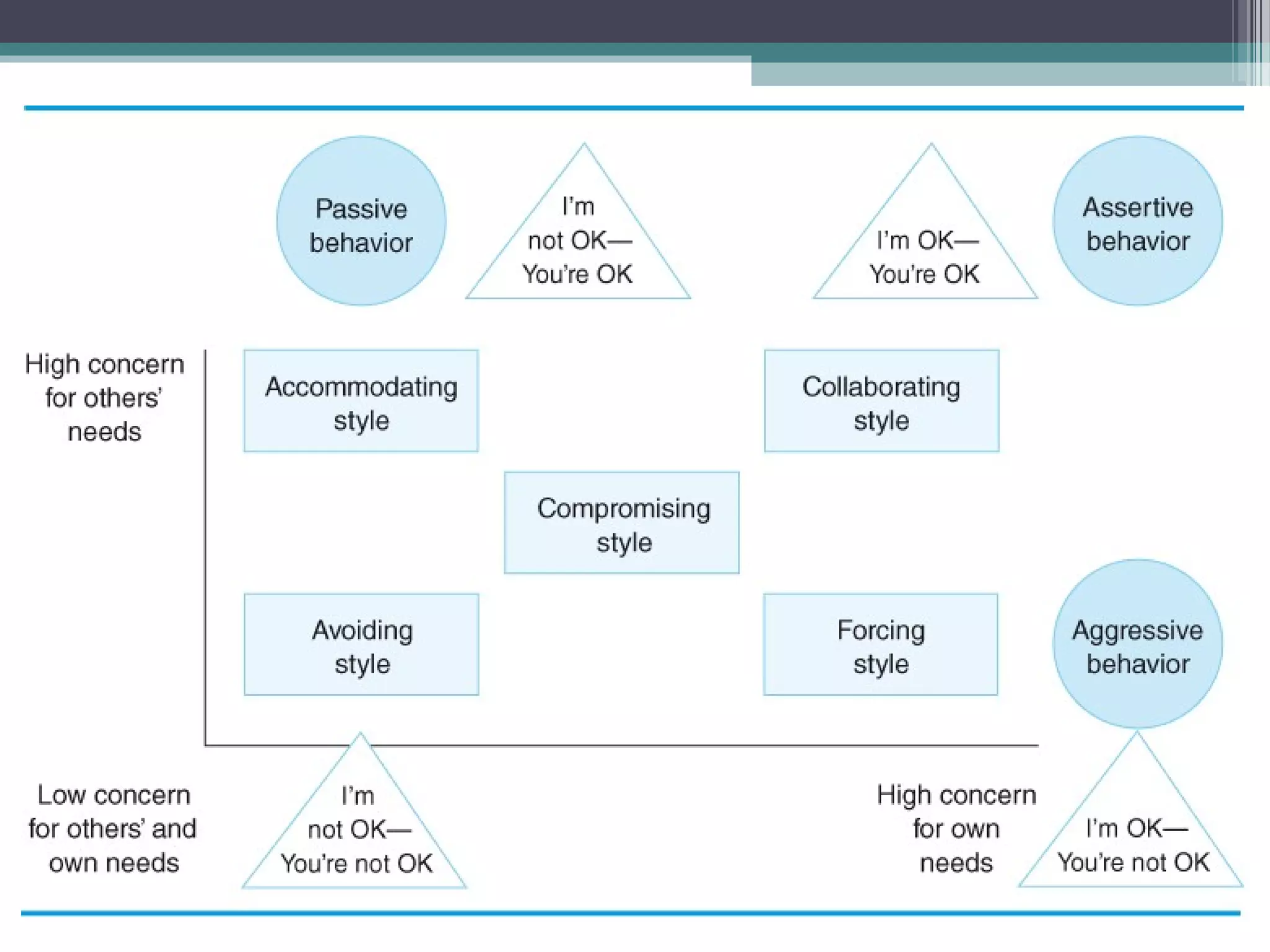
◦ Passive behaviors come from an “I’m not OK” life position.
◦ Used to avoid doing something or to accommodate someone else
without standing up for yourself.
◦ Nonverbals = looking down, speaking very soft, helpless gestures,
slouched posture.
◦ Self-denial and sacrifice attitude.
◦ Rationalizing = “it doesn’t matter anyway.”
◦ Usually internally distressed & in pain - increases one’s stress levels.
◦ Others tend to take unfair advantage of passive people.
◦ When a passive person does speak up – others usually don’t pay any
attention to them – and interrupt them frequently.
◦ Poor self-esteem and unhappy.
◦ Passivity often based in fear: of rejection, retaliation, of hurting or being hurt.
◦ It is often a result of life-long learning patterns.
◦ It is unproductive behavior.
Aggressive Behavior
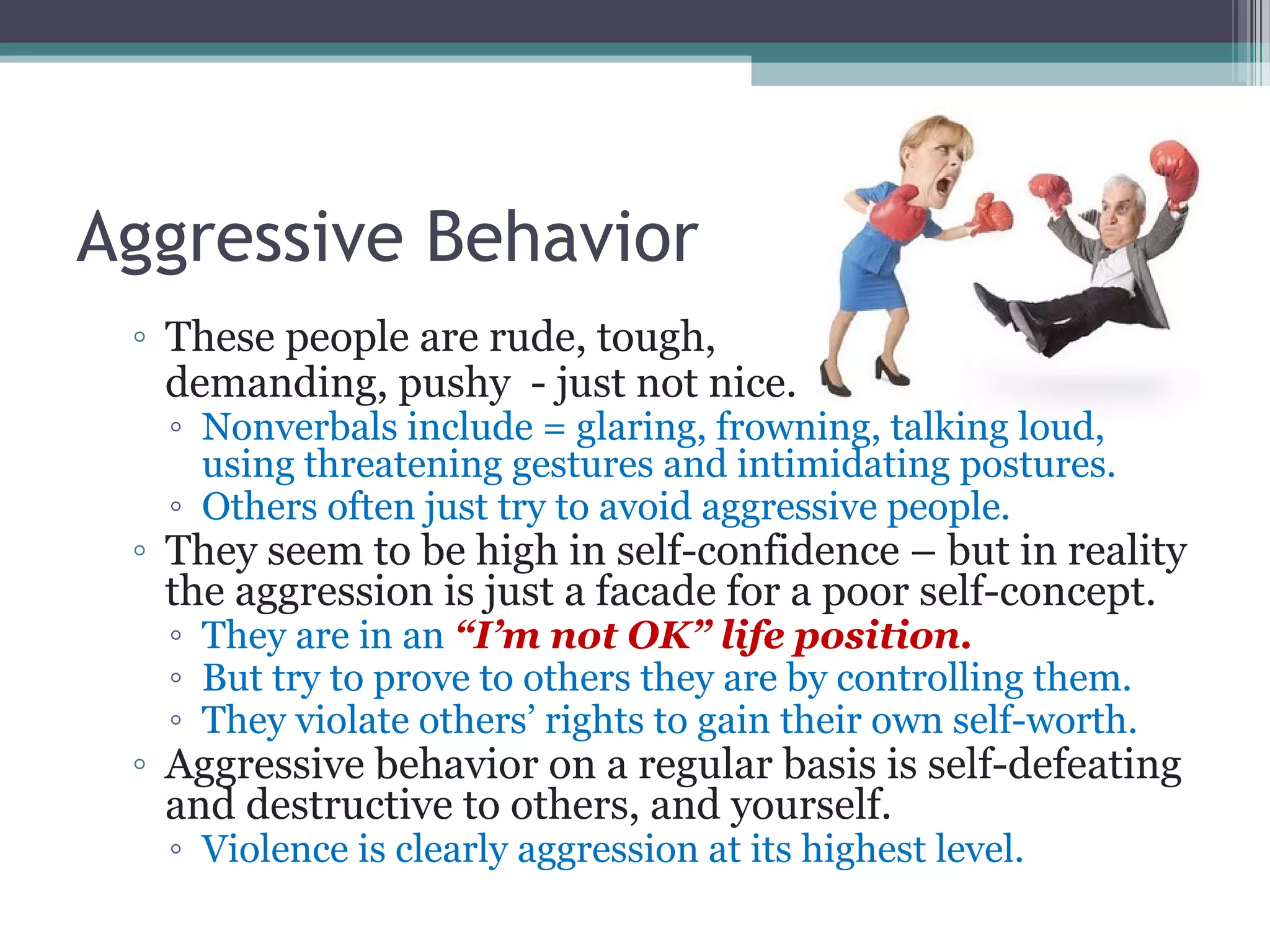
◦ These people are rude, tough,
demanding, pushy - just not nice.
◦ Nonverbals include = glaring, frowning, talking loud,
using threatening gestures and intimidating postures.
◦ Others often just try to avoid aggressive people.
◦ They seem to be high in self-confidence – but in reality
the aggression is just a facade for a poor self-concept.
◦ They are in an “I’m not OK” life position.
◦ But try to prove to others they are by controlling them.
◦ They violate others’ rights to gain their own self-worth.
◦ Aggressive behavior on a regular basis is self-defeating
and destructive to others, and yourself.
◦ Violence is clearly aggression at its highest level.
Passive-Aggressive Behavior
The most difficult to understand and
deal with - say one thing and do
another!
◦ Displayed In 3 Major Ways
 SPORADICALLY
 Aggressive one time – passive the next .
 You never know who is there… Jekyl or Hyde.
 SITUATIONALLY
 Passive during the communication.
 Then aggressive later.
 Displacement of hostility – meek and submissive then goes
home and kicks the dog.
 STUFFING HOSTILITY
 Being passive by not addressing the issue of concern.
 Allowing the anger to build…then exploding.
Assertive Behavior
◦ Comes from the adult ego state.
◦ “I’m OK – you’re OK” life position.
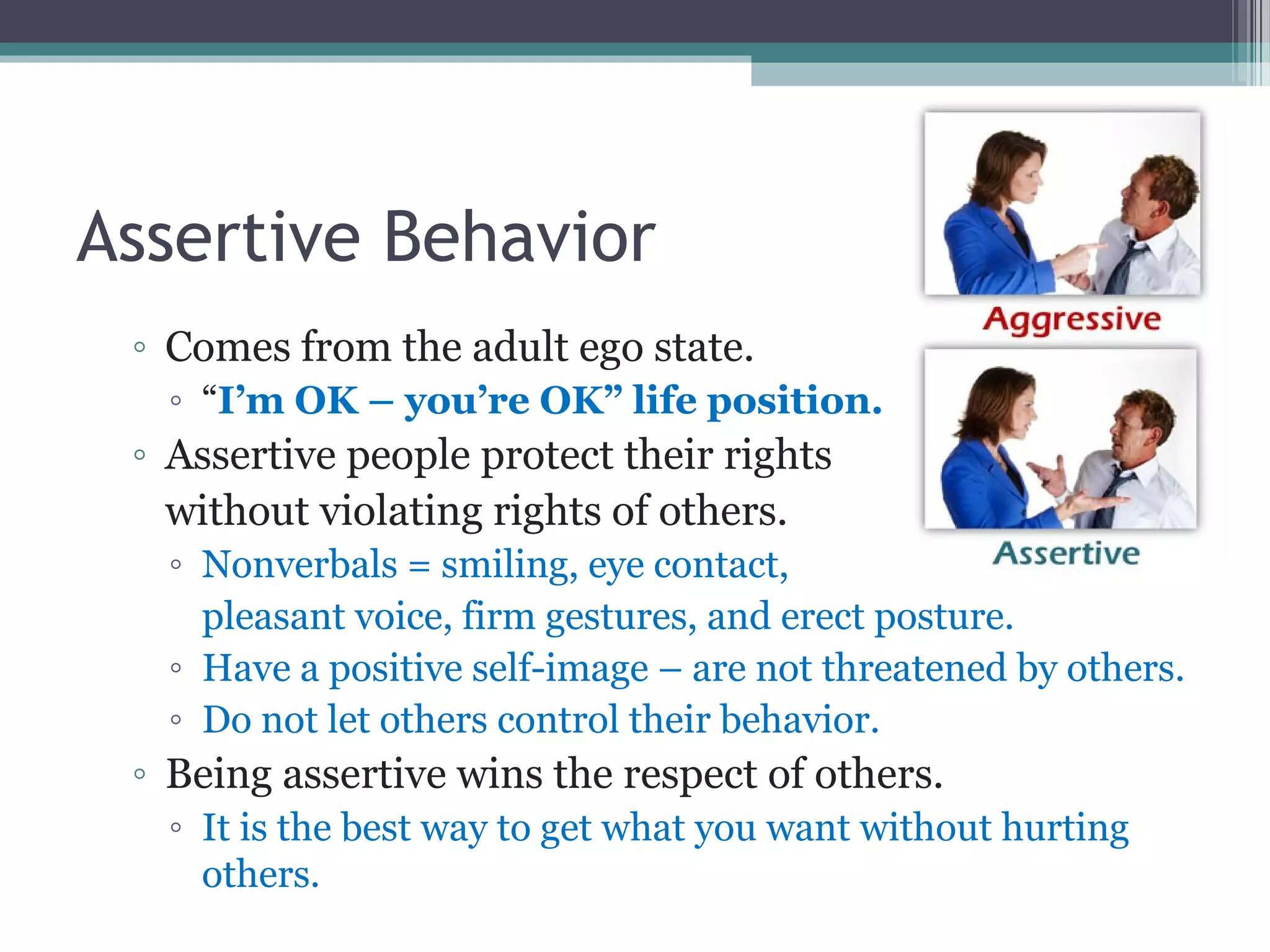
◦ Assertive people protect their rights
without violating rights of others.
◦ Nonverbals = smiling, eye contact,
pleasant voice, firm gestures, and erect posture.
◦ Have a positive self-image – are not threatened by others.
◦ Do not let others control their behavior.
◦ Being assertive wins the respect of others.
◦ It is the best way to get what you want without hurting
others.
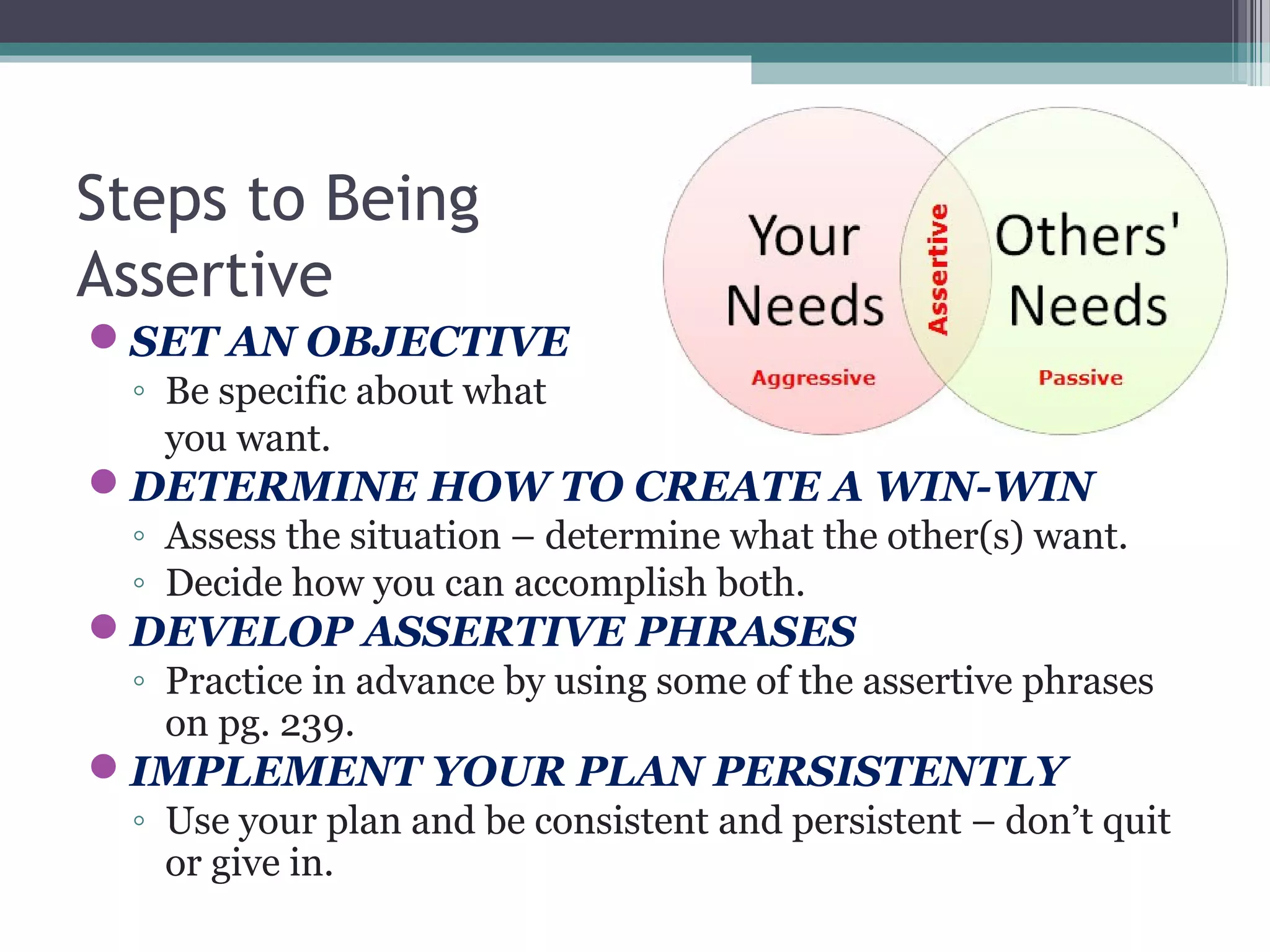
Steps to Being
Assertive
SET AN OBJECTIVE
◦ Be specific about what
you want.
DETERMINE HOW TO CREATE A WIN-WIN
◦ Assess the situation – determine what the other(s) want.
◦ Decide how you can accomplish both.
DEVELOP ASSERTIVE PHRASES
◦ Practice in advance by using some of the assertive phrases
on pg. 239.
IMPLEMENT YOUR PLAN PERSISTENTLY
◦ Use your plan and be consistent and persistent – don’t quit
or give in.
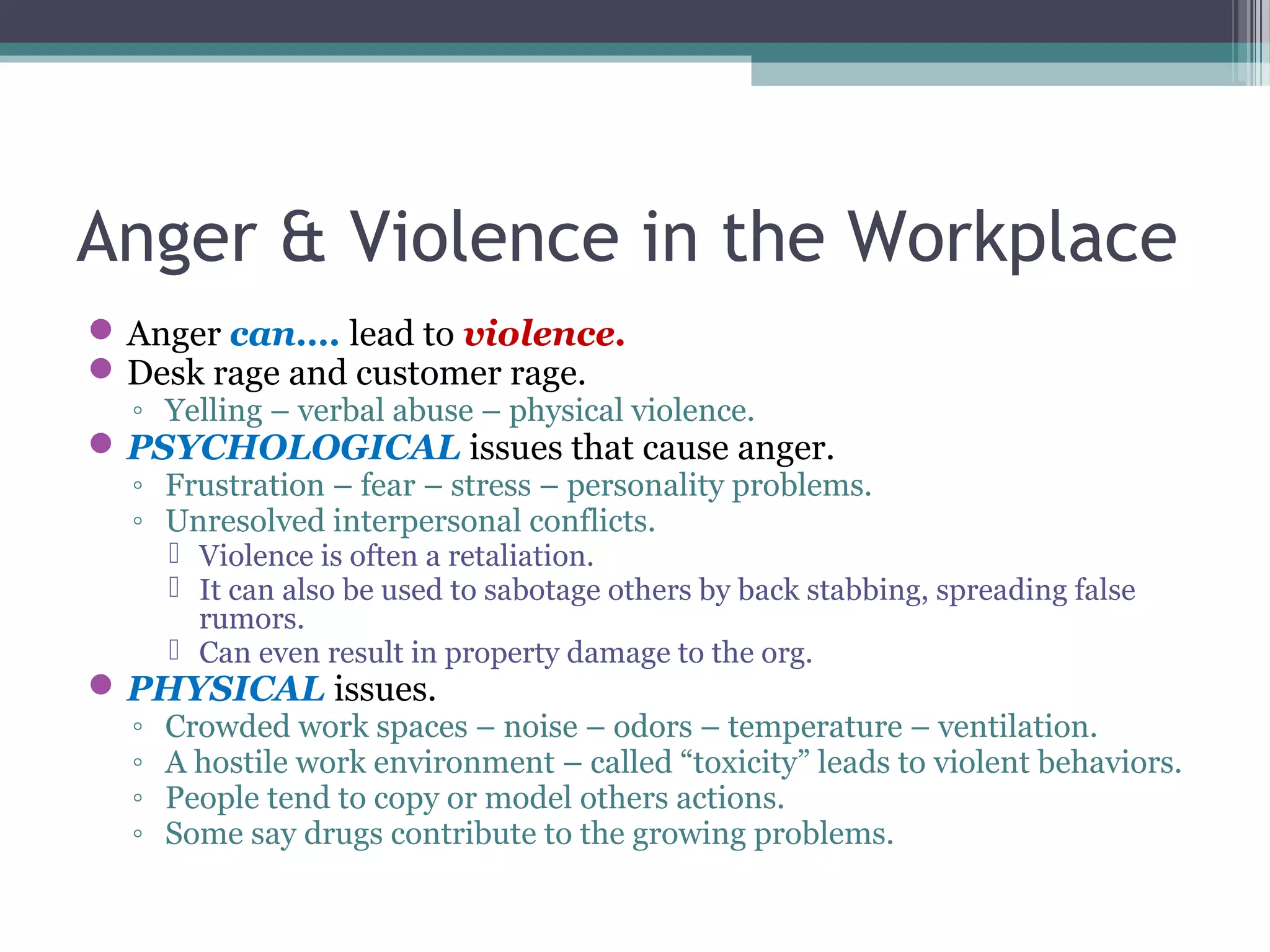
Anger & Violence in the Workplace
Anger can…. lead to violence.
Desk rage and customer rage.
◦ Yelling – verbal abuse – physical violence.
PSYCHOLOGICAL issues that cause anger.
◦ Frustration – fear – stress – personality problems.
◦ Unresolved interpersonal conflicts.
 Violence is often a retaliation.
 It can also be used to sabotage others by back stabbing, spreading false
rumors.
 Can even result in property damage to the org.
PHYSICAL issues.
◦ Crowded work spaces – noise – odors – temperature – ventilation.
◦ A hostile work environment – called “toxicity” leads to violent behaviors.
◦ People tend to copy or model others actions.
◦ Some say drugs contribute to the growing problems.
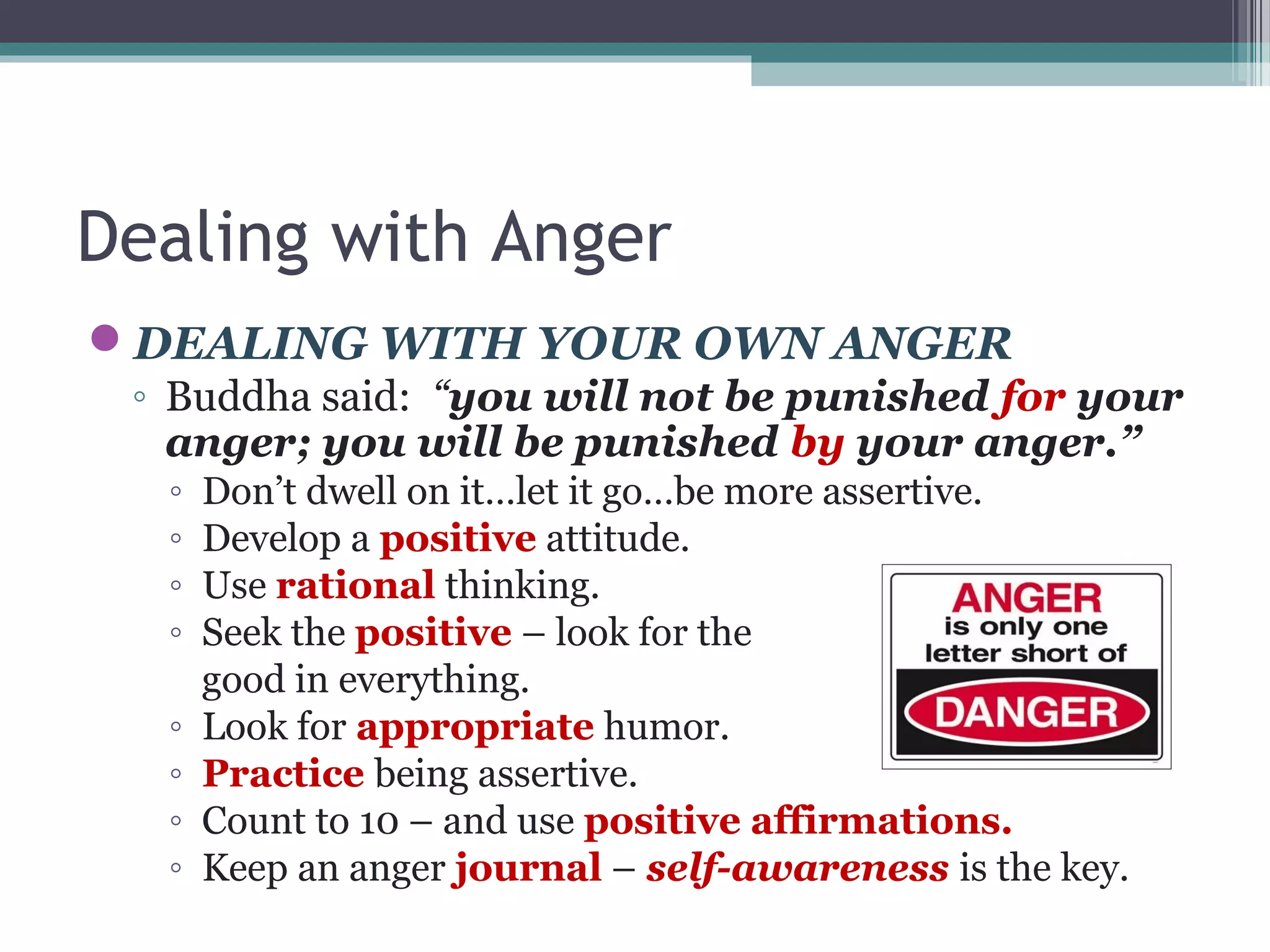
Dealing with Anger
DEALING WITH YOUR OWN ANGER
◦ Buddha said: “you will not be punished for your
anger; you will be punished by your anger.”
◦ Don’t dwell on it…let it go…be more assertive.
◦ Develop a positive attitude.
◦ Use rational thinking.
◦ Seek the positive – look for the
good in everything.
◦ Look for appropriate humor.
◦ Practice being assertive.
◦ Count to 10 – and use positive affirmations.
◦ Keep an anger journal – self-awareness is the key.
Dealing with the Anger of Others
DEALING WITH THE ANGER OF OTHERS
◦ Don’t respond to anger with anger – STAY CALM.
◦ Don’t ever use put-down statements – it only adds fuel to
the fire.
◦ Don’t give orders or issue ultimatums.
◦ Watch your nonverbal communication carefully.
 Stay calm – speak softly – don’t get too close – or make sudden
moves.
◦ Realize anger is natural – encourage people to ventilate it in
appropriate ways.
◦ Validate the angry person’s feelings – use reflecting
responses.
◦ Get away from the person if needed or call in a third party
(security if available).
Preventing Workplace Violence
Workplace violence is rarely spontaneous.
It is usually a result of escalating steps due to unresolved issues.
It can be prevented if you watch for these warning signs.
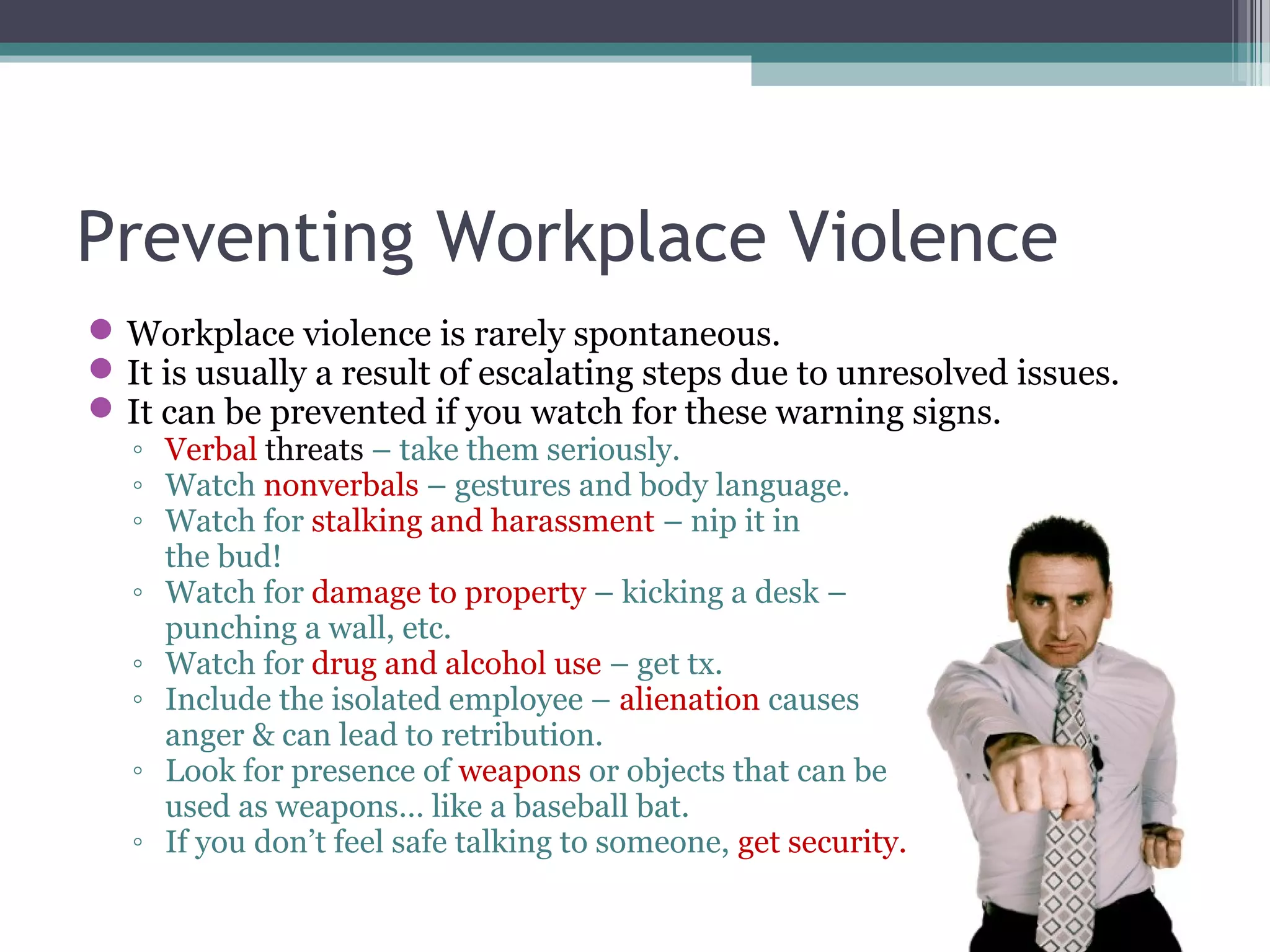
◦ Verbal threats – take them seriously.
◦ Watch nonverbals – gestures and body language.
◦ Watch for stalking and harassment – nip it in
the bud!
◦ Watch for damage to property – kicking a desk –
punching a wall, etc.
◦ Watch for drug and alcohol use – get tx.
◦ Include the isolated employee – alienation causes
anger & can lead to retribution.
◦ Look for presence of weapons or objects that can be
used as weapons… like a baseball bat.
◦ If you don’t feel safe talking to someone, get security.
Organizational Prevention of
Workplace Violence
Number one prevention is training all employees to deal with
anger and how to prevent violence.
 It starts with a written policy and procedures in the orgs. Manual.
Orgs should have a zero-tolerance policy.
 Taking immediate disciplinary action is vital or it may spread.
 Don’t allow managers to model violence.
 The org. should have a set policy for dealing with grievances & it should
be used.
Screening potential employees for past or potential violence.
Developing a good work environment decreases
violence.
Demotions, firings, layoffs, should be handled in a
humane way.
Outplacement services should be offered.
Individual Prevention
• Prevention is the key – police can’t come
until after a violent event has taken place.
▫ Keep in mind there is always a potential for
violence – don’t be naïve.
▫ Never be alone with a potentially violent person –
or if you must, keep an exit
between you and them.
▫ Know when to get away from
them.
▫ Report any troubling behavior.
Conflict Management Styles
 CONFLICT
◦ Exists whenever two or more people disagree.
◦ It is inherent in any team or organization.
◦ Dealing with conflict is part of your emotional intelligence.
◦ Your ability to manage conflict is critical to your success.
 REASONS FOR & AVOIDING CONFLICTS
◦ Conflict arises when our expectations have not been met.
 We don’t let others know what we expect.
 We don’t bother to find out the expectations of others.
 We assume that everyone has the same expectations as ours .
 BENEFITS OF CONFLICT – NOT ALWAYS NEGATIVE…
◦ Challenging the status quo can lead to conflict but can ultimately lead to improved
performance.
◦ Sometimes it’s okay to upset the apple cart as long as it is done without anger –
violence – or malice.
◦ Confrontation gets a bad rap – but sometimes it’s a good thing.
◦ http://www.youtube.com/watch?v=6xCkhV7zhuw
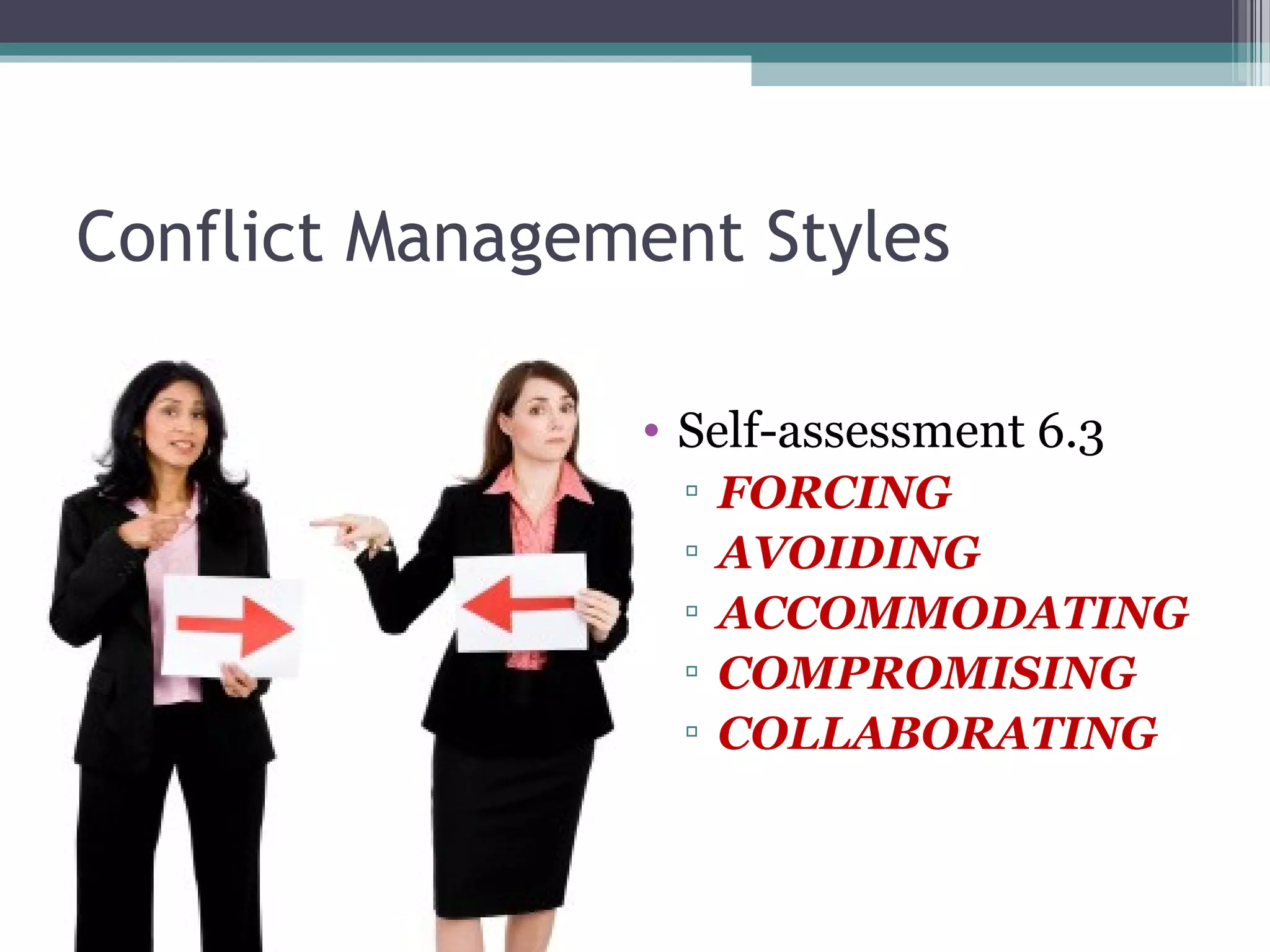
Conflict Management Styles
• Self-assessment 6.3
▫ FORCING
▫ AVOIDING
▫ ACCOMMODATING
▫ COMPROMISING
▫ COLLABORATING
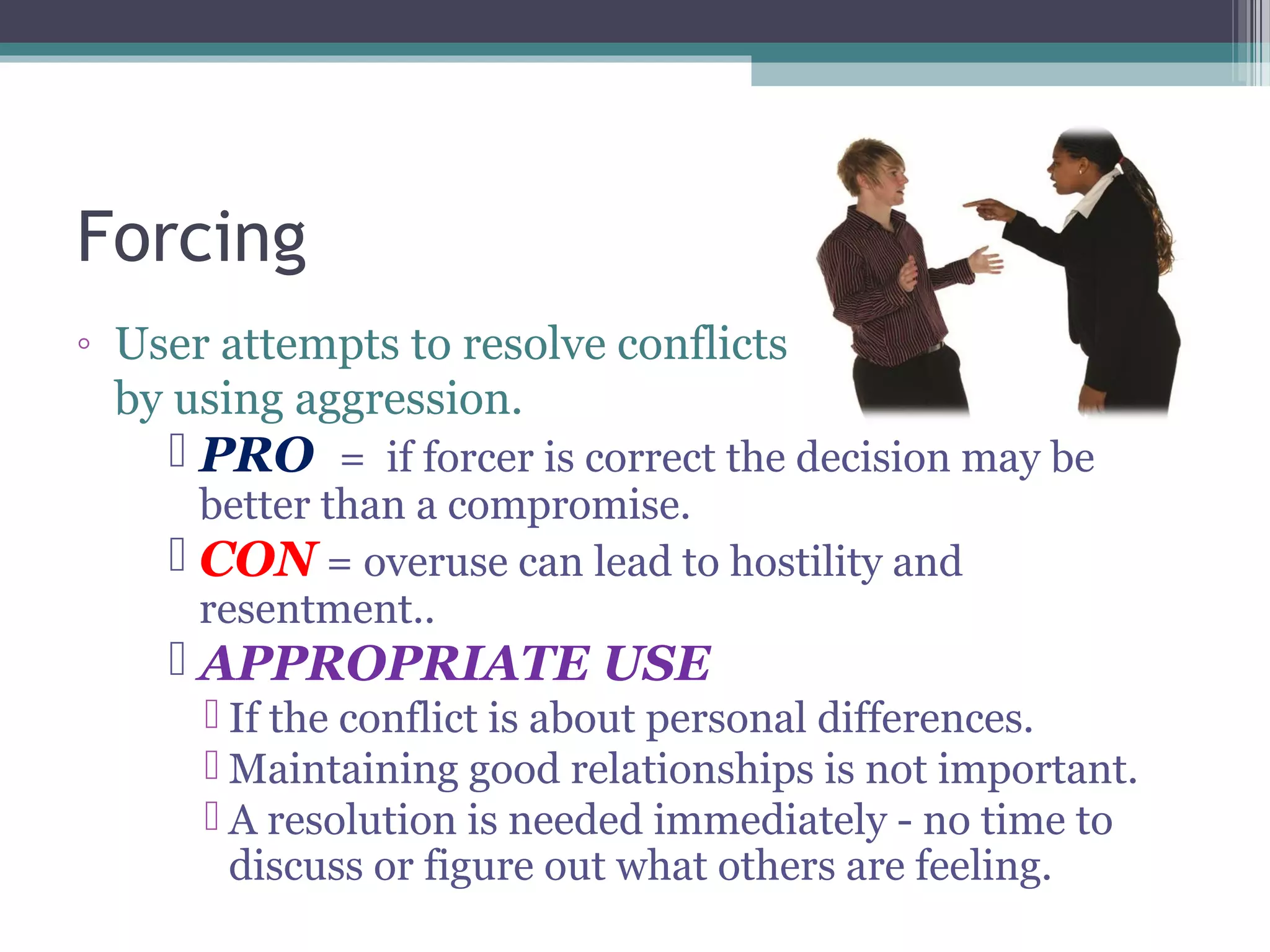
Forcing
◦ User attempts to resolve conflicts
by using aggression.
 PRO = if forcer is correct the decision may be
better than a compromise.
 CON = overuse can lead to hostility and
resentment..
 APPROPRIATE USE
 If the conflict is about personal differences.
 Maintaining good relationships is not important.
 A resolution is needed immediately - no time to
discuss or figure out what others are feeling.
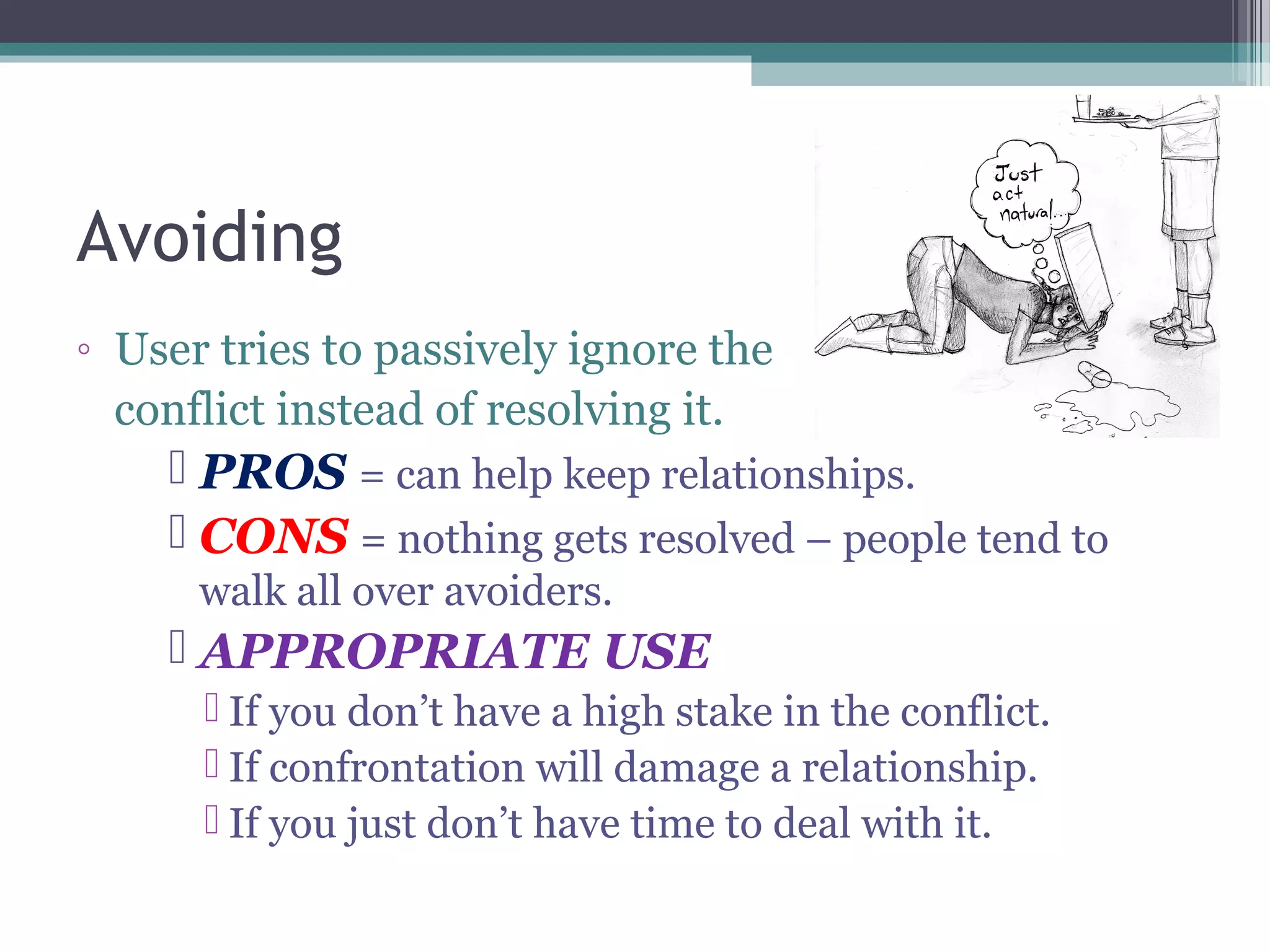
Avoiding
◦ User tries to passively ignore the
conflict instead of resolving it.
 PROS = can help keep relationships.
 CONS = nothing gets resolved – people tend to
walk all over avoiders.
 APPROPRIATE USE
 If you don’t have a high stake in the conflict.
 If confrontation will damage a relationship.
 If you just don’t have time to deal with it.
Accommodating
Difference between avoiding and accommodating.
◦ Avoiding takes no action – accommodating you have
to say or do something.
◦ Attempts to resolve conflict by passively giving in to
the other party.
 PROS = relationships are maintained.
 CONS = simply giving in may be counterproductive
especially if you have a better solution.
 APPROPRIATE USE
 Keeping the relationship is the most important.
 The changes aren’t important to you but they are to
others.
 Time to resolve issue is limited.
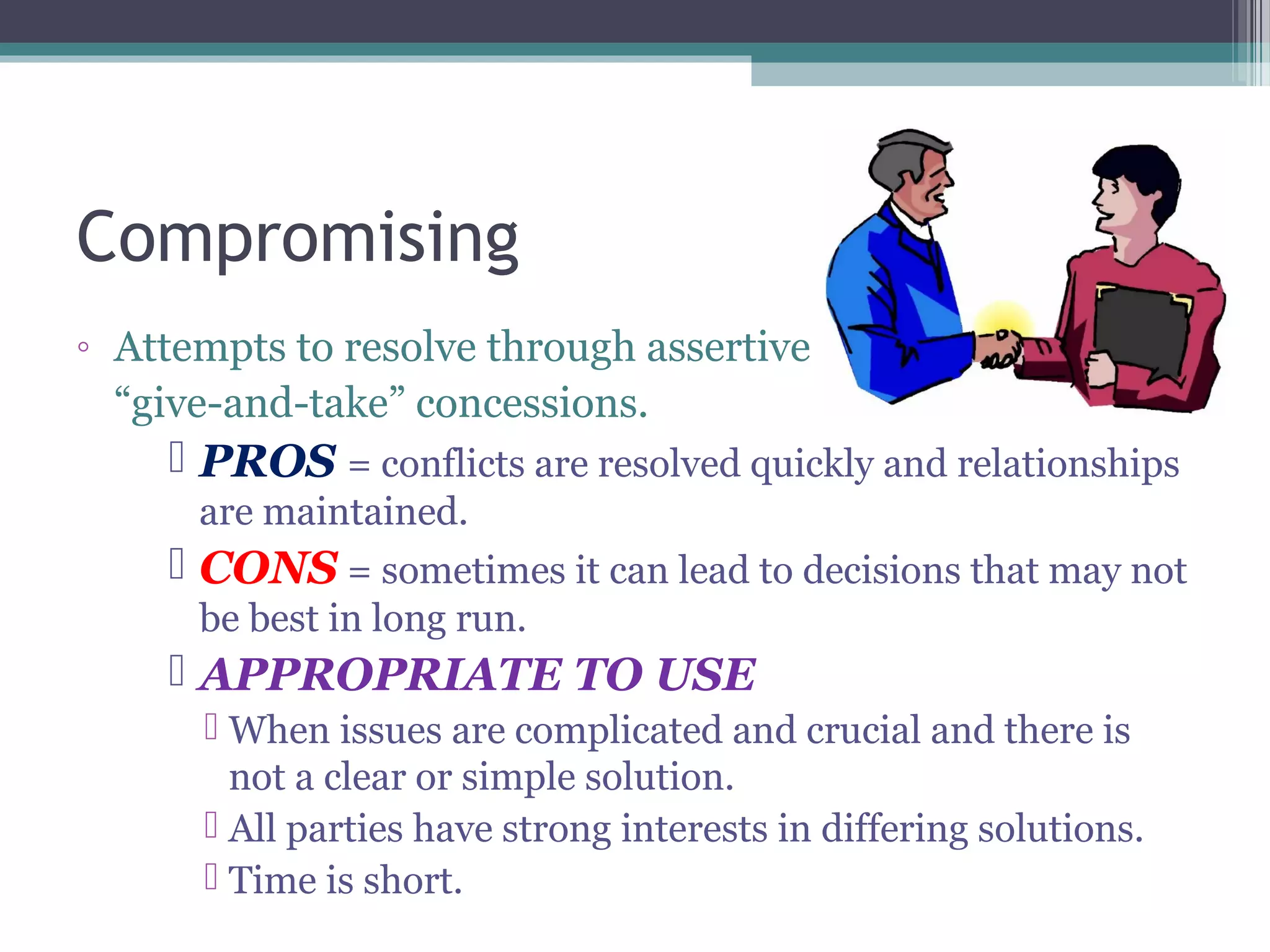
Compromising
◦ Attempts to resolve through assertive
“give-and-take” concessions.
 PROS = conflicts are resolved quickly and relationships
are maintained.
 CONS = sometimes it can lead to decisions that may not
be best in long run.
 APPROPRIATE TO USE
 When issues are complicated and crucial and there is
not a clear or simple solution.
 All parties have strong interests in differing solutions.
 Time is short.
Collaborating
◦ An assertive attempt to resolve conflict with the best solution
agreeable to all parties.
◦ A.k.a. = problem-solving style.
◦ This is really the only style that creates a “win-win” situation.
◦ Difference between compromise and collaboration - in
compromise someone wins and someone loses – concessions are
made by both – collaborating means both sides win
 PROS = tends to be the best resolution.
 CONS = takes more time and greater effort than any others.
 APPROPRIATE TO USE
 Keeping relationships is important.
 You have plenty of time.
 The conflict is between peers.
Initiating Conflict Resolution – Step 1
• When beginning the collaborative style follow these three
steps (this means you are the one to start or initiate the
process).
▫ Maintain ownership of the problem using the XYZ
model.
 X = BEHAVIOR
 Y = CONSEQUENCES
 Z = FEELINGS
▫ Implement your plan PERSISTENTLY.
 It lets the other person know there is a problem .
 If they won’t acknowledge it – keep trying.
▫ Make an AGREEMENT for change.
 When you finally get their attention, then make an agreement
that you can both live with.
Initiating Conflict Resolution – Step 2
Implement your plan persistently.
Often people do not realize there is a problem.
But when approached properly – they are willing
to change.
You cannot resolve a problem unless both parties
agree there is one to solve.
Repeat your planned statement several times.
Explain it in different terms if needed.
Don’t give up too easily- watch for nonverbal cues.
If one party is not responsive to solving the problem
appeal to common goals – point out the benefits .
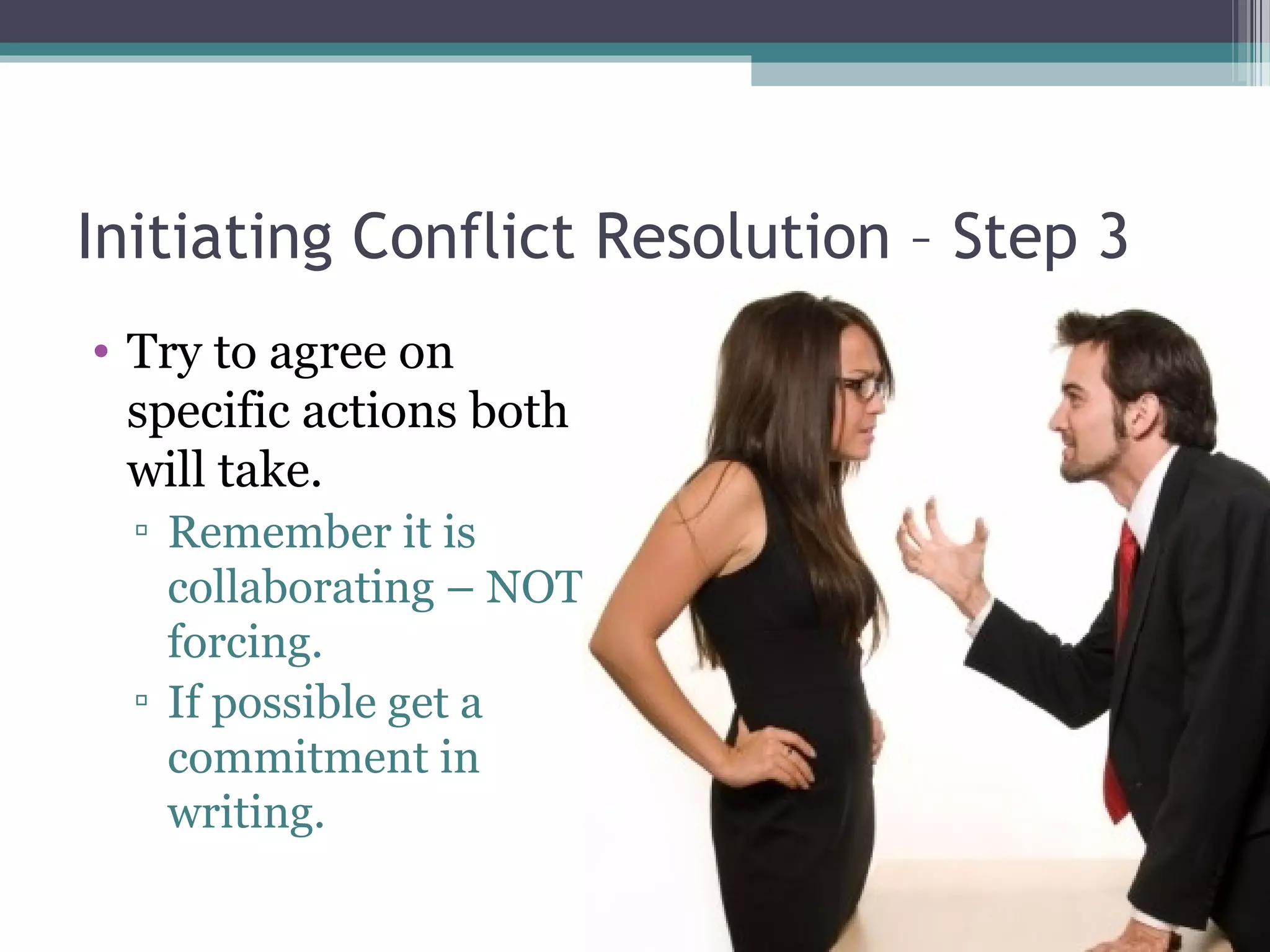
Initiating Conflict Resolution – Step 3
• Try to agree on
specific actions both
will take.
▫ Remember it is
collaborating – NOT
forcing.
▫ If possible get a
commitment in
writing.
Responding to Conflict Resolution
• Many times there can’t be an agreement and a third party is brought
in to help reach some sort of resolution.
▫ Trained mediators are used in many business situations – in personal
conflicts such as marriage and family issues, therapists and psychologists
are used.
▫ Mediators only help the resolution process – the parties are not held to
the outcome.
▫ Arbitration is a different process where the final outcome is decided by
the arbitrator and parties are held accountable to the outcome.
• Using the four mediating conflict resolution steps.
 Each party states their side using the xyz model.
 Agree on the problems.
 Develop alternative solutions.
 Make an agreement for change and follow up.
• APOLOGIZE…
▫ Even if you don’t think you are in the wrong…apologies are the high road
to resolving conflicts.
Summary of Key Concepts
◦ The 3 ego states of Transactional Analysis.
◦ The 3 types of transactions.
◦ The difference between passive, aggressive, and
assertive behaviors.
◦ The 4 steps to assertiveness.
◦ When and how to use conflict management.
◦ The steps of initiating, responding to, and
mediating conflict resolutions.

PSY 126 Week 6: Dealing with Conflict

  • 1.
    Dealing with Conflict MatthewL. Eisenhard, Psy.D. Week 6: Psychology for Business & Industry
  • 2.
    Main Topics ◦ TRANSACTIONALANALYSIS  A way for determining how people interact.  It is common for people to disagree.  Dealing with emotions - your own and others – is part of Emotional Intelligence. ◦ ASSERTIVENESS  Is standing up for your own rights – without pushing others around. ◦ CONFLICT MANAGEMENT  Is a critical skill in being successful and productive.
  • 3.
    Transactional Analysis (T/A) •Is a method of understanding behavior in interpersonal situations. ▫ International Transactional Analysis Association: www.itaaworld-org. • Developed by Eric Berne – 1960 used in psychiatry and social psychology – and carried over into human relations. ▫ Ego States. ▫ Types Of Transactions. ▫ Life Positions And Stroking.
  • 4.
    T/A Ego States •Self-assessment exercise 6.1 According to Berne there are 3 MAJOR EGO STATES that effect our behavior and the way we communicate. You may have one preferred style…but They can fluctuate during a day, or even during the course of a single communication transaction – depending on the purpose – the other person – the situation – etc. ◦ PARENT ◦ CHILD ◦ ADULT
  • 5.
    T/A – EgoStates PARENT EGO STATE ◦ CRITICAL PARENT  Makes responses that are critical, judgmental, opinionated, demanding, disapproving, etc.  Use lots of “dos and don’ts” in conversations.  Autocratic managers use this style because they are high in task-directive communication. ◦ SYMPATHETIC PARENT  Makes reassuring responses that are protective, permissive, consoling, nurturing, etc.  Managers using the consultative and participative styles use this type of communication because they are high in supportive-relationship behaviors.
  • 6.
    T/A – EgoStates CHILD EGO STATE ◦ NATURAL CHILD  Responds with probing style showing curiosity, intimacy, fun, joy, fantasy, impulsiveness, etc.  Successful managers tend not to operate from this state on a regular basis. ◦ ADAPTED CHILD  Responds with aggression, confrontation, rebelliousness, pouting, anger, fear, anxiety, inadequacy, procrastination, etc.  Managers need to avoid this style.  It results in emotional responses and similar behaviors.  If a manager encounters this style they need to respond with the adult ego state style.
  • 7.
    T/A – EgoStates ADULT EGO STATE ◦ Responses are rational, logical, and unemotional. ◦ Adults gather information, use critical thinking skills. ◦ Remains calm, cool, and collected. ◦ Adults avoid becoming the victim by controlling the situation ◦ This is generally the most effective style of communication. ◦ It is always good to assess the style of others when communicating with them – it will help you understand their actions – and make the right type of response accordingly.  Adult = adult.  Child = parent.  Sometimes it’s okay to let go and have fun from the child ego state – it depends on the situation!
  • 9.
    Types of Transactions Within The Ego States There Are 3 Types Of Transactions ◦ COMPLEMENTARY (SUPPORT EACH OTHER)  When the sender of the message gets the intended response from the receiver.  Generally the most effective communication with less hurt feelings and confrontations. ◦ CROSSED (MISSES THE MARK)  When the sender does not get the expected response from the receiver.  Generally result in surprise, disappointment, and hurt feelings for the sender. ◦ ULTERIOR (HIDDEN AGENDAS)  Hidden messages – the words seem to come from one ego state, but in reality they are coming from another.  Sometimes people don’t know how to ask for what they want directly, so they use ulterior methods to get their message across.  Usually best to avoid this style – they waste time and cause problems.
  • 11.
    T/A – LifePositions & Stroking • LIFE POSITIONS ▫ Your attitudes toward yourself and others. ▫ “OK” = positive attitudes. ▫ “NOT OK” = negative attitudes.  Exhibit 6.3 - what is the best position to be in? • STROKING ▫ Any behavior that implies recognition of another’s presence – we all need validation.  It costs nothing to give people positive strokes and helps create win-win communication which is the goal of human relations. ▫ Strokes can be…  Positive = praise, awards, raises, etc.  Negative = tearing someone down, ignoring their value and contributions – being hurtful.
  • 12.
    Assertiveness • Self-assessment 6.2 •Is the process of expressing thoughts and feelings while asking for what you want in an appropriate way. • We need to avoid the traps and pitfalls of inappropriate styles of behavior ▫ PASSIVE BEHAVIOR – inappropriate. ▫ AGGRESSIVE BEHAVIOR – inappropriate. ▫ PASSIVE-AGGRESSIVE BEHAVIOR – inappropriate. ▫ ASSERTIVE BEHAVIOR – APPROPRIATE.
  • 13.
    Passive Behavior ◦ Passivebehaviors come from an “I’m not OK” life position. ◦ Used to avoid doing something or to accommodate someone else without standing up for yourself. ◦ Nonverbals = looking down, speaking very soft, helpless gestures, slouched posture. ◦ Self-denial and sacrifice attitude. ◦ Rationalizing = “it doesn’t matter anyway.” ◦ Usually internally distressed & in pain - increases one’s stress levels. ◦ Others tend to take unfair advantage of passive people. ◦ When a passive person does speak up – others usually don’t pay any attention to them – and interrupt them frequently. ◦ Poor self-esteem and unhappy. ◦ Passivity often based in fear: of rejection, retaliation, of hurting or being hurt. ◦ It is often a result of life-long learning patterns. ◦ It is unproductive behavior.
  • 14.
    Aggressive Behavior ◦ Thesepeople are rude, tough, demanding, pushy - just not nice. ◦ Nonverbals include = glaring, frowning, talking loud, using threatening gestures and intimidating postures. ◦ Others often just try to avoid aggressive people. ◦ They seem to be high in self-confidence – but in reality the aggression is just a facade for a poor self-concept. ◦ They are in an “I’m not OK” life position. ◦ But try to prove to others they are by controlling them. ◦ They violate others’ rights to gain their own self-worth. ◦ Aggressive behavior on a regular basis is self-defeating and destructive to others, and yourself. ◦ Violence is clearly aggression at its highest level.
  • 15.
    Passive-Aggressive Behavior The mostdifficult to understand and deal with - say one thing and do another! ◦ Displayed In 3 Major Ways  SPORADICALLY  Aggressive one time – passive the next .  You never know who is there… Jekyl or Hyde.  SITUATIONALLY  Passive during the communication.  Then aggressive later.  Displacement of hostility – meek and submissive then goes home and kicks the dog.  STUFFING HOSTILITY  Being passive by not addressing the issue of concern.  Allowing the anger to build…then exploding.
  • 16.
    Assertive Behavior ◦ Comesfrom the adult ego state. ◦ “I’m OK – you’re OK” life position. ◦ Assertive people protect their rights without violating rights of others. ◦ Nonverbals = smiling, eye contact, pleasant voice, firm gestures, and erect posture. ◦ Have a positive self-image – are not threatened by others. ◦ Do not let others control their behavior. ◦ Being assertive wins the respect of others. ◦ It is the best way to get what you want without hurting others.
  • 18.
    Steps to Being Assertive SETAN OBJECTIVE ◦ Be specific about what you want. DETERMINE HOW TO CREATE A WIN-WIN ◦ Assess the situation – determine what the other(s) want. ◦ Decide how you can accomplish both. DEVELOP ASSERTIVE PHRASES ◦ Practice in advance by using some of the assertive phrases on pg. 239. IMPLEMENT YOUR PLAN PERSISTENTLY ◦ Use your plan and be consistent and persistent – don’t quit or give in.
  • 19.
    Anger & Violencein the Workplace Anger can…. lead to violence. Desk rage and customer rage. ◦ Yelling – verbal abuse – physical violence. PSYCHOLOGICAL issues that cause anger. ◦ Frustration – fear – stress – personality problems. ◦ Unresolved interpersonal conflicts.  Violence is often a retaliation.  It can also be used to sabotage others by back stabbing, spreading false rumors.  Can even result in property damage to the org. PHYSICAL issues. ◦ Crowded work spaces – noise – odors – temperature – ventilation. ◦ A hostile work environment – called “toxicity” leads to violent behaviors. ◦ People tend to copy or model others actions. ◦ Some say drugs contribute to the growing problems.
  • 20.
    Dealing with Anger DEALINGWITH YOUR OWN ANGER ◦ Buddha said: “you will not be punished for your anger; you will be punished by your anger.” ◦ Don’t dwell on it…let it go…be more assertive. ◦ Develop a positive attitude. ◦ Use rational thinking. ◦ Seek the positive – look for the good in everything. ◦ Look for appropriate humor. ◦ Practice being assertive. ◦ Count to 10 – and use positive affirmations. ◦ Keep an anger journal – self-awareness is the key.
  • 21.
    Dealing with theAnger of Others DEALING WITH THE ANGER OF OTHERS ◦ Don’t respond to anger with anger – STAY CALM. ◦ Don’t ever use put-down statements – it only adds fuel to the fire. ◦ Don’t give orders or issue ultimatums. ◦ Watch your nonverbal communication carefully.  Stay calm – speak softly – don’t get too close – or make sudden moves. ◦ Realize anger is natural – encourage people to ventilate it in appropriate ways. ◦ Validate the angry person’s feelings – use reflecting responses. ◦ Get away from the person if needed or call in a third party (security if available).
  • 22.
    Preventing Workplace Violence Workplaceviolence is rarely spontaneous. It is usually a result of escalating steps due to unresolved issues. It can be prevented if you watch for these warning signs. ◦ Verbal threats – take them seriously. ◦ Watch nonverbals – gestures and body language. ◦ Watch for stalking and harassment – nip it in the bud! ◦ Watch for damage to property – kicking a desk – punching a wall, etc. ◦ Watch for drug and alcohol use – get tx. ◦ Include the isolated employee – alienation causes anger & can lead to retribution. ◦ Look for presence of weapons or objects that can be used as weapons… like a baseball bat. ◦ If you don’t feel safe talking to someone, get security.
  • 23.
    Organizational Prevention of WorkplaceViolence Number one prevention is training all employees to deal with anger and how to prevent violence.  It starts with a written policy and procedures in the orgs. Manual. Orgs should have a zero-tolerance policy.  Taking immediate disciplinary action is vital or it may spread.  Don’t allow managers to model violence.  The org. should have a set policy for dealing with grievances & it should be used. Screening potential employees for past or potential violence. Developing a good work environment decreases violence. Demotions, firings, layoffs, should be handled in a humane way. Outplacement services should be offered.
  • 24.
    Individual Prevention • Preventionis the key – police can’t come until after a violent event has taken place. ▫ Keep in mind there is always a potential for violence – don’t be naïve. ▫ Never be alone with a potentially violent person – or if you must, keep an exit between you and them. ▫ Know when to get away from them. ▫ Report any troubling behavior.
  • 25.
    Conflict Management Styles CONFLICT ◦ Exists whenever two or more people disagree. ◦ It is inherent in any team or organization. ◦ Dealing with conflict is part of your emotional intelligence. ◦ Your ability to manage conflict is critical to your success.  REASONS FOR & AVOIDING CONFLICTS ◦ Conflict arises when our expectations have not been met.  We don’t let others know what we expect.  We don’t bother to find out the expectations of others.  We assume that everyone has the same expectations as ours .  BENEFITS OF CONFLICT – NOT ALWAYS NEGATIVE… ◦ Challenging the status quo can lead to conflict but can ultimately lead to improved performance. ◦ Sometimes it’s okay to upset the apple cart as long as it is done without anger – violence – or malice. ◦ Confrontation gets a bad rap – but sometimes it’s a good thing. ◦ http://www.youtube.com/watch?v=6xCkhV7zhuw
  • 26.
    Conflict Management Styles •Self-assessment 6.3 ▫ FORCING ▫ AVOIDING ▫ ACCOMMODATING ▫ COMPROMISING ▫ COLLABORATING
  • 27.
    Forcing ◦ User attemptsto resolve conflicts by using aggression.  PRO = if forcer is correct the decision may be better than a compromise.  CON = overuse can lead to hostility and resentment..  APPROPRIATE USE  If the conflict is about personal differences.  Maintaining good relationships is not important.  A resolution is needed immediately - no time to discuss or figure out what others are feeling.
  • 28.
    Avoiding ◦ User triesto passively ignore the conflict instead of resolving it.  PROS = can help keep relationships.  CONS = nothing gets resolved – people tend to walk all over avoiders.  APPROPRIATE USE  If you don’t have a high stake in the conflict.  If confrontation will damage a relationship.  If you just don’t have time to deal with it.
  • 29.
    Accommodating Difference between avoidingand accommodating. ◦ Avoiding takes no action – accommodating you have to say or do something. ◦ Attempts to resolve conflict by passively giving in to the other party.  PROS = relationships are maintained.  CONS = simply giving in may be counterproductive especially if you have a better solution.  APPROPRIATE USE  Keeping the relationship is the most important.  The changes aren’t important to you but they are to others.  Time to resolve issue is limited.
  • 30.
    Compromising ◦ Attempts toresolve through assertive “give-and-take” concessions.  PROS = conflicts are resolved quickly and relationships are maintained.  CONS = sometimes it can lead to decisions that may not be best in long run.  APPROPRIATE TO USE  When issues are complicated and crucial and there is not a clear or simple solution.  All parties have strong interests in differing solutions.  Time is short.
  • 31.
    Collaborating ◦ An assertiveattempt to resolve conflict with the best solution agreeable to all parties. ◦ A.k.a. = problem-solving style. ◦ This is really the only style that creates a “win-win” situation. ◦ Difference between compromise and collaboration - in compromise someone wins and someone loses – concessions are made by both – collaborating means both sides win  PROS = tends to be the best resolution.  CONS = takes more time and greater effort than any others.  APPROPRIATE TO USE  Keeping relationships is important.  You have plenty of time.  The conflict is between peers.
  • 34.
    Initiating Conflict Resolution– Step 1 • When beginning the collaborative style follow these three steps (this means you are the one to start or initiate the process). ▫ Maintain ownership of the problem using the XYZ model.  X = BEHAVIOR  Y = CONSEQUENCES  Z = FEELINGS ▫ Implement your plan PERSISTENTLY.  It lets the other person know there is a problem .  If they won’t acknowledge it – keep trying. ▫ Make an AGREEMENT for change.  When you finally get their attention, then make an agreement that you can both live with.
  • 35.
    Initiating Conflict Resolution– Step 2 Implement your plan persistently. Often people do not realize there is a problem. But when approached properly – they are willing to change. You cannot resolve a problem unless both parties agree there is one to solve. Repeat your planned statement several times. Explain it in different terms if needed. Don’t give up too easily- watch for nonverbal cues. If one party is not responsive to solving the problem appeal to common goals – point out the benefits .
  • 36.
    Initiating Conflict Resolution– Step 3 • Try to agree on specific actions both will take. ▫ Remember it is collaborating – NOT forcing. ▫ If possible get a commitment in writing.
  • 37.
    Responding to ConflictResolution • Many times there can’t be an agreement and a third party is brought in to help reach some sort of resolution. ▫ Trained mediators are used in many business situations – in personal conflicts such as marriage and family issues, therapists and psychologists are used. ▫ Mediators only help the resolution process – the parties are not held to the outcome. ▫ Arbitration is a different process where the final outcome is decided by the arbitrator and parties are held accountable to the outcome. • Using the four mediating conflict resolution steps.  Each party states their side using the xyz model.  Agree on the problems.  Develop alternative solutions.  Make an agreement for change and follow up. • APOLOGIZE… ▫ Even if you don’t think you are in the wrong…apologies are the high road to resolving conflicts.
  • 38.
    Summary of KeyConcepts ◦ The 3 ego states of Transactional Analysis. ◦ The 3 types of transactions. ◦ The difference between passive, aggressive, and assertive behaviors. ◦ The 4 steps to assertiveness. ◦ When and how to use conflict management. ◦ The steps of initiating, responding to, and mediating conflict resolutions.