Working With Difficult People   Feels Like Getting Pinched by a Lobster Claw! Presented by Greg McKenzie ,  Oregon School Boards Association Winton Goodrich ,  Vermont School Boards Association
Cowboy Words of Wisdom “ Life is simpler when you plough around the stump.” “ Words that soak into your ears are whispered, not yelled.” “ Forgive your enemies.  It messes with their minds.” “ Don’t corner something meaner than you.” “ Remember,  silence is sometimes the best answer.”
Coping With Difficult People   Dr. Robert Bramson     Dealing With People You Can’t Stand   Dr. Rick Brinkman & Dr. Rick Kirschner
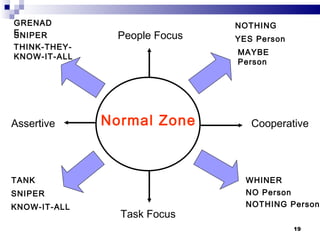
10 Most  Un wanted List 1. “ Tank ” Confrontational, pointed & angry The ultimate in pushy behavior 2. “ Sniper ” Rude comments, biting sarcasm Attempts to make you look foolish
10 Most  Un wanted List 3. “ Grenade ” After initial calm, explodes into uncontrolled ranting & raving 4. “ Know-it-All ” Has a low tolerance for correction and contradiction
10 Most  Un wanted List 5. “ Think-They-Know-It-All ” Attempt to fool some or all of the people most of the time Really an attempt to get attention 6. “ Yes Person ” Say “yes” without thinking things through An attempt to please people and avoid confrontation
10 Most  Un wanted List 7. “ Maybe Person ” Procrastinates  in hope that a better choice will present itself 8. “ Nothing Person ” No verbal feedback No non-verbal feedback Nothing
10 Most  Un wanted List 9. “ NO Person ” Able to defeat big ideas with a single syllable Deadly to morale 10. “ Whiner ” Feel overwhelmed by an unfair world Misery loves company and they bring their problems to you 2006 NSBA Convention
Four Choices These are the difficult people that most people cannot stand working with, talking to, or dealing with.  You have  four  options:
1 st  Choice 1. Stay and do nothing Leads to suffering and complaining to someone who can do nothing about it Can be dangerous because frustration builds and gets worse over time Complaining to people who can do nothing tends to lower morale
2 nd  Choice 2. Vote with your feet Not all situations are resolvable and some are just not worth resolving If everything you say makes matters worse, remember, discretion is the better part of valor Eleanor Roosevelt said, “You’re nobody’s victim without your permission.”
3 rd  Choice 3.  Change your attitude about your fellow board members Learn to:  see them differently, listen to them differently and feel differently around them Change  your  attitude to set you free from your reaction to the problem you see in their behavior
4 th  Choice 4. Change your behavior Change the way you deal with people and they will need to learn new ways to deal with you Once you know what needs to be done and how to do, you will be able to take charge of an unpleasant situation and redirect its result
Observations About People  People: Are creatures of habit Behave in certain ways to meet their needs Observations: How we communicate is a habit When our needs are not met, we react Stronger the need, the stronger the reaction
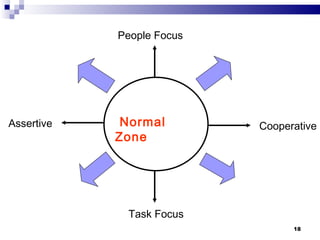
Lens of Understanding Everybody responds to different situations predictably during times of challenge, difficulty, or stress.  People tend to move outside their behavior comfort zone and become either more passive or more aggressive than normal.
Patterns For a better understanding of a person’s predictable behavior during times of duress, look for patterns of behavior to determine what  people usually focus their attention on in a given situation. People vs. Task Assertive vs. Cooperative
People Focus Assertive Cooperative Task Focus Normal Zone
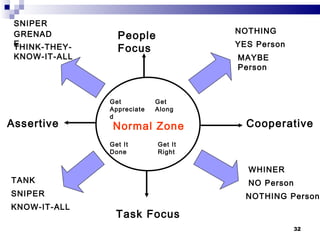
People Focus Assertive Cooperative Task Focus Normal Zone GRENADE SNIPER THINK-THEY-KNOW-IT-ALL NOTHING YES Person MAYBE Person TANK SNIPER KNOW-IT-ALL NOTHING Person NO Person WHINER
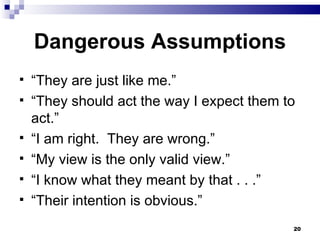
Dangerous Assumptions “ They are just like me.” “ They should act the way I expect them to act.” “ I am right.  They are wrong.” “ My view is the only valid view.” “ I know what they meant by that . . .” “ Their intention is obvious.”
Table Work Complete Communications Style choices Locate communication quadrant Separate into groups Pose questions to groups
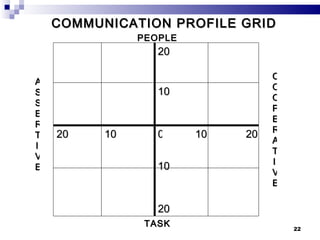
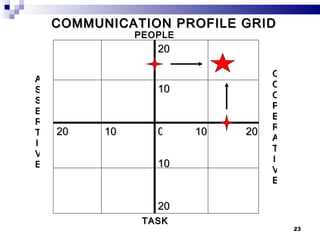
COMMUNICATION PROFILE GRID PEOPLE TASK ASSERTIVE COOPERATIVE 0 10 20 10 10 10 20 20 20
Question #1 List 5-8 words that describe your group’s behavior style.
The Nail Game
Observers Report
Behavior Has a Purpose Every behavior has an intent or  purpose and that intent is to fulfill. People do what they do based on  what seems to be most important for  any given moment. Four “general intents” determine  how people will behave in any given  situation.
Four General Intents 1. Get the job done. 2. Get the job done right. 3. Get along with people. 4. Get appreciation from people.
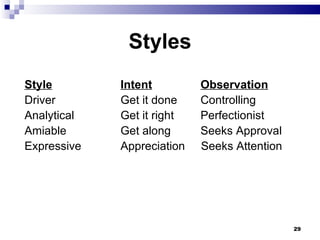
Styles   Style Intent   Observation Driver Get it done   Controlling Analytical Get it right   Perfectionist Amiable Get along   Seeks Approval Expressive Appreciation  Seeks Attention
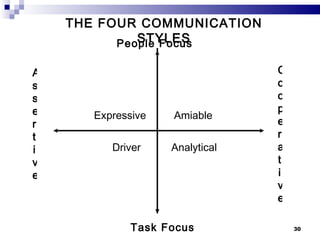
THE FOUR COMMUNICATION STYLES People Focus Task Focus Assertive Cooperative Amiable Analytical Driver Expressive
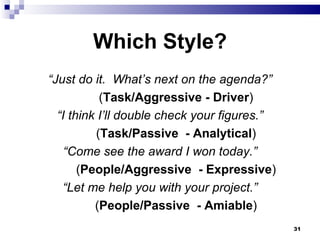
Which Style? “ Just do it.  What’s next on the agenda?” ( Task/Aggressive - Driver ) “ I think I’ll double check your figures.” ( Task/Passive  - Analytical ) “ Come see the award I won today.” ( People/Aggressive  - Expressive ) “ Let me help you with your project.” ( People/Passive  - Amiable )
People Focus Assertive Cooperative Task Focus Normal Zone Get Appreciated Get  Along Get It Done Get It Right GRENADE SNIPER THINK-THEY-KNOW-IT-ALL NOTHING YES Person MAYBE Person TANK SNIPER KNOW-IT-ALL NOTHING Person NO Person WHINER
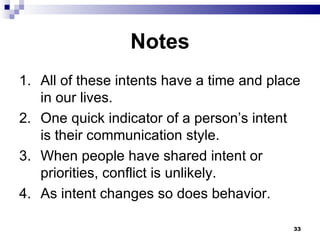
Notes 1. All of these intents have a time and place in our lives. 2. One quick indicator of a person’s intent is their communication style. 3. When people have shared intent or priorities, conflict is unlikely. 4. As intent changes so does behavior.
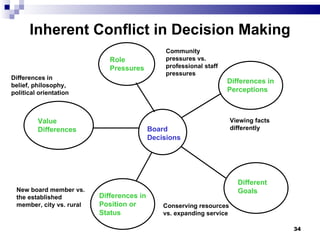
Inherent Conflict in Decision Making Board Decisions Role Pressures Value Differences Differences in Position or Status Different Goals Differences in Perceptions Community pressures vs. professional staff pressures Viewing facts differently Conserving resources vs. expanding service New board member vs. the established member, city vs. rural Differences in belief, philosophy, political orientation
Know Your Teammates Not understanding the intent and communication style of team members  amplifies the inherent conflicts already complicating board decision-making. Not understanding why groups are dysfunctional in part or whole further complicates effective decision-making.
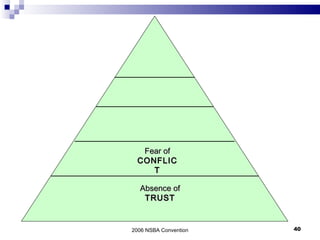
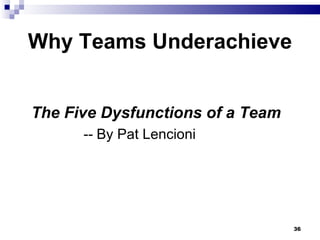
Why Teams Underachieve The Five Dysfunctions of a Team --  By Pat Lencioni
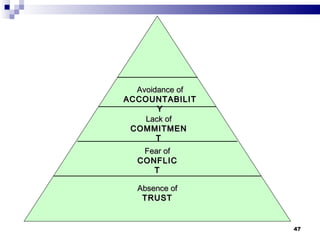
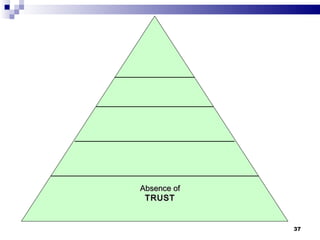
Absence of  TRUST
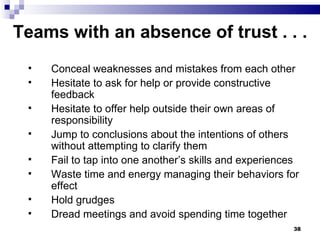
Teams with an absence of trust . . . Conceal weaknesses and mistakes from each other Hesitate to ask for help or provide constructive feedback Hesitate to offer help outside their own areas of responsibility Jump to conclusions about the intentions of others without attempting to clarify them Fail to tap into one another’s skills and experiences Waste time and energy managing their behaviors for effect  Hold grudges Dread meetings and avoid spending time together
Overcoming Lack of Trust Vulnerability-based trust requires shared experiences over time, multiple instances of follow-through and credibility, and an in-depth understanding of the unique attributes of team members. Personal Histories Exercise Team Effectiveness Exercise Personality and Behavioral Preference Profiles Spending social time together
2006 NSBA Convention Fear of  CONFLICT Absence of  TRUST
Teams that fear conflict… Have boring meetings Create environments where back-channel politics and personal attacks thrive Ignore controversial topics that are critical to team success Fail to tap into all the opinions and perspectives of team members Waste time and energy with posturing and interpersonal risk management
Overcoming Fear of Conflict The first step is acknowledging that conflict is productive. Mining Real Time Permission Personality Profiling The second step is  always  debate “issues” not personalities.
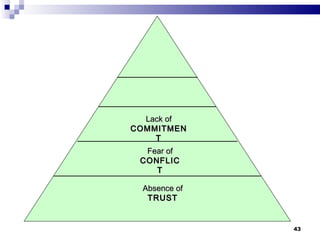
Lack of  COMMITMENT Fear of  CONFLICT Absence of  TRUST
A team that fails to commit… Creates ambiguity among the team about direction and priorities  Watches windows of opportunity close due to excessive analysis and unnecessary delay Breeds lack of confidence and fear of failure Revisits discussions and decisions again and again Encourages second-guessing among team members
Overcoming lack of commitment Discuss what needs to be achieved up front  Clarify the worst-case scenario for a decision you are struggling to make. Engage in substantial discussion. The quality of the decision is usually better than expected. Review the key decisions made during the meeting,  and agree on what needs to be communicated to other constituencies about those decisions.
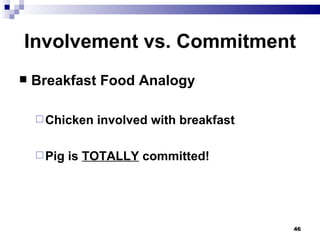
Involvement vs. Commitment Breakfast Food Analogy Chicken involved with breakfast Pig is  TOTALLY  committed!
Avoidance of  ACCOUNTABILITY Lack of  COMMITMENT Fear of  CONFLICT Absence of  TRUST
A team that avoids accountability… Creates resentment among team members who have different standards of performance Encourages mediocrity Misses deadlines and key deliverables Places an undue burden on the team leader as the sole source of discipline.
Overcoming Absence of Accountability The key to overcoming this dysfunction is adhering to a few classic management tools that are as effective as they are simple. Publication of Goals & Standards -  Clarify  publicly  exactly what the team needs to achieve, who needs to deliver what, and how everyone must behave in order to succeed.
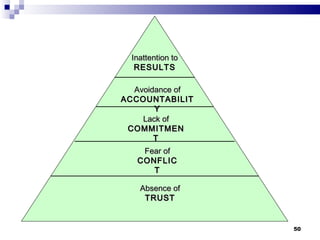
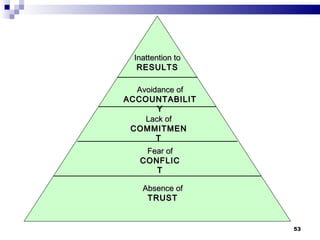
Inattention to  RESULTS Avoidance of  ACCOUNTABILITY Lack of  COMMITMENT Fear of  CONFLICT Absence of  TRUST
A team that is not focused on results… Stagnates or fails to grow Loses achievement-oriented employees and team members Encourages team members to focus on their own careers and individual goals Is easily distracted
Overcoming Inattention to Results  Public Declaration of Results  –  Committing  publicly to specific results is more likely to create a passionate, even desperate desire to achieve those results. Teams whose goal is, “We’ll do our best,” are subtly, if not purposefully, preparing themselves for failure Results-Based Rewards  – Tie the team’s rewards  to the achievement of specific outcomes.
Inattention to  RESULTS Avoidance of  ACCOUNTABILITY Lack of  COMMITMENT Fear of  CONFLICT Absence of  TRUST
Easy Steps Just as certainly some people bring out the best in you, some people bring out the worst in you. There are effective learnable strategies for building better teamwork and overcoming group dysfunctions.
Listening Skills Exercise Divide the group into pairs Select one person as the speaker Select one person as the listener Brief each group separately One minute speaking exercise Switch Speaker/Listener
Listening Exercise Debrief We communicate our interest while listening by: Verbal responses Body language
’ s Closing Remarks On Resiliency…
Listening Skills For Eye contact Focus on points of agreement Not judgmental Attentive body language No interruptions Repeat some words of speaker
Listening Skills Against Inattentive body language Verbal fillers No eye contact Distractions Kidnap their story Constant interruptions
Listening in 3 Channels VERBAL  - Actual words used VOCAL  - Tone, inflection, volume,    speed, tempo, pitch NON-VERBAL  - Body language
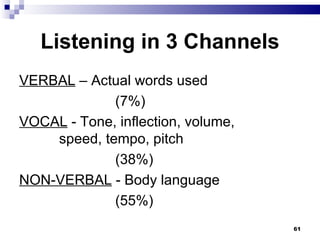
Listening in 3 Channels VERBAL  – Actual words used (7%) VOCAL  - Tone, inflection, volume,    speed, tempo, pitch (38%) NON-VERBAL  - Body language (55%)
Blending Any behavior by which you reduce the differences between you Result is to increase rapport Automatic when people share a common vision, care about each other No one cooperates with someone who seems to be against them
Blending Strategies Mirror each other’s body posture, facial expressions and degree of animation Blend with the speaker’s voice volume and speed (**anger exception**) Ask clarifying questions Identify what you think the speaker really wants
Blending Strategies Listening “for” while the difficult person vents, blows off steam, whines or complains Repeat some of the actual words the other person is using Summarize what you have heard Check for understanding
Redirecting Any behavior by which you use the rapport from “blending” to change the direction of the interaction “ Redirecting” always follows blending whether listening to understand or speaking to be understood
Tips We get along better with people when the emphasis is on our similarities Success in communication depends on finding common ground  Reducing differences is vital in dealing with people who cause you difficulty When we communicate better – teams function better
Communicate Challenge Your goal:   Communicate to be understood Action Plan: 1. Monitor your voice’s tone, pitch,  volume, pace, etc.  2. Be positive about your response 3. Tactfully interrupt  4. Ask clarifying questions 5. Be ready to listen attentively  6. Blend and Redirect
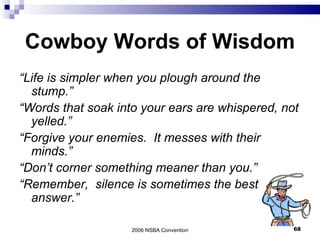
Cowboy Words of Wisdom “ Life is simpler when you plough around the stump.” “ Words that soak into your ears are whispered, not yelled.” “ Forgive your enemies.  It messes with their minds.” “ Don’t corner something meaner than you.” “ Remember,  silence is sometimes the best answer.” 2006 NSBA Convention
  Attitude Life is 10% what happens to me and 90% how I react to it!
2006 NSBA Convention
THANK YOU

Working with difficult people

  • 1.
    Working With DifficultPeople Feels Like Getting Pinched by a Lobster Claw! Presented by Greg McKenzie , Oregon School Boards Association Winton Goodrich , Vermont School Boards Association
  • 2.
    Cowboy Words ofWisdom “ Life is simpler when you plough around the stump.” “ Words that soak into your ears are whispered, not yelled.” “ Forgive your enemies. It messes with their minds.” “ Don’t corner something meaner than you.” “ Remember, silence is sometimes the best answer.”
  • 3.
    Coping With DifficultPeople Dr. Robert Bramson Dealing With People You Can’t Stand Dr. Rick Brinkman & Dr. Rick Kirschner
  • 4.
    10 Most Un wanted List 1. “ Tank ” Confrontational, pointed & angry The ultimate in pushy behavior 2. “ Sniper ” Rude comments, biting sarcasm Attempts to make you look foolish
  • 5.
    10 Most Un wanted List 3. “ Grenade ” After initial calm, explodes into uncontrolled ranting & raving 4. “ Know-it-All ” Has a low tolerance for correction and contradiction
  • 6.
    10 Most Un wanted List 5. “ Think-They-Know-It-All ” Attempt to fool some or all of the people most of the time Really an attempt to get attention 6. “ Yes Person ” Say “yes” without thinking things through An attempt to please people and avoid confrontation
  • 7.
    10 Most Un wanted List 7. “ Maybe Person ” Procrastinates in hope that a better choice will present itself 8. “ Nothing Person ” No verbal feedback No non-verbal feedback Nothing
  • 8.
    10 Most Un wanted List 9. “ NO Person ” Able to defeat big ideas with a single syllable Deadly to morale 10. “ Whiner ” Feel overwhelmed by an unfair world Misery loves company and they bring their problems to you 2006 NSBA Convention
  • 9.
    Four Choices Theseare the difficult people that most people cannot stand working with, talking to, or dealing with. You have four options:
  • 10.
    1 st Choice 1. Stay and do nothing Leads to suffering and complaining to someone who can do nothing about it Can be dangerous because frustration builds and gets worse over time Complaining to people who can do nothing tends to lower morale
  • 11.
    2 nd Choice 2. Vote with your feet Not all situations are resolvable and some are just not worth resolving If everything you say makes matters worse, remember, discretion is the better part of valor Eleanor Roosevelt said, “You’re nobody’s victim without your permission.”
  • 13.
    3 rd Choice 3. Change your attitude about your fellow board members Learn to: see them differently, listen to them differently and feel differently around them Change your attitude to set you free from your reaction to the problem you see in their behavior
  • 14.
    4 th Choice 4. Change your behavior Change the way you deal with people and they will need to learn new ways to deal with you Once you know what needs to be done and how to do, you will be able to take charge of an unpleasant situation and redirect its result
  • 15.
    Observations About People People: Are creatures of habit Behave in certain ways to meet their needs Observations: How we communicate is a habit When our needs are not met, we react Stronger the need, the stronger the reaction
  • 16.
    Lens of UnderstandingEverybody responds to different situations predictably during times of challenge, difficulty, or stress. People tend to move outside their behavior comfort zone and become either more passive or more aggressive than normal.
  • 17.
    Patterns For abetter understanding of a person’s predictable behavior during times of duress, look for patterns of behavior to determine what people usually focus their attention on in a given situation. People vs. Task Assertive vs. Cooperative
  • 18.
    People Focus AssertiveCooperative Task Focus Normal Zone
  • 19.
    People Focus AssertiveCooperative Task Focus Normal Zone GRENADE SNIPER THINK-THEY-KNOW-IT-ALL NOTHING YES Person MAYBE Person TANK SNIPER KNOW-IT-ALL NOTHING Person NO Person WHINER
  • 20.
    Dangerous Assumptions “They are just like me.” “ They should act the way I expect them to act.” “ I am right. They are wrong.” “ My view is the only valid view.” “ I know what they meant by that . . .” “ Their intention is obvious.”
  • 21.
    Table Work CompleteCommunications Style choices Locate communication quadrant Separate into groups Pose questions to groups
  • 22.
    COMMUNICATION PROFILE GRIDPEOPLE TASK ASSERTIVE COOPERATIVE 0 10 20 10 10 10 20 20 20
  • 23.
    COMMUNICATION PROFILE GRIDPEOPLE TASK ASSERTIVE COOPERATIVE 0 10 20 10 10 10 20 20 20
  • 24.
    Question #1 List5-8 words that describe your group’s behavior style.
  • 25.
  • 26.
  • 27.
    Behavior Has aPurpose Every behavior has an intent or purpose and that intent is to fulfill. People do what they do based on what seems to be most important for any given moment. Four “general intents” determine how people will behave in any given situation.
  • 28.
    Four General Intents1. Get the job done. 2. Get the job done right. 3. Get along with people. 4. Get appreciation from people.
  • 29.
    Styles Style Intent Observation Driver Get it done Controlling Analytical Get it right Perfectionist Amiable Get along Seeks Approval Expressive Appreciation Seeks Attention
  • 30.
    THE FOUR COMMUNICATIONSTYLES People Focus Task Focus Assertive Cooperative Amiable Analytical Driver Expressive
  • 31.
    Which Style? “Just do it. What’s next on the agenda?” ( Task/Aggressive - Driver ) “ I think I’ll double check your figures.” ( Task/Passive - Analytical ) “ Come see the award I won today.” ( People/Aggressive - Expressive ) “ Let me help you with your project.” ( People/Passive - Amiable )
  • 32.
    People Focus AssertiveCooperative Task Focus Normal Zone Get Appreciated Get Along Get It Done Get It Right GRENADE SNIPER THINK-THEY-KNOW-IT-ALL NOTHING YES Person MAYBE Person TANK SNIPER KNOW-IT-ALL NOTHING Person NO Person WHINER
  • 33.
    Notes 1. Allof these intents have a time and place in our lives. 2. One quick indicator of a person’s intent is their communication style. 3. When people have shared intent or priorities, conflict is unlikely. 4. As intent changes so does behavior.
  • 34.
    Inherent Conflict inDecision Making Board Decisions Role Pressures Value Differences Differences in Position or Status Different Goals Differences in Perceptions Community pressures vs. professional staff pressures Viewing facts differently Conserving resources vs. expanding service New board member vs. the established member, city vs. rural Differences in belief, philosophy, political orientation
  • 35.
    Know Your TeammatesNot understanding the intent and communication style of team members amplifies the inherent conflicts already complicating board decision-making. Not understanding why groups are dysfunctional in part or whole further complicates effective decision-making.
  • 36.
    Why Teams UnderachieveThe Five Dysfunctions of a Team -- By Pat Lencioni
  • 37.
  • 38.
    Teams with anabsence of trust . . . Conceal weaknesses and mistakes from each other Hesitate to ask for help or provide constructive feedback Hesitate to offer help outside their own areas of responsibility Jump to conclusions about the intentions of others without attempting to clarify them Fail to tap into one another’s skills and experiences Waste time and energy managing their behaviors for effect Hold grudges Dread meetings and avoid spending time together
  • 39.
    Overcoming Lack ofTrust Vulnerability-based trust requires shared experiences over time, multiple instances of follow-through and credibility, and an in-depth understanding of the unique attributes of team members. Personal Histories Exercise Team Effectiveness Exercise Personality and Behavioral Preference Profiles Spending social time together
  • 40.
    2006 NSBA ConventionFear of CONFLICT Absence of TRUST
  • 41.
    Teams that fearconflict… Have boring meetings Create environments where back-channel politics and personal attacks thrive Ignore controversial topics that are critical to team success Fail to tap into all the opinions and perspectives of team members Waste time and energy with posturing and interpersonal risk management
  • 42.
    Overcoming Fear ofConflict The first step is acknowledging that conflict is productive. Mining Real Time Permission Personality Profiling The second step is always debate “issues” not personalities.
  • 43.
    Lack of COMMITMENT Fear of CONFLICT Absence of TRUST
  • 44.
    A team thatfails to commit… Creates ambiguity among the team about direction and priorities Watches windows of opportunity close due to excessive analysis and unnecessary delay Breeds lack of confidence and fear of failure Revisits discussions and decisions again and again Encourages second-guessing among team members
  • 45.
    Overcoming lack ofcommitment Discuss what needs to be achieved up front Clarify the worst-case scenario for a decision you are struggling to make. Engage in substantial discussion. The quality of the decision is usually better than expected. Review the key decisions made during the meeting, and agree on what needs to be communicated to other constituencies about those decisions.
  • 46.
    Involvement vs. CommitmentBreakfast Food Analogy Chicken involved with breakfast Pig is TOTALLY committed!
  • 47.
    Avoidance of ACCOUNTABILITY Lack of COMMITMENT Fear of CONFLICT Absence of TRUST
  • 48.
    A team thatavoids accountability… Creates resentment among team members who have different standards of performance Encourages mediocrity Misses deadlines and key deliverables Places an undue burden on the team leader as the sole source of discipline.
  • 49.
    Overcoming Absence ofAccountability The key to overcoming this dysfunction is adhering to a few classic management tools that are as effective as they are simple. Publication of Goals & Standards - Clarify publicly exactly what the team needs to achieve, who needs to deliver what, and how everyone must behave in order to succeed.
  • 50.
    Inattention to RESULTS Avoidance of ACCOUNTABILITY Lack of COMMITMENT Fear of CONFLICT Absence of TRUST
  • 51.
    A team thatis not focused on results… Stagnates or fails to grow Loses achievement-oriented employees and team members Encourages team members to focus on their own careers and individual goals Is easily distracted
  • 52.
    Overcoming Inattention toResults Public Declaration of Results – Committing publicly to specific results is more likely to create a passionate, even desperate desire to achieve those results. Teams whose goal is, “We’ll do our best,” are subtly, if not purposefully, preparing themselves for failure Results-Based Rewards – Tie the team’s rewards to the achievement of specific outcomes.
  • 53.
    Inattention to RESULTS Avoidance of ACCOUNTABILITY Lack of COMMITMENT Fear of CONFLICT Absence of TRUST
  • 54.
    Easy Steps Justas certainly some people bring out the best in you, some people bring out the worst in you. There are effective learnable strategies for building better teamwork and overcoming group dysfunctions.
  • 55.
    Listening Skills ExerciseDivide the group into pairs Select one person as the speaker Select one person as the listener Brief each group separately One minute speaking exercise Switch Speaker/Listener
  • 56.
    Listening Exercise DebriefWe communicate our interest while listening by: Verbal responses Body language
  • 57.
    ’ s ClosingRemarks On Resiliency…
  • 58.
    Listening Skills ForEye contact Focus on points of agreement Not judgmental Attentive body language No interruptions Repeat some words of speaker
  • 59.
    Listening Skills AgainstInattentive body language Verbal fillers No eye contact Distractions Kidnap their story Constant interruptions
  • 60.
    Listening in 3Channels VERBAL - Actual words used VOCAL - Tone, inflection, volume, speed, tempo, pitch NON-VERBAL - Body language
  • 61.
    Listening in 3Channels VERBAL – Actual words used (7%) VOCAL - Tone, inflection, volume, speed, tempo, pitch (38%) NON-VERBAL - Body language (55%)
  • 62.
    Blending Any behaviorby which you reduce the differences between you Result is to increase rapport Automatic when people share a common vision, care about each other No one cooperates with someone who seems to be against them
  • 63.
    Blending Strategies Mirroreach other’s body posture, facial expressions and degree of animation Blend with the speaker’s voice volume and speed (**anger exception**) Ask clarifying questions Identify what you think the speaker really wants
  • 64.
    Blending Strategies Listening“for” while the difficult person vents, blows off steam, whines or complains Repeat some of the actual words the other person is using Summarize what you have heard Check for understanding
  • 65.
    Redirecting Any behaviorby which you use the rapport from “blending” to change the direction of the interaction “ Redirecting” always follows blending whether listening to understand or speaking to be understood
  • 66.
    Tips We getalong better with people when the emphasis is on our similarities Success in communication depends on finding common ground Reducing differences is vital in dealing with people who cause you difficulty When we communicate better – teams function better
  • 67.
    Communicate Challenge Yourgoal: Communicate to be understood Action Plan: 1. Monitor your voice’s tone, pitch, volume, pace, etc. 2. Be positive about your response 3. Tactfully interrupt 4. Ask clarifying questions 5. Be ready to listen attentively 6. Blend and Redirect
  • 68.
    Cowboy Words ofWisdom “ Life is simpler when you plough around the stump.” “ Words that soak into your ears are whispered, not yelled.” “ Forgive your enemies. It messes with their minds.” “ Don’t corner something meaner than you.” “ Remember, silence is sometimes the best answer.” 2006 NSBA Convention
  • 69.
    AttitudeLife is 10% what happens to me and 90% how I react to it!
  • 70.
  • 71.

Editor's Notes

  • #35 While these are all single and separate elements, they are often all present in decision making situations and act upon each other to create the conflict.