WTCSB Clinical Workforce Development
Manager Clinical Workgroup
2
Program Manager Clinical Training Group
Welcome & Introductions!
1. Business & Housekeeping
a) OP Conference
๏ƒผKeynote Speaker: Elliot Connie
๏ƒผVolunteers for Conference Committee
b) Implementing the Socratic Team Model with Program
c) Schedule for Today
๏ƒผClinical Practice training
๏ƒผBreakout sessions: Case Presentation and Role Play (10 am to 12 am). 1-2 cases depending on complexity.
๏ƒผLunch & Learn Regroup (12-1)
2. Clinical Practice: training, discussion & role play on clinical best practice methods and professional
competencies: โ€œPassive Aggression and the Emergence of Symptomsโ€
3. Case Presentation (s): case assessment, treatment planning and modeling/practice of interventive technique.
Agenda: Friday, November 15, 2024; 8:30 โ€“ 1:00; HV
3
Reminder:
These meetings are part of a continuous Learning Experience!!!
Our goal is to improve how we teach and
train staff in counseling and psychotherapy!
Passive Aggression and the
Emergence of Symptoms
Or, How to Influence Others Without Really Trying!
Power = Self-Esteem
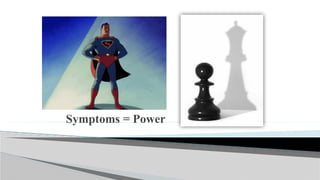
Symptoms = Power
Oxford Dictionary:
Power is โ€œthe capacity or ability to direct or influence the behavior of others or the course of events.โ€
Sources of Power:
Role, Function, Title, Experience, Expertise, Resources, Money, Notoriety, and strong Interpersonal Skills such as leadership skills,
charisma, effective communication, strong decision-making abilities, self-confidence, and the ability to navigate complex situations.
In Therapy: How is the Power Dynamic manipulated?
1. Who or what can empower the client or motivate them to change?
2. How do 3rd
Parties, including Triangles, Collusions, & Alliances, shift power in relationships?
3. How is Aggression, Abuse, or Emotional Injury used to Over-Power or Undermine Others?
4. How is Self-sabotage (Passive Aggressions) such as Failure, Displays of Inadequacy, and even Illness,
Depression and Suicide used to relinquish power, frustrate or ensnare others?
5. Symptoms: what role do they play in the Power Dynamic?
6
Power
7
What are
Symptoms?
(psychological problems?)
..and what is their
relationship to Power &
Passive Aggression?
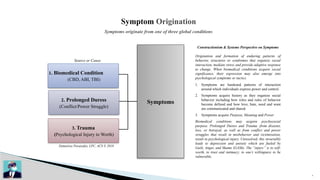
Constructionism & Systems Perspective on Symptoms
Origination and formation of enduring patterns of
behavior, structures or syndromes that organize social
interaction, mediate stress and provide adaptive response
to change. When biomedical conditions acquire social
significance, their expression may also emerge into
psychological symptoms or tactics.
1. Symptoms are hardened patterns of interaction
around which individuals express power and control.
2. Symptoms acquire history as they organize social
behavior including how roles and rules of behavior
become defined and how love, hate, need and want
are communicated and shared.
3. Symptoms acquire Purpose, Meaning and Power
Biomedical conditions may acquire psychosocial
purpose. Prolonged Duress and Trauma -from disaster,
loss, or betrayal, as well as from conflict and power
struggles that result in misbehavior and victimization,
result in psychological injury. Unresolved, this invariably
leads to depression and anxiety which are fueled by
Guilt, Anger, and Shame (GASh). The โ€œinjuryโ€ is to self-
worth, to trust and intimacy; to oneโ€™s willingness to be
vulnerable.
Symptom Origination
Symptoms originate from one of three global conditions
Symptoms
1. Biomedical Condition
(CBD, ABI, TBI)
2. Prolonged Duress
(Conflict/Power Struggle)
3. Trauma
(Psychological Injury to Worth)
Source or Cause
Demetrios Peratsakis, LPC, ACS ยฉ 2018
8
9
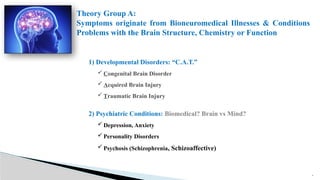
Theory Group A:
Symptoms originate from Bioneuromedical Illnesses & Conditions
Problems with the Brain Structure, Chemistry or Function
1) Developmental Disorders: โ€œC.A.T.โ€
๏ƒผ Congenital Brain Disorder
๏ƒผ Acquired Brain Injury
๏ƒผ Traumatic Brain Injury
2) Psychiatric Conditions: Biomedical? Brain vs Mind?
๏ƒผ Depression, Anxiety
๏ƒผ Personality Disorders
๏ƒผ Psychosis (Schizophrenia, Schizoaffective)
10
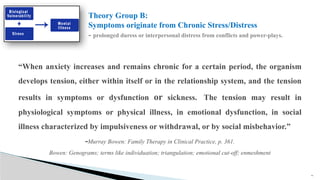
Theory Group B:
Symptoms originate from Chronic Stress/Distress
- prolonged duress or interpersonal distress from conflicts and power-plays.
โ€œWhen anxiety increases and remains chronic for a certain period, the organism
develops tension, either within itself or in the relationship system, and the tension
results in symptoms or dysfunction or sickness. The tension may result in
physiological symptoms or physical illness, in emotional dysfunction, in social
illness characterized by impulsiveness or withdrawal, or by social misbehavior.โ€
-Murray Bowen: Family Therapy in Clinical Practice, p. 361.
Bowen: Genograms; terms like individuation; triangulation; emotional cut-off; enmeshment
11
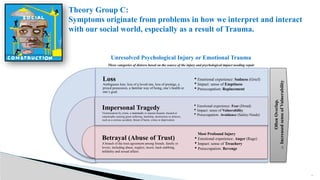
Theory Group C:
Symptoms originate from problems in how we interpret and interact
with our social world, especially as a result of Trauma.
Loss
Ambiguous loss; loss of a loved one, loss of prestige, a
prized possession, a familiar way of being, oneโ€™s health or
oneโ€™s goal.
Betrayal (Abuse of Trust)
A breach of the trust agreement among friends, family or
lovers, including abuse, neglect, incest, back-stabbing,
infidelity and sexual affairs.
Impersonal Tragedy
Victimization by crime, a manmade or natural disaster, hazard or
catastrophe causing great suffering, hardship, destruction or distress,
such as a serious accident, threat of harm, crime or deprivation.
๏‚ง Emotional experience: Sadness (Grief)
๏‚ง Impact: sense of Emptiness
๏‚ง Preoccupation: Replacement
Most Profound Injury
๏‚ง Emotional experience: Anger (Rage)
๏‚ง Impact: sense of Treachery
๏‚ง Preoccupation: Revenge
๏‚ง Emotional experience: Fear (Dread)
๏‚ง Impact: sense of Vulnerability
๏‚ง Preoccupation: Avoidance (Safety-Needs)
Unresolved Psychological Injury or Emotional Trauma
Three categories of distress based on the source of the injury and psychological impact needing repair
Often
Overlap.
๏ƒŸ
Increased
sense
of
Vulnerability
12
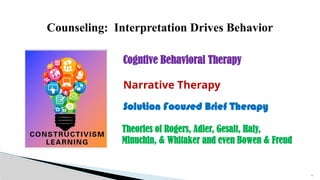
Cogntive Behavioral Therapy
Narrative Therapy
Solution Focused Brief Therapy
Theories of Rogers, Adler, Gesalt, Haly,
Minuchin, & Whitaker and even Bowen & Freud
Counseling: Interpretation Drives Behavior
13
Letโ€™s Put on Our Thinking Caps !
14
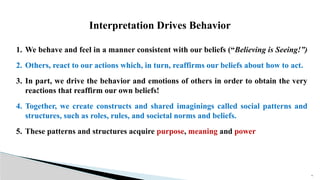
1. We behave and feel in a manner consistent with our beliefs (โ€œBelieving is Seeing!โ€)
2. Others, react to our actions which, in turn, reaffirms our beliefs about how to act.
3. In part, we drive the behavior and emotions of others in order to obtain the very
reactions that reaffirm our own beliefs!
4. Together, we create constructs and shared imaginings called social patterns and
structures, such as roles, rules, and societal norms and beliefs.
5. These patterns and structures acquire purpose, meaning and power
Interpretation Drives Behavior
15
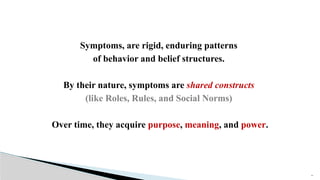
Symptoms, are rigid, enduring patterns
of behavior and belief structures.
By their nature, symptoms are shared constructs
(like Roles, Rules, and Social Norms)
Over time, they acquire purpose, meaning, and power.
16
โ€œAll social interaction includes an attempt โ€“or struggle,
to control the definition of the relationship.
Symptoms, are tactics in human relationships. Inherent, is the
metacommunication that the individual has no control over the symptom.
They are passive-aggressive power-plays.
The primary goal of the symptomatic behavior
is to create an advantage by which the individual can
gain control over another and set the rules for that relationship.โ€
- Jay Haley, Strategies of Psychotherapy, 1963, Grune and Stratton.
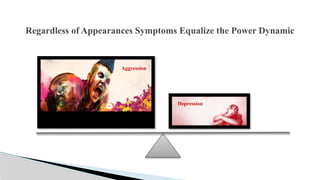
Regardless of Appearances Symptoms Equalize the Power Dynamic
Depression
Aggression
Symptoms are a Passive
Aggressive Display of Power
What is it?
๏‚ง A form of avoidance, an expression of unwillingness, denial, rejection or refusal.
๏‚ง We all do it, typically around demands, tasks, or expectations we find unpleasant
or contrary to our desires and interests.
๏‚ง It is a form of control, an expression of Power: an interpersonal tactic whose
purpose is to control others through the secretive manipulation of events,
circumstances, resources, decisions, and outcomes.
๏‚ง Some, use it as a means of coping or self-protection. It can be incredibly powerful;
as when used in depression/anxiety, personality disorders, psychosis, suicide, or the
use of symptoms.
19
Passive Aggression
20
Why we do it?
๏‚ง To get out of doing things we donโ€™t wish to do. To get our way.
๏‚ง To inflate self-esteem with a false sense of empowerment (I get my way! I win! = I must be important)
๏‚ง To control, frustrate, punish, retaliate or overpower others.
๏‚ง To avoid responsibility; passivity forces others to act or decide or delays until circumstances are
more favorable. Responsibility carries the burden of potential failure.
๏‚ง To avoid blame (and shame): excuses failure and inadequacies and lowers performance expectation.
๏‚ง Excitement from secret refusal to comply or abide by the rules
๏‚ง Modulates intimacy and the risk of emotional injury
Passive Aggression
Why itโ€™s Not Healthy?
1) Resentment by others (antisocial); this reduces intimacy and increases
the potential for rejection. For some, rejection is the goal.
2) Reduces opportunity for growth. Although risk is avoided, so is the
reward of achievement and accomplishment.
3) Symptoms must often emerge (or are be used) to perpetuate control
and avoidance while remaining blameless and not responsible.
Symptoms also provide a false sense of โ€œnobilityโ€ -- one perceivers
despite their โ€œhardshipโ€ or โ€œdisabilityโ€.
21
Passive Aggression
22
Passive Aggression allows one to gain or retain control whenever one can
1. Be Exempt from the Rules!
(ie. Depression)
2. Defy the Rules!
(ie. antisocialism, criminality, paraphilia/deviance)
3. Negate the Rules!
(ie. psychosis)
Bottom-Line
23
Demetrios Peratsakis, ACS, LPC ยฉ 2014, 2024
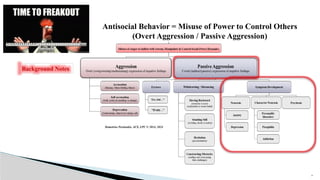
Antisocial Behavior = Misuse of Power to Control Others
(Overt Aggression / Passive Aggression)
Background Notes
24
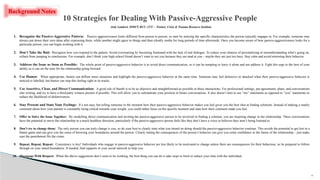
1. Recognize the Passive-Aggressive Pattern: Passive aggressiveness looks different from person to person, so start by noticing the specific characteristics the person typically engages in. For example, someone may
always put down their own ideas after expressing them, while another might agree to things and then silently seethe for long periods of time afterwards. Once you become aware of how passive-aggressiveness looks for a
particular person, you can begin working with it.
2. Donโ€™t Take the Bait: Recognize how you respond to the pattern. Avoid overreacting by becoming frustrated with the lack of real dialogue. To reduce your chances of personalizing or misunderstanding whatโ€™s going on,
refrain from jumping to conclusions. For example, donโ€™t think your high school friend doesnโ€™t want to see you because they are mad at you โ€“ maybe they are just too busy. Stay calm and avoid mirroring their behavior.
3. Address the Issue as Soon as Possible: The whole point of passive-aggressive behavior is to avoid direct communication, so it can be tempting to leave it alone and not address it. Fight this urge to the best of your
ability as it can set the tone for the relationship going forward.
4. Use Humor: When appropriate, humor can diffuse tense situations and highlight the passive-aggressive behavior at the same time. Someone may feel defensive or attacked when their passive-aggressive behavior is
noticed or labelled, but humor can stop this feeling right in its tracks.
5. Use Assertive, Clear, and Direct Communication: A good rule of thumb is to be as objective and straightforward as possible in these interactions. For professional settings, put agreements, plans, and conversations
into writing, and try to have a third-party witness present if possible. This will allow you to substantiate your position in future conversations. It also doesnโ€™t hurt to use โ€œmeโ€ statements as opposed to โ€œyouโ€ statements to
reduce the likelihood of defensiveness.
6. Stay Present and State Your Feelings: Itโ€™s not easy, but telling someone in the moment how their passive-aggressive behavior makes you feel gives you the best shot at finding solutions. Instead of making a snarky
comment about how your partner is constantly being critical towards your weight, you could rather focus on the specific moment and state how their comment made you feel.
7. Offer to Solve the Issue Together: By modelling direct communication and inviting the passive-aggressive person to be involved in finding a solution, you are inspiring change in the relationship. These conversations
have the potential to move the relationship in a much healthier direction, particularly if the passive-aggressive person feels like they donโ€™t have a voice or believes they arenโ€™t being listened to.
8. Donโ€™t try to change them: The only person you can truly change is you, so do your best to clearly state what you intend on doing should the passive-aggressive behavior continue. This avoids the potential to get lost in a
blame game and can give you the sense of knowing your boundaries around the person. Clearly stating the consequences of the personโ€™s behavior can give you some confidence in the future of the relationship โ€“ just make
sure the punishment fits the crime.
9. Repeat, Repeat, Repeat: Consistency is key! Individuals who engage in passive-aggressive behavior are less likely to be motivated to change unless there are consequences for their behaviour, so be prepared to follow
through on your stated boundaries. If needed, find supports in your social network to help you.
10. Disengage With Respect: When the above suggestions donโ€™t seem to be working, the best thing you can do is take steps to limit or reduce your time with the individual.
10 Strategies for Dealing With Passive-Aggressive People
Jody Lambert, MMFT, RCC, CCC โ€“ Trainer, Crisis & Trauma Resource Institute
Background Notes
25
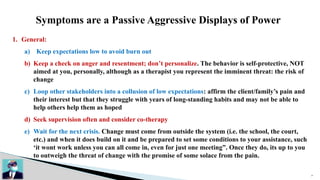
1. General:
a) Keep expectations low to avoid burn out
b) Keep a check on anger and resentment; donโ€™t personalize. The behavior is self-protective, NOT
aimed at you, personally, although as a therapist you represent the imminent threat: the risk of
change
c) Loop other stakeholders into a collusion of low expectations: affirm the client/familyโ€™s pain and
their interest but that they struggle with years of long-standing habits and may not be able to
help others help them as hoped
d) Seek supervision often and consider co-therapy
e) Wait for the next crisis. Change must come from outside the system (i.e. the school, the court,
etc.) and when it does build on it and be prepared to set some conditions to your assistance, such
โ€˜it wont work unless you can all come in, even for just one meetingโ€. Once they do, its up to you
to outweigh the threat of change with the promise of some solace from the pain.
Symptoms are a Passive Aggressive Displays of Power
26
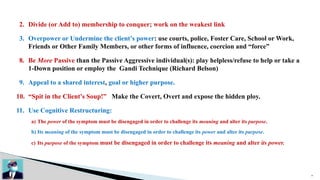
2. Divide (or Add to) membership to conquer; work on the weakest link
3. Overpower or Undermine the clientโ€™s power: use courts, police, Foster Care, School or Work,
Friends or Other Family Members, or other forms of influence, coercion and โ€œforceโ€
8. Be More Passive than the Passive Aggressive individual(s): play helpless/refuse to help or take a
1-Down position or employ the Gandi Technique (Richard Belson)
9. Appeal to a shared interest, goal or higher purpose.
10. โ€œSpit in the Clientโ€™s Soup!โ€ Make the Covert, Overt and expose the hidden ploy.
11. Use Cognitive Restructuring:
a) The power of the symptom must be disengaged in order to challenge its meaning and alter its purpose.
b) Its meaning of the symptom must be disengaged in order to challenge its power and alter its purpose.
c) Its purpose of the symptom must be disengaged in order to challenge its meaning and alter its power.
27
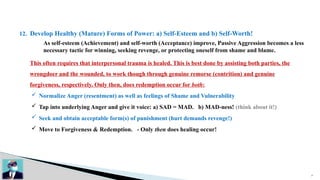
12. Develop Healthy (Mature) Forms of Power: a) Self-Esteem and b) Self-Worth!
As self-esteem (Achievement) and self-worth (Acceptance) improve, Passive Aggression becomes a less
necessary tactic for winning, seeking revenge, or protecting oneself from shame and blame.
This often requires that interpersonal trauma is healed. This is best done by assisting both parties, the
wrongdoer and the wounded, to work though through genuine remorse (contrition) and genuine
forgiveness, respectively. Only then, does redemption occur for both:
๏ƒผ Normalize Anger (resentment) as well as feelings of Shame and Vulnerability
๏ƒผ Tap into underlying Anger and give it voice: a) SAD = MAD. b) MAD-ness! (think about it!)
๏ƒผ Seek and obtain acceptable form(s) of punishment (hurt demands revenge!)
๏ƒผ Move to Forgiveness & Redemption. - Only then does healing occur!
28
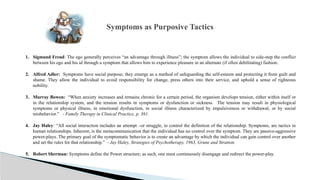
1. Sigmund Freud: The ego generally perceives โ€œan advantage through illnessโ€; the symptom allows the individual to side-step the conflict
between his ego and his id through a symptom that allows him to experience pleasure in an alternate (if often debilitating) fashion.
2. Alfred Adler: Symptoms have social purpose; they emerge as a method of safeguarding the self-esteem and protecting it from guilt and
shame. They allow the individual to avoid responsibility for change, press others into their service, and uphold a sense of righteous
nobility.
3. Murray Bowen: โ€œWhen anxiety increases and remains chronic for a certain period, the organism develops tension, either within itself or
in the relationship system, and the tension results in symptoms or dysfunction or sickness. The tension may result in physiological
symptoms or physical illness, in emotional dysfunction, in social illness characterized by impulsiveness or withdrawal, or by social
misbehavior.โ€ - Family Therapy in Clinical Practice, p. 361.
4. Jay Haley: โ€œAll social interaction includes an attempt โ€“or struggle, to control the definition of the relationship. Symptoms, are tactics in
human relationships. Inherent, is the metacommunication that the individual has no control over the symptom. They are passive-aggressive
power-plays. The primary goal of the symptomatic behavior is to create an advantage by which the individual can gain control over another
and set the rules for that relationship.โ€ - Jay Haley, Strategies of Psychotherapy, 1963, Grune and Stratton.
5. Robert Sherman: Symptoms define the Power structure; as such, one must continuously disengage and redirect the power-play.
Symptoms as Purposive Tactics
Ready for a
Mind Blower?!
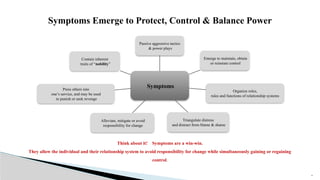
Symptoms
Passive aggressive tactics
& power plays
Emerge to maintain, obtain
or reinstate control
Organize roles,
rules and functions of relationship systems
Triangulate distress
and distract from blame & shame
Alleviate, mitigate or avoid
responsibility for change
Press others into
oneโ€™s service, and may be used
to punish or seek revenge
Contain inherent
traits of โ€œnobilityโ€
31
Symptoms Emerge to Protect, Control & Balance Power
Think about it! Symptoms are a win-win.
They allow the individual and their relationship system to avoid responsibility for change while simultaneously gaining or regaining
control.
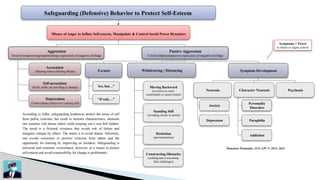
Safeguarding (Defensive) Behavior to Protect Self-Esteem
Misuse of Anger to Inflate Self-esteem, Manipulate & Control Social Power Dynamics
Aggression
Overt (overpowering/undermining) expression of negative feelings
Accusation
(Blaming Others/Shifting Blame)
Self-accusation
(Guilt, noble yet unwilling to change)
Deprecation
(Undervaluing others/over valuing self)
Passive Aggression
Covert (indirect/passive) expression of negative feelings
Excuses
Yes, butโ€ฆโ€
โ€œIf onlyโ€ฆโ€
Withdrawing / Distancing
Moving Backward
(reversion to more
comfortable or secure belief)
Standing Still
(avoiding choice or action)
Hesitation
(procrastination)
Constructing Obstacles
(crafting and overcoming
false challenges)
Symptom Development
Neurosis
Anxiety
Depression
Character Neurosis
Personality
Disorders
Paraphilia
Addiction
Psychosis
Symptoms = Power
to obtain or regain control
According to Adler, safeguarding tendencies protect the sense of self
from public criticism, but result in neurotic characteristics, elements
one assumes will please others while keeping oneโ€™s real Self hidden.
The result is a fictional existence that avoids risk of failure and
mitigates critique by others. The intent is to avoid shame. Adversely,
one avoids correction or positive criticism from others and the
opportunity for learning by improving on mistakes. Safeguarding is
universal and common; overreliance, however, as a means to protect
self-esteem and avoid responsibility for change is problematic.
Demetrios Peratsakis, ACS, LPC ยฉ 2014, 2024
33
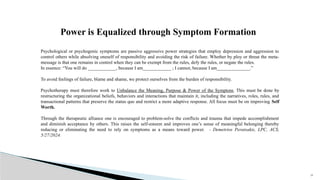
Psychological or psychogenic symptoms are passive aggressive power strategies that employ depression and aggression to
control others while absolving oneself of responsibility and avoiding the risk of failure. Whether by ploy or threat the meta-
message is that one remains in control when they can be exempt from the rules, defy the rules, or negate the rules.
In essence: โ€œYou will do ____________, because I am____________ ; I cannot, because I am______________.โ€
To avoid feelings of failure, blame and shame, we protect ourselves from the burden of responsibility.
Psychotherapy must therefore work to Unbalance the Meaning, Purpose & Power of the Symptom. This must be done by
restructuring the organizational beliefs, behaviors and interactions that maintain it, including the narratives, roles, rules, and
transactional patterns that preserve the status quo and restrict a more adaptive response. All focus must be on improving Self
Worth.
Through the therapeutic alliance one is encouraged to problem-solve the conflicts and trauma that impede accomplishment
and diminish acceptance by others. This raises the self-esteem and improves oneโ€™s sense of meaningful belonging thereby
reducing or eliminating the need to rely on symptoms as a means toward power. - Demetrios Peratsakis, LPC, ACS,
5/27/2024.
Power is Equalized through Symptom Formation

Passive Aggression in Counseling & Psychotherapy

  • 1.
    WTCSB Clinical WorkforceDevelopment Manager Clinical Workgroup
  • 2.
    2 Program Manager ClinicalTraining Group Welcome & Introductions! 1. Business & Housekeeping a) OP Conference ๏ƒผKeynote Speaker: Elliot Connie ๏ƒผVolunteers for Conference Committee b) Implementing the Socratic Team Model with Program c) Schedule for Today ๏ƒผClinical Practice training ๏ƒผBreakout sessions: Case Presentation and Role Play (10 am to 12 am). 1-2 cases depending on complexity. ๏ƒผLunch & Learn Regroup (12-1) 2. Clinical Practice: training, discussion & role play on clinical best practice methods and professional competencies: โ€œPassive Aggression and the Emergence of Symptomsโ€ 3. Case Presentation (s): case assessment, treatment planning and modeling/practice of interventive technique. Agenda: Friday, November 15, 2024; 8:30 โ€“ 1:00; HV
  • 3.
    3 Reminder: These meetings arepart of a continuous Learning Experience!!! Our goal is to improve how we teach and train staff in counseling and psychotherapy!
  • 4.
    Passive Aggression andthe Emergence of Symptoms Or, How to Influence Others Without Really Trying!
  • 5.
  • 6.
    Oxford Dictionary: Power isโ€œthe capacity or ability to direct or influence the behavior of others or the course of events.โ€ Sources of Power: Role, Function, Title, Experience, Expertise, Resources, Money, Notoriety, and strong Interpersonal Skills such as leadership skills, charisma, effective communication, strong decision-making abilities, self-confidence, and the ability to navigate complex situations. In Therapy: How is the Power Dynamic manipulated? 1. Who or what can empower the client or motivate them to change? 2. How do 3rd Parties, including Triangles, Collusions, & Alliances, shift power in relationships? 3. How is Aggression, Abuse, or Emotional Injury used to Over-Power or Undermine Others? 4. How is Self-sabotage (Passive Aggressions) such as Failure, Displays of Inadequacy, and even Illness, Depression and Suicide used to relinquish power, frustrate or ensnare others? 5. Symptoms: what role do they play in the Power Dynamic? 6 Power
  • 7.
    7 What are Symptoms? (psychological problems?) ..andwhat is their relationship to Power & Passive Aggression?
  • 8.
    Constructionism & SystemsPerspective on Symptoms Origination and formation of enduring patterns of behavior, structures or syndromes that organize social interaction, mediate stress and provide adaptive response to change. When biomedical conditions acquire social significance, their expression may also emerge into psychological symptoms or tactics. 1. Symptoms are hardened patterns of interaction around which individuals express power and control. 2. Symptoms acquire history as they organize social behavior including how roles and rules of behavior become defined and how love, hate, need and want are communicated and shared. 3. Symptoms acquire Purpose, Meaning and Power Biomedical conditions may acquire psychosocial purpose. Prolonged Duress and Trauma -from disaster, loss, or betrayal, as well as from conflict and power struggles that result in misbehavior and victimization, result in psychological injury. Unresolved, this invariably leads to depression and anxiety which are fueled by Guilt, Anger, and Shame (GASh). The โ€œinjuryโ€ is to self- worth, to trust and intimacy; to oneโ€™s willingness to be vulnerable. Symptom Origination Symptoms originate from one of three global conditions Symptoms 1. Biomedical Condition (CBD, ABI, TBI) 2. Prolonged Duress (Conflict/Power Struggle) 3. Trauma (Psychological Injury to Worth) Source or Cause Demetrios Peratsakis, LPC, ACS ยฉ 2018 8
  • 9.
    9 Theory Group A: Symptomsoriginate from Bioneuromedical Illnesses & Conditions Problems with the Brain Structure, Chemistry or Function 1) Developmental Disorders: โ€œC.A.T.โ€ ๏ƒผ Congenital Brain Disorder ๏ƒผ Acquired Brain Injury ๏ƒผ Traumatic Brain Injury 2) Psychiatric Conditions: Biomedical? Brain vs Mind? ๏ƒผ Depression, Anxiety ๏ƒผ Personality Disorders ๏ƒผ Psychosis (Schizophrenia, Schizoaffective)
  • 10.
    10 Theory Group B: Symptomsoriginate from Chronic Stress/Distress - prolonged duress or interpersonal distress from conflicts and power-plays. โ€œWhen anxiety increases and remains chronic for a certain period, the organism develops tension, either within itself or in the relationship system, and the tension results in symptoms or dysfunction or sickness. The tension may result in physiological symptoms or physical illness, in emotional dysfunction, in social illness characterized by impulsiveness or withdrawal, or by social misbehavior.โ€ -Murray Bowen: Family Therapy in Clinical Practice, p. 361. Bowen: Genograms; terms like individuation; triangulation; emotional cut-off; enmeshment
  • 11.
    11 Theory Group C: Symptomsoriginate from problems in how we interpret and interact with our social world, especially as a result of Trauma. Loss Ambiguous loss; loss of a loved one, loss of prestige, a prized possession, a familiar way of being, oneโ€™s health or oneโ€™s goal. Betrayal (Abuse of Trust) A breach of the trust agreement among friends, family or lovers, including abuse, neglect, incest, back-stabbing, infidelity and sexual affairs. Impersonal Tragedy Victimization by crime, a manmade or natural disaster, hazard or catastrophe causing great suffering, hardship, destruction or distress, such as a serious accident, threat of harm, crime or deprivation. ๏‚ง Emotional experience: Sadness (Grief) ๏‚ง Impact: sense of Emptiness ๏‚ง Preoccupation: Replacement Most Profound Injury ๏‚ง Emotional experience: Anger (Rage) ๏‚ง Impact: sense of Treachery ๏‚ง Preoccupation: Revenge ๏‚ง Emotional experience: Fear (Dread) ๏‚ง Impact: sense of Vulnerability ๏‚ง Preoccupation: Avoidance (Safety-Needs) Unresolved Psychological Injury or Emotional Trauma Three categories of distress based on the source of the injury and psychological impact needing repair Often Overlap. ๏ƒŸ Increased sense of Vulnerability
  • 12.
    12 Cogntive Behavioral Therapy NarrativeTherapy Solution Focused Brief Therapy Theories of Rogers, Adler, Gesalt, Haly, Minuchin, & Whitaker and even Bowen & Freud Counseling: Interpretation Drives Behavior
  • 13.
    13 Letโ€™s Put onOur Thinking Caps !
  • 14.
    14 1. We behaveand feel in a manner consistent with our beliefs (โ€œBelieving is Seeing!โ€) 2. Others, react to our actions which, in turn, reaffirms our beliefs about how to act. 3. In part, we drive the behavior and emotions of others in order to obtain the very reactions that reaffirm our own beliefs! 4. Together, we create constructs and shared imaginings called social patterns and structures, such as roles, rules, and societal norms and beliefs. 5. These patterns and structures acquire purpose, meaning and power Interpretation Drives Behavior
  • 15.
    15 Symptoms, are rigid,enduring patterns of behavior and belief structures. By their nature, symptoms are shared constructs (like Roles, Rules, and Social Norms) Over time, they acquire purpose, meaning, and power.
  • 16.
    16 โ€œAll social interactionincludes an attempt โ€“or struggle, to control the definition of the relationship. Symptoms, are tactics in human relationships. Inherent, is the metacommunication that the individual has no control over the symptom. They are passive-aggressive power-plays. The primary goal of the symptomatic behavior is to create an advantage by which the individual can gain control over another and set the rules for that relationship.โ€ - Jay Haley, Strategies of Psychotherapy, 1963, Grune and Stratton.
  • 17.
    Regardless of AppearancesSymptoms Equalize the Power Dynamic Depression Aggression
  • 18.
    Symptoms are aPassive Aggressive Display of Power
  • 19.
    What is it? ๏‚งA form of avoidance, an expression of unwillingness, denial, rejection or refusal. ๏‚ง We all do it, typically around demands, tasks, or expectations we find unpleasant or contrary to our desires and interests. ๏‚ง It is a form of control, an expression of Power: an interpersonal tactic whose purpose is to control others through the secretive manipulation of events, circumstances, resources, decisions, and outcomes. ๏‚ง Some, use it as a means of coping or self-protection. It can be incredibly powerful; as when used in depression/anxiety, personality disorders, psychosis, suicide, or the use of symptoms. 19 Passive Aggression
  • 20.
    20 Why we doit? ๏‚ง To get out of doing things we donโ€™t wish to do. To get our way. ๏‚ง To inflate self-esteem with a false sense of empowerment (I get my way! I win! = I must be important) ๏‚ง To control, frustrate, punish, retaliate or overpower others. ๏‚ง To avoid responsibility; passivity forces others to act or decide or delays until circumstances are more favorable. Responsibility carries the burden of potential failure. ๏‚ง To avoid blame (and shame): excuses failure and inadequacies and lowers performance expectation. ๏‚ง Excitement from secret refusal to comply or abide by the rules ๏‚ง Modulates intimacy and the risk of emotional injury Passive Aggression
  • 21.
    Why itโ€™s NotHealthy? 1) Resentment by others (antisocial); this reduces intimacy and increases the potential for rejection. For some, rejection is the goal. 2) Reduces opportunity for growth. Although risk is avoided, so is the reward of achievement and accomplishment. 3) Symptoms must often emerge (or are be used) to perpetuate control and avoidance while remaining blameless and not responsible. Symptoms also provide a false sense of โ€œnobilityโ€ -- one perceivers despite their โ€œhardshipโ€ or โ€œdisabilityโ€. 21 Passive Aggression
  • 22.
    22 Passive Aggression allowsone to gain or retain control whenever one can 1. Be Exempt from the Rules! (ie. Depression) 2. Defy the Rules! (ie. antisocialism, criminality, paraphilia/deviance) 3. Negate the Rules! (ie. psychosis) Bottom-Line
  • 23.
    23 Demetrios Peratsakis, ACS,LPC ยฉ 2014, 2024 Antisocial Behavior = Misuse of Power to Control Others (Overt Aggression / Passive Aggression) Background Notes
  • 24.
    24 1. Recognize thePassive-Aggressive Pattern: Passive aggressiveness looks different from person to person, so start by noticing the specific characteristics the person typically engages in. For example, someone may always put down their own ideas after expressing them, while another might agree to things and then silently seethe for long periods of time afterwards. Once you become aware of how passive-aggressiveness looks for a particular person, you can begin working with it. 2. Donโ€™t Take the Bait: Recognize how you respond to the pattern. Avoid overreacting by becoming frustrated with the lack of real dialogue. To reduce your chances of personalizing or misunderstanding whatโ€™s going on, refrain from jumping to conclusions. For example, donโ€™t think your high school friend doesnโ€™t want to see you because they are mad at you โ€“ maybe they are just too busy. Stay calm and avoid mirroring their behavior. 3. Address the Issue as Soon as Possible: The whole point of passive-aggressive behavior is to avoid direct communication, so it can be tempting to leave it alone and not address it. Fight this urge to the best of your ability as it can set the tone for the relationship going forward. 4. Use Humor: When appropriate, humor can diffuse tense situations and highlight the passive-aggressive behavior at the same time. Someone may feel defensive or attacked when their passive-aggressive behavior is noticed or labelled, but humor can stop this feeling right in its tracks. 5. Use Assertive, Clear, and Direct Communication: A good rule of thumb is to be as objective and straightforward as possible in these interactions. For professional settings, put agreements, plans, and conversations into writing, and try to have a third-party witness present if possible. This will allow you to substantiate your position in future conversations. It also doesnโ€™t hurt to use โ€œmeโ€ statements as opposed to โ€œyouโ€ statements to reduce the likelihood of defensiveness. 6. Stay Present and State Your Feelings: Itโ€™s not easy, but telling someone in the moment how their passive-aggressive behavior makes you feel gives you the best shot at finding solutions. Instead of making a snarky comment about how your partner is constantly being critical towards your weight, you could rather focus on the specific moment and state how their comment made you feel. 7. Offer to Solve the Issue Together: By modelling direct communication and inviting the passive-aggressive person to be involved in finding a solution, you are inspiring change in the relationship. These conversations have the potential to move the relationship in a much healthier direction, particularly if the passive-aggressive person feels like they donโ€™t have a voice or believes they arenโ€™t being listened to. 8. Donโ€™t try to change them: The only person you can truly change is you, so do your best to clearly state what you intend on doing should the passive-aggressive behavior continue. This avoids the potential to get lost in a blame game and can give you the sense of knowing your boundaries around the person. Clearly stating the consequences of the personโ€™s behavior can give you some confidence in the future of the relationship โ€“ just make sure the punishment fits the crime. 9. Repeat, Repeat, Repeat: Consistency is key! Individuals who engage in passive-aggressive behavior are less likely to be motivated to change unless there are consequences for their behaviour, so be prepared to follow through on your stated boundaries. If needed, find supports in your social network to help you. 10. Disengage With Respect: When the above suggestions donโ€™t seem to be working, the best thing you can do is take steps to limit or reduce your time with the individual. 10 Strategies for Dealing With Passive-Aggressive People Jody Lambert, MMFT, RCC, CCC โ€“ Trainer, Crisis & Trauma Resource Institute Background Notes
  • 25.
    25 1. General: a) Keepexpectations low to avoid burn out b) Keep a check on anger and resentment; donโ€™t personalize. The behavior is self-protective, NOT aimed at you, personally, although as a therapist you represent the imminent threat: the risk of change c) Loop other stakeholders into a collusion of low expectations: affirm the client/familyโ€™s pain and their interest but that they struggle with years of long-standing habits and may not be able to help others help them as hoped d) Seek supervision often and consider co-therapy e) Wait for the next crisis. Change must come from outside the system (i.e. the school, the court, etc.) and when it does build on it and be prepared to set some conditions to your assistance, such โ€˜it wont work unless you can all come in, even for just one meetingโ€. Once they do, its up to you to outweigh the threat of change with the promise of some solace from the pain. Symptoms are a Passive Aggressive Displays of Power
  • 26.
    26 2. Divide (orAdd to) membership to conquer; work on the weakest link 3. Overpower or Undermine the clientโ€™s power: use courts, police, Foster Care, School or Work, Friends or Other Family Members, or other forms of influence, coercion and โ€œforceโ€ 8. Be More Passive than the Passive Aggressive individual(s): play helpless/refuse to help or take a 1-Down position or employ the Gandi Technique (Richard Belson) 9. Appeal to a shared interest, goal or higher purpose. 10. โ€œSpit in the Clientโ€™s Soup!โ€ Make the Covert, Overt and expose the hidden ploy. 11. Use Cognitive Restructuring: a) The power of the symptom must be disengaged in order to challenge its meaning and alter its purpose. b) Its meaning of the symptom must be disengaged in order to challenge its power and alter its purpose. c) Its purpose of the symptom must be disengaged in order to challenge its meaning and alter its power.
  • 27.
    27 12. Develop Healthy(Mature) Forms of Power: a) Self-Esteem and b) Self-Worth! As self-esteem (Achievement) and self-worth (Acceptance) improve, Passive Aggression becomes a less necessary tactic for winning, seeking revenge, or protecting oneself from shame and blame. This often requires that interpersonal trauma is healed. This is best done by assisting both parties, the wrongdoer and the wounded, to work though through genuine remorse (contrition) and genuine forgiveness, respectively. Only then, does redemption occur for both: ๏ƒผ Normalize Anger (resentment) as well as feelings of Shame and Vulnerability ๏ƒผ Tap into underlying Anger and give it voice: a) SAD = MAD. b) MAD-ness! (think about it!) ๏ƒผ Seek and obtain acceptable form(s) of punishment (hurt demands revenge!) ๏ƒผ Move to Forgiveness & Redemption. - Only then does healing occur!
  • 28.
  • 30.
    1. Sigmund Freud:The ego generally perceives โ€œan advantage through illnessโ€; the symptom allows the individual to side-step the conflict between his ego and his id through a symptom that allows him to experience pleasure in an alternate (if often debilitating) fashion. 2. Alfred Adler: Symptoms have social purpose; they emerge as a method of safeguarding the self-esteem and protecting it from guilt and shame. They allow the individual to avoid responsibility for change, press others into their service, and uphold a sense of righteous nobility. 3. Murray Bowen: โ€œWhen anxiety increases and remains chronic for a certain period, the organism develops tension, either within itself or in the relationship system, and the tension results in symptoms or dysfunction or sickness. The tension may result in physiological symptoms or physical illness, in emotional dysfunction, in social illness characterized by impulsiveness or withdrawal, or by social misbehavior.โ€ - Family Therapy in Clinical Practice, p. 361. 4. Jay Haley: โ€œAll social interaction includes an attempt โ€“or struggle, to control the definition of the relationship. Symptoms, are tactics in human relationships. Inherent, is the metacommunication that the individual has no control over the symptom. They are passive-aggressive power-plays. The primary goal of the symptomatic behavior is to create an advantage by which the individual can gain control over another and set the rules for that relationship.โ€ - Jay Haley, Strategies of Psychotherapy, 1963, Grune and Stratton. 5. Robert Sherman: Symptoms define the Power structure; as such, one must continuously disengage and redirect the power-play. Symptoms as Purposive Tactics
  • 31.
    Ready for a MindBlower?! Symptoms Passive aggressive tactics & power plays Emerge to maintain, obtain or reinstate control Organize roles, rules and functions of relationship systems Triangulate distress and distract from blame & shame Alleviate, mitigate or avoid responsibility for change Press others into oneโ€™s service, and may be used to punish or seek revenge Contain inherent traits of โ€œnobilityโ€ 31 Symptoms Emerge to Protect, Control & Balance Power Think about it! Symptoms are a win-win. They allow the individual and their relationship system to avoid responsibility for change while simultaneously gaining or regaining control.
  • 32.
    Safeguarding (Defensive) Behaviorto Protect Self-Esteem Misuse of Anger to Inflate Self-esteem, Manipulate & Control Social Power Dynamics Aggression Overt (overpowering/undermining) expression of negative feelings Accusation (Blaming Others/Shifting Blame) Self-accusation (Guilt, noble yet unwilling to change) Deprecation (Undervaluing others/over valuing self) Passive Aggression Covert (indirect/passive) expression of negative feelings Excuses Yes, butโ€ฆโ€ โ€œIf onlyโ€ฆโ€ Withdrawing / Distancing Moving Backward (reversion to more comfortable or secure belief) Standing Still (avoiding choice or action) Hesitation (procrastination) Constructing Obstacles (crafting and overcoming false challenges) Symptom Development Neurosis Anxiety Depression Character Neurosis Personality Disorders Paraphilia Addiction Psychosis Symptoms = Power to obtain or regain control According to Adler, safeguarding tendencies protect the sense of self from public criticism, but result in neurotic characteristics, elements one assumes will please others while keeping oneโ€™s real Self hidden. The result is a fictional existence that avoids risk of failure and mitigates critique by others. The intent is to avoid shame. Adversely, one avoids correction or positive criticism from others and the opportunity for learning by improving on mistakes. Safeguarding is universal and common; overreliance, however, as a means to protect self-esteem and avoid responsibility for change is problematic. Demetrios Peratsakis, ACS, LPC ยฉ 2014, 2024
  • 33.
    33 Psychological or psychogenicsymptoms are passive aggressive power strategies that employ depression and aggression to control others while absolving oneself of responsibility and avoiding the risk of failure. Whether by ploy or threat the meta- message is that one remains in control when they can be exempt from the rules, defy the rules, or negate the rules. In essence: โ€œYou will do ____________, because I am____________ ; I cannot, because I am______________.โ€ To avoid feelings of failure, blame and shame, we protect ourselves from the burden of responsibility. Psychotherapy must therefore work to Unbalance the Meaning, Purpose & Power of the Symptom. This must be done by restructuring the organizational beliefs, behaviors and interactions that maintain it, including the narratives, roles, rules, and transactional patterns that preserve the status quo and restrict a more adaptive response. All focus must be on improving Self Worth. Through the therapeutic alliance one is encouraged to problem-solve the conflicts and trauma that impede accomplishment and diminish acceptance by others. This raises the self-esteem and improves oneโ€™s sense of meaningful belonging thereby reducing or eliminating the need to rely on symptoms as a means toward power. - Demetrios Peratsakis, LPC, ACS, 5/27/2024. Power is Equalized through Symptom Formation