


Withdrawal
Prepared By
Manu Melwin Joy
Research Scholar
School of Management Studies
CUSAT, Kerala, India.
Phone – 9744551114
Mail – manu_melwinjoy@yahoo.com
Kindly restrict the use of slides for personal purpose.
Please seek permission to reproduce the same in public
forms and presentations.
Withdrawal
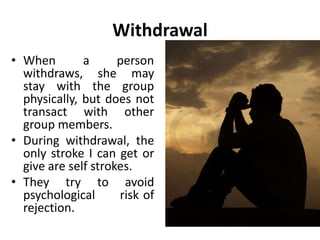
• When a person
withdraws, she may
stay with the group
physically, but does not
transact with other
group members.
• During withdrawal, the
only stroke I can get or
give are self strokes.
• They try to avoid
psychological risk of
rejection.
Withdrawal
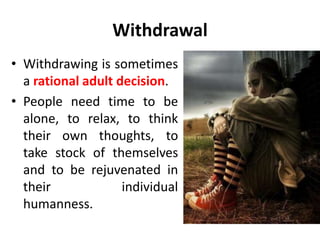
• Withdrawing is sometimes
a rational adult decision.
• People need time to be
alone, to relax, to think
their own thoughts, to
take stock of themselves
and to be rejuvenated in
their individual
humanness.
Withdrawal
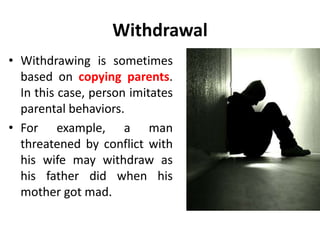
• Withdrawing is sometimes
based on copying parents.
In this case, person imitates
parental behaviors.
• For example, a man
threatened by conflict with
his wife may withdraw as
his father did when his
mother got mad.
Withdrawal
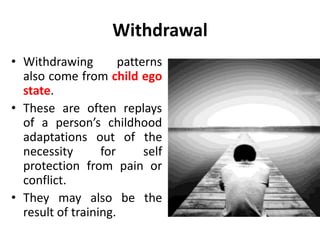
• Withdrawing patterns
also come from child ego
state.
• These are often replays
of a person’s childhood
adaptations out of the
necessity for self
protection from pain or
conflict.
• They may also be the
result of training.
Withdrawal
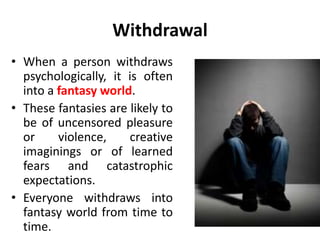
• When a person withdraws
psychologically, it is often
into a fantasy world.
• These fantasies are likely to
be of uncensored pleasure
or violence, creative
imaginings or of learned
fears and catastrophic
expectations.
• Everyone withdraws into
fantasy world from time to
time.
Thank You
Other TA topics available on slideshare
1. Strokes - http://www.slideshare.net/manumjoy/strokes-24081607.
2. Games People Play - http://www.slideshare.net/manumjoy/psychological-
games-people-play.
3. Structural Analysis - http://www.slideshare.net/manumjoy/the-ego-state-model.
4. What is TA? - http://www.slideshare.net/manumjoy/what-ta-is
5. Cycles of Development - http://www.slideshare.net/manumjoy/cycles-of-
developement-pamela-levin-transactional-analysis.
6. Stages of Cure - http://www.slideshare.net/manumjoy/stages-of-cure.
7. Transactions - http://www.slideshare.net/manumjoy/transactions-33677298.
8. Time Structuring - http://www.slideshare.net/manumjoy/time-structuring.
9. Life Position - http://www.slideshare.net/manumjoy/life-position.
10. Autonomy - http://www.slideshare.net/manumjoy/autonomy-33690557.
11. Structural Pathology - http://www.slideshare.net/manumjoy/structural-pathology.
12. Game Analysis - http://www.slideshare.net/manumjoy/game-analysis-33725636.
13. Integrated Adult - http://www.slideshare.net/manumjoy/integrated-adult.
14. Stroke Economy - http://www.slideshare.net/manumjoy/stroke-economy-
33826702.

Withdrawal - Transactional Analysis

  • 1.
  • 2.
    Prepared By Manu MelwinJoy Research Scholar School of Management Studies CUSAT, Kerala, India. Phone – 9744551114 Mail – manu_melwinjoy@yahoo.com Kindly restrict the use of slides for personal purpose. Please seek permission to reproduce the same in public forms and presentations.
  • 3.
    Withdrawal • When aperson withdraws, she may stay with the group physically, but does not transact with other group members. • During withdrawal, the only stroke I can get or give are self strokes. • They try to avoid psychological risk of rejection.
  • 4.
    Withdrawal • Withdrawing issometimes a rational adult decision. • People need time to be alone, to relax, to think their own thoughts, to take stock of themselves and to be rejuvenated in their individual humanness.
  • 5.
    Withdrawal • Withdrawing issometimes based on copying parents. In this case, person imitates parental behaviors. • For example, a man threatened by conflict with his wife may withdraw as his father did when his mother got mad.
  • 6.
    Withdrawal • Withdrawing patterns alsocome from child ego state. • These are often replays of a person’s childhood adaptations out of the necessity for self protection from pain or conflict. • They may also be the result of training.
  • 7.
    Withdrawal • When aperson withdraws psychologically, it is often into a fantasy world. • These fantasies are likely to be of uncensored pleasure or violence, creative imaginings or of learned fears and catastrophic expectations. • Everyone withdraws into fantasy world from time to time.
  • 8.
  • 9.
    Other TA topicsavailable on slideshare 1. Strokes - http://www.slideshare.net/manumjoy/strokes-24081607. 2. Games People Play - http://www.slideshare.net/manumjoy/psychological- games-people-play. 3. Structural Analysis - http://www.slideshare.net/manumjoy/the-ego-state-model. 4. What is TA? - http://www.slideshare.net/manumjoy/what-ta-is 5. Cycles of Development - http://www.slideshare.net/manumjoy/cycles-of- developement-pamela-levin-transactional-analysis. 6. Stages of Cure - http://www.slideshare.net/manumjoy/stages-of-cure. 7. Transactions - http://www.slideshare.net/manumjoy/transactions-33677298. 8. Time Structuring - http://www.slideshare.net/manumjoy/time-structuring. 9. Life Position - http://www.slideshare.net/manumjoy/life-position. 10. Autonomy - http://www.slideshare.net/manumjoy/autonomy-33690557. 11. Structural Pathology - http://www.slideshare.net/manumjoy/structural-pathology. 12. Game Analysis - http://www.slideshare.net/manumjoy/game-analysis-33725636. 13. Integrated Adult - http://www.slideshare.net/manumjoy/integrated-adult. 14. Stroke Economy - http://www.slideshare.net/manumjoy/stroke-economy- 33826702.