Papilledema Vs.
Papillitis
ZAGADA, TIMOTHY M.
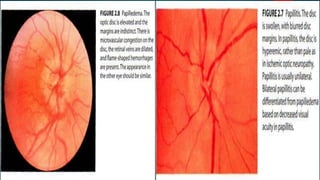
Papilledema
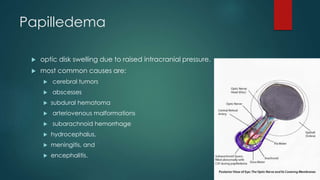
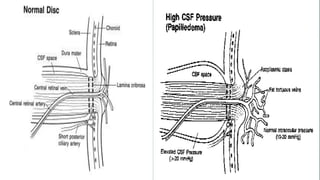
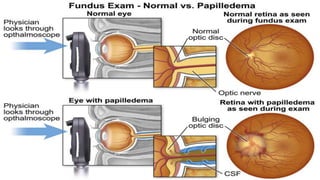
๏ต optic disk swelling due to raised intracranial pressure.
๏ต most common causes are:
๏ต cerebral tumors
๏ต abscesses
๏ต subdural hematoma
๏ต arteriovenous malformations
๏ต subarachnoid hemorrhage
๏ต hydrocephalus,
๏ต meningitis, and
๏ต encephalitis.
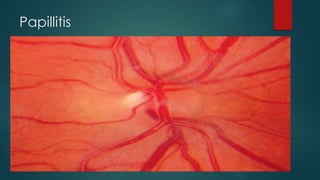
Papillitis
๏ต Papillitis is disk swelling caused by inflammation at the nerve head
(intraocular optic nerve).
๏ต Cause:
๏ต Optic neuritis
๏ต multiple sclerosis
๏ต Loss of vision is the cardinal symptom of optic neuritis and is
particularly useful in differentiating papillitis from papilledema
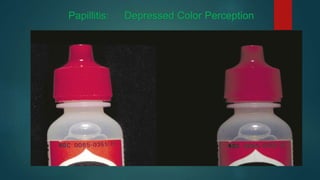
Papillitis: Depressed Color Perception
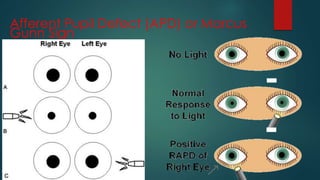
Afferent Pupil Defect (APD) or Marcus
Gunn Sign
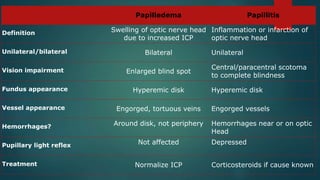
Papilledema Papillitis
Definition Swelling of optic nerve head
due to increased ICP
Inflammation or infarction of
optic nerve head
Unilateral/bilateral Bilateral Unilateral
Vision impairment Enlarged blind spot
Central/paracentral scotoma
to complete blindness
Fundus appearance Hyperemic disk Hyperemic disk
Vessel appearance Engorged, tortuous veins Engorged vessels
Hemorrhages? Around disk, not periphery Hemorrhages near or on optic
Head
Pupillary light reflex Not affected Depressed
Treatment Normalize ICP Corticosteroids if cause known
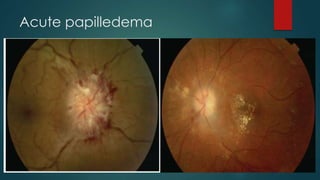
Acute papilledema
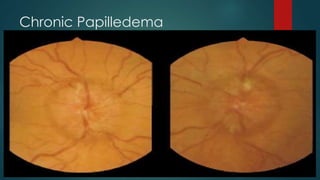
Chronic Papilledema
Papillitis
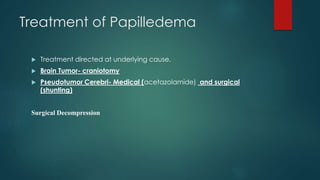
Treatment of Papilledema
๏ต Treatment directed at underlying cause.
๏ต Brain Tumor- craniotomy
๏ต Pseudotumor Cerebri- Medical (acetazolamide) and surgical
(shunting)
Surgical Decompression
Treatment of Papillitis
๏ต Steroid therapy
๏ต intravenously- methylprednisolone, 1 g/d for 3 days with or without
a subsequent tapering course of oral prednisolone
๏ต orally- methylprednisolone, 500 mg/d to 2 g/d for 3โ€“5 days with or
without subsequent oral prednisolone, or prednisolone, 1 mg/kg/d
tapered over 10โ€“21 days
๏ต retrobulbar injection

Papilledema vs papillitis with notes timothy zagada

  • 1.
  • 2.
    Papilledema ๏ต optic diskswelling due to raised intracranial pressure. ๏ต most common causes are: ๏ต cerebral tumors ๏ต abscesses ๏ต subdural hematoma ๏ต arteriovenous malformations ๏ต subarachnoid hemorrhage ๏ต hydrocephalus, ๏ต meningitis, and ๏ต encephalitis.
  • 5.
    Papillitis ๏ต Papillitis isdisk swelling caused by inflammation at the nerve head (intraocular optic nerve). ๏ต Cause: ๏ต Optic neuritis ๏ต multiple sclerosis ๏ต Loss of vision is the cardinal symptom of optic neuritis and is particularly useful in differentiating papillitis from papilledema
  • 6.
  • 7.
    Afferent Pupil Defect(APD) or Marcus Gunn Sign
  • 8.
    Papilledema Papillitis Definition Swellingof optic nerve head due to increased ICP Inflammation or infarction of optic nerve head Unilateral/bilateral Bilateral Unilateral Vision impairment Enlarged blind spot Central/paracentral scotoma to complete blindness Fundus appearance Hyperemic disk Hyperemic disk Vessel appearance Engorged, tortuous veins Engorged vessels Hemorrhages? Around disk, not periphery Hemorrhages near or on optic Head Pupillary light reflex Not affected Depressed Treatment Normalize ICP Corticosteroids if cause known
  • 10.
  • 11.
  • 12.
  • 13.
    Treatment of Papilledema ๏ตTreatment directed at underlying cause. ๏ต Brain Tumor- craniotomy ๏ต Pseudotumor Cerebri- Medical (acetazolamide) and surgical (shunting) Surgical Decompression
  • 14.
    Treatment of Papillitis ๏ตSteroid therapy ๏ต intravenously- methylprednisolone, 1 g/d for 3 days with or without a subsequent tapering course of oral prednisolone ๏ต orally- methylprednisolone, 500 mg/d to 2 g/d for 3โ€“5 days with or without subsequent oral prednisolone, or prednisolone, 1 mg/kg/d tapered over 10โ€“21 days ๏ต retrobulbar injection

Editor's Notes

  • #3ย 1. Congestion of retinal veins โ€“ loss of venous pulsation, 2. Hyperemia of disc โ€“ filling of physiologic cup, 3. Disc edges blurred โ€“ first upper and lower margins, then nasal margin, finally temporal margin; 4. Elevation of nerve head (3 โ€“ 10 Dioptres), 5. Spread of edema to retina โ€“ macular fan, 6. Hump of vessels leaving and entering disc more marked, 7. Vessels appear and disappear as they course near the disc, 8. Disc swelling reduces โ€“ disc becomes yellowish white โ€“ arteries
  • #4ย developmentally and histologically optic nerve is a part of the brain and surrounded by three meninges. Dura continuous with orbital periosteum, pia and arachnoid fuse with the sclera. Subarachnoid space around optic nerve is continuous with the brain subarachnoid space. Rise in cerebral subarachnoid pressure is transmitted to the optic subarachnoid space. Rise in ICP results in 1. Compression of central vein of retina as it crosses the space. 2. Impeding lymphatic drainage from retina. 3. Interference with slow component of anterograde axoplasmic transport in the optic nerve head. Thus swelling of axons in optic disc and surrounding retina occurs.
  • #5ย It takes 24โ€“48 hours for early papilledema to occur and 1 week to develop fully. It takes 6โ€“8 weeks for fully developed papilledema to resolve following adequate treatment.
  • #6ย Visual loss is generally subacute, developing over 2โ€“7 days. In adults, approximately one-third of patients have vision better than 20/40 during their first attack, and slightly more than one-third have vision worse than 20/200. Color vision and contrast sensitivity are correspondingly impaired. In over 90% of cases, there is pain in the region of the eye, and about 50% of patients report that the pain is exacerbated by eye movement.
  • #9ย In papilledema, which usually causes bilateral optic disk changes, there is often greater elevation of the optic nerve head, normal corrected visual acuity, normal pupillary response to light, and an intact visual field except for an enlarged blind spot. Differentiation between papilledema and papillitis is particularly difficult when papilledema is asymmetric and/or associated with visual loss or papillitis is bilateral and/or associated with minimal visual impairment. Diagnosis may depend on results of MRI and lumbar puncture, as well as subsequent clinical course.
  • #10ย Papillitis can be differentiated from papilledema by an afferent pupillary defect (Marcus Gunn pupil), by its greater effect in decreasing visual acuity and color vision, and by the presence of a central scotoma. Papilledema that is not yet chronic will not have as dramatic an effect on vision. Because increased intracranial pressure can cause both papilledema and a sixth (abducens) nerve palsy, papilledema can be differentiated from papillitis if esotropia and loss of abduction are also present. However, esotropia may also develop secondarily in an eye that has lost vision from papillitis.ย 
  • #11ย Optic disk swelling with cotton-wool spots and hemorrhages. (B) Retinal exudates Cotton wool spotsย are an abnormal finding onย fundoscopicย exam of theย retinaย of the eye. They appear as fluffy white patches on the retina. They are caused by damage to nerve fibers and are a result of accumulations ofย axoplasmicย material within theย nerve fiber layer. Theย nerve fibersย are damaged by swelling in the surface layer of the retina. The cause of this swelling is due to the reducedย axonal transportย (and hence backlog and accumulation of intracellular products) within the nerves because of the ischemia.
  • #12ย Chronic papilledema with prominent disk swelling, capillary dilation, and retinal folds but few hemorrhages or cotton-wool spots (A) and (B). Cotton wool spotsย are an abnormal finding onย fundoscopicย exam of theย retinaย of the eye. They appear as fluffy white patches on the retina. They are caused by damage to nerve fibers and are a result of accumulations ofย axoplasmicย material within theย nerve fiber layer. Theย nerve fibersย are damaged by swelling in the surface layer of the retina. The cause of this swelling is due to the reducedย axonal transportย (and hence backlog and accumulation of intracellular products) within the nerves because of the ischemia.
  • #15ย intravenously (methylprednisolone, 1 g/d for 3 days with or without a subsequent tapering course of oral prednisolone), orally (methylprednisolone, 500 mg/d to 2 g/d for 3โ€“5 days with or without subsequent oral prednisolone, or prednisolone, 1 mg/kg/d tapered over 10โ€“21 days), or by retrobulbar injectionโ€”probably accelerates recovery of vision but does not influence the ultimate visual outcome