Guide: Dr Anupama Karanth
Presenter: Dr Madhurima
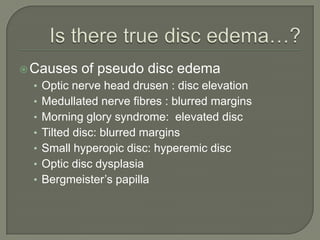
Causes of pseudo disc edema
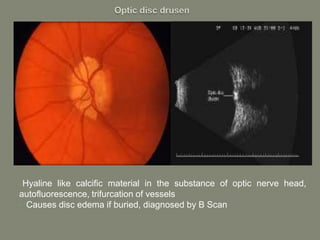
• Optic nerve head drusen : disc elevation
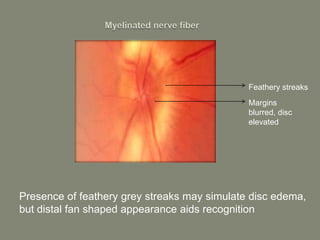
• Medullated nerve fibres : blurred margins
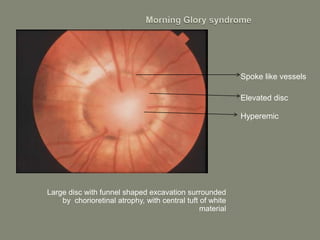
• Morning glory syndrome: elevated disc
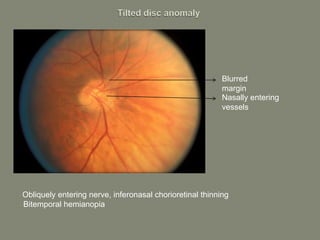
• Tilted disc: blurred margins
• Small hyperopic disc: hyperemic disc
• Optic disc dysplasia
• Bergmeister’s papilla
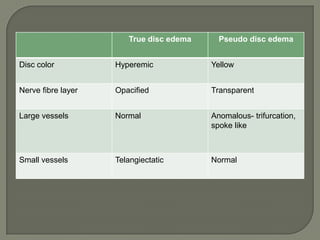
True disc edema Pseudo disc edema
Disc color Hyperemic Yellow
Nerve fibre layer Opacified Transparent
Large vessels Normal Anomalous- trifurcation,
spoke like
Small vessels Telangiectatic Normal
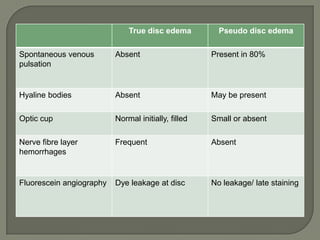
True disc edema Pseudo disc edema
Spontaneous venous
pulsation
Absent Present in 80%
Hyaline bodies Absent May be present
Optic cup Normal initially, filled Small or absent
Nerve fibre layer
hemorrhages
Frequent Absent
Fluorescein angiography Dye leakage at disc No leakage/ late staining
• Hyaline like calcific material in the substance of optic nerve head,
autofluorescence, trifurcation of vessels
• Causes disc edema if buried, diagnosed by B Scan
• Obliquely entering nerve, inferonasal chorioretinal thinning
• Bitemporal hemianopia
Blurred
margin
Nasally entering
vessels
Large disc with funnel shaped excavation surrounded
by chorioretinal atrophy, with central tuft of white
material
Spoke like vessels
Elevated disc
Hyperemic
Presence of feathery grey streaks may simulate disc edema,
but distal fan shaped appearance aids recognition
Feathery streaks
Margins
blurred, disc
elevated
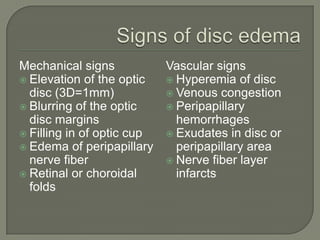
Mechanical signs
 Elevation of the optic
disc (3D=1mm)
 Blurring of the optic
disc margins
 Filling in of optic cup
 Edema of peripapillary
nerve fiber
 Retinal or choroidal
folds
Vascular signs
 Hyperemia of disc
 Venous congestion
 Peripapillary
hemorrhages
 Exudates in disc or
peripapillary area
 Nerve fiber layer
infarcts
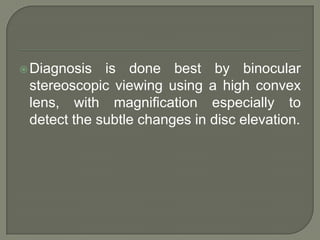
Diagnosis is done best by binocular
stereoscopic viewing using a high convex
lens, with magnification especially to
detect the subtle changes in disc elevation.
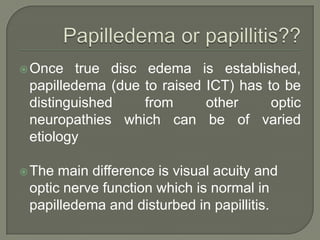
Once true disc edema is established,
papilledema (due to raised ICT) has to be
distinguished from other optic
neuropathies which can be of varied
etiology
The main difference is visual acuity and
optic nerve function which is normal in
papilledema and disturbed in papillitis.
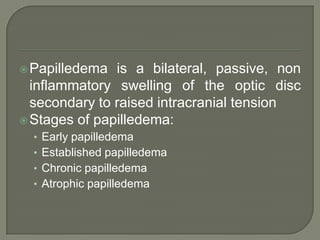
Papilledema is a bilateral, passive, non
inflammatory swelling of the optic disc
secondary to raised intracranial tension
Stages of papilledema:
• Early papilledema
• Established papilledema
• Chronic papilledema
• Atrophic papilledema
 Difficult to diagnose
 Disc hyperemia
 Blurring of peripapillary retinal nerve fibre
layer
 Blurring of the disc margins
 Disc elevation
 Dilatation of retinal veins
 Hemorrhages on disc margins
 Absence of spontaneous retinal vein
pulsations (normal in 20% population)
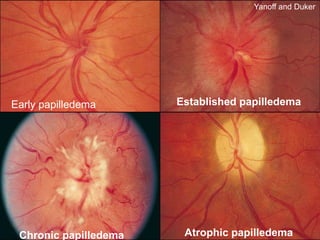
Established papilledema: obscuration of all
borders, disc elevated, cup filled, blood
vessels obscured on the surface,
peripapillary hemorrhages.
Chronic papilledema: cup is obliterated,
hard exudates occur within the nerve head
Post papilledema atrophy: post neuritic
type, arterioles are narrowed or sheathed,
optic disc appears dirty gray and blurred
Early papilledema
Chronic papilledema Atrophic papilledema
Established papilledema
Yanoff and Duker
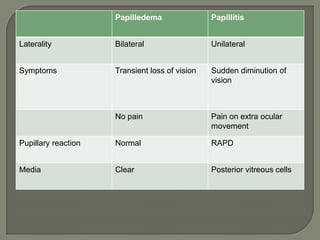
Papilledema Papillitis
Laterality Bilateral Unilateral
Symptoms Transient loss of vision Sudden diminution of
vision
No pain Pain on extra ocular
movement
Pupillary reaction Normal RAPD
Media Clear Posterior vitreous cells
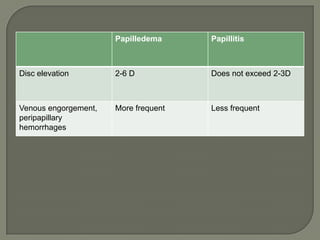
Papilledema Papillitis
Disc elevation 2-6 D Does not exceed 2-3D
Venous engorgement,
peripapillary
hemorrhages
More frequent Less frequent
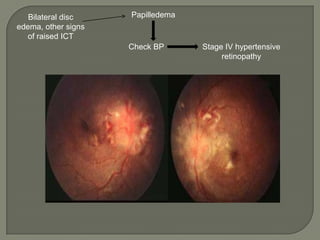
Papilledema
Check BP Stage IV hypertensive
retinopathy
Bilateral disc
edema, other signs
of raised ICT
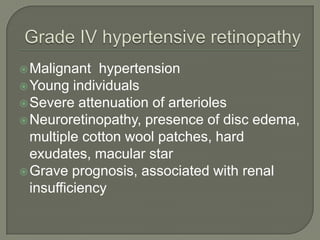
Malignant hypertension
Young individuals
Severe attenuation of arterioles
Neuroretinopathy, presence of disc edema,
multiple cotton wool patches, hard
exudates, macular star
Grave prognosis, associated with renal
insufficiency
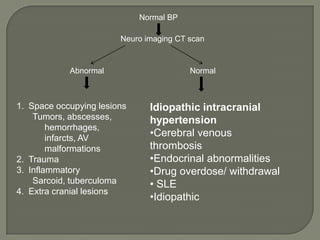
Neuro imaging CT scan
Abnormal
1. Space occupying lesions
Tumors, abscesses,
hemorrhages,
infarcts, AV
malformations
2. Trauma
3. Inflammatory
Sarcoid, tuberculoma
4. Extra cranial lesions
Idiopathic intracranial
hypertension
•Cerebral venous
thrombosis
•Endocrinal abnormalities
•Drug overdose/ withdrawal
• SLE
•Idiopathic
Normal
Normal BP
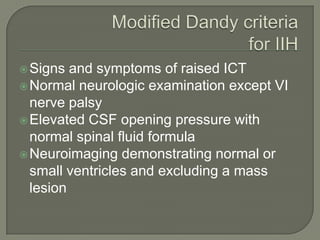
Signs and symptoms of raised ICT
Normal neurologic examination except VI
nerve palsy
Elevated CSF opening pressure with
normal spinal fluid formula
Neuroimaging demonstrating normal or
small ventricles and excluding a mass
lesion
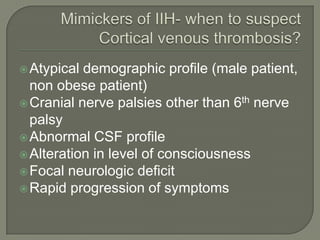
Atypical demographic profile (male patient,
non obese patient)
Cranial nerve palsies other than 6th nerve
palsy
Abnormal CSF profile
Alteration in level of consciousness
Focal neurologic deficit
Rapid progression of symptoms
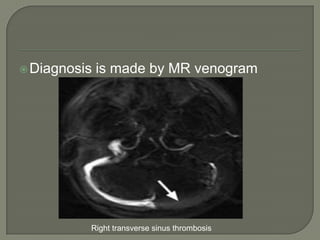
Diagnosis is made by MR venogram
Right transverse sinus thrombosis
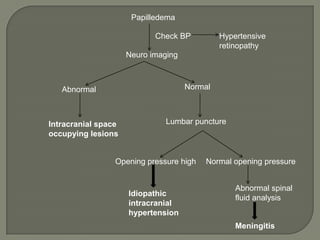
Papilledema
Check BP Hypertensive
retinopathy
Neuro imaging
Abnormal Normal
Intracranial space
occupying lesions
Lumbar puncture
Opening pressure high
Idiopathic
intracranial
hypertension
Normal opening pressure
Abnormal spinal
fluid analysis
Meningitis
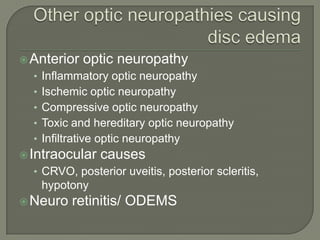
Anterior optic neuropathy
• Inflammatory optic neuropathy
• Ischemic optic neuropathy
• Compressive optic neuropathy
• Toxic and hereditary optic neuropathy
• Infiltrative optic neuropathy
Intraocular causes
• CRVO, posterior uveitis, posterior scleritis,
hypotony
Neuro retinitis/ ODEMS
Optic neuropathies should be considered
under two circumstances
Visual loss associated with anomalous,
swollen or pale disc
Fundus is normal, but acuity, color vision,
field abnormalities are accompanied by an
afferent pupil defect
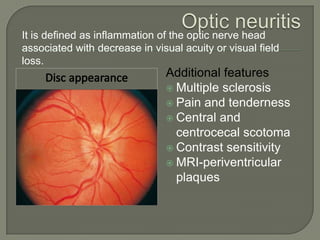
Additional features
 Multiple sclerosis
 Pain and tenderness
 Central and
centrocecal scotoma
 Contrast sensitivity
 MRI-periventricular
plaques
It is defined as inflammation of the optic nerve head
associated with decrease in visual acuity or visual field
loss.
Typical optic neuritis
 Young adult
 Usually associated
with multiple sclerosis
 Vision starts to
improve by 2-3 weeks
Atypical optic neuritis
 Marked disc swelling
 Vitritis
 Progression of visual
loss after 1 week
 Lack of partial
recovery within 4
weeks of onset
 Persistent pain
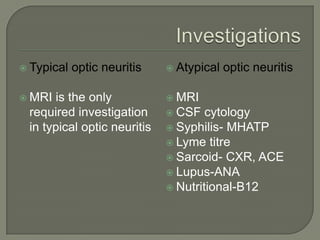
 Typical optic neuritis
 MRI is the only
required investigation
in typical optic neuritis
 Atypical optic neuritis
 MRI
 CSF cytology
 Syphilis- MHATP
 Lyme titre
 Sarcoid- CXR, ACE
 Lupus-ANA
 Nutritional-B12
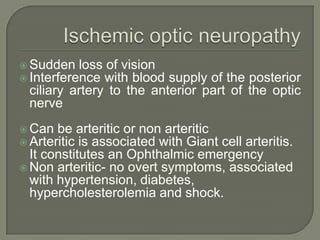
 Sudden loss of vision
 Interference with blood supply of the posterior
ciliary artery to the anterior part of the optic
nerve
 Can be arteritic or non arteritic
 Arteritic is associated with Giant cell arteritis.
It constitutes an Ophthalmic emergency
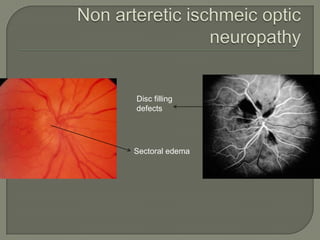
 Non arteritic- no overt symptoms, associated
with hypertension, diabetes,
hypercholesterolemia and shock.
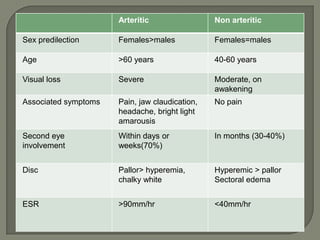
Arteritic Non arteritic
Sex predilection Females>males Females=males
Age >60 years 40-60 years
Visual loss Severe Moderate, on
awakening
Associated symptoms Pain, jaw claudication,
headache, bright light
amarousis
No pain
Second eye
involvement
Within days or
weeks(70%)
In months (30-40%)
Disc Pallor> hyperemia,
chalky white
Hyperemic > pallor
Sectoral edema
ESR >90mm/hr <40mm/hr
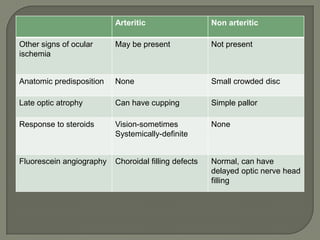
Arteritic Non arteritic
Other signs of ocular
ischemia
May be present Not present
Anatomic predisposition None Small crowded disc
Late optic atrophy Can have cupping Simple pallor
Response to steroids Vision-sometimes
Systemically-definite
None
Fluorescein angiography Choroidal filling defects Normal, can have
delayed optic nerve head
filling
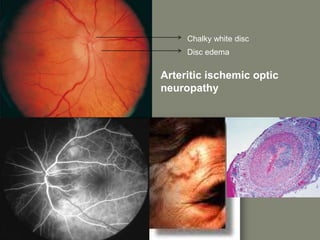
Chalky white disc
Disc edema
Arteritic ischemic optic
neuropathy
Sectoral edema
Disc filling
defects
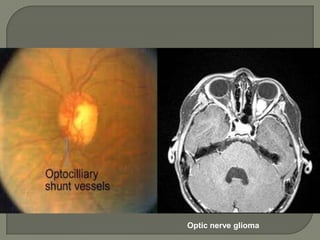
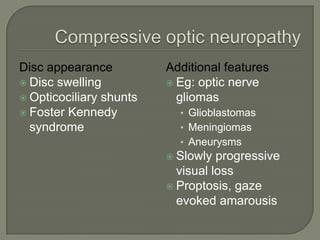
Disc appearance
 Disc swelling
 Opticociliary shunts
 Foster Kennedy
syndrome
Additional features
 Eg: optic nerve
gliomas
• Glioblastomas
• Meningiomas
• Aneurysms
 Slowly progressive
visual loss
 Proptosis, gaze
evoked amarousis
Optic nerve glioma
Disc appearance
 Disc hyperemia
 Obscuration of disc
margins
 Dilated capillaries on
disc surface that may
extend into surrounding
retina (telangiectatic
microaneurysms),
Additional features
 Swelling of NFL layer
and dilatation
 Tortuosity of posterior
pole vasculature
 Maternally inherited mt
DNA mutations
 Males, 15-35 years
 Subacute painless
severe loss of vision in
one eye, followed by
the other
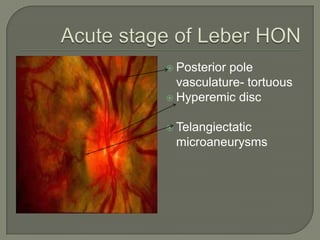
 Posterior pole
vasculature- tortuous
 Hyperemic disc
 Telangiectatic
microaneurysms
Optic neuropathy due to methanol
poisoning is different from others as it
causes sudden visual loss and disc
edema.
Disc edema is indistinguishable from
papilledema
Other symptoms are headache, dyspnoea,
vomiting, abdominal pain and bilateral
visual blurring.
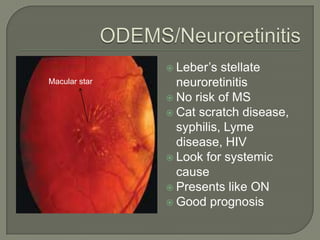
 Leber’s stellate
neuroretinitis
 No risk of MS
 Cat scratch disease,
syphilis, Lyme
disease, HIV
 Look for systemic
cause
 Presents like ON
 Good prognosis
Macular star
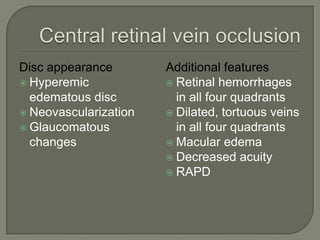
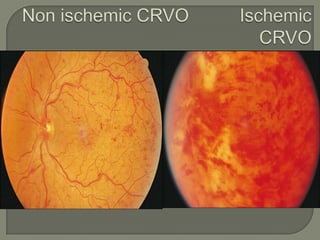
Disc appearance
 Hyperemic
edematous disc
 Neovascularization
 Glaucomatous
changes
Additional features
 Retinal hemorrhages
in all four quadrants
 Dilated, tortuous veins
in all four quadrants
 Macular edema
 Decreased acuity
 RAPD
Papillitis
Compressive optic neuropathy
Ischemic optic neuropathy
Infiltrative optic neuropathy
CRVO and venous stasis retinopathy
Optic disc vasculitis
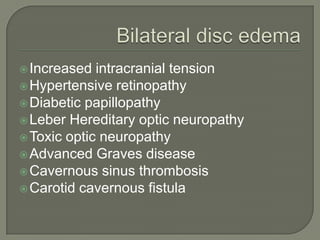
Increased intracranial tension
Hypertensive retinopathy
Diabetic papillopathy
Leber Hereditary optic neuropathy
Toxic optic neuropathy
Advanced Graves disease
Cavernous sinus thrombosis
Carotid cavernous fistula
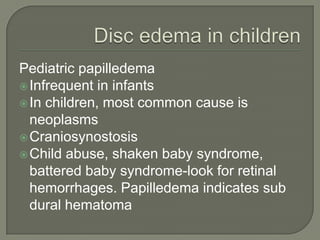
Pediatric papilledema
Infrequent in infants
In children, most common cause is
neoplasms
Craniosynostosis
Child abuse, shaken baby syndrome,
battered baby syndrome-look for retinal
hemorrhages. Papilledema indicates sub
dural hematoma
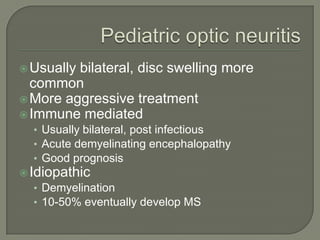
Usually bilateral, disc swelling more
common
More aggressive treatment
Immune mediated
• Usually bilateral, post infectious
• Acute demyelinating encephalopathy
• Good prognosis
Idiopathic
• Demyelination
• 10-50% eventually develop MS
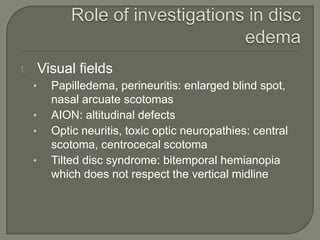
1. Visual fields
• Papilledema, perineuritis: enlarged blind spot,
nasal arcuate scotomas
• AION: altitudinal defects
• Optic neuritis, toxic optic neuropathies: central
scotoma, centrocecal scotoma
• Tilted disc syndrome: bitemporal hemianopia
which does not respect the vertical midline
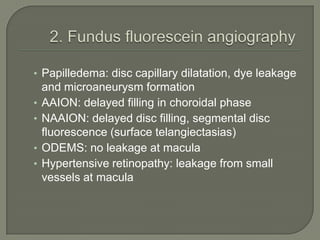
• Papilledema: disc capillary dilatation, dye leakage
and microaneurysm formation
• AAION: delayed filling in choroidal phase
• NAAION: delayed disc filling, segmental disc
fluorescence (surface telangiectasias)
• ODEMS: no leakage at macula
• Hypertensive retinopathy: leakage from small
vessels at macula
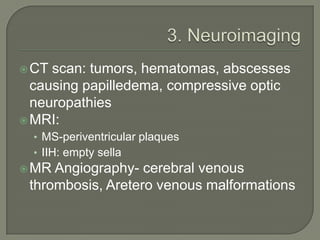
CT scan: tumors, hematomas, abscesses
causing papilledema, compressive optic
neuropathies
MRI:
• MS-periventricular plaques
• IIH: empty sella
MR Angiography- cerebral venous
thrombosis, Aretero venous malformations
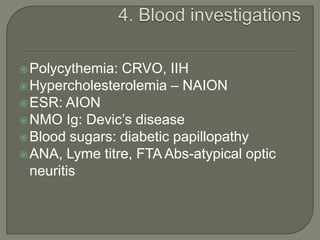
Polycythemia: CRVO, IIH
Hypercholesterolemia – NAION
ESR: AION
NMO Ig: Devic’s disease
Blood sugars: diabetic papillopathy
ANA, Lyme titre, FTA Abs-atypical optic
neuritis
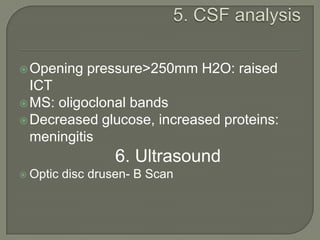
Opening pressure>250mm H2O: raised
ICT
MS: oligoclonal bands
Decreased glucose, increased proteins:
meningitis
6. Ultrasound
 Optic disc drusen- B Scan
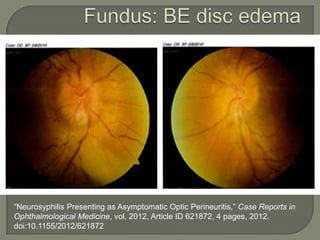
41 year old man, referred for blurred disc
margins
History of swollen groin lymph nodes 1
month back, no other history
Headache, eye pain
Vision BE 20/20, color vision OU normal,
LE RAPD
IOP RE 12mm Hg, LE 18mm Hg
“Neurosyphilis Presenting as Asymptomatic Optic Perineuritis,” Case Reports in
Ophthalmological Medicine, vol. 2012, Article ID 621872, 4 pages, 2012.
doi:10.1155/2012/621872
“Neurosyphilis Presenting as Asymptomatic Optic Perineuritis,” Case Reports in
Ophthalmological Medicine, vol. 2012, Article ID 621872, 4 pages, 2012.
doi:10.1155/2012/621872
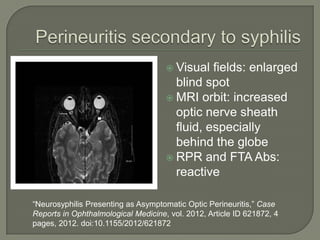
 Visual fields: enlarged
blind spot
 MRI orbit: increased
optic nerve sheath
fluid, especially
behind the globe
 RPR and FTA Abs:
reactive
“Neurosyphilis Presenting as Asymptomatic Optic Perineuritis,” Case
Reports in Ophthalmological Medicine, vol. 2012, Article ID 621872, 4
pages, 2012. doi:10.1155/2012/621872
A 9 year old boy, intermittent headache
and bouts of abdominal pain since 3
months, no h/o recent infections, systemic
medications
General examination was unremarkable
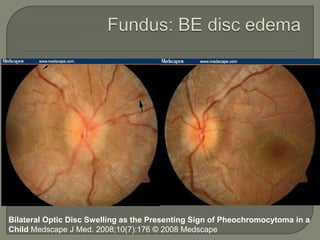
Vision BE 6/6, N6, color vision BE within
normal limits, pupils and visual fields were
normal
Bilateral Optic Disc Swelling as the Presenting Sign of Pheochromocytoma in a
Child Medscape J Med. 2008;10(7):176 © 2008 Medscape
Bilateral Optic Disc Swelling as the Presenting Sign of Pheochromocytoma in a
Child Medscape J Med. 2008;10(7):176 © 2008 Medscape
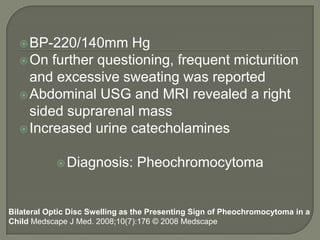
BP-220/140mm Hg
On further questioning, frequent micturition
and excessive sweating was reported
Abdominal USG and MRI revealed a right
sided suprarenal mass
Increased urine catecholamines
Diagnosis: Pheochromocytoma
Bilateral Optic Disc Swelling as the Presenting Sign of Pheochromocytoma in a
Child Medscape J Med. 2008;10(7):176 © 2008 Medscape
Thank you

Dd of disc edema

  • 1.
    Guide: Dr AnupamaKaranth Presenter: Dr Madhurima
  • 2.
    Causes of pseudodisc edema • Optic nerve head drusen : disc elevation • Medullated nerve fibres : blurred margins • Morning glory syndrome: elevated disc • Tilted disc: blurred margins • Small hyperopic disc: hyperemic disc • Optic disc dysplasia • Bergmeister’s papilla
  • 3.
    True disc edemaPseudo disc edema Disc color Hyperemic Yellow Nerve fibre layer Opacified Transparent Large vessels Normal Anomalous- trifurcation, spoke like Small vessels Telangiectatic Normal
  • 4.
    True disc edemaPseudo disc edema Spontaneous venous pulsation Absent Present in 80% Hyaline bodies Absent May be present Optic cup Normal initially, filled Small or absent Nerve fibre layer hemorrhages Frequent Absent Fluorescein angiography Dye leakage at disc No leakage/ late staining
  • 5.
    • Hyaline likecalcific material in the substance of optic nerve head, autofluorescence, trifurcation of vessels • Causes disc edema if buried, diagnosed by B Scan
  • 6.
    • Obliquely enteringnerve, inferonasal chorioretinal thinning • Bitemporal hemianopia Blurred margin Nasally entering vessels
  • 7.
    Large disc withfunnel shaped excavation surrounded by chorioretinal atrophy, with central tuft of white material Spoke like vessels Elevated disc Hyperemic
  • 8.
    Presence of featherygrey streaks may simulate disc edema, but distal fan shaped appearance aids recognition Feathery streaks Margins blurred, disc elevated
  • 9.
    Mechanical signs  Elevationof the optic disc (3D=1mm)  Blurring of the optic disc margins  Filling in of optic cup  Edema of peripapillary nerve fiber  Retinal or choroidal folds Vascular signs  Hyperemia of disc  Venous congestion  Peripapillary hemorrhages  Exudates in disc or peripapillary area  Nerve fiber layer infarcts
  • 10.
    Diagnosis is donebest by binocular stereoscopic viewing using a high convex lens, with magnification especially to detect the subtle changes in disc elevation.
  • 11.
    Once true discedema is established, papilledema (due to raised ICT) has to be distinguished from other optic neuropathies which can be of varied etiology The main difference is visual acuity and optic nerve function which is normal in papilledema and disturbed in papillitis.
  • 12.
    Papilledema is abilateral, passive, non inflammatory swelling of the optic disc secondary to raised intracranial tension Stages of papilledema: • Early papilledema • Established papilledema • Chronic papilledema • Atrophic papilledema
  • 13.
     Difficult todiagnose  Disc hyperemia  Blurring of peripapillary retinal nerve fibre layer  Blurring of the disc margins  Disc elevation  Dilatation of retinal veins  Hemorrhages on disc margins  Absence of spontaneous retinal vein pulsations (normal in 20% population)
  • 14.
    Established papilledema: obscurationof all borders, disc elevated, cup filled, blood vessels obscured on the surface, peripapillary hemorrhages. Chronic papilledema: cup is obliterated, hard exudates occur within the nerve head Post papilledema atrophy: post neuritic type, arterioles are narrowed or sheathed, optic disc appears dirty gray and blurred
  • 15.
    Early papilledema Chronic papilledemaAtrophic papilledema Established papilledema Yanoff and Duker
  • 16.
    Papilledema Papillitis Laterality BilateralUnilateral Symptoms Transient loss of vision Sudden diminution of vision No pain Pain on extra ocular movement Pupillary reaction Normal RAPD Media Clear Posterior vitreous cells
  • 17.
    Papilledema Papillitis Disc elevation2-6 D Does not exceed 2-3D Venous engorgement, peripapillary hemorrhages More frequent Less frequent
  • 18.
    Papilledema Check BP StageIV hypertensive retinopathy Bilateral disc edema, other signs of raised ICT
  • 19.
    Malignant hypertension Young individuals Severeattenuation of arterioles Neuroretinopathy, presence of disc edema, multiple cotton wool patches, hard exudates, macular star Grave prognosis, associated with renal insufficiency
  • 20.
    Neuro imaging CTscan Abnormal 1. Space occupying lesions Tumors, abscesses, hemorrhages, infarcts, AV malformations 2. Trauma 3. Inflammatory Sarcoid, tuberculoma 4. Extra cranial lesions Idiopathic intracranial hypertension •Cerebral venous thrombosis •Endocrinal abnormalities •Drug overdose/ withdrawal • SLE •Idiopathic Normal Normal BP
  • 21.
    Signs and symptomsof raised ICT Normal neurologic examination except VI nerve palsy Elevated CSF opening pressure with normal spinal fluid formula Neuroimaging demonstrating normal or small ventricles and excluding a mass lesion
  • 22.
    Atypical demographic profile(male patient, non obese patient) Cranial nerve palsies other than 6th nerve palsy Abnormal CSF profile Alteration in level of consciousness Focal neurologic deficit Rapid progression of symptoms
  • 23.
    Diagnosis is madeby MR venogram Right transverse sinus thrombosis
  • 24.
    Papilledema Check BP Hypertensive retinopathy Neuroimaging Abnormal Normal Intracranial space occupying lesions Lumbar puncture Opening pressure high Idiopathic intracranial hypertension Normal opening pressure Abnormal spinal fluid analysis Meningitis
  • 25.
    Anterior optic neuropathy •Inflammatory optic neuropathy • Ischemic optic neuropathy • Compressive optic neuropathy • Toxic and hereditary optic neuropathy • Infiltrative optic neuropathy Intraocular causes • CRVO, posterior uveitis, posterior scleritis, hypotony Neuro retinitis/ ODEMS
  • 26.
    Optic neuropathies shouldbe considered under two circumstances Visual loss associated with anomalous, swollen or pale disc Fundus is normal, but acuity, color vision, field abnormalities are accompanied by an afferent pupil defect
  • 27.
    Additional features  Multiplesclerosis  Pain and tenderness  Central and centrocecal scotoma  Contrast sensitivity  MRI-periventricular plaques It is defined as inflammation of the optic nerve head associated with decrease in visual acuity or visual field loss.
  • 28.
    Typical optic neuritis Young adult  Usually associated with multiple sclerosis  Vision starts to improve by 2-3 weeks Atypical optic neuritis  Marked disc swelling  Vitritis  Progression of visual loss after 1 week  Lack of partial recovery within 4 weeks of onset  Persistent pain
  • 29.
     Typical opticneuritis  MRI is the only required investigation in typical optic neuritis  Atypical optic neuritis  MRI  CSF cytology  Syphilis- MHATP  Lyme titre  Sarcoid- CXR, ACE  Lupus-ANA  Nutritional-B12
  • 30.
     Sudden lossof vision  Interference with blood supply of the posterior ciliary artery to the anterior part of the optic nerve  Can be arteritic or non arteritic  Arteritic is associated with Giant cell arteritis. It constitutes an Ophthalmic emergency  Non arteritic- no overt symptoms, associated with hypertension, diabetes, hypercholesterolemia and shock.
  • 31.
    Arteritic Non arteritic Sexpredilection Females>males Females=males Age >60 years 40-60 years Visual loss Severe Moderate, on awakening Associated symptoms Pain, jaw claudication, headache, bright light amarousis No pain Second eye involvement Within days or weeks(70%) In months (30-40%) Disc Pallor> hyperemia, chalky white Hyperemic > pallor Sectoral edema ESR >90mm/hr <40mm/hr
  • 32.
    Arteritic Non arteritic Othersigns of ocular ischemia May be present Not present Anatomic predisposition None Small crowded disc Late optic atrophy Can have cupping Simple pallor Response to steroids Vision-sometimes Systemically-definite None Fluorescein angiography Choroidal filling defects Normal, can have delayed optic nerve head filling
  • 33.
    Chalky white disc Discedema Arteritic ischemic optic neuropathy
  • 34.
  • 35.
    Disc appearance  Discswelling  Opticociliary shunts  Foster Kennedy syndrome Additional features  Eg: optic nerve gliomas • Glioblastomas • Meningiomas • Aneurysms  Slowly progressive visual loss  Proptosis, gaze evoked amarousis
  • 36.
  • 37.
    Disc appearance  Dischyperemia  Obscuration of disc margins  Dilated capillaries on disc surface that may extend into surrounding retina (telangiectatic microaneurysms), Additional features  Swelling of NFL layer and dilatation  Tortuosity of posterior pole vasculature  Maternally inherited mt DNA mutations  Males, 15-35 years  Subacute painless severe loss of vision in one eye, followed by the other
  • 38.
     Posterior pole vasculature-tortuous  Hyperemic disc  Telangiectatic microaneurysms
  • 39.
    Optic neuropathy dueto methanol poisoning is different from others as it causes sudden visual loss and disc edema. Disc edema is indistinguishable from papilledema Other symptoms are headache, dyspnoea, vomiting, abdominal pain and bilateral visual blurring.
  • 40.
     Leber’s stellate neuroretinitis No risk of MS  Cat scratch disease, syphilis, Lyme disease, HIV  Look for systemic cause  Presents like ON  Good prognosis Macular star
  • 41.
    Disc appearance  Hyperemic edematousdisc  Neovascularization  Glaucomatous changes Additional features  Retinal hemorrhages in all four quadrants  Dilated, tortuous veins in all four quadrants  Macular edema  Decreased acuity  RAPD
  • 43.
    Papillitis Compressive optic neuropathy Ischemicoptic neuropathy Infiltrative optic neuropathy CRVO and venous stasis retinopathy Optic disc vasculitis
  • 44.
    Increased intracranial tension Hypertensiveretinopathy Diabetic papillopathy Leber Hereditary optic neuropathy Toxic optic neuropathy Advanced Graves disease Cavernous sinus thrombosis Carotid cavernous fistula
  • 45.
    Pediatric papilledema Infrequent ininfants In children, most common cause is neoplasms Craniosynostosis Child abuse, shaken baby syndrome, battered baby syndrome-look for retinal hemorrhages. Papilledema indicates sub dural hematoma
  • 46.
    Usually bilateral, discswelling more common More aggressive treatment Immune mediated • Usually bilateral, post infectious • Acute demyelinating encephalopathy • Good prognosis Idiopathic • Demyelination • 10-50% eventually develop MS
  • 47.
    1. Visual fields •Papilledema, perineuritis: enlarged blind spot, nasal arcuate scotomas • AION: altitudinal defects • Optic neuritis, toxic optic neuropathies: central scotoma, centrocecal scotoma • Tilted disc syndrome: bitemporal hemianopia which does not respect the vertical midline
  • 48.
    • Papilledema: disccapillary dilatation, dye leakage and microaneurysm formation • AAION: delayed filling in choroidal phase • NAAION: delayed disc filling, segmental disc fluorescence (surface telangiectasias) • ODEMS: no leakage at macula • Hypertensive retinopathy: leakage from small vessels at macula
  • 49.
    CT scan: tumors,hematomas, abscesses causing papilledema, compressive optic neuropathies MRI: • MS-periventricular plaques • IIH: empty sella MR Angiography- cerebral venous thrombosis, Aretero venous malformations
  • 50.
    Polycythemia: CRVO, IIH Hypercholesterolemia– NAION ESR: AION NMO Ig: Devic’s disease Blood sugars: diabetic papillopathy ANA, Lyme titre, FTA Abs-atypical optic neuritis
  • 51.
    Opening pressure>250mm H2O:raised ICT MS: oligoclonal bands Decreased glucose, increased proteins: meningitis 6. Ultrasound  Optic disc drusen- B Scan
  • 52.
    41 year oldman, referred for blurred disc margins History of swollen groin lymph nodes 1 month back, no other history Headache, eye pain Vision BE 20/20, color vision OU normal, LE RAPD IOP RE 12mm Hg, LE 18mm Hg “Neurosyphilis Presenting as Asymptomatic Optic Perineuritis,” Case Reports in Ophthalmological Medicine, vol. 2012, Article ID 621872, 4 pages, 2012. doi:10.1155/2012/621872
  • 53.
    “Neurosyphilis Presenting asAsymptomatic Optic Perineuritis,” Case Reports in Ophthalmological Medicine, vol. 2012, Article ID 621872, 4 pages, 2012. doi:10.1155/2012/621872
  • 54.
     Visual fields:enlarged blind spot  MRI orbit: increased optic nerve sheath fluid, especially behind the globe  RPR and FTA Abs: reactive “Neurosyphilis Presenting as Asymptomatic Optic Perineuritis,” Case Reports in Ophthalmological Medicine, vol. 2012, Article ID 621872, 4 pages, 2012. doi:10.1155/2012/621872
  • 55.
    A 9 yearold boy, intermittent headache and bouts of abdominal pain since 3 months, no h/o recent infections, systemic medications General examination was unremarkable Vision BE 6/6, N6, color vision BE within normal limits, pupils and visual fields were normal Bilateral Optic Disc Swelling as the Presenting Sign of Pheochromocytoma in a Child Medscape J Med. 2008;10(7):176 © 2008 Medscape
  • 56.
    Bilateral Optic DiscSwelling as the Presenting Sign of Pheochromocytoma in a Child Medscape J Med. 2008;10(7):176 © 2008 Medscape
  • 57.
    BP-220/140mm Hg On furtherquestioning, frequent micturition and excessive sweating was reported Abdominal USG and MRI revealed a right sided suprarenal mass Increased urine catecholamines Diagnosis: Pheochromocytoma Bilateral Optic Disc Swelling as the Presenting Sign of Pheochromocytoma in a Child Medscape J Med. 2008;10(7):176 © 2008 Medscape
  • 58.