OBESITY
Zagada, Timothy M.
Obesity
• Defined as abnormal or excessive fat accumulation
that presents a risk to health.
• BMI of >30
• Eating more in combination with reduced activity
levels has resulted in a tendency for the sustained
deposition of fat.
o The fundamental cause of obesity and overweight is an energy
imbalance between calories consumed and calories expended.
Obesity
• an increased intake of
energy-dense foods
• a decrease in physical
activity due to the
o increasingly sedentary nature of
many forms of work,
o changing modes of transportation
o increasing urbanization
Obesity Facts from WHO
• Worldwide obesity has
more than doubled since
1980.
• In 2008;
o 1.5 billion adults, 20 and older, were
overweight.
• Overall, more than one in
ten of the world’s adult
population was obese.
Obesity Facts from WHO
• Nearly 43 million children
under the age of five
were overweight in 2010.
Obesity Facts from WHO
• Overweight and obesity are
linked to more deaths
worldwide than
underweight.
• At least 2.8 million adults die
each year as a result of
being overweight or obese.
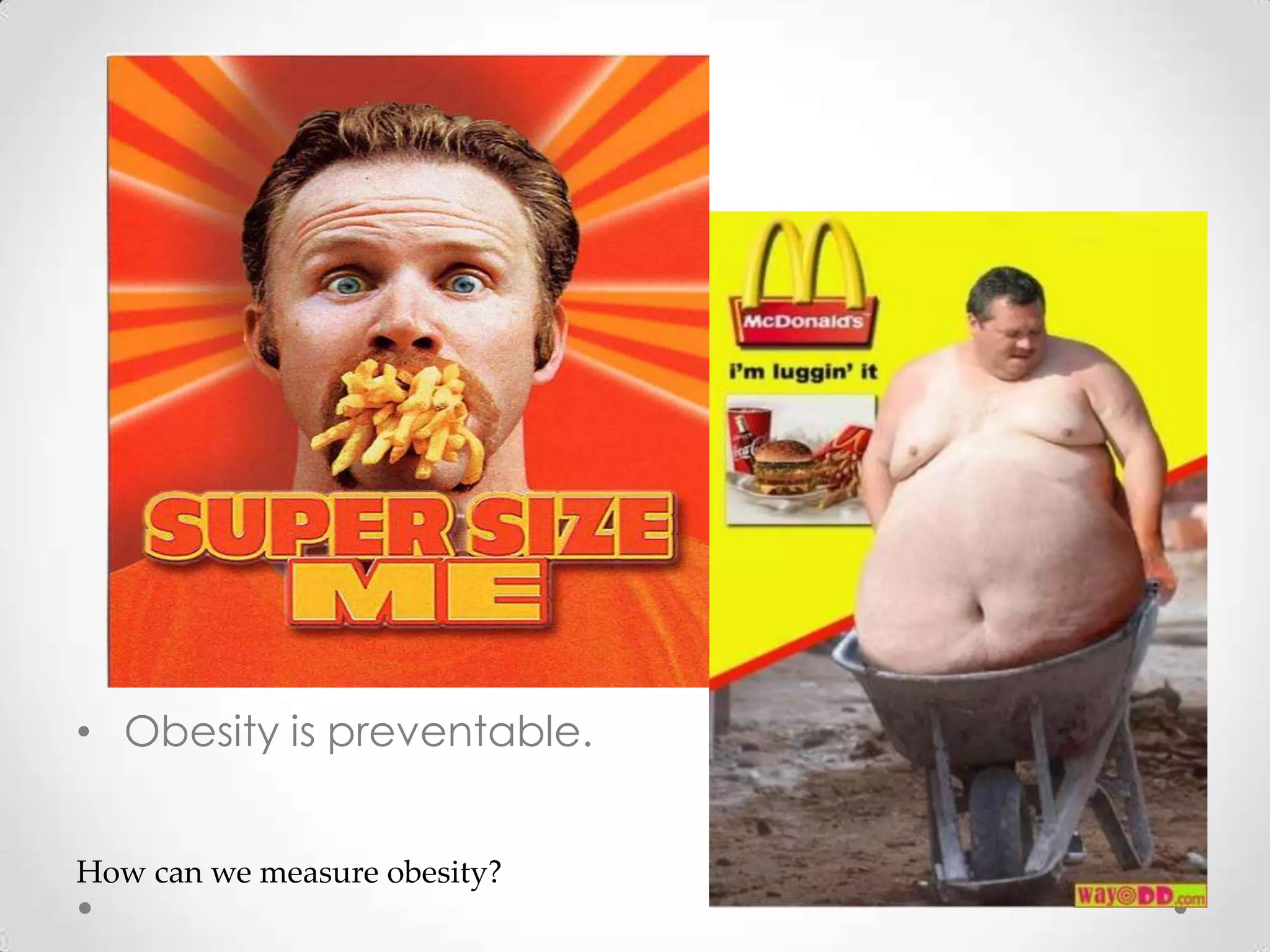
• Obesity is preventable.
How can we measure obesity?
Body Mass Index
• A crude population measure of
obesity is the body mass index
(BMI)
• Accounts for differences in body
composition by defining the level
of adiposity according to the
relationship of weight to height.
• A person’s weight (in kilograms)
divided by the square of his or her
height (in metres).
BMI = (weight in kg)/(height in meters)2
Body Mass Index
• While it does not directly measure body fat,
it is more accurate at approximating degree
of body fatness than weight alone.
• Allows comparisons both within and
between populations.
Disadvantage of BMI
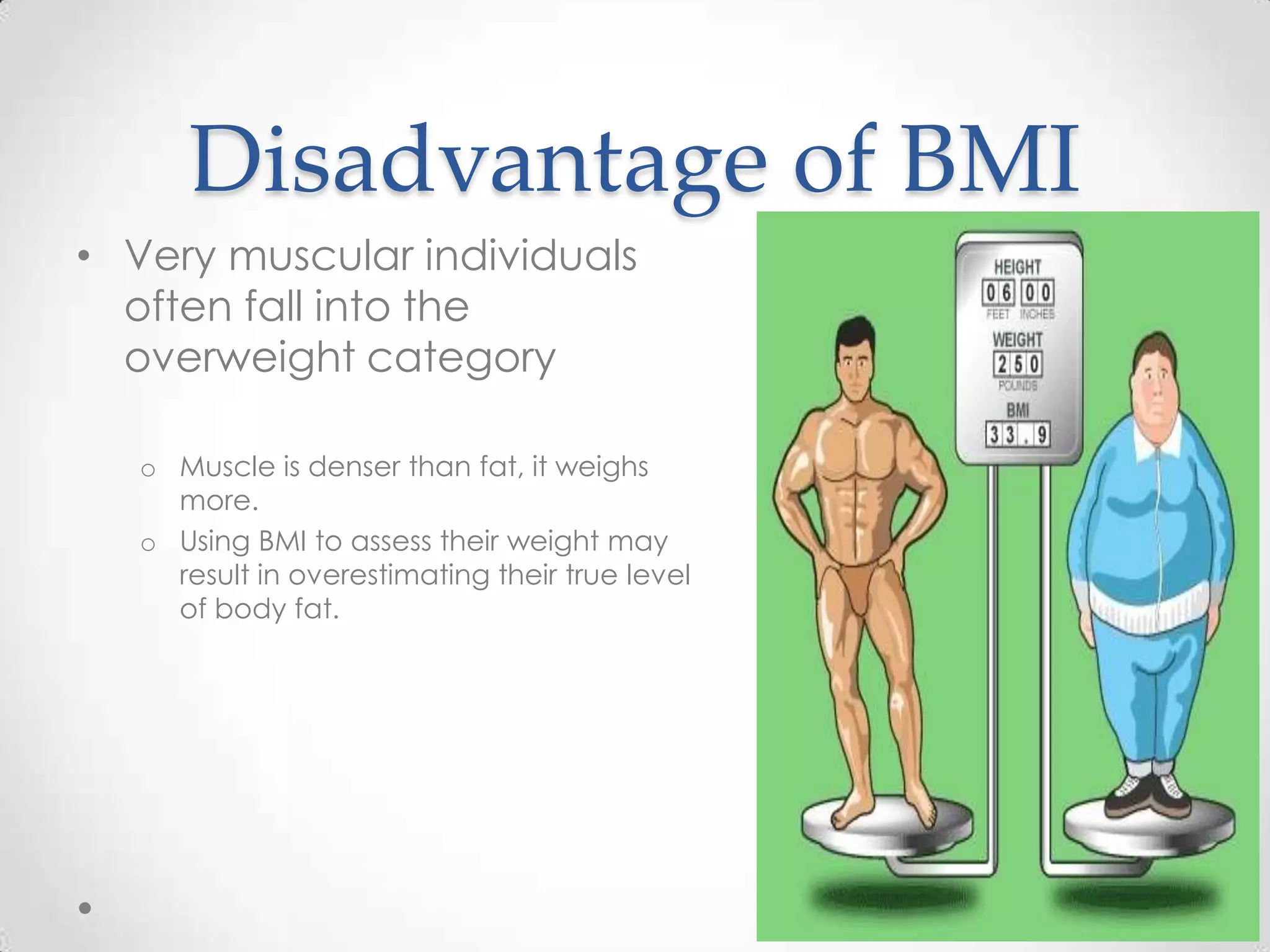
• Very muscular individuals
often fall into the
overweight category
o Muscle is denser than fat, it weighs
more.
o Using BMI to assess their weight may
result in overestimating their true level
of body fat.
Other measurements
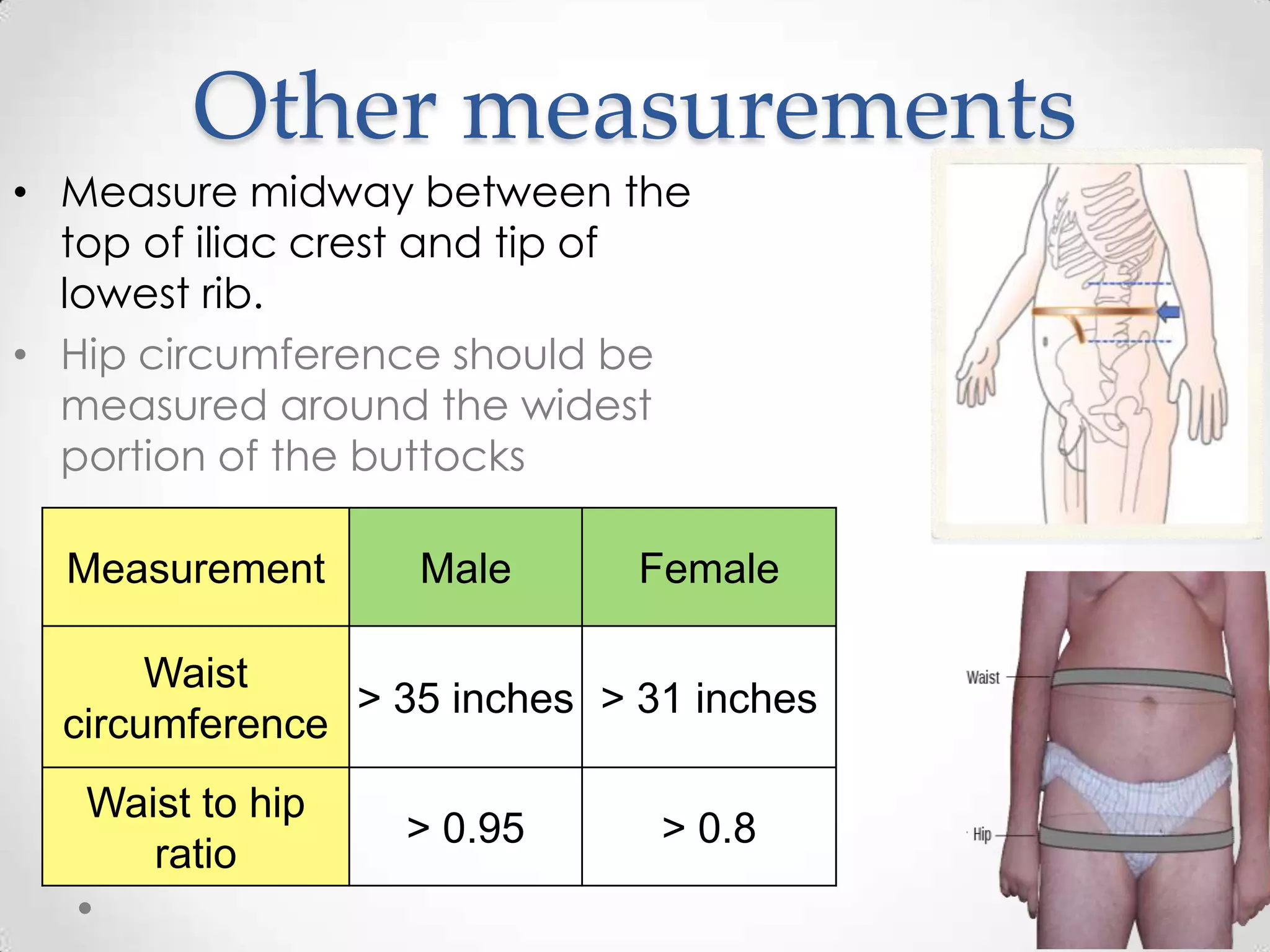
• Measure midway between the
top of iliac crest and tip of
lowest rib.
• Hip circumference should be
measured around the widest
portion of the buttocks
Measurement Male Female
Waist
circumference
> 35 inches > 31 inches
Waist to hip
ratio
> 0.95 > 0.8
Adipose
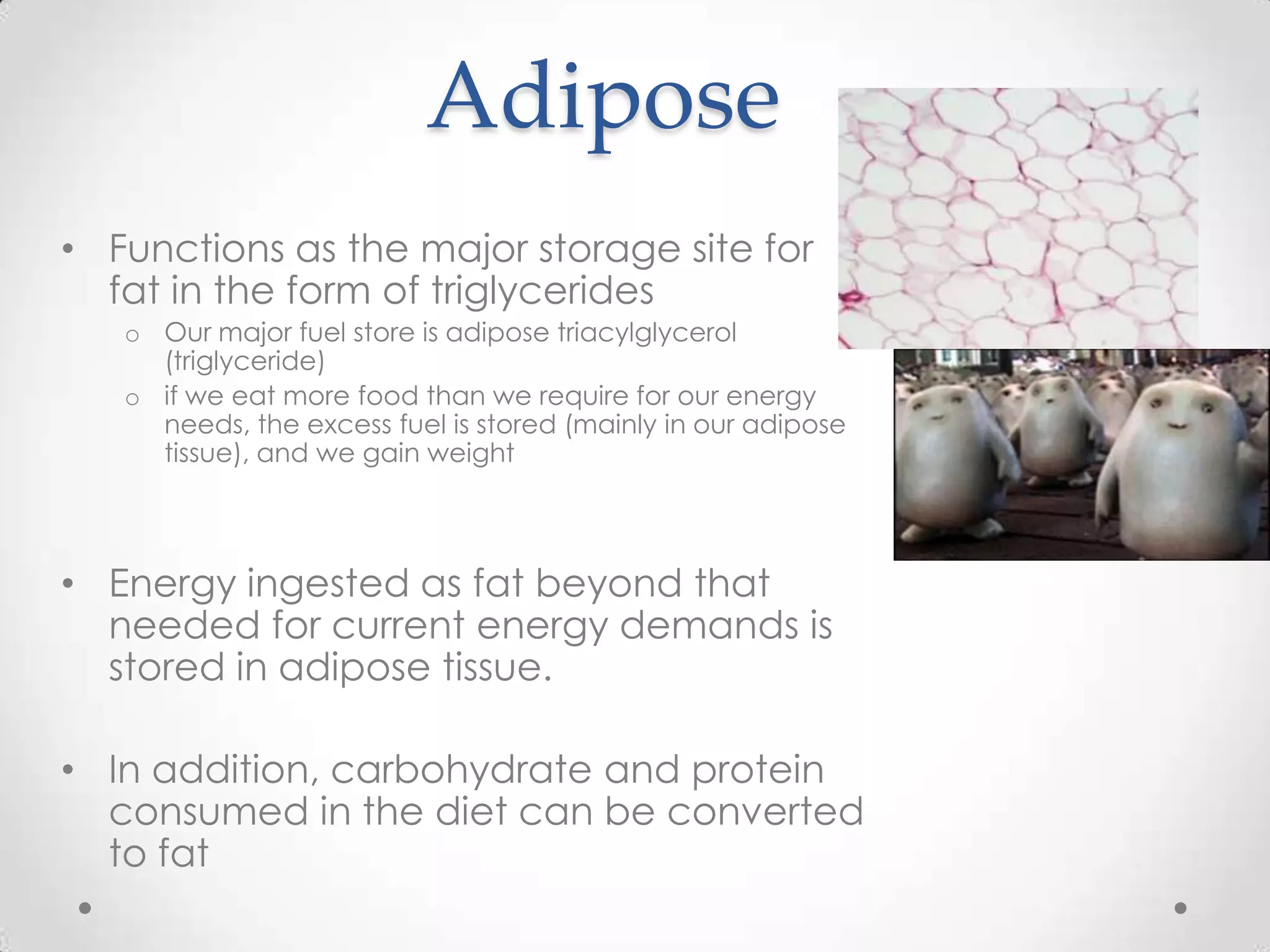
• Functions as the major storage site for
fat in the form of triglycerides
o Our major fuel store is adipose triacylglycerol
(triglyceride)
o if we eat more food than we require for our energy
needs, the excess fuel is stored (mainly in our adipose
tissue), and we gain weight
• Energy ingested as fat beyond that
needed for current energy demands is
stored in adipose tissue.
• In addition, carbohydrate and protein
consumed in the diet can be converted
to fat
Adipose
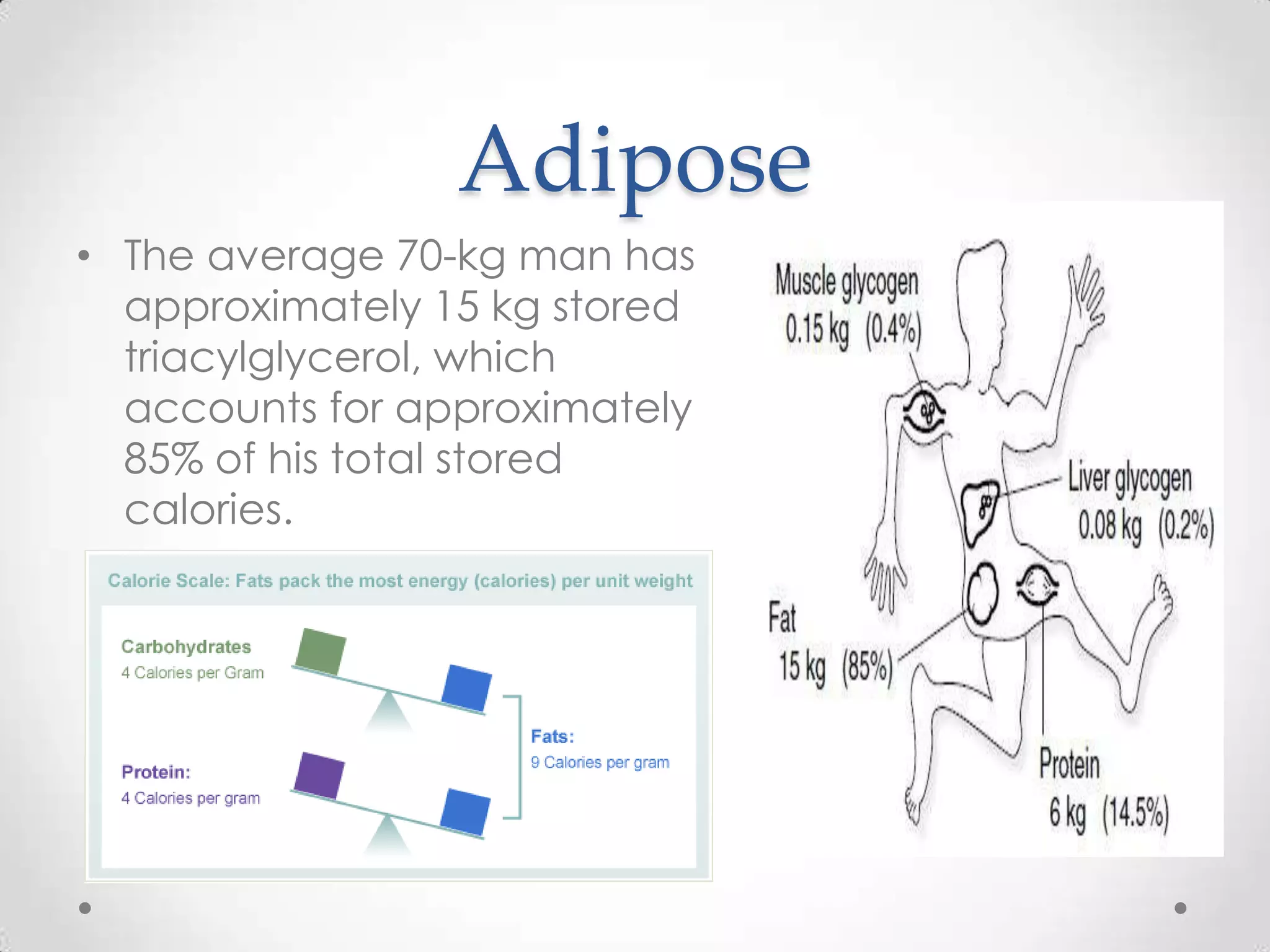
• The average 70-kg man has
approximately 15 kg stored
triacylglycerol, which
accounts for approximately
85% of his total stored
calories.
Adipose
• When triacylglycerols are
deposited in adipocytes, the
cells initially show a modest
increase in size
• When its maximal size is
reached, it divides.
• Fat cells, once gained, are
NEVER LOST.
• Thus, when an obese individual
loses weight, the size of the fat
cells is reduced, but the number
of fat cells is not affected.
• The observation that fat cells are
never lost emphasizes the
importance of preventing
obesity in the first place.
Anatomic differences in fat
deposition
• Android - Excess fat located in the
central abdominal area of the body
o waist to hip ratio of more than
• 0.8 for women
• 1.0 for men
• Gynoid - Fat distributed in the lower
extremities around the hips or
gluteal region
o waist to hip ratio of less than
• 0.8 for women
• 1.0 for men
Android vs. Gynoid
• is associated
with a greater
risk for:
o Hypertension
o insulin
resistance
o Diabetes
o Dyslipidemia
o coronary heart
disease
• is relatively
benign
healthwise, and
is commonly
found in
females.
• Fat deposits are
presumably
energy reserves
to support
demands of
pregnancy and
lactation
1 cup Veg
16 kcal
1 cup Rice
200 kcal
1 cup Ice cream
267 kcal
1 cup Mayonnaise
720 kcal
CASE
• Height: 5’8” (172.72cm)
• Weight: 250lbs (113.6kg)
• Physical Activity: Sedentary
• BMI: 113.6/1.72= 39.3 (Obese
class II)
Patients Actual Caloric
Intake
• CHO: 590g
• CHON: 135g
• Fat: 115g
X 4
X 4
X 9
= 2360 kcal
= 540 kcal
=1035 kcal
3935 Kcal
Patients’ Ideal Body Weight and Caloric
Requirement
• (IBW) Tannhausers
Method
o (172.72kg – 100kg) – 10%
o 72.72 - 7.272
o 65.5kg ~ 66kg
• Total Caloric
Requirement
o 66kg x 30= 1980 kcal
o 2000 kcal
• Actual wt/ IBW
113.6kg/66kg= 172%
The patients’ wt is 72% above
his IBW
• Corrected Body Weight (CBW)
– [(Actual BW –IBW) x25%]+ IBW
– [(113.6–66) x 0.25]+ 66
– [47.6 x 0.25]+ 66
– 11.9 + 66
– 77.9kg ~ 78kg
• Total Caloric Requirement
– 78kg x 30= 2340 kcal
– 2350 kcal
Caloric Distribution
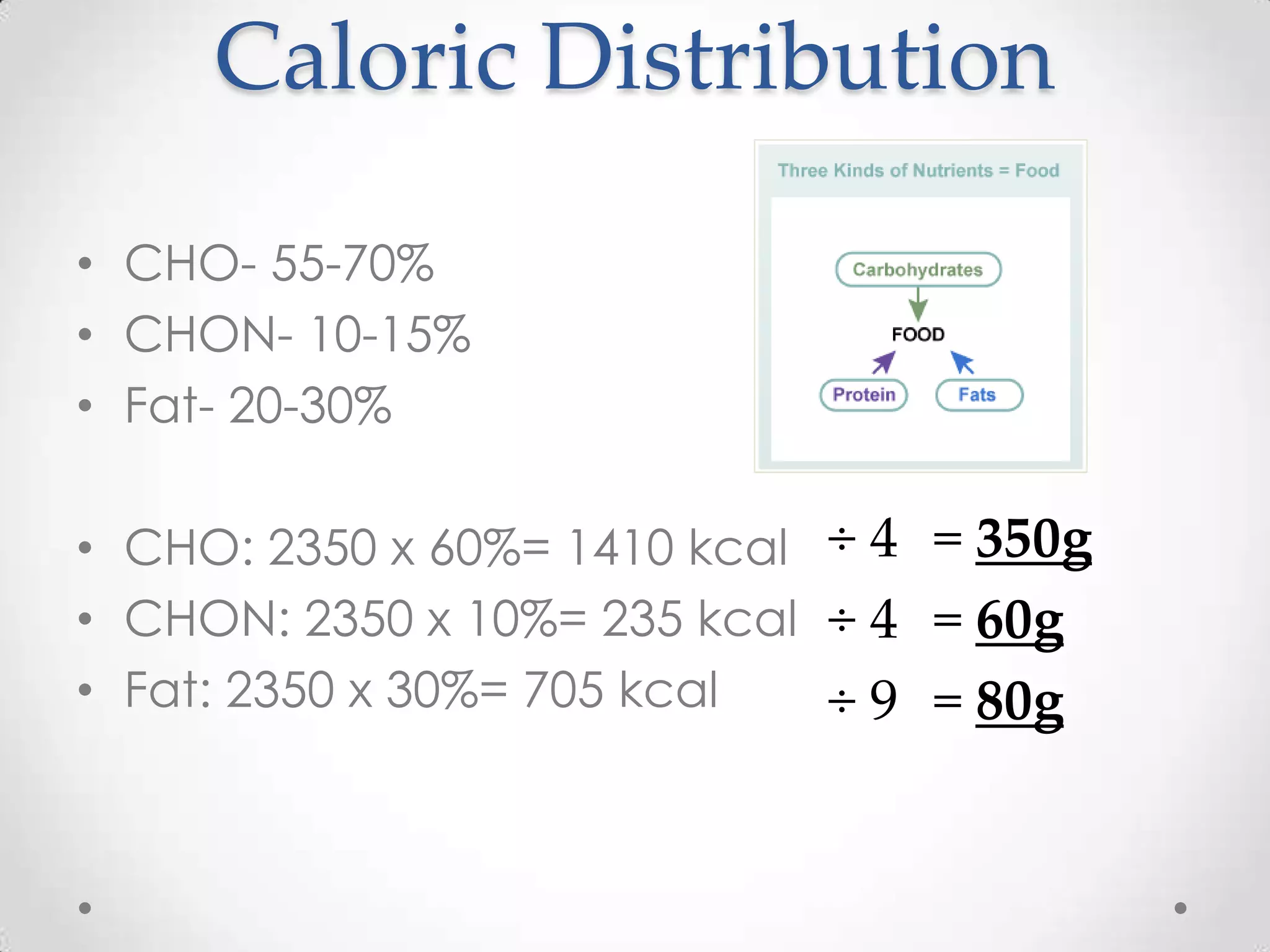
• CHO- 55-70%
• CHON- 10-15%
• Fat- 20-30%
• CHO: 2350 x 60%= 1410 kcal
• CHON: 2350 x 10%= 235 kcal
• Fat: 2350 x 30%= 705 kcal
÷ 4
÷ 4
÷ 9
= 350g
= 60g
= 80g
Energy and Nutrient Requirements
Actual
• Calorie: 3935 Kcal
• CHO: 590g
• CHON: 135g
• FAT: 115g
Required
• Calorie : 2350 kcal
• CHO: 350g
• CHON: 60g
• FAT: 80g

Obesity

  • 1.
  • 2.
    Obesity • Defined asabnormal or excessive fat accumulation that presents a risk to health. • BMI of >30 • Eating more in combination with reduced activity levels has resulted in a tendency for the sustained deposition of fat. o The fundamental cause of obesity and overweight is an energy imbalance between calories consumed and calories expended.
  • 3.
    Obesity • an increasedintake of energy-dense foods • a decrease in physical activity due to the o increasingly sedentary nature of many forms of work, o changing modes of transportation o increasing urbanization
  • 4.
    Obesity Facts fromWHO • Worldwide obesity has more than doubled since 1980. • In 2008; o 1.5 billion adults, 20 and older, were overweight. • Overall, more than one in ten of the world’s adult population was obese.
  • 5.
    Obesity Facts fromWHO • Nearly 43 million children under the age of five were overweight in 2010.
  • 6.
    Obesity Facts fromWHO • Overweight and obesity are linked to more deaths worldwide than underweight. • At least 2.8 million adults die each year as a result of being overweight or obese.
  • 7.
    • Obesity ispreventable. How can we measure obesity?
  • 8.
    Body Mass Index •A crude population measure of obesity is the body mass index (BMI) • Accounts for differences in body composition by defining the level of adiposity according to the relationship of weight to height. • A person’s weight (in kilograms) divided by the square of his or her height (in metres). BMI = (weight in kg)/(height in meters)2
  • 9.
    Body Mass Index •While it does not directly measure body fat, it is more accurate at approximating degree of body fatness than weight alone. • Allows comparisons both within and between populations.
  • 10.
    Disadvantage of BMI •Very muscular individuals often fall into the overweight category o Muscle is denser than fat, it weighs more. o Using BMI to assess their weight may result in overestimating their true level of body fat.
  • 11.
    Other measurements • Measuremidway between the top of iliac crest and tip of lowest rib. • Hip circumference should be measured around the widest portion of the buttocks Measurement Male Female Waist circumference > 35 inches > 31 inches Waist to hip ratio > 0.95 > 0.8
  • 12.
    Adipose • Functions asthe major storage site for fat in the form of triglycerides o Our major fuel store is adipose triacylglycerol (triglyceride) o if we eat more food than we require for our energy needs, the excess fuel is stored (mainly in our adipose tissue), and we gain weight • Energy ingested as fat beyond that needed for current energy demands is stored in adipose tissue. • In addition, carbohydrate and protein consumed in the diet can be converted to fat
  • 14.
    Adipose • The average70-kg man has approximately 15 kg stored triacylglycerol, which accounts for approximately 85% of his total stored calories.
  • 15.
    Adipose • When triacylglycerolsare deposited in adipocytes, the cells initially show a modest increase in size • When its maximal size is reached, it divides. • Fat cells, once gained, are NEVER LOST. • Thus, when an obese individual loses weight, the size of the fat cells is reduced, but the number of fat cells is not affected. • The observation that fat cells are never lost emphasizes the importance of preventing obesity in the first place.
  • 16.
    Anatomic differences infat deposition • Android - Excess fat located in the central abdominal area of the body o waist to hip ratio of more than • 0.8 for women • 1.0 for men • Gynoid - Fat distributed in the lower extremities around the hips or gluteal region o waist to hip ratio of less than • 0.8 for women • 1.0 for men
  • 17.
    Android vs. Gynoid •is associated with a greater risk for: o Hypertension o insulin resistance o Diabetes o Dyslipidemia o coronary heart disease • is relatively benign healthwise, and is commonly found in females. • Fat deposits are presumably energy reserves to support demands of pregnancy and lactation
  • 18.
    1 cup Veg 16kcal 1 cup Rice 200 kcal 1 cup Ice cream 267 kcal 1 cup Mayonnaise 720 kcal
  • 20.
    CASE • Height: 5’8”(172.72cm) • Weight: 250lbs (113.6kg) • Physical Activity: Sedentary • BMI: 113.6/1.72= 39.3 (Obese class II)
  • 21.
    Patients Actual Caloric Intake •CHO: 590g • CHON: 135g • Fat: 115g X 4 X 4 X 9 = 2360 kcal = 540 kcal =1035 kcal 3935 Kcal
  • 22.
    Patients’ Ideal BodyWeight and Caloric Requirement • (IBW) Tannhausers Method o (172.72kg – 100kg) – 10% o 72.72 - 7.272 o 65.5kg ~ 66kg • Total Caloric Requirement o 66kg x 30= 1980 kcal o 2000 kcal • Actual wt/ IBW 113.6kg/66kg= 172% The patients’ wt is 72% above his IBW • Corrected Body Weight (CBW) – [(Actual BW –IBW) x25%]+ IBW – [(113.6–66) x 0.25]+ 66 – [47.6 x 0.25]+ 66 – 11.9 + 66 – 77.9kg ~ 78kg • Total Caloric Requirement – 78kg x 30= 2340 kcal – 2350 kcal
  • 23.
    Caloric Distribution • CHO-55-70% • CHON- 10-15% • Fat- 20-30% • CHO: 2350 x 60%= 1410 kcal • CHON: 2350 x 10%= 235 kcal • Fat: 2350 x 30%= 705 kcal ÷ 4 ÷ 4 ÷ 9 = 350g = 60g = 80g
  • 24.
    Energy and NutrientRequirements Actual • Calorie: 3935 Kcal • CHO: 590g • CHON: 135g • FAT: 115g Required • Calorie : 2350 kcal • CHO: 350g • CHON: 60g • FAT: 80g