Dr. Atul Kumar Anand
Senior Resident
AIIMS Patna
ANATOMY
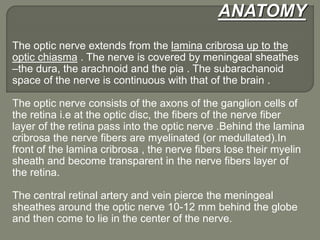
The optic nerve extends from the lamina cribrosa up to the
optic chiasma . The nerve is covered by meningeal sheathes
–the dura, the arachnoid and the pia . The subarachanoid
space of the nerve is continuous with that of the brain .
The optic nerve consists of the axons of the ganglion cells of
the retina i.e at the optic disc, the fibers of the nerve fiber
layer of the retina pass into the optic nerve .Behind the lamina
cribrosa the nerve fibers are myelinated (or medullated).In
front of the lamina cribrosa , the nerve fibers lose their myelin
sheath and become transparent in the nerve fibers layer of
the retina.
The central retinal artery and vein pierce the meningeal
sheathes around the optic nerve 10-12 mm behind the globe
and then come to lie in the center of the nerve.
 ON divided in 4 parts
 Intra-ocular part (1mm)
 Intra-orbital part (25-30
mm)
 Intra-canalicular part (5-9
mm)
 Intra-cranial part (10-16
mm)
ON have approx
1.2 million axons
Inflammation of the optic nerve in any part of its
couse.
Clinical two categories
Those affecting part of nerve
ophthalmoscopically visible at disc:- papillitis &
neuroretinitis
Those affecting part of nerve
ophthalmoscopically not visible at disc:- retro -
bulbar neuritis(RBN)
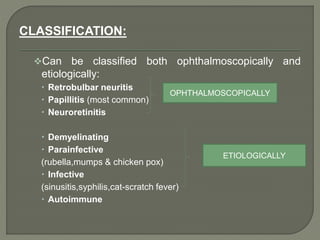
CLASSIFICATION:
Can be classified both ophthalmoscopically and
etiologically:
 Retrobulbar neuritis
 Papillitis (most common)
 Neuroretinitis
 Demyelinating
 Parainfective
(rubella,mumps & chicken pox)
 Infective
(sinusitis,syphilis,cat-scratch fever)
 Autoimmune
OPHTHALMOSCOPICALLY
ETIOLOGICALLY
 Retrobulbar neuritis
 Optic nerve is affected more posteriorly behind eyeball with
no disc swelling. C/F similar to papillitis except for fundus
 Papillitis: involvement of optic disc
Affect optic nerve head (hyperaemia & oedema of optic disc)
+ peri-papillary flame-shaped haemorrhages
 Neuroretinitis: combined involvement of ONH &
surrounding retina
Characterized by papillitis with inflammation of the retinal
nerve fiber layer. A macular star figure composed of hard
exudates may present. Least common and most frequently
associated with viral infections and cat-scratch fever, Syphilis
and Lyme disease. Usually self-limiting which resolves 6-12
months.
Neuroretinitis is rarely a manifestation of demyelination.
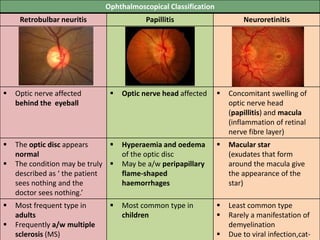
Ophthalmoscopical Classification
Retrobulbar neuritis Papillitis Neuroretinitis
 Optic nerve affected
behind the eyeball
 Optic nerve head affected  Concomitant swelling of
optic nerve head
(papillitis) and macula
(inflammation of retinal
nerve fibre layer)
 The optic disc appears
normal
 The condition may be truly
described as ‘ the patient
sees nothing and the
doctor sees nothing.’
 Hyperaemia and oedema
of the optic disc
 May be a/w peripapillary
flame-shaped
haemorrhages
 Macular star
(exudates that form
around the macula give
the appearance of the
star)
 Most frequent type in
adults
 Frequently a/w multiple
sclerosis (MS)
 Most common type in
children
 Least common type
 Rarely a manifestation of
demyelination
 Due to viral infection,cat-
Normal optic disc, primary optic atrophy. The condition may be
truly described as ‘ the patient sees nothing and the doctor sees
nothing.’
Retrobulbar neuritis
swollen disc with blurring and hyperaemia of disc margin; venous dilation and
engorgement ; vitreous haziness because of inflammatory exudates and cells that
invaded the vitreous( mild vitritis); Flame-shaped hemorrhages and cotton wool spot
(soft exudates) on and around the disc; secondary optic atrophy
Papillitis
Macular star
(Exudates in a star-shaped pattern
radiating from the macula)
Neuroretinitis
Diffuse Unilateral Subacute
Neuroretinitis - Nematode
1. Demyelinating
 Pathological process: the normally myelinated nerve fibres
lose their insulating myelin layer (The myelin is phagocytosed
by microglia and macrophages,subsequent to which
astrocytes lay down fibrous tissue (plaque) -> distrupts nerve
conduction w/in white matter tracts( brain,brainstem,spinal
cord)
 Ages: 20-50 years old, F:M = 3:2
 Most common cause (eg. Multiple sclerosis)
 Optic disc is normal (retrobulbar neuritis)
1. Isolated optic neuritis
2. Multiple sclerosis
3. Devic disease (neuromyelitis optica) :
bilateral optic neuritis (91%)
 Usu. women aged btw 18-45yrs(mean around 30 years)
 Acute unilateral loss of vision, may progress over a few
days, then slowly improve
 Pain exacerbated on eye movement (retrobulbar neuritis) b/c
rectus contraction pulls on the optic nerve sheath; painless
(papillitis)
 Dyschromatopsia (change in color perception) in affected eye
 Flashes of light/ phosphenes (tiny white or coloured flashes or
sparkles) induced by eye movement or loud sounds
 Relapsing( most common)/ Progressive (10%)
 A preceding H/O viral illness in some cases
 Vision loss exacerbated by increase in body temp. or exercise
(Uhthoff phenomenon).
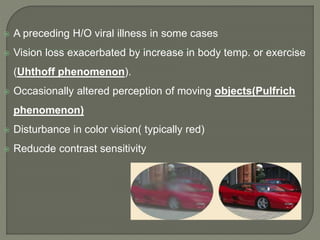
 Occasionally altered perception of moving objects(Pulfrich
phenomenon)
 Disturbance in color vision( typically red)
 Reducde contrast sensitivity
Reduced visual acuity
Reduced color vision, decreased stereoacuity
Abnormal contrast sensitivity
RAPD (Relative afferent pupillary defect) :
reduced optic nerve conduction(MG pupil)
 VFA: Central or centrocaecal scotoma
Normal disc: retrobulbar neuritis(common in adult
 Swollen hyperemic disc : papillitis(child & young
SLE: inflammatory cells in vitreous
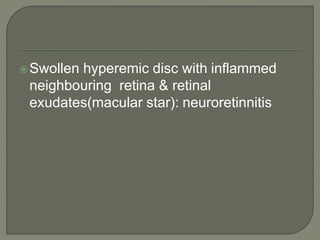
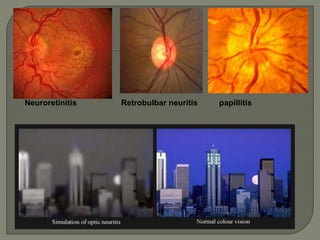
Swollen hyperemic disc with inflammed
neighbouring retina & retinal
exudates(macular star): neuroretinnitis
papillitis
Neuroretinitis Retrobulbar neuritis
In majority cases vision starts to improve in 2nd
or 3rd week & by 4th to 6th week VA returns to
normal or near normal
CV, contrass sensitivity & visual field take
longer to recover(6-12months) or may never
returns comletely to normal.
In small percentage VA not impove to functional
level or rarely doesnot improve at all(atypical
neuritits: out of typical age range, progressive diminution of
VA beyond 1st week, poor VA persisting beyond 2nd week)
AION: affects elderly
Papilloedema & pseudo- papilloedema
Leber hereditary optic neuropathy: primarily
affects male around 20yrs age group,
transmitted by female carrier(mitochondrial
inheritance) progressive loss of vision fundus
initially normal or mild hyperemic– B/L primary
optic atrophy.
 The diagnosis of optic neuritis is clinical, based on the
history and physical findings.
 Investigations
• Brain MRI
• Serological tests: ESR, syphilis, antinuclear antibody
(ANA), antineutrophil cytoplasmic antibodies (ANCA)
• CSF analysis (lumbar puncture) : Presence of
oligoclonal band, elevated IgG level suggest MS.
 MRI of the brain and orbits with gadolinium contrast
has become the cornerstone of the evaluation in patients
with optic neuritis
• To confirm the clinical diagnosis (look for additional
plaques of demyelination)
• Offers very strong prognostic information about the
risk of future demyelinating events and MS
• For treatment decision
A gadolinium-enhanced fat-saturated T1-weighted scan will show a
bright enhancement of the inflamed optic nerve (upper left red
arrow). Additionally, bright spots characteristic of multiple sclerosis
may also be seen in the brain (lower right red arrow).
White matter lesions in
brain MRI denotes
higher risk of
developing MS
TREAT THE
UNDERLYING
CAUSE
 In most cases (mild vision loss, no significant visual field
loss, no enhancing lesions on brain MRI) - no treatment
 Vision slowly recovers over several weeks even w/o
treatment (spontaneously)
 Treatment Indicated
• Visual acuity worsen than 6/12
• Treatment hasten the visual recovery process,
decreases recurrene but no effect on long-term
visual outcome
 Regimen
• IV corticosteroid (eg. methylprednisolone)
 1g daily for 3 days followed by oral steroid as
prednisolone (1mg/kg/day) for 11 days and then
tapered for 3 days
Oral prednisolone alone is contraindicated b/c it doesnot affect the
speed of recovry & is a/w a significantly high recurrence rate.
Chronic Retrobulbar Neuritis : (Toxic
Amblyopic)
It includes a number of conditions in which the ganglion
cells/optic nerve fibers are damaged by the exogenous
poisons.
Etiology:
1-Tobacco-chewing or smoking. The causative agent
is nicotine, cyanide collidine or lutidine.
2-Ethyl and methyl alcohol.
3-Lead
4-Arsenic
5-Quinine
Predisposing factors: poor general health and
vitamin deficiency.
Symptoms:
1) gradual diminision of vision – sharp vision i.e. vision
for fine work such as reading fine print, threading a
needle etc. Is particularly affected.
2) Colour blindness.
Sign:
At first no changes are seen in the fundus. Later there is
blurring of the disc margin, pallor of the temporal side of
the disc.
Central fields: shows central or centrocaecal scotoma for
white and coloured objects (red and green).
Treatment:
1-Complete withdrawal of tobacco, alcohol
2-Administration of high doses of Vitamin B1
, B6 and B12 (hydrox-cobalamine)
3-Improvement of general health
4-Vasodilators – nicotinic acid.
Occurs in heavy drinkers suffering from
chronic gastritis
Chronic amblyopia
Optic neuritis with peripheral neuritis
C/F similar to tobacco amblyopia
Prognosis not so good
Due to intake of methylated spirit in cheap
adulterated beverage
Ocular features: in early case mild disc
edema, markedly narrowed blood vessels,
finally acute B/L primary optic atrophy
resulting in complete blindness in 2-3 days
Gastric lavage
Administration of alkali : to overcome
acidosis(sodi bicarb- orally or iv)
Ethyl alcohol : for enzyme (alcohol
dehydrogenase) compettitive inhibition,
90ml 3hrly for 3days
Prognosis very poor
Optic Neuritis.pptx

Optic Neuritis.pptx

  • 1.
    Dr. Atul KumarAnand Senior Resident AIIMS Patna
  • 2.
    ANATOMY The optic nerveextends from the lamina cribrosa up to the optic chiasma . The nerve is covered by meningeal sheathes –the dura, the arachnoid and the pia . The subarachanoid space of the nerve is continuous with that of the brain . The optic nerve consists of the axons of the ganglion cells of the retina i.e at the optic disc, the fibers of the nerve fiber layer of the retina pass into the optic nerve .Behind the lamina cribrosa the nerve fibers are myelinated (or medullated).In front of the lamina cribrosa , the nerve fibers lose their myelin sheath and become transparent in the nerve fibers layer of the retina. The central retinal artery and vein pierce the meningeal sheathes around the optic nerve 10-12 mm behind the globe and then come to lie in the center of the nerve.
  • 3.
     ON dividedin 4 parts  Intra-ocular part (1mm)  Intra-orbital part (25-30 mm)  Intra-canalicular part (5-9 mm)  Intra-cranial part (10-16 mm) ON have approx 1.2 million axons
  • 4.
    Inflammation of theoptic nerve in any part of its couse. Clinical two categories Those affecting part of nerve ophthalmoscopically visible at disc:- papillitis & neuroretinitis Those affecting part of nerve ophthalmoscopically not visible at disc:- retro - bulbar neuritis(RBN)
  • 5.
    CLASSIFICATION: Can be classifiedboth ophthalmoscopically and etiologically:  Retrobulbar neuritis  Papillitis (most common)  Neuroretinitis  Demyelinating  Parainfective (rubella,mumps & chicken pox)  Infective (sinusitis,syphilis,cat-scratch fever)  Autoimmune OPHTHALMOSCOPICALLY ETIOLOGICALLY
  • 7.
     Retrobulbar neuritis Optic nerve is affected more posteriorly behind eyeball with no disc swelling. C/F similar to papillitis except for fundus  Papillitis: involvement of optic disc Affect optic nerve head (hyperaemia & oedema of optic disc) + peri-papillary flame-shaped haemorrhages  Neuroretinitis: combined involvement of ONH & surrounding retina Characterized by papillitis with inflammation of the retinal nerve fiber layer. A macular star figure composed of hard exudates may present. Least common and most frequently associated with viral infections and cat-scratch fever, Syphilis and Lyme disease. Usually self-limiting which resolves 6-12 months. Neuroretinitis is rarely a manifestation of demyelination.
  • 8.
    Ophthalmoscopical Classification Retrobulbar neuritisPapillitis Neuroretinitis  Optic nerve affected behind the eyeball  Optic nerve head affected  Concomitant swelling of optic nerve head (papillitis) and macula (inflammation of retinal nerve fibre layer)  The optic disc appears normal  The condition may be truly described as ‘ the patient sees nothing and the doctor sees nothing.’  Hyperaemia and oedema of the optic disc  May be a/w peripapillary flame-shaped haemorrhages  Macular star (exudates that form around the macula give the appearance of the star)  Most frequent type in adults  Frequently a/w multiple sclerosis (MS)  Most common type in children  Least common type  Rarely a manifestation of demyelination  Due to viral infection,cat-
  • 9.
    Normal optic disc,primary optic atrophy. The condition may be truly described as ‘ the patient sees nothing and the doctor sees nothing.’ Retrobulbar neuritis
  • 10.
    swollen disc withblurring and hyperaemia of disc margin; venous dilation and engorgement ; vitreous haziness because of inflammatory exudates and cells that invaded the vitreous( mild vitritis); Flame-shaped hemorrhages and cotton wool spot (soft exudates) on and around the disc; secondary optic atrophy Papillitis
  • 11.
    Macular star (Exudates ina star-shaped pattern radiating from the macula) Neuroretinitis Diffuse Unilateral Subacute Neuroretinitis - Nematode
  • 12.
    1. Demyelinating  Pathologicalprocess: the normally myelinated nerve fibres lose their insulating myelin layer (The myelin is phagocytosed by microglia and macrophages,subsequent to which astrocytes lay down fibrous tissue (plaque) -> distrupts nerve conduction w/in white matter tracts( brain,brainstem,spinal cord)  Ages: 20-50 years old, F:M = 3:2  Most common cause (eg. Multiple sclerosis)  Optic disc is normal (retrobulbar neuritis)
  • 13.
    1. Isolated opticneuritis 2. Multiple sclerosis 3. Devic disease (neuromyelitis optica) : bilateral optic neuritis (91%)
  • 15.
     Usu. womenaged btw 18-45yrs(mean around 30 years)  Acute unilateral loss of vision, may progress over a few days, then slowly improve  Pain exacerbated on eye movement (retrobulbar neuritis) b/c rectus contraction pulls on the optic nerve sheath; painless (papillitis)  Dyschromatopsia (change in color perception) in affected eye  Flashes of light/ phosphenes (tiny white or coloured flashes or sparkles) induced by eye movement or loud sounds  Relapsing( most common)/ Progressive (10%)
  • 16.
     A precedingH/O viral illness in some cases  Vision loss exacerbated by increase in body temp. or exercise (Uhthoff phenomenon).  Occasionally altered perception of moving objects(Pulfrich phenomenon)  Disturbance in color vision( typically red)  Reducde contrast sensitivity
  • 17.
    Reduced visual acuity Reducedcolor vision, decreased stereoacuity Abnormal contrast sensitivity RAPD (Relative afferent pupillary defect) : reduced optic nerve conduction(MG pupil)  VFA: Central or centrocaecal scotoma Normal disc: retrobulbar neuritis(common in adult  Swollen hyperemic disc : papillitis(child & young SLE: inflammatory cells in vitreous
  • 18.
    Swollen hyperemic discwith inflammed neighbouring retina & retinal exudates(macular star): neuroretinnitis
  • 19.
  • 20.
    In majority casesvision starts to improve in 2nd or 3rd week & by 4th to 6th week VA returns to normal or near normal CV, contrass sensitivity & visual field take longer to recover(6-12months) or may never returns comletely to normal. In small percentage VA not impove to functional level or rarely doesnot improve at all(atypical neuritits: out of typical age range, progressive diminution of VA beyond 1st week, poor VA persisting beyond 2nd week)
  • 21.
    AION: affects elderly Papilloedema& pseudo- papilloedema Leber hereditary optic neuropathy: primarily affects male around 20yrs age group, transmitted by female carrier(mitochondrial inheritance) progressive loss of vision fundus initially normal or mild hyperemic– B/L primary optic atrophy.
  • 23.
     The diagnosisof optic neuritis is clinical, based on the history and physical findings.  Investigations • Brain MRI • Serological tests: ESR, syphilis, antinuclear antibody (ANA), antineutrophil cytoplasmic antibodies (ANCA) • CSF analysis (lumbar puncture) : Presence of oligoclonal band, elevated IgG level suggest MS.
  • 24.
     MRI ofthe brain and orbits with gadolinium contrast has become the cornerstone of the evaluation in patients with optic neuritis • To confirm the clinical diagnosis (look for additional plaques of demyelination) • Offers very strong prognostic information about the risk of future demyelinating events and MS • For treatment decision
  • 25.
    A gadolinium-enhanced fat-saturatedT1-weighted scan will show a bright enhancement of the inflamed optic nerve (upper left red arrow). Additionally, bright spots characteristic of multiple sclerosis may also be seen in the brain (lower right red arrow). White matter lesions in brain MRI denotes higher risk of developing MS
  • 26.
  • 27.
     In mostcases (mild vision loss, no significant visual field loss, no enhancing lesions on brain MRI) - no treatment  Vision slowly recovers over several weeks even w/o treatment (spontaneously)  Treatment Indicated • Visual acuity worsen than 6/12 • Treatment hasten the visual recovery process, decreases recurrene but no effect on long-term visual outcome
  • 28.
     Regimen • IVcorticosteroid (eg. methylprednisolone)  1g daily for 3 days followed by oral steroid as prednisolone (1mg/kg/day) for 11 days and then tapered for 3 days Oral prednisolone alone is contraindicated b/c it doesnot affect the speed of recovry & is a/w a significantly high recurrence rate.
  • 29.
    Chronic Retrobulbar Neuritis: (Toxic Amblyopic) It includes a number of conditions in which the ganglion cells/optic nerve fibers are damaged by the exogenous poisons. Etiology: 1-Tobacco-chewing or smoking. The causative agent is nicotine, cyanide collidine or lutidine. 2-Ethyl and methyl alcohol. 3-Lead 4-Arsenic 5-Quinine Predisposing factors: poor general health and vitamin deficiency.
  • 30.
    Symptoms: 1) gradual diminisionof vision – sharp vision i.e. vision for fine work such as reading fine print, threading a needle etc. Is particularly affected. 2) Colour blindness. Sign: At first no changes are seen in the fundus. Later there is blurring of the disc margin, pallor of the temporal side of the disc. Central fields: shows central or centrocaecal scotoma for white and coloured objects (red and green).
  • 31.
    Treatment: 1-Complete withdrawal oftobacco, alcohol 2-Administration of high doses of Vitamin B1 , B6 and B12 (hydrox-cobalamine) 3-Improvement of general health 4-Vasodilators – nicotinic acid.
  • 32.
    Occurs in heavydrinkers suffering from chronic gastritis Chronic amblyopia Optic neuritis with peripheral neuritis C/F similar to tobacco amblyopia Prognosis not so good
  • 33.
    Due to intakeof methylated spirit in cheap adulterated beverage Ocular features: in early case mild disc edema, markedly narrowed blood vessels, finally acute B/L primary optic atrophy resulting in complete blindness in 2-3 days
  • 34.
    Gastric lavage Administration ofalkali : to overcome acidosis(sodi bicarb- orally or iv) Ethyl alcohol : for enzyme (alcohol dehydrogenase) compettitive inhibition, 90ml 3hrly for 3days Prognosis very poor

Editor's Notes

  • #9 The papilla (the blind spot) is the spot there the optic nerve leaves the retina A swollen disc with blurring and hyperaemia of disc margin
  • #16 Phosphenes – sensation of light produced by mechanical or electrical stimulation for the peripheral or central optic pathway of nervous system
  • #17 Lhermitte sign= electric sensation on neck flexion
  • #29 Interferon beta balances the expression of pro- and anti-inflammatory agents in the brain, and reduces the number of inflammatory cells that cross the blood brain barrier.[4] Overall, therapy with interferon beta leads to a reduction of neuron inflammation.[4] Moreover, it is also thought to increase the production of nerve growth factor and consequently improve neuronal survival.[4] IM interferon β-1a - immunosuppresant medication may help to prevent or delay its onset. These medications are given as subcutaneous injections. They include interferon β-1a (Avonex, Rebif) and interferon β-1b (Betaseron). Also associated with a wide range of side effects, such as flu-like symptoms, depression, liver damage, reduced immunity and tissue damage at the site of injection.