Papilloedema
Mohammad A.M. El-Hifnawy, MD.
Professor of Ophthalmology
Alexandria University
Papilloedema
Definition
It is a passive oedema of the optic disc due to
increased ICP. It is almost always bilateral without
visual deficits.
Disc oedema is used for other forms of optic disc
swelling caused by inflammation, stasis or toxic
substances.
Pathologically papilloedema closely resembles disc
oedema not related to increased ICP.
Papilloedema
Aetiology
I. Increased intracranial pressure.
II. Systemic causes.
III. Orbital causes.
IV. Ocular causes.
Papilloedema
Aetiology
I. Increased intracranial pressure
1. Increased intracranial total mass volume:
Space occupying lesion: Brain tumours
 Infratentorial: cerebellum & 4th ventricle
(obstruction through aqueduct).
 Supratentorial: 3rd ventricle tumours.
Papilloedema
Aetiology
I. Increased intracranial pressure
1. Increased intracranial total mass volume
 Less likely with brainstem and base of skull
tumours, parietal, occipital and parasagittal
tumours.
 Rare with pituitary tumours.
 Only 60% of patients with cerebral tumours
have papilloedema.
Papilloedema
Aetiology
I. Increased intracranial pressure
2. Increased protein content of CSF
Increased CSF osomotic pressure and
blocking absorptive pathways.
e.g. spinal tumours, Guillain-Barre syndrome,
meningitis, encephalitis.
Papilloedema
Aetiology
I. Increased intracranial pressure
3. Increased CSF production
Choroidal plexus papilloma.
Papilloedema
Aetiology
I. Increased intracranial pressure
4. Poor uptake of CSF
Idiopathic intracranial hypertension.
Papilloedema
Aetiology
I. Increased intracranial pressure
5. Increased venous pressure:
 Superior vena cava obstruction.
 Congestive heart failure.
 Neck surgery.
 Jugular vein compression.
 Cerebral venous sinus thrombosis.
Papilloedema
Aetiology
I. Increased intracranial pressure
6. Obstructive hydrocephalus
Papilloedema
Aetiology
I. Increased intracranial pressure
7. Subarachnoid haemeorrhage
Can develop within 1 hour
Papilloedema
Aetiology
I. Increased intracranial pressure
8. Skull malformation
 Oxycephaly.
 Craniofacial dysostosis.
Papilloedema
Aetiology
II. Systemic causes
Malignant hypertension
 Often associated with increased ICP.
 Less venous distension, more arteriolar
narrowing, more diffuse retinal haemorrhages
and exudates.
Papilloedema
Aetiology
III. Orbital causes
Pressure on the optic nerve within the orbit
 Tumours.
 Abscesses.
 Endocrine exophthalmos.
- Usually associated with proptosis, unilateral.
Papilloedema
Aetiology
IV. Ocular causes
1. Hypotony
Decreased tissue pressure within the
prelaminar area.
Papilloedema
Aetiology
IV. Ocular causes
2. Inflammatory conditions
 Pars planitis
 Irvine-Gass syndrome
Papilloedema
Aetiology
IV. Ocular causes
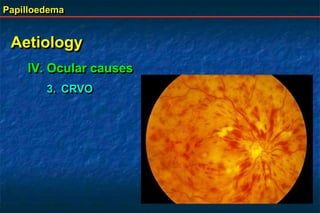
3. CRVO
Papilloedema
Pathogenesis
Controversial
Mechanical rather than vascular phenomenon.
Old theory
Increased CSF pressure  vaginal sheaths of ON
 CRV compression in perineural subarachnoid
space  stagnation of venous return  vascular
congestion and oedema.
Papilloedema
Pathogenesis:
Controversial
Hayreh
Increased ICP  p. in perineural subarachnooid
space  CSF diffuses into ON  tissue pressure
 axoplasmic flow block at lamina cribrosa ON
fiber swelling in ONH & leakage of H2O, proteins &
other axoplasmic contents into the extracellular
space of prelaminar region of ON.
Papilloedema
Pathogenesis
Controversial
Hayreh
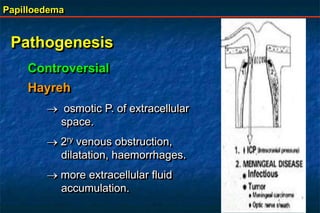
 osmotic P. of extracellular
space.
 2ry venous obstruction,
dilatation, haemorrhages.
 more extracellular fluid
accumulation.
Papilloedema
Clinical picture
Race: No predilection.
Sex: equal.
Age: almost any age.
- Infants: uncommon; un-obliterated fontanels.
- 2-10 years: more frequent; more infratentorial tumours.
- Elderly patients: rare; low incidence of brain tumours.
Papilloedema
Clinical picture
Bilateral: rule
Unilateral
1. Ocular/orbital causes
2. Increased ICP
- Frontal lobe tumour: Foster-Kennedy: rare.
- Pre-existing unilateral optic disc anomaly, atrophy,
high myopia.
- Obstruction of pressure transmission by the tumour
or congenital anomaly of ON sheath.
Papilloedema
Clinical picture
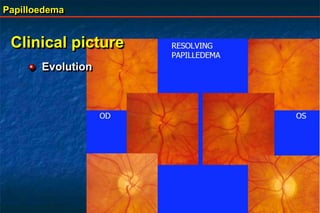
Evolution
Develops quickly, subsides slowly
- Evolution: 1-5 days.
Exception: acute intracranial haemorrhage;
intracerebral, subarachnoid: 2-8 hrs.
- Recovery: 6-8 weeks after return to normal pressure.
Papilloedema
Clinical picture
Evolution
Papilloedema
Clinical picture
Symptoms
Associated neurologic symptoms.
Normal vision.
Transient obscuration of vision.
Vision loss.
Papilloedema
Clinical picture
Symptoms
Associated neurologic symptoms
Headache
- Acute/chronic
- Unilateral/generalized
- Mild/moderate/severe
- Worse in the morning
- by coughing, sneezing, straining.
± nausea and vomiting.
Papilloedema
Clinical picture
Symptoms
Normal vision
DD: Optic neuritis, AION
Papilloedema
Clinical picture
Symptoms
Transient obscuration of vision
- “Gray outs”/”black outs”: slight blur  complete blindness.
- Alternating, rarely simultaneously bilateral.
- 5-30 seconds.
- Abrupt onset & end, clears completely.
- Frequency: few/w  50/d.
- Poor visual outcome with frequency and intensity of
episodes.
- Triggering factors: standing up, stooping, turning the head
abruptly.
- Moderate-severe papilloedema.
Papilloedema
Clinical picture
Symptoms
Transient obscuration of vision
D.D.
- Amaurosis fugax: carotid occlusive disease
5-15 min, fundus emboli.
- Retinal migraine: 15-20 min  headache.
Papilloedema
Clinical picture
Symptoms
Transient obscuration of vision
Mechanism
- Hydrocephalus: 3rd ventricle distension  P. on chiasm.
- Medial temporal lobe herniation  ipsilateral posterior
cerebral artery compression  visual cortex ischaemia.
- Optic disc ischaemia (Hayreh).
- Retinal artery spasm.
- Fluctuation in ONH perfusion.
Papilloedema
Clinical picture
Symptoms
Vision loss
- Macular oedema or haemorrhage.
- Optic atrophy: 6-9 M.
Papilloedema
Clinical picture
Ophthalmoscopic appearance
Early: blurring of NFL with obscuration of superior
and inferior disc margins (followed by nasal, finally
temporal).
Papilloedema
Clinical picture
Ophthalmoscopic appearance
1. Disc hyperaemia: due to congestion of disc capillaries
(fluorescein leakage).
Papilloedema
Clinical picture
Ophthalmoscopic appearance
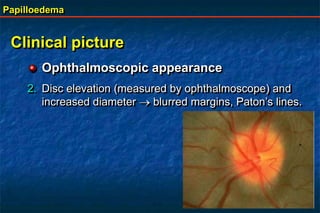
2. Disc elevation (measured by ophthalmoscope) and
increased diameter  blurred margins, Paton’s lines.
Papilloedema
Clinical picture
Ophthalmoscopic appearance
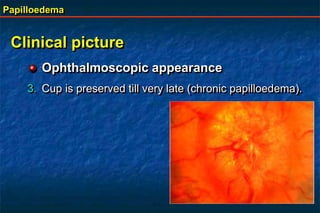
3. Cup is preserved till very late (chronic papilloedema).
Papilloedema
Clinical picture
Ophthalmoscopic appearance
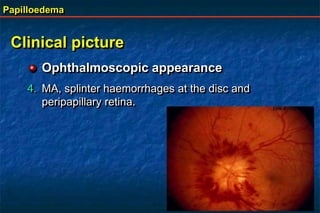
4. MA, splinter haemorrhages at the disc and
peripapillary retina.
Papilloedema
Clinical picture
Ophthalmoscopic appearance
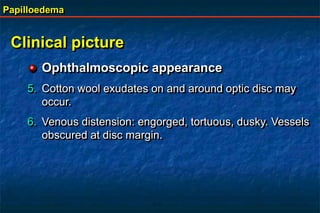
5. Cotton wool exudates on and around optic disc may
occur.
6. Venous distension: engorged, tortuous, dusky. Vessels
obscured at disc margin.
Papilloedema
Clinical picture
Ophthalmoscopic appearance
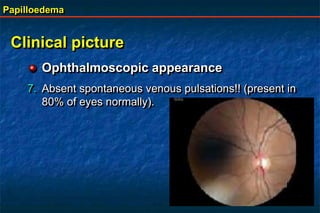
7. Absent spontaneous venous pulsations!! (present in
80% of eyes normally).
Papilloedema
Clinical picture
Ophthalmoscopic appearance
8. Macular changes: oedema, star formation.
Papilloedema
Clinical picture
Ophthalmoscopic appearance
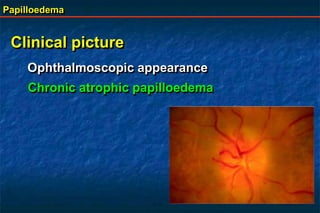
Chronic atrophic papilloedema
Hyperaemia resolves.
Haemorrhages & exudates disappear.
Disc becomes pale: dome of champagne cork finally flat
& pale.
Cup remains obliterated.
Venous congestion disappears.
Arteries become attenuated, sheathed.
Takes 6-8 months to develop.
Papilloedema
Clinical picture
Ophthalmoscopic appearance
Chronic atrophic papilloedema
Papilloedema
Clinical picture
Ophthalmoscopic appearance
Stages:
Early
Fully developed
Chronic
Atrophic
Papilloedema
Clinical picture
Ophthalmoscopic appearance
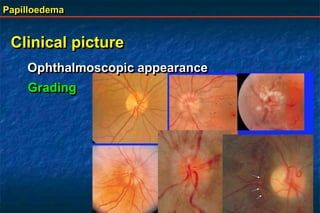
The Friesen scale for grading papilledema:
Stage 0. Blurring of superior and inferior poles of disc.
Stage 1. Obscuration of nasal borders of disc, graying opacity of radial NFL,
concentric folds.
Stage 2. Obscuration of all borders and nasal elevation.
Stage 3. Moderate obscuration and elevation of all borders and some vessels,
leaving the disc with an early peripapillary halo.
Stage 4. Dome-shaped protrusion (champagne cork appearance) of the disc
with smoothly demarcated peripapillary halo and total obliteration of disc vessels
as well as the cup. There may also be marked hyperemia, vessel tortuosity,
hemorrhages, hard exudates, and cotton wool spots
Papilloedema
Clinical picture
Ophthalmoscopic appearance
Grading
Papilloedema
Clinical picture
Normal colour vision.
Normal pupillary reactions; DD.
Visual field changes.
E.O. muscle palsies.
Other cranial nerve affection.
Other signs
Papilloedema
Clinical picture
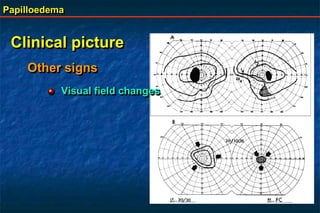
Visual field changes
- Enlargement of blind spot.
- Visual field defect caused by the underlying lesion.
- Late: Progressive visual field defects; optic
atrophy: constriction of peripheral field/NF bundle
defects.
Other signs
Papilloedema
Clinical picture
Visual field changes
Other signs
Papilloedema
Clinical picture
E.O. muscle palsies
- 6th nerve; false localizing
Unilateral/bilateral
Long course, P at petrous temporal bone 
diplopia, ET.
Sometimes intermittent.
Other signs
Papilloedema
Clinical picture
Other signs
E.O. muscle palsies
- 3rd, 4th nerves; rare.
Supratentorial mass  cerebral tissue
displacement in a caudal direction  nerve
stretching, displacement, compression, ischaemia.
Papilloedema
Differential Diagnosis
Papillitis: APD,  VA,  colour vision, pain, unilateral.
AION: ESR, severe visual loss, field.
Diabetic papillopathy: bilateral, mild.
Sarcoidosis.
Malignant infiltration.
Hyperopia.
Medullated N.F.
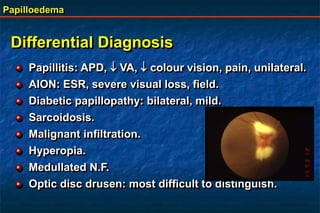
Optic disc drusen: most difficult to distinguish.
Papilloedema
Differential Diagnosis
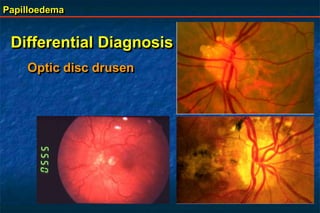
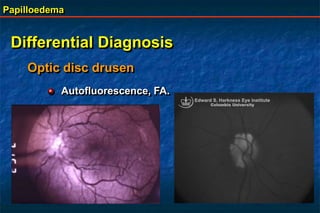
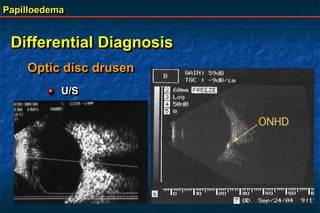
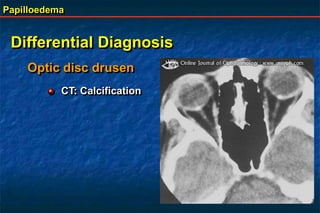
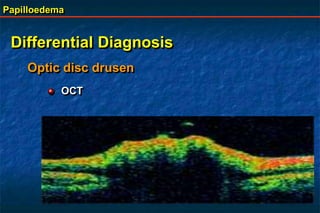
Optic disc drusen
AD, irregular.
Onset: 2nd – 3rd decade.
Bilateral: 73%.
Small mulberry-like mass or waxy tumour 
crenated edge.
Hidden drusen ≠ papilloedema  examine parents.
Central cup: absent.
Papilloedema
Differential Diagnosis
Optic disc drusen
Papilloedema
Differential Diagnosis
Optic disc drusen
Intact central vision
 VA: Haemorrhgic complications
- Bleeding from submacular CNV.
- Arterial occlusions.
- OD infraction.
Occasional transient obscuration of vision.
Papilloedema
Differential Diagnosis
Optic disc drusen
Field
- Enlargement of blind spot.
- Arcuate or NF bundle defect.
- Irregular peripheral contraction: very slow
progression.
Papilloedema
Differential Diagnosis
Optic disc drusen
Autofluorescence, FA.
Papilloedema
Differential Diagnosis
Optic disc drusen
U/S
Papilloedema
Differential Diagnosis
Optic disc drusen
CT: Calcification
Papilloedema
Differential Diagnosis
Optic disc drusen
OCT
Papilloedema
Idiopathic Intracranial Hypertension (IIH)
Pseudotumour cerebri / Benign intracranial hypertension
Syndrome of IC pressure without discernable
cause (diagnosis of exclusion).
Papilloedema
Age: 2nd – 5th decade.
Sex: more in females, 17-35% are males.
Obesity.
Visual blur ± diplopia.
Papilloedema ± 6th nerve palsy.
Persistent: visual impairment (optic atrophy).
Idiopathic Intracranial Hypertension (IIH)
Papilloedema
CT/MRI
Ventricles: Normal to small.
No signs of mass lesion.
Idiopathic Intracranial Hypertension (IIH)
Papilloedema
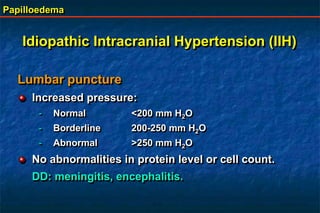
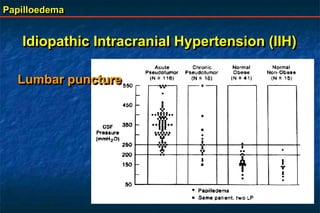
Lumbar puncture
Increased pressure:
- Normal <200 mm H2O
- Borderline 200-250 mm H2O
- Abnormal >250 mm H2O
No abnormalities in protein level or cell count.
DD: meningitis, encephalitis.
Idiopathic Intracranial Hypertension (IIH)
Papilloedema
Lumbar puncture
Idiopathic Intracranial Hypertension (IIH)
Papilloedema
Diagnosis (Dandy’s)
Symptoms & signs of increased ICP: Headache,
papilloedema ….
No focal neurological signs except for 6th n. palsy.
Normal radiological studies (small ventricles).
Increased CSF pressure, normal contents.
Idiopathic Intracranial Hypertension (IIH)
Papilloedema
Causes: U-Devils
U Uraemia
D Drugs: steroids & steroid withdrawal, tetracycline, nalidixic acid,
lithium, amiodarone, heavy metal poisoning.
E Endocrine: obesity, Addison’s, DM, hypoparathyroidism.
V Vitamin A intoxication.
I Iron deficiency anaemia, pernicious anaemia.
L Last menstrual period: female, menarche, pregnancy, eclampsia.
S Sleep apnoea, chronic pulmonary disease.
Cerebral dural sinus obstruction.
In most cases, no clearly identifiable cause.
Idiopathic Intracranial Hypertension (IIH)
Papilloedema
Management
Frequent careful perimetry /M  /3 M
Weight reduction (obese patients)
FU only:
- No visual symptoms or deficits.
- Minimal headache.
Idiopathic Intracranial Hypertension (IIH)
Papilloedema
Management
Severe headache
- Medical treatment
 Diamox 500 mg 1x2 up to 2 gm/d.
Or Lasix (furosemide) 80-120 mg/d taper over several M.
 Corticosteroids: less useful.
- Several lumbar punctures for several days.
- Visual field defect: initial/develops
 Surgery:
o Lumbar peritoneal shunt
o ON sheath decompression
Idiopathic Intracranial Hypertension (IIH)
Papilloedema
Therapeutic success
Relief of headaches.
 frequency of transient visual obscurations.
Regression of papilloedema.
Stability/improvement of field defects.
Weight reduction.
Idiopathic Intracranial Hypertension (IIH)
Thank you

Papilloedema.PPT