Optic Neuritis
Dr. Sachin Adukia
Definition, Incidence , epidemiology
 Optic neuritis is an inflammatory, demyelinating
condition that causes acute, usually monocular, visual
loss.
 presenting feature in 15 to 20 % of patients of MS
 Occurs in 50 percent at some time during the illness
 occur in women (two thirds), typically between age 20
and 40 years age
 highest in higher latitudes, lowest close to equator
 In the United States, 6.4/ 1,00,000
 whites > blacks,
 More in Southeast Asia relative to incidence of MS
Pathology and pathophysiology
 pathologic basis is inflammatory demyelination of the optic nerve.
 pathology is similar to MS plaques in the brain
 perivascular cuffing,
 edema in the myelinated nerve sheaths,
 myelin breakdown
 Myelin loss exceeds axonal loss.
 demyelination immune mediated, but specific mechanism and target antigen-
unknown.
 Systemic T cell activation occurs at symptom onset and precedes changes in
CSF
 T cell activation leads to the release of cytokines
 B cell activation against myelin basic protein is not seen in peripheral blood but
in CSF
 genetic susceptibility
 Overrepresentation of certain HLA types in ON
Unilateral vs bilateral
 in 10 %, both eyes, either simultaneously or in rapid
succession
 Bilateral ON is more common in children - 12 to 15
years
 also in Asian and black South Africans
 Because bilateral symptoms are relatively uncommon,
search for alternative diagnosis
Clinical features
 the Optic Neuritis Treatment Trial (ONTT),
 enrolled 457 patients, 18 to 46 years, with acute unilateral ON
 2 most common symtoms
 Vision loss
 develops over hours to days, peaking within 1-2 weeks.
 Continued deterioration suggests alternative diagnosis
 > 90 % inONTT had significant decrease in central visual acuity.
 Eye pain in 92%-
 often worsened with eye movement
 onset of pain generally coincided with visual acuity loss and
improved along with it.
Visual field loss
 RAPD always occurs in ON if other eye is uninvolved
 demonstrated by swinging light test, finding that direct
response to light is more sluggish in the affected eye.
 visual field defect
 Typically, central scotoma
 in the ONTT,
 diffuse vision loss and
 altitudinal, arcuate, hemianopic, and cecocentral defects.
 defect that extends to periphery - compressive lesion,
 while altitudinal defect, particularly inferior altitudinal- AION
 Visual field defects usually resolve;
 in the ONTT,
 56 percent - normalized at one year
 73 percent - normalized at 10 years
Fundoscopy
 Papillitis with hyperemia and swelling of the disk,
blurring of disk margins, and distended veins
 is seen 1/3 of ON
 2/3 of this pool have retrobulbar neuritis with a normal fundus
 more common in children <14
 black South Africans and Southeast Asians
 Peripapillary hemorrhages
 rare in optic neuritis
 but commonly accompanies papillitis due to AION
Other clinical features
 Photopsias (flickering or flashes of light)
 precipitated with eye movement
 30 % of patients in the ONTT
 Loss of color of vision out of proportion to the loss of visual acuity
is specific to optic nerve pathology.
 Abnormal color vision
 by Ishihara plates 88 % in the ONTT
 by the more sensitive Farnsworth Munsell 100 hue test - 94 %
 Funduscopic or slit lamp examination
 Perivenous sheathing or periphlebitis retinae –
 12 % in ON
 implies a high risk for MS
 Uveitis,
 cells in the anterior chamber
 pars planitis
•Uncommon in ON
•more typical of infections and
otherautoimmune diseases
CHRONIC CLINICAL FEATURES
 Persistent visual loss.
 Most recover functional vision within one year.
 However, on testing, deficits in color vision, contrast sensitivity, stereo
acuity, and light brightness are detectable in most patients till 2 years
 RAPD in 25% till 2 years
 Color desaturation
 refers to a qualitative intereye difference in color perception that can
be tested by comparing vision of a red object with each eye.
 Eg. monocular "red desaturation"
 Uhthoff's phenomenon- temporary exacerbations
 Optic atrophy
 follows ON, despite return of visual acuity
 Normal, 20/20 visual acuity requires less than ½ of normal foveal
axons
 temporal pallor
 The pattern-shift VER remains delayed, even with visual
recovery.
DD’s:- Causes of optic neuropathy
 Ischemic optic neuropathy
 Arteritic ischemic optic neuropathy
 Nonarteritic ischemic optic neuropathy
 Optic neuritis
 Infections
 NeMeningitis (any cause)
 Syphilis,
 Lyme diseaseuroretinitis: viruses, toxoplasmosis, bartonella, others
 Inflammatory
 Parainfectious
 Systemic autoimmune disease: SLE, SjS, , others
 Paraneoplastic
 Sarcoidosis
 Genetic
 Leber's hereditary optic neuropathy
 Kjer type autosomal dominant optic atrophy
 Neoplasms (compressive, infiltrative)
 Optic glioma
 Meningioma
 Metastasis
 Lymphoma
 Compression
 Abscess
 Carotid-ophthalmic artery aneurysm
 Thyroid ophthalmopathy
 Orbital pseudotumor
 Pseudotumor cerebri
 Toxic/metabolic
 DrugsToxins
 Nutritional deficiency (vitamin B1, B12, folate)
 Tobacco-Alcohol amblyopia
 Radiation
 Trauma
 Recurrent ON in non-NMO or MS
 sarcoidosis,
 Lupus
 chronic relapsing inflammatory optic neuropathy (CRION),
 paraneoplastic optic neuropathy (serum CRMP5/ CV2 antibody)).
Evaluation
History - Neurological examination - Fundus examination
 MRI Orbit with Gandolinium contrast
 longitudinal extent of nerve involvement correlates with visual impairment at
presentation
 and with visual prognosis
 Gadolinium enhancement persists for a mean of 30 days since onset
 brain MRI –
 white matter abnormalities characteristic of MS
 Typical lesions are ovoid, periventricular, >3 mm.
 prevalence of white matter abnormalities varies 23 to 75 percent
 Individuals with white matter abnormalities are at a higher risk of developing MS
 Yield of MRI spinal cord imaging is low in unselected patients.
Brain MRI of a 30-
year-old woman
presenting with optic
neuritis.
Fat saturated T2-weighted
coronal (A) image shows
hyperintensity in the right
optic nerve (arrow).
Post-gadolinium fat-
saturated T1-weighted
coronal (B) image shows
abnormal enhancement in
the right optic nerve
(arrow).
Four years later, sagittal
FLAIR (C) shows two
plaques radiating outward
from the corpus callosum
CSF Analysis
 not an essential diagnostic test
 Considered in atypical cases
 bilateral presentation,
 <15 years in age
 symptoms suggesting infection
 60 to 80 percent of ON- nonspecific abnormalities in CSF
 lymphocytes (10 to 100)
 elevated protein
 Other CSF
 OCB implies a higher risk of developing MS.
 However, since OCB are also associated with white matter lesions
on brain MRI, they are not an independent prognostic importance
Other tests-
to be done when considering an alternative diagnosis
 ESR, ANA, Sr. ACE level, serologic and CSF tests for Lyme disease and syphilis
 Fluorescein angiography
 not routinely performed in evaluation of ON and is often normal.
 Up to 25 percent demonstrate either dye leakage or perivenous sheathing
 may identify patients at somewhat higher risk for developing MS.
 Visual evoked response
 delay in the P100 of VER is the electrophysiologic manifestation - as a result of
axonal demyelination
 helpful if there is a suspicion that the visual loss is functional.
 Multifocal VER -more sensitive and specific but generally not available
 Optical coherence tomography measures the
thickness in the retinal nerve fiber layer
 detects thinning in 85 percent% of ON
 lower values correlate with impaired visual outcome,
 prognostic Value- limited as abnormal values do not show
up until early swelling disappears.
 greater severity of optic nerve injury – suggests NMO > ON
associated with MS
 Aquaporin 4 specific serum autoantibody
 patients with either severe or recurrent optic neuritis, may be
seropositive for Aquaporin 4 specific serum autoantibody
 seropositivity for the aquaporin4specific serum autoantibody was
predictive of subsequent NMO in recurrent ON
 Serum NMO antibody test is suggested with recurrent ON, particularly if
MRI brain is negative for any abnormal T2/FLAIR lesions outside of the
affected optic nerve(s).
 The role for testing to myelinoligodendrocyte glycoprotein (MOG)
antibodies is investigational
Prognosis
 Recovery of vision — Without treatment, vision begins to
improve after a few weeks
 Can continue over many months;
 90 percent have 20/40 or better vision at one year
 Lower visual acuity at presentation = less complete recovery
 Longer lesions in the optic nerve on MRI, particularly those
extending into the optic canal= poorer visual outcome
 Most children have a good visual outcome despite a more
severe visual deficit on presentation
 approximately 20 % - persistent functional visual impairment
 MS= poor outcome
 Aquaporin 4 specific serum autoab. positive= poor outcome
 Recurrence
 In the ONTT,
 35 percent recurrence of optic neuritis at 10 years
 14 percent in the original eye,
 12 percent in the other eye,
 9 percent in both eyes
 recurrent optic neuritis = greater risk of developing MS
 Recurrent ON + seropositivity for the aquaporin 4
specific serum autoantibody predicts subsequent NMO
Higher Risk of Subsequent multiple sclerosis
 In the ONTT,
 five year incidence of clinically definite MS – 30%
 40 %at 12 years and
 50 % at 15 years
 F>M
 Caucasians > Asians
 African –Americans more likely to develop NMO
 MRI abnormalities: presence of characteristic demyelinating lesions - a strong
predictor of, independent of no. of lesions
 Retinal perivenous sheathing = higher risk of MS
 OCB in CSF= higher risk of MS
 HLADR2 alleles = higher risk of MS
Lower Risk of Subsequent multiple sclerosis
 simultaneous bilateral involvement at initial
presentation
 Age- risk is lower if the initial attack of ON occurs
in childhood
 Patients at an older age (>35 to 40) are less likely
to develop MS
 ON relatively uncommon in over 40 years
Treatment = Steroids
 Patients in Optic Neuritis Treatment Trial (ONTT) were
randomly assigned to
 oral prednisone (1 mg/kg/d) for 14 days with 4 day taper
 IV methylprednisolone (250 mg four times/d) for 3 days f/b oral
prednisone (1 mg/kg per day) for 11 days with a four day taper
 oral placebo for 14 days
 IV methylprednisolone accelerated the recovery of visual
function
 also reduced the risk of conversion to MS
 Whereas, risk of recurrent ON in both eyes was higher
in oral steroid arm
 IV treatment is used in
 abnormal high signal abnormalities on brain MRI, since this may
delay the onset of MS.
 severe or bilateral vision loss- may speed up recovery
 IVIG and PLEX- do not have established efficacy in ON
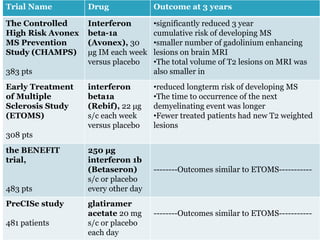
Trial Name Drug Outcome at 3 years
The Controlled
High Risk Avonex
MS Prevention
Study (CHAMPS)
383 pts
Interferon
beta-1a
(Avonex), 30
μg IM each week
versus placebo
•significantly reduced 3 year
cumulative risk of developing MS
•smaller number of gadolinium enhancing
lesions on brain MRI
•The total volume of T2 lesions on MRI was
also smaller in
Early Treatment
of Multiple
Sclerosis Study
(ETOMS)
308 pts
interferon
beta1a
(Rebif), 22 μg
s/c each week
versus placebo
•reduced longterm risk of developing MS
•The time to occurrence of the next
demyelinating event was longer
•Fewer treated patients had new T2 weighted
lesions
the BENEFIT
trial,
483 pts
250 μg
interferon 1b
(Betaseron)
s/c or placebo
every other day
--------Outcomes similar to ETOMS-----------
PreCISe study
481 patients
glatiramer
acetate 20 mg
s/c or placebo
each day
--------Outcomes similar to ETOMS-----------
 Common side effects
 Depression
 injection site reactions,
 Flu like Symptoms
 Deranged LFTs
 potential benefits
 longer attack free interval
 Reduced number of demyelinating attacks
 delay to MS associated disability
Treatment in children
 Clinical trials have been limited to adults
 IV Methylprednisolone to be considered for acute treatment for severe
debilitating bilateral vision
 In general, immunomodulatory treatments with interferons are not used
in younger children,
 Older children (>15 years) are probably appropriately treated under the
same guidelines as adults
Investigational treatments
 Alfampridine (4- aminopyridine; fampridine), a
potassium channel blocker, may improve axonal
function in demyelinating disease.
 Erythropoietin –
 in a phase II clinical trial
 active treatment was safe
 associated with reduced retinal nerve fiber layer thinning on OCT
 shortened latencies on VEP at 16 weeks.
References
 The clinical profile of optic neuritis. Experience of the Optic Neuritis Treatment Trial.
Optic Neuritis Study Group. Arch Ophthalmol 1991; 109:1673
 Beck RW, Gal RL, Bhatti MT, et al. Visual function more than 10 years after optic neuritis:
experience of the optic neuritis treatment trial. Am J Ophthalmol 2004; 137:77
 Beck RW, Trobe JD, Moke PS, et al. High and low risk profiles for the development of
multiple sclerosis within 10 years after optic neuritis: experience of the optic neuritis
treatment trial. Arch Ophthalmol 2003; 121:944.
 Nilsson P, Larsson EM, Maly Sundgren P, et al. Predicting the outcome of optic neuritis:
evaluation of risk factors after 30 years of followup. J Neurol 2005; 252:396
 Comi G, Martinelli V, Rodegher M, et al. Effect of glatiramer acetate on conversion to
clinically definite multiple sclerosis in patients with clinically isolated syndrome (PreCISe
study): a randomised, doubleblind, placebo controlled trial. Lancet 2009; 374:1503.
Thank You

Optic neuritis

  • 1.
  • 2.
    Definition, Incidence ,epidemiology  Optic neuritis is an inflammatory, demyelinating condition that causes acute, usually monocular, visual loss.  presenting feature in 15 to 20 % of patients of MS  Occurs in 50 percent at some time during the illness  occur in women (two thirds), typically between age 20 and 40 years age  highest in higher latitudes, lowest close to equator  In the United States, 6.4/ 1,00,000  whites > blacks,  More in Southeast Asia relative to incidence of MS
  • 3.
    Pathology and pathophysiology pathologic basis is inflammatory demyelination of the optic nerve.  pathology is similar to MS plaques in the brain  perivascular cuffing,  edema in the myelinated nerve sheaths,  myelin breakdown  Myelin loss exceeds axonal loss.  demyelination immune mediated, but specific mechanism and target antigen- unknown.  Systemic T cell activation occurs at symptom onset and precedes changes in CSF  T cell activation leads to the release of cytokines  B cell activation against myelin basic protein is not seen in peripheral blood but in CSF  genetic susceptibility  Overrepresentation of certain HLA types in ON
  • 4.
    Unilateral vs bilateral in 10 %, both eyes, either simultaneously or in rapid succession  Bilateral ON is more common in children - 12 to 15 years  also in Asian and black South Africans  Because bilateral symptoms are relatively uncommon, search for alternative diagnosis
  • 5.
    Clinical features  theOptic Neuritis Treatment Trial (ONTT),  enrolled 457 patients, 18 to 46 years, with acute unilateral ON  2 most common symtoms  Vision loss  develops over hours to days, peaking within 1-2 weeks.  Continued deterioration suggests alternative diagnosis  > 90 % inONTT had significant decrease in central visual acuity.  Eye pain in 92%-  often worsened with eye movement  onset of pain generally coincided with visual acuity loss and improved along with it.
  • 6.
    Visual field loss RAPD always occurs in ON if other eye is uninvolved  demonstrated by swinging light test, finding that direct response to light is more sluggish in the affected eye.  visual field defect  Typically, central scotoma  in the ONTT,  diffuse vision loss and  altitudinal, arcuate, hemianopic, and cecocentral defects.  defect that extends to periphery - compressive lesion,  while altitudinal defect, particularly inferior altitudinal- AION  Visual field defects usually resolve;  in the ONTT,  56 percent - normalized at one year  73 percent - normalized at 10 years
  • 7.
    Fundoscopy  Papillitis withhyperemia and swelling of the disk, blurring of disk margins, and distended veins  is seen 1/3 of ON  2/3 of this pool have retrobulbar neuritis with a normal fundus  more common in children <14  black South Africans and Southeast Asians  Peripapillary hemorrhages  rare in optic neuritis  but commonly accompanies papillitis due to AION
  • 9.
    Other clinical features Photopsias (flickering or flashes of light)  precipitated with eye movement  30 % of patients in the ONTT  Loss of color of vision out of proportion to the loss of visual acuity is specific to optic nerve pathology.  Abnormal color vision  by Ishihara plates 88 % in the ONTT  by the more sensitive Farnsworth Munsell 100 hue test - 94 %  Funduscopic or slit lamp examination  Perivenous sheathing or periphlebitis retinae –  12 % in ON  implies a high risk for MS  Uveitis,  cells in the anterior chamber  pars planitis •Uncommon in ON •more typical of infections and otherautoimmune diseases
  • 10.
    CHRONIC CLINICAL FEATURES Persistent visual loss.  Most recover functional vision within one year.  However, on testing, deficits in color vision, contrast sensitivity, stereo acuity, and light brightness are detectable in most patients till 2 years  RAPD in 25% till 2 years  Color desaturation  refers to a qualitative intereye difference in color perception that can be tested by comparing vision of a red object with each eye.  Eg. monocular "red desaturation"
  • 11.
     Uhthoff's phenomenon-temporary exacerbations  Optic atrophy  follows ON, despite return of visual acuity  Normal, 20/20 visual acuity requires less than ½ of normal foveal axons  temporal pallor  The pattern-shift VER remains delayed, even with visual recovery.
  • 12.
    DD’s:- Causes ofoptic neuropathy  Ischemic optic neuropathy  Arteritic ischemic optic neuropathy  Nonarteritic ischemic optic neuropathy  Optic neuritis  Infections  NeMeningitis (any cause)  Syphilis,  Lyme diseaseuroretinitis: viruses, toxoplasmosis, bartonella, others  Inflammatory  Parainfectious  Systemic autoimmune disease: SLE, SjS, , others  Paraneoplastic  Sarcoidosis  Genetic  Leber's hereditary optic neuropathy  Kjer type autosomal dominant optic atrophy
  • 13.
     Neoplasms (compressive,infiltrative)  Optic glioma  Meningioma  Metastasis  Lymphoma  Compression  Abscess  Carotid-ophthalmic artery aneurysm  Thyroid ophthalmopathy  Orbital pseudotumor  Pseudotumor cerebri  Toxic/metabolic  DrugsToxins  Nutritional deficiency (vitamin B1, B12, folate)  Tobacco-Alcohol amblyopia  Radiation  Trauma  Recurrent ON in non-NMO or MS  sarcoidosis,  Lupus  chronic relapsing inflammatory optic neuropathy (CRION),  paraneoplastic optic neuropathy (serum CRMP5/ CV2 antibody)).
  • 14.
    Evaluation History - Neurologicalexamination - Fundus examination  MRI Orbit with Gandolinium contrast  longitudinal extent of nerve involvement correlates with visual impairment at presentation  and with visual prognosis  Gadolinium enhancement persists for a mean of 30 days since onset  brain MRI –  white matter abnormalities characteristic of MS  Typical lesions are ovoid, periventricular, >3 mm.  prevalence of white matter abnormalities varies 23 to 75 percent  Individuals with white matter abnormalities are at a higher risk of developing MS  Yield of MRI spinal cord imaging is low in unselected patients.
  • 16.
    Brain MRI ofa 30- year-old woman presenting with optic neuritis. Fat saturated T2-weighted coronal (A) image shows hyperintensity in the right optic nerve (arrow). Post-gadolinium fat- saturated T1-weighted coronal (B) image shows abnormal enhancement in the right optic nerve (arrow). Four years later, sagittal FLAIR (C) shows two plaques radiating outward from the corpus callosum
  • 17.
    CSF Analysis  notan essential diagnostic test  Considered in atypical cases  bilateral presentation,  <15 years in age  symptoms suggesting infection  60 to 80 percent of ON- nonspecific abnormalities in CSF  lymphocytes (10 to 100)  elevated protein  Other CSF  OCB implies a higher risk of developing MS.  However, since OCB are also associated with white matter lesions on brain MRI, they are not an independent prognostic importance
  • 18.
    Other tests- to bedone when considering an alternative diagnosis  ESR, ANA, Sr. ACE level, serologic and CSF tests for Lyme disease and syphilis  Fluorescein angiography  not routinely performed in evaluation of ON and is often normal.  Up to 25 percent demonstrate either dye leakage or perivenous sheathing  may identify patients at somewhat higher risk for developing MS.  Visual evoked response  delay in the P100 of VER is the electrophysiologic manifestation - as a result of axonal demyelination  helpful if there is a suspicion that the visual loss is functional.  Multifocal VER -more sensitive and specific but generally not available
  • 19.
     Optical coherencetomography measures the thickness in the retinal nerve fiber layer  detects thinning in 85 percent% of ON  lower values correlate with impaired visual outcome,  prognostic Value- limited as abnormal values do not show up until early swelling disappears.  greater severity of optic nerve injury – suggests NMO > ON associated with MS
  • 20.
     Aquaporin 4specific serum autoantibody  patients with either severe or recurrent optic neuritis, may be seropositive for Aquaporin 4 specific serum autoantibody  seropositivity for the aquaporin4specific serum autoantibody was predictive of subsequent NMO in recurrent ON  Serum NMO antibody test is suggested with recurrent ON, particularly if MRI brain is negative for any abnormal T2/FLAIR lesions outside of the affected optic nerve(s).  The role for testing to myelinoligodendrocyte glycoprotein (MOG) antibodies is investigational
  • 21.
    Prognosis  Recovery ofvision — Without treatment, vision begins to improve after a few weeks  Can continue over many months;  90 percent have 20/40 or better vision at one year  Lower visual acuity at presentation = less complete recovery  Longer lesions in the optic nerve on MRI, particularly those extending into the optic canal= poorer visual outcome  Most children have a good visual outcome despite a more severe visual deficit on presentation  approximately 20 % - persistent functional visual impairment  MS= poor outcome  Aquaporin 4 specific serum autoab. positive= poor outcome
  • 22.
     Recurrence  Inthe ONTT,  35 percent recurrence of optic neuritis at 10 years  14 percent in the original eye,  12 percent in the other eye,  9 percent in both eyes  recurrent optic neuritis = greater risk of developing MS  Recurrent ON + seropositivity for the aquaporin 4 specific serum autoantibody predicts subsequent NMO
  • 23.
    Higher Risk ofSubsequent multiple sclerosis  In the ONTT,  five year incidence of clinically definite MS – 30%  40 %at 12 years and  50 % at 15 years  F>M  Caucasians > Asians  African –Americans more likely to develop NMO  MRI abnormalities: presence of characteristic demyelinating lesions - a strong predictor of, independent of no. of lesions  Retinal perivenous sheathing = higher risk of MS  OCB in CSF= higher risk of MS  HLADR2 alleles = higher risk of MS
  • 24.
    Lower Risk ofSubsequent multiple sclerosis  simultaneous bilateral involvement at initial presentation  Age- risk is lower if the initial attack of ON occurs in childhood  Patients at an older age (>35 to 40) are less likely to develop MS  ON relatively uncommon in over 40 years
  • 25.
    Treatment = Steroids Patients in Optic Neuritis Treatment Trial (ONTT) were randomly assigned to  oral prednisone (1 mg/kg/d) for 14 days with 4 day taper  IV methylprednisolone (250 mg four times/d) for 3 days f/b oral prednisone (1 mg/kg per day) for 11 days with a four day taper  oral placebo for 14 days  IV methylprednisolone accelerated the recovery of visual function  also reduced the risk of conversion to MS  Whereas, risk of recurrent ON in both eyes was higher in oral steroid arm
  • 26.
     IV treatmentis used in  abnormal high signal abnormalities on brain MRI, since this may delay the onset of MS.  severe or bilateral vision loss- may speed up recovery  IVIG and PLEX- do not have established efficacy in ON
  • 27.
    Trial Name DrugOutcome at 3 years The Controlled High Risk Avonex MS Prevention Study (CHAMPS) 383 pts Interferon beta-1a (Avonex), 30 μg IM each week versus placebo •significantly reduced 3 year cumulative risk of developing MS •smaller number of gadolinium enhancing lesions on brain MRI •The total volume of T2 lesions on MRI was also smaller in Early Treatment of Multiple Sclerosis Study (ETOMS) 308 pts interferon beta1a (Rebif), 22 μg s/c each week versus placebo •reduced longterm risk of developing MS •The time to occurrence of the next demyelinating event was longer •Fewer treated patients had new T2 weighted lesions the BENEFIT trial, 483 pts 250 μg interferon 1b (Betaseron) s/c or placebo every other day --------Outcomes similar to ETOMS----------- PreCISe study 481 patients glatiramer acetate 20 mg s/c or placebo each day --------Outcomes similar to ETOMS-----------
  • 28.
     Common sideeffects  Depression  injection site reactions,  Flu like Symptoms  Deranged LFTs  potential benefits  longer attack free interval  Reduced number of demyelinating attacks  delay to MS associated disability
  • 29.
    Treatment in children Clinical trials have been limited to adults  IV Methylprednisolone to be considered for acute treatment for severe debilitating bilateral vision  In general, immunomodulatory treatments with interferons are not used in younger children,  Older children (>15 years) are probably appropriately treated under the same guidelines as adults
  • 30.
    Investigational treatments  Alfampridine(4- aminopyridine; fampridine), a potassium channel blocker, may improve axonal function in demyelinating disease.  Erythropoietin –  in a phase II clinical trial  active treatment was safe  associated with reduced retinal nerve fiber layer thinning on OCT  shortened latencies on VEP at 16 weeks.
  • 31.
    References  The clinicalprofile of optic neuritis. Experience of the Optic Neuritis Treatment Trial. Optic Neuritis Study Group. Arch Ophthalmol 1991; 109:1673  Beck RW, Gal RL, Bhatti MT, et al. Visual function more than 10 years after optic neuritis: experience of the optic neuritis treatment trial. Am J Ophthalmol 2004; 137:77  Beck RW, Trobe JD, Moke PS, et al. High and low risk profiles for the development of multiple sclerosis within 10 years after optic neuritis: experience of the optic neuritis treatment trial. Arch Ophthalmol 2003; 121:944.  Nilsson P, Larsson EM, Maly Sundgren P, et al. Predicting the outcome of optic neuritis: evaluation of risk factors after 30 years of followup. J Neurol 2005; 252:396  Comi G, Martinelli V, Rodegher M, et al. Effect of glatiramer acetate on conversion to clinically definite multiple sclerosis in patients with clinically isolated syndrome (PreCISe study): a randomised, doubleblind, placebo controlled trial. Lancet 2009; 374:1503.
  • 32.