University of
Alexandria
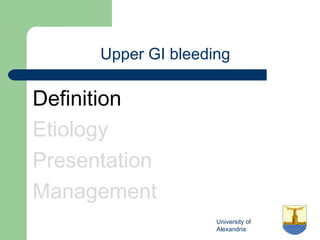
Upper gastrointestinal bleeding
GI Surgery Unit
Faculty of Medicine
University of Alexandria
By: Mohamed Mourad
Assistant lecturer of general surgery
University of
Alexandria
Upper GI bleeding
Definition
Etiology
Presentation
Management
University of
Alexandria
Upper GI bleeding
Definition
Etiology
Presentation
Management
University of
Alexandria
Definition
  Hemorrhage in the gastrointestinal tract
above the ligament of Treitz, which connects
the fourth portion of the duodenum to
the diaphragm near the splenic flexure of the
colon.
University of
Alexandria
Upper GI bleeding
Definition
Etiology
Presentation
Management
University of
Alexandria
Etiology
 Anatomically:
– Esophageal causes:
 Esophageal varices
 Esophagitis
 Esophageal cancer
 Esophageal ulcers
 Mallory-Weiss tear
 Hiatal hernia
University of
Alexandria
Etiology
 Gastric causes:
– Gastric ulcer
– Gastric cancer
– Gastritis
– Gastric varices
– Dieulafoy's lesions
– portal gastropathy,
– Ménétrier's disease
University of
Alexandria
Etiology
 Duodenal causes
– Duodenal ulcer
– Duodenal carcinoma
– Vascular malformation
– Hematobilia,
– Severe superior mesenteric artery syndrome
University of
Alexandria
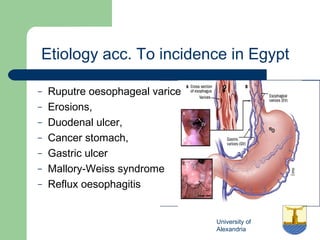
Etiology acc. To incidence in Egypt
– Ruputre oesophageal varice
– Erosions,
– Duodenal ulcer,
– Cancer stomach,
– Gastric ulcer
– Mallory-Weiss syndrome
– Reflux oesophagitis
University of
Alexandria
Gatroesophageal Varices
 In the lower 3-5 cm of the oesophagus..WHY??
 Squeal of portal hypertension.
 Portosystemic shunt (Lt gastric v.& oesophageal vessels)
 Incidence
– 20-30%-------Mortality in each attack
– 60-70%-------Rebleed within 1 yr if untreated
– 75% -----------Bleeding ceases spontaneously
University of
Alexandria
•Cirrhotic liver
•Esophagoscopic
view (at cardia)
•Azygos vein
•Diaphragm
•Esophageal branches of left
gastric vein
•Short gastric vein
•Suprahepathic vein
•Inferior vena cava
•Superior vena cava •Azygos vein
•Esophagus
•Esophageal
varices
•Volume
increased splein
•Gastric
veins
•Splenic vein
•Portal vein
pressure
increases up to
20-30 mmHg
University of
Alexandria
Isolated Gastric Varices
 Isolated gastric varices are those that occur
in the absence of esophageal varices and are
classified as
– type 1 (fundic)
– type 2 (distal to fundus
including proximal duodenum).
University of
Alexandria
Sites of portosystemic anastomosis
University of
Alexandria
Bleeding peptic ulcer
 Approximately 20% of patients with peptic
ulcer will bleed.
 Bleeding duodenal ulcer: 10 times more
common than bleeding gastric ulcer
 Post. ulcer erodes the gastroduodenal artery,
ant. ulcer → no severe bleeding.
 90% of patients stop bleeding within 8 h of
admission.
University of
Alexandria
Beheviour of PU Bleeding
 Spontaneous stoping: 70-80 %
 Probability of rebleeding: 30-50 %
 Mortality among patients operated
because of rebleeding: 20-30 %
University of
Alexandria
Acute erosive gastritis
 Diffuse superficial mucosal lesion in body
and fundus may duodenum.
– NSAID
– Alcohol
– Drugs
– Gastric irradiation
– Stressful situation
University of
Alexandria
NSAID-induced ulcer
 Depends on:
– Dose of NSAID
– Taking 2 or more at once
– Concomitant anticoagulant or corticosteroid.
University of
Alexandria
Mallory-Weiss tear
 The lesion is a longitudinal tear in the mucosa
of the GE junction.
 Transient increase in P. gradient between the
intrathoracic and intragastric portion of GOJ.
 It is presumably caused by forceful vomiting
and/or retching, and is commonly seen in
alcoholics.
 Endoscopy is diagnostic and theraputic---90%
University of
Alexandria
Dieulafoy's lesion
 congenital arteriovenous malformation
characterized by an unusually large
tortuous submucosal artery.
 It causes massive recurrent bleeding with
no prodromal symptoms
University of
Alexandria
Dieulafoy's lesion
University of
Alexandria
Portal hypertensive gastropathy
 changes in the mucosa of the stomach in
patients with portal hypertension
 These changes in the mucosa include friability
of the mucosa and the presence of dilated
blood vessels at the surface.
University of
Alexandria
Hypertrophic Gastropathy
(Ménétrier's Disease)
 Clinical syndromes characterized by
epithelial hyperplasia and giant gastric folds
 There are large rugal folds in the proximal
stomach, and the antrum is usually spared.
 Characteristically associated with protein-
losing gastropathy and hypochlorhydria
University of
Alexandria
Aortoenteric fistula
 Prior aortic reconstructive surgery should
raise suspicion for an aortoenteric fistula
University of
Alexandria
Upper GI bleeding
Definition
Etiology
Presentation
Management
University of
Alexandria
History
 Melena, hematemsis, hematochizia according
to the amount of bleeding
• Melena:
Liquid, jet black or black with reddish tinge
pungent characteristic smell quite unlike smell
of faeces.
• Dark formed stools → insignificant.
• Iron therapy → sticky faeces with dark grey
rather than black.
• Melena:
Liquid, jet black or black with reddish tinge
pungent characteristic smell quite unlike smell
of faeces.
• Dark formed stools → insignificant.
• Iron therapy → sticky faeces with dark grey
rather than black.
University of
Alexandria
History
 Symptoms of anemia;
– Syncope, fatigue, dyspnea, chest pain
 History of
– liver disease or bilhariziasis
– Alcohol intake
– bleeding tendency or anticoagulant intake
– analgesic abuse
– Past gastric surgeries
University of
Alexandria
Examination
 Hemodynamic stability
– Tachycardia, thready pulse
– Hypotension
 Careful abdominal examination
– Bowel sounds
– Abdominal tenderness
– Ascites—shifting dullness
 Signs of chronic liver disease or portal hypertension
– Hepatomegaly, Splenomegaly, ictrus
University of
Alexandria
Shock assessment
Estimated Fluid and Blood Losses in Shock
Class 1 Class 2 Class 3 Class 4
Blood Loss,
mL
Up to 750 750-1500 1500-2000 >2000
Blood Loss,%
blood volume
Up to 15% 15-30% 30-40% >40%
Pulse Rate,
bpm
<100 >100 >120 >140
Blood
Pressure
Normal Normal Decreased Decreased
Respiratory
Rate
Normal or
Increased
Decreased Decreased Decreased
Urine
Output,
mL/h
14-20 20-30 30-40 >35
CNS/Mental
Status
Slightly
anxious
Mildly
anxious
Anxious,
confused
Confused,
lethargic
Fluid
Replacement,
3-for-1 rule
Crystalloid Crystalloid
Crystalloid
and blood
Crystalloid
and blood
University of
Alexandria
Upper GI bleeding
Definition
Etiology
Presentation
Management
University of
Alexandria
Laboratory Ix
 Hemoglobin level
 Coagulation profile
 Liver function
 BUN to creatinine
ratio
University of
Alexandria
Endoscopy
 Endoscopy identifies the site of bleeding in
about 90% of patients with upper GI bleeding
 The ideal time to perform this examination is
– when the patient is hemodynamically stable, and
– when the nasogastric aspirate following irrigation is
clear.
University of
Alexandria
Endoscopic findings in OV
University of
Alexandria
Endoscopic Clues for Risk of
Rebleeding in PU
1. Visible vessel (blue or red).
– Protruding lesion with ulcer base
1. Spurter (arterial).
2. Black or red spot.
3. Overlying clot.
•50%
rebleeding
•10%
rebleeding
University of
Alexandria
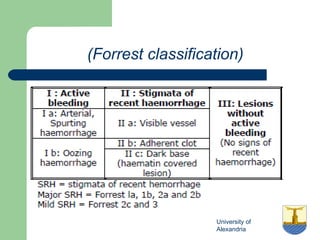
(Forrest classification)
University of
Alexandria
(Forrest classification)
 Forrest 1a
– Spurting bleeding
 Forrest 1b
– Non-spurting active
bleeding
University of
Alexandria
(Forrest classification)
 Forrest 2a
– Non-bleeding visible
vessel
 Forrest 2b
– Non-bleeding ulcer
with an adherent clot
University of
Alexandria
(Forrest classification)
 Forrest 2c
– Ulcer with haematin-
covered base
 Forrest 3
– Ulcer with clean
base
University of
Alexandria
Clean Ulcer Base
 50% of bleeding ulcers
 Rebleeding about 5%
 Should not undergo endoscopic haemostasis.
University of
Alexandria
Non Bleeding Visible Vessel
 20% of bleeding ulcers
 Rebleeding about 40-50%
 80% will stop bleeding spontaneous.
University of
Alexandria
University of
Alexandria
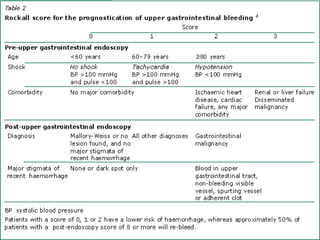
Rockall’s Risk Score
University of
Alexandria
Treatment
 Resuscitation measures
 Management of the cause
University of
Alexandria
Resuscitation
 ICU admition
 Large-bore IV access, Foley
catheterization, and nasogastric intubation
 IV fluid replacement
 Blood transfusion
– Till Hemoglobin------8g/dl
 Fresh frozen plasma & platelet transfusion
University of
Alexandria
Role of nasogastric tube
 Confirms a UGIB.
 Activity of gross bleeding
– Red blood suggests currently active bleeding
– coffee grounds suggest recently active bleeding.
– Continued aspiration of red blood suggests
severe, active hemorrhage.
 NGT clears the gastric field for endoscopic
visualization, and to prevent aspiration of
gastric content
University of
Alexandria
Activity of bleeding
 Grossly bloody haematemsis or large fresh
clots per rectum.
 Active bleeding 2 to 3 fold mortality.
 NG aspirate may be negative in 10% of
bleeding D.U. due to edema or pylorospasm
 The sensitivity of NG aspirate of assessing
active bleeding is 79%
Cuellar et al. Arch Intern Med 1990; 323: 1381-84.
University of
Alexandria
Rebleeding
 Recurrence of haematemsis or bleeding in
nasogastric tube,
 Recurrence of melena or haematochezia
coupled with instable vital signs:
 Systolic <90 mmHg, HR >110 beats/min.
 Decrease in hematocrit of >4% in 24 hours.
Acta Medica Medianae 2007,Vol.46
University of
Alexandria
Role of nasogastric tube
However, lavage may not be positive if
bleeding has ceased or arises beyond a closed
pylorus. The presence of bilious fluid
suggests that the pylorus is open and, if
lavage is negative, that there is no active
upper GI bleeding distal to the pylorus
University of
Alexandria
Blood transfusion
 High-risk patients should receive packed red
blood cell transfusions to maintain the
hematocrit above 30 percent.eg,
– Elderly
– severe comorbid illnesses such as coronary disease
or cirrhosis
 Young and otherwise healthy patients should
be transfused to maintain their hematocrit
above 20 percent.
University of
Alexandria
Blood transfusion
 Patients who have variceal bleeding are
conservatively transfused to a hematocrit of only
27 to avoid exacerbating the bleeding by
increasing the portal pressure, with
transfusion only for shock or a hemoglobin less
than 8mg/dl.
University of
Alexandria
Oesophageal varices
 Measures to avoid hepatic enephalopathy
– Gastric lavage
– Lactulose enema
– Oral Neomycin
– Antibiotic administration
– Avoid hypoglycemia
– Avoid Na containing fluids
University of
Alexandria
Oesophageal varices
 Pharmacologic therapy
– Vasopressin, Glypressin (50% Control)
 IV at a dose of 0.2 to 0.8 units/min
 Side effect???
– Somatostatin and its analogue octreotide (of choice)
 initial bolus of 50 µg IV followed by continuous infusion of
50 µg/h (65% Control)
 cause splanchnic vasoconstriction
 can be administered for 5 days or longer
– Vit. K administration (parentral)
University of
Alexandria
Oesophageal varices
 Balloon tamponade using
a Sengstaken-Blakemore
tube
– will control refractory
variceal bleeding in >80%
of patients
– SE ????
– should be limited to short-
term therapy (<24 hours)
University of
Alexandria
Endoscopy
 EGD should be carried out as soon as possible
and EVL should be performed
 Injection sclerotherspy using ethanolamine (80-
90% Control)
– Gastric varices injection with N-butyl-cyanoacrylate
Sclerotherapy Band ligation
Minor chest pain, fever No resternal pain
Chest complication Superficial ulcers
Oesophageal ulcer G. varices
Stricture Equal efficacy
University of
Alexandria
Endoscopy
University of
Alexandria
Refractory variceal bleeding
 10 to 20% of patients with variceal bleeding
will continue to bleed
 It will be managed by
– Surgery
– TIPS
University of
Alexandria
Transjugular Intrahepatic
Portosystemic Shunt
 In Child-Pugh B&C
 control variceal bleeding in >90% of cases
refractory to medical treatment
 Disadvantages
– bleeding,
– infections,
– renal failure,
– decreased hepatic function, and hepatic
encephalopathy
University of
Alexandria
Transjugular Intrahepatic
Portosystemic Shunt
•Shunt
•Esophagus
•Coronary v.
•Spleen
•Splenic vein
•Kidney
•Left renal vein
•Inferior vena cava•Inferior mesenteric vein
•Superior mesenteric vein
•Portal vein
•Liver
•Stomach
University of
Alexandria
Prevention of variceal rebleeding
 EVL
– 1-2wks till varices disappear
– Then every 6 mon to detect recurrence
 Propranolol
– 20% efficacy
University of
Alexandria
University of
Alexandria
Bleeding peptic ulcer
 Medical
– PPI (80mg IV bolus, then 8mg/hr infusion)
– H2 blockers
– Antacid
– Sucralfat
– Bismuth
 Endoscopic
– Injection of adrenaline, electrocautary
 Surgical
University of
Alexandria
Bleeding peptic ulcer
University of
Alexandria
Endoscopic Haemostasis
 Topical treatment
 Injection treatment
 Mechanical treatment
 Thermal treatment
University of
Alexandria
Injection therapy
 Epinephrin (1:10,000) (Tonogen)
 Sclerotizing drugs (Aethoxysklerol)
 Alcohol (96-99.5 %)
 Thrombin
University of
Alexandria
Topical treatment
 Tissue adhesives (cyanoacrylat)
 Blood clotting factors (thrombin,fibrinogen)
 Vasoconstricting drugd (epinephrin)
 collagen
 Ferromagnetic tamponade
University of
Alexandria
Mechanic treatment
 Loops
 Sutures
 Haemostatic clips
University of
Alexandria
Thermal treatment
 Laser fotocoagulation (Argon, Nd YAG)
 Heater probe
 Electrocoagulation
 Monopolar
 Bipolar
 Electrohydrothermo sond
University of
Alexandria
Indications of surgery
 Massive bleeding requiring >10 units.
 Rebleeding after cessation → Early
surgery Death rate >30%.
 Visible bleeding vessel on endoscopy →
50% rebleeding.
University of
Alexandria
Relative indications of surgery
 Giant G.U. or D.U.
 Visible vessel.
 Shortage of blood.
 Previous hemorrhage for the same lesion.
University of
Alexandria
Surgical treatment
 Local operation?
Suture
Stiching of ulcer
 Local operation + vagotomy
 resection type operation
University of
Alexandria
Surgery
 The use of a definitive ulcer curing operation
is mandatory in patients with hemorrhage
but optional in patients with perforation.
– The rebleeding rate is very high in local surgery
only, 70-80 %,
– Recurrent bleeding in both → 13%
University of
Alexandria
Bleeding peptic ulcer
University of
Alexandria
Oversew of DU
University of
Alexandria
Oversew of DU
University of
Alexandria
Prognosis
 Mortality of emergency operation 8-10%
– Mortality of PG 8% double that of TV + gj.
 Mortality of elective operation 1-2%
University of
Alexandria
Acute erosive gastritis
 Treatment options
 Near total gastrotomy + Roux en Y.
 Ligation of all blood vessels to the stomach.
 Vagotomy & pyloroplasty.
 Conserve until transfusion requirement are 12 units or more.
 50% mortality with surgery
University of
Alexandria
Mallory-weiss
o with bleeding → endoscopic
intervention
o no bleeding → No intervention
o Rebleeding in 0-2%
University of
Alexandria
Indications of surgery in UG bleeding
 Hemodynamic instability despite vigorous
resuscitation (>6 units transfusion)  
 Failure of endoscopic techniques to arrest
hemorrhage   
 Recurrent hemorrhage after initial stabilization (with
up to two attempts at obtaining endoscopic
hemostasis)  
 Shock associated with recurrent hemorrhage   
 Continued slow bleeding with a transfusion
requirement exceeding 4 units/day
University of Alexandria
Upper gastrointestinal bleeding
Thank You

Upper gastrointestinal bleeding