Dr Harsh Shah
MS, FMAS, DNB, MCh (MAMC, New Delhi)
Surgical Gastroenterologist & HPB Surgeon
Pancreatic Surgery - An
Update
 Anatomy
 Management of Necrotizing pancreatitis
 Management of Pancreatic cancer
Anatomy
 Pan Kreas (Greek)– all flesh
Pancreatic ducts
Celiac Trunk
Arterial supply
Venous Drainage
Learning points
 Duodenum will always be excised due to a
common blood supply with HOP
 Spleen with distal pancreas
 GDA acts as a communicating vessel between
celiac & SMA
 Positive resection margin near SMA in
uncinate tumours
Pancreatitis
Etiologies of Acute Pancreatitis
Common Causes
• Gallstones (most common)
• Alcohol Intake
• ERCP
• Blunt trauma abdomen
• Drugs (sulfonamides, 6-MP)
• Hypertriglyceridemia
Uncommon Causes
• Hypercalcemia
• Periampullary diverticulum
• Pancreas divisum
• Hereditary pancreatitis
• Cystic Fibrosis
• Ca head of pancreas
Diagnosis
Two out of three:
(1) abdominal pain consistent with acute
pancreatitis (acute onset of a persistent, severe,
epigastric pain often radiating to the back)
(2) serum lipase activity (or amylase activity) at
least three times greater than the upper limit of
normal; and
(3) characteristic findings of acute pancreatitis on
contrast-enhanced computed tomography (CECT)
and less commonly magnetic resonance imaging
(MRI) or transabdominal ultrasonography.
Revised Atlanta Classification-
2012
 Interstitial edematous pancreatitis
 Acute peripancreatic fluid collection
 Pancreatic pseudocyst
 Necrotizing pancreatitis
 Acute necrotic collection
 Walled off necrosis
Interstitial Edematous
Pancreatitis
 Acute inflammation of
pancreatic parenchyma &
peripancreatic tissue
without recognizable tissue
necrosis
 CECT criteria:
 Parenchymal
enhancement by
intravenous contrast
agent
 No e/o necrosis
Acute Peripancreatic Fluid
collection
 Peripancreatic fluid associated
with IEP
 Within first 4 weeks of onset of
IEP
 CECT criteria
 IEP
 Homogenous collection with
fluid density
 Confined by normal
peripancreatic fascial
planes
 Adjacent to pancreas
Pancreatic Pseudocyst
 Encapsulated collection of
fluid with a well defined
inflammatory wall outside the
pancreas with minimal or no
necrosis
 >4 weeks after IEP
 CECT criteria:
 Well circumscribed(round or
oval)
 Homogenous fluid density
 No non-liquid component
 Well defined wall
Necrotising Pancreatitis
 Inflammation associated with pancreatic
parenchymal or peripancreatic necrosis
 CECT criteria:
 Lack of parenchymal enhancement by IV contrast
&/or
 Presence of peripancreatic necrosis
Acute Necrotic collection
 Collection containing variable amounts of both
fluid & necrosis associated with NP
 Can involve pancreatic parenchyma &/or
peripancreatic tissue
 CECT criteria:
 Only with NP
 Heterogenous & non-liquid density of varying
degrees
 No definable wall
 Intrapancreatic &/or extrapancreatic
Acute Necrotic collection
Walled-off Necrosis
 A mature, encapsulated collection of
pancreatic &/or peripancreatic necrosis
 >4weeks after onset of necrotising pancreatitis
 CECT criteria:
 Heterogenous with liquid & non-liquid density
(may be homogenous)
 Completely encapsulated
 Intrapancreatic &/or extrapancreatic
Walled-off Necrosis
Infected Pancreatic Necrosis
 Pancreatic and peripancreatic necrosis can
remain sterile or become infected;
 Failure of intestinal barrier
 Incidence of Infection of necrosis- 25-70 %
 Mortality of infected PN- 20-25 %
 No absolute correlation between the extent of
necrosis and the risk of infection
 Infected necrosis is rare during the first week
Rau BM. Outcome determinants in acute pancreatitis. Am J Surg
2007; 194:S39-S44.
Infected Pancreatic Necrosis
 The diagnosis of infected pancreatic necrosis is
important
 Need for antibiotic treatment
 Need for active intervention
 The presence of infection can be presumed
 extraluminal gas in the pancreatic and/or
peripancreatic tissues on CECT or when
percutaneous, image-guided, fine-needle
aspiration (FNA) is positive for bacteria and/or
fungi on Gram stain and culture
Natural course of Acute
Pancreatitis
 Early Phase
 1st week
 Mild pancreatitis- resolve
 Organ failure related to SIRS: transient vs persistent
 Infection usually does not occur
 Late phase
 From 2nd week onwards
 Disease severity: Necrosis, Organ failure
Buchler et al. Acute necrotizing pancreatitis: Treatment strategy according
to status of infection. Ann Surg 2000;232:619-26
Medical management of AP
 Adequate pain relief
 Fluid resuscitation- Target HCT: 35-45%
 No role of prophylactic antibiotics
 Enteral nutrition preferred (NG/NJ)
MANAGEMENT OF
INFECTED PANCREATIC
NECROSIS
DIAGNOSIS
CECT Scan
 Pancreatic protocol – 25 sec (Delayed arterial
phase)
 slice thickness (i.e. 5mm or less),
 During follow up only a portal venous phase
(monophasic) is generally sufficient
CECT scan
 Necrosis: Absence of enhancement of
pancreatic parenchyma
 Infected pancreatic necrosis: presence of
multiloculated gas within the gland and
surrounding tissues
 Multisystem impairment:
 Evidence of pulmonary edema, pleural effusions
 Diminished renal enhancement
 Anasarca
Silvermann et al, 2004: A modified CT severity index for evaluating acute
pancreatitis: improved correlation with patient outcome. Am J Roentgenol
183:1261-1265
FNAc
 Routine percutaneous FNAc of peripancreatic
collections to detect bacteria is not indicated.
Indications
 To rule infection in sterile necrosis- persistent
SIRS, organ failure
 False negative rate: 12-15 %
Microbiology
 Gram-negative
(Escherichia coli, Klebsiella) 35%–55%.
 Gram-positive isolates
(Staphylococcus, Streptococcus) 20%–
35%.
 Anaerobic isolates
(Bacteroides sp.) 8%–15%.
 Fungal isolates
(candida) 20%–25%.
MANAGEMENT
INDICATIONS FOR
INTERVENTION IN
NECROTIZING PANCREATITIS
IAP/APA guidelines for the management of acute
Pancreatitis-2012
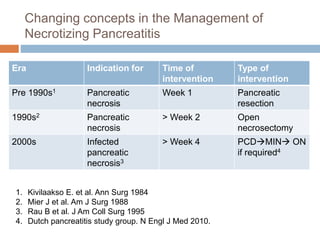
Changing concepts in the Management of
Necrotizing Pancreatitis
Era Indication for Time of
intervention
Type of
intervention
Pre 1990s1 Pancreatic
necrosis
Week 1 Pancreatic
resection
1990s2 Pancreatic
necrosis
> Week 2 Open
necrosectomy
2000s Infected
pancreatic
necrosis3
> Week 4 PCDMIN ON
if required4
1. Kivilaakso E. et al. Ann Surg 1984
2. Mier J et al. Am J Surg 1988
3. Rau B et al. J Am Coll Surg 1995
4. Dutch pancreatitis study group. N Engl J Med 2010.
Indications for Intervention
 Infected pancreatic Necrosis
 Symptomatic sterile necrosis
 gastric outlet, intestinal, or biliary obstruction due
to mass effect(>4 week)
 Persistent symptoms (e.g. pain, ‘persistent
unwellness’) (i.e. >8 weeks)
Timing of intervention
 At least >4weeks after the onset of disease
 When necrotic process has stopped extending
 Clear demarcation between viable & non-viable
tissues
 Infected necrotic tissue has become walled-off
 This approach
 Decreases the risk of bleeding
 Avoiding removal of normal pancreatic tissue-
endocrine & exocrine insufficiency
Classification of type of
intervention
Depending on how the target lesion is visualized
on
 Radiological method
 CT, USG, Fluoroscope
 Endoscopic methods
 Gastroscope
 Laparoscope
 Nephroscope
 Open surgical
Minimally Invasive Techniques
Potential benefits claimed
 Minimizing operative trauma
 to postpone or obviate the need for surgical
intervention
 Minimize damage to healthy pancreatic tissue
Radiologic Drainage
Techniques
 Most effective if target lesion is liquified
 Most common location lesser sac, anterior & left
pararenal spaces
 USG or CT guidance
 Retroperitoneal approach is preferred to reduce
the risk of contamination and possible peritonitis
 Needle guidewire is passed down the needle
the tract is dilated to accommodate a catheter
 Catheter upgradation is essential
Radiologic Drainage
Techniques
 Repeated flushing of catheter to prevent
blockage
 Multiple catheters are required, especially for
large or complex lesions
 The efficacy is reduced with more solid lesions
Videoscopic-assisted retroperitoneal
debridement (VARD) Hovrath- 2001
 Radiologic drainage of the lesion is first instituted
 The patient is placed in supine position with the
left side 30-40 degree elevated
 A subcostal incision of 5 cm is placed over drain
site.
 A finger is used to probe and confirm entry into
the necrotic cavity
 Fluid and loose necrotic debris are removed by
suction
Videoscopic-assisted retroperitoneal
debridement (VARD) Hovrath- 2001
 Two ports (10 to 12 mm) are inserted through
the incision
 The incision is sealed with wet sponges and
towel clips to allow insufflation with CO2
 Debridement of necrotic tissue is performed
with hydrodissection and 10 mm forceps
 Drains are placed for postoperative continuous
lavage
 An ostomy bag is then positioned over the flank
continuous lavage is performed
Nephroscopic techniques
-Carter 2000
 The first step is to insert a drainage catheter into
the pancreatic lesion under CT guidance
 the drain tract is dilated to allow insertion of a 34-
Fr Amplatz sheath
 A nephroscope is inserted through the sheath into
the cavity, and jet lavage with warm saline is used
to clear away debris and suppurative fluid
 Drains placed for post-op lavage
Nephroscopic techniques
-Carter 2000
Pre-op Post-op
Indications for Open
Necrosectomy
 Failure of minimally invasive techniques to drain
the infected necrosis & persistent sepsis
 Massive haemorrhage
 Bowel perforation (Duodenum or transverse
colon)
Principle of surgical
techniques
 Eliminate necrotic & infected tissue/fluid
 Preservation of vital tissue
 Avoidance of haemorrhage
 All fluid collection identified on CT scan should
be identified, opened & evacuated
Open Surgical Necrosectomy
 midline or bilateral subcostal incision
 The body and tail of the pancreas exposed by
entering the lesser sac
 Either by division of gastrocolic omentum or
gastrohepatic omentum
 Via transverse mesocolon
 Great care is required- as Inflammatory
adhesions may exist between the pancreas and
stomach or transverse mesocolon
Technical pearls
 Debridement is performed bluntly, usually with
digital dissection, careful use of instruments &
lavage
 Only loosely adherent tissue should be removed
 Avoid sharp dissection- to prevent haemorrhage
 Strands of tissue forming bridges across cavity
may be vessels & should not be avulsed
 Extensive irrigation of necrotic cavity
Technical pearls
 Hydrogen peroxide may be used
 Systematic approach- examining in turn in
retroperitoneum behind transverse, ascending &
descending
 Do not leave any collection undrained
 If massive bleeding is encountered packing
 If colon viability is doubtful- perform ileostomy
 Feeding Jejunostomy is routine
What is a step-up approach ?
 The first step is percutaneous or endoscopic
drainage of the collection of infected fluid to
mitigate sepsis
 If drainage does not lead to clinical improvement,
the next step is minimally invasive retroperitoneal
necrosectomy
 Open Necrosectomy
Step up approach- PANTER study
Besselink MG. Dutch study group. A Step-up Approach or Open
Necrosectomy for Necrotizing Pancreatitis. N Engl J Med 2010
 Multicenter RCT, 88 patients
 45-primary open necrosectomy, 43- MI step up
approach
 The primary end point was occurence
 major complications (new-onset multiple-organ failure or
multiple systemic complications, perforation of a
visceral organ or enterocutaneous fistula, or bleeding)
 death
Step up approach- PANTER study
Results:
 The primary end point occurred in 31 of 45 patients
(69%) assigned to open necrosectomy and in 17 of
43 patients (40%) assigned to the step-up approach
(P = 0.006).
In patients assigned to the step-up approach
 35% were treated with percutaneous drainage only
 New-onset multiple-organ failure occurred less often
(12% vs. 40%, P = 0.002).
 Lower rate of incisional hernias (7% vs. 24%, P =
0.03) and new-onset diabetes (16% vs. 38%, P =
Summary
 Mild acute pancreatitis- 80% case- no role of
surgery
 Severe necrotizing pancreatitis- 20%
 Interventions should preferably be delayed:
>4weeks
 Indications for interventions : infected necrosis,
Clinical deterioration, persistent organ failure- in
sterile necrosis
 Step up approach is preferred
Pancreatic & Periampullary
Tumours
Lower end of CBD
Periampullary pancreas
Duodenum
Ampulla
Clinical features
CT protocols for pancreas
 Noncontrast phase:
 Evaluation of pancreatic calcifications
 Arterial phases (early and delayed)
 Early arterial phase evaluates pancreatic vasculature without
interference from venous opacification.
 Late arterial phase is to distinguish pancreatic tumor from adjacent
normal pancreatic tissue
 Evaluate hypervascular liver metastases in patients with NET of
the pancreas.
 Portal venous phase
 Evaluation of relationship with the veins and hypovascular liver
metastases in patients with adenocarcinoma
Staging – investigations
Tumour
CBD
Pancreatic duct
GB
stent
Cystic neoplasm in body-tail
MRCP
 Magnetic resonance
cholangiopancreatography
shows a clearer delineation
of the pancreatic duct.
 Normal pancreatic duct in
the pancreatic head
(arrowheads)
 Filling defect in the
pancreatic body, and distal
dilation of the pancreatic
duct in the tail 69
EUS (Endoscopic Ultrasound)
• Small lesions
• Vascular involvement
• FNAc
Pancreatic Ca
 Most common site is pancreatic head (78%)
 body and tail (20-25%)
 Surgery is the cornerstone of treatment
 In the late 1960s postoperative morbidity rate was up to 60%
and mortality rate approaching 25%
 Mortality rate is less than 2% and morbidity rate 30-40% in
high volume centre
Büchler et al, 2003; Cameron et al, 2006; Wagner et al, 2004
Preoperative Preparation
• Nutrition
• Assess for vascular involvement & liver mets
• CBD stent placement
• An absolute indication for biliary drainage is
 Bil >15mg%
 Cholangitis
 Malnutrition
Types of Resections
 Whipple’s Pancreaticoduodenectomy
 Distal pancreatectomy
 Segmental pancreatectomy
 Total pancreatectomy
Resectable lesion
SMV
SMA
Head mass
Borderline resectable tumour
Tumour
SMV
SMA
Unresectable tumour
Tumour
SMA
 Nonresectable lesions:
 Encase (i.e., >180° invasion) SMA, CA or CHA
 Occlude the SMV- PV such that no reconstruction is
possible
• Borderline resectable lesions:
 Abut the visceral arteries (<180° invasion)
 Distort the visceral veins, or even occlude the SMV-PV but venous
reconstruction still technically feasible
Callery MP et al. Ann Surg Oncol 2009
Role of staging laparoscopy
 Approximately 50% of patients with pancreatic
cancer can have liver or peritoneal mets on
operation
 SL can avoid unnecessary exploration
 Prospective study at MSKCC: of 115 pts 36% saved
from exploration Conlon KC et al. Ann Surg 1996
Staging – investigations
Staging Lap - Indications
 HOP tumor size >4cm
 Boarder line resectable tumors
 CA 19-9 >150 IU/ml
 Body and tail carcinoma
WPD specimen
Contact with SMV & SM
SMA first approach
Uncinate tumour with SMA
involvement
Replace
d right
hepatic
artery
Vein resection
PJ Vs PG
 PG was developed as an alternative to PJ
 Chance of leakage may be less due to rich gastric
vascularity
 Pancreatic enzymes may be inactivated by the gastric acid
 Meta analysis including 3RCTs, concluded no added
advantage of PG over PJ Menahem B, Ann Surg 2014
Extended Lymphadenectomy
 Standard PD involves removal of peripancreatic and
subpyloric nodes
 Extended lymphadenectomy involves removal of nodes from
liver hilum, paraaortic nodes from diaphragm to IMA
 Riall et al showed no difference in survival with significant
higher morbidity
Riall TS J Gastrointest surg, 2005
 Jin Young et al showed increased operative time with similar
morbidity and mortality without any survival benefit
Jin Young Ann Surg, 2014
 Exteneded lymphadenectomy is not recommended for
pancraetic cancers
Venous Resection
 Peritumoral inflammation can mimic tumor
invasion
 Traditionally involvement of SMV or PV were
considered unresectable
Venous Resection
 Perioperative morbidity and mortality rates for pancreatic
resections with PV or SMV resection are similar to those
without it
 Bachellier et al, 2001; Carrere et al, 2006; Leach et al, 1998; Nakao
et al, 2006; Riediger et al, 2006; Wagner et al, 2004
 Tumor infiltration into the tunica media of the PV has a
worse prognosis and a long-term survival of less than 2
years
Arterial reconstruction
 Arterial reconstruction is associated with high
morbidity and poor short and long term survival
 Stitzenberg KB, Ann Surg Oncol 2008
 Nakao A, World J Surg, 2006
 Mollberg N, Ann Surg 2011
 Sufficient data is not available to change the
practice so arterial involvement is still a
contraindication
Distal Pancreatectomy
 For tumors arising in the body or tail of the
pancreas
 Types
1. Classical Left to right distal pancreatectomy
2. Radical antegrade modular pancreaticosplenectomy
(RAMPS)
3. Distal pancraetectomy with celiac artery resection
Left to right distal pancreatectomy
 Performed by early ligation of the splenic artery followed
by mobilization of the spleen and pancreas, from a left-
to-right
 Drawbacks
 Inadequate nodal dissection
 Higher rate of margin positivity
RAMPS
 Complete regional LN dissection and less incidence of
margin positivity mainly the posterior tangential margin
 Plane of the posterior dissection is modular depending on
the position of the tumor in relation to the adrenal gland on
preoperative CT scans
 Not an extended pancreatic resection
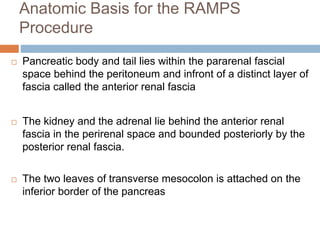
Anatomic Basis for the RAMPS
Procedure
 Pancreatic body and tail lies within the pararenal fascial
space behind the peritoneum and infront of a distinct layer of
fascia called the anterior renal fascia
 The kidney and the adrenal lie behind the anterior renal
fascia in the perirenal space and bounded posteriorly by the
posterior renal fascia.
 The two leaves of transverse mesocolon is attached on the
inferior border of the pancreas
Plane of resection
 When the tumor has not penetrated the posterior capsule of
the pancreas on preoperative CT scans, resection plane is
behind the anterior renal fascia (anterior RAMPS)
 When the posterior capsule is invaded the plane of resection
is behind the adrenal gland and Gerota fascia (posterior
RAMPS)
 In each case, the adrenal vein is the intraoperative guide to
the position of the margin.
 In anterior RAMPS, the posterior margin is formed by
identifying the adrenal vein at its junction with the left renal
vein and following its anterior surface retrograde in a right
to-left direction to the left OF adrenal gland.
 In the posterior RAMPS, the adrenal vein is divided at its
termination with the renal vein and elevated along with the
adrenal to give the posterior margin.
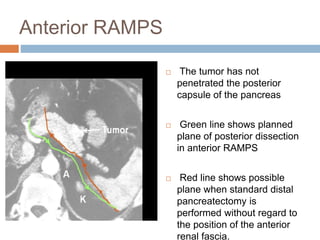
Anterior RAMPS
 The tumor has not
penetrated the posterior
capsule of the pancreas
 Green line shows planned
plane of posterior dissection
in anterior RAMPS
 Red line shows possible
plane when standard distal
pancreatectomy is
performed without regard to
the position of the anterior
renal fascia.
Posterior RAMPS
 Green line shows
planned plane of
posterior dissection
in posterior RAMPS
 The tumor has
penetrated the
posterior capsule of
pancreas.
 Red : standard distal
pancraetectomy
 Green: anterior
RAMPS
 Blue posterior
RAMPS
A
P
Results
 long-term results of 47 patients
 Negative tangential margin rate of 89%
 An actuarial overall 5-year survival rate of 35.5%.
 The actual 5-year survival was 30.4%
 Steven M. Strasberg, The Cancer Journal 2012
Distal pancreatectomy with celiac axis
resection
 Procedure for cancers with celiac axis involvement
 It is based on the fact that resection of the celiac axis may
be performed without devascularizing the liver, which then
receives its blood supply by the pancreaticoduodenal
arcade.
Total
Pancreatectomy
 Indications
1. IPMN – for clear margins
2. To achieve negative margin
3. Atrophic, soft, friable remnant
 c/c
1. Brittle diabetes
2. steatorrhea
Summary
 EUS has added advantage in staging
 SMA first approach for pancreatic head
tumours
 RAMPS gives negative posterior margin in
distal pancreatic tumours
THANK YOU

Pancreatic Surgery

  • 1.
    Dr Harsh Shah MS,FMAS, DNB, MCh (MAMC, New Delhi) Surgical Gastroenterologist & HPB Surgeon Pancreatic Surgery - An Update
  • 2.
     Anatomy  Managementof Necrotizing pancreatitis  Management of Pancreatic cancer
  • 3.
    Anatomy  Pan Kreas(Greek)– all flesh
  • 5.
  • 6.
  • 7.
  • 9.
  • 12.
    Learning points  Duodenumwill always be excised due to a common blood supply with HOP  Spleen with distal pancreas  GDA acts as a communicating vessel between celiac & SMA  Positive resection margin near SMA in uncinate tumours
  • 13.
  • 14.
    Etiologies of AcutePancreatitis Common Causes • Gallstones (most common) • Alcohol Intake • ERCP • Blunt trauma abdomen • Drugs (sulfonamides, 6-MP) • Hypertriglyceridemia Uncommon Causes • Hypercalcemia • Periampullary diverticulum • Pancreas divisum • Hereditary pancreatitis • Cystic Fibrosis • Ca head of pancreas
  • 15.
    Diagnosis Two out ofthree: (1) abdominal pain consistent with acute pancreatitis (acute onset of a persistent, severe, epigastric pain often radiating to the back) (2) serum lipase activity (or amylase activity) at least three times greater than the upper limit of normal; and (3) characteristic findings of acute pancreatitis on contrast-enhanced computed tomography (CECT) and less commonly magnetic resonance imaging (MRI) or transabdominal ultrasonography.
  • 16.
    Revised Atlanta Classification- 2012 Interstitial edematous pancreatitis  Acute peripancreatic fluid collection  Pancreatic pseudocyst  Necrotizing pancreatitis  Acute necrotic collection  Walled off necrosis
  • 17.
    Interstitial Edematous Pancreatitis  Acuteinflammation of pancreatic parenchyma & peripancreatic tissue without recognizable tissue necrosis  CECT criteria:  Parenchymal enhancement by intravenous contrast agent  No e/o necrosis
  • 18.
    Acute Peripancreatic Fluid collection Peripancreatic fluid associated with IEP  Within first 4 weeks of onset of IEP  CECT criteria  IEP  Homogenous collection with fluid density  Confined by normal peripancreatic fascial planes  Adjacent to pancreas
  • 19.
    Pancreatic Pseudocyst  Encapsulatedcollection of fluid with a well defined inflammatory wall outside the pancreas with minimal or no necrosis  >4 weeks after IEP  CECT criteria:  Well circumscribed(round or oval)  Homogenous fluid density  No non-liquid component  Well defined wall
  • 20.
    Necrotising Pancreatitis  Inflammationassociated with pancreatic parenchymal or peripancreatic necrosis  CECT criteria:  Lack of parenchymal enhancement by IV contrast &/or  Presence of peripancreatic necrosis
  • 21.
    Acute Necrotic collection Collection containing variable amounts of both fluid & necrosis associated with NP  Can involve pancreatic parenchyma &/or peripancreatic tissue  CECT criteria:  Only with NP  Heterogenous & non-liquid density of varying degrees  No definable wall  Intrapancreatic &/or extrapancreatic
  • 22.
  • 23.
    Walled-off Necrosis  Amature, encapsulated collection of pancreatic &/or peripancreatic necrosis  >4weeks after onset of necrotising pancreatitis  CECT criteria:  Heterogenous with liquid & non-liquid density (may be homogenous)  Completely encapsulated  Intrapancreatic &/or extrapancreatic
  • 24.
  • 25.
    Infected Pancreatic Necrosis Pancreatic and peripancreatic necrosis can remain sterile or become infected;  Failure of intestinal barrier  Incidence of Infection of necrosis- 25-70 %  Mortality of infected PN- 20-25 %  No absolute correlation between the extent of necrosis and the risk of infection  Infected necrosis is rare during the first week Rau BM. Outcome determinants in acute pancreatitis. Am J Surg 2007; 194:S39-S44.
  • 26.
  • 27.
    Infected Pancreatic Necrosis The diagnosis of infected pancreatic necrosis is important  Need for antibiotic treatment  Need for active intervention  The presence of infection can be presumed  extraluminal gas in the pancreatic and/or peripancreatic tissues on CECT or when percutaneous, image-guided, fine-needle aspiration (FNA) is positive for bacteria and/or fungi on Gram stain and culture
  • 28.
    Natural course ofAcute Pancreatitis  Early Phase  1st week  Mild pancreatitis- resolve  Organ failure related to SIRS: transient vs persistent  Infection usually does not occur  Late phase  From 2nd week onwards  Disease severity: Necrosis, Organ failure Buchler et al. Acute necrotizing pancreatitis: Treatment strategy according to status of infection. Ann Surg 2000;232:619-26
  • 29.
    Medical management ofAP  Adequate pain relief  Fluid resuscitation- Target HCT: 35-45%  No role of prophylactic antibiotics  Enteral nutrition preferred (NG/NJ)
  • 30.
  • 31.
  • 32.
    CECT Scan  Pancreaticprotocol – 25 sec (Delayed arterial phase)  slice thickness (i.e. 5mm or less),  During follow up only a portal venous phase (monophasic) is generally sufficient
  • 33.
    CECT scan  Necrosis:Absence of enhancement of pancreatic parenchyma  Infected pancreatic necrosis: presence of multiloculated gas within the gland and surrounding tissues  Multisystem impairment:  Evidence of pulmonary edema, pleural effusions  Diminished renal enhancement  Anasarca
  • 35.
    Silvermann et al,2004: A modified CT severity index for evaluating acute pancreatitis: improved correlation with patient outcome. Am J Roentgenol 183:1261-1265
  • 36.
    FNAc  Routine percutaneousFNAc of peripancreatic collections to detect bacteria is not indicated. Indications  To rule infection in sterile necrosis- persistent SIRS, organ failure  False negative rate: 12-15 %
  • 37.
    Microbiology  Gram-negative (Escherichia coli,Klebsiella) 35%–55%.  Gram-positive isolates (Staphylococcus, Streptococcus) 20%– 35%.  Anaerobic isolates (Bacteroides sp.) 8%–15%.  Fungal isolates (candida) 20%–25%.
  • 38.
  • 39.
    INDICATIONS FOR INTERVENTION IN NECROTIZINGPANCREATITIS IAP/APA guidelines for the management of acute Pancreatitis-2012
  • 40.
    Changing concepts inthe Management of Necrotizing Pancreatitis Era Indication for Time of intervention Type of intervention Pre 1990s1 Pancreatic necrosis Week 1 Pancreatic resection 1990s2 Pancreatic necrosis > Week 2 Open necrosectomy 2000s Infected pancreatic necrosis3 > Week 4 PCDMIN ON if required4 1. Kivilaakso E. et al. Ann Surg 1984 2. Mier J et al. Am J Surg 1988 3. Rau B et al. J Am Coll Surg 1995 4. Dutch pancreatitis study group. N Engl J Med 2010.
  • 41.
    Indications for Intervention Infected pancreatic Necrosis  Symptomatic sterile necrosis  gastric outlet, intestinal, or biliary obstruction due to mass effect(>4 week)  Persistent symptoms (e.g. pain, ‘persistent unwellness’) (i.e. >8 weeks)
  • 42.
    Timing of intervention At least >4weeks after the onset of disease  When necrotic process has stopped extending  Clear demarcation between viable & non-viable tissues  Infected necrotic tissue has become walled-off  This approach  Decreases the risk of bleeding  Avoiding removal of normal pancreatic tissue- endocrine & exocrine insufficiency
  • 43.
    Classification of typeof intervention Depending on how the target lesion is visualized on  Radiological method  CT, USG, Fluoroscope  Endoscopic methods  Gastroscope  Laparoscope  Nephroscope  Open surgical
  • 44.
    Minimally Invasive Techniques Potentialbenefits claimed  Minimizing operative trauma  to postpone or obviate the need for surgical intervention  Minimize damage to healthy pancreatic tissue
  • 45.
    Radiologic Drainage Techniques  Mosteffective if target lesion is liquified  Most common location lesser sac, anterior & left pararenal spaces  USG or CT guidance  Retroperitoneal approach is preferred to reduce the risk of contamination and possible peritonitis  Needle guidewire is passed down the needle the tract is dilated to accommodate a catheter  Catheter upgradation is essential
  • 46.
    Radiologic Drainage Techniques  Repeatedflushing of catheter to prevent blockage  Multiple catheters are required, especially for large or complex lesions  The efficacy is reduced with more solid lesions
  • 47.
    Videoscopic-assisted retroperitoneal debridement (VARD)Hovrath- 2001  Radiologic drainage of the lesion is first instituted  The patient is placed in supine position with the left side 30-40 degree elevated  A subcostal incision of 5 cm is placed over drain site.  A finger is used to probe and confirm entry into the necrotic cavity  Fluid and loose necrotic debris are removed by suction
  • 48.
    Videoscopic-assisted retroperitoneal debridement (VARD)Hovrath- 2001  Two ports (10 to 12 mm) are inserted through the incision  The incision is sealed with wet sponges and towel clips to allow insufflation with CO2  Debridement of necrotic tissue is performed with hydrodissection and 10 mm forceps  Drains are placed for postoperative continuous lavage  An ostomy bag is then positioned over the flank continuous lavage is performed
  • 50.
    Nephroscopic techniques -Carter 2000 The first step is to insert a drainage catheter into the pancreatic lesion under CT guidance  the drain tract is dilated to allow insertion of a 34- Fr Amplatz sheath  A nephroscope is inserted through the sheath into the cavity, and jet lavage with warm saline is used to clear away debris and suppurative fluid  Drains placed for post-op lavage
  • 51.
  • 52.
    Indications for Open Necrosectomy Failure of minimally invasive techniques to drain the infected necrosis & persistent sepsis  Massive haemorrhage  Bowel perforation (Duodenum or transverse colon)
  • 53.
    Principle of surgical techniques Eliminate necrotic & infected tissue/fluid  Preservation of vital tissue  Avoidance of haemorrhage  All fluid collection identified on CT scan should be identified, opened & evacuated
  • 54.
    Open Surgical Necrosectomy midline or bilateral subcostal incision  The body and tail of the pancreas exposed by entering the lesser sac  Either by division of gastrocolic omentum or gastrohepatic omentum  Via transverse mesocolon  Great care is required- as Inflammatory adhesions may exist between the pancreas and stomach or transverse mesocolon
  • 55.
    Technical pearls  Debridementis performed bluntly, usually with digital dissection, careful use of instruments & lavage  Only loosely adherent tissue should be removed  Avoid sharp dissection- to prevent haemorrhage  Strands of tissue forming bridges across cavity may be vessels & should not be avulsed  Extensive irrigation of necrotic cavity
  • 56.
    Technical pearls  Hydrogenperoxide may be used  Systematic approach- examining in turn in retroperitoneum behind transverse, ascending & descending  Do not leave any collection undrained  If massive bleeding is encountered packing  If colon viability is doubtful- perform ileostomy  Feeding Jejunostomy is routine
  • 57.
    What is astep-up approach ?  The first step is percutaneous or endoscopic drainage of the collection of infected fluid to mitigate sepsis  If drainage does not lead to clinical improvement, the next step is minimally invasive retroperitoneal necrosectomy  Open Necrosectomy
  • 58.
    Step up approach-PANTER study Besselink MG. Dutch study group. A Step-up Approach or Open Necrosectomy for Necrotizing Pancreatitis. N Engl J Med 2010  Multicenter RCT, 88 patients  45-primary open necrosectomy, 43- MI step up approach  The primary end point was occurence  major complications (new-onset multiple-organ failure or multiple systemic complications, perforation of a visceral organ or enterocutaneous fistula, or bleeding)  death
  • 59.
    Step up approach-PANTER study Results:  The primary end point occurred in 31 of 45 patients (69%) assigned to open necrosectomy and in 17 of 43 patients (40%) assigned to the step-up approach (P = 0.006). In patients assigned to the step-up approach  35% were treated with percutaneous drainage only  New-onset multiple-organ failure occurred less often (12% vs. 40%, P = 0.002).  Lower rate of incisional hernias (7% vs. 24%, P = 0.03) and new-onset diabetes (16% vs. 38%, P =
  • 61.
    Summary  Mild acutepancreatitis- 80% case- no role of surgery  Severe necrotizing pancreatitis- 20%  Interventions should preferably be delayed: >4weeks  Indications for interventions : infected necrosis, Clinical deterioration, persistent organ failure- in sterile necrosis  Step up approach is preferred
  • 62.
  • 63.
    Lower end ofCBD Periampullary pancreas Duodenum Ampulla
  • 65.
  • 66.
    CT protocols forpancreas  Noncontrast phase:  Evaluation of pancreatic calcifications  Arterial phases (early and delayed)  Early arterial phase evaluates pancreatic vasculature without interference from venous opacification.  Late arterial phase is to distinguish pancreatic tumor from adjacent normal pancreatic tissue  Evaluate hypervascular liver metastases in patients with NET of the pancreas.  Portal venous phase  Evaluation of relationship with the veins and hypovascular liver metastases in patients with adenocarcinoma
  • 67.
  • 68.
  • 69.
    MRCP  Magnetic resonance cholangiopancreatography showsa clearer delineation of the pancreatic duct.  Normal pancreatic duct in the pancreatic head (arrowheads)  Filling defect in the pancreatic body, and distal dilation of the pancreatic duct in the tail 69
  • 70.
    EUS (Endoscopic Ultrasound) •Small lesions • Vascular involvement • FNAc
  • 71.
    Pancreatic Ca  Mostcommon site is pancreatic head (78%)  body and tail (20-25%)  Surgery is the cornerstone of treatment  In the late 1960s postoperative morbidity rate was up to 60% and mortality rate approaching 25%  Mortality rate is less than 2% and morbidity rate 30-40% in high volume centre Büchler et al, 2003; Cameron et al, 2006; Wagner et al, 2004
  • 72.
    Preoperative Preparation • Nutrition •Assess for vascular involvement & liver mets • CBD stent placement • An absolute indication for biliary drainage is  Bil >15mg%  Cholangitis  Malnutrition
  • 73.
    Types of Resections Whipple’s Pancreaticoduodenectomy  Distal pancreatectomy  Segmental pancreatectomy  Total pancreatectomy
  • 74.
  • 75.
  • 76.
  • 77.
     Nonresectable lesions: Encase (i.e., >180° invasion) SMA, CA or CHA  Occlude the SMV- PV such that no reconstruction is possible • Borderline resectable lesions:  Abut the visceral arteries (<180° invasion)  Distort the visceral veins, or even occlude the SMV-PV but venous reconstruction still technically feasible Callery MP et al. Ann Surg Oncol 2009
  • 78.
    Role of staginglaparoscopy  Approximately 50% of patients with pancreatic cancer can have liver or peritoneal mets on operation  SL can avoid unnecessary exploration  Prospective study at MSKCC: of 115 pts 36% saved from exploration Conlon KC et al. Ann Surg 1996
  • 79.
  • 80.
    Staging Lap -Indications  HOP tumor size >4cm  Boarder line resectable tumors  CA 19-9 >150 IU/ml  Body and tail carcinoma
  • 83.
  • 84.
  • 85.
    Uncinate tumour withSMA involvement
  • 86.
  • 87.
  • 88.
    PJ Vs PG PG was developed as an alternative to PJ  Chance of leakage may be less due to rich gastric vascularity  Pancreatic enzymes may be inactivated by the gastric acid  Meta analysis including 3RCTs, concluded no added advantage of PG over PJ Menahem B, Ann Surg 2014
  • 89.
    Extended Lymphadenectomy  StandardPD involves removal of peripancreatic and subpyloric nodes  Extended lymphadenectomy involves removal of nodes from liver hilum, paraaortic nodes from diaphragm to IMA  Riall et al showed no difference in survival with significant higher morbidity Riall TS J Gastrointest surg, 2005  Jin Young et al showed increased operative time with similar morbidity and mortality without any survival benefit Jin Young Ann Surg, 2014  Exteneded lymphadenectomy is not recommended for pancraetic cancers
  • 90.
    Venous Resection  Peritumoralinflammation can mimic tumor invasion  Traditionally involvement of SMV or PV were considered unresectable
  • 91.
    Venous Resection  Perioperativemorbidity and mortality rates for pancreatic resections with PV or SMV resection are similar to those without it  Bachellier et al, 2001; Carrere et al, 2006; Leach et al, 1998; Nakao et al, 2006; Riediger et al, 2006; Wagner et al, 2004  Tumor infiltration into the tunica media of the PV has a worse prognosis and a long-term survival of less than 2 years
  • 92.
    Arterial reconstruction  Arterialreconstruction is associated with high morbidity and poor short and long term survival  Stitzenberg KB, Ann Surg Oncol 2008  Nakao A, World J Surg, 2006  Mollberg N, Ann Surg 2011  Sufficient data is not available to change the practice so arterial involvement is still a contraindication
  • 93.
    Distal Pancreatectomy  Fortumors arising in the body or tail of the pancreas  Types 1. Classical Left to right distal pancreatectomy 2. Radical antegrade modular pancreaticosplenectomy (RAMPS) 3. Distal pancraetectomy with celiac artery resection
  • 94.
    Left to rightdistal pancreatectomy  Performed by early ligation of the splenic artery followed by mobilization of the spleen and pancreas, from a left- to-right  Drawbacks  Inadequate nodal dissection  Higher rate of margin positivity
  • 95.
    RAMPS  Complete regionalLN dissection and less incidence of margin positivity mainly the posterior tangential margin  Plane of the posterior dissection is modular depending on the position of the tumor in relation to the adrenal gland on preoperative CT scans  Not an extended pancreatic resection
  • 96.
    Anatomic Basis forthe RAMPS Procedure  Pancreatic body and tail lies within the pararenal fascial space behind the peritoneum and infront of a distinct layer of fascia called the anterior renal fascia  The kidney and the adrenal lie behind the anterior renal fascia in the perirenal space and bounded posteriorly by the posterior renal fascia.  The two leaves of transverse mesocolon is attached on the inferior border of the pancreas
  • 97.
    Plane of resection When the tumor has not penetrated the posterior capsule of the pancreas on preoperative CT scans, resection plane is behind the anterior renal fascia (anterior RAMPS)  When the posterior capsule is invaded the plane of resection is behind the adrenal gland and Gerota fascia (posterior RAMPS)  In each case, the adrenal vein is the intraoperative guide to the position of the margin.
  • 98.
     In anteriorRAMPS, the posterior margin is formed by identifying the adrenal vein at its junction with the left renal vein and following its anterior surface retrograde in a right to-left direction to the left OF adrenal gland.  In the posterior RAMPS, the adrenal vein is divided at its termination with the renal vein and elevated along with the adrenal to give the posterior margin.
  • 99.
    Anterior RAMPS  Thetumor has not penetrated the posterior capsule of the pancreas  Green line shows planned plane of posterior dissection in anterior RAMPS  Red line shows possible plane when standard distal pancreatectomy is performed without regard to the position of the anterior renal fascia.
  • 100.
    Posterior RAMPS  Greenline shows planned plane of posterior dissection in posterior RAMPS  The tumor has penetrated the posterior capsule of pancreas.
  • 101.
     Red :standard distal pancraetectomy  Green: anterior RAMPS  Blue posterior RAMPS A P
  • 102.
    Results  long-term resultsof 47 patients  Negative tangential margin rate of 89%  An actuarial overall 5-year survival rate of 35.5%.  The actual 5-year survival was 30.4%  Steven M. Strasberg, The Cancer Journal 2012
  • 103.
    Distal pancreatectomy withceliac axis resection  Procedure for cancers with celiac axis involvement  It is based on the fact that resection of the celiac axis may be performed without devascularizing the liver, which then receives its blood supply by the pancreaticoduodenal arcade.
  • 104.
    Total Pancreatectomy  Indications 1. IPMN– for clear margins 2. To achieve negative margin 3. Atrophic, soft, friable remnant  c/c 1. Brittle diabetes 2. steatorrhea
  • 105.
    Summary  EUS hasadded advantage in staging  SMA first approach for pancreatic head tumours  RAMPS gives negative posterior margin in distal pancreatic tumours
  • 106.