Pacemakers: Some Basic and
Some Not-So-Basic Concepts
Muzaffar Ali, DM
SKIMS SOURA
Pacemaker Components
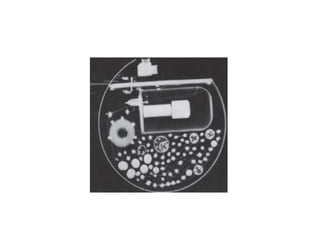
• Battery
• Primary power source
• Mercury zinc batteries were used in early pacemakers
• These batteries produced gasses over time that required
venting.
• This resulted in fluid leakage into the pacemaker at times
that caused electrical shorting and premature device failure
• Mercury zinc batteries have a fairly short useful life
• Have an abrupt drop in voltage as they become depleted.
• This makes predicting the pending failure of the batteries
difficult.
• No devices of this type are currently in use
• Nuclear pacemakers use a very small amount of radioactive
element plutonium to generate heat
• The heat is converted into electricity by a thermocouple
• These devices had very long service lives (some were
guaranteed for 72 years)
• They were large
• Created problems when travelling between states and
countries due to the presence of their radioactive fuel
• They must also be removed at the time of death and
returned for proper disposal
• Nuclear power sources became obsolete when the long-
lived lithium batteries were developed
• Rechargeable pacemakers use a nickel-cadmium
battery that must be charged each week.
• The recharging is done using a method known as
“inductive coupling”.
• A coil is placed on the skin over the pacemaker
that transfers energy to a coil within the device
via electromagnetic waves.
• The Pacemakers are large and became obsolete
with newer technology
• Lithium iodine is currently the predominant
power source being used in pacemakers today
• A long shelf life and high energy density
• The self-discharge rate is very low resulting in a
long shelf life
• It has a stable voltage through much of the useful
life, then tapers down in a gradual and
predictable manner
Circuitry
• Highly complex and integrated microprocessor
based systems
• Large data storage capabilities
• Includes total number of cardiac events, the rate
of these events, whether these were paced or
intrinsic, and high rate episodes
• The newest devices have the ability to store
intracardiac electrograms and function as event
monitors with the ability to playback the paced or
sensed events
Connector Block
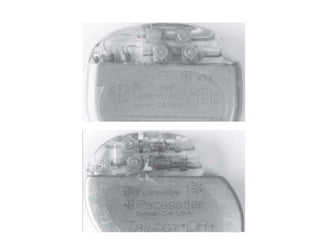
• Also referred to as the “header”
• The means by which the pacemaker wire is
connected to the pacemaker circuitry.
• Many different sizes and styles of connector
blocks.
• Most pacemakers use setscrews
• Some connectors do not use any setscrews
• These have spring connectors for all of the
electrical connections and a mechanism for
gripping the lead body to hold it in place.
• The advantage to this system is that it makes the
electrical connection “automatic”,
• Does not rely on the physician to make a secure
connection with a screw
Leads
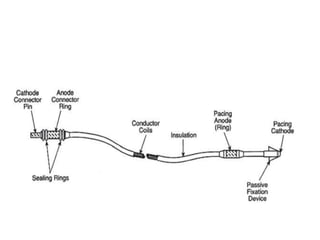
• More than simple “wires”.
• They are complex and highly engineered devices
that consist of many components
• Electrodes
• Electrically active surfaces
• Delivers an electrical stimulus, detects intrinsic
cardiac electrical activity, or both
• Material used:
• elgiloy
• polished platinum
• microporous platinum (platinized or “black”
platinum)
• macroporous platinum (mesh)
• iridium-oxide
• platinum-iridium
• titanium nitride
• Modern electrodes elute an anti-inflammatory
drug such as dexamethasone
• Eluting such a drug at the electrode surface
reduces the amount of acute inflammation and
fibrosis at the electrode myocardial interface.
• Greater charge density
• Reduces current required to stimulate
• Lower battery drain
• Increased longevity
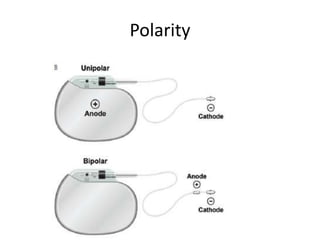
• Anode/ring electrode
• Larger than cathode
• Positioned about 1cm or more back from the
cathode
• Changes in the spacing between these two
electrodes affect the sensing function, with closer
spacing minimizing oversensing of electrical
signals from other sources
• Insulation
• One of the most important components
• Prevents electrical shorting between the
conductor coils within the lead,
• Prevents stimulation of tissues other than the
heart,
• Allows smooth passage of the lead into the vein.
• Failure of the insulation may result in a number
of different problems, the most important of
which is failure to pace.
• Insulation types:
• silicone / silastic
• 55D polyurethane
• 80A polyurethane
• Other polyurethanes
• Teflon “coated coil” technology
• Metal ion oxidation (MIO)
• Environmental stress cracking (ESC)
• Coated coil insulation:insulating coat to each
individual filament of the wire, that are then
wound together in a design known as coradial
construction. The whole wire is then covered
with a standard insulator.
• Conductor Coil: carries the electrical impulse
from the pacemaker to the heart and the
signal from the heart back to the pacemaker
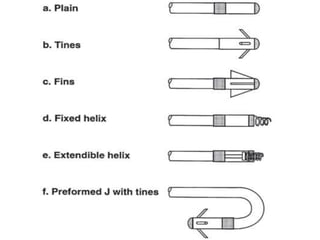
• Fixation:
• “kerplunk” leads
• tines
• fins
• fixed extended helix
• retractable helix
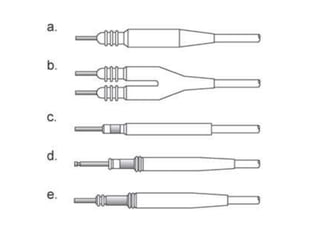
Connector
• Portion of the lead that connects it to the pacemaker
• Many types of connectors
• All manufacturers have agreed upon the International
Standard-1 (IS-1)
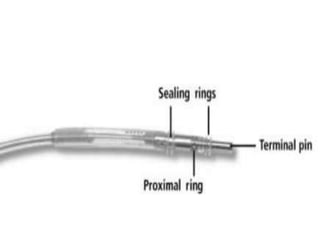
• IS-1: 3.2 mm wide, sealing rings, short pin, uni/bipolar
• An IS-1 lead from one manufacturer should be
compatible with an IS-1 connector block of another
manufacturer
• IS-4
Polarity
• Simpler and more reliable single coil lead
construction.
• Much easier to see the pace artifact
• Bipolar electrograms represent the difference in
potential recorded between two closely spaced
intracardiac electrodes.
• Due to the close spacing of two typically small
electrodes, far-field signals (i.e.,signals not
generated by the tissue the lead electrode is in
contact with) are smaller and thus more easily
rejected
• More resistant to electrical interference caused by
skeletal muscle activity or electromagnetic
interference (EMI) relative to unipolar systems
• At higher output settings one may have stimulation
of the pocket around the pacemaker in a unipolar
system
• Pacing artifact: makes determination of function and
malfunction more difficult, not uncommon to see a
pacemaker programmed to pace in the unipolar
polarity and to sense in the bipolar polarity.
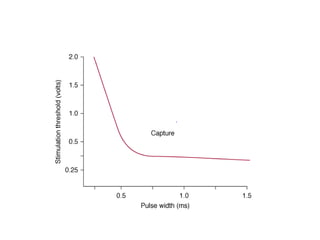
Pacing threshold
• Minimum amount of energy required to
consistently cause depolarization
• Measured in terms of both amplitude (the
strength of the impulse) and the duration of time
for which it is applied to the myocardium (pulse
width), measured in msec
• Method of measuring threhold
• Wedensky effect
• Standard method for threshold testing
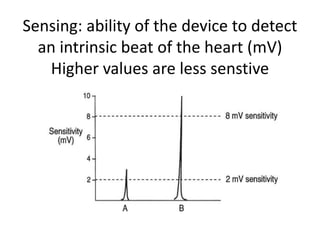
Sensing: ability of the device to detect
an intrinsic beat of the heart (mV)
Higher values are less senstive
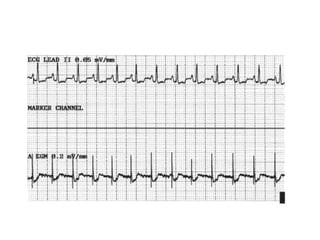
• The pacing lead does not see a QRS or P-wave as
we see it on the surface ECG
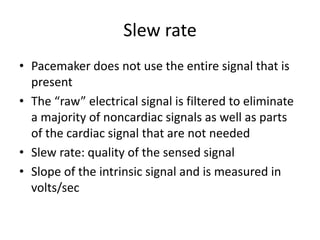
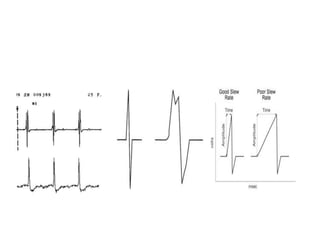
• It sees an intracardiac electrogram that is more
like a “spike”
Slew rate
• Pacemaker does not use the entire signal that is
present
• The “raw” electrical signal is filtered to eliminate
a majority of noncardiac signals as well as parts
of the cardiac signal that are not needed
• Slew rate: quality of the sensed signal
• Slope of the intrinsic signal and is measured in
volts/sec
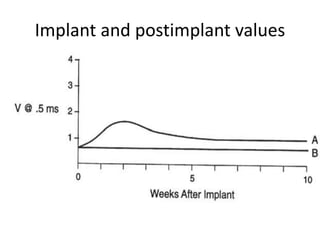
Implant and postimplant values
The Rule of 60,000
• 60,000 Rule: 60,000 msec in a minute
• 60,000/Heart rate = Interval in milliseconds
• 60,000/Interval in milliseconds = Heart rate
• Examples:
• Heart rate = 70 bpm
• 60,000/70 = 857 msec cycle length
• Cycle length = 857 msec
• 60,000/857 = 70 bpm
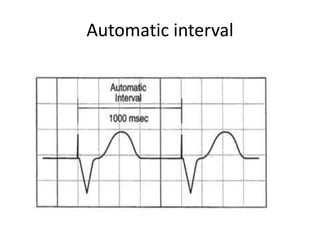
Automatic interval
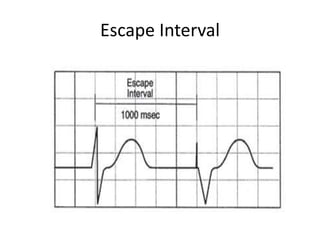
Escape Interval
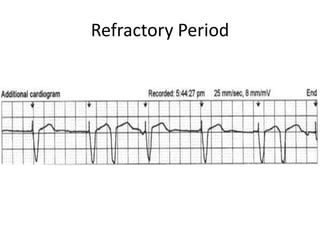
Refractory Period
• The reason for having a refractory period in a
ventricular pacemaker is to prevent sensing of
the evoked QRS and T-wave that occurs
immediately after the paced event
• In atrial pacemakers the refractory period also
prevents sensing of the far-field R-wave or T-
wave
• Blanking period
Hysteresis
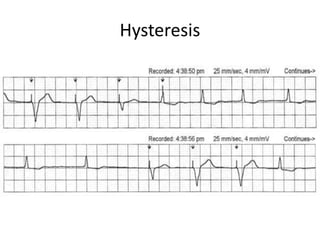
• Useful in patients with ventricular pacemakers
and sinus rhythm that have infrequent pacing
needs, thus minimizing the loss of atrio-
ventricular synchrony.
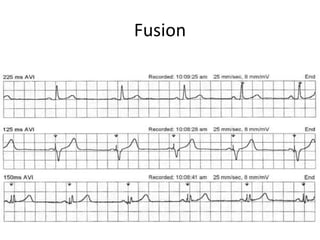
Fusion
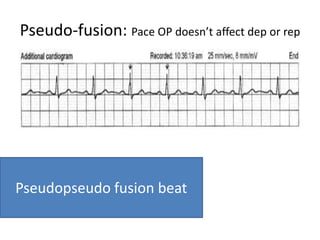
Pseudo-fusion: Pace OP doesn’t affect dep or rep
Pseudopseudo fusion beat
Latency
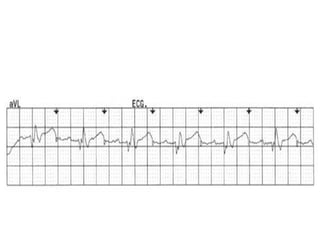
• Pacemaker output spike occurs and captures,
however there is a period (latent period) of
isoelectric baseline prior to the QRS or P wave
following the spike.
• Usually associated with metabolic derangements
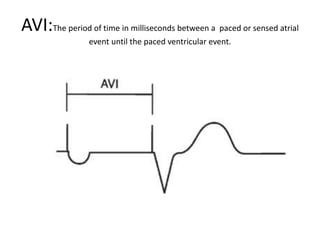
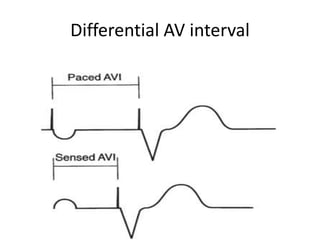
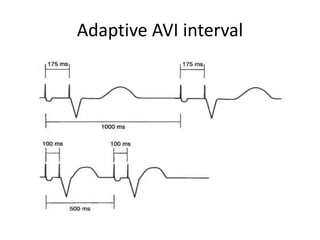
AVI:The period of time in milliseconds between a paced or sensed atrial
event until the paced ventricular event.
Differential AV interval
Adaptive AVI interval
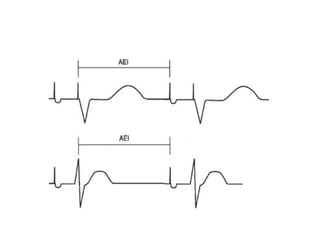
Atrial Escape Interval (AEI)
• Maximum period of time that can elapse
between the last sensed or paced ventricular
event and the next atrial event
• If no intrinsic atrial beat occurs by the end of the
AEI, an atrial pace output will be delivered
• AEI = Base pacing rate minus AVI
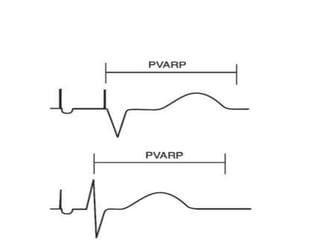
Post Ventricular Atrial Refractory
Period (PVARP)
• Atrial refractory period that begins with each
paced or sensed ventricular event
• It turns off the atrial amplifier to prevent the
atrial lead from sensing the ventricular
depolarization (QRS and T-wave)
• Prevents sensing of retrograde P-waves should a
PVC occur
Total Atrial Refractory Period (TARP)
• AVI + PVARP = TARP
• No atrial sensing for the purpose of tracking
occurs during the AVI and during the PVARP
• Atrial event occurring during TARP will not start
an AVI
• The TARP limits the upper rate limit of the
pacemaker
Upper Rate Limit (URL)
• Maximum tracking rate (MTR) or the
• Maximum tracking interval (MTI)
• Programmable feature
• The maximum rate at which the pacemaker will
allow the ventricle to pace
• Depends on TARP
• URL = 60,000/TARP
• The URL may be separately programmable for
tracking P-waves and for the upper sensor driven
rate
Ventricular Blanking Period
• Follows immediately after an atrial pacing pulse is
delivered.
• Prevents the ventricular sensing channel from sensing
the large atrial pulse
• Should ventricular sensing of the atrial output occur,
the ventricular output pulse will be inhibited and the
patient will not have a ventricular beat: “crosstalk”
• The blanking period is usually set in the range of 12-50
msec
• Long blanking periods are very effective against
crosstalk but limit the ability of the pacemaker to sense
normal or premature ventricular beats.
Upper rate behavior
• Seen any time a mode is used that allows the
ventricle to be paced as the result of an atrial
sensed event ie intrinsic to DDD & VDD
• Occurs when the patient’s atrial rate is faster than
the URL and/or exceeds the atrial sensing limits
imposed by the programmed TARP.
• When the patient’s atrial rate reaches the limits
imposed by the pacemaker in a patient with high
degree AV block, one of two types of responses
can be seen
Block
• Same way as second degree (Mobitz-II) AV block.
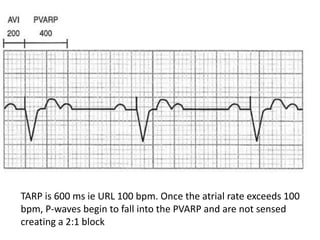
• 2:1 pacemaker block will occur when the
maximum tracking rate is set to the limits
imposed by the TARP (PVARP + AVI)
• With TARP= 500 msec(120bp,) and
URL=120/min. If atrial rate is >120, everyother P
wave will fall into PVARP and will not be sensed
resulting in 2:1 block and symptoms
TARP is 600 ms ie URL 100 bpm. Once the atrial rate exceeds 100
bpm, P-waves begin to fall into the PVARP and are not sensed
creating a 2:1 block
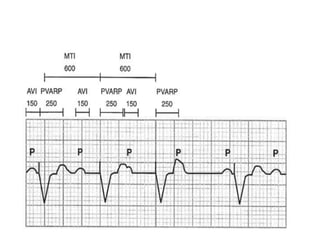
Pseudo-Wenckebach
• Appears like classic Mobitz-I
• Occurs when the URL is programmed to a rate
lower than the limits imposed by the TARP
• TARP=400 msec limiting the upper tracking rate
to 150 bpm. Programming a URL to 100 bpm
would result in Wenckebach behavior for atrial
rates that exceed the URL of 100 bpm but are
below the 2:1 block rate of 150 bpm
• Wenckebach interval
• The pacemaker delays the ventricular output to
prevent pacing the ventricle faster than allowed by the
programmed URL.
• Because of the delayed ventricular pacing, the next P
wave falls even earlier into the next cardiac cycle and
the AVI extension is even greater
• Because the ventricular output is delayed, the AVI
appears prolonged giving a Wenckebach appearance
• Each successive AVI will lengthen until a P-wave falls
into the atrial refractory period and is therefore not
sensed. This P-wave will not start an AVI, and thus the
next QRS is “dropped”.
• It is preferable to program a device so that
Wenckebach behavior will occur prior to the 2:1
block behavior.
• This allows the patient some warning before the
heart rate will drop abruptly
• Methods have been developed to minimize the
effect of abrupt onset 2:1 blocking
• Rate Smoothing: limits changes in R to R intervals
to a percentage of the previous interval. For
example, by setting this parameter to a value of
6%, one cardiac cycle will not be allowed to differ
from the previous one by more or less than 6%.
Also be useful to reduce the pauses seen in
patients with frequent PVCs and to reduce the
risk of tracking retrograde atrial beats.
• Fallback Response: allows the pacemaker rate to
gradually decrease after the upper rate is
reached. It is usually programmable as to the
lower rate to which it will fall and the period of
time it will take to get to the fallback rate
• Sensor Driven Rate Smoothing: The pacing rate will
drop to the rate indicated by the activity sensor at that
point in time.
• A patient has a DDDR pacemaker programmed to an
upper rate and 2:1 block rate of 120 bpm. If the patient
is running and the sensor rate indicates a pacing rate of
115 bpm while the atrial rate is 125 bpm, the device
will act as if the lower rate limit is 115. The pacing rate
will vary between the URL of 120 and the sensor
indicated rate of 115 until the native atrial rate falls
below the URL
Positive AV Interval Hysteresis
• Autointrinsic Conduction Search
• AV Search
• Functional mode switching
• Narrow nonpaced QRS achieves a greater stroke
volume than a paced left bundle branch block (LBBB)
pattern QRS
• Adds an additional interval onto the programmed AVI
for one cycle. If a sensed QRS occurs during this
prolonged AV interval, the device maintains the longer
interval. If the device does not sense a QRS during the
longer interval, pacing continues at the normal
programmed AVI
Negative AV Interval Hysteresis
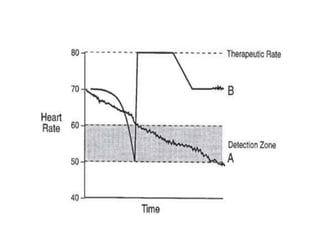
Rate Drop Response
• The pacemaker is set with a lower pacing rate
and a therapeutic pacing rate
• Also set with a heart rate zone and a rate of
change within that zone
• Patients who have autonomic dysfunction with a
cardioinhibitory response alone, or combined
with a vasodepressor response
Sleep Mode / Circadian Response
• Not physiologic to maintain usual rates when sleeping
• Rationale behind features designed to slow the rate
during periods of inactivity or sleep
• A common method of accomplishing this goal is the
use of a clock within the pacemaker.
• One can set the current time, the patient’s normal
waking time and normal bedtime and a separate sleep
rate is then programmed.
• If the patient gets up and becomes active during the
designated sleep time, the activity sensor notes the
patient movement and overrides the sleep rate
• A patient’s sleep time may vary day to day
• Patients may nap at odd hours during the day
• Patients and their pacemakers cross time zones but the
internal pacemaker clock has no way of knowing this.
• Another feature uses the variability of patient activity
as determined by the activity sensor. The pacemaker
notes inactivity of the patient after a period of time. It
will then allow the rate to drop to the sleep rate. As the
patient becomes active again, the pacemaker resumes
the regular lower rate limit. This algorithm has the
advantage of being patient based rather than clock
based.
Automatic Mode Switching
• Limitation imposed when utilizing the DDD or
VDD based modes in patients with intermittent
atrial tachyarrhythmias
• Use of the DDI or DVI modes can prevent this,
patients with AV block cannot track the atrium
when the patient is in sinus rhythm.
• Allows the pacemaker to actually change it’s
mode from tracking to nontracking mode
• from DDD, DDDR, VDD or VDDR to either DDI,
DDIR, VVI, VVIR
• DDDR devices can utilize the sensor to evaluate
whether the atrial rhythm is appropriate (such as
sinus tachycardia due to exercise) or
inappropriate (such as atrial fibrillation) for a
given level of activity.
• If a rapid atrial rate is seen at a time when the
sensor indicates that the patient is at rest, the
atrial rhythm is classified as pathologic.
• The pacemaker then converts to VVIR until the
atrial rate drops into the “physiologic range”
again at which time DDDR function is restored
• The most common approach to mode switching
does not require a sensor.
• A separately programmable “atrial tachycardia
detection rate” (or “mode switch rate”) is
selected
• If the atrial rate exceeds the mode switch
detection rate for a given period of time or a
specific number of beats, the device will switch to
a nontracking mode.
• It will switch back when the atrial rate drops back
into the normal range
Atrial Fibrillation Suppression
Algorithms
• PACs with the resulting sinus pause may allow the
atrium to become unstable and thereby
predispose to the development of PAF
• These algorithms primarily attempt to suppress
the PACs by overdrive pacing them, attempting to
pace the atrium 100% of the time.
• Rate smoothing
Automatic Polarity Change
• What happens when a lead breaks or the
insulation fails
• If an inner conductor coil (cathode) fracture
occurs in a bipolar lead, the lead must be
replaced
• If the outer coil (anode) fractures on this type of
lead, a pacemaker with programmable polarity
may be reprogrammed to the unipolar
configuration thus bypassing the failed coil
• By changing polarity, the pacemaker can become
the anode and there is no need for the outer coil
of the lead.
• The same can be done if the lead impedance falls
to a low level on a bipolar lead indicating a failure
of the insulation between the two conductors
• Changing to unipolar polarity prevents a “dead
short” between the two coils
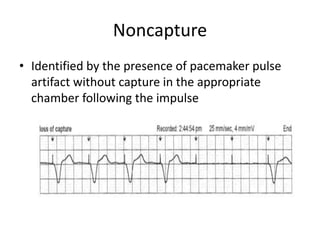
Noncapture
• Identified by the presence of pacemaker pulse
artifact without capture in the appropriate
chamber following the impulse
Causes of noncapture
• High capture threshold
• Inappropriate programming to a low output or pulse
width
• Lead dislodgment
• Lead fracture
• Lead insulation failure
• Loose lead connection to pacemaker
• Low battery output
• Severe metabolic imbalance
• Threshold rise due to drug effect
• “Pseudo-noncapture” (pacing during the myocardial
refractory period due to undersensing of the preceding
complex
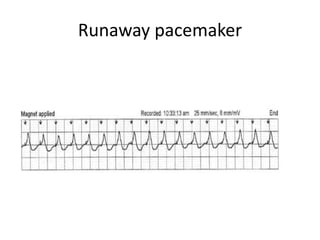
Runaway pacemaker
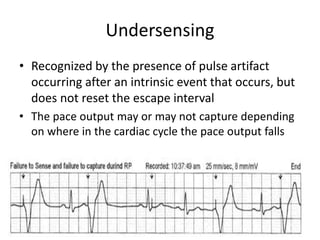
Undersensing
• Recognized by the presence of pulse artifact
occurring after an intrinsic event that occurs, but
does not reset the escape interval
• The pace output may or may not capture depending
on where in the cardiac cycle the pace output falls
Causes of undersensing
• Poor lead position with poor R-wave or P-wave amplitude
• Lead dislodgment
• Lead fracture
• Lead insulation failure
• Lead perforation of the myocardium
• Severe metabolic disturbance
• Defibrillation near pacemaker
• Myocardial infarction of tissue near electrode
• Ectopic beats of poor intracardiac amplitude
• Inappropriate programming
• Magnet application
Oversensing
• Inappropriate inhibition of the pacemaker
• May be seen as total inhibition of output, or as
prolongation of the escape interval
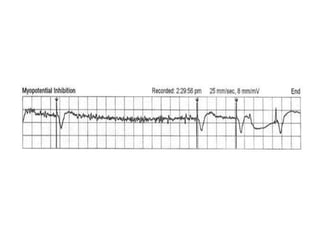
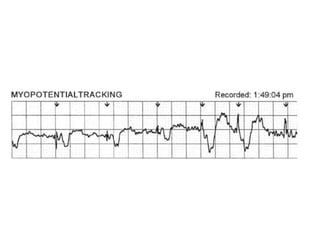
• Myopotentials are a common cause of oversensing
seen predominately in unipolar pacemakers, and is
usually caused by sensing noncardiac muscle activity
• Myopotentials are typically caused by arm
movements or lifting for prepectoral implants
Causes of oversensing
• Myopotentials
• Electromagnetic Interference
• T-wave sensing
• Far-field R-wave sensing (atrial lead)
• Lead insulation failure
• Lead dislodgement
• Lead fracture
• Loose fixation screw
• Crosstalk
Pacemaker Syndrome
• Can occur in patients with sinus rhythm who
receive VVI pacing systems
• In patients with dual chamber devices where the
atrial lead does not properly capture or sense
• The classic patient to develop pacemaker
syndrome is........one with retrograde AV node
conduction
• The atrium then contracts against the mitral and
tricuspid valves which are closed due to the
ventricular contraction
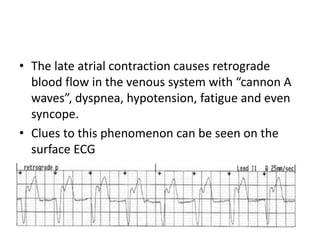
• The late atrial contraction causes retrograde
blood flow in the venous system with “cannon A
waves”, dyspnea, hypotension, fatigue and even
syncope.
• Clues to this phenomenon can be seen on the
surface ECG
Pacemaker Mediated Tachycardia
(PMT)
• Endless loop tachycardia or ELT
• An abnormal state caused by the presence of an
accessory pathway (the pacemaker)
• PMT often begins with a premature ventricular
beat that is either spontaneous or pacemaker
induced
• The electrical impulse travels retrograde up the
Bundle of His to the AV node and then to the
atrium
• If this retrograde P-wave occurs after PVARP has
ended, the pacemaker will sense it
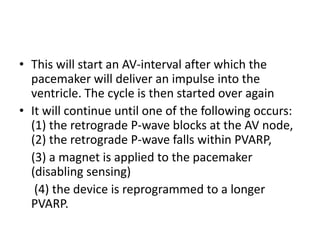
• This will start an AV-interval after which the
pacemaker will deliver an impulse into the
ventricle. The cycle is then started over again
• It will continue until one of the following occurs:
(1) the retrograde P-wave blocks at the AV node,
(2) the retrograde P-wave falls within PVARP,
(3) a magnet is applied to the pacemaker
(disabling sensing)
(4) the device is reprogrammed to a longer
PVARP.
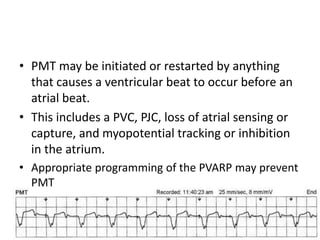
• PMT may be initiated or restarted by anything
that causes a ventricular beat to occur before an
atrial beat.
• This includes a PVC, PJC, loss of atrial sensing or
capture, and myopotential tracking or inhibition
in the atrium.
• Appropriate programming of the PVARP may prevent
PMT
• Some patients have markedly prolonged AV-nodal
conduction. The long PVARP that is necessary to
prevent PMT in these cases may severely limit the
maximum tracking rate of the device due to the
resulting long TARP
• One option automatically extends PVARP for one
cycle following a sensed R-wave that is not preceded
by a paced or sensed P-wave (presumably a PVC)
• This event prolongs the PVARP for only one cycle,
then reverts back to the shorter one
• Another variation of this method is to turn off
atrial sensing completely for the cycle following a
PVC
• This is known as “DVI on PVC” since there is no
atrial sensing at all for the one cycle
• The newest prevention algorithm will force an
atrial output on sensing of a PVC. By pacing the
atrium at this time, the anterograde and
retrograde beats collide in the AV node, thus
preventing the onset of PMT.
• Finally, most devices now provide an automatic
termination algorithm if PMT is suspected.
• When the pacemaker is at its upper rate (or a
separately programmable PMT detection rate) for
a specified number of beats, the device may
insert a single long PVARP, DVI cycle, or pace into
the atrium. This action will terminate the PMT if it
is present
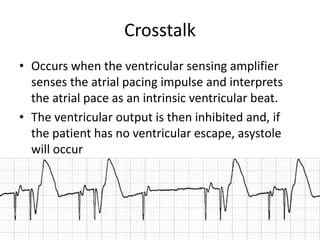
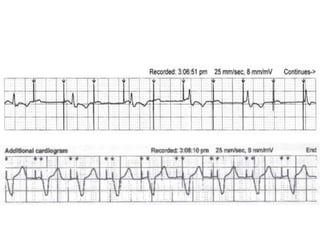
Crosstalk
• Occurs when the ventricular sensing amplifier
senses the atrial pacing impulse and interprets
the atrial pace as an intrinsic ventricular beat.
• The ventricular output is then inhibited and, if
the patient has no ventricular escape, asystole
will occur
• Crosstalk is most likely to occur when the atrial
output is set very high and the ventricular
channel is at a very sensitive setting
• The prevention of this problem is critical
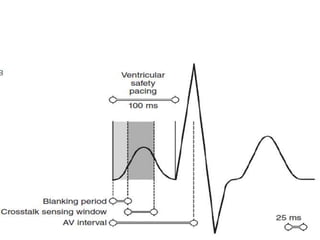
“Safety Pacing”
• Ventricular Safety Standby
• Non-Physiologic AV-Delay
• Allows a brief period of ventricular sensing during
the early post atrial output period
• This special sensing interval that follows the
blanking period is known as the “crosstalk sensing
window”, or CTW.
• An event falling into the CTW may be the result of
crosstalk, or of a true ventricular beat
• If an event is sensed on the ventricular lead
during the CTW, a ventricular pace is committed
at a short AV-delay (usually 100-120 msec)(“110
ms phenomenon”)
• Pacing in this manner provides ventricular rate
support should crosstalk actually be present
NASPE Guidelines for Pacemaker
Follow-Up
• Predischarge:
• Full clinic evaluation + PA & Lateral CXR
and 12- lead ECG,
• Provide TTM transmitter and training in its use.
• 1st Outpatient F/U (6-8 weeks post implant):
• Full clinic evaluation
• Programming outputs to appropriate chronic values
• Review patient education and retention of concepts
• TTM prior to this visit only as required for symptoms
• Early Surveillance Period (through 5th month):
• One clinic or one TTM contact
• Maintenance Period (beginning at 6 months):
• Full clinic evaluation yearly
• TTM with patient interview q 3 months, unless
clinic evaluation is performed near scheduled TTM.
• Intensified Period (when battery shows significant
wear):
• Full clinic evaluation yearly
• TTM with patient interview q 1 month, unless clinic
• evaluation is performed near a scheduled TTM.

Pacemakers

  • 1.
    Pacemakers: Some Basicand Some Not-So-Basic Concepts Muzaffar Ali, DM SKIMS SOURA
  • 2.
    Pacemaker Components • Battery •Primary power source • Mercury zinc batteries were used in early pacemakers • These batteries produced gasses over time that required venting. • This resulted in fluid leakage into the pacemaker at times that caused electrical shorting and premature device failure • Mercury zinc batteries have a fairly short useful life • Have an abrupt drop in voltage as they become depleted. • This makes predicting the pending failure of the batteries difficult. • No devices of this type are currently in use
  • 3.
    • Nuclear pacemakersuse a very small amount of radioactive element plutonium to generate heat • The heat is converted into electricity by a thermocouple • These devices had very long service lives (some were guaranteed for 72 years) • They were large • Created problems when travelling between states and countries due to the presence of their radioactive fuel • They must also be removed at the time of death and returned for proper disposal • Nuclear power sources became obsolete when the long- lived lithium batteries were developed
  • 5.
    • Rechargeable pacemakersuse a nickel-cadmium battery that must be charged each week. • The recharging is done using a method known as “inductive coupling”. • A coil is placed on the skin over the pacemaker that transfers energy to a coil within the device via electromagnetic waves. • The Pacemakers are large and became obsolete with newer technology
  • 6.
    • Lithium iodineis currently the predominant power source being used in pacemakers today • A long shelf life and high energy density • The self-discharge rate is very low resulting in a long shelf life • It has a stable voltage through much of the useful life, then tapers down in a gradual and predictable manner
  • 7.
    Circuitry • Highly complexand integrated microprocessor based systems • Large data storage capabilities • Includes total number of cardiac events, the rate of these events, whether these were paced or intrinsic, and high rate episodes • The newest devices have the ability to store intracardiac electrograms and function as event monitors with the ability to playback the paced or sensed events
  • 8.
    Connector Block • Alsoreferred to as the “header” • The means by which the pacemaker wire is connected to the pacemaker circuitry. • Many different sizes and styles of connector blocks. • Most pacemakers use setscrews
  • 10.
    • Some connectorsdo not use any setscrews • These have spring connectors for all of the electrical connections and a mechanism for gripping the lead body to hold it in place. • The advantage to this system is that it makes the electrical connection “automatic”, • Does not rely on the physician to make a secure connection with a screw
  • 11.
    Leads • More thansimple “wires”. • They are complex and highly engineered devices that consist of many components
  • 14.
    • Electrodes • Electricallyactive surfaces • Delivers an electrical stimulus, detects intrinsic cardiac electrical activity, or both
  • 15.
    • Material used: •elgiloy • polished platinum • microporous platinum (platinized or “black” platinum) • macroporous platinum (mesh) • iridium-oxide • platinum-iridium • titanium nitride
  • 16.
    • Modern electrodeselute an anti-inflammatory drug such as dexamethasone • Eluting such a drug at the electrode surface reduces the amount of acute inflammation and fibrosis at the electrode myocardial interface. • Greater charge density • Reduces current required to stimulate • Lower battery drain • Increased longevity
  • 17.
    • Anode/ring electrode •Larger than cathode • Positioned about 1cm or more back from the cathode • Changes in the spacing between these two electrodes affect the sensing function, with closer spacing minimizing oversensing of electrical signals from other sources
  • 18.
    • Insulation • Oneof the most important components • Prevents electrical shorting between the conductor coils within the lead, • Prevents stimulation of tissues other than the heart, • Allows smooth passage of the lead into the vein. • Failure of the insulation may result in a number of different problems, the most important of which is failure to pace.
  • 19.
    • Insulation types: •silicone / silastic • 55D polyurethane • 80A polyurethane • Other polyurethanes • Teflon “coated coil” technology
  • 20.
    • Metal ionoxidation (MIO) • Environmental stress cracking (ESC) • Coated coil insulation:insulating coat to each individual filament of the wire, that are then wound together in a design known as coradial construction. The whole wire is then covered with a standard insulator.
  • 21.
    • Conductor Coil:carries the electrical impulse from the pacemaker to the heart and the signal from the heart back to the pacemaker
  • 23.
    • Fixation: • “kerplunk”leads • tines • fins • fixed extended helix • retractable helix
  • 25.
    Connector • Portion ofthe lead that connects it to the pacemaker • Many types of connectors • All manufacturers have agreed upon the International Standard-1 (IS-1) • IS-1: 3.2 mm wide, sealing rings, short pin, uni/bipolar • An IS-1 lead from one manufacturer should be compatible with an IS-1 connector block of another manufacturer • IS-4
  • 28.
  • 29.
    • Simpler andmore reliable single coil lead construction. • Much easier to see the pace artifact • Bipolar electrograms represent the difference in potential recorded between two closely spaced intracardiac electrodes. • Due to the close spacing of two typically small electrodes, far-field signals (i.e.,signals not generated by the tissue the lead electrode is in contact with) are smaller and thus more easily rejected
  • 30.
    • More resistantto electrical interference caused by skeletal muscle activity or electromagnetic interference (EMI) relative to unipolar systems • At higher output settings one may have stimulation of the pocket around the pacemaker in a unipolar system • Pacing artifact: makes determination of function and malfunction more difficult, not uncommon to see a pacemaker programmed to pace in the unipolar polarity and to sense in the bipolar polarity.
  • 31.
    Pacing threshold • Minimumamount of energy required to consistently cause depolarization • Measured in terms of both amplitude (the strength of the impulse) and the duration of time for which it is applied to the myocardium (pulse width), measured in msec • Method of measuring threhold • Wedensky effect • Standard method for threshold testing
  • 33.
    Sensing: ability ofthe device to detect an intrinsic beat of the heart (mV) Higher values are less senstive
  • 34.
    • The pacinglead does not see a QRS or P-wave as we see it on the surface ECG • It sees an intracardiac electrogram that is more like a “spike”
  • 37.
    Slew rate • Pacemakerdoes not use the entire signal that is present • The “raw” electrical signal is filtered to eliminate a majority of noncardiac signals as well as parts of the cardiac signal that are not needed • Slew rate: quality of the sensed signal • Slope of the intrinsic signal and is measured in volts/sec
  • 39.
  • 40.
    The Rule of60,000 • 60,000 Rule: 60,000 msec in a minute • 60,000/Heart rate = Interval in milliseconds • 60,000/Interval in milliseconds = Heart rate • Examples: • Heart rate = 70 bpm • 60,000/70 = 857 msec cycle length • Cycle length = 857 msec • 60,000/857 = 70 bpm
  • 41.
  • 42.
  • 43.
  • 44.
    • The reasonfor having a refractory period in a ventricular pacemaker is to prevent sensing of the evoked QRS and T-wave that occurs immediately after the paced event • In atrial pacemakers the refractory period also prevents sensing of the far-field R-wave or T- wave • Blanking period
  • 45.
  • 46.
    • Useful inpatients with ventricular pacemakers and sinus rhythm that have infrequent pacing needs, thus minimizing the loss of atrio- ventricular synchrony.
  • 47.
  • 50.
    Pseudo-fusion: Pace OPdoesn’t affect dep or rep Pseudopseudo fusion beat
  • 51.
    Latency • Pacemaker outputspike occurs and captures, however there is a period (latent period) of isoelectric baseline prior to the QRS or P wave following the spike. • Usually associated with metabolic derangements
  • 53.
    AVI:The period oftime in milliseconds between a paced or sensed atrial event until the paced ventricular event.
  • 54.
  • 55.
  • 56.
    Atrial Escape Interval(AEI) • Maximum period of time that can elapse between the last sensed or paced ventricular event and the next atrial event • If no intrinsic atrial beat occurs by the end of the AEI, an atrial pace output will be delivered • AEI = Base pacing rate minus AVI
  • 58.
    Post Ventricular AtrialRefractory Period (PVARP) • Atrial refractory period that begins with each paced or sensed ventricular event • It turns off the atrial amplifier to prevent the atrial lead from sensing the ventricular depolarization (QRS and T-wave) • Prevents sensing of retrograde P-waves should a PVC occur
  • 60.
    Total Atrial RefractoryPeriod (TARP) • AVI + PVARP = TARP • No atrial sensing for the purpose of tracking occurs during the AVI and during the PVARP • Atrial event occurring during TARP will not start an AVI • The TARP limits the upper rate limit of the pacemaker
  • 61.
    Upper Rate Limit(URL) • Maximum tracking rate (MTR) or the • Maximum tracking interval (MTI) • Programmable feature • The maximum rate at which the pacemaker will allow the ventricle to pace • Depends on TARP • URL = 60,000/TARP • The URL may be separately programmable for tracking P-waves and for the upper sensor driven rate
  • 62.
    Ventricular Blanking Period •Follows immediately after an atrial pacing pulse is delivered. • Prevents the ventricular sensing channel from sensing the large atrial pulse • Should ventricular sensing of the atrial output occur, the ventricular output pulse will be inhibited and the patient will not have a ventricular beat: “crosstalk” • The blanking period is usually set in the range of 12-50 msec • Long blanking periods are very effective against crosstalk but limit the ability of the pacemaker to sense normal or premature ventricular beats.
  • 63.
    Upper rate behavior •Seen any time a mode is used that allows the ventricle to be paced as the result of an atrial sensed event ie intrinsic to DDD & VDD • Occurs when the patient’s atrial rate is faster than the URL and/or exceeds the atrial sensing limits imposed by the programmed TARP. • When the patient’s atrial rate reaches the limits imposed by the pacemaker in a patient with high degree AV block, one of two types of responses can be seen
  • 64.
    Block • Same wayas second degree (Mobitz-II) AV block. • 2:1 pacemaker block will occur when the maximum tracking rate is set to the limits imposed by the TARP (PVARP + AVI) • With TARP= 500 msec(120bp,) and URL=120/min. If atrial rate is >120, everyother P wave will fall into PVARP and will not be sensed resulting in 2:1 block and symptoms
  • 65.
    TARP is 600ms ie URL 100 bpm. Once the atrial rate exceeds 100 bpm, P-waves begin to fall into the PVARP and are not sensed creating a 2:1 block
  • 66.
    Pseudo-Wenckebach • Appears likeclassic Mobitz-I • Occurs when the URL is programmed to a rate lower than the limits imposed by the TARP • TARP=400 msec limiting the upper tracking rate to 150 bpm. Programming a URL to 100 bpm would result in Wenckebach behavior for atrial rates that exceed the URL of 100 bpm but are below the 2:1 block rate of 150 bpm • Wenckebach interval
  • 67.
    • The pacemakerdelays the ventricular output to prevent pacing the ventricle faster than allowed by the programmed URL. • Because of the delayed ventricular pacing, the next P wave falls even earlier into the next cardiac cycle and the AVI extension is even greater • Because the ventricular output is delayed, the AVI appears prolonged giving a Wenckebach appearance • Each successive AVI will lengthen until a P-wave falls into the atrial refractory period and is therefore not sensed. This P-wave will not start an AVI, and thus the next QRS is “dropped”.
  • 69.
    • It ispreferable to program a device so that Wenckebach behavior will occur prior to the 2:1 block behavior. • This allows the patient some warning before the heart rate will drop abruptly
  • 70.
    • Methods havebeen developed to minimize the effect of abrupt onset 2:1 blocking • Rate Smoothing: limits changes in R to R intervals to a percentage of the previous interval. For example, by setting this parameter to a value of 6%, one cardiac cycle will not be allowed to differ from the previous one by more or less than 6%. Also be useful to reduce the pauses seen in patients with frequent PVCs and to reduce the risk of tracking retrograde atrial beats.
  • 71.
    • Fallback Response:allows the pacemaker rate to gradually decrease after the upper rate is reached. It is usually programmable as to the lower rate to which it will fall and the period of time it will take to get to the fallback rate
  • 72.
    • Sensor DrivenRate Smoothing: The pacing rate will drop to the rate indicated by the activity sensor at that point in time. • A patient has a DDDR pacemaker programmed to an upper rate and 2:1 block rate of 120 bpm. If the patient is running and the sensor rate indicates a pacing rate of 115 bpm while the atrial rate is 125 bpm, the device will act as if the lower rate limit is 115. The pacing rate will vary between the URL of 120 and the sensor indicated rate of 115 until the native atrial rate falls below the URL
  • 73.
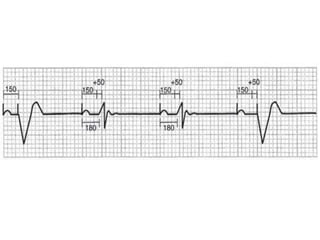
    Positive AV IntervalHysteresis • Autointrinsic Conduction Search • AV Search • Functional mode switching • Narrow nonpaced QRS achieves a greater stroke volume than a paced left bundle branch block (LBBB) pattern QRS • Adds an additional interval onto the programmed AVI for one cycle. If a sensed QRS occurs during this prolonged AV interval, the device maintains the longer interval. If the device does not sense a QRS during the longer interval, pacing continues at the normal programmed AVI
  • 75.
  • 76.
    Rate Drop Response •The pacemaker is set with a lower pacing rate and a therapeutic pacing rate • Also set with a heart rate zone and a rate of change within that zone • Patients who have autonomic dysfunction with a cardioinhibitory response alone, or combined with a vasodepressor response
  • 78.
    Sleep Mode /Circadian Response • Not physiologic to maintain usual rates when sleeping • Rationale behind features designed to slow the rate during periods of inactivity or sleep • A common method of accomplishing this goal is the use of a clock within the pacemaker. • One can set the current time, the patient’s normal waking time and normal bedtime and a separate sleep rate is then programmed. • If the patient gets up and becomes active during the designated sleep time, the activity sensor notes the patient movement and overrides the sleep rate
  • 79.
    • A patient’ssleep time may vary day to day • Patients may nap at odd hours during the day • Patients and their pacemakers cross time zones but the internal pacemaker clock has no way of knowing this. • Another feature uses the variability of patient activity as determined by the activity sensor. The pacemaker notes inactivity of the patient after a period of time. It will then allow the rate to drop to the sleep rate. As the patient becomes active again, the pacemaker resumes the regular lower rate limit. This algorithm has the advantage of being patient based rather than clock based.
  • 80.
    Automatic Mode Switching •Limitation imposed when utilizing the DDD or VDD based modes in patients with intermittent atrial tachyarrhythmias • Use of the DDI or DVI modes can prevent this, patients with AV block cannot track the atrium when the patient is in sinus rhythm. • Allows the pacemaker to actually change it’s mode from tracking to nontracking mode • from DDD, DDDR, VDD or VDDR to either DDI, DDIR, VVI, VVIR
  • 81.
    • DDDR devicescan utilize the sensor to evaluate whether the atrial rhythm is appropriate (such as sinus tachycardia due to exercise) or inappropriate (such as atrial fibrillation) for a given level of activity. • If a rapid atrial rate is seen at a time when the sensor indicates that the patient is at rest, the atrial rhythm is classified as pathologic. • The pacemaker then converts to VVIR until the atrial rate drops into the “physiologic range” again at which time DDDR function is restored
  • 82.
    • The mostcommon approach to mode switching does not require a sensor. • A separately programmable “atrial tachycardia detection rate” (or “mode switch rate”) is selected • If the atrial rate exceeds the mode switch detection rate for a given period of time or a specific number of beats, the device will switch to a nontracking mode. • It will switch back when the atrial rate drops back into the normal range
  • 83.
    Atrial Fibrillation Suppression Algorithms •PACs with the resulting sinus pause may allow the atrium to become unstable and thereby predispose to the development of PAF • These algorithms primarily attempt to suppress the PACs by overdrive pacing them, attempting to pace the atrium 100% of the time. • Rate smoothing
  • 84.
    Automatic Polarity Change •What happens when a lead breaks or the insulation fails • If an inner conductor coil (cathode) fracture occurs in a bipolar lead, the lead must be replaced • If the outer coil (anode) fractures on this type of lead, a pacemaker with programmable polarity may be reprogrammed to the unipolar configuration thus bypassing the failed coil
  • 85.
    • By changingpolarity, the pacemaker can become the anode and there is no need for the outer coil of the lead. • The same can be done if the lead impedance falls to a low level on a bipolar lead indicating a failure of the insulation between the two conductors • Changing to unipolar polarity prevents a “dead short” between the two coils
  • 86.
    Noncapture • Identified bythe presence of pacemaker pulse artifact without capture in the appropriate chamber following the impulse
  • 87.
    Causes of noncapture •High capture threshold • Inappropriate programming to a low output or pulse width • Lead dislodgment • Lead fracture • Lead insulation failure • Loose lead connection to pacemaker • Low battery output • Severe metabolic imbalance • Threshold rise due to drug effect • “Pseudo-noncapture” (pacing during the myocardial refractory period due to undersensing of the preceding complex
  • 88.
  • 89.
    Undersensing • Recognized bythe presence of pulse artifact occurring after an intrinsic event that occurs, but does not reset the escape interval • The pace output may or may not capture depending on where in the cardiac cycle the pace output falls
  • 90.
    Causes of undersensing •Poor lead position with poor R-wave or P-wave amplitude • Lead dislodgment • Lead fracture • Lead insulation failure • Lead perforation of the myocardium • Severe metabolic disturbance • Defibrillation near pacemaker • Myocardial infarction of tissue near electrode • Ectopic beats of poor intracardiac amplitude • Inappropriate programming • Magnet application
  • 91.
    Oversensing • Inappropriate inhibitionof the pacemaker • May be seen as total inhibition of output, or as prolongation of the escape interval • Myopotentials are a common cause of oversensing seen predominately in unipolar pacemakers, and is usually caused by sensing noncardiac muscle activity • Myopotentials are typically caused by arm movements or lifting for prepectoral implants
  • 94.
    Causes of oversensing •Myopotentials • Electromagnetic Interference • T-wave sensing • Far-field R-wave sensing (atrial lead) • Lead insulation failure • Lead dislodgement • Lead fracture • Loose fixation screw • Crosstalk
  • 95.
    Pacemaker Syndrome • Canoccur in patients with sinus rhythm who receive VVI pacing systems • In patients with dual chamber devices where the atrial lead does not properly capture or sense • The classic patient to develop pacemaker syndrome is........one with retrograde AV node conduction • The atrium then contracts against the mitral and tricuspid valves which are closed due to the ventricular contraction
  • 96.
    • The lateatrial contraction causes retrograde blood flow in the venous system with “cannon A waves”, dyspnea, hypotension, fatigue and even syncope. • Clues to this phenomenon can be seen on the surface ECG
  • 97.
    Pacemaker Mediated Tachycardia (PMT) •Endless loop tachycardia or ELT • An abnormal state caused by the presence of an accessory pathway (the pacemaker) • PMT often begins with a premature ventricular beat that is either spontaneous or pacemaker induced • The electrical impulse travels retrograde up the Bundle of His to the AV node and then to the atrium • If this retrograde P-wave occurs after PVARP has ended, the pacemaker will sense it
  • 98.
    • This willstart an AV-interval after which the pacemaker will deliver an impulse into the ventricle. The cycle is then started over again • It will continue until one of the following occurs: (1) the retrograde P-wave blocks at the AV node, (2) the retrograde P-wave falls within PVARP, (3) a magnet is applied to the pacemaker (disabling sensing) (4) the device is reprogrammed to a longer PVARP.
  • 99.
    • PMT maybe initiated or restarted by anything that causes a ventricular beat to occur before an atrial beat. • This includes a PVC, PJC, loss of atrial sensing or capture, and myopotential tracking or inhibition in the atrium. • Appropriate programming of the PVARP may prevent PMT
  • 100.
    • Some patientshave markedly prolonged AV-nodal conduction. The long PVARP that is necessary to prevent PMT in these cases may severely limit the maximum tracking rate of the device due to the resulting long TARP • One option automatically extends PVARP for one cycle following a sensed R-wave that is not preceded by a paced or sensed P-wave (presumably a PVC) • This event prolongs the PVARP for only one cycle, then reverts back to the shorter one
  • 101.
    • Another variationof this method is to turn off atrial sensing completely for the cycle following a PVC • This is known as “DVI on PVC” since there is no atrial sensing at all for the one cycle • The newest prevention algorithm will force an atrial output on sensing of a PVC. By pacing the atrium at this time, the anterograde and retrograde beats collide in the AV node, thus preventing the onset of PMT.
  • 102.
    • Finally, mostdevices now provide an automatic termination algorithm if PMT is suspected. • When the pacemaker is at its upper rate (or a separately programmable PMT detection rate) for a specified number of beats, the device may insert a single long PVARP, DVI cycle, or pace into the atrium. This action will terminate the PMT if it is present
  • 103.
    Crosstalk • Occurs whenthe ventricular sensing amplifier senses the atrial pacing impulse and interprets the atrial pace as an intrinsic ventricular beat. • The ventricular output is then inhibited and, if the patient has no ventricular escape, asystole will occur
  • 104.
    • Crosstalk ismost likely to occur when the atrial output is set very high and the ventricular channel is at a very sensitive setting • The prevention of this problem is critical
  • 105.
    “Safety Pacing” • VentricularSafety Standby • Non-Physiologic AV-Delay • Allows a brief period of ventricular sensing during the early post atrial output period • This special sensing interval that follows the blanking period is known as the “crosstalk sensing window”, or CTW.
  • 106.
    • An eventfalling into the CTW may be the result of crosstalk, or of a true ventricular beat • If an event is sensed on the ventricular lead during the CTW, a ventricular pace is committed at a short AV-delay (usually 100-120 msec)(“110 ms phenomenon”) • Pacing in this manner provides ventricular rate support should crosstalk actually be present
  • 109.
    NASPE Guidelines forPacemaker Follow-Up • Predischarge: • Full clinic evaluation + PA & Lateral CXR and 12- lead ECG, • Provide TTM transmitter and training in its use. • 1st Outpatient F/U (6-8 weeks post implant): • Full clinic evaluation • Programming outputs to appropriate chronic values • Review patient education and retention of concepts • TTM prior to this visit only as required for symptoms • Early Surveillance Period (through 5th month): • One clinic or one TTM contact
  • 110.
    • Maintenance Period(beginning at 6 months): • Full clinic evaluation yearly • TTM with patient interview q 3 months, unless clinic evaluation is performed near scheduled TTM. • Intensified Period (when battery shows significant wear): • Full clinic evaluation yearly • TTM with patient interview q 1 month, unless clinic • evaluation is performed near a scheduled TTM.

Editor's Notes

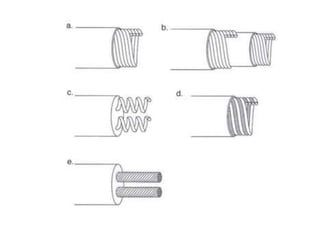
  • #14 The five basic types of leads. a) Unipolar design with a single coil covered by an insulator. b) Coaxial bipolar design uses two concentric coils separated by a layer of insulation. c) Parallel bipolar design is similar to an electrical cord with the two conductors side by side. d) Coated coil bipolar design insulates each individual filament so they may be wound together giving the look and feel of a unipolar lead. e) Cable design has no lumen for stylet. It must be positioned through a special sheath delivery system, however it can be made much thinner than other leads.
  • #21 MIO is a reaction catalyzed by the metals of the conductor coil. It results in a breakdown of the polyurethane between the conductors such that it will fail to be capable of insulating. This was found to be most prevalent in leads that utilized silver in the conductor coil. ESC may be severe and result in cracks in the insulation resulting in electrical shorting
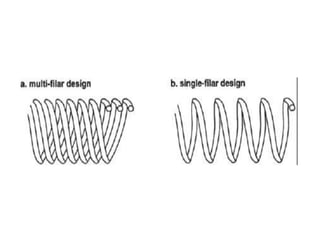
  • #23 a) Multi-filar design is made up of several thin filiments of wire twisted together providing both strength and flexibility. b) Single-filar design is similar to a coat hanger. It can be fractured easily by repeated bending and flexing
  • #24 “kerplunk” leads since they were heavy and stiff thus dropping into position.
  • #25 Fixation types. A)Plain leads had no fixation device and were held in place by their weight and stiffness. b) Tines were added to act as a “grappling hook” to reduce dislodgment. c) Fins are a variation on tines. These may be less likely to become entangled in the valve. d) Fixed helix active fixation leads screw into the myocardium by rotating the entire lead. The helix is always out. Some manufacturers coat the helix with an inert and rapidly dissolving substance (such as a sugar) to protect the helix during insertion. e) Extendable helix leads have a mechanism to extend and retract the screw. f) Preformed “J” lead for simplified atrial placement.
  • #31 Because the distance between the electrodes is small (short antenna) and since both of the electrodes are located deep within the body, these devices are much more resistant to electrical interference caused by skeletal muscle activity or electromagnetic interference (EMI) relative to unipolar systems.... This makes determination of function and malfunction more difficult. For this reason it is not uncommon to see a pacemaker programmed to pace in the unipolar polarity and to sense in the bipolar polarity.
  • #32 some devices still use milliamps (mA) as the adjustable parameter
  • #36 Comparison of surface cardiogram and intracardiac electrogram recordings.Tracing A shows sinus rhythm with the normal QRS on top and the intracardiac ventricular electrogram on the bottom.
  • #40 2.21. Capture threshold versus time plot. Curve A is typical of older leads showing a threshold rise and fall during the four to six week period after implant. Curve B is typical of a modern technology lead, such as one with steroid elution. Little or no threshold rise is present due to the anti-inflammatory action of the steroid.
  • #42 This is the period of time between two uninterrupted paced events. In this example, the automatic interval is 1000 msec (or 60 beats per minute).
  • #43 The period of time after a sensed event until the next paced event. The escape interval is usually the same as the automatic interval. It may be different if a feature called “hysteresis” is enabled
  • #44 Refractory period. The pacemaker will not respond to an intrinsic beat that occurs during the pacemaker refractory period. In this example the pacemaker is set to VVI at 55 bpm. The refractory period has been programmed to 475 msec. QRS #3 and #7 are PVCs that fall within the refractory period of the preceding paced beats. Since the pacemaker sensing is refractory during the PVC, the PVC is not sensed. This is a programming problem, not a malfunction of the pacemaker.
  • #46 This is the one time when the escape interval is longer than the automatic interval. In this example the automatic rate is set to 70 bpm and the hysteresis rate is set to 50 bpm. The device paces at 70 bpm until inhibited by a sensed beat (5th beat on the top strip). It does not begin to pace again until the patient’s intrinsic rate falls to 50 bpm (3rd beat on the bottom strip). The pacemaker then paces at 70 bpm until another intrinsic beat is sensed (last beat on the bottom strip), at which time the hysteresis rate of 50 bpm is restored.
  • #48 These three strips wre recorded from the same patient. The top strip shows the intrinsic QRS without any pacing. The second strip shows a strip with a paced QRS. The bottom strip shows a fused QRS that is intermediate between the paced and nonpaced complexes.
  • #51 Pseudo-fusion. The arrows show 2 paced outputs that occurred after the intrinsic complex is formed. The pace output does not affect the depolarization or repolarization of the heart (if it does then it is a fusion beat or a paced beat). This is often seen in normally functioning pacemakers, though in some situations it may also represent a malfunction sensing of an intrinsic beat may not occur until late in the complex. Thus, even though the intrinsic QRS has started, the pacemaker may deliver an output as programmed since the intrinsic depolarization did not reach the electrode by the time the paced output is due to occur. Pseudopseudo fusion: when an atrial stimulus deforms qrs clx
  • #53 This strip is recorded from a patient being paced in the atrium. Note the pause between the pace artifact (arrows) and the evoked P-wave. This patient had a significant metabolic abnormality at the time this tracing was recorded. Antiarrythmics Severe acidosis hyperkalemia
  • #54 Under most circumstances an intrinsic QRS sensed before the end of the AVI will inhibit the ventricular output and the timing cycle will be reset for the next atrial output
  • #56 Most newer dualchamber pacemakers now offer a feature known as adaptive AVI.As the name suggests, the AVI adapts based on the heart rate. Faster heart ratescause a shortening of the AVI.This results in two benefits. The first is more optimal hemodynamics for the patient by preserving the natural change in timing between atria and ventricles. The second in view of total atrial refractory period (TARP) and it’s effect on the upper rate that the pacemaker can achieve. A shorter AVI will allow the pacemaker to operate normally at higher rates by allowing atrial sensing to occur at higher rates.
  • #69 Max rate: 150 bpm URL set at 100 bp,
  • #75 Positive AV interval hysteresis (autointrinsic conduction search). This feature is designed to allow intrinsic AV node conduction to occur whenever possible. During AV pacing, after 256 ventricular paced events, the pacemaker will insert an extra period during the AV interval to search for intrinsic conduction. In this example the base AV interval is programmed in 150 ms, and the positive AV hysteresis is programmed to 50 ms. The second AV interval is a “search interval”, and the QRS is conducted via the AV node. The pacemaker output to the ventricle is withheld due to the extra 50 ms added to the AV interval and the intrinsic conduction. On the last beat, the AV node fails to conduct and the pacemaker paces at the end of the extended interval. Following this beat the original AV interval will be restored until the search occurs again 256 beats later. If during the “search” no intrinsic conduction is seen, the base AV interval is restored for the next 255 beats.
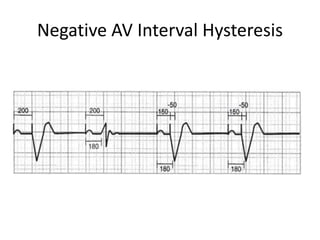
  • #76 Negative AV interval hysteresis attempts to maintain constant pacing of the ventricle. Any time a QRS is sensed after a P-wave, the AVI is shortened by a programmed amount which, in this example, is 50 ms. This feature is useful in patients with obstructive hypertrophic cardiomyopathy.
  • #78 Rate drop response is a feature that triggers a higher “therapeutic” pacing rate if the patient’s own rate drops abruptly. Curve A shows a gradual slowing of the heart rate through the shaded detection zone. This would be typical of a person going to sleep. No therapeutic pacing would be delivered in this situation. Curve B shows an abrupt decreasing heart rate such as might be seen with carotid sinus hypersensitivity or a “vasovagal”episode. When the detection zone is crossed rapidly like this, the pacemaker responds with pacing at a higher rate for a period of time, then falls back to its “ready rate
  • #89 This strip shows VVI pacing at 180 bpm (the runaway protect limit on this device). The pacemaker was programmed to the DDD mode with an upper rate limit of 120 bpm. Therapeutic radiation delivered to the pacemaker in a patient with breast cancer resulted in circuit failure and rapid pacing. Even magnet application did not slow the pacing rate. The device was replaced emergently.
  • #93 Myopotential inhibition. As the patient begins to use the arm on the same side of the pacemaker, the electrical signals of the pectoralis are sensed and mistaken to be QRS signals. The device is inhibited until the patient relaxes. Note the muscle artifact on the baseline of this rhythm strip.
  • #94 Myopotential tracking. This pacemaker is tracking the patient’s sinus rhythm. As the patient begins to use the arm on the same side of the pacemaker, the atrial channel of the pacemaker senses the electrical impulses generated by the pectoralis muscle. The pacemaker “tracks” the myopotentials instead of the P-waves resulting in loss of AV synchrony and rapid ventricular pacing. If the myopotentials inhibit the ventricular channel, asystole may result.
  • #100 The electrical impulse is conducted in a retrograde manner through the AV node (B) causing the atrium to contract. The retrograde P wave is sensed by the pacemaker which then starts an AV interval. At the end of the AV interval a pace stimulus is delivered to the ventricle (C) and the cycle continues.
  • #108 If the ventricular sensing circuit senses activity during the crosstalk sensing window, a ventricular pacing artifact is delivered early, usually at 100–110 ms after the atrial event. This is to ensure that ventricular depolarization is not inhibited by cross-talk