PACEMAKER
NECDET
GÜVEN
ALİ ÖZCAN
ÜNAL
MAHMUT
KAMALAK
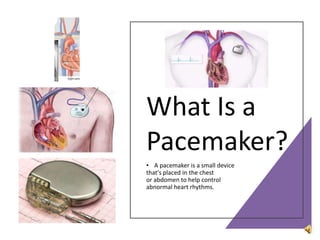
What Is a
Pacemaker?
• A pacemaker is a small device
that's placed in the chest
or abdomen to help control
abnormal heart rhythms.
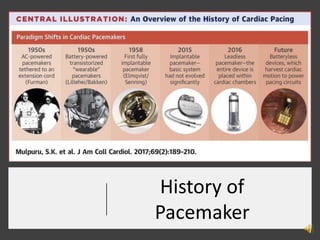
History of
Pacemaker
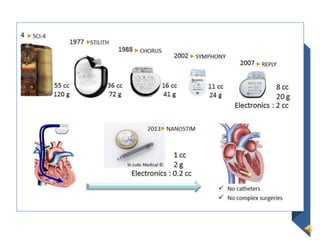
History of Pacemaker
When are Pacemaker used?
• Doctors recommend pacemakers
for many reasons. The most common
reasons:
 Bradycardia
 Heart block
 Heart medicines such as beta
blockers
 Faint or have other symptoms of a
slow heartbeat
 Heart muscle problems
 Long QT syndrome
 Arrhytmia(Atrial fibrillation)
Type of Pacemaker
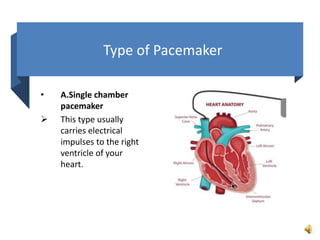
• A.Single chamber
pacemaker
 This type usually
carries electrical
impulses to the right
ventricle of your
heart.
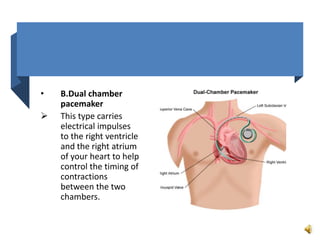
• B.Dual chamber
pacemaker
 This type carries
electrical impulses
to the right ventricle
and the right atrium
of your heart to help
control the timing of
contractions
between the two
chambers.
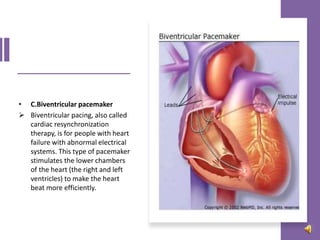
• C.Biventricular pacemaker
 Biventricular pacing, also called
cardiac resynchronization
therapy, is for people with heart
failure with abnormal electrical
systems. This type of pacemaker
stimulates the lower chambers
of the heart (the right and left
ventricles) to make the heart
beat more efficiently.
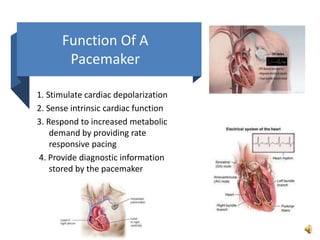
Function Of A
Pacemaker
1. Stimulate cardiac depolarization
2. Sense intrinsic cardiac function
3. Respond to increased metabolic
demand by providing rate
responsive pacing
4. Provide diagnostic information
stored by the pacemaker
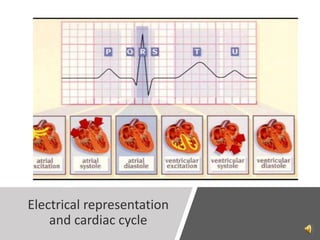
Electrical representation
and cardiac cycle
Parts of Pacemaker
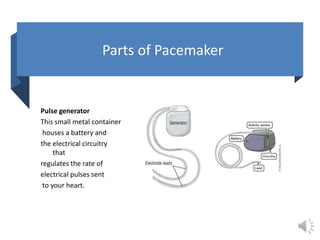
Pulse generator
This small metal container
houses a battery and
the electrical circuitry
that
regulates the rate of
electrical pulses sent
to your heart.
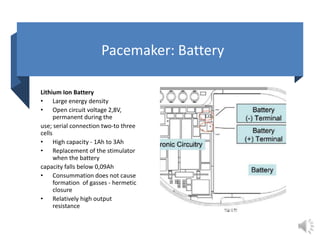
Pacemaker: Battery
Lithium Ion Battery
• Large energy density
• Open circuit voltage 2,8V,
permanent during the
use; serial connection two-to three
cells
• High capacity - 1Ah to 3Ah
• Replacement of the stimulator
when the battery
capacity falls below 0,09Ah
• Consummation does not cause
formation of gasses - hermetic
closure
• Relatively high output
resistance
Pacemaker:
Battery
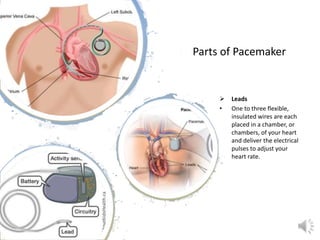
Parts of Pacemaker
 Leads
• One to three flexible,
insulated wires are each
placed in a chamber, or
chambers, of your heart
and deliver the electrical
pulses to adjust your
heart rate.
Pacemaker:
Leads
Important characteristics of the leads
• –Good conductor
• –Mechanically strong and reliable
• •Must withstand effects of motion due to
beating of heart and movement of body
• –Good electrical insulation
Current designs
• –Interwound helical coil of spring-wire alloy
molded in a silicone-rubber or polyurethane
cylinder
• –Coil minimizes mechanical stresses
• –Multiple strands prevent loss of
stimulation in event of failure of one wire
• –Soft coating provides flexibility, electrical
insulation and biological compatibility
Pacemaker:
Electrodes
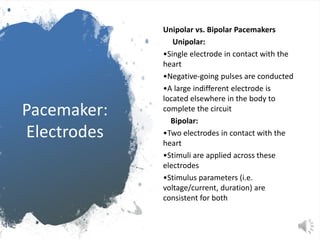
Unipolar vs. Bipolar Pacemakers
Unipolar:
•Single electrode in contact with the
heart
•Negative-going pulses are conducted
•A large indifferent electrode is
located elsewhere in the body to
complete the circuit
Bipolar:
•Two electrodes in contact with the
heart
•Stimuli are applied across these
electrodes
•Stimulus parameters (i.e.
voltage/current, duration) are
consistent for both
Pacemaker: Electrodes
Important characteristics of electrodes
–Mechanically durable
–Material cannot:
•Dissolve in tissue
•Irritate the tissue
•Undergo electrolytic reaction due to stimulation
•React biologically
–Good Interface with leads
Current designs
–Platinum, platinum alloys, and other specialized alloys are used
Pacemaker: Electrodes
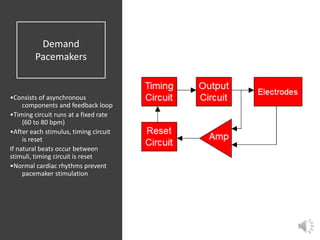
Demand
Pacemakers
•Consists of asynchronous
components and feedback loop
•Timing circuit runs at a fixed rate
(60 to 80 bpm)
•After each stimulus, timing circuit
is reset
If natural beats occur between
stimuli, timing circuit is reset
•Normal cardiac rhythms prevent
pacemaker stimulation
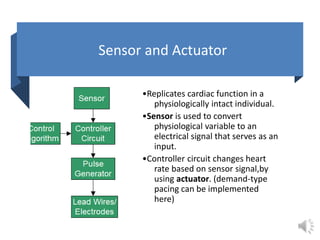
Sensor and Actuator
•Replicates cardiac function in a
physiologically intact individual.
•Sensor is used to convert
physiological variable to an
electrical signal that serves as an
input.
•Controller circuit changes heart
rate based on sensor signal,by
using actuator. (demand-type
pacing can be implemented
here)
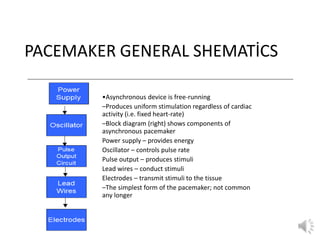
PACEMAKER GENERAL SHEMATİCS
•Asynchronous device is free-running
–Produces uniform stimulation regardless of cardiac
activity (i.e. fixed heart-rate)
–Block diagram (right) shows components of
asynchronous pacemaker
Power supply – provides energy
Oscillator – controls pulse rate
Pulse output – produces stimuli
Lead wires – conduct stimuli
Electrodes – transmit stimuli to the tissue
–The simplest form of the pacemaker; not common
any longer
Components Inside a General Artificial
Pacemaker
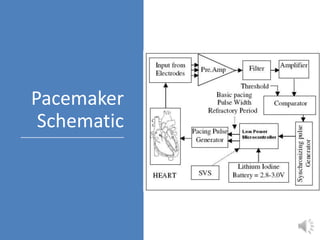
Pacemaker
Schematic
Cardiac
Pacemaker
Design
These generally have two functional units:
the ”sensing circuit”, which monitors the
heart’s natural electrical activity, and
the ”pacing circuit”, which emits
an electrical signal to the heart muscles
Procedure During the Pacemaker
Implanted
•A small incision, approximately 5
cm long is made in the upper
chest.
•A lead (thin insulated wire, like
spaghetti noodle) is guided
through the vein into the heart.
•Your doctor connects the lead to
the pacemaker and programs the
device.
•The pacemaker is then inserted
beneath the skin.
•Your doctor tests the pacemaker
to ensure it is working properly.
•The incision is then closed.
Procedure During the Pacemaker
Implanted
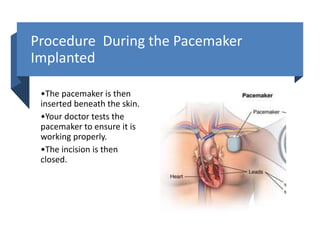
•The pacemaker is then
inserted beneath the skin.​
•Your doctor tests the
pacemaker to ensure it is
working properly.​
•The incision is then
closed.​
Benefits and Risks of the Pacemaker
•Overview
•An implantable pacemaker
relieves symptoms of a slow,
irregular heart rhythm. It
does this by restoring
normal heart rates. A normal
heart rate provides your
body with the proper
amount of blood circulation.
Benefits
• •By regulating the heart’s rhythm, a pacemaker can often
eliminate the symptoms of bradycardia. This means
individuals often have more energy and less shortness of
breath. However, a pacemaker is not a cure. It will not prevent
or stop heart disease, nor will it prevent heart attacks.
Risks
•Risks associated with pacemaker system implant include, but are not limited to,
infection at the surgical site and/or sensitivity to the device material, failure to
deliver therapy when it is needed, or receiving extra therapy when it is not
needed.
•After receiving an implantable pacemaker system, you will have limitations with
respect to magnetic and electromagnetic fields, electric or gas-powered
appliances, and tools with which you are allowed to be in contact.
New Pacemaker Technologies
• The Micra leadless pacemaker,
which is placed directly into
the heart, is the newest and
smallest of Medtronic’s
pacemakers. It was approved
in the US last year.
• Much smaller than a
conventional pacemakers, the
Micra is about the size of a
large vitamin capsule. It is
fitted via a vein in the leg and
is completely self-contained in
the heart.
First apps to let heart
patients monitor their
pacemakers
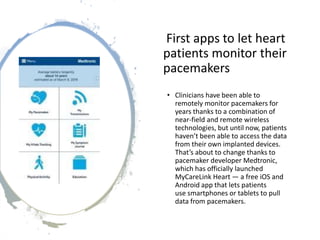
• Clinicians have been able to
remotely monitor pacemakers for
years thanks to a combination of
near-field and remote wireless
technologies, but until now, patients
haven’t been able to access the data
from their own implanted devices.
That’s about to change thanks to
pacemaker developer Medtronic,
which has officially launched
MyCareLink Heart — a free iOS and
Android app that lets patients
use smartphones or tablets to pull
data from pacemakers.
REFERENCES
• https://www.nhlbi.nih.gov/health-
topics/pacemakers
• https://www.mayoclinic.org/tests-
procedures/pacemaker/about/pac-
20384689
• https://www.ncbi.nlm.nih.gov/pmc/articl
es/PMC3232561/
• https://stanfordhealthcare.org/medical-
treatments/p/pacemaker/types.html
• https://www.slideshare.net/raghukishore
galla/components-of-pacemaker-and-
icds-understanding-the-hardware
• Bifulco, Paolo, et al. "A simple, wide
bandwidth, biopotential amplifier to
record pacemaker pulse
waveform." Medical devices (Auckland,
NZ) 9 (2016): 325.
• https://www.mayoclinic.org/tests-
procedures/pacemaker/about/pac-
20384689

Pacemaker

  • 1.
  • 2.
    What Is a Pacemaker? •A pacemaker is a small device that's placed in the chest or abdomen to help control abnormal heart rhythms.
  • 3.
  • 4.
  • 6.
    When are Pacemakerused? • Doctors recommend pacemakers for many reasons. The most common reasons:  Bradycardia  Heart block  Heart medicines such as beta blockers  Faint or have other symptoms of a slow heartbeat  Heart muscle problems  Long QT syndrome  Arrhytmia(Atrial fibrillation)
  • 7.
    Type of Pacemaker •A.Single chamber pacemaker  This type usually carries electrical impulses to the right ventricle of your heart.
  • 8.
    • B.Dual chamber pacemaker This type carries electrical impulses to the right ventricle and the right atrium of your heart to help control the timing of contractions between the two chambers.
  • 9.
    • C.Biventricular pacemaker Biventricular pacing, also called cardiac resynchronization therapy, is for people with heart failure with abnormal electrical systems. This type of pacemaker stimulates the lower chambers of the heart (the right and left ventricles) to make the heart beat more efficiently.
  • 10.
    Function Of A Pacemaker 1.Stimulate cardiac depolarization 2. Sense intrinsic cardiac function 3. Respond to increased metabolic demand by providing rate responsive pacing 4. Provide diagnostic information stored by the pacemaker
  • 12.
  • 14.
    Parts of Pacemaker Pulsegenerator This small metal container houses a battery and the electrical circuitry that regulates the rate of electrical pulses sent to your heart.
  • 15.
    Pacemaker: Battery Lithium IonBattery • Large energy density • Open circuit voltage 2,8V, permanent during the use; serial connection two-to three cells • High capacity - 1Ah to 3Ah • Replacement of the stimulator when the battery capacity falls below 0,09Ah • Consummation does not cause formation of gasses - hermetic closure • Relatively high output resistance
  • 16.
  • 17.
    Parts of Pacemaker Leads • One to three flexible, insulated wires are each placed in a chamber, or chambers, of your heart and deliver the electrical pulses to adjust your heart rate.
  • 18.
    Pacemaker: Leads Important characteristics ofthe leads • –Good conductor • –Mechanically strong and reliable • •Must withstand effects of motion due to beating of heart and movement of body • –Good electrical insulation Current designs • –Interwound helical coil of spring-wire alloy molded in a silicone-rubber or polyurethane cylinder • –Coil minimizes mechanical stresses • –Multiple strands prevent loss of stimulation in event of failure of one wire • –Soft coating provides flexibility, electrical insulation and biological compatibility
  • 20.
    Pacemaker: Electrodes Unipolar vs. BipolarPacemakers Unipolar: •Single electrode in contact with the heart •Negative-going pulses are conducted •A large indifferent electrode is located elsewhere in the body to complete the circuit Bipolar: •Two electrodes in contact with the heart •Stimuli are applied across these electrodes •Stimulus parameters (i.e. voltage/current, duration) are consistent for both
  • 21.
    Pacemaker: Electrodes Important characteristicsof electrodes –Mechanically durable –Material cannot: •Dissolve in tissue •Irritate the tissue •Undergo electrolytic reaction due to stimulation •React biologically –Good Interface with leads Current designs –Platinum, platinum alloys, and other specialized alloys are used
  • 22.
  • 23.
    Demand Pacemakers •Consists of asynchronous componentsand feedback loop •Timing circuit runs at a fixed rate (60 to 80 bpm) •After each stimulus, timing circuit is reset If natural beats occur between stimuli, timing circuit is reset •Normal cardiac rhythms prevent pacemaker stimulation
  • 24.
    Sensor and Actuator •Replicatescardiac function in a physiologically intact individual. •Sensor is used to convert physiological variable to an electrical signal that serves as an input. •Controller circuit changes heart rate based on sensor signal,by using actuator. (demand-type pacing can be implemented here)
  • 25.
    PACEMAKER GENERAL SHEMATİCS •Asynchronousdevice is free-running –Produces uniform stimulation regardless of cardiac activity (i.e. fixed heart-rate) –Block diagram (right) shows components of asynchronous pacemaker Power supply – provides energy Oscillator – controls pulse rate Pulse output – produces stimuli Lead wires – conduct stimuli Electrodes – transmit stimuli to the tissue –The simplest form of the pacemaker; not common any longer
  • 26.
    Components Inside aGeneral Artificial Pacemaker
  • 27.
  • 28.
    Cardiac Pacemaker Design These generally havetwo functional units: the ”sensing circuit”, which monitors the heart’s natural electrical activity, and the ”pacing circuit”, which emits an electrical signal to the heart muscles
  • 29.
    Procedure During thePacemaker Implanted •A small incision, approximately 5 cm long is made in the upper chest. •A lead (thin insulated wire, like spaghetti noodle) is guided through the vein into the heart. •Your doctor connects the lead to the pacemaker and programs the device. •The pacemaker is then inserted beneath the skin. •Your doctor tests the pacemaker to ensure it is working properly. •The incision is then closed.
  • 30.
    Procedure During thePacemaker Implanted •The pacemaker is then inserted beneath the skin.​ •Your doctor tests the pacemaker to ensure it is working properly.​ •The incision is then closed.​
  • 31.
    Benefits and Risksof the Pacemaker •Overview •An implantable pacemaker relieves symptoms of a slow, irregular heart rhythm. It does this by restoring normal heart rates. A normal heart rate provides your body with the proper amount of blood circulation.
  • 32.
    Benefits • •By regulatingthe heart’s rhythm, a pacemaker can often eliminate the symptoms of bradycardia. This means individuals often have more energy and less shortness of breath. However, a pacemaker is not a cure. It will not prevent or stop heart disease, nor will it prevent heart attacks.
  • 33.
    Risks •Risks associated withpacemaker system implant include, but are not limited to, infection at the surgical site and/or sensitivity to the device material, failure to deliver therapy when it is needed, or receiving extra therapy when it is not needed. •After receiving an implantable pacemaker system, you will have limitations with respect to magnetic and electromagnetic fields, electric or gas-powered appliances, and tools with which you are allowed to be in contact.
  • 34.
    New Pacemaker Technologies •The Micra leadless pacemaker, which is placed directly into the heart, is the newest and smallest of Medtronic’s pacemakers. It was approved in the US last year. • Much smaller than a conventional pacemakers, the Micra is about the size of a large vitamin capsule. It is fitted via a vein in the leg and is completely self-contained in the heart.
  • 35.
    First apps tolet heart patients monitor their pacemakers • Clinicians have been able to remotely monitor pacemakers for years thanks to a combination of near-field and remote wireless technologies, but until now, patients haven’t been able to access the data from their own implanted devices. That’s about to change thanks to pacemaker developer Medtronic, which has officially launched MyCareLink Heart — a free iOS and Android app that lets patients use smartphones or tablets to pull data from pacemakers.
  • 36.
    REFERENCES • https://www.nhlbi.nih.gov/health- topics/pacemakers • https://www.mayoclinic.org/tests- procedures/pacemaker/about/pac- 20384689 •https://www.ncbi.nlm.nih.gov/pmc/articl es/PMC3232561/ • https://stanfordhealthcare.org/medical- treatments/p/pacemaker/types.html • https://www.slideshare.net/raghukishore galla/components-of-pacemaker-and- icds-understanding-the-hardware • Bifulco, Paolo, et al. "A simple, wide bandwidth, biopotential amplifier to record pacemaker pulse waveform." Medical devices (Auckland, NZ) 9 (2016): 325. • https://www.mayoclinic.org/tests- procedures/pacemaker/about/pac- 20384689