Electrical Testing Of Pacemaker
  & Pacemaker Complications
            Msn Pavan Kumar,DM,NIMS.
Electrical Testing Of Pacemaker
Pacemaker complications
Electrical Testing Of Pacemaker
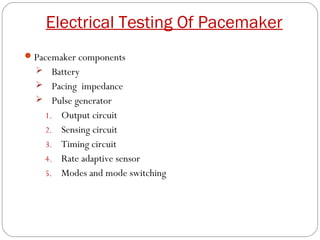
 Pacemaker components
   Battery
   Pacing impedance
   Pulse generator
    1.   Output circuit
    2.   Sensing circuit
    3.   Timing circuit
    4.   Rate adaptive sensor
    5.   Modes and mode switching
Electrical Testing Of Pacemaker
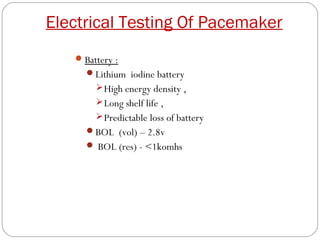
    Battery :
     Lithium iodine battery
       High energy density ,
         Long shelf life ,
         Predictable loss of battery
     BOL (vol) – 2.8v
      BOL (res) - <1komhs
Electrical Testing Of Pacemaker
 Pacing impedance :
 Pacing impedance refers to the opposition to current flow. Three
  sources contribute to pacing impedance:
     1. Pacing lead conductor coil
     2. Electrode-tissue interface
         Electrode resistance
         Polarization
 Normal lead impedance vary from 250-1200ohms.
 Single impedance value may be of little use with out previous values
  for comparison.
Electrical Testing Of Pacemaker
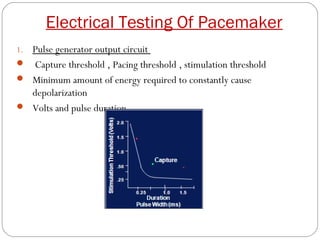
1.Pulse generator output circuit
 Capture threshold , Pacing threshold , stimulation threshold
 Minimum amount of energy required to constantly cause
  depolarization
 Volts and pulse duration
Electrical Testing Of Pacemaker
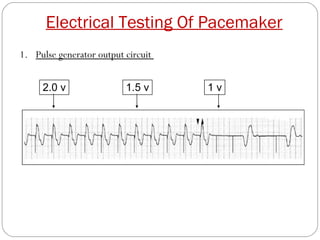
1. Pulse generator output circuit


     2.0 v                1.5 v     1v
Electrical Testing Of Pacemaker
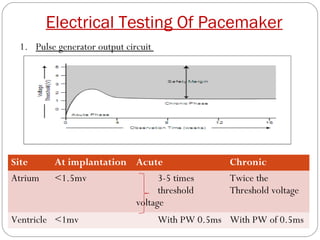
 1. Pulse generator output circuit


Site      At implantation Acute                    Chronic
Atrium    <1.5mv                3-5 times          Twice the
                                threshold          Threshold voltage
                          voltage
Ventricle <1mv                       With PW 0.5ms With PW of 0.5ms
Electrical Testing Of Pacemaker
1.Pulse generator output circuit
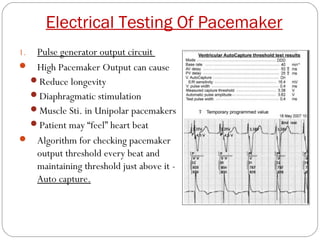
 High Pacemaker Output can cause
 Reduce longevity
 Diaphragmatic stimulation
 Muscle Sti. in Unipolar pacemakers
 Patient may “feel” heart beat
 Algorithm for checking pacemaker
  output threshold every beat and
  maintaining threshold just above it -
  Auto capture.
Electrical Testing Of Pacemaker
2.Pulse generator sensing circuit :
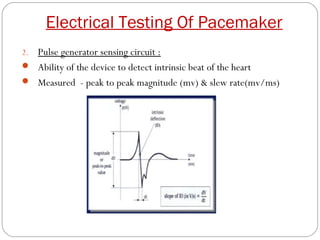
 Ability of the device to detect intrinsic beat of the heart
 Measured - peak to peak magnitude (mv) & slew rate(mv/ms)
Electrical Testing Of Pacemaker
2.     Pulse generator sensing circuit :
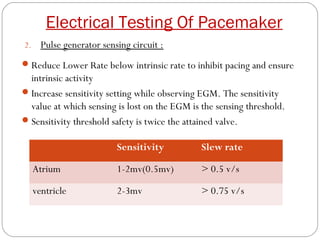
 Reduce Lower Rate below intrinsic rate to inhibit pacing and ensure
  intrinsic activity
 Increase sensitivity setting while observing EGM. The sensitivity
  value at which sensing is lost on the EGM is the sensing threshold.
 Sensitivity threshold safety is twice the attained valve.

                           Sensitivity         Slew rate

     Atrium                1-2mv(0.5mv)        > 0.5 v/s

     ventricle             2-3mv               > 0.75 v/s
Electrical Testing Of Pacemaker
3.     Pulse generator timing circuit :
     a. Lower rate limit (LRL)
     b. Hysteresis rate
     c. Refractory and blanking periods
     d. Ventricular safety pacing interval .
     e. Upper rate response .
Electrical Testing Of Pacemaker
3.Pulse generator timing circuit :
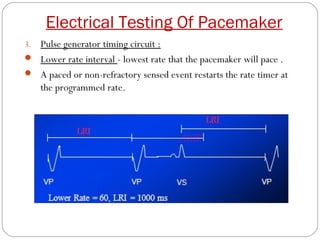
 Lower rate interval - lowest rate that the pacemaker will pace .
 A paced or non-refractory sensed event restarts the rate timer at
  the programmed rate.
Electrical Testing Of Pacemaker
3. Pulse generator timing circuit :

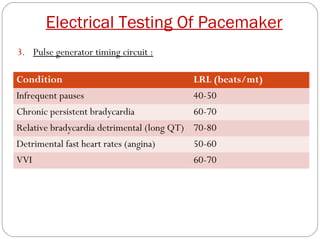
Condition                                 LRL (beats/mt)
Infrequent pauses                         40-50
Chronic persistent bradycardia            60-70
Relative bradycardia detrimental (long QT) 70-80
Detrimental fast heart rates (angina)     50-60
VVI                                       60-70
Electrical Testing Of Pacemaker
3. Pulse generator timing circuit :
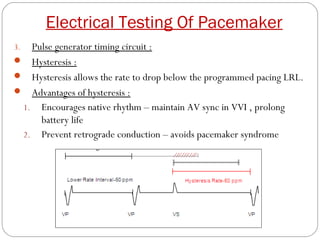
 Hysteresis :
 Hysteresis allows the rate to drop below the programmed pacing LRL.
 Advantages of hysteresis :
 1. Encourages native rhythm – maintain AV sync in VVI , prolong
     battery life
 2. Prevent retrograde conduction – avoids pacemaker syndrome
Electrical Testing Of Pacemaker
3. Pulse generator timing circuit :
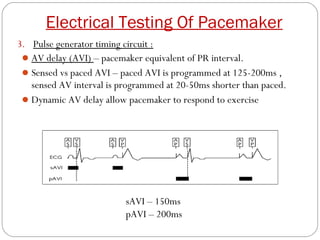
  AV delay (AVI) – pacemaker equivalent of PR interval.
  Sensed vs paced AVI – paced AVI is programmed at 125-200ms ,
   sensed AV interval is programmed at 20-50ms shorter than paced.
  Dynamic AV delay allow pacemaker to respond to exercise


                          sAVI – 150ms
                          pAVI – 200ms
Electrical Testing Of Pacemaker
3. Pulse generator timing circuit :

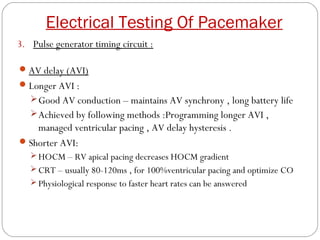
 AV delay (AVI)
 Longer AVI :
    Good AV conduction – maintains AV synchrony , long battery life
    Achieved by following methods :Programming longer AVI ,
    managed ventricular pacing , AV delay hysteresis .
 Shorter AVI:
    HOCM – RV apical pacing decreases HOCM gradient
    CRT – usually 80-120ms , for 100%ventricular pacing and optimize CO
    Physiological response to faster heart rates can be answered
Electrical Testing Of Pacemaker
3. Pulse generator timing circuit :

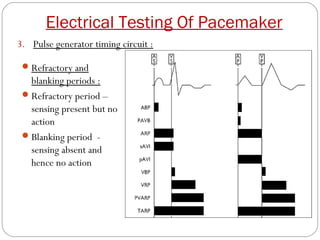
  Refractory and
   blanking periods :
  Refractory period –
   sensing present but no
   action
  Blanking period -
   sensing absent and
   hence no action
Electrical Testing Of Pacemaker
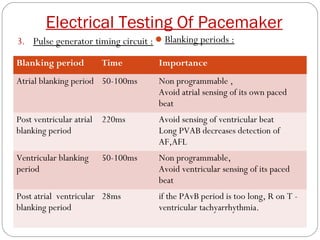
3. Pulse generator timing circuit :  Blanking periods :

Blanking period        Time         Importance
Atrial blanking period 50-100ms     Non programmable ,
                                    Avoid atrial sensing of its own paced
                                    beat
Post ventricular atrial 220ms       Avoid sensing of ventricular beat
blanking period                     Long PVAB decreases detection of
                                    AF,AFL
Ventricular blanking   50-100ms     Non programmable,
period                              Avoid ventricular sensing of its paced
                                    beat
Post atrial ventricular 28ms        if the PAvB period is too long, R on T -
blanking period                     ventricular tachyarrhythmia.
Electrical Testing Of Pacemaker
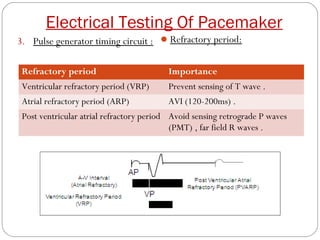
3. Pulse generator timing circuit :  Refractory period:

 Refractory period                       Importance
 Ventricular refractory period (VRP)     Prevent sensing of T wave .
 Atrial refractory period (ARP)          AVI (120-200ms) .
 Post ventricular atrial refractory period Avoid sensing retrograde P waves
                                           (PMT) , far field R waves .
Electrical Testing Of Pacemaker
 3. Pulse generator timing circuit :
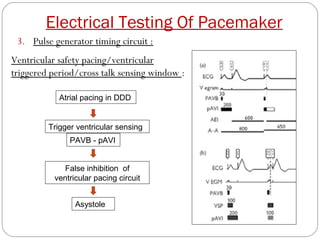
Ventricular safety pacing/ventricular
triggered period/cross talk sensing window :

            Atrial pacing in DDD


         Trigger ventricular sensing
               PAVB - pAVI


            False inhibition of
          ventricular pacing circuit


                Asystole
Electrical Testing Of Pacemaker
4. Pulse generator rate responsive pacing:

 Rate responsive pacing refer to ability of pacemaker to increase its
  lower rate in response to physiological stimulus
 Sinus node dysfunction , AF patients – fail to increase heart rates
 HRR should start with in 10s of exercise , peak at 90 – 120s and
  should return to baseline with in 60 – 120s after exercise.
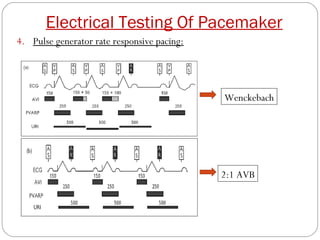
 Fastest rate at which pacemaker will pace upper rate response.
 If intrinsic atrial rate exceeds URR then wenckebach or 2:1 AVB
 Choosing URR : young patients (150b/mt) , old angina (<110b/mt).
 Various sensors (activity , minute ventilation , QT)
Electrical Testing Of Pacemaker
4. Pulse generator rate responsive pacing:


                                             Wenckebach


                                             2:1 AVB
Electrical Testing Of Pacemaker
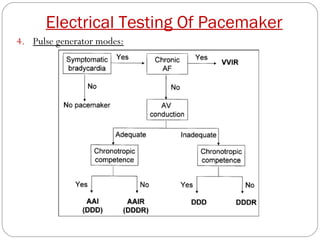
4. Pulse generator modes:
Electrical Testing Of Pacemaker
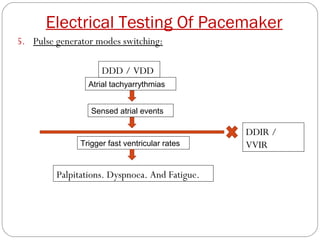
5. Pulse generator modes switching:

                     DDD / VDD
                 Atrial tachyarrythmias


                  Sensed atrial events

                                                DDIR /
               Trigger fast ventricular rates   VVIR

         Palpitations. Dyspnoea. And Fatigue.
Electrical Testing Of Pacemaker
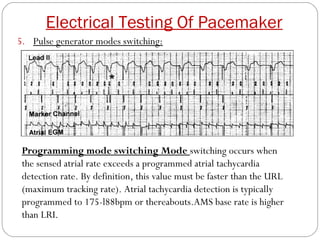
5. Pulse generator modes switching:


 Programming mode switching Mode switching occurs when
 the sensed atrial rate exceeds a programmed atrial tachycardia
 detection rate. By definition, this value must be faster than the URL
 (maximum tracking rate). Atrial tachycardia detection is typically
 programmed to 175-l88bpm or thereabouts.AMS base rate is higher
 than LRI.
Electrical Testing Of Pacemaker
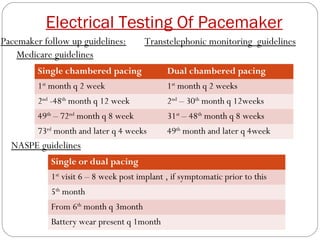
Pacemaker follow up guidelines:        Transtelephonic monitoring guidelines
    Medicare guidelines
         Single chambered pacing              Dual chambered pacing
         1st month q 2 week                   1st month q 2 weeks
         2nd -48th month q 12 week            2nd – 30th month q 12weeks
         49th – 72nd month q 8 week           31st – 48th month q 8 weeks
         73rd month and later q 4 weeks       49th month and later q 4week
  NASPE guidelines
            Single or dual pacing
            1st visit 6 – 8 week post implant , if symptomatic prior to this
            5th month
            From 6th month q 3month
            Battery wear present q 1month
Electrical Testing Of Pacemaker
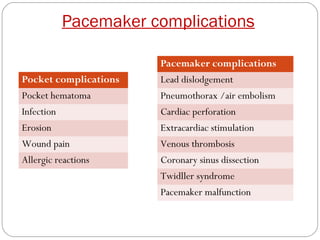
Pacemaker complications

                       Pacemaker complications
Pocket complications   Lead dislodgement
Pocket hematoma        Pneumothorax /air embolism
Infection              Cardiac perforation
Erosion                Extracardiac stimulation
Wound pain             Venous thrombosis
Allergic reactions     Coronary sinus dissection
                       Twidller syndrome
                       Pacemaker malfunction
Pacemaker complications

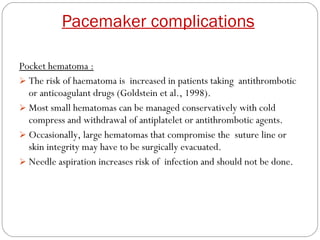
Pocket hematoma :
 The risk of haematoma is increased in patients taking antithrombotic
  or anticoagulant drugs (Goldstein et al., 1998).
 Most small hematomas can be managed conservatively with cold
  compress and withdrawal of antiplatelet or antithrombotic agents.
 Occasionally, large hematomas that compromise the suture line or
  skin integrity may have to be surgically evacuated.
 Needle aspiration increases risk of infection and should not be done.
Pacemaker complications

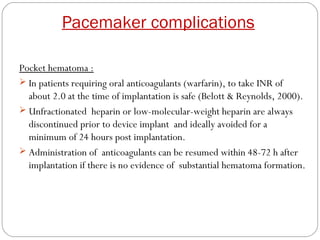
Pocket hematoma :
 In patients requiring oral anticoagulants (warfarin), to take INR of
  about 2.0 at the time of implantation is safe (Belott & Reynolds, 2000).
 Unfractionated heparin or low-molecular-weight heparin are always
  discontinued prior to device implant and ideally avoided for a
  minimum of 24 hours post implantation.
 Administration of anticoagulants can be resumed within 48-72 h after
  implantation if there is no evidence of substantial hematoma formation.
Pacemaker complications
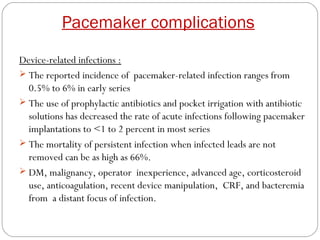
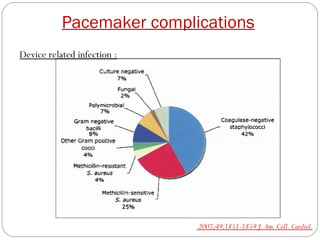
Device-related infections :
 The reported incidence of pacemaker-related infection ranges from
  0.5% to 6% in early series
 The use of prophylactic antibiotics and pocket irrigation with antibiotic
  solutions has decreased the rate of acute infections following pacemaker
  implantations to <1 to 2 percent in most series
 The mortality of persistent infection when infected leads are not
  removed can be as high as 66%.
 DM, malignancy, operator inexperience, advanced age, corticosteroid
  use, anticoagulation, recent device manipulation, CRF, and bacteremia
  from a distant focus of infection.
Pacemaker complications
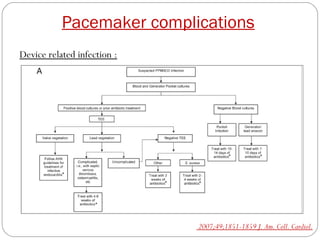
Device related infection :
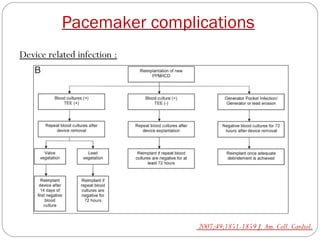
 Device infection is defined as either:
   (a) deep infection - infection involving the generator pocket
    and/or the intravenous portion of the leads, with bacteremia,
    requiring device extraction or
   (b) superficial infection - characterized by local inflammation,
    involving the skin but not the generator pocket, and treated with
    oral antibiotics.
Pacemaker complications
Device related infection :


                             2007;49;1851-1859 J. Am. Coll. Cardiol.
Pacemaker complications
Device related infection :


                             2007;49;1851-1859 J. Am. Coll. Cardiol.
Pacemaker complications
Device related infection :


                             2007;49;1851-1859 J. Am. Coll. Cardiol.
Pacemaker complications
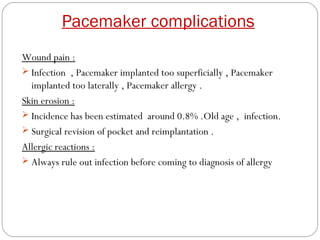
Wound pain :
 Infection , Pacemaker implanted too superficially , Pacemaker
  implanted too laterally , Pacemaker allergy .
Skin erosion :
 Incidence has been estimated around 0.8% .Old age , infection.
 Surgical revision of pocket and reimplantation .
Allergic reactions :
 Always rule out infection before coming to diagnosis of allergy
Pacemaker complications
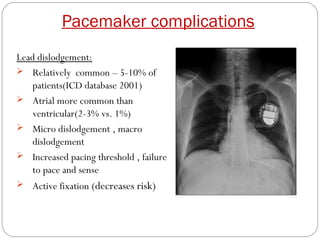
Lead dislodgement:
 Relatively common – 5-10% of
    patients(ICD database 2001)
 Atrial more common than
    ventricular(2-3% vs. 1%)
 Micro dislodgement , macro
    dislodgement
 Increased pacing threshold , failure
    to pace and sense
 Active fixation (decreases risk)
Pacemaker complications
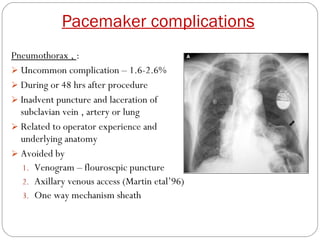
Pneumothorax , :
 Uncommon complication – 1.6-2.6%
 During or 48 hrs after procedure
 Inadvent puncture and laceration of
  subclavian vein , artery or lung
 Related to operator experience and
  underlying anatomy
 Avoided by
   1. Venogram – flouroscpic puncture
   2. Axillary venous access (Martin etal’96)
   3. One way mechanism sheath
Pacemaker complications
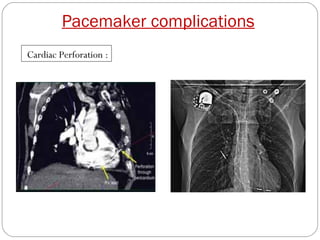
Cardiac Perforation :
 Uncommon but potentially serious complication - lower than 1%.
 Acute (<5 days) , subacute(5d-1month) , chronic (>1month)
 Increasing stimulation threshold , RBBB pattern for RV pacing,
  intercostal muscle or diaphragmatic contraction, friction rub, and
  pericarditis, pericardial effusion, or cardiac tamponade.
 CXR , ECHO , CT
 Lead withdrawal and repositioning ; surgical back up
Pacemaker complications
Cardiac Perforation :
Pacemaker complications
Extracardiac stimulation
 The diaphragm or pectoral or intercostal muscles
 Diaphragmatic stimulation - direct stimulation of the diaphragm (left)
  or stimulation of the phrenic nerve (right).
 Early postimplantation period , dislodgment of the pacing lead.
 MC in patients with LV coronary vein branch lead placement for CRT
 Output pacing importance (testing and treatment)
 Pectoral stimulation - incorrect orientation of the pacemaker or a
  current leak from a lead insulation failure or exposed connector.
Pacemaker complications
Venous thrombosis :
 Venous thrombosis occurs in 30% to 50% of patients and only 1-3%
  of patients become symptomatic.
 Manifestations vary from usually asymptomatic, acute symptomatic
  thrombosis, and even SVCS .
 Early or late after pacemaker implantation.
 Predictors of severe stenosis are multiple pacemaker leads , previous
  pacing , double coils , hormone therapy .
 Asymptomatic (no treatment) , symptomatic (anticoagulants –
  endovascular stents – surgical correction ).
Pacemaker complications
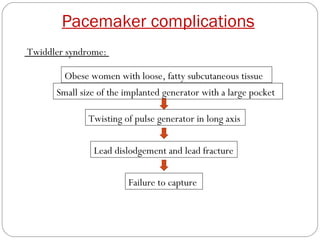
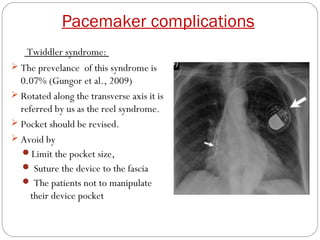
Twiddler syndrome:

        Obese women with loose, fatty subcutaneous tissue
      Small size of the implanted generator with a large pocket

              Twisting of pulse generator in long axis


               Lead dislodgement and lead fracture

                        Failure to capture
Pacemaker complications
    Twiddler syndrome:
 The prevelance of this syndrome is
  0.07% (Gungor et al., 2009)
 Rotated along the transverse axis it is
  referred by us as the reel syndrome.
 Pocket should be revised.
 Avoid by
  Limit the pocket size,
   Suture the device to the fascia
   The patients not to manipulate
     their device pocket
Pacemaker malfunction

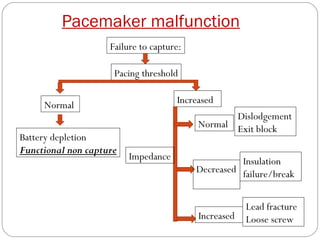
 Failure to capture
 Failure to output
 Sensing abnormalities(under and over sensing)
 Specific mode complications
  1. Pacemaker related tachycardia
  2. Pacemaker syndrome
Pacemaker malfunction
Failure to capture:
 Pacing artifact present but no evoked potential .
 Causes
   1. Lead dislodgement or perforation
   2. Lead maturation(inflammation/fibrosis)(exit block)
   3. Battery depletion
   4. Circuit failure(coil fracture , insulation defect)
   5. Capture management algorithm failure
   6. Inappropriate programming
   7. Pseudo malfunction
   8. Functional non capture
   9. Metabolic , drugs , cardiomyopathies
Pacemaker malfunction
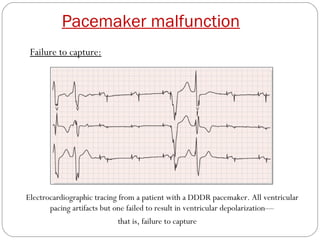
 Failure to capture:


Electrocardiographic tracing from a patient with a DDDR pacemaker. All ventricular
       pacing artifacts but one failed to result in ventricular depolarization—
                             that is, failure to capture
Pacemaker malfunction
                    Failure to capture:

                     Pacing threshold

     Normal                          Increased
                                                 Dislodgement
                                          Normal Exit block
Battery depletion
Functional non capture
                         Impedance                  Insulation
                                          Decreased failure/break


                                                      Lead fracture
                                          Increased   Loose screw
Pacemaker malfunction
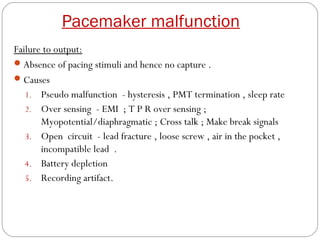
Failure to output:
 Absence of pacing stimuli and hence no capture .
 Causes
   1. Pseudo malfunction - hysteresis , PMT termination , sleep rate
   2. Over sensing - EMI ; T P R over sensing ;
       Myopotential/diaphragmatic ; Cross talk ; Make break signals
   3. Open circuit - lead fracture , loose screw , air in the pocket ,
       incompatible lead .
   4. Battery depletion
   5. Recording artifact.
Pacemaker malfunction
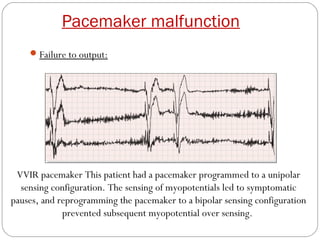
     Failure to output:


 VVIR pacemaker This patient had a pacemaker programmed to a unipolar
  sensing configuration. The sensing of myopotentials led to symptomatic
pauses, and reprogramming the pacemaker to a bipolar sensing configuration
             prevented subsequent myopotential over sensing.
Pacemaker malfunction
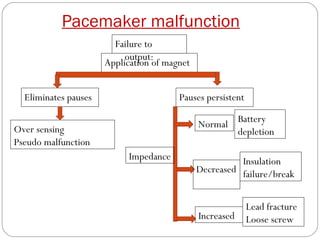
                        Failure to
                           output:
                      Application of magnet


  Eliminates pauses                     Pauses persistent


Over sensing                                  Normal Battery
                                                     depletion
Pseudo malfunction
                            Impedance                   Insulation
                                              Decreased failure/break


                                                            Lead fracture
                                              Increased     Loose screw
Pacemaker malfunction
Battery depletion :
 Elective replacement indicators (ERI)
   1. Low voltage(2.1-2.4)
   2. Low pacing rate on magnet application
   3. Elevated battery impedance
   4. Increased pulse width duration
   5. Restricted programmability
   6. Change to simpler pacing mode
 End of life (EOL)
   1. Low voltage(≤2.1vol)
Pacemaker malfunction
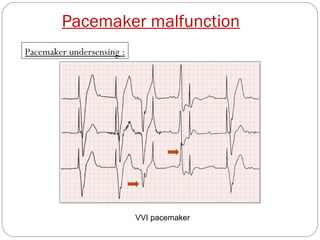
Pacemaker undersensing :
 Pacing artifact present but no sensing(sensed beat doesn’t reset cycle)
 Causes are
  1. Defect in signal production – scar /fibrosis , BBB , ectopic ,
      cardioversion , defibrillation , metabolic.
  2. Defect in signal transmission – lead fracture /dislodgement ,
      insulation failure , partial open circuit.
  3. Defect in pacemaker – battery depletion , sensing circuit
      abnormalities , committed DVI.
Pacemaker malfunction
Pacemaker undersensing :


                           VVI pacemaker
Pacemaker malfunction
Pacemaker over sensing :
                                Cross talk :
 Present as failure to pace
                                       High atrial output
 Causes
                                   High ventricular sensitivity
  1. EMI                                   Low VBP
  2. T , P , R over sensing .
  3. Cross talk                   Ventricular sensing of
  4. Myopotential (unipolar)      paced atrial impulse
  5. Make break signals
                                Pts with Poor AV conduction
                                – Ventricular Asystole
Pacemaker malfunction
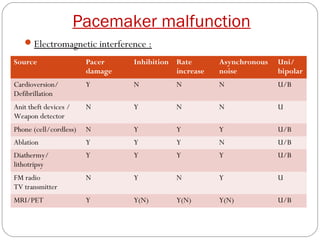
    Electromagnetic interference :

Source                  Pacer    Inhibition Rate       Asynchronous   Uni/
                        damage              increase   noise          bipolar
Cardioversion/          Y        N          N          N              U/B
Defibrillation
Anit theft devices /    N        Y          N          N              U
Weapon detector
Phone (cell/cordless)   N        Y          Y          Y              U/B
Ablation                Y        Y          Y          N              U/B
Diathermy/              Y        Y          Y          Y              U/B
lithotripsy
FM radio                N        Y          N          Y              U
TV transmitter
MRI/PET                 Y        Y(N)       Y(N)       Y(N)           U/B
Pacemaker malfunction
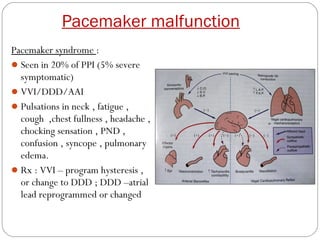
Pacemaker syndrome :
 Seen in 20% of PPI (5% severe
  symptomatic)
 VVI/DDD/AAI
 Pulsations in neck , fatigue ,
  cough ,chest fullness , headache ,
  chocking sensation , PND ,
  confusion , syncope , pulmonary
  edema.
 Rx : VVI – program hysteresis ,
  or change to DDD ; DDD –atrial
  lead reprogrammed or changed
Pacemaker malfunction
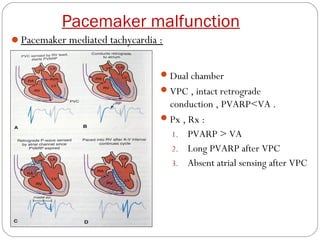
Pacemaker mediated tachycardia :


                                 Dual chamber
                                 VPC , intact retrograde
                                  conduction , PVARP<VA .
                                 Px , Rx :
                                  1. PVARP > VA
                                  2. Long PVARP after VPC
                                  3. Absent atrial sensing after VPC
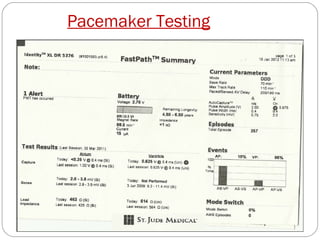
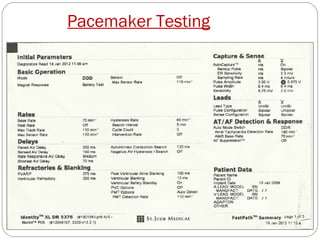
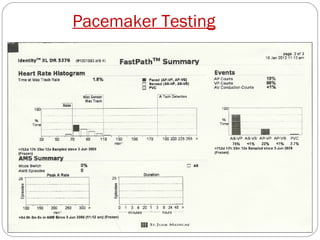
Pacemaker Testing
Pacemaker Testing
Pacemaker Testing
Thank you
Hey:Share with me please.

Electrical testing of pacemaker

  • 1.
    Electrical Testing OfPacemaker & Pacemaker Complications Msn Pavan Kumar,DM,NIMS.
  • 2.
    Electrical Testing OfPacemaker Pacemaker complications
  • 3.
    Electrical Testing OfPacemaker  Pacemaker components  Battery  Pacing impedance  Pulse generator 1. Output circuit 2. Sensing circuit 3. Timing circuit 4. Rate adaptive sensor 5. Modes and mode switching
  • 4.
    Electrical Testing OfPacemaker  Battery : Lithium iodine battery  High energy density ,  Long shelf life ,  Predictable loss of battery BOL (vol) – 2.8v  BOL (res) - <1komhs
  • 5.
    Electrical Testing OfPacemaker  Pacing impedance :  Pacing impedance refers to the opposition to current flow. Three sources contribute to pacing impedance: 1. Pacing lead conductor coil 2. Electrode-tissue interface  Electrode resistance  Polarization  Normal lead impedance vary from 250-1200ohms.  Single impedance value may be of little use with out previous values for comparison.
  • 6.
    Electrical Testing OfPacemaker 1.Pulse generator output circuit  Capture threshold , Pacing threshold , stimulation threshold  Minimum amount of energy required to constantly cause depolarization  Volts and pulse duration
  • 7.
    Electrical Testing OfPacemaker 1. Pulse generator output circuit 2.0 v 1.5 v 1v
  • 8.
    Electrical Testing OfPacemaker 1. Pulse generator output circuit Site At implantation Acute Chronic Atrium <1.5mv 3-5 times Twice the threshold Threshold voltage voltage Ventricle <1mv With PW 0.5ms With PW of 0.5ms
  • 9.
    Electrical Testing OfPacemaker 1.Pulse generator output circuit  High Pacemaker Output can cause Reduce longevity Diaphragmatic stimulation Muscle Sti. in Unipolar pacemakers Patient may “feel” heart beat  Algorithm for checking pacemaker output threshold every beat and maintaining threshold just above it - Auto capture.
  • 10.
    Electrical Testing OfPacemaker 2.Pulse generator sensing circuit :  Ability of the device to detect intrinsic beat of the heart  Measured - peak to peak magnitude (mv) & slew rate(mv/ms)
  • 11.
    Electrical Testing OfPacemaker 2. Pulse generator sensing circuit :  Reduce Lower Rate below intrinsic rate to inhibit pacing and ensure intrinsic activity  Increase sensitivity setting while observing EGM. The sensitivity value at which sensing is lost on the EGM is the sensing threshold.  Sensitivity threshold safety is twice the attained valve. Sensitivity Slew rate Atrium 1-2mv(0.5mv) > 0.5 v/s ventricle 2-3mv > 0.75 v/s
  • 12.
    Electrical Testing OfPacemaker 3. Pulse generator timing circuit : a. Lower rate limit (LRL) b. Hysteresis rate c. Refractory and blanking periods d. Ventricular safety pacing interval . e. Upper rate response .
  • 13.
    Electrical Testing OfPacemaker 3.Pulse generator timing circuit :  Lower rate interval - lowest rate that the pacemaker will pace .  A paced or non-refractory sensed event restarts the rate timer at the programmed rate.
  • 14.
    Electrical Testing OfPacemaker 3. Pulse generator timing circuit : Condition LRL (beats/mt) Infrequent pauses 40-50 Chronic persistent bradycardia 60-70 Relative bradycardia detrimental (long QT) 70-80 Detrimental fast heart rates (angina) 50-60 VVI 60-70
  • 15.
    Electrical Testing OfPacemaker 3. Pulse generator timing circuit :  Hysteresis :  Hysteresis allows the rate to drop below the programmed pacing LRL.  Advantages of hysteresis : 1. Encourages native rhythm – maintain AV sync in VVI , prolong battery life 2. Prevent retrograde conduction – avoids pacemaker syndrome
  • 16.
    Electrical Testing OfPacemaker 3. Pulse generator timing circuit :  AV delay (AVI) – pacemaker equivalent of PR interval.  Sensed vs paced AVI – paced AVI is programmed at 125-200ms , sensed AV interval is programmed at 20-50ms shorter than paced.  Dynamic AV delay allow pacemaker to respond to exercise sAVI – 150ms pAVI – 200ms
  • 17.
    Electrical Testing OfPacemaker 3. Pulse generator timing circuit :  AV delay (AVI)  Longer AVI :  Good AV conduction – maintains AV synchrony , long battery life  Achieved by following methods :Programming longer AVI , managed ventricular pacing , AV delay hysteresis .  Shorter AVI:  HOCM – RV apical pacing decreases HOCM gradient  CRT – usually 80-120ms , for 100%ventricular pacing and optimize CO  Physiological response to faster heart rates can be answered
  • 18.
    Electrical Testing OfPacemaker 3. Pulse generator timing circuit :  Refractory and blanking periods :  Refractory period – sensing present but no action  Blanking period - sensing absent and hence no action
  • 19.
    Electrical Testing OfPacemaker 3. Pulse generator timing circuit :  Blanking periods : Blanking period Time Importance Atrial blanking period 50-100ms Non programmable , Avoid atrial sensing of its own paced beat Post ventricular atrial 220ms Avoid sensing of ventricular beat blanking period Long PVAB decreases detection of AF,AFL Ventricular blanking 50-100ms Non programmable, period Avoid ventricular sensing of its paced beat Post atrial ventricular 28ms if the PAvB period is too long, R on T - blanking period ventricular tachyarrhythmia.
  • 20.
    Electrical Testing OfPacemaker 3. Pulse generator timing circuit :  Refractory period: Refractory period Importance Ventricular refractory period (VRP) Prevent sensing of T wave . Atrial refractory period (ARP) AVI (120-200ms) . Post ventricular atrial refractory period Avoid sensing retrograde P waves (PMT) , far field R waves .
  • 21.
    Electrical Testing OfPacemaker 3. Pulse generator timing circuit : Ventricular safety pacing/ventricular triggered period/cross talk sensing window : Atrial pacing in DDD Trigger ventricular sensing PAVB - pAVI False inhibition of ventricular pacing circuit Asystole
  • 22.
    Electrical Testing OfPacemaker 4. Pulse generator rate responsive pacing:  Rate responsive pacing refer to ability of pacemaker to increase its lower rate in response to physiological stimulus  Sinus node dysfunction , AF patients – fail to increase heart rates  HRR should start with in 10s of exercise , peak at 90 – 120s and should return to baseline with in 60 – 120s after exercise.  Fastest rate at which pacemaker will pace upper rate response.  If intrinsic atrial rate exceeds URR then wenckebach or 2:1 AVB  Choosing URR : young patients (150b/mt) , old angina (<110b/mt).  Various sensors (activity , minute ventilation , QT)
  • 23.
    Electrical Testing OfPacemaker 4. Pulse generator rate responsive pacing: Wenckebach 2:1 AVB
  • 24.
    Electrical Testing OfPacemaker 4. Pulse generator modes:
  • 25.
    Electrical Testing OfPacemaker 5. Pulse generator modes switching: DDD / VDD Atrial tachyarrythmias Sensed atrial events DDIR / Trigger fast ventricular rates VVIR Palpitations. Dyspnoea. And Fatigue.
  • 26.
    Electrical Testing OfPacemaker 5. Pulse generator modes switching: Programming mode switching Mode switching occurs when the sensed atrial rate exceeds a programmed atrial tachycardia detection rate. By definition, this value must be faster than the URL (maximum tracking rate). Atrial tachycardia detection is typically programmed to 175-l88bpm or thereabouts.AMS base rate is higher than LRI.
  • 27.
    Electrical Testing OfPacemaker Pacemaker follow up guidelines: Transtelephonic monitoring guidelines Medicare guidelines Single chambered pacing Dual chambered pacing 1st month q 2 week 1st month q 2 weeks 2nd -48th month q 12 week 2nd – 30th month q 12weeks 49th – 72nd month q 8 week 31st – 48th month q 8 weeks 73rd month and later q 4 weeks 49th month and later q 4week NASPE guidelines Single or dual pacing 1st visit 6 – 8 week post implant , if symptomatic prior to this 5th month From 6th month q 3month Battery wear present q 1month
  • 28.
    Electrical Testing OfPacemaker Pacemaker complications
  • 29.
    Pacemaker complications Pacemaker complications Pocket complications Lead dislodgement Pocket hematoma Pneumothorax /air embolism Infection Cardiac perforation Erosion Extracardiac stimulation Wound pain Venous thrombosis Allergic reactions Coronary sinus dissection Twidller syndrome Pacemaker malfunction
  • 30.
    Pacemaker complications Pocket hematoma:  The risk of haematoma is increased in patients taking antithrombotic or anticoagulant drugs (Goldstein et al., 1998).  Most small hematomas can be managed conservatively with cold compress and withdrawal of antiplatelet or antithrombotic agents.  Occasionally, large hematomas that compromise the suture line or skin integrity may have to be surgically evacuated.  Needle aspiration increases risk of infection and should not be done.
  • 31.
    Pacemaker complications Pocket hematoma:  In patients requiring oral anticoagulants (warfarin), to take INR of about 2.0 at the time of implantation is safe (Belott & Reynolds, 2000).  Unfractionated heparin or low-molecular-weight heparin are always discontinued prior to device implant and ideally avoided for a minimum of 24 hours post implantation.  Administration of anticoagulants can be resumed within 48-72 h after implantation if there is no evidence of substantial hematoma formation.
  • 32.
    Pacemaker complications Device-related infections:  The reported incidence of pacemaker-related infection ranges from 0.5% to 6% in early series  The use of prophylactic antibiotics and pocket irrigation with antibiotic solutions has decreased the rate of acute infections following pacemaker implantations to <1 to 2 percent in most series  The mortality of persistent infection when infected leads are not removed can be as high as 66%.  DM, malignancy, operator inexperience, advanced age, corticosteroid use, anticoagulation, recent device manipulation, CRF, and bacteremia from a distant focus of infection.
  • 33.
    Pacemaker complications Device relatedinfection :  Device infection is defined as either:  (a) deep infection - infection involving the generator pocket and/or the intravenous portion of the leads, with bacteremia, requiring device extraction or  (b) superficial infection - characterized by local inflammation, involving the skin but not the generator pocket, and treated with oral antibiotics.
  • 34.
    Pacemaker complications Device relatedinfection : 2007;49;1851-1859 J. Am. Coll. Cardiol.
  • 35.
    Pacemaker complications Device relatedinfection : 2007;49;1851-1859 J. Am. Coll. Cardiol.
  • 36.
    Pacemaker complications Device relatedinfection : 2007;49;1851-1859 J. Am. Coll. Cardiol.
  • 37.
    Pacemaker complications Wound pain:  Infection , Pacemaker implanted too superficially , Pacemaker implanted too laterally , Pacemaker allergy . Skin erosion :  Incidence has been estimated around 0.8% .Old age , infection.  Surgical revision of pocket and reimplantation . Allergic reactions :  Always rule out infection before coming to diagnosis of allergy
  • 38.
    Pacemaker complications Lead dislodgement: Relatively common – 5-10% of patients(ICD database 2001)  Atrial more common than ventricular(2-3% vs. 1%)  Micro dislodgement , macro dislodgement  Increased pacing threshold , failure to pace and sense  Active fixation (decreases risk)
  • 39.
    Pacemaker complications Pneumothorax ,:  Uncommon complication – 1.6-2.6%  During or 48 hrs after procedure  Inadvent puncture and laceration of subclavian vein , artery or lung  Related to operator experience and underlying anatomy  Avoided by 1. Venogram – flouroscpic puncture 2. Axillary venous access (Martin etal’96) 3. One way mechanism sheath
  • 40.
    Pacemaker complications Cardiac Perforation:  Uncommon but potentially serious complication - lower than 1%.  Acute (<5 days) , subacute(5d-1month) , chronic (>1month)  Increasing stimulation threshold , RBBB pattern for RV pacing, intercostal muscle or diaphragmatic contraction, friction rub, and pericarditis, pericardial effusion, or cardiac tamponade.  CXR , ECHO , CT  Lead withdrawal and repositioning ; surgical back up
  • 41.
  • 42.
    Pacemaker complications Extracardiac stimulation The diaphragm or pectoral or intercostal muscles  Diaphragmatic stimulation - direct stimulation of the diaphragm (left) or stimulation of the phrenic nerve (right).  Early postimplantation period , dislodgment of the pacing lead.  MC in patients with LV coronary vein branch lead placement for CRT  Output pacing importance (testing and treatment)  Pectoral stimulation - incorrect orientation of the pacemaker or a current leak from a lead insulation failure or exposed connector.
  • 43.
    Pacemaker complications Venous thrombosis:  Venous thrombosis occurs in 30% to 50% of patients and only 1-3% of patients become symptomatic.  Manifestations vary from usually asymptomatic, acute symptomatic thrombosis, and even SVCS .  Early or late after pacemaker implantation.  Predictors of severe stenosis are multiple pacemaker leads , previous pacing , double coils , hormone therapy .  Asymptomatic (no treatment) , symptomatic (anticoagulants – endovascular stents – surgical correction ).
  • 44.
    Pacemaker complications Twiddler syndrome: Obese women with loose, fatty subcutaneous tissue Small size of the implanted generator with a large pocket Twisting of pulse generator in long axis Lead dislodgement and lead fracture Failure to capture
  • 45.
    Pacemaker complications Twiddler syndrome:  The prevelance of this syndrome is 0.07% (Gungor et al., 2009)  Rotated along the transverse axis it is referred by us as the reel syndrome.  Pocket should be revised.  Avoid by Limit the pocket size,  Suture the device to the fascia  The patients not to manipulate their device pocket
  • 46.
    Pacemaker malfunction  Failureto capture  Failure to output  Sensing abnormalities(under and over sensing)  Specific mode complications 1. Pacemaker related tachycardia 2. Pacemaker syndrome
  • 47.
    Pacemaker malfunction Failure tocapture:  Pacing artifact present but no evoked potential .  Causes 1. Lead dislodgement or perforation 2. Lead maturation(inflammation/fibrosis)(exit block) 3. Battery depletion 4. Circuit failure(coil fracture , insulation defect) 5. Capture management algorithm failure 6. Inappropriate programming 7. Pseudo malfunction 8. Functional non capture 9. Metabolic , drugs , cardiomyopathies
  • 48.
    Pacemaker malfunction Failureto capture: Electrocardiographic tracing from a patient with a DDDR pacemaker. All ventricular pacing artifacts but one failed to result in ventricular depolarization— that is, failure to capture
  • 49.
    Pacemaker malfunction Failure to capture: Pacing threshold Normal Increased Dislodgement Normal Exit block Battery depletion Functional non capture Impedance Insulation Decreased failure/break Lead fracture Increased Loose screw
  • 50.
    Pacemaker malfunction Failure tooutput:  Absence of pacing stimuli and hence no capture .  Causes 1. Pseudo malfunction - hysteresis , PMT termination , sleep rate 2. Over sensing - EMI ; T P R over sensing ; Myopotential/diaphragmatic ; Cross talk ; Make break signals 3. Open circuit - lead fracture , loose screw , air in the pocket , incompatible lead . 4. Battery depletion 5. Recording artifact.
  • 51.
    Pacemaker malfunction  Failure to output: VVIR pacemaker This patient had a pacemaker programmed to a unipolar sensing configuration. The sensing of myopotentials led to symptomatic pauses, and reprogramming the pacemaker to a bipolar sensing configuration prevented subsequent myopotential over sensing.
  • 52.
    Pacemaker malfunction Failure to output: Application of magnet Eliminates pauses Pauses persistent Over sensing Normal Battery depletion Pseudo malfunction Impedance Insulation Decreased failure/break Lead fracture Increased Loose screw
  • 53.
    Pacemaker malfunction Battery depletion:  Elective replacement indicators (ERI) 1. Low voltage(2.1-2.4) 2. Low pacing rate on magnet application 3. Elevated battery impedance 4. Increased pulse width duration 5. Restricted programmability 6. Change to simpler pacing mode  End of life (EOL) 1. Low voltage(≤2.1vol)
  • 54.
    Pacemaker malfunction Pacemaker undersensing:  Pacing artifact present but no sensing(sensed beat doesn’t reset cycle)  Causes are 1. Defect in signal production – scar /fibrosis , BBB , ectopic , cardioversion , defibrillation , metabolic. 2. Defect in signal transmission – lead fracture /dislodgement , insulation failure , partial open circuit. 3. Defect in pacemaker – battery depletion , sensing circuit abnormalities , committed DVI.
  • 55.
  • 56.
    Pacemaker malfunction Pacemaker oversensing : Cross talk :  Present as failure to pace High atrial output  Causes High ventricular sensitivity 1. EMI Low VBP 2. T , P , R over sensing . 3. Cross talk Ventricular sensing of 4. Myopotential (unipolar) paced atrial impulse 5. Make break signals Pts with Poor AV conduction – Ventricular Asystole
  • 57.
    Pacemaker malfunction  Electromagnetic interference : Source Pacer Inhibition Rate Asynchronous Uni/ damage increase noise bipolar Cardioversion/ Y N N N U/B Defibrillation Anit theft devices / N Y N N U Weapon detector Phone (cell/cordless) N Y Y Y U/B Ablation Y Y Y N U/B Diathermy/ Y Y Y Y U/B lithotripsy FM radio N Y N Y U TV transmitter MRI/PET Y Y(N) Y(N) Y(N) U/B
  • 58.
    Pacemaker malfunction Pacemaker syndrome:  Seen in 20% of PPI (5% severe symptomatic)  VVI/DDD/AAI  Pulsations in neck , fatigue , cough ,chest fullness , headache , chocking sensation , PND , confusion , syncope , pulmonary edema.  Rx : VVI – program hysteresis , or change to DDD ; DDD –atrial lead reprogrammed or changed
  • 59.
    Pacemaker malfunction Pacemaker mediatedtachycardia :  Dual chamber  VPC , intact retrograde conduction , PVARP<VA .  Px , Rx : 1. PVARP > VA 2. Long PVARP after VPC 3. Absent atrial sensing after VPC
  • 60.
  • 61.
  • 62.
  • 63.
  • 64.