
Polymer-free Drug-Coated Coronary Stents
in Patients at High Bleeding Risk
(LEADERS FREE trial)
October 14,
2015, NEJM.
15% of patients undergoing PCI are at high risk of bleeding
Such patients are usually excluded from trials of stents and adjunctive therapy,
The default management of their care, supported by current guidelines, favors
the use of either a second-generation drug-eluting stent with a shortened
course of dual antiplatelet therapy or a bare-metal stent followed by1 month of
dual antiplatelet therapy
The latter strategy, driven by the need to minimize the risk of bleeding, is
associated with a higher risk of restenosis and reintervention than that
observed with the use of a drug-eluting stent.
A polymer-free and carrier-free drug-coated stent, the BioFreedom stent
(Biosensors Europe), has been developed that transfers umirolimus (also known as
biolimus A9), a highly lipophilic sirolimus analogue, into the vessel wall over a
period of 1 month
In a preclinical study, the umirolimus-coated stent showed less neointimal
proliferation and inflammation at 180 days than did a sirolimus-eluting stent.
In a first-in-human evaluation, the umirolimus-coated stent was noninferior to a
paclitaxel-eluting stent with respect to in-stent late lumen loss at 12 months.
The Prospective Randomized Comparison of the BioFreedom Biolimus
A9 Drug-Coated Stent versus the Gazelle Bare-Metal Stent in Patients at
High Bleeding Risk (LEADERS FREE) trial was designed to evaluate the
efficacy and safety of the polymer-free umirolimus-coated stent as
compared with a bare-metal stent in patients with increased bleeding
risk, with a 1-month regimen of dual antiplatelet therapy in both
groups.
Methods
The LEADERS FREE trial is an ongoing randomized, double-blind clinical
trial conducted at 68 sites in 20 countries on 4 continents
The trial was sponsored by Biosensors Europe (Morges, Switzerland)
Study Population
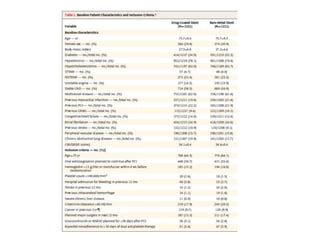
Eligible patients had coronary artery disease with a clinical indication for PCI. In
addition, participants were required to meet one or more of the criteria listed in
Table 1.
These criteria were chosen to define a population of patients who had
increased bleeding risk or who were otherwise considered by the investigator to
be candidates for implantation of a bare-metal stent instead of a drug-eluting
stent, owing to the perceived need to terminate dual antiplatelet therapy at 1
month.
Study Procedures
Patients were randomly assigned in a 1:1 ratio to undergo PCI with the BioFreedom
polymer-free umirolimus-coated stent or a similar bare-metal stent (the Gazelle stent,
Biosensors Interventional Technologies, Singapore).
Randomization was performed with the use of either a Web-based system or a
telephone interactive voice-response system (both from Merge Healthcare) in blocks
of 16 with no stratification
Patients were enrolled after the guidewire had crossed the first target lesion, and
PCI was performed according to standard techniques
Vascular access, periprocedural antithrombotic regimen, and lesion preparation
were left to the operator’s preferance All target lesions were treated with
at least one study stent. Staged procedures were permitted within 1 week after
the index procedure; all the stents used were of the assigned type
The protocol mandated that all patients receive
both aspirin (75 to 250 mg once daily) and
a P2Y12 inhibitor (with clopidogrel, 75 to 150 mg
once daily, being the preferred agent) for 30 days,
followed by a single antiplatelet agent thereafter
(aspirin preferred).
Patients who were discharged
while receiving a vitamin K antagonist could receive
either triple therapy or the vitamin K antagonist
plus clopidogrel (without aspirin) during the
first 30 days.
A patient follow-up visit was performed at the study center at 30 days (time
window, 23 to 37 days), when the change from dual antiplatelet therapy to
single antiplatelet therapy was prescribed, and again at 360 days
Further contacts, either on site or by telephone, were made at 60, 120, and 720
days. Ischemia testing and angiographic evaluation during follow-up were not
mandated by the protocol and were left to the discretion of the investigator.
Study End Points
The primary safety end point was the cumulative incidence of a composite of
cardiac death, myocardial infarction, or definite or probable stent thrombosis at
390 days
The primary efficacy end point was the incidence of clinically driven target lesion
revascularization at 390 days.
Other end points included bleeding, target-vessel revascularization, and indexes
of technical procedural success. Primary end-point events and bleeding events
were recorded for up to 390 days in order to capture any events occurring soon
after (and as a consequence of) the planned 1-year visit.
Statistical Analysis
The composite primary safety end point was evaluated with the use of a
noninferiority analysis.The predicted 1-year incidence was 8% for this end
point in the bare-metal–stent group. Noninferiority was to be declared if the
upper limit of the one-sided 97.5% confidence interval of the difference in
event rates between the two groups at 1 year was less than 3.2 percentage
points.
For the primary efficacy end point of clinically driven target-lesion
revascularization, the predicted event rate was of 10% at 1 year in the bare-
metal–stent group.
Using a two-sided type I error rate of 5% and allowing for a rate of loss
to follow-up of up to 8%, we determined that 1228 patients per group would
provide more than 80% power to detect an absolute difference
of 3.3 percentage points in the rate of clinically driven target-lesion
revascularization between study groups.
Results
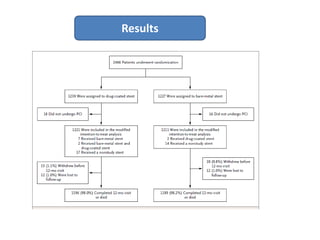
A total of 2466 patients underwent randomization (1239 were assigned to the
polymer-free umirolimus-coated stent and 1227 were assigned to the bare-metal
stent) from December 2012 through May 2014.
The patient population was characterized by advanced age and major coexisting
conditions indicative of increased bleeding risk
Patients had a mean of 1.7 inclusion criteria, and the two groups were well
balanced with respect to baseline characteristics
Primary End Points
DISCUSSION
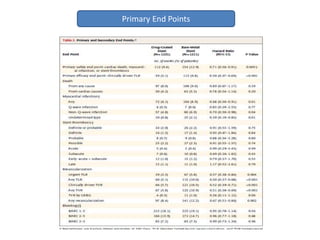
In the LEADERS FREE trial involving patients at high risk for bleeding who
underwent PCI, the rate of the composite primary safety end point of cardiac
death, myocardial infarction, or stent thrombosis was significantly lower with
the BioFreedom polymer-free and carrier-free umirolimus- coated stent than
with a similar baremetal stent.
This result was driven mainly by alower rate of myocardial infarctio In addition
the rate of the primary efficacy end point of clinically driven target-lesion
revascularization was significantly lower with the drug-coated stent than with
the bare-metal stent.
The trial was designed with the intention of enrolling patients who were
considered to be at high risk for bleeding or who were, for any reason, considered
not to be candidates for prolonged use of dual antiplatelet therapy.
As expected in this high-risk population, despite the short course of
dual antiplatelet therapy, the rate of bleeding was high (with 7.2% of
patients meeting criteria for BARC types 3 to 5 bleeding) and was
similar in the two groups
In contrast, the rate of major bleeding ranged from 0.6% to 2.8% during
the first year after PCI in trials that included patients at low-tomoderate
risk who received dual antiplatelet therapy for longer durations.
It is notable that 64% of the trial participants were regarded as being at
high risk for bleeding specifically because of age; many such patients
might not be regarded as requiring a shortened course of dual antiplatelet
therapy in routine clinical practice. Age of 75 years was chosen to define a
population at increased risk for bleeding because this was a frequently
used cutoff value in major trials of bleeding associated with antiplatelet
treatment and in studies focusing on risk factors for bleeding after PCI.
The rate of myocardial infarction was significantly lower in the drug-coated–
stent group than in the bare-metal–stent group. Spontaneous myocardial
infarction (type 1) and myocardial infarction related to in-stent restenosis
(type 4c), as categorized according to the third universal definition of
myocardial infarction, occurred significantly less frequently among patients
with a drug-coated stent
Because routine angiography was not systematically performed, it is likely that
many of the spontaneous myocardial infarctions were also related to in-stent
restenosis, although this uncertainty does not affect the comparison between
treatment groups.
The rate of periprocedural myocardial infarction (type 4a) was low in both
groups, which may be a consequence of the approach taken in
this trial to detect such events. The protocol mandated at least one biomarker
determination during a time window of 18 to 24 hours after PCI, or before
discharge if this occurred earlier.
Rates of definite or probable stent thrombosis in this study were high, although
they are similar to those reported in some “all-comer” trials of drug-eluting
stents as well as in trials of triple therapy or in trials involving patients who were
considered to be uncertain candidates for drug-eluting stents
The rate of stent thrombosis did not differ significantly between
the two groups, and more than half the stent thromboses in both groups
occurred during the first 30 days, when patients were prescribed dual
antiplatelet therapy
These high rates of stent thrombosis may be a consequence of the high risk of
bleeding among the trial participants, because patients at the highest risk for
bleeding are often also at the highest risk for stent thrombosis
Current European guidelines (ESC/EACTS) suggest the use of polymer-coated,
new-generation drug-eluting stents with a 3-month course of dual antiplatelet
therapy as an alternative option for PCI in patients at increased risk for bleeding,
but they stress that this recommendation is based on only limited evidence
These guidelines were not available at the time of trial design, when the
only reference treatment was a bare-metal stent with 1 month of dual
antiplatelet therapy. Further evaluation is warranted of the use of the
polymer-free drug-coated stent in comparison with currently available drug-
eluting stents with a shortened course of dual antiplatelet therapy in patients at
increased risk for bleeding
Patients at high risk for bleeding who underwent PCI received either a polymer-
free umirolimus-coated stent or a baremetal stent, with a 1-month course of
dual antiplatelet therapy
Use of the drug-coated stent, as compared with the bare-metal stent,
was associated with a lower rate of the composite primary safety end point of
cardiac death, myocardial infarction, or stent thrombosis and a lower rate of the
primary efficacy end point of clinically driven target-lesion revascularization.
In Summary
Thank You

Leads free trial)

  • 1.
    Polymer-free Drug-Coated CoronaryStents in Patients at High Bleeding Risk (LEADERS FREE trial) October 14, 2015, NEJM.
  • 2.
    15% of patientsundergoing PCI are at high risk of bleeding Such patients are usually excluded from trials of stents and adjunctive therapy, The default management of their care, supported by current guidelines, favors the use of either a second-generation drug-eluting stent with a shortened course of dual antiplatelet therapy or a bare-metal stent followed by1 month of dual antiplatelet therapy The latter strategy, driven by the need to minimize the risk of bleeding, is associated with a higher risk of restenosis and reintervention than that observed with the use of a drug-eluting stent.
  • 3.
    A polymer-free andcarrier-free drug-coated stent, the BioFreedom stent (Biosensors Europe), has been developed that transfers umirolimus (also known as biolimus A9), a highly lipophilic sirolimus analogue, into the vessel wall over a period of 1 month In a preclinical study, the umirolimus-coated stent showed less neointimal proliferation and inflammation at 180 days than did a sirolimus-eluting stent. In a first-in-human evaluation, the umirolimus-coated stent was noninferior to a paclitaxel-eluting stent with respect to in-stent late lumen loss at 12 months.
  • 4.
    The Prospective RandomizedComparison of the BioFreedom Biolimus A9 Drug-Coated Stent versus the Gazelle Bare-Metal Stent in Patients at High Bleeding Risk (LEADERS FREE) trial was designed to evaluate the efficacy and safety of the polymer-free umirolimus-coated stent as compared with a bare-metal stent in patients with increased bleeding risk, with a 1-month regimen of dual antiplatelet therapy in both groups.
  • 5.
    Methods The LEADERS FREEtrial is an ongoing randomized, double-blind clinical trial conducted at 68 sites in 20 countries on 4 continents The trial was sponsored by Biosensors Europe (Morges, Switzerland)
  • 6.
    Study Population Eligible patientshad coronary artery disease with a clinical indication for PCI. In addition, participants were required to meet one or more of the criteria listed in Table 1. These criteria were chosen to define a population of patients who had increased bleeding risk or who were otherwise considered by the investigator to be candidates for implantation of a bare-metal stent instead of a drug-eluting stent, owing to the perceived need to terminate dual antiplatelet therapy at 1 month.
  • 8.
    Study Procedures Patients wererandomly assigned in a 1:1 ratio to undergo PCI with the BioFreedom polymer-free umirolimus-coated stent or a similar bare-metal stent (the Gazelle stent, Biosensors Interventional Technologies, Singapore). Randomization was performed with the use of either a Web-based system or a telephone interactive voice-response system (both from Merge Healthcare) in blocks of 16 with no stratification
  • 9.
    Patients were enrolledafter the guidewire had crossed the first target lesion, and PCI was performed according to standard techniques Vascular access, periprocedural antithrombotic regimen, and lesion preparation were left to the operator’s preferance All target lesions were treated with at least one study stent. Staged procedures were permitted within 1 week after the index procedure; all the stents used were of the assigned type
  • 10.
    The protocol mandatedthat all patients receive both aspirin (75 to 250 mg once daily) and a P2Y12 inhibitor (with clopidogrel, 75 to 150 mg once daily, being the preferred agent) for 30 days, followed by a single antiplatelet agent thereafter (aspirin preferred). Patients who were discharged while receiving a vitamin K antagonist could receive either triple therapy or the vitamin K antagonist plus clopidogrel (without aspirin) during the first 30 days.
  • 11.
    A patient follow-upvisit was performed at the study center at 30 days (time window, 23 to 37 days), when the change from dual antiplatelet therapy to single antiplatelet therapy was prescribed, and again at 360 days Further contacts, either on site or by telephone, were made at 60, 120, and 720 days. Ischemia testing and angiographic evaluation during follow-up were not mandated by the protocol and were left to the discretion of the investigator.
  • 12.
    Study End Points Theprimary safety end point was the cumulative incidence of a composite of cardiac death, myocardial infarction, or definite or probable stent thrombosis at 390 days The primary efficacy end point was the incidence of clinically driven target lesion revascularization at 390 days. Other end points included bleeding, target-vessel revascularization, and indexes of technical procedural success. Primary end-point events and bleeding events were recorded for up to 390 days in order to capture any events occurring soon after (and as a consequence of) the planned 1-year visit.
  • 13.
    Statistical Analysis The compositeprimary safety end point was evaluated with the use of a noninferiority analysis.The predicted 1-year incidence was 8% for this end point in the bare-metal–stent group. Noninferiority was to be declared if the upper limit of the one-sided 97.5% confidence interval of the difference in event rates between the two groups at 1 year was less than 3.2 percentage points. For the primary efficacy end point of clinically driven target-lesion revascularization, the predicted event rate was of 10% at 1 year in the bare- metal–stent group. Using a two-sided type I error rate of 5% and allowing for a rate of loss to follow-up of up to 8%, we determined that 1228 patients per group would provide more than 80% power to detect an absolute difference of 3.3 percentage points in the rate of clinically driven target-lesion revascularization between study groups.
  • 14.
  • 15.
    A total of2466 patients underwent randomization (1239 were assigned to the polymer-free umirolimus-coated stent and 1227 were assigned to the bare-metal stent) from December 2012 through May 2014. The patient population was characterized by advanced age and major coexisting conditions indicative of increased bleeding risk Patients had a mean of 1.7 inclusion criteria, and the two groups were well balanced with respect to baseline characteristics
  • 16.
  • 17.
    DISCUSSION In the LEADERSFREE trial involving patients at high risk for bleeding who underwent PCI, the rate of the composite primary safety end point of cardiac death, myocardial infarction, or stent thrombosis was significantly lower with the BioFreedom polymer-free and carrier-free umirolimus- coated stent than with a similar baremetal stent. This result was driven mainly by alower rate of myocardial infarctio In addition the rate of the primary efficacy end point of clinically driven target-lesion revascularization was significantly lower with the drug-coated stent than with the bare-metal stent. The trial was designed with the intention of enrolling patients who were considered to be at high risk for bleeding or who were, for any reason, considered not to be candidates for prolonged use of dual antiplatelet therapy.
  • 18.
    As expected inthis high-risk population, despite the short course of dual antiplatelet therapy, the rate of bleeding was high (with 7.2% of patients meeting criteria for BARC types 3 to 5 bleeding) and was similar in the two groups In contrast, the rate of major bleeding ranged from 0.6% to 2.8% during the first year after PCI in trials that included patients at low-tomoderate risk who received dual antiplatelet therapy for longer durations. It is notable that 64% of the trial participants were regarded as being at high risk for bleeding specifically because of age; many such patients might not be regarded as requiring a shortened course of dual antiplatelet therapy in routine clinical practice. Age of 75 years was chosen to define a population at increased risk for bleeding because this was a frequently used cutoff value in major trials of bleeding associated with antiplatelet treatment and in studies focusing on risk factors for bleeding after PCI.
  • 19.
    The rate ofmyocardial infarction was significantly lower in the drug-coated– stent group than in the bare-metal–stent group. Spontaneous myocardial infarction (type 1) and myocardial infarction related to in-stent restenosis (type 4c), as categorized according to the third universal definition of myocardial infarction, occurred significantly less frequently among patients with a drug-coated stent Because routine angiography was not systematically performed, it is likely that many of the spontaneous myocardial infarctions were also related to in-stent restenosis, although this uncertainty does not affect the comparison between treatment groups. The rate of periprocedural myocardial infarction (type 4a) was low in both groups, which may be a consequence of the approach taken in this trial to detect such events. The protocol mandated at least one biomarker determination during a time window of 18 to 24 hours after PCI, or before discharge if this occurred earlier.
  • 20.
    Rates of definiteor probable stent thrombosis in this study were high, although they are similar to those reported in some “all-comer” trials of drug-eluting stents as well as in trials of triple therapy or in trials involving patients who were considered to be uncertain candidates for drug-eluting stents The rate of stent thrombosis did not differ significantly between the two groups, and more than half the stent thromboses in both groups occurred during the first 30 days, when patients were prescribed dual antiplatelet therapy These high rates of stent thrombosis may be a consequence of the high risk of bleeding among the trial participants, because patients at the highest risk for bleeding are often also at the highest risk for stent thrombosis
  • 21.
    Current European guidelines(ESC/EACTS) suggest the use of polymer-coated, new-generation drug-eluting stents with a 3-month course of dual antiplatelet therapy as an alternative option for PCI in patients at increased risk for bleeding, but they stress that this recommendation is based on only limited evidence These guidelines were not available at the time of trial design, when the only reference treatment was a bare-metal stent with 1 month of dual antiplatelet therapy. Further evaluation is warranted of the use of the polymer-free drug-coated stent in comparison with currently available drug- eluting stents with a shortened course of dual antiplatelet therapy in patients at increased risk for bleeding
  • 22.
    Patients at highrisk for bleeding who underwent PCI received either a polymer- free umirolimus-coated stent or a baremetal stent, with a 1-month course of dual antiplatelet therapy Use of the drug-coated stent, as compared with the bare-metal stent, was associated with a lower rate of the composite primary safety end point of cardiac death, myocardial infarction, or stent thrombosis and a lower rate of the primary efficacy end point of clinically driven target-lesion revascularization. In Summary
  • 23.