AUTOMATION
Automation is basically the delegation of
human control functions to technical
equipment aimed towards achieving:
Higher productivity.
Superior quality of end product.
Efficient usage of energy and raw
materials.
Improved safety in working conditions
etc.
INDUSTRIAL AUTOMATION
The use of Computerized or robotic devices to complete
manufacturing tasks.
CONTROL SYSTEM
FIELD
INSTRUMENT
HARDWARE
CONTROL
SOFTWARE
CONTROL
PLANT
DEVELOPMENT OF CONTROL SYSTEM
 Manual control
 Pneumatic control
 Hard wired logic control
 Electronics control
 PLC control.
PLC(PROGRAMMABLE LOGIC CONTROLLER)
 Programmable Logic Controller (PLC) is an industrial computer that
monitors inputs, makes decisions based on its program and controls
outputs to automate a process or machine.
The automation of many different processes, such as controlling machines
or factory assembly lines, is done through the use of small computers called
a programmable logic controllers (PLCs).
PLC Origin
• Developed to replace relays in the late 1960s
• Costs dropped and became popular by 1980s
• Now used in many industrial designs
WHY PLC?
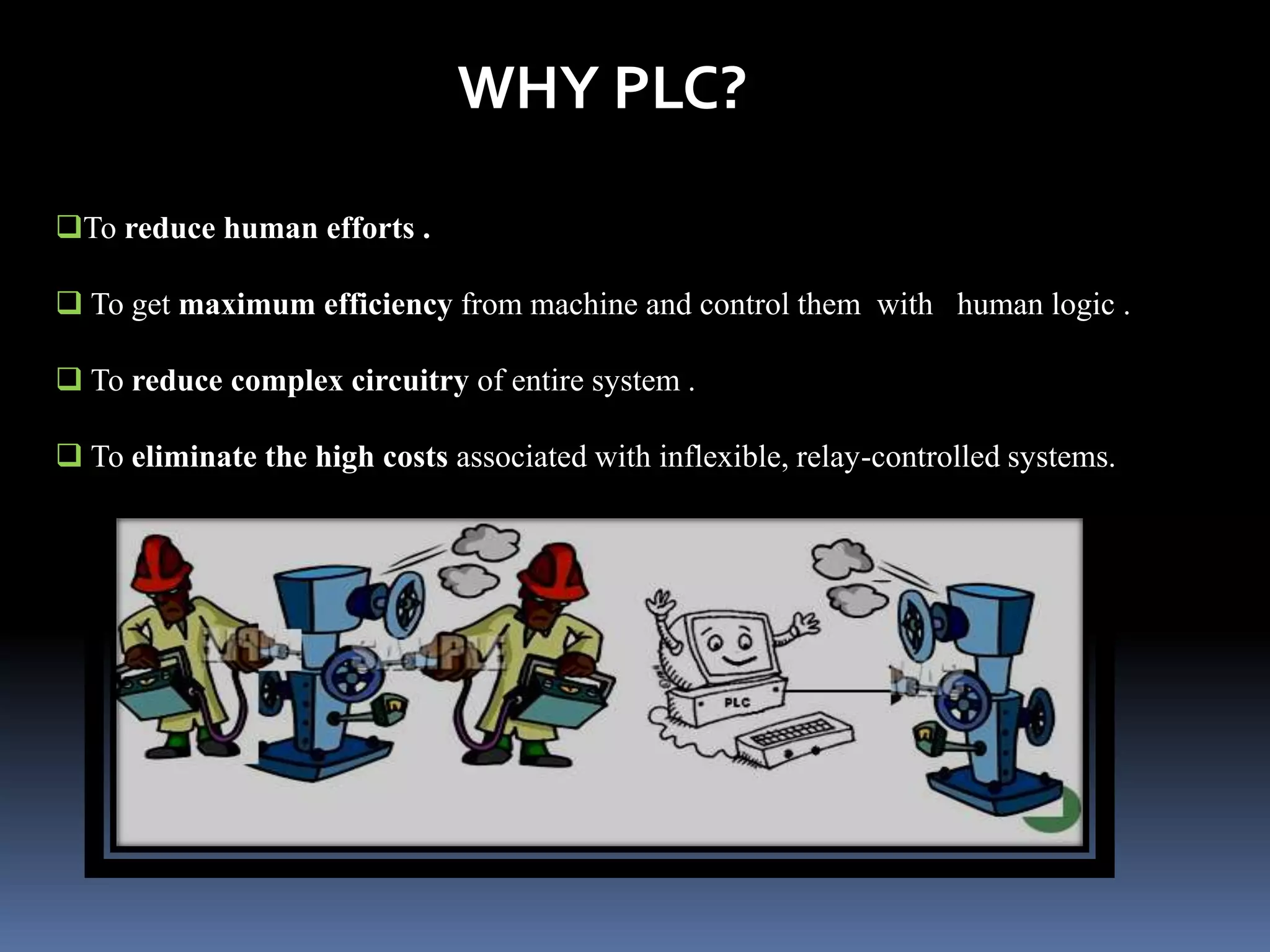
To reduce human efforts .
 To get maximum efficiency from machine and control them with human logic .
 To reduce complex circuitry of entire system .
 To eliminate the high costs associated with inflexible, relay-controlled systems.
Areas of Application
Manufacturing / Machining
 Food / Beverage
 Metals
 Power
 Mining
 Petrochemical / Chemical
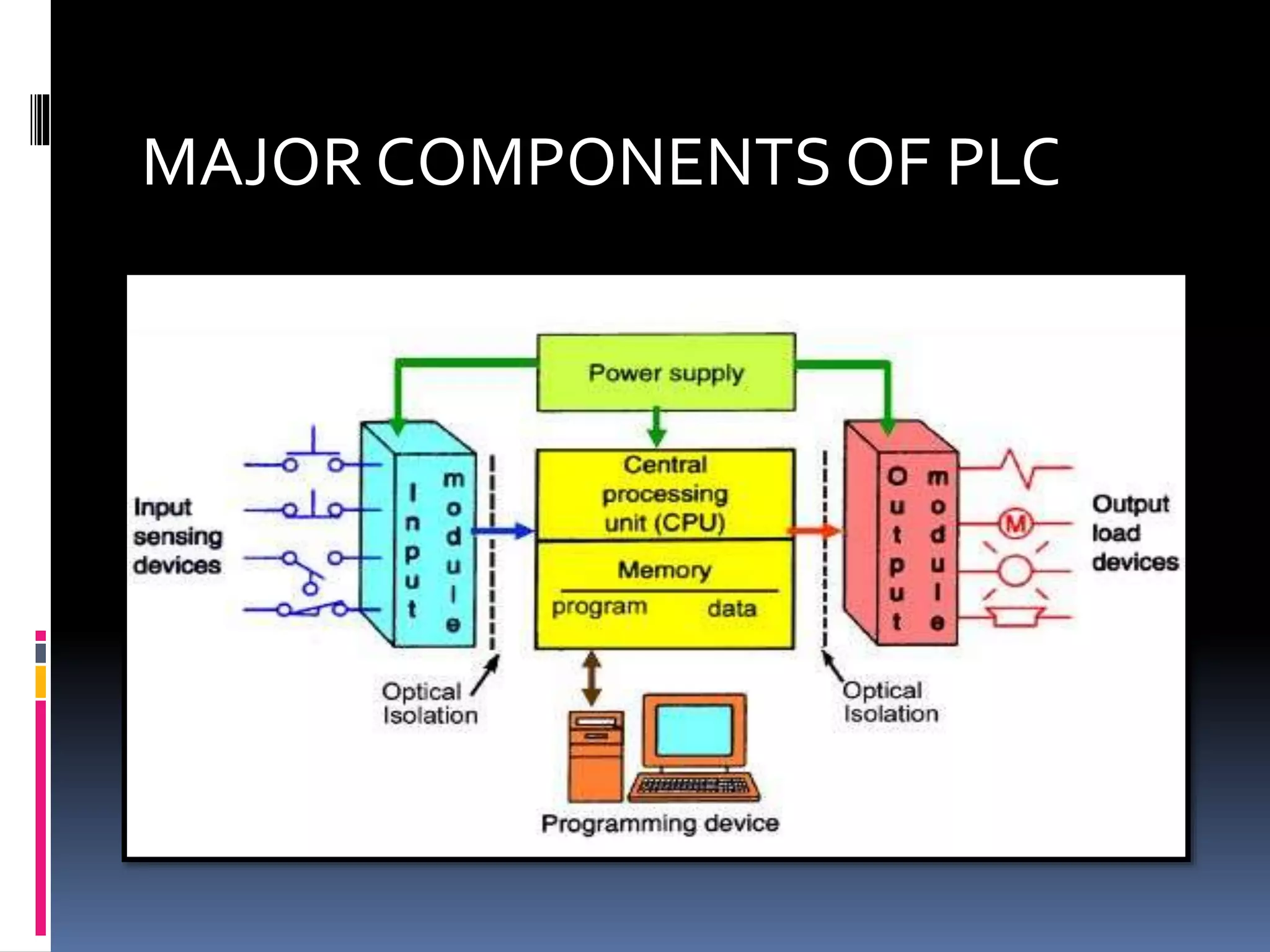
MAJOR COMPONENTS OF PLC
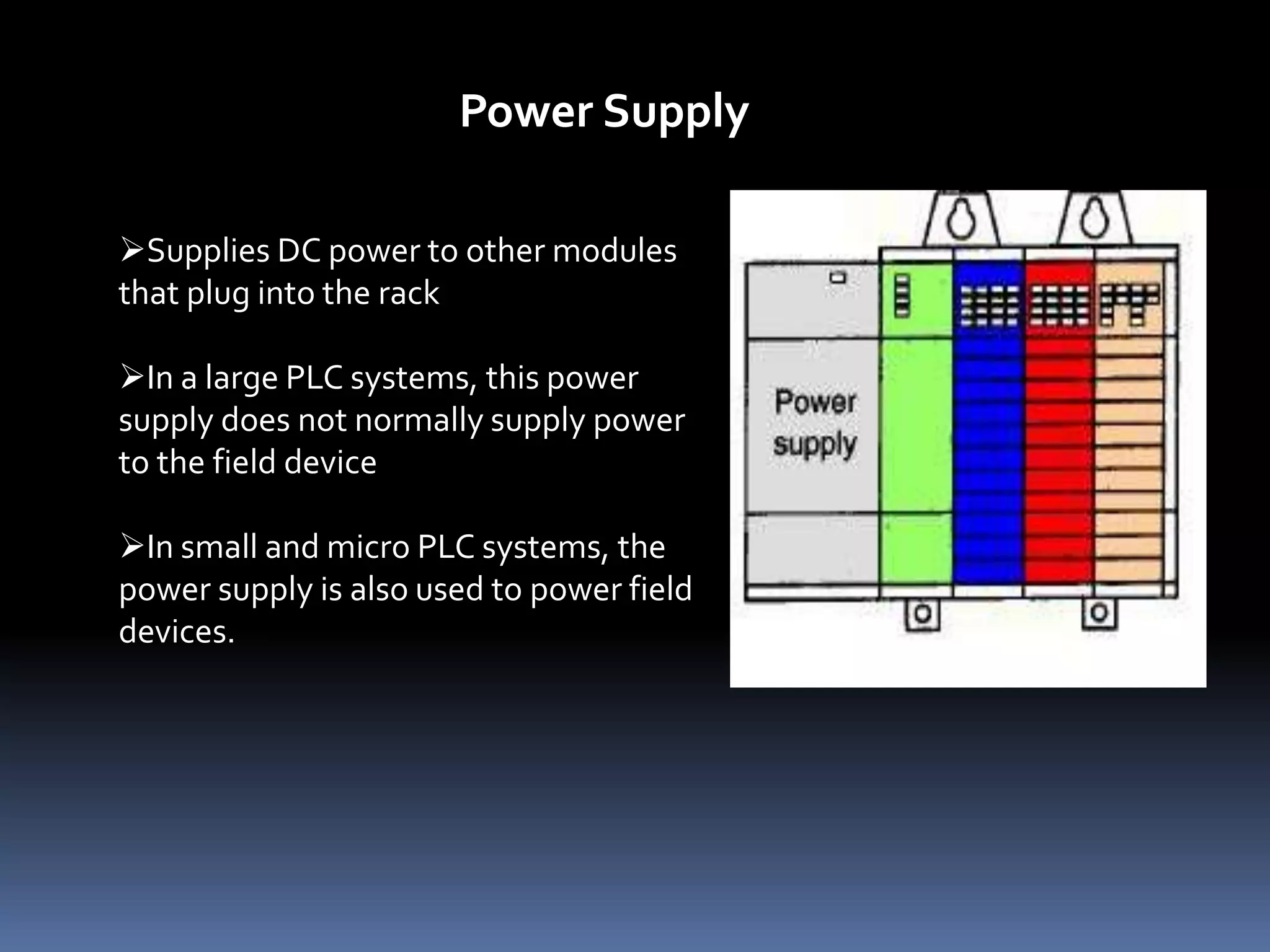
Supplies DC power to other modules
that plug into the rack
In a large PLC systems, this power
supply does not normally supply power
to the field device
In small and micro PLC systems, the
power supply is also used to power field
devices.
Power Supply
CENTRAL PROCESSING UNIT(CPU)
It is the brain of PLC and governs the activities of the entire PLC
systems
 The CPU consists of following blocks :
Arithmetic Logic Unit (ALU),
Internal memory of CPU
Internal timers ,counters and Flags .
 The various operations performed are :
Program execution
Peripheral and External device communication,
Data handling and self diagnostics.
MEMORY
 It is the component that stores information, programs and data in a PLC.
Types of memories
used in PLCs are;
read only memory (ROM)
random access memory (RAM).
Programmable Read Only Memory (PROM)
EPROM Erasable Programmable Read Only Memory (EPROM)
Programming Device
A personal computer(PC) is the most commonly used programming device
The software allows users to create, edit, modify, and troubleshoot the program.
The personal computer communicates with the PLC processor via a serial or
parallel data communication link.
Software for PLC Programming:
1. PL7 4.4
2. Win pro ladder
Input/Output Section
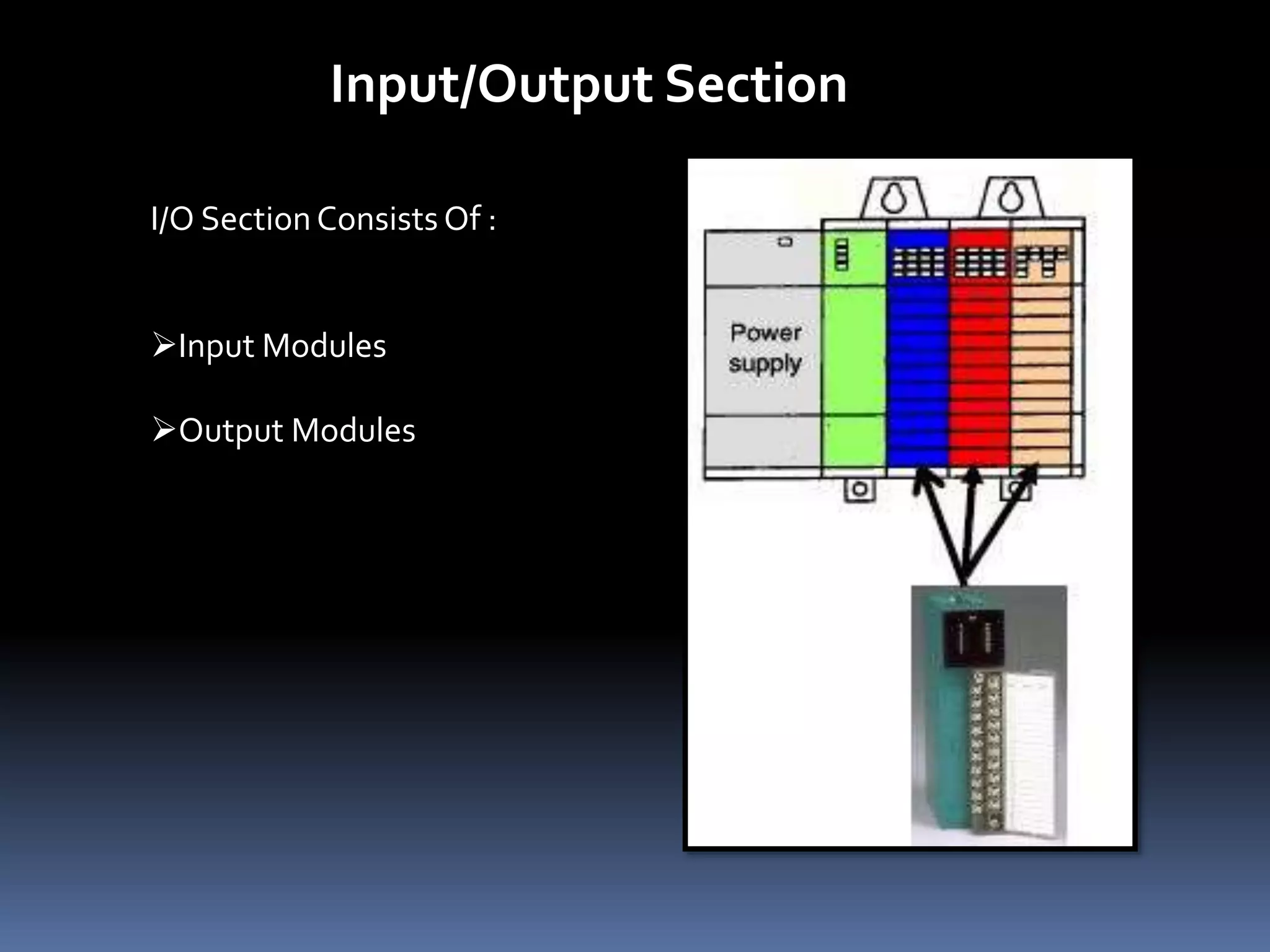
I/O SectionConsists Of :
Input Modules
Output Modules
Accepts and converts signals from
sensors into a logic signal
Forms the interface by which
input devices are connected to the
controller.
Input device is physically wired
into the system.
Like temperature sensor, water
level sensor, pressure sensor.
Input Module
That convert control instructions a signal that
can be used by actuators.
Ex. : lamps, alarm.
Forms the interface by which output field
device are connected to the controller.
PLC employ an optical isolator which uses light
to electrically isolate the internal components
from the output terminal.
Output Module
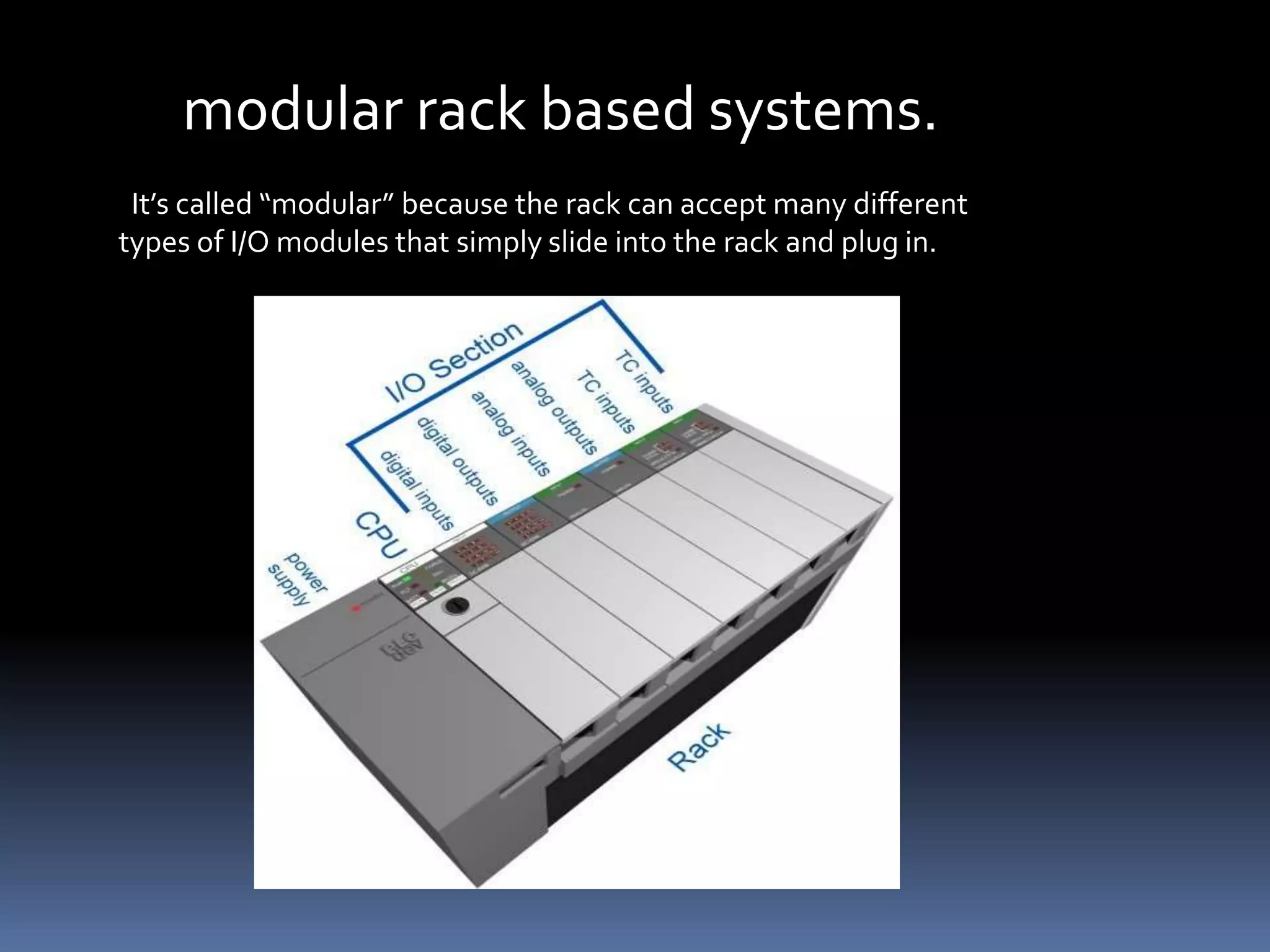
modular rack based systems.
It’s called “modular” because the rack can accept many different
types of I/O modules that simply slide into the rack and plug in.
PLC
INPUTS
CONTACTOR
PUSHBUTTONS
OUTPUTS
MOTOR
LAMP
I/O MODULES
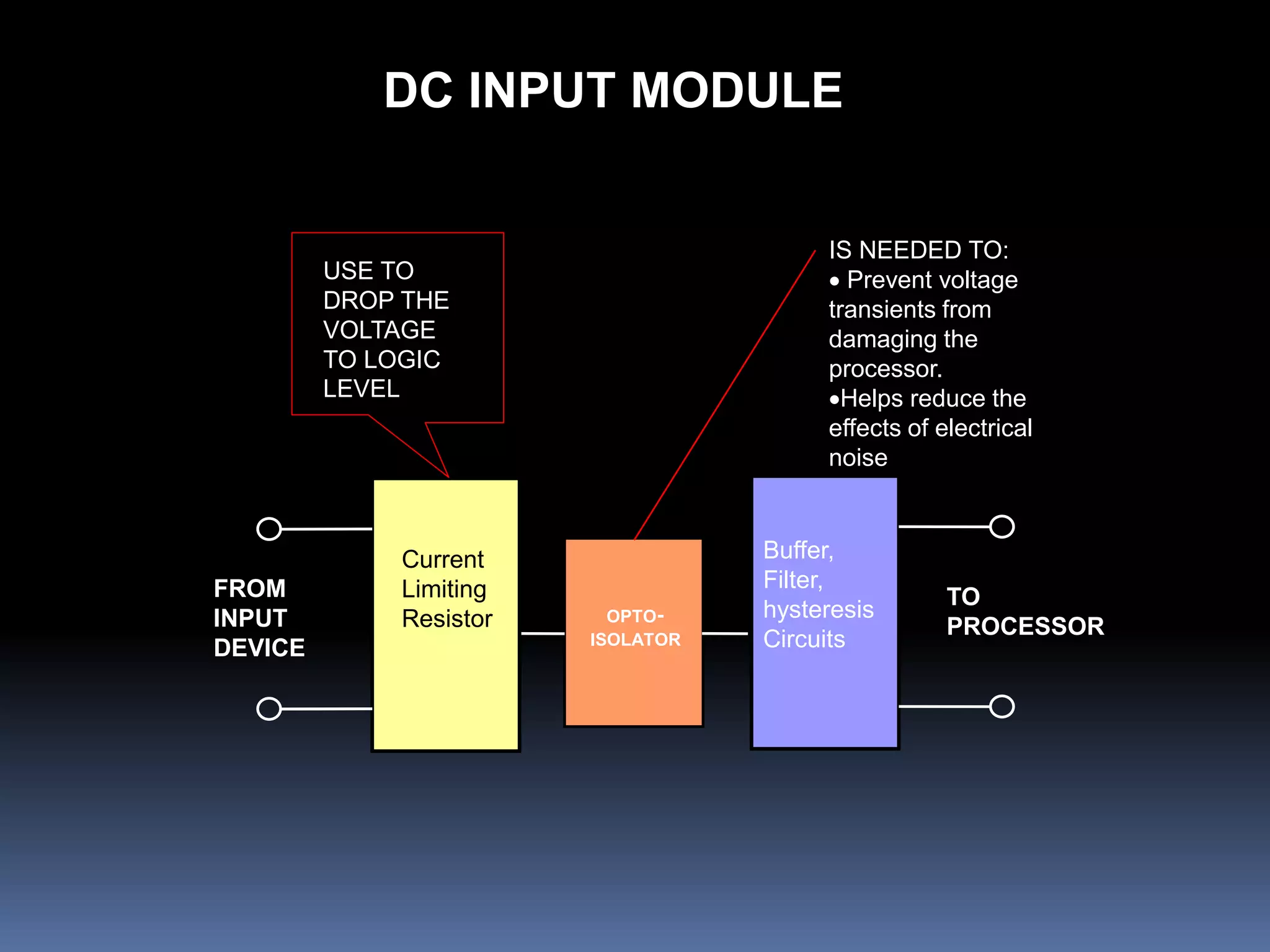
DC INPUT MODULE
OPTO-
ISOLATOR
IS NEEDED TO:
 Prevent voltage
transients from
damaging the
processor.
Helps reduce the
effects of electrical
noise
Buffer,
Filter,
hysteresis
Circuits
TO
PROCESSOR
Current
Limiting
Resistor
FROM
INPUT
DEVICE
USE TO
DROP THE
VOLTAGE
TO LOGIC
LEVEL
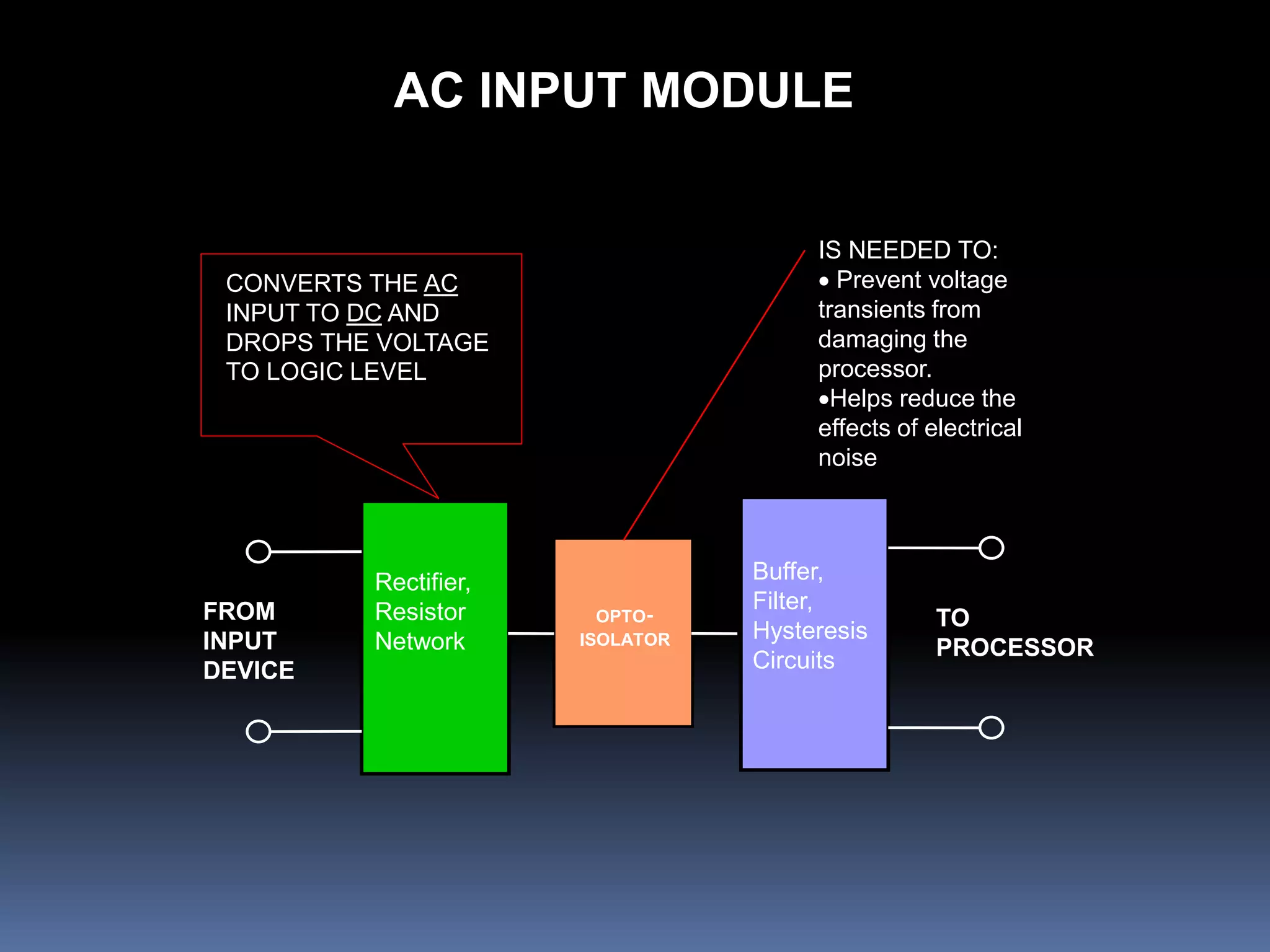
Rectifier,
Resistor
Network
FROM
INPUT
DEVICE
CONVERTS THE AC
INPUT TO DC AND
DROPS THE VOLTAGE
TO LOGIC LEVEL
OPTO-
ISOLATOR
IS NEEDED TO:
 Prevent voltage
transients from
damaging the
processor.
Helps reduce the
effects of electrical
noise
Buffer,
Filter,
Hysteresis
Circuits
TO
PROCESSOR
AC INPUT MODULE
DC / AC OUTPUT MODULE
TTL
Circuits
FROM
PROCESSOR
OPTO-
ISOLATOR
IS NEEDED TO:
 Prevent voltage
transients from
damaging the
processor.
Helps reduce the
effects of electrical
noise
Amplifier
RELAY
TO
OUTPUT
DEVICE
(TTL)Transistor-Transistor logic is a class of digital circuits built from
bipolar junction transistors and resistors
Discrete / Digital Input
An input that is either ON or OFF are connected to the PLC
digital input.
In the ON condition it is referred to as logic 1 or a logic high and
in the OFF condition maybe referred to as logic o or logic low.
NormallyOpen Pushbutton
Normally Closed Pushbutton
NormallyOpen switch
Normally Closed switch
NormallyOpen contact
Normally closed contact
Discrete / Digital Input
Digital Output
A discrete output is either in an ON or OFF condition.
Solenoids, contactors coils, lamps are example of devices connected to
the Discrete or digital outputs.
The lamp can be turned ON or OFF by the PLC output it is connected to.
Analog Input
An input signal that has a continuous signal.
Typical inputs may vary from 0 to 20mA, 4 to 20mA or 0 to10V.
A level transmitter monitors the level of liquid in the tank. Depending on
the level , the signal to the PLC can either increase or decrease as the
level increases or decreases.
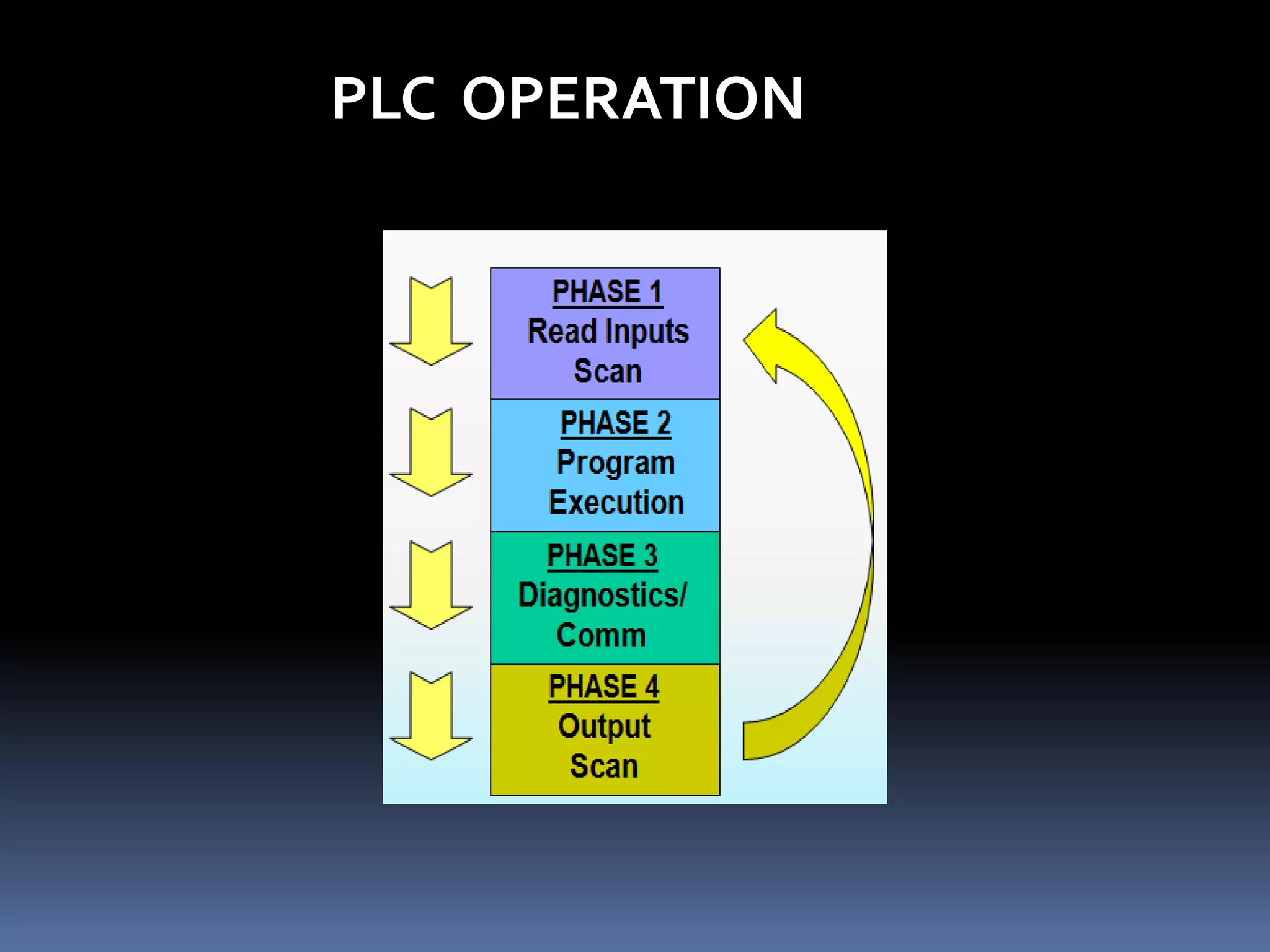
PLC OPERATION
PHASE 1 – Input Status scan
A PLC scan cycle begins with the CPU reading the status of its
inputs.
The process of sequentially reading the inputs, executing the
program in memory, and updating the outputs is known as scanning.
PHASE 2– Logic Solve/Program Execution
The application program is executed using the status of the inputs
PHASE 3– Logic Solve/Program Execution
Once the program is executed, the CPU performs diagnostics and
communication tasks
PHASE 4 - Output Status Scan
•An output status scan is then performed, whereby the stored output
values are sent to actuators and other field output devices. The cycle ends
by updating the outputs.
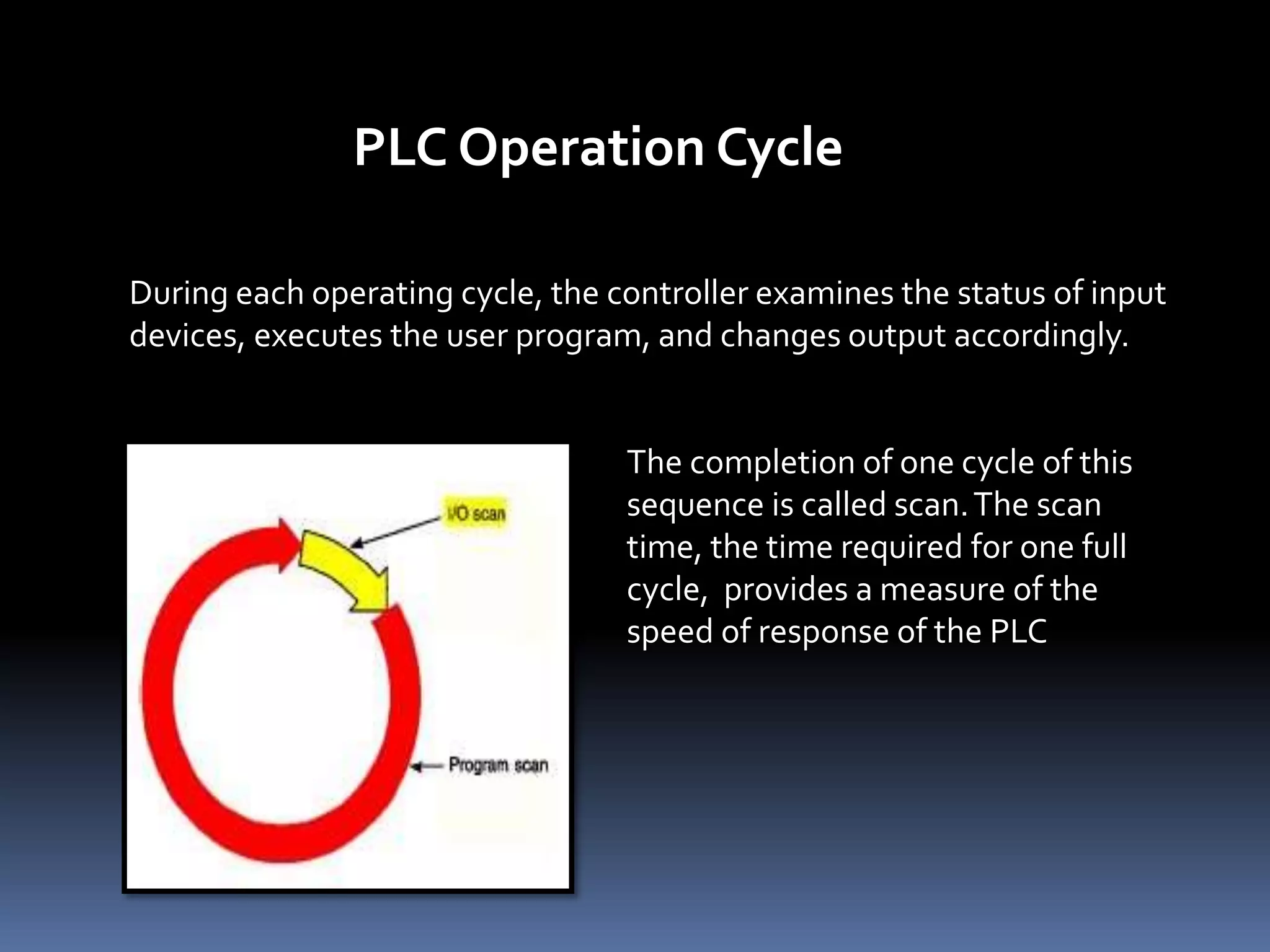
PLC Operation Cycle
During each operating cycle, the controller examines the status of input
devices, executes the user program, and changes output accordingly.
The completion of one cycle of this
sequence is called scan.The scan
time, the time required for one full
cycle, provides a measure of the
speed of response of the PLC
PLC PROGRAMMING
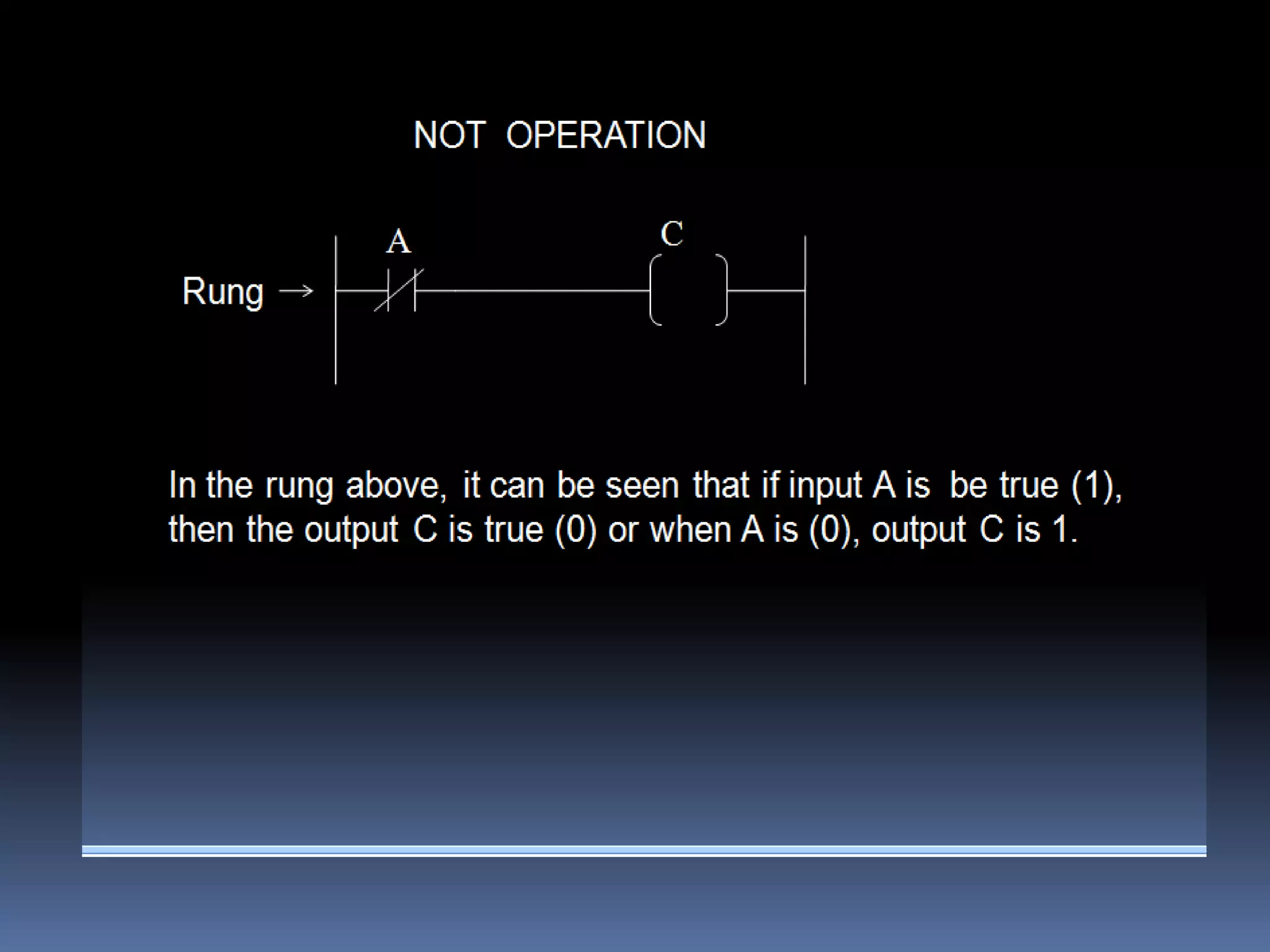
 Ladder logic is widely used to program PLCs,
where sequential control of a process or
manufacturing operation is required.
 useful for simple but critical control systems
or for reworking old hardwired relay circuits
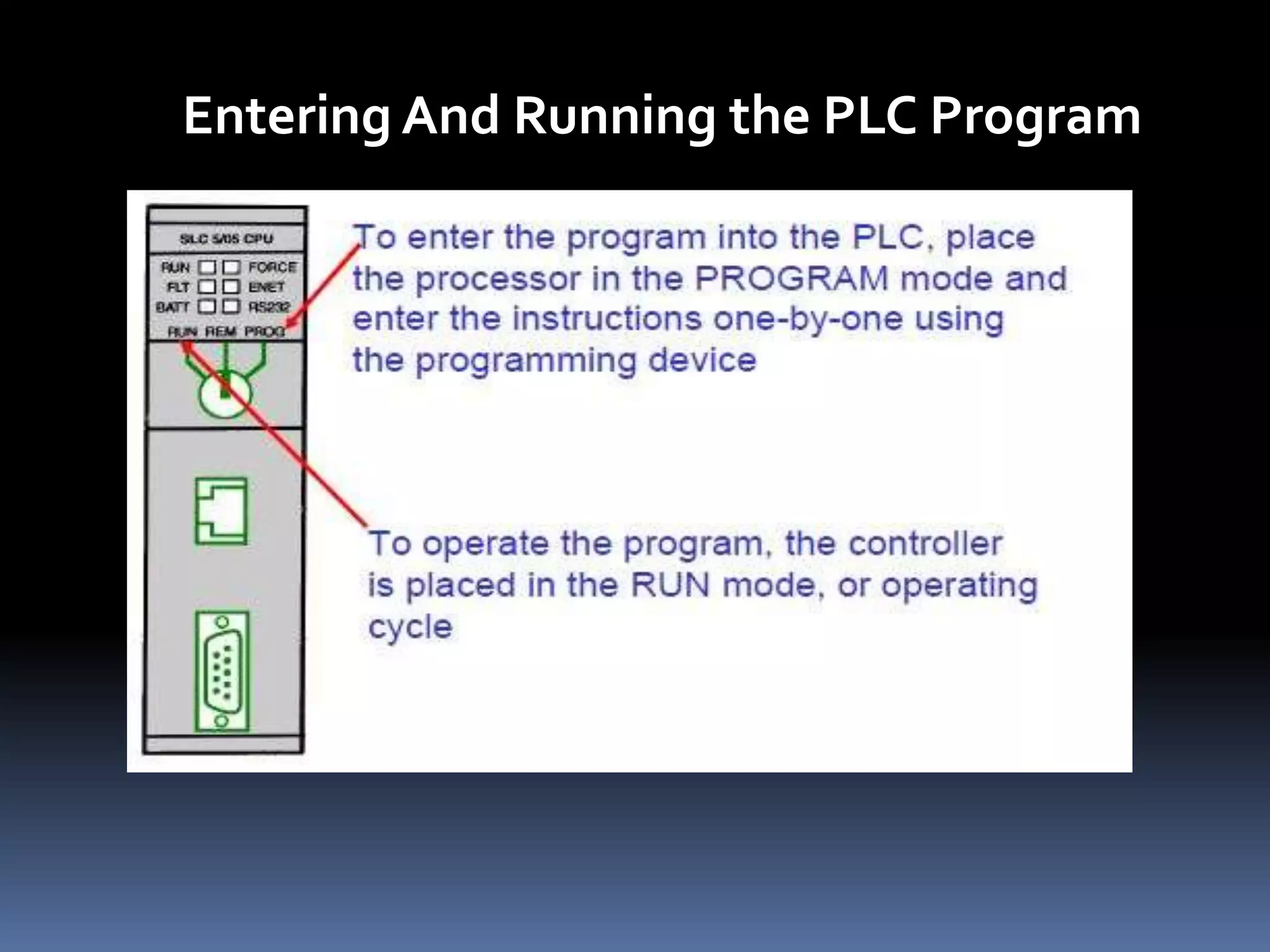
Entering And Running the PLC Program
Practical Example
Mixer Process Control
Problem
Mixer Motor to automatically stir the liquid in
the vat when the temperature and pressure
reach at preset value
Alternate manual pushbutton control to
start/stop motor manually.
The temperature and pressure sensors
switches close their respective contacts when
condition fulfill.
Sensors Connection
Here , Water level sensor and Hydrostatic sensor
connected to PLC and transmit different types of signal
to PLC
Human Machine Interface
This device is used for:
Manually control PLC
Monitor device activity in different level
ADVANTAGES
Replacing Human Operators
Dangerous Environments
Beyond Human Capabilities
 Fast
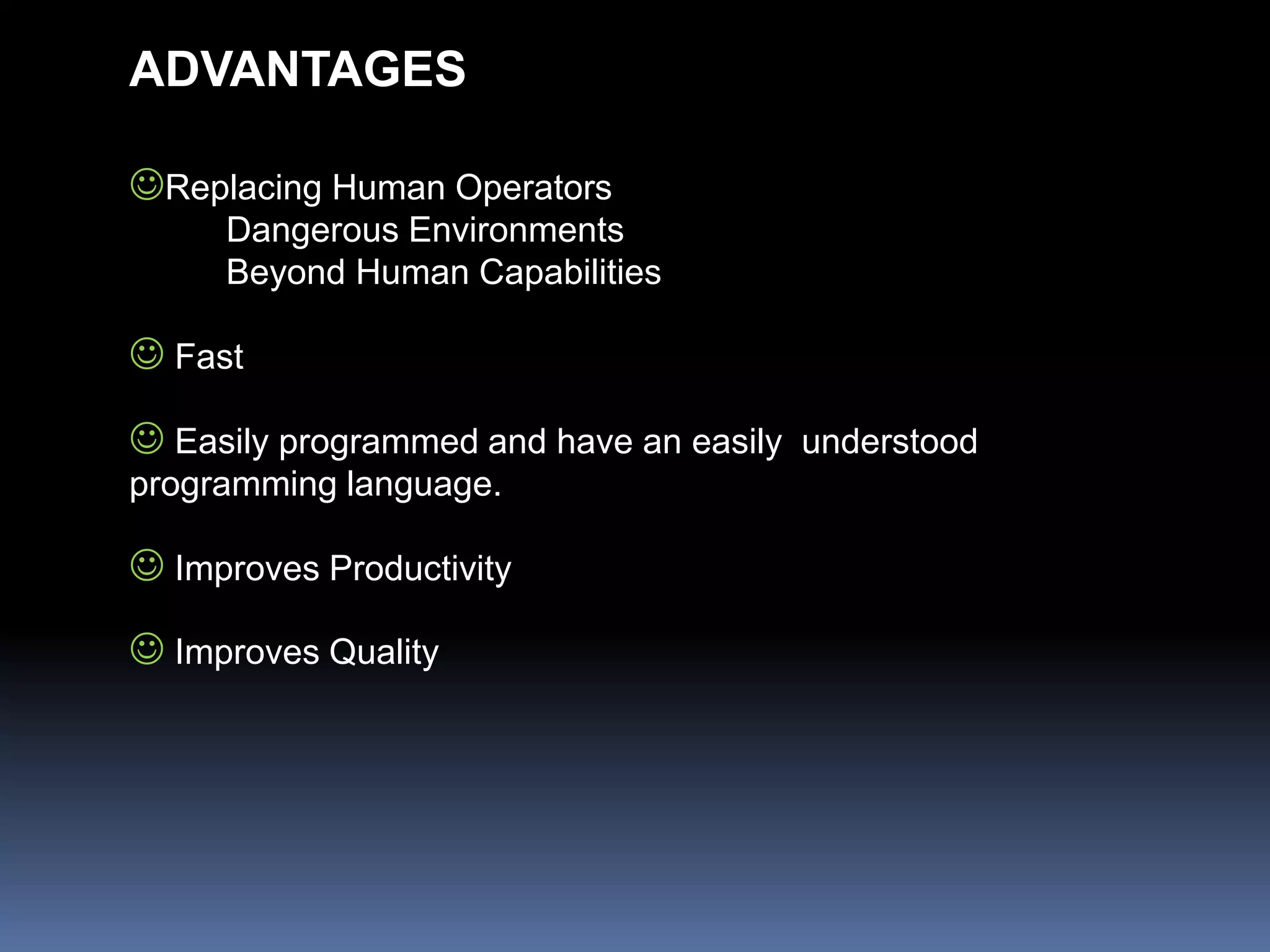
 Easily programmed and have an easily understood
programming language.
 Improves Productivity
 Improves Quality
DISADVANTAGES
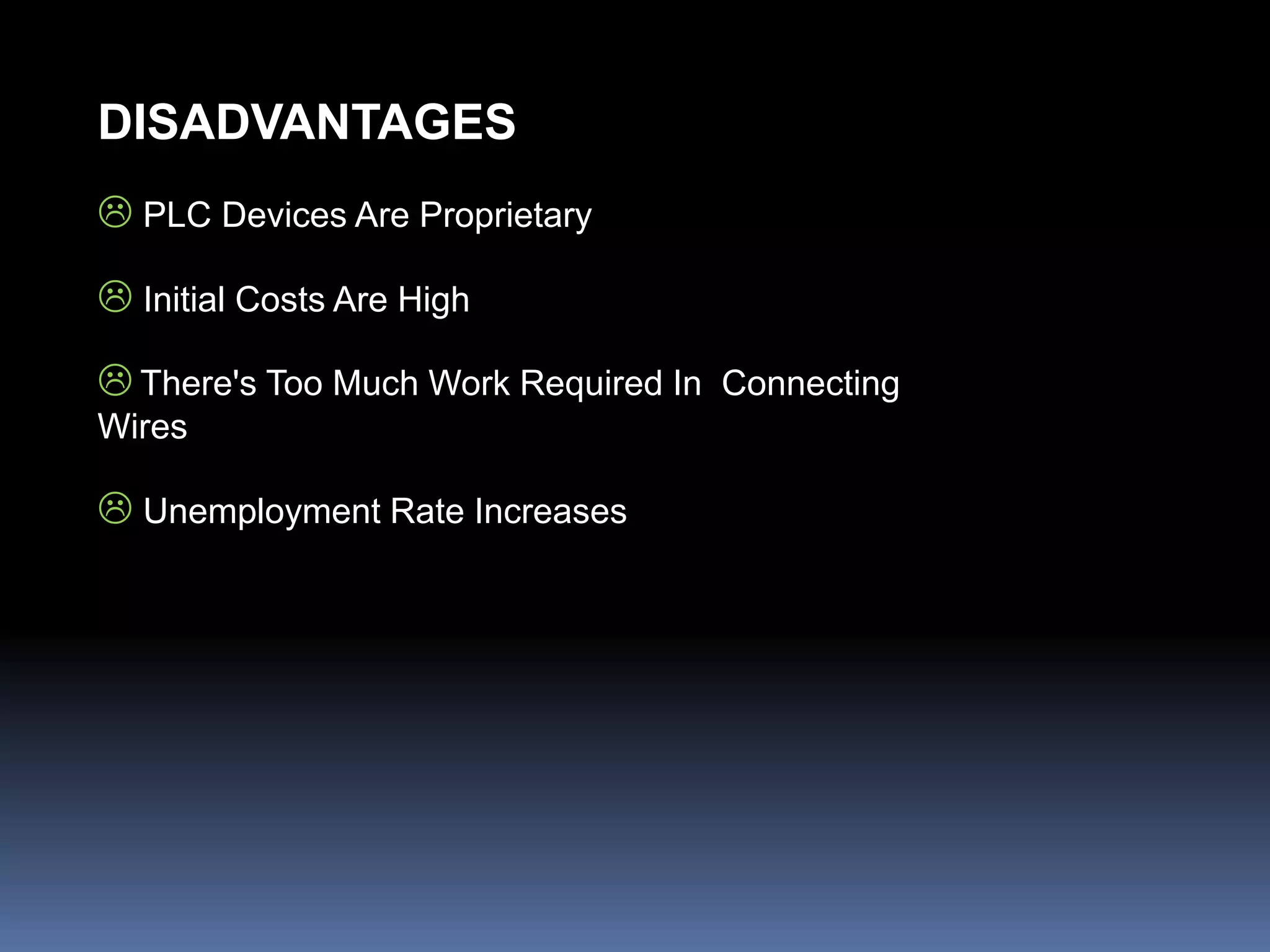
 PLC Devices Are Proprietary
 Initial Costs Are High
 There's Too Much Work Required In Connecting
Wires
 Unemployment Rate Increases
Ipc presentation

Ipc presentation

  • 1.
    AUTOMATION Automation is basicallythe delegation of human control functions to technical equipment aimed towards achieving: Higher productivity. Superior quality of end product. Efficient usage of energy and raw materials. Improved safety in working conditions etc.
  • 2.
    INDUSTRIAL AUTOMATION The useof Computerized or robotic devices to complete manufacturing tasks. CONTROL SYSTEM FIELD INSTRUMENT HARDWARE CONTROL SOFTWARE CONTROL PLANT
  • 3.
    DEVELOPMENT OF CONTROLSYSTEM  Manual control  Pneumatic control  Hard wired logic control  Electronics control  PLC control.
  • 4.
    PLC(PROGRAMMABLE LOGIC CONTROLLER) Programmable Logic Controller (PLC) is an industrial computer that monitors inputs, makes decisions based on its program and controls outputs to automate a process or machine. The automation of many different processes, such as controlling machines or factory assembly lines, is done through the use of small computers called a programmable logic controllers (PLCs).
  • 5.
    PLC Origin • Developedto replace relays in the late 1960s • Costs dropped and became popular by 1980s • Now used in many industrial designs
  • 6.
    WHY PLC? To reducehuman efforts .  To get maximum efficiency from machine and control them with human logic .  To reduce complex circuitry of entire system .  To eliminate the high costs associated with inflexible, relay-controlled systems.
  • 7.
    Areas of Application Manufacturing/ Machining  Food / Beverage  Metals  Power  Mining  Petrochemical / Chemical
  • 8.
  • 9.
    Supplies DC powerto other modules that plug into the rack In a large PLC systems, this power supply does not normally supply power to the field device In small and micro PLC systems, the power supply is also used to power field devices. Power Supply
  • 10.
    CENTRAL PROCESSING UNIT(CPU) Itis the brain of PLC and governs the activities of the entire PLC systems  The CPU consists of following blocks : Arithmetic Logic Unit (ALU), Internal memory of CPU Internal timers ,counters and Flags .  The various operations performed are : Program execution Peripheral and External device communication, Data handling and self diagnostics.
  • 11.
    MEMORY  It isthe component that stores information, programs and data in a PLC. Types of memories used in PLCs are; read only memory (ROM) random access memory (RAM). Programmable Read Only Memory (PROM) EPROM Erasable Programmable Read Only Memory (EPROM)
  • 12.
    Programming Device A personalcomputer(PC) is the most commonly used programming device The software allows users to create, edit, modify, and troubleshoot the program. The personal computer communicates with the PLC processor via a serial or parallel data communication link. Software for PLC Programming: 1. PL7 4.4 2. Win pro ladder
  • 13.
    Input/Output Section I/O SectionConsistsOf : Input Modules Output Modules
  • 14.
    Accepts and convertssignals from sensors into a logic signal Forms the interface by which input devices are connected to the controller. Input device is physically wired into the system. Like temperature sensor, water level sensor, pressure sensor. Input Module
  • 15.
    That convert controlinstructions a signal that can be used by actuators. Ex. : lamps, alarm. Forms the interface by which output field device are connected to the controller. PLC employ an optical isolator which uses light to electrically isolate the internal components from the output terminal. Output Module
  • 16.
    modular rack basedsystems. It’s called “modular” because the rack can accept many different types of I/O modules that simply slide into the rack and plug in.
  • 17.
  • 18.
    DC INPUT MODULE OPTO- ISOLATOR ISNEEDED TO:  Prevent voltage transients from damaging the processor. Helps reduce the effects of electrical noise Buffer, Filter, hysteresis Circuits TO PROCESSOR Current Limiting Resistor FROM INPUT DEVICE USE TO DROP THE VOLTAGE TO LOGIC LEVEL
  • 19.
    Rectifier, Resistor Network FROM INPUT DEVICE CONVERTS THE AC INPUTTO DC AND DROPS THE VOLTAGE TO LOGIC LEVEL OPTO- ISOLATOR IS NEEDED TO:  Prevent voltage transients from damaging the processor. Helps reduce the effects of electrical noise Buffer, Filter, Hysteresis Circuits TO PROCESSOR AC INPUT MODULE
  • 20.
    DC / ACOUTPUT MODULE TTL Circuits FROM PROCESSOR OPTO- ISOLATOR IS NEEDED TO:  Prevent voltage transients from damaging the processor. Helps reduce the effects of electrical noise Amplifier RELAY TO OUTPUT DEVICE (TTL)Transistor-Transistor logic is a class of digital circuits built from bipolar junction transistors and resistors
  • 21.
    Discrete / DigitalInput An input that is either ON or OFF are connected to the PLC digital input. In the ON condition it is referred to as logic 1 or a logic high and in the OFF condition maybe referred to as logic o or logic low. NormallyOpen Pushbutton Normally Closed Pushbutton NormallyOpen switch Normally Closed switch NormallyOpen contact Normally closed contact
  • 22.
  • 23.
    Digital Output A discreteoutput is either in an ON or OFF condition. Solenoids, contactors coils, lamps are example of devices connected to the Discrete or digital outputs. The lamp can be turned ON or OFF by the PLC output it is connected to.
  • 24.
    Analog Input An inputsignal that has a continuous signal. Typical inputs may vary from 0 to 20mA, 4 to 20mA or 0 to10V. A level transmitter monitors the level of liquid in the tank. Depending on the level , the signal to the PLC can either increase or decrease as the level increases or decreases.
  • 26.
  • 27.
    PHASE 1 –Input Status scan A PLC scan cycle begins with the CPU reading the status of its inputs. The process of sequentially reading the inputs, executing the program in memory, and updating the outputs is known as scanning. PHASE 2– Logic Solve/Program Execution The application program is executed using the status of the inputs PHASE 3– Logic Solve/Program Execution Once the program is executed, the CPU performs diagnostics and communication tasks PHASE 4 - Output Status Scan •An output status scan is then performed, whereby the stored output values are sent to actuators and other field output devices. The cycle ends by updating the outputs.
  • 28.
    PLC Operation Cycle Duringeach operating cycle, the controller examines the status of input devices, executes the user program, and changes output accordingly. The completion of one cycle of this sequence is called scan.The scan time, the time required for one full cycle, provides a measure of the speed of response of the PLC
  • 29.
    PLC PROGRAMMING  Ladderlogic is widely used to program PLCs, where sequential control of a process or manufacturing operation is required.  useful for simple but critical control systems or for reworking old hardwired relay circuits
  • 34.
    Entering And Runningthe PLC Program
  • 35.
    Practical Example Mixer ProcessControl Problem Mixer Motor to automatically stir the liquid in the vat when the temperature and pressure reach at preset value Alternate manual pushbutton control to start/stop motor manually. The temperature and pressure sensors switches close their respective contacts when condition fulfill.
  • 36.
    Sensors Connection Here ,Water level sensor and Hydrostatic sensor connected to PLC and transmit different types of signal to PLC
  • 37.
    Human Machine Interface Thisdevice is used for: Manually control PLC Monitor device activity in different level
  • 38.
    ADVANTAGES Replacing Human Operators DangerousEnvironments Beyond Human Capabilities  Fast  Easily programmed and have an easily understood programming language.  Improves Productivity  Improves Quality
  • 39.
    DISADVANTAGES  PLC DevicesAre Proprietary  Initial Costs Are High  There's Too Much Work Required In Connecting Wires  Unemployment Rate Increases