INTRODUCTORY MATHEMATICALINTRODUCTORY MATHEMATICAL
ANALYSISANALYSISFor Business, Economics, and the Life and Social Sciences
©2007 Pearson Education Asia
Chapter 0Chapter 0
Review of AlgebraReview of Algebra
©2007 Pearson Education Asia
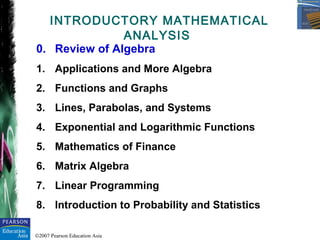
INTRODUCTORY MATHEMATICAL
ANALYSIS
0. Review of Algebra
1. Applications and More Algebra
2. Functions and Graphs
3. Lines, Parabolas, and Systems
4. Exponential and Logarithmic Functions
5. Mathematics of Finance
6. Matrix Algebra
7. Linear Programming
8. Introduction to Probability and Statistics
©2007 Pearson Education Asia
9. Additional Topics in Probability
10. Limits and Continuity
11. Differentiation
12. Additional Differentiation Topics
13. Curve Sketching
14. Integration
15. Methods and Applications of Integration
16. Continuous Random Variables
17. Multivariable Calculus
INTRODUCTORY MATHEMATICAL
ANALYSIS
©2007 Pearson Education Asia
• To be familiar with sets, real numbers, real-number line.
• To relate properties of real numbers in terms of their
operations.
• To review the procedure of rationalizing the
denominator.
• To perform operations of algebraic expressions.
• To state basic rules for factoring.
• To rationalize the denominator of a fraction.
• To solve linear equations.
• To solve quadratic equations.
Chapter 0: Review of Algebra
Chapter ObjectivesChapter Objectives
©2007 Pearson Education Asia
Sets of Real Numbers
Some Properties of Real Numbers
Exponents and Radicals
Operations with Algebraic Expressions
Factoring
Fractions
Equations, in Particular Linear Equations
Quadratic Equations
Chapter 0: Review of Algebra
Chapter OutlineChapter Outline
0.1)
0.2)
0.3)
0.4)
0.5)
0.6)
0.7)
0.8)
©2007 Pearson Education Asia
• A set is a collection of objects.
• An object in a set is called an element of that
set.
• Different type of integers:
• The real-number line is shown as
Chapter 0: Review of Algebra
0.1 Sets of Real Numbers0.1 Sets of Real Numbers
{ }...,3,2,1=integerspositiveofSet
{ }1,2,3..., −−−=integersnegativeofSet
©2007 Pearson Education Asia
• Important properties of real numbers
1. The Transitive Property of Equality
2. The Closure Properties of Addition and
Multiplication
3. The Commutative Properties of Addition
and Multiplication
Chapter 0: Review of Algebra
0.2 Some Properties of Real Numbers0.2 Some Properties of Real Numbers
.then,andIf cacbba ===
.and
numbersrealuniquearetherenumbers,realallFor
abba +
baababba =+=+ and
©2007 Pearson Education Asia
4. The Commutative Properties of Addition
and Multiplication
5. The Identity Properties
6. The Inverse Properties
7. The Distributive Properties
Chapter 0: Review of Algebra
0.2 Some Properties of Real Numbers
( ) ( ) ( ) ( )cabbcacbacba =++=++ and
aaaa ==+ 1and0
( ) 0=−+ aa 11
=⋅ −
aa
( ) ( ) cabaacbacabcba +=++=+ and
©2007 Pearson Education Asia
Chapter 0: Review of Algebra
0.2 Some Properties of Real Numbers
Example 1 – Applying Properties of Real Numbers
Example 3 – Applying Properties of Real
Numbers
( ) ( )
( ) ( )354543b.
2323a.
⋅=⋅
+−=+− xwzywzyxSolution:
a. Show that
Solution:
.0for ≠





= c
c
b
a
c
ab
( ) 





=





⋅=⋅=
c
b
a
c
ba
c
ab
c
ab 11
©2007 Pearson Education Asia
Chapter 0: Review of Algebra
0.2 Some Properties of Real Numbers
Example 3 – Applying Properties of Real Numbers
b. Show that
Solution:
.0for
c
b
≠+=
+
c
c
a
c
ba
( )
c
b
c
a
c
ba
c
ba 111
⋅+⋅=+=
+
c
b
c
a
c
ba
c
b
c
a
c
b
c
a
+=
+
+=⋅+⋅
11
©2007 Pearson Education Asia
• Properties:
Chapter 0: Review of Algebra
0.3 Exponents and Radicals0.3 Exponents and Radicals
14.
1
3.
0for
11
2.
1.
0
=
=
≠
⋅⋅
==
⋅⋅=
−
−
x
x
x
x
xxxxx
x
xxxxx
n
n
factorsn
n
n
factorsn
n
 
 
n
x
exponent
base
©2007 Pearson Education Asia
Chapter 0: Review of Algebra
0.3 Exponents and Radicals
Example 1 – Exponents
xx
π
=
=−==
==
==






=























=





1
000
5
5-
5
5-
4
e.
1)5(,1,12d.
2433
3
1
c.
243
1
3
1
3b.
16
1
2
1
2
1
2
1
2
1
2
1
a.
©2007 Pearson Education Asia
Chapter 0: Review of Algebra
0.3 Exponents and Radicals
• The symbol is called a radical.
n is the index, x is the radicand, and is the
radical sign.
n
x
©2007 Pearson Education Asia
Chapter 0: Review of Algebra
0.3 Exponents and Radicals
Example 3 – Rationalizing Denominators
Solution:
Example 5 – Exponents
( )
x
x
x
x
xxx 3
32
3
32
3
2
3
2
3
2
b.
5
52
5
52
55
52
5
2
5
2
a.
6 55
6 566 5
1
6
1
6
5
6
1
2
1
2
1
2
1
2
1
2
1
===
⋅
=
=
⋅
=
⋅
⋅
==
a. Eliminate negative exponents in and
simplify.
Solution:
11 −−
+ yx
xy
xy
yx
yx
+
=+=+ −− 1111
©2007 Pearson Education Asia
Chapter 0: Review of Algebra
0.3 Exponents and Radicals
Example 5 – Exponents
b. Simplify by using the distributive law.
Solution:
c. Eliminate negative exponents in
Solution:
( )12/12/12/3
−=− xxxx
2/12/3
xx −
( ) .77
22 −−
+ xx
( )
( ) 2222
22
49
17
7
17
77
xxxx
xx +=+=+
−−
©2007 Pearson Education Asia
Chapter 0: Review of Algebra
0.3 Exponents and Radicals
Example 5 – Exponents
d. Eliminate negative exponents in
Solution:
e. Apply the distributive law to
Solution:
( ) .
211 −−−
− yx
( )
( )2
222
22
211 11
xy
yx
xy
xy
xy
xy
yx
yx
−
=





−
=





 −
=





−=−
−−
−−−
( ).2 5
6
2
1
5
2
xyx +
( ) 5
8
2
1
5
2
5
6
2
1
5
2
22 xyxxyx +=+
©2007 Pearson Education Asia
Chapter 0: Review of Algebra
0.3 Exponents and Radicals
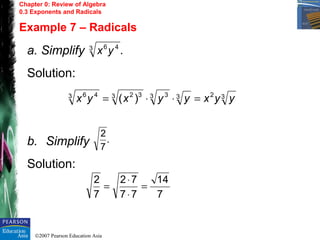
Example 7 – Radicals
a. Simplify
Solution:
b. Simplify
Solution:
3233 33 323 46
)( yyxyyxyx =⋅⋅=
7
14
77
72
7
2
=
⋅
⋅
=
.3 46
yx
.
7
2
©2007 Pearson Education Asia
Chapter 0: Review of Algebra
0.3 Exponents and Radicals
Example 7 – Radicals
c. Simplify
Solution:
d. If x is any real number, simplify
Solution:
Thus, and
210105
2152510521550250
+=
+−=+−
.21550250 +−
.2
x



<−
≥
=
0if
0if2
xx
xx
x
222
= ( ) .33
2
=−
©2007 Pearson Education Asia
• If symbols are combined by any or all of the
operations, the resulting expression is called
an algebraic expression.
• A polynomial in x is an algebraic expression
of the form:
where n = non-negative integer
cn = constants
Chapter 0: Review of Algebra
0.4 Operations with Algebraic Expressions0.4 Operations with Algebraic Expressions
01
1
1 cxcxcxc n
n
n
n ++++ −
− 
©2007 Pearson Education Asia
Chapter 0: Review of Algebra
0.4 Operations with Algebraic Expressions
Example 1 – Algebraic Expressions
a. is an algebraic expression in the
variable x.
b. is an algebraic expression in the
variable y.
c. is an algebraic expression in the
variables x and y.
3
3
10
253
x
xx
−
−−
( ) 2
3
+
−+
y
xyyx
2
7
5
310
y
y
+
+−
©2007 Pearson Education Asia
Chapter 0: Review of Algebra
0.4 Operations with Algebraic Expressions
Example 3 – Subtracting Algebraic Expressions
Simplify
Solution:
( ) ( ).364123 22
−+−+− xyxxyx
( ) ( )
( ) ( )
48
316243
)364()123(
364123
2
2
22
22
+−−=
++−−+−=
+−−++−=
−+−+−
xyx
xyx
xyxxyx
xyxxyx
©2007 Pearson Education Asia
• A list of products may be obtained from the
distributive property:
Chapter 0: Review of Algebra
0.4 Operations with Algebraic Expressions
©2007 Pearson Education Asia
Chapter 0: Review of Algebra
0.4 Operations with Algebraic Expressions
Example 5 – Special Products
a. By Rule 2,
b. By Rule 3,
( )( )
( ) ( )
103
5252
52
2
2
−−=
−+−+=
−+
xx
xx
xx
( )( )
( )
204721
45754373
4753
2
2
+−=
⋅+⋅+⋅+⋅=
++
zz
zz
zz
©2007 Pearson Education Asia
Chapter 0: Review of Algebra
0.4 Operations with Algebraic Expressions
Example 5 – Special Products
c. By Rule 5,
d. By Rule 6,
e. By Rule 7,
( )
( )
168
442
4
2
22
2
+−=
+−=
−
xx
xx
x
( )( )
( )
8
31
3131
2
2
2
2
22
−=
−+=
−+++
y
y
yy
( )
( ) ( )( ) ( ) ( ) ( )
8365427
23233233
23
23
3223
3
+++=
+++=
+
xxx
xxx
x
©2007 Pearson Education Asia
Chapter 0: Review of Algebra
0.4 Operations with Algebraic Expressions
Example 7 – Dividing a Multinomial by a Monomial
z
zz
z
zzz
x
x
xx
3
2
3
42
2
6384
b.
3
3
a.
2
23
2
3
−+−=
−+−
+=
+
©2007 Pearson Education Asia
• If two or more expressions are multiplied
together, the expressions are called the
factors of the product.
Chapter 0: Review of Algebra
0.5 Factoring0.5 Factoring
©2007 Pearson Education Asia
Chapter 0: Review of Algebra
0.5 Factoring
Example 1 – Common Factors
a. Factor completely.
Solution:
b. Factor completely.
Solution:
xkxk 322
93 +
( )kxxkxkxk 3393 2322
+=+
224432325
268 zxybayzbayxa −−
( )24232232
224432325
342
268
xyzbazbyxaya
zxybayzbayxa
−−=
−−
©2007 Pearson Education Asia
Chapter 0: Review of Algebra
0.5 Factoring
Example 3 – Factoring
( )
( )( )
( )( )
( )
( )zzzz
xxx
yyyyyy
xxxx
xxx
+=+
−=+−
+−=−+
++=++
+=++
1e.
396d.
23231836c.
2313299b.
4168a.
4/14/54/1
22
23
2
42
( )( )( )
( )( )
( )( )( )
( )( )
( )( )
( )( )( )( )2222
333366
23
2222
3/13/13/13/2
24
j.
2428i.
bbaah.
4145g.
1111f.
yxyxyxyxyxyx
yxyxyx
xxxx
bayxyxyxyx
xxxx
xxxx
++−+−+=
−+=−
++−=−
+−+=−+−
−−=+−
−++=−
©2007 Pearson Education Asia
Simplifying Fractions
• Allows us to multiply/divide the numerator and
denominator by the same nonzero quantity.
Multiplication and Division of Fractions
• The rule for multiplying and dividing is
Chapter 0: Review of Algebra
0.6 Fractions0.6 Fractions
bd
ac
d
c
b
a
=











bc
ad
d
c
b
a
=÷
©2007 Pearson Education Asia
Rationalizing the Denominator
• For a denominator with square roots, it may be
rationalized by multiplying an expression that
makes the denominator a difference of two
squares.
Addition and Subtraction of Fractions
• If we add two fractions having the same
denominator, we get a fraction whose
denominator is the common denominator.
Chapter 0: Review of Algebra
0.6 Fractions
©2007 Pearson Education Asia
Chapter 0: Review of Algebra
0.6 Fractions
Example 1 – Simplifying Fractions
a. Simplify
Solution:
b. Simplify
Solution:
.
127
6
2
2
+−
−−
xx
xx
( )( )
( )( ) 4
2
43
23
127
6
2
2
−
+
=
−−
+−
=
+−
−−
x
x
xx
xx
xx
xx
.
448
862
2
2
xx
xx
−−
−+
( )( )
( )( ) ( )22
4
214
412
448
862
2
2
+
+
=
+−
+−
=
−−
−+
x
x
xx
xx
xx
xx
©2007 Pearson Education Asia
Chapter 0: Review of Algebra
0.6 Fractions
Example 3 – Dividing Fractions
( )
( )( )
( )
( )( )41
2
82
1
1
4
1
82
1
4
c.
32
5
2
1
3
5
2
3
5
b.
32
5
3
5
25
3
2
a.
222
2
++
=
+
−
⋅
−
=
−
+
−
−
−
=⋅
−
−
=−
−
++
−
=
+
−
⋅
+
=
−
+
÷
+
xxxx
x
x
x
x
xx
x
x
xx
x
xx
x
x
x
x
xx
xx
x
x
x
x
x
x
x
x
©2007 Pearson Education Asia
Chapter 0: Review of Algebra
0.6 Fractions
Example 5 – Adding and Subtracting Fractions
( ) ( )
2
33
2
235
2
23
2
5
a.
2
2
2
−
−+
=
−
++−
=
−
+
+
−
−
p
pp
p
pp
p
p
p
p
( )( )
( )( )
( )
( )( )
3
4
32
2
31
41
65
2
32
45
b. 2
2
2
2
+
−=
++
+
−
+−
−−
=
++
+
−
−+
+−
x
xx
xx
xx
xx
xx
xx
xx
xx
( ) ( ) ( )
1
7
7
7
425
149
84
7
2
7
5
c.
22
2
22
=
−
−
=
−
−+−−−+
=
+−
+−
+
−
−
−
−
−+
x
x
x
xxx
xx
x
x
x
x
xx
©2007 Pearson Education Asia
Chapter 0: Review of Algebra
0.6 Fractions
Example 7 – Subtracting Fractions
( )
( )( )( ) ( )( )
( ) ( )
( ) ( )
( ) ( )332
615
332
6512102
332
32322
92
2
96
2
2
2
2
22
222
−+
+−
=
−+
−−−+−
=
−+
++−−−
=
−
+
−
++
−
xx
xx
xx
xxxx
xx
xxxx
x
x
xx
x
©2007 Pearson Education Asia
Equations
• An equation is a statement that two
expressions are equal.
• The two expressions that make up an equation
are called its sides.
• They are separated by the equality sign, =.
Chapter 0: Review of Algebra
0.7 Equations, in Particular Linear Equations0.7 Equations, in Particular Linear Equations
©2007 Pearson Education Asia
Chapter 0: Review of Algebra
0.7 Equations, in Particular Linear Equations
Example 1 – Examples of Equations
zw
y
y
xx
x
−=
=
−
=++
=+
7d.
6
4
c.
023b.
32a.
2
• A variable (e.g. x, y) is a symbol that can be
replaced by any one of a set of different
numbers.
©2007 Pearson Education Asia
Equivalent Equations
• Two equations are said to be equivalent if they
have exactly the same solutions.
• There are three operations that guarantee
equivalence:
1. Adding/subtracting the same polynomial
to/from both sides of an equation.
2. Multiplying/dividing both sides of an
equation by the same nonzero constant.
3. Replacing either side of an equation by an
equal expression.
Chapter 0: Review of Algebra
0.7 Equations, in Particular Linear Equations
©2007 Pearson Education Asia
Chapter 0: Review of Algebra
0.7 Equations, in Particular Linear Equations
Operations That May Not Produce Equivalent
Equations
4. Multiplying both sides of an equation by an
expression involving the variable.
5. Dividing both sides of an equation by an
expression involving the variable.
6. Raising both sides of an equation to equal
powers.
©2007 Pearson Education Asia
Chapter 0: Review of Algebra
0.7 Equations, in Particular Linear Equations
Linear Equations
• A linear equation in the variable x can be
written in the form
where a and b are constants and .
• A linear equation is also called a first-degree
equation or an equation of degree one.
0=+ bax
0≠a
©2007 Pearson Education Asia
Chapter 0: Review of Algebra
0.7 Equations, in Particular Linear Equations
Example 3 – Solving a Linear Equation
Solve
Solution:
.365 xx =−
( ) ( )
3
2
6
2
2
62
60662
062
33365
365
=
=
=
+=+−
=−
−+=−+−
=−
x
x
x
x
x
xxxx
xx
©2007 Pearson Education Asia
Chapter 0: Review of Algebra
0.7 Equations, in Particular Linear Equations
Example 5 – Solving a Linear Equations
Solve
Solution:
.6
4
89
2
37
=
−
−
+ xx
( )
( ) ( )
2
105
24145
2489372
64
4
89
2
37
4
=
=
=+
=−−+
=




 −
−
+
x
x
x
xx
xx
©2007 Pearson Education Asia
Chapter 0: Review of Algebra
0.7 Equations, in Particular Linear Equations
Literal Equations
• Equations where constants are not specified,
but are represented as a, b, c, d, etc. are
called literal equations.
• The letters are called literal constants.
©2007 Pearson Education Asia
Chapter 0: Review of Algebra
0.7 Equations, in Particular Linear Equations
Example 7 – Solving a Literal Equation
Solve for x.
Solution:
( ) ( )
( )
ac
a
x
aacx
aaxxxcxax
axxxca
−
=
=−
++=++
+=++
2
2
222
22
2
( ) ( )22
axxxca +=++
©2007 Pearson Education Asia
Chapter 0: Review of Algebra
0.7 Equations, in Particular Linear Equations
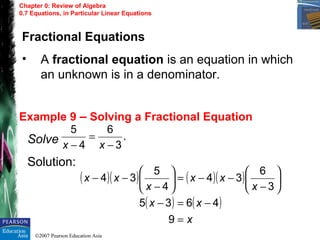
Example 9 – Solving a Fractional Equation
Solve
Solution:
Fractional Equations
• A fractional equation is an equation in which
an unknown is in a denominator.
.
3
6
4
5
−
=
− xx
( )( ) ( )( )
( ) ( )
x
xx
x
xx
x
xx
=
−=−






−
−−=





−
−−
9
4635
3
6
34
4
5
34
©2007 Pearson Education Asia
Chapter 0: Review of Algebra
0.7 Equations, in Particular Linear Equations
Example 11 – Literal Equation
If express u in terms of the remaining
letters; that is, solve for u.
Solution:
,
vau
u
s
+
=
( )
( )
sa
sv
u
svsau
usvsau
uvaus
vau
u
s
−
=
−=−
=+
=+
+
=
1
1
©2007 Pearson Education Asia
Chapter 0: Review of Algebra
0.7 Equations, in Particular Linear Equations
Radical Equations
• A radical equation is one in which an unknown
occurs in a radicand.
Example 13 – Solving a Radical Equation
Solve
Solution:
.33 −=−− yy
4
2
126
963
33
=
=
=
+−=−
−=−−
y
y
y
yyy
yy
©2007 Pearson Education Asia
• A quadratic equation in the variable x is an
equation that can be written in the form
where a, b, and c are constants and
• A quadratic equation is also called a second-
degree equation or an equation of degree two.
Chapter 0: Review of Algebra
0.8 Quadratic Equations0.8 Quadratic Equations
02
=++ cbxax
.0≠a
©2007 Pearson Education Asia
Chapter 0: Review of Algebra
0.8 Quadratic Equations
Example 1 – Solving a Quadratic Equation by Factoring
a. Solve
Solution:
Factor the left side factor:
Whenever the product of two or more quantities
is zero, at least one of the quantities must be
zero.
.0122
=−+ xx
( )( ) 043 =+− xx
( ) ( )
43
04or03
−==
=+=−
xx
xx
©2007 Pearson Education Asia
Chapter 0: Review of Algebra
0.8 Quadratic Equations
Example 1 – Solving a Quadratic Equation by Factoring
b. Solve
Solution:
.56 2
ww =
( )
6
5
or0
056
56 2
==
=−
=
ww
ww
ww
©2007 Pearson Education Asia
Chapter 0: Review of Algebra
0.8 Quadratic Equations
Example 3 – Solving a Higher-Degree Equation by
Factoring
a. Solve
Solution:
b. Solve
Solution:
.044 3
=− xx
( )
( )( )
1or1or0
0114
014
044
2
3
−===
=+−
=−
=−
xxx
xxx
xx
xx
( ) ( ) ( ) .0252
32
=++++ xxxxx
( ) ( ) ( )
( ) ( ) ( )[ ]
( ) ( )
7/2or2or0
0722
0252
0252
2
2
32
−=−==
=++
=++++
=++++
xxx
xxx
xxxx
xxxxx
©2007 Pearson Education Asia
Chapter 0: Review of Algebra
0.8 Quadratic Equations
Example 5 – Solution by Factoring
Solve
Solution:
.32
=x
( )( )
3Thus,
3or3
033
03
3
2
2
±=
−==
=+−
=−
=
x
xx
xx
x
x
©2007 Pearson Education Asia
Quadratic Formula
• The roots of the quadratic equation
can be given as
Chapter 0: Review of Algebra
0.8 Quadratic Equations
02
=++ cbxax
a
acbb
x
2
42
−±−
=
©2007 Pearson Education Asia
Chapter 0: Review of Algebra
0.8 Quadratic Equations
Example 7 – A Quadratic Equation with One Real Root
Solve by the quadratic formula.
Solution:
Here a = 9, b = 6√2, and c = 2. The roots are
09262 2
=++ yy
( )
3
2
18
026
or
3
2
18
026
92
026
−=
−−
=−=
+−
=
±−
=
yy
y
©2007 Pearson Education Asia
Quadratic-Form Equation
• When a non-quadratic equation can be
transformed into a quadratic equation by an
appropriate substitution, the given equation is
said to have quadratic-form.
Chapter 0: Review of Algebra
0.8 Quadratic Equations
©2007 Pearson Education Asia
Chapter 0: Review of Algebra
0.8 Quadratic Equations
Example 9 –– Solving a Quadratic-Form Equation
Solve
Solution:
This equation can be written as
Substituting w =1/x3
, we have
Thus, the roots are
.08
91
36
=++
xx
08
1
9
1
3
2
3
=+





+





xx
( )( )
1or8
018
0892
−=−=
=++
=++
ww
ww
ww
1or
2
1
1
1
or8
1
33
−=−=
−=−=
xx
xx

Introductory maths analysis chapter 00 official

  • 1.
    INTRODUCTORY MATHEMATICALINTRODUCTORY MATHEMATICAL ANALYSISANALYSISForBusiness, Economics, and the Life and Social Sciences ©2007 Pearson Education Asia Chapter 0Chapter 0 Review of AlgebraReview of Algebra
  • 2.
    ©2007 Pearson EducationAsia INTRODUCTORY MATHEMATICAL ANALYSIS 0. Review of Algebra 1. Applications and More Algebra 2. Functions and Graphs 3. Lines, Parabolas, and Systems 4. Exponential and Logarithmic Functions 5. Mathematics of Finance 6. Matrix Algebra 7. Linear Programming 8. Introduction to Probability and Statistics
  • 3.
    ©2007 Pearson EducationAsia 9. Additional Topics in Probability 10. Limits and Continuity 11. Differentiation 12. Additional Differentiation Topics 13. Curve Sketching 14. Integration 15. Methods and Applications of Integration 16. Continuous Random Variables 17. Multivariable Calculus INTRODUCTORY MATHEMATICAL ANALYSIS
  • 4.
    ©2007 Pearson EducationAsia • To be familiar with sets, real numbers, real-number line. • To relate properties of real numbers in terms of their operations. • To review the procedure of rationalizing the denominator. • To perform operations of algebraic expressions. • To state basic rules for factoring. • To rationalize the denominator of a fraction. • To solve linear equations. • To solve quadratic equations. Chapter 0: Review of Algebra Chapter ObjectivesChapter Objectives
  • 5.
    ©2007 Pearson EducationAsia Sets of Real Numbers Some Properties of Real Numbers Exponents and Radicals Operations with Algebraic Expressions Factoring Fractions Equations, in Particular Linear Equations Quadratic Equations Chapter 0: Review of Algebra Chapter OutlineChapter Outline 0.1) 0.2) 0.3) 0.4) 0.5) 0.6) 0.7) 0.8)
  • 6.
    ©2007 Pearson EducationAsia • A set is a collection of objects. • An object in a set is called an element of that set. • Different type of integers: • The real-number line is shown as Chapter 0: Review of Algebra 0.1 Sets of Real Numbers0.1 Sets of Real Numbers { }...,3,2,1=integerspositiveofSet { }1,2,3..., −−−=integersnegativeofSet
  • 7.
    ©2007 Pearson EducationAsia • Important properties of real numbers 1. The Transitive Property of Equality 2. The Closure Properties of Addition and Multiplication 3. The Commutative Properties of Addition and Multiplication Chapter 0: Review of Algebra 0.2 Some Properties of Real Numbers0.2 Some Properties of Real Numbers .then,andIf cacbba === .and numbersrealuniquearetherenumbers,realallFor abba + baababba =+=+ and
  • 8.
    ©2007 Pearson EducationAsia 4. The Commutative Properties of Addition and Multiplication 5. The Identity Properties 6. The Inverse Properties 7. The Distributive Properties Chapter 0: Review of Algebra 0.2 Some Properties of Real Numbers ( ) ( ) ( ) ( )cabbcacbacba =++=++ and aaaa ==+ 1and0 ( ) 0=−+ aa 11 =⋅ − aa ( ) ( ) cabaacbacabcba +=++=+ and
  • 9.
    ©2007 Pearson EducationAsia Chapter 0: Review of Algebra 0.2 Some Properties of Real Numbers Example 1 – Applying Properties of Real Numbers Example 3 – Applying Properties of Real Numbers ( ) ( ) ( ) ( )354543b. 2323a. ⋅=⋅ +−=+− xwzywzyxSolution: a. Show that Solution: .0for ≠      = c c b a c ab ( )       =      ⋅=⋅= c b a c ba c ab c ab 11
  • 10.
    ©2007 Pearson EducationAsia Chapter 0: Review of Algebra 0.2 Some Properties of Real Numbers Example 3 – Applying Properties of Real Numbers b. Show that Solution: .0for c b ≠+= + c c a c ba ( ) c b c a c ba c ba 111 ⋅+⋅=+= + c b c a c ba c b c a c b c a += + +=⋅+⋅ 11
  • 11.
    ©2007 Pearson EducationAsia • Properties: Chapter 0: Review of Algebra 0.3 Exponents and Radicals0.3 Exponents and Radicals 14. 1 3. 0for 11 2. 1. 0 = = ≠ ⋅⋅ == ⋅⋅= − − x x x x xxxxx x xxxxx n n factorsn n n factorsn n     n x exponent base
  • 12.
    ©2007 Pearson EducationAsia Chapter 0: Review of Algebra 0.3 Exponents and Radicals Example 1 – Exponents xx π = =−== == ==       =                        =      1 000 5 5- 5 5- 4 e. 1)5(,1,12d. 2433 3 1 c. 243 1 3 1 3b. 16 1 2 1 2 1 2 1 2 1 2 1 a.
  • 13.
    ©2007 Pearson EducationAsia Chapter 0: Review of Algebra 0.3 Exponents and Radicals • The symbol is called a radical. n is the index, x is the radicand, and is the radical sign. n x
  • 14.
    ©2007 Pearson EducationAsia Chapter 0: Review of Algebra 0.3 Exponents and Radicals Example 3 – Rationalizing Denominators Solution: Example 5 – Exponents ( ) x x x x xxx 3 32 3 32 3 2 3 2 3 2 b. 5 52 5 52 55 52 5 2 5 2 a. 6 55 6 566 5 1 6 1 6 5 6 1 2 1 2 1 2 1 2 1 2 1 === ⋅ = = ⋅ = ⋅ ⋅ == a. Eliminate negative exponents in and simplify. Solution: 11 −− + yx xy xy yx yx + =+=+ −− 1111
  • 15.
    ©2007 Pearson EducationAsia Chapter 0: Review of Algebra 0.3 Exponents and Radicals Example 5 – Exponents b. Simplify by using the distributive law. Solution: c. Eliminate negative exponents in Solution: ( )12/12/12/3 −=− xxxx 2/12/3 xx − ( ) .77 22 −− + xx ( ) ( ) 2222 22 49 17 7 17 77 xxxx xx +=+=+ −−
  • 16.
    ©2007 Pearson EducationAsia Chapter 0: Review of Algebra 0.3 Exponents and Radicals Example 5 – Exponents d. Eliminate negative exponents in Solution: e. Apply the distributive law to Solution: ( ) . 211 −−− − yx ( ) ( )2 222 22 211 11 xy yx xy xy xy xy yx yx − =      − =       − =      −=− −− −−− ( ).2 5 6 2 1 5 2 xyx + ( ) 5 8 2 1 5 2 5 6 2 1 5 2 22 xyxxyx +=+
  • 17.
    ©2007 Pearson EducationAsia Chapter 0: Review of Algebra 0.3 Exponents and Radicals Example 7 – Radicals a. Simplify Solution: b. Simplify Solution: 3233 33 323 46 )( yyxyyxyx =⋅⋅= 7 14 77 72 7 2 = ⋅ ⋅ = .3 46 yx . 7 2
  • 18.
    ©2007 Pearson EducationAsia Chapter 0: Review of Algebra 0.3 Exponents and Radicals Example 7 – Radicals c. Simplify Solution: d. If x is any real number, simplify Solution: Thus, and 210105 2152510521550250 += +−=+− .21550250 +− .2 x    <− ≥ = 0if 0if2 xx xx x 222 = ( ) .33 2 =−
  • 19.
    ©2007 Pearson EducationAsia • If symbols are combined by any or all of the operations, the resulting expression is called an algebraic expression. • A polynomial in x is an algebraic expression of the form: where n = non-negative integer cn = constants Chapter 0: Review of Algebra 0.4 Operations with Algebraic Expressions0.4 Operations with Algebraic Expressions 01 1 1 cxcxcxc n n n n ++++ − − 
  • 20.
    ©2007 Pearson EducationAsia Chapter 0: Review of Algebra 0.4 Operations with Algebraic Expressions Example 1 – Algebraic Expressions a. is an algebraic expression in the variable x. b. is an algebraic expression in the variable y. c. is an algebraic expression in the variables x and y. 3 3 10 253 x xx − −− ( ) 2 3 + −+ y xyyx 2 7 5 310 y y + +−
  • 21.
    ©2007 Pearson EducationAsia Chapter 0: Review of Algebra 0.4 Operations with Algebraic Expressions Example 3 – Subtracting Algebraic Expressions Simplify Solution: ( ) ( ).364123 22 −+−+− xyxxyx ( ) ( ) ( ) ( ) 48 316243 )364()123( 364123 2 2 22 22 +−−= ++−−+−= +−−++−= −+−+− xyx xyx xyxxyx xyxxyx
  • 22.
    ©2007 Pearson EducationAsia • A list of products may be obtained from the distributive property: Chapter 0: Review of Algebra 0.4 Operations with Algebraic Expressions
  • 23.
    ©2007 Pearson EducationAsia Chapter 0: Review of Algebra 0.4 Operations with Algebraic Expressions Example 5 – Special Products a. By Rule 2, b. By Rule 3, ( )( ) ( ) ( ) 103 5252 52 2 2 −−= −+−+= −+ xx xx xx ( )( ) ( ) 204721 45754373 4753 2 2 +−= ⋅+⋅+⋅+⋅= ++ zz zz zz
  • 24.
    ©2007 Pearson EducationAsia Chapter 0: Review of Algebra 0.4 Operations with Algebraic Expressions Example 5 – Special Products c. By Rule 5, d. By Rule 6, e. By Rule 7, ( ) ( ) 168 442 4 2 22 2 +−= +−= − xx xx x ( )( ) ( ) 8 31 3131 2 2 2 2 22 −= −+= −+++ y y yy ( ) ( ) ( )( ) ( ) ( ) ( ) 8365427 23233233 23 23 3223 3 +++= +++= + xxx xxx x
  • 25.
    ©2007 Pearson EducationAsia Chapter 0: Review of Algebra 0.4 Operations with Algebraic Expressions Example 7 – Dividing a Multinomial by a Monomial z zz z zzz x x xx 3 2 3 42 2 6384 b. 3 3 a. 2 23 2 3 −+−= −+− += +
  • 26.
    ©2007 Pearson EducationAsia • If two or more expressions are multiplied together, the expressions are called the factors of the product. Chapter 0: Review of Algebra 0.5 Factoring0.5 Factoring
  • 27.
    ©2007 Pearson EducationAsia Chapter 0: Review of Algebra 0.5 Factoring Example 1 – Common Factors a. Factor completely. Solution: b. Factor completely. Solution: xkxk 322 93 + ( )kxxkxkxk 3393 2322 +=+ 224432325 268 zxybayzbayxa −− ( )24232232 224432325 342 268 xyzbazbyxaya zxybayzbayxa −−= −−
  • 28.
    ©2007 Pearson EducationAsia Chapter 0: Review of Algebra 0.5 Factoring Example 3 – Factoring ( ) ( )( ) ( )( ) ( ) ( )zzzz xxx yyyyyy xxxx xxx +=+ −=+− +−=−+ ++=++ +=++ 1e. 396d. 23231836c. 2313299b. 4168a. 4/14/54/1 22 23 2 42 ( )( )( ) ( )( ) ( )( )( ) ( )( ) ( )( ) ( )( )( )( )2222 333366 23 2222 3/13/13/13/2 24 j. 2428i. bbaah. 4145g. 1111f. yxyxyxyxyxyx yxyxyx xxxx bayxyxyxyx xxxx xxxx ++−+−+= −+=− ++−=− +−+=−+− −−=+− −++=−
  • 29.
    ©2007 Pearson EducationAsia Simplifying Fractions • Allows us to multiply/divide the numerator and denominator by the same nonzero quantity. Multiplication and Division of Fractions • The rule for multiplying and dividing is Chapter 0: Review of Algebra 0.6 Fractions0.6 Fractions bd ac d c b a =            bc ad d c b a =÷
  • 30.
    ©2007 Pearson EducationAsia Rationalizing the Denominator • For a denominator with square roots, it may be rationalized by multiplying an expression that makes the denominator a difference of two squares. Addition and Subtraction of Fractions • If we add two fractions having the same denominator, we get a fraction whose denominator is the common denominator. Chapter 0: Review of Algebra 0.6 Fractions
  • 31.
    ©2007 Pearson EducationAsia Chapter 0: Review of Algebra 0.6 Fractions Example 1 – Simplifying Fractions a. Simplify Solution: b. Simplify Solution: . 127 6 2 2 +− −− xx xx ( )( ) ( )( ) 4 2 43 23 127 6 2 2 − + = −− +− = +− −− x x xx xx xx xx . 448 862 2 2 xx xx −− −+ ( )( ) ( )( ) ( )22 4 214 412 448 862 2 2 + + = +− +− = −− −+ x x xx xx xx xx
  • 32.
    ©2007 Pearson EducationAsia Chapter 0: Review of Algebra 0.6 Fractions Example 3 – Dividing Fractions ( ) ( )( ) ( ) ( )( )41 2 82 1 1 4 1 82 1 4 c. 32 5 2 1 3 5 2 3 5 b. 32 5 3 5 25 3 2 a. 222 2 ++ = + − ⋅ − = − + − − − =⋅ − − =− − ++ − = + − ⋅ + = − + ÷ + xxxx x x x x xx x x xx x xx x x x x xx xx x x x x x x x x
  • 33.
    ©2007 Pearson EducationAsia Chapter 0: Review of Algebra 0.6 Fractions Example 5 – Adding and Subtracting Fractions ( ) ( ) 2 33 2 235 2 23 2 5 a. 2 2 2 − −+ = − ++− = − + + − − p pp p pp p p p p ( )( ) ( )( ) ( ) ( )( ) 3 4 32 2 31 41 65 2 32 45 b. 2 2 2 2 + −= ++ + − +− −− = ++ + − −+ +− x xx xx xx xx xx xx xx xx ( ) ( ) ( ) 1 7 7 7 425 149 84 7 2 7 5 c. 22 2 22 = − − = − −+−−−+ = +− +− + − − − − −+ x x x xxx xx x x x x xx
  • 34.
    ©2007 Pearson EducationAsia Chapter 0: Review of Algebra 0.6 Fractions Example 7 – Subtracting Fractions ( ) ( )( )( ) ( )( ) ( ) ( ) ( ) ( ) ( ) ( )332 615 332 6512102 332 32322 92 2 96 2 2 2 2 22 222 −+ +− = −+ −−−+− = −+ ++−−− = − + − ++ − xx xx xx xxxx xx xxxx x x xx x
  • 35.
    ©2007 Pearson EducationAsia Equations • An equation is a statement that two expressions are equal. • The two expressions that make up an equation are called its sides. • They are separated by the equality sign, =. Chapter 0: Review of Algebra 0.7 Equations, in Particular Linear Equations0.7 Equations, in Particular Linear Equations
  • 36.
    ©2007 Pearson EducationAsia Chapter 0: Review of Algebra 0.7 Equations, in Particular Linear Equations Example 1 – Examples of Equations zw y y xx x −= = − =++ =+ 7d. 6 4 c. 023b. 32a. 2 • A variable (e.g. x, y) is a symbol that can be replaced by any one of a set of different numbers.
  • 37.
    ©2007 Pearson EducationAsia Equivalent Equations • Two equations are said to be equivalent if they have exactly the same solutions. • There are three operations that guarantee equivalence: 1. Adding/subtracting the same polynomial to/from both sides of an equation. 2. Multiplying/dividing both sides of an equation by the same nonzero constant. 3. Replacing either side of an equation by an equal expression. Chapter 0: Review of Algebra 0.7 Equations, in Particular Linear Equations
  • 38.
    ©2007 Pearson EducationAsia Chapter 0: Review of Algebra 0.7 Equations, in Particular Linear Equations Operations That May Not Produce Equivalent Equations 4. Multiplying both sides of an equation by an expression involving the variable. 5. Dividing both sides of an equation by an expression involving the variable. 6. Raising both sides of an equation to equal powers.
  • 39.
    ©2007 Pearson EducationAsia Chapter 0: Review of Algebra 0.7 Equations, in Particular Linear Equations Linear Equations • A linear equation in the variable x can be written in the form where a and b are constants and . • A linear equation is also called a first-degree equation or an equation of degree one. 0=+ bax 0≠a
  • 40.
    ©2007 Pearson EducationAsia Chapter 0: Review of Algebra 0.7 Equations, in Particular Linear Equations Example 3 – Solving a Linear Equation Solve Solution: .365 xx =− ( ) ( ) 3 2 6 2 2 62 60662 062 33365 365 = = = +=+− =− −+=−+− =− x x x x x xxxx xx
  • 41.
    ©2007 Pearson EducationAsia Chapter 0: Review of Algebra 0.7 Equations, in Particular Linear Equations Example 5 – Solving a Linear Equations Solve Solution: .6 4 89 2 37 = − − + xx ( ) ( ) ( ) 2 105 24145 2489372 64 4 89 2 37 4 = = =+ =−−+ =      − − + x x x xx xx
  • 42.
    ©2007 Pearson EducationAsia Chapter 0: Review of Algebra 0.7 Equations, in Particular Linear Equations Literal Equations • Equations where constants are not specified, but are represented as a, b, c, d, etc. are called literal equations. • The letters are called literal constants.
  • 43.
    ©2007 Pearson EducationAsia Chapter 0: Review of Algebra 0.7 Equations, in Particular Linear Equations Example 7 – Solving a Literal Equation Solve for x. Solution: ( ) ( ) ( ) ac a x aacx aaxxxcxax axxxca − = =− ++=++ +=++ 2 2 222 22 2 ( ) ( )22 axxxca +=++
  • 44.
    ©2007 Pearson EducationAsia Chapter 0: Review of Algebra 0.7 Equations, in Particular Linear Equations Example 9 – Solving a Fractional Equation Solve Solution: Fractional Equations • A fractional equation is an equation in which an unknown is in a denominator. . 3 6 4 5 − = − xx ( )( ) ( )( ) ( ) ( ) x xx x xx x xx = −=−       − −−=      − −− 9 4635 3 6 34 4 5 34
  • 45.
    ©2007 Pearson EducationAsia Chapter 0: Review of Algebra 0.7 Equations, in Particular Linear Equations Example 11 – Literal Equation If express u in terms of the remaining letters; that is, solve for u. Solution: , vau u s + = ( ) ( ) sa sv u svsau usvsau uvaus vau u s − = −=− =+ =+ + = 1 1
  • 46.
    ©2007 Pearson EducationAsia Chapter 0: Review of Algebra 0.7 Equations, in Particular Linear Equations Radical Equations • A radical equation is one in which an unknown occurs in a radicand. Example 13 – Solving a Radical Equation Solve Solution: .33 −=−− yy 4 2 126 963 33 = = = +−=− −=−− y y y yyy yy
  • 47.
    ©2007 Pearson EducationAsia • A quadratic equation in the variable x is an equation that can be written in the form where a, b, and c are constants and • A quadratic equation is also called a second- degree equation or an equation of degree two. Chapter 0: Review of Algebra 0.8 Quadratic Equations0.8 Quadratic Equations 02 =++ cbxax .0≠a
  • 48.
    ©2007 Pearson EducationAsia Chapter 0: Review of Algebra 0.8 Quadratic Equations Example 1 – Solving a Quadratic Equation by Factoring a. Solve Solution: Factor the left side factor: Whenever the product of two or more quantities is zero, at least one of the quantities must be zero. .0122 =−+ xx ( )( ) 043 =+− xx ( ) ( ) 43 04or03 −== =+=− xx xx
  • 49.
    ©2007 Pearson EducationAsia Chapter 0: Review of Algebra 0.8 Quadratic Equations Example 1 – Solving a Quadratic Equation by Factoring b. Solve Solution: .56 2 ww = ( ) 6 5 or0 056 56 2 == =− = ww ww ww
  • 50.
    ©2007 Pearson EducationAsia Chapter 0: Review of Algebra 0.8 Quadratic Equations Example 3 – Solving a Higher-Degree Equation by Factoring a. Solve Solution: b. Solve Solution: .044 3 =− xx ( ) ( )( ) 1or1or0 0114 014 044 2 3 −=== =+− =− =− xxx xxx xx xx ( ) ( ) ( ) .0252 32 =++++ xxxxx ( ) ( ) ( ) ( ) ( ) ( )[ ] ( ) ( ) 7/2or2or0 0722 0252 0252 2 2 32 −=−== =++ =++++ =++++ xxx xxx xxxx xxxxx
  • 51.
    ©2007 Pearson EducationAsia Chapter 0: Review of Algebra 0.8 Quadratic Equations Example 5 – Solution by Factoring Solve Solution: .32 =x ( )( ) 3Thus, 3or3 033 03 3 2 2 ±= −== =+− =− = x xx xx x x
  • 52.
    ©2007 Pearson EducationAsia Quadratic Formula • The roots of the quadratic equation can be given as Chapter 0: Review of Algebra 0.8 Quadratic Equations 02 =++ cbxax a acbb x 2 42 −±− =
  • 53.
    ©2007 Pearson EducationAsia Chapter 0: Review of Algebra 0.8 Quadratic Equations Example 7 – A Quadratic Equation with One Real Root Solve by the quadratic formula. Solution: Here a = 9, b = 6√2, and c = 2. The roots are 09262 2 =++ yy ( ) 3 2 18 026 or 3 2 18 026 92 026 −= −− =−= +− = ±− = yy y
  • 54.
    ©2007 Pearson EducationAsia Quadratic-Form Equation • When a non-quadratic equation can be transformed into a quadratic equation by an appropriate substitution, the given equation is said to have quadratic-form. Chapter 0: Review of Algebra 0.8 Quadratic Equations
  • 55.
    ©2007 Pearson EducationAsia Chapter 0: Review of Algebra 0.8 Quadratic Equations Example 9 –– Solving a Quadratic-Form Equation Solve Solution: This equation can be written as Substituting w =1/x3 , we have Thus, the roots are .08 91 36 =++ xx 08 1 9 1 3 2 3 =+      +      xx ( )( ) 1or8 018 0892 −=−= =++ =++ ww ww ww 1or 2 1 1 1 or8 1 33 −=−= −=−= xx xx