Section	1.1
                 Functions
              V63.0121.006/016, Calculus	I


                     January	19, 2010


Announcements
   Syllabus	is	on	the	common	Blackboard
   Office	Hours	TBA
                                          .   .   .   .   .   .
Outline

  What	is	a	function?

  Modeling

  Examples	of	functions
     Functions	expressed	by	formulas
     Functions	described	numerically
     Functions	described	graphically
     Functions	described	verbally

  Properties	of	functions
     Monotonicity
     Symmetry


                                       .   .   .   .   .   .
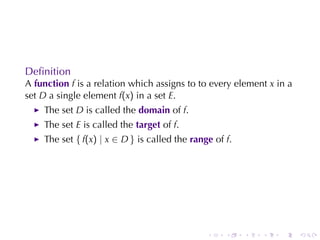
Definition
A function f is	a	relation	which	assigns	to	to	every	element x in	a
set D a	single	element f(x) in	a	set E.
    The	set D is	called	the domain of f.
    The	set E is	called	the target of f.
    The	set { f(x) | x ∈ D } is	called	the range of f.


                                               .    .    .   .   .    .
Outline

  What	is	a	function?

  Modeling

  Examples	of	functions
     Functions	expressed	by	formulas
     Functions	described	numerically
     Functions	described	graphically
     Functions	described	verbally

  Properties	of	functions
     Monotonicity
     Symmetry


                                       .   .   .   .   .   .
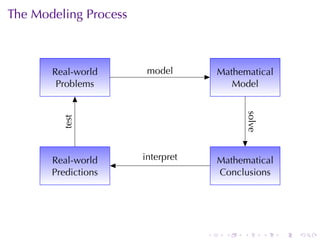
The	Modeling	Process


     .                                 .
         Real-world
              .
              .         m
                        . odel             Mathematical
                                                .
          Problems                            Model


                                                    s
                                                    . olve
           .est
           t


     .                 i
                       .nterpret       .
         Real-world
              .                            Mathematical
                                                .
         Predictions                       Conclusions


                                   .        .   .            .   .   .
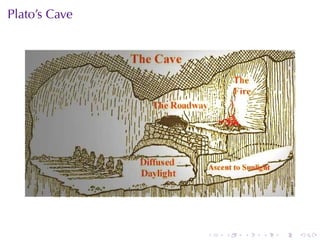
Plato’s	Cave


               .   .   .   .   .   .
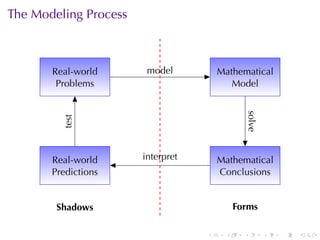
The	Modeling	Process


     .                                 .
         Real-world
              .
              .         m
                        . odel             Mathematical
                                                .
          Problems                            Model


                                                      s
                                                      . olve
           .est
           t


     .                 i
                       .nterpret       .
         Real-world
              .                            Mathematical
                                                .
         Predictions                       Conclusions


          S
          . hadows                              F
                                                . orms

                                   .        .     .            .   .   .
Outline

  What	is	a	function?

  Modeling

  Examples	of	functions
     Functions	expressed	by	formulas
     Functions	described	numerically
     Functions	described	graphically
     Functions	described	verbally

  Properties	of	functions
     Monotonicity
     Symmetry


                                       .   .   .   .   .   .
Functions	expressed	by	formulas


   Any	expression	in	a	single	variable x defines	a	function. In	this
   case, the	domain	is	understood	to	be	the	largest	set	of x which
   after	substitution, give	a	real	number.


                                                .   .    .   .    .   .
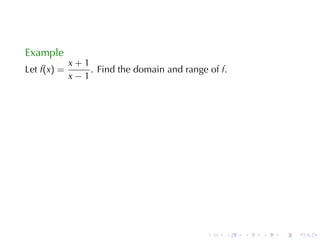
Example
             x+1
Let f(x) =       . Find	the	domain	and	range	of f.
             x−1


                                             .   .   .   .   .   .
Example
             x+1
Let f(x) =       . Find	the	domain	and	range	of f.
             x−1
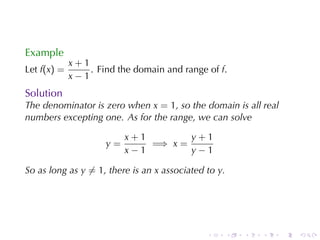
Solution
The	denominator	is	zero	when x = 1, so	the	domain	is	all	real
numbers	excepting	one. As	for	the	range, we	can	solve

                          x+1        y+1
                     y=       =⇒ x =
                          x−1        y−1

So	as	long	as y ̸= 1, there	is	an x associated	to y.


                                               .       .   .   .   .   .
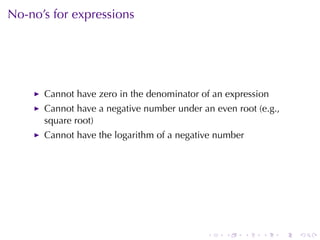
No-no’s	for	expressions


      Cannot	have	zero	in	the	denominator	of	an	expression
      Cannot	have	a	negative	number	under	an	even	root	(e.g.,
      square	root)
      Cannot	have	the	logarithm	of	a	negative	number


                                            .   .      .   .    .   .
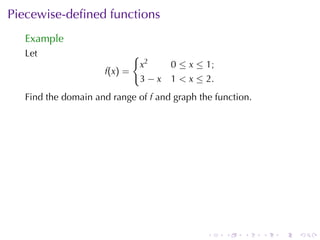
Piecewise-defined	functions
  Example
  Let                      {
                            x2      0 ≤ x ≤ 1;
                    f(x) =
                            3−x     1 < x ≤ 2.
  Find	the	domain	and	range	of f and	graph	the	function.


                                             .   .    .    .   .   .
Piecewise-defined	functions
  Example
  Let                        {
                              x2         0 ≤ x ≤ 1;
                      f(x) =
                              3−x        1 < x ≤ 2.
  Find	the	domain	and	range	of f and	graph	the	function.

  Solution
  The	domain	is [0, 2]. The	range	is [0, 2). The	graph	is	piecewise.

                            . .
                            2       .

                            . .
                            1       .        .

                               .     .        .
                             0
                             .     1
                                   .        2
                                            .

                                                  .   .   .   .   .    .
Functions	described	numerically


   We	can	just	describe	a	function	by	a	table	of	values, or	a	diagram.


                                                .   .    .    .   .      .
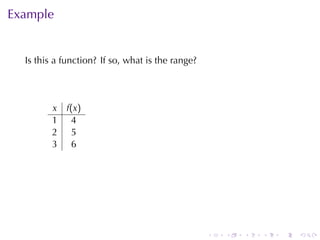
Example


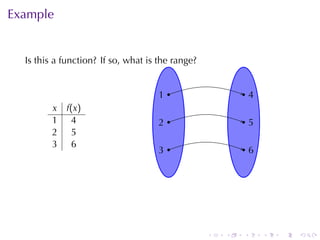
  Is	this	a	function? If	so, what	is	the	range?


         x f(x)
         1 4
         2 5
         3 6


                                                  .   .   .   .   .   .
Example


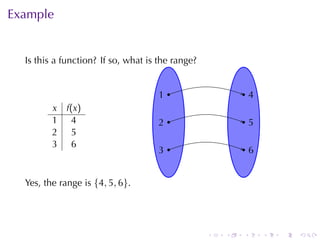
  Is	this	a	function? If	so, what	is	the	range?


                                     . .
                                     1                    ..
                                                           4
         x f(x)
         1 4                         . ..
                                     2                    .. .
                                                             5
         2 5
         3 6
                                     . .
                                     3                    ..
                                                           6


                                                  .   .   .      .   .   .
Example


  Is	this	a	function? If	so, what	is	the	range?


                                     . .
                                     1                    ..
                                                           4
         x f(x)
         1 4                         . ..
                                     2                    .. .
                                                             5
         2 5
         3 6
                                     . .
                                     3                    ..
                                                           6


  Yes, the	range	is {4, 5, 6}.


                                                  .   .   .      .   .   .
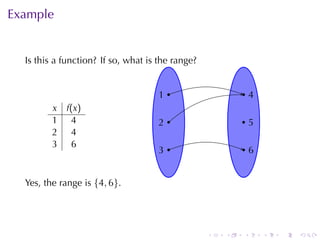
Example


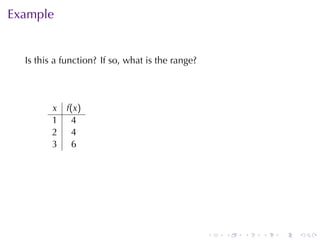
  Is	this	a	function? If	so, what	is	the	range?


         x f(x)
         1 4
         2 4
         3 6


                                                  .   .   .   .   .   .
Example


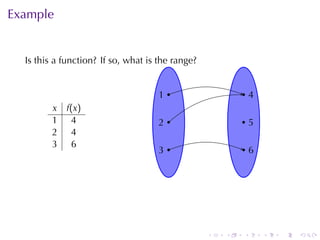
  Is	this	a	function? If	so, what	is	the	range?


                                     . .
                                     1                    ..
                                                           4
         x f(x)
         1 4                         . ..
                                     2                    .. .
                                                             5
         2 4
         3 6
                                     . .
                                     3                    ..
                                                           6


                                                  .   .   .      .   .   .
Example


  Is	this	a	function? If	so, what	is	the	range?


                                     . .
                                     1                    ..
                                                           4
         x f(x)
         1 4                         . ..
                                     2                    .. .
                                                             5
         2 4
         3 6
                                     . .
                                     3                    ..
                                                           6


  Yes, the	range	is {4, 6}.


                                                  .   .   .      .   .   .
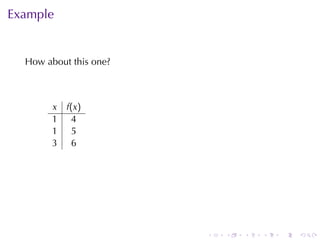
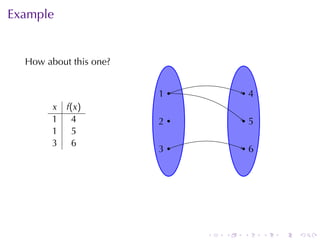
Example


  How	about	this	one?


        x f(x)
        1 4
        1 5
        3 6


                        .   .   .   .   .   .
Example


  How	about	this	one?


                        . .
                        1              ..
                                        4
        x f(x)
        1 4             . ..
                        2              .. .
                                          5
        1 5
        3 6
                        . .
                        3              ..
                                        6


                               .   .   .      .   .   .
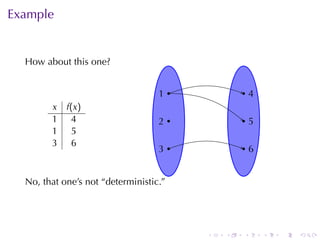
Example


  How	about	this	one?


                                   . .
                                   1              ..
                                                   4
        x f(x)
        1 4                        . ..
                                   2              .. .
                                                     5
        1 5
        3 6
                                   . .
                                   3              ..
                                                   6


  No, that	one’s	not	“deterministic.”


                                          .   .   .      .   .   .
In	science, functions	are	often	defined	by	data. Or, we	observe
data	and	assume	that	it’s	close	to	some	nice	continuous	function.


                                            .   .    .   .    .     .
Example
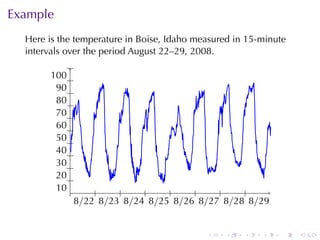
  Here	is	the	temperature	in	Boise, Idaho	measured	in	15-minute
  intervals	over	the	period	August	22–29, 2008.
              .
        1
        . 00 .
          9
          .0.
          8
          .0.
          7
          .0.
          6
          .0.
          5
          .0.
          4
          .0.
          3
          .0.
          2
          .0.
          1
          .0.        .     .     .     .     .     .     .
                8
                . /22 . /23 . /24 . /25 . /26 . /27 . /28 . /29
                       8     8     8     8     8     8     8


                                            .   .    .   .   .    .
Functions	described	graphically
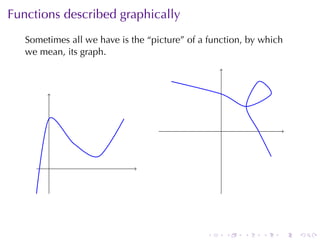
   Sometimes	all	we	have	is	the	“picture”	of	a	function, by	which
   we	mean, its	graph.


                                                  .


        .


                                              .       .   .   .   .   .
Functions	described	graphically
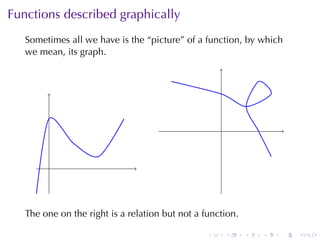
   Sometimes	all	we	have	is	the	“picture”	of	a	function, by	which
   we	mean, its	graph.


                                                     .


         .


   The	one	on	the	right	is	a	relation	but	not	a	function.

                                                 .       .   .   .   .   .
Functions	described	verbally


   Oftentimes	our	functions	come	out	of	nature	and	have	verbal
   descriptions:
       The	temperature T(t) in	this	room	at	time t.
       The	elevation h(θ) of	the	point	on	the	equator	at	longitude θ.
       The	utility u(x) I derive	by	consuming x burritos.


                                               .      .     .   .   .   .
Outline

  What	is	a	function?

  Modeling

  Examples	of	functions
     Functions	expressed	by	formulas
     Functions	described	numerically
     Functions	described	graphically
     Functions	described	verbally

  Properties	of	functions
     Monotonicity
     Symmetry


                                       .   .   .   .   .   .
Monotonicity
  Example
  Let P(x) be	the	probability	that	my	income	was	at	least	$x last
  year. What	might	a	graph	of P(x) look	like?


                                               .   .    .   .       .   .
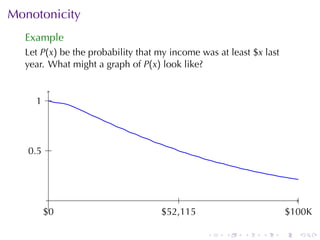
Monotonicity
  Example
  Let P(x) be	the	probability	that	my	income	was	at	least	$x last
  year. What	might	a	graph	of P(x) look	like?


     . .
     1


   . .5 .
   0


        .                               .                                   .
      $
      .0                           $
                                   . 52,115                             $
                                                                        . 100K

                                               .   .    .   .       .      .
Monotonicity


  Definition
      A function f is decreasing if f(x1 ) > f(x2 ) whenever x1 < x2
      for	any	two	points x1 and x2 in	the	domain	of f.
      A function f is increasing if f(x1 ) < f(x2 ) whenever x1 < x2
      for	any	two	points x1 and x2 in	the	domain	of f.


                                                .   .    .    .    .   .
Examples


  Example
  Going	back	to	the	burrito	function, would	you	call	it	increasing?


                                              .    .   .    .   .     .
Examples


  Example
  Going	back	to	the	burrito	function, would	you	call	it	increasing?

  Example
  Obviously, the	temperature	in	Boise	is	neither	increasing	nor
  decreasing.


                                              .    .   .    .     .   .
Symmetry


  Example
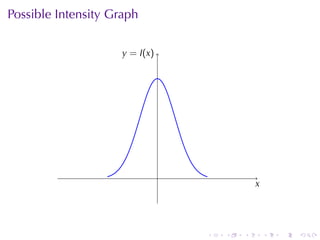
  Let I(x) be	the	intensity	of	light x distance	from	a	point.

  Example
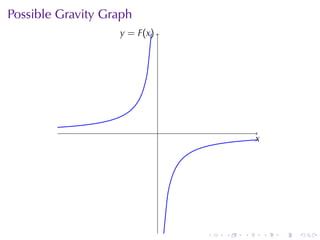
  Let F(x) be	the	gravitational	force	at	a	point x distance	from	a
  black	hole.


                                                 .    .    .    .    .   .
Possible	Intensity	Graph

                     y
                     . = I(x)


                                .
                                                x
                                                .


                                    .   .   .       .   .   .
Possible	Gravity	Graph
                   y
                   . = F(x)


                              .
                                              x
                                              .


                                  .   .   .       .   .   .
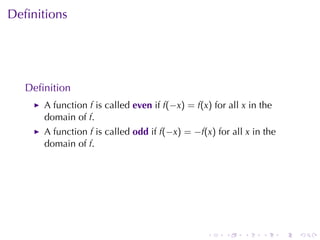
Definitions


  Definition
      A function f is	called even if f(−x) = f(x) for	all x in	the
      domain	of f.
      A function f is	called odd if f(−x) = −f(x) for	all x in	the
      domain	of f.


                                                .    .    .    .     .   .
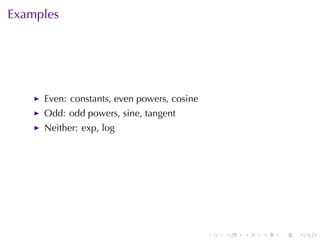
Examples


     Even: constants, even	powers, cosine
     Odd: odd	powers, sine, tangent
     Neither: exp, log


                                            .   .   .   .   .   .

Lesson 1: Functions and their Representations

  • 1.
    Section 1.1 Functions V63.0121.006/016, Calculus I January 19, 2010 Announcements Syllabus is on the common Blackboard Office Hours TBA . . . . . .
  • 2.
    Outline What is a function? Modeling Examples of functions Functions expressed by formulas Functions described numerically Functions described graphically Functions described verbally Properties of functions Monotonicity Symmetry . . . . . .
  • 3.
    Definition A function fis a relation which assigns to to every element x in a set D a single element f(x) in a set E. The set D is called the domain of f. The set E is called the target of f. The set { f(x) | x ∈ D } is called the range of f. . . . . . .
  • 4.
    Outline What is a function? Modeling Examples of functions Functions expressed by formulas Functions described numerically Functions described graphically Functions described verbally Properties of functions Monotonicity Symmetry . . . . . .
  • 5.
    The Modeling Process . . Real-world . . m . odel Mathematical . Problems Model s . olve .est t . i .nterpret . Real-world . Mathematical . Predictions Conclusions . . . . . .
  • 6.
    Plato’s Cave . . . . . .
  • 7.
    The Modeling Process . . Real-world . . m . odel Mathematical . Problems Model s . olve .est t . i .nterpret . Real-world . Mathematical . Predictions Conclusions S . hadows F . orms . . . . . .
  • 8.
    Outline What is a function? Modeling Examples of functions Functions expressed by formulas Functions described numerically Functions described graphically Functions described verbally Properties of functions Monotonicity Symmetry . . . . . .
  • 9.
    Functions expressed by formulas Any expression in a single variable x defines a function. In this case, the domain is understood to be the largest set of x which after substitution, give a real number. . . . . . .
  • 10.
    Example x+1 Let f(x) = . Find the domain and range of f. x−1 . . . . . .
  • 11.
    Example x+1 Let f(x) = . Find the domain and range of f. x−1 Solution The denominator is zero when x = 1, so the domain is all real numbers excepting one. As for the range, we can solve x+1 y+1 y= =⇒ x = x−1 y−1 So as long as y ̸= 1, there is an x associated to y. . . . . . .
  • 12.
    No-no’s for expressions Cannot have zero in the denominator of an expression Cannot have a negative number under an even root (e.g., square root) Cannot have the logarithm of a negative number . . . . . .
  • 13.
    Piecewise-defined functions Example Let { x2 0 ≤ x ≤ 1; f(x) = 3−x 1 < x ≤ 2. Find the domain and range of f and graph the function. . . . . . .
  • 14.
    Piecewise-defined functions Example Let { x2 0 ≤ x ≤ 1; f(x) = 3−x 1 < x ≤ 2. Find the domain and range of f and graph the function. Solution The domain is [0, 2]. The range is [0, 2). The graph is piecewise. . . 2 . . . 1 . . . . . 0 . 1 . 2 . . . . . . .
  • 15.
    Functions described numerically We can just describe a function by a table of values, or a diagram. . . . . . .
  • 16.
    Example Is this a function?If so, what is the range? x f(x) 1 4 2 5 3 6 . . . . . .
  • 17.
    Example Is this a function?If so, what is the range? . . 1 .. 4 x f(x) 1 4 . .. 2 .. . 5 2 5 3 6 . . 3 .. 6 . . . . . .
  • 18.
    Example Is this a function?If so, what is the range? . . 1 .. 4 x f(x) 1 4 . .. 2 .. . 5 2 5 3 6 . . 3 .. 6 Yes, the range is {4, 5, 6}. . . . . . .
  • 19.
    Example Is this a function?If so, what is the range? x f(x) 1 4 2 4 3 6 . . . . . .
  • 20.
    Example Is this a function?If so, what is the range? . . 1 .. 4 x f(x) 1 4 . .. 2 .. . 5 2 4 3 6 . . 3 .. 6 . . . . . .
  • 21.
    Example Is this a function?If so, what is the range? . . 1 .. 4 x f(x) 1 4 . .. 2 .. . 5 2 4 3 6 . . 3 .. 6 Yes, the range is {4, 6}. . . . . . .
  • 22.
    Example How about this one? x f(x) 1 4 1 5 3 6 . . . . . .
  • 23.
    Example How about this one? . . 1 .. 4 x f(x) 1 4 . .. 2 .. . 5 1 5 3 6 . . 3 .. 6 . . . . . .
  • 24.
    Example How about this one? . . 1 .. 4 x f(x) 1 4 . .. 2 .. . 5 1 5 3 6 . . 3 .. 6 No, that one’s not “deterministic.” . . . . . .
  • 25.
    In science, functions are often defined by data. Or,we observe data and assume that it’s close to some nice continuous function. . . . . . .
  • 26.
    Example Here is the temperature in Boise,Idaho measured in 15-minute intervals over the period August 22–29, 2008. . 1 . 00 . 9 .0. 8 .0. 7 .0. 6 .0. 5 .0. 4 .0. 3 .0. 2 .0. 1 .0. . . . . . . . 8 . /22 . /23 . /24 . /25 . /26 . /27 . /28 . /29 8 8 8 8 8 8 8 . . . . . .
  • 27.
    Functions described graphically Sometimes all we have is the “picture” of a function, by which we mean, its graph. . . . . . . . .
  • 28.
    Functions described graphically Sometimes all we have is the “picture” of a function, by which we mean, its graph. . . The one on the right is a relation but not a function. . . . . . .
  • 29.
    Functions described verbally Oftentimes our functions come out of nature and have verbal descriptions: The temperature T(t) in this room at time t. The elevation h(θ) of the point on the equator at longitude θ. The utility u(x) I derive by consuming x burritos. . . . . . .
  • 30.
    Outline What is a function? Modeling Examples of functions Functions expressed by formulas Functions described numerically Functions described graphically Functions described verbally Properties of functions Monotonicity Symmetry . . . . . .
  • 31.
    Monotonicity Example Let P(x) be the probability that my income was at least $x last year. What might a graph of P(x) look like? . . . . . .
  • 32.
    Monotonicity Example Let P(x) be the probability that my income was at least $x last year. What might a graph of P(x) look like? . . 1 . .5 . 0 . . . $ .0 $ . 52,115 $ . 100K . . . . . .
  • 33.
    Monotonicity Definition A function f is decreasing if f(x1 ) > f(x2 ) whenever x1 < x2 for any two points x1 and x2 in the domain of f. A function f is increasing if f(x1 ) < f(x2 ) whenever x1 < x2 for any two points x1 and x2 in the domain of f. . . . . . .
  • 34.
    Examples Example Going back to the burrito function, would you call it increasing? . . . . . .
  • 35.
    Examples Example Going back to the burrito function, would you call it increasing? Example Obviously, the temperature in Boise is neither increasing nor decreasing. . . . . . .
  • 36.
    Symmetry Example Let I(x) be the intensity of light x distance from a point. Example Let F(x) be the gravitational force at a point x distance from a black hole. . . . . . .
  • 37.
    Possible Intensity Graph y . = I(x) . x . . . . . . .
  • 38.
    Possible Gravity Graph y . = F(x) . x . . . . . . .
  • 39.
    Definitions Definition A function f is called even if f(−x) = f(x) for all x in the domain of f. A function f is called odd if f(−x) = −f(x) for all x in the domain of f. . . . . . .
  • 40.
    Examples Even: constants, even powers, cosine Odd: odd powers, sine, tangent Neither: exp, log . . . . . .