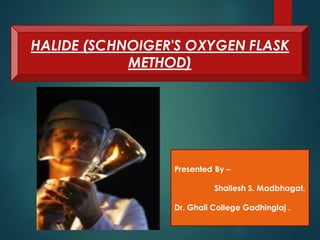
HALIDE (SCHNOIGER'S OXYGEN FLASK
METHOD)
Presented By –
Shailesh S. Madbhagat.
Dr. Ghali College Gadhinglaj .
• CONTENTS -
1. INTRODUCTION
2. APPARATUS
3. PREPARATION OF SAMPLE
4. PROCEDURE OF DETERMINATION
5. APPLICATIONS
• INTRODUCTION -
1. Schnoigers oxygen flask method is also known as
oxygen flask combustion method.
2. This method was developed by wolfgang
schnoiger in 1955.
3. Oxygen flask combustion method is used to identify
halogens that are produced by combusting
organic compound.
4. The definition of OFCM says that the method is
useful in identifying or determining if sulphur or
halogens are produced when organic compounds
are combusted.
5. The compounds contain iodine, fluorine, chlorine,
bromine or sulphur in a flask that is filled with oxygen.
6. When these compounds are combusted they give
out inorganic products which are soluble in water.
• APPARATUS -
1. The apparatus consist of 500 ml conical flask fitted
with a cork ( ground glass stopper) at the bottom
of which is fixed platinum wire.
2. Through this platinum wire attached a platinum
specimen carrier.
3. The upper part of the flask is made like saucer.
4. The ground stopper is made up of hard glass.
5. For the determination of fluorine the flask and
stopper used should made up of quartz.
• PREPARATION OF TEST SOLUTION AND BLANK
SOLUTION -
Samples of test solution were prepared by the following method
below :
• PREPARATION OF SAMPLE -
1) For solid samples - Weight accurately suitable
quantity of sample on halide free filter paper,
wrapped it and placed it on platinum guaze.
2) For liquid samples - Use a gelatine capsule or
mixed with methyl cellulose powder and place in
platinum gauze.
3) For ointments and creams - Place the sample on
grease proof paper. Fold it and place in sample
holder.
• Method of Combustion -
1) The absorbing liquid should be placed in flask.
2) Then the flask should be filled with oxygen and the ground part of the
stopper should be moistened with water.
3) Then the fuse strip is ignited and transferred to the flask immediately.
4) The flask should be kept air tightening until the combination if finished.
5) The flask should be shaken occasionally so that the white smoke
completely vanishes.
6) Let it stand for 15 to 30 minutes and resulting solution would be labeled
as a test solution.
7) Prepare the blank solution in the same manner without sample.
• PROCEDURE OF
DETERMINATION -
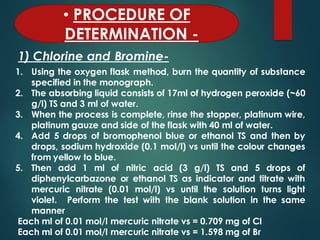
1) Chlorine and Bromine-
1. Using the oxygen flask method, burn the quantity of substance
specified in the monograph.
2. The absorbing liquid consists of 17ml of hydrogen peroxide (~60
g/l) TS and 3 ml of water.
3. When the process is complete, rinse the stopper, platinum wire,
platinum gauze and side of the flask with 40 ml of water.
4. Add 5 drops of bromophenol blue or ethanol TS and then by
drops, sodium hydroxide (0.1 mol/l) vs until the colour changes
from yellow to blue.
5. Then add 1 ml of nitric acid (3 g/l) TS and 5 drops of
diphenylcarbazone or ethanol TS as indicator and titrate with
mercuric nitrate (0.01 mol/l) vs until the solution turns light
violet. Perform the test with the blank solution in the same
manner
Each ml of 0.01 mol/l mercuric nitrate vs = 0.709 mg of Cl
Each ml of 0.01 mol/l mercuric nitrate vs = 1.598 mg of Br
2) Fluorine -
1. Using the oxygen flask method, burn the quantity
of the substance specified in the monograph.
2. The absorbing liquid consists of 15 ml water.
3. When the process is complete, rinse the stopper,
platinum wure, platinum gauze and side of the
flask with 40 ml of water.
4. Add 0.6 ml of sodium alizarin sulfonate (1 g/l) TS
and then by drops, sodium hydroxide (0.1 mol/l)
vs until the colour changes from pink to yellow.
5. Add 5 ml of acetate buffer, pH 3.0, TS and titrate
with thorium nitrate (0.005 mol/l) vs until the yellow
colour changes to pinkish yellow. Perform the test
with blank solution in the same manner.
Each ml of 0.005 mol/l thorium nitrate vs = 0.380 mg
of F.
• APPLICATIONS -
1. Oxygen flask combustion method has been used
to determine of sulphur and halogen in medicine.
2. This method is used for determination of halogen,
sulphur, phosphorus, argon and boron in organic
compound.
3. Determination of chlorine in polymers.
4. Determination of total fluorine in coal.
5. Determination of mercury in ash and soil sample.
The End
🌟 THANK
YOU 🌟

Oxygen flask combustion method ppt.pdf

  • 1.
    HALIDE (SCHNOIGER'S OXYGENFLASK METHOD) Presented By – Shailesh S. Madbhagat. Dr. Ghali College Gadhinglaj .
  • 2.
    • CONTENTS - 1.INTRODUCTION 2. APPARATUS 3. PREPARATION OF SAMPLE 4. PROCEDURE OF DETERMINATION 5. APPLICATIONS
  • 3.
    • INTRODUCTION - 1.Schnoigers oxygen flask method is also known as oxygen flask combustion method. 2. This method was developed by wolfgang schnoiger in 1955. 3. Oxygen flask combustion method is used to identify halogens that are produced by combusting organic compound. 4. The definition of OFCM says that the method is useful in identifying or determining if sulphur or halogens are produced when organic compounds are combusted.
  • 4.
    5. The compoundscontain iodine, fluorine, chlorine, bromine or sulphur in a flask that is filled with oxygen. 6. When these compounds are combusted they give out inorganic products which are soluble in water.
  • 5.
  • 6.
    1. The apparatusconsist of 500 ml conical flask fitted with a cork ( ground glass stopper) at the bottom of which is fixed platinum wire. 2. Through this platinum wire attached a platinum specimen carrier. 3. The upper part of the flask is made like saucer. 4. The ground stopper is made up of hard glass. 5. For the determination of fluorine the flask and stopper used should made up of quartz.
  • 7.
    • PREPARATION OFTEST SOLUTION AND BLANK SOLUTION - Samples of test solution were prepared by the following method below : • PREPARATION OF SAMPLE - 1) For solid samples - Weight accurately suitable quantity of sample on halide free filter paper, wrapped it and placed it on platinum guaze. 2) For liquid samples - Use a gelatine capsule or mixed with methyl cellulose powder and place in platinum gauze.
  • 8.
    3) For ointmentsand creams - Place the sample on grease proof paper. Fold it and place in sample holder.
  • 9.
    • Method ofCombustion - 1) The absorbing liquid should be placed in flask. 2) Then the flask should be filled with oxygen and the ground part of the stopper should be moistened with water. 3) Then the fuse strip is ignited and transferred to the flask immediately. 4) The flask should be kept air tightening until the combination if finished. 5) The flask should be shaken occasionally so that the white smoke completely vanishes. 6) Let it stand for 15 to 30 minutes and resulting solution would be labeled as a test solution. 7) Prepare the blank solution in the same manner without sample.
  • 10.
    • PROCEDURE OF DETERMINATION- 1) Chlorine and Bromine- 1. Using the oxygen flask method, burn the quantity of substance specified in the monograph. 2. The absorbing liquid consists of 17ml of hydrogen peroxide (~60 g/l) TS and 3 ml of water. 3. When the process is complete, rinse the stopper, platinum wire, platinum gauze and side of the flask with 40 ml of water. 4. Add 5 drops of bromophenol blue or ethanol TS and then by drops, sodium hydroxide (0.1 mol/l) vs until the colour changes from yellow to blue. 5. Then add 1 ml of nitric acid (3 g/l) TS and 5 drops of diphenylcarbazone or ethanol TS as indicator and titrate with mercuric nitrate (0.01 mol/l) vs until the solution turns light violet. Perform the test with the blank solution in the same manner Each ml of 0.01 mol/l mercuric nitrate vs = 0.709 mg of Cl Each ml of 0.01 mol/l mercuric nitrate vs = 1.598 mg of Br
  • 11.
    2) Fluorine - 1.Using the oxygen flask method, burn the quantity of the substance specified in the monograph. 2. The absorbing liquid consists of 15 ml water. 3. When the process is complete, rinse the stopper, platinum wure, platinum gauze and side of the flask with 40 ml of water. 4. Add 0.6 ml of sodium alizarin sulfonate (1 g/l) TS and then by drops, sodium hydroxide (0.1 mol/l) vs until the colour changes from pink to yellow. 5. Add 5 ml of acetate buffer, pH 3.0, TS and titrate with thorium nitrate (0.005 mol/l) vs until the yellow colour changes to pinkish yellow. Perform the test with blank solution in the same manner. Each ml of 0.005 mol/l thorium nitrate vs = 0.380 mg of F.
  • 12.
    • APPLICATIONS - 1.Oxygen flask combustion method has been used to determine of sulphur and halogen in medicine. 2. This method is used for determination of halogen, sulphur, phosphorus, argon and boron in organic compound. 3. Determination of chlorine in polymers. 4. Determination of total fluorine in coal. 5. Determination of mercury in ash and soil sample.
  • 13.