

ASSIGNMENT-4
PRESENTED BY:-
NARENDRA SINGH UMATH
16TMM2365
PRESENTEDTO:-
Dr. I.P. SINGH
Limit test for heavy
metal-lead
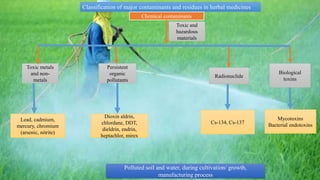
Classification of major contaminants and residues in herbal medicines
Chemical contaminants
Toxic and
hazardous
materials
Persistent
organic
pollutants
Toxic metals
and non-
metals
Radionuclide
Biological
toxins
Lead, cadmium,
mercury, chromium
(arsenic, nitrite)
Polluted soil and water, during cultivation/ growth,
manufacturing process
Cs-134, Cs-137
Mycotoxins
Bacterial endotoxins
Dioxin aldrin,
chlordane, DDT,
dieldrin, endrin,
heptachlor, mirex
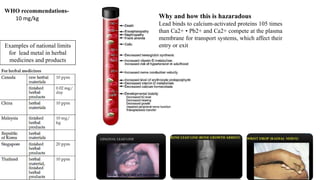
WHO recommendations-
10 mg/kg
Examples of national limits
for lead metal in herbal
medicines and products
Why and how this is hazaradous
Lead binds to calcium-activated proteins 105 times
than Ca2+ • Pb2+ and Ca2+ compete at the plasma
membrane for transport systems, which affect their
entry or exit
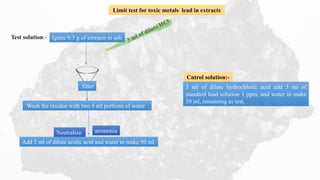
Limit test for toxic metals lead in extracts
Test solution:- Ignite 0.3 g of extracts to ash
filter
Wash the residue with two 5 ml portions of water
Neutralize ammonia
Add 2 ml of dilute acetic acid and water to make 50 ml
Cntrol solution:-
3 ml of dilute hydrochloric acid add 3 ml of
standard lead solution 1 ppm, and water to make
50 ml, remaining as test.
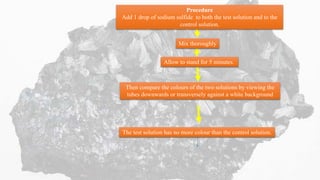
Procedure
Add 1 drop of sodium sulfide to both the test solution and to the
control solution.
Mix thoroughly
Allow to stand for 5 minutes.
Then compare the colours of the two solutions by viewing the
tubes downwards or transversely against a white background
The test solution has no more colour than the control solution.
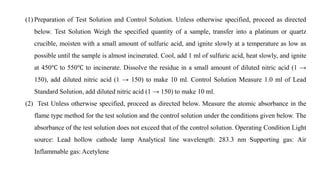
(1) Preparation of Test Solution and Control Solution. Unless otherwise specified, proceed as directed
below. Test Solution Weigh the specified quantity of a sample, transfer into a platinum or quartz
crucible, moisten with a small amount of sulfuric acid, and ignite slowly at a temperature as low as
possible until the sample is almost incinerated. Cool, add 1 ml of sulfuric acid, heat slowly, and ignite
at 450℃ to 550℃ to incinerate. Dissolve the residue in a small amount of diluted nitric acid (1 →
150), add diluted nitric acid (1 → 150) to make 10 ml. Control Solution Measure 1.0 ml of Lead
Standard Solution, add diluted nitric acid (1 → 150) to make 10 ml.
(2) Test Unless otherwise specified, proceed as directed below. Measure the atomic absorbance in the
flame type method for the test solution and the control solution under the conditions given below. The
absorbance of the test solution does not exceed that of the control solution. Operating Condition Light
source: Lead hollow cathode lamp Analytical line wavelength: 283.3 nm Supporting gas: Air
Inflammable gas: Acetylene
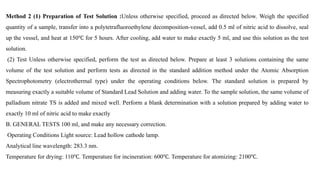
Method 2 (1) Preparation of Test Solution :Unless otherwise specified, proceed as directed below. Weigh the specified
quantity of a sample, transfer into a polytetrafluoroethylene decomposition-vessel, add 0.5 ml of nitric acid to dissolve, seal
up the vessel, and heat at 150℃ for 5 hours. After cooling, add water to make exactly 5 ml, and use this solution as the test
solution.
(2) Test Unless otherwise specified, perform the test as directed below. Prepare at least 3 solutions containing the same
volume of the test solution and perform tests as directed in the standard addition method under the Atomic Absorption
Spectrophotometry (electrothermal type) under the operating conditions below. The standard solution is prepared by
measuring exactly a suitable volume of Standard Lead Solution and adding water. To the sample solution, the same volume of
palladium nitrate TS is added and mixed well. Perform a blank determination with a solution prepared by adding water to
exactly 10 ml of nitric acid to make exactly
B. GENERAL TESTS 100 ml, and make any necessary correction.
Operating Conditions Light source: Lead hollow cathode lamp.
Analytical line wavelength: 283.3 nm.
Temperature for drying: 110℃. Temperature for incineration: 600℃. Temperature for atomizing: 2100℃.
LIMIT TEST FOR HEAVY METAL LEAD

LIMIT TEST FOR HEAVY METAL LEAD

  • 1.
    ASSIGNMENT-4 PRESENTED BY:- NARENDRA SINGHUMATH 16TMM2365 PRESENTEDTO:- Dr. I.P. SINGH Limit test for heavy metal-lead
  • 2.
    Classification of majorcontaminants and residues in herbal medicines Chemical contaminants Toxic and hazardous materials Persistent organic pollutants Toxic metals and non- metals Radionuclide Biological toxins Lead, cadmium, mercury, chromium (arsenic, nitrite) Polluted soil and water, during cultivation/ growth, manufacturing process Cs-134, Cs-137 Mycotoxins Bacterial endotoxins Dioxin aldrin, chlordane, DDT, dieldrin, endrin, heptachlor, mirex
  • 3.
    WHO recommendations- 10 mg/kg Examplesof national limits for lead metal in herbal medicines and products Why and how this is hazaradous Lead binds to calcium-activated proteins 105 times than Ca2+ • Pb2+ and Ca2+ compete at the plasma membrane for transport systems, which affect their entry or exit
  • 4.
    Limit test fortoxic metals lead in extracts Test solution:- Ignite 0.3 g of extracts to ash filter Wash the residue with two 5 ml portions of water Neutralize ammonia Add 2 ml of dilute acetic acid and water to make 50 ml Cntrol solution:- 3 ml of dilute hydrochloric acid add 3 ml of standard lead solution 1 ppm, and water to make 50 ml, remaining as test.
  • 5.
    Procedure Add 1 dropof sodium sulfide to both the test solution and to the control solution. Mix thoroughly Allow to stand for 5 minutes. Then compare the colours of the two solutions by viewing the tubes downwards or transversely against a white background The test solution has no more colour than the control solution.
  • 6.
    (1) Preparation ofTest Solution and Control Solution. Unless otherwise specified, proceed as directed below. Test Solution Weigh the specified quantity of a sample, transfer into a platinum or quartz crucible, moisten with a small amount of sulfuric acid, and ignite slowly at a temperature as low as possible until the sample is almost incinerated. Cool, add 1 ml of sulfuric acid, heat slowly, and ignite at 450℃ to 550℃ to incinerate. Dissolve the residue in a small amount of diluted nitric acid (1 → 150), add diluted nitric acid (1 → 150) to make 10 ml. Control Solution Measure 1.0 ml of Lead Standard Solution, add diluted nitric acid (1 → 150) to make 10 ml. (2) Test Unless otherwise specified, proceed as directed below. Measure the atomic absorbance in the flame type method for the test solution and the control solution under the conditions given below. The absorbance of the test solution does not exceed that of the control solution. Operating Condition Light source: Lead hollow cathode lamp Analytical line wavelength: 283.3 nm Supporting gas: Air Inflammable gas: Acetylene
  • 7.
    Method 2 (1)Preparation of Test Solution :Unless otherwise specified, proceed as directed below. Weigh the specified quantity of a sample, transfer into a polytetrafluoroethylene decomposition-vessel, add 0.5 ml of nitric acid to dissolve, seal up the vessel, and heat at 150℃ for 5 hours. After cooling, add water to make exactly 5 ml, and use this solution as the test solution. (2) Test Unless otherwise specified, perform the test as directed below. Prepare at least 3 solutions containing the same volume of the test solution and perform tests as directed in the standard addition method under the Atomic Absorption Spectrophotometry (electrothermal type) under the operating conditions below. The standard solution is prepared by measuring exactly a suitable volume of Standard Lead Solution and adding water. To the sample solution, the same volume of palladium nitrate TS is added and mixed well. Perform a blank determination with a solution prepared by adding water to exactly 10 ml of nitric acid to make exactly B. GENERAL TESTS 100 ml, and make any necessary correction. Operating Conditions Light source: Lead hollow cathode lamp. Analytical line wavelength: 283.3 nm. Temperature for drying: 110℃. Temperature for incineration: 600℃. Temperature for atomizing: 2100℃.