DISSOLVED OXYGEN MEASUREMENT
DISSOLVED OXYGEN (DO)
The DO determination measures the amount of
dissolved (or free) oxygen present in water or
wastewater. Aerobic bacteria and aquatic life
such as fish must have DO to survive.
Aerobic wastewater treatment processes use
aerobic and facultative bacteria to break down
the organic compounds found in wastewater into
more stable products that will not harm the
receiving waters.
SAMPLING
• Proper sampling is necessary if laboratory testing is to
be accurate.
• The sample must be representative and handled
carefully.
• If the sample is not representative, the results of the
test will not reflect actual conditions and can lead to
poor plant performance.
• Select a sampling location where mixing is thorough
and the wastewater quality is uniform.
• The higher the amount of solids in the sample, the
more important a well-mixed sample becomes.
• If testing is not done on an hourly basis, choose times
when the sample best represents the waste
characteristics so that changes can be spotted quickly.
SAMPLE PRESERVATION
• If the samples must wait for a time period of up
to two hours before testing and have no iodine
demand, they may be stored by adding
manganous sulfate solution, alkaline-iodide-azide
solution, sulfuric acid solution and shaking well
(making sure that no air bubbles are trapped or
formed).
• Those samples which have an iodine demand
may be preserved for 4 to 8 hours by adding
0.7 mL concentrated sulfuric acid (H2SO4) and
1.0 mL sodium azide solution (2.0 g NaN3/100 mL
distilled water) to the DO bottle
SAMPLE CONTAINERS
• For the Winkler analysis, samples should be
collected in narrow-mouth glass-stoppered
BOD bottles with 300 mL capacity with
tapered, ground-glass, pointed stoppers and
flared mouths.
• Samples must be taken so that the bottle will
be completely filled with liquid that has not
been in contact with air and no air is trapped
under the stopper.
SAMPLE CONTAINER PREPARATION
• Sample containers must be clean, dry and free of
contaminants.
• The best method to prepare sample containers is by acid
cleaning with dichromate cleaning acid, which can either be
bought already prepared, or mixed at the plant.
• If cleaning acid is not available, use a laboratory grade
detergent that is low in phosphorus and nitrates.
• Wash with a good cleaning brush, and rinse thoroughly
with tap water, followed by distilled water. Allow the
bottles to dry in an upside-down position
• All sample containers should be cleaned immediately after
the test has been completed to prevent accumulation of
residues in the containers which can affect the test.
MODIFIED WINKLER METHOD
• REAGENTS
• 1. Manganous sulfate solution
• 2. Alkaline potassium iodide-sodium azide
solution
• 3. Sulfuric acid (H2SO4), concentrated
• 4. Starch indicator solution
• 5. Sodium thiosulfate (Na2S2O3 5H2O), 0.025 N
• 6. Phenylarsine oxide (PAO), 0.025 N
• 7. Potassium bi-iodate (KH(IO3)2), 0.025 N
• 8. Distilled or deionized water
EQUIPMENT
• 1. Burette, graduated to 0.1 mL
• 2. Burette stand
• 3. 300 mL glass stoppered BOD bottles
• 4. 500 mL wide-mouthed Erlenmeyer flasks
• 5. Pipettes with elongated tips and minimum
volume of 1.0 mL (+/- 0.1 mL)
• 6. Pipette bulb
• 7. 250 mL graduated cylinders
• 8. Distilled water rinse bottle
LABORATORY PROCEDURE
• 1. Collect the sample to be tested in a 300 mL BOD bottle taking special
care to avoid adding air to the liquid being collected. Fill bottle completely and
add stopper
• 2. Remove bottle stopper and add 1 mL of the manganous sulfate solution
at the surface of the liquid.
• 3. Add 1 mL of the alkaline-potassium iodide-sodium azide solution at the
surface of the liquid.
• 4. Replace the stopper, avoid trapping air bubbles and shake well by
inverting the bottle several times. Repeat shaking after floc has settled
halfway. Allow floc to settle a second time.
• 5. Add 1 mL of concentrated sulfuric acid by allowing the acid to run down
the neck of the bottle above the surface of the liquid.
• 6. Restopper, rinse the top of the bottle to remove any acid and shake well
until the precipitate has dissolved.
• 7. Titrate a volume of treated sample which corresponds to 200 mL of the
original sample. This corrects for the loss of some sample during the addition
of reagents. This volume calculated using the formula: mL of sample to titrate
= 200 x [300/(300-2)] = 201 mL
• 8. Pour 201 mL of sample from the BOD bottle into an Erlenmeyer flask.
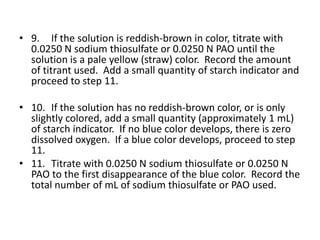
• 9. If the solution is reddish-brown in color, titrate with
0.0250 N sodium thiosulfate or 0.0250 N PAO until the
solution is a pale yellow (straw) color. Record the amount
of titrant used. Add a small quantity of starch indicator and
proceed to step 11.
• 10. If the solution has no reddish-brown color, or is only
slightly colored, add a small quantity (approximately 1 mL)
of starch indicator. If no blue color develops, there is zero
dissolved oxygen. If a blue color develops, proceed to step
11.
• 11. Titrate with 0.0250 N sodium thiosulfate or 0.0250 N
PAO to the first disappearance of the blue color. Record the
total number of mL of sodium thiosulfate or PAO used.
CALCULATIONS
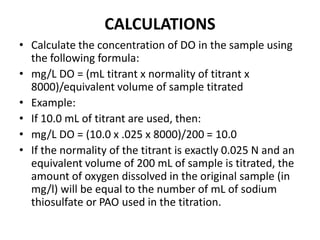
• Calculate the concentration of DO in the sample using
the following formula:
• mg/L DO = (mL titrant x normality of titrant x
8000)/equivalent volume of sample titrated
• Example:
• If 10.0 mL of titrant are used, then:
• mg/L DO = (10.0 x .025 x 8000)/200 = 10.0
• If the normality of the titrant is exactly 0.025 N and an
equivalent volume of 200 mL of sample is titrated, the
amount of oxygen dissolved in the original sample (in
mg/l) will be equal to the number of mL of sodium
thiosulfate or PAO used in the titration.
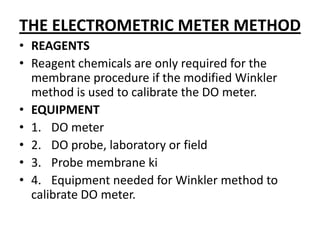
THE ELECTROMETRIC METER METHOD
• REAGENTS
• Reagent chemicals are only required for the
membrane procedure if the modified Winkler
method is used to calibrate the DO meter.
• EQUIPMENT
• 1. DO meter
• 2. DO probe, laboratory or field
• 3. Probe membrane ki
• 4. Equipment needed for Winkler method to
calibrate DO meter.
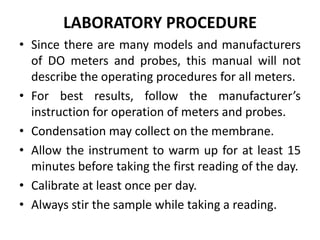
LABORATORY PROCEDURE
• Since there are many models and manufacturers
of DO meters and probes, this manual will not
describe the operating procedures for all meters.
• For best results, follow the manufacturer’s
instruction for operation of meters and probes.
• Condensation may collect on the membrane.
• Allow the instrument to warm up for at least 15
minutes before taking the first reading of the day.
• Calibrate at least once per day.
• Always stir the sample while taking a reading.

Do measurement

  • 2.
    DISSOLVED OXYGEN MEASUREMENT DISSOLVEDOXYGEN (DO) The DO determination measures the amount of dissolved (or free) oxygen present in water or wastewater. Aerobic bacteria and aquatic life such as fish must have DO to survive. Aerobic wastewater treatment processes use aerobic and facultative bacteria to break down the organic compounds found in wastewater into more stable products that will not harm the receiving waters.
  • 3.
    SAMPLING • Proper samplingis necessary if laboratory testing is to be accurate. • The sample must be representative and handled carefully. • If the sample is not representative, the results of the test will not reflect actual conditions and can lead to poor plant performance. • Select a sampling location where mixing is thorough and the wastewater quality is uniform. • The higher the amount of solids in the sample, the more important a well-mixed sample becomes. • If testing is not done on an hourly basis, choose times when the sample best represents the waste characteristics so that changes can be spotted quickly.
  • 4.
    SAMPLE PRESERVATION • Ifthe samples must wait for a time period of up to two hours before testing and have no iodine demand, they may be stored by adding manganous sulfate solution, alkaline-iodide-azide solution, sulfuric acid solution and shaking well (making sure that no air bubbles are trapped or formed). • Those samples which have an iodine demand may be preserved for 4 to 8 hours by adding 0.7 mL concentrated sulfuric acid (H2SO4) and 1.0 mL sodium azide solution (2.0 g NaN3/100 mL distilled water) to the DO bottle
  • 5.
    SAMPLE CONTAINERS • Forthe Winkler analysis, samples should be collected in narrow-mouth glass-stoppered BOD bottles with 300 mL capacity with tapered, ground-glass, pointed stoppers and flared mouths. • Samples must be taken so that the bottle will be completely filled with liquid that has not been in contact with air and no air is trapped under the stopper.
  • 6.
    SAMPLE CONTAINER PREPARATION •Sample containers must be clean, dry and free of contaminants. • The best method to prepare sample containers is by acid cleaning with dichromate cleaning acid, which can either be bought already prepared, or mixed at the plant. • If cleaning acid is not available, use a laboratory grade detergent that is low in phosphorus and nitrates. • Wash with a good cleaning brush, and rinse thoroughly with tap water, followed by distilled water. Allow the bottles to dry in an upside-down position • All sample containers should be cleaned immediately after the test has been completed to prevent accumulation of residues in the containers which can affect the test.
  • 7.
    MODIFIED WINKLER METHOD •REAGENTS • 1. Manganous sulfate solution • 2. Alkaline potassium iodide-sodium azide solution • 3. Sulfuric acid (H2SO4), concentrated • 4. Starch indicator solution • 5. Sodium thiosulfate (Na2S2O3 5H2O), 0.025 N • 6. Phenylarsine oxide (PAO), 0.025 N • 7. Potassium bi-iodate (KH(IO3)2), 0.025 N • 8. Distilled or deionized water
  • 8.
    EQUIPMENT • 1. Burette,graduated to 0.1 mL • 2. Burette stand • 3. 300 mL glass stoppered BOD bottles • 4. 500 mL wide-mouthed Erlenmeyer flasks • 5. Pipettes with elongated tips and minimum volume of 1.0 mL (+/- 0.1 mL) • 6. Pipette bulb • 7. 250 mL graduated cylinders • 8. Distilled water rinse bottle
  • 9.
    LABORATORY PROCEDURE • 1.Collect the sample to be tested in a 300 mL BOD bottle taking special care to avoid adding air to the liquid being collected. Fill bottle completely and add stopper • 2. Remove bottle stopper and add 1 mL of the manganous sulfate solution at the surface of the liquid. • 3. Add 1 mL of the alkaline-potassium iodide-sodium azide solution at the surface of the liquid. • 4. Replace the stopper, avoid trapping air bubbles and shake well by inverting the bottle several times. Repeat shaking after floc has settled halfway. Allow floc to settle a second time. • 5. Add 1 mL of concentrated sulfuric acid by allowing the acid to run down the neck of the bottle above the surface of the liquid. • 6. Restopper, rinse the top of the bottle to remove any acid and shake well until the precipitate has dissolved. • 7. Titrate a volume of treated sample which corresponds to 200 mL of the original sample. This corrects for the loss of some sample during the addition of reagents. This volume calculated using the formula: mL of sample to titrate = 200 x [300/(300-2)] = 201 mL • 8. Pour 201 mL of sample from the BOD bottle into an Erlenmeyer flask.
  • 10.
    • 9. Ifthe solution is reddish-brown in color, titrate with 0.0250 N sodium thiosulfate or 0.0250 N PAO until the solution is a pale yellow (straw) color. Record the amount of titrant used. Add a small quantity of starch indicator and proceed to step 11. • 10. If the solution has no reddish-brown color, or is only slightly colored, add a small quantity (approximately 1 mL) of starch indicator. If no blue color develops, there is zero dissolved oxygen. If a blue color develops, proceed to step 11. • 11. Titrate with 0.0250 N sodium thiosulfate or 0.0250 N PAO to the first disappearance of the blue color. Record the total number of mL of sodium thiosulfate or PAO used.
  • 11.
    CALCULATIONS • Calculate theconcentration of DO in the sample using the following formula: • mg/L DO = (mL titrant x normality of titrant x 8000)/equivalent volume of sample titrated • Example: • If 10.0 mL of titrant are used, then: • mg/L DO = (10.0 x .025 x 8000)/200 = 10.0 • If the normality of the titrant is exactly 0.025 N and an equivalent volume of 200 mL of sample is titrated, the amount of oxygen dissolved in the original sample (in mg/l) will be equal to the number of mL of sodium thiosulfate or PAO used in the titration.
  • 12.
    THE ELECTROMETRIC METERMETHOD • REAGENTS • Reagent chemicals are only required for the membrane procedure if the modified Winkler method is used to calibrate the DO meter. • EQUIPMENT • 1. DO meter • 2. DO probe, laboratory or field • 3. Probe membrane ki • 4. Equipment needed for Winkler method to calibrate DO meter.
  • 13.
    LABORATORY PROCEDURE • Sincethere are many models and manufacturers of DO meters and probes, this manual will not describe the operating procedures for all meters. • For best results, follow the manufacturer’s instruction for operation of meters and probes. • Condensation may collect on the membrane. • Allow the instrument to warm up for at least 15 minutes before taking the first reading of the day. • Calibrate at least once per day. • Always stir the sample while taking a reading.