Practical No. 3
Submitted to: Dr. Tauseef Anwar
Submitted by: Group 3
Saima Zahoor, Atiqa Sarfaraz, Muhammad Junaid
Maria Anwar, Gulzaib Mukhtiar, Ayesha Aslam
Semester: 6th
(1M)
Department: Botany
Subject: Plant Physiology – I
Topic: Determination of the amount of O2 used by the
Respiring water plant by the Winkler method
Determination of the amount of O2 used by the respiring water plant by the Winkler method
Principle
• The Winkler Method uses titration to determine dissolved oxygen in the water sample. A sample
bottle is filled completely with water (no air is left to skew the results). The dissolved oxygen in the
sample is then "fixed" by adding a series of reagents that form an acid compound that is then
titrated with a neutralizing compound that results in a colour change. The point of colour change is
called the "endpoint," which coincides with the dissolved oxygen concentration in the sample.
Dissolved oxygen analysis is best done in the field, as the sample will be less altered by
atmospheric equilibration.
Apparatus
 Narrow-Mouth Bottle with Stopper
Apparatus
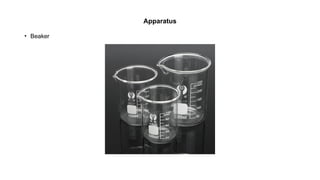
• Beaker
Apparatus
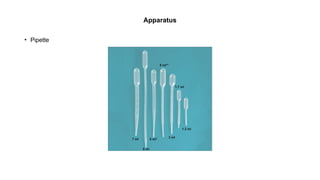
• Pipette
Apparatus
• Burette with stand
Apparatus
• Conical flask
Apparatus
Reagent
 2ml Manganese sulfate
 2ml alkali Potassium iodide-azide
 2ml concentrated sulfuric acid
 2ml starch solution
 Sodium thiosulfate (0.01N)
Procedure
Procedure
1. Collection of Sample
2. Fixation of Dissolved Oxygen
3. Titration
1.Collection of sample
i. Take 300 ml of sample water in the narrow mouth bottle.
ii. Fix the stopper into the bottle’s mouth to make it airtight.
Procedure
2.Fixation of Dissolved Oxygen
i. Remove the stopper and add 2ml of manganese sulphate to the collection bottle by inserting the
calibrated pipette just below the surface of the liquid. (If the reagent is added above the surface,
you will introduce oxygen into the sample.) Squeeze the pipette slowly so no bubbles are
introduced via pipette.
ii. Add 2ml of alkali potassium iodide-azide reagent in the same manner.
iii. Stopper the bottle with care to be sure no air is introduced. Mix the sample by inverting several
times. Check for air bubbles; discard the sample and start over if any are seen. If oxygen is
present, a brownish-orange cloud of precipitate will appear.
iv. Wait till the precipitate has settled to the bottom, mix the sample by turning it upside down several
times and let it settle down again.
v. Add 2ml of concentrated sulfuric acid via pipette. Carefully stopper the bottle and invert several
times to dissolve the precipitate. At this point the sample is “fixed” and can be stored for up to 8
hours if kept in cool dark place.
Procedure
3.Titration
i. Take 100ml water sample from the bottle and titrate it with 0.01N sodium. Titrate by slowly dropping titrant
solution into the flask and continually stirring or swirling and sample water. titrate the sample to a pale
straw color.
ii. Add 2ml of starch solution so a blue color forms.
iii. Continue slowly titrating until the sample turns clear. As this experiment reaches the end point, it will take
one drop to eliminate the blue color. Be careful that each drop is mixed fully before another one is added. It
is sometimes helpful to hold the flask up to a white sheet of paper to check for absence of the blue color.
iv. It is suggested that take three readings and record the mean volume of sodium thiosulphate used. The
concentration of dissolved oxygen in the sample can be calculated by this equation.
O2/litre of sample= Whereas V is volume and N is Normality of titrant.
Procedure
Observations and calculations
Equation
1) 2Mn2+
(aq) + 4 OH-
(aq) + O2 (aq)  2 MnO2 (s) + 2H2O (l)
2) MnO2 (s) + 4H+
(aq) + 2I-
(aq)  Mn2+
(aq) + I2 (aq) + 2H2O (l)
3) I2 (aq) + 2S2O3
2-
(aq)  S4O6
2-
(aq) + 2I-
(aq)
Sr. No. Initial Reading
(ml)
Final Reading
(ml)
Volume Used
(ml)
1 0 11 11
2 11 21 10
3 21 32.5 11.5
Average 10.83ml
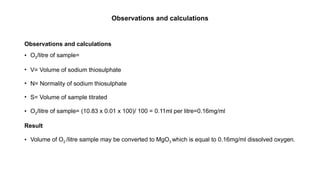
Observations and calculations
• O2/litre of sample=
• V= Volume of sodium thiosulphate
• N= Normality of sodium thiosulphate
• S= Volume of sample titrated
• O2/litre of sample= (10.83 x 0.01 x 100)/ 100 = 0.11ml per litre=0.16mg/ml
Result
• Volume of O2 /litre sample may be converted to MgO3 which is equal to 0.16mg/ml dissolved oxygen.
Precautions
 Sulfuric acid is extremely corrosive to eyes, skin and other tissue. Winkler solution #2 contains
sodium hydroxide and sodium iodide, and is also severely corrosive and strongly alkaline. Wear
chemical splash goggles, chemical-resistant gloves, and a chemical-resistant apron.
 Avoid air bubbles in the nozzle of the of the burette. Remove the funnel from the burette after
titration. Titrate drop by drop to ensure accuracy. Wear protective clothing when handling with
acidic chemicals.
 Prevent contamination of the sample by atmospheric O2 during sampling, fixation and storage.
Drawing tubes, sample flasks and reagent dispensing systems must be free of bubbles.
 Wash hands thoroughly after handling.

Practical No practical practical practical 3.pptx

  • 1.
    Practical No. 3 Submittedto: Dr. Tauseef Anwar Submitted by: Group 3 Saima Zahoor, Atiqa Sarfaraz, Muhammad Junaid Maria Anwar, Gulzaib Mukhtiar, Ayesha Aslam Semester: 6th (1M) Department: Botany Subject: Plant Physiology – I Topic: Determination of the amount of O2 used by the Respiring water plant by the Winkler method
  • 2.
    Determination of theamount of O2 used by the respiring water plant by the Winkler method Principle • The Winkler Method uses titration to determine dissolved oxygen in the water sample. A sample bottle is filled completely with water (no air is left to skew the results). The dissolved oxygen in the sample is then "fixed" by adding a series of reagents that form an acid compound that is then titrated with a neutralizing compound that results in a colour change. The point of colour change is called the "endpoint," which coincides with the dissolved oxygen concentration in the sample. Dissolved oxygen analysis is best done in the field, as the sample will be less altered by atmospheric equilibration.
  • 3.
  • 4.
  • 5.
  • 6.
  • 7.
  • 8.
    Apparatus Reagent  2ml Manganesesulfate  2ml alkali Potassium iodide-azide  2ml concentrated sulfuric acid  2ml starch solution  Sodium thiosulfate (0.01N)
  • 9.
    Procedure Procedure 1. Collection ofSample 2. Fixation of Dissolved Oxygen 3. Titration 1.Collection of sample i. Take 300 ml of sample water in the narrow mouth bottle. ii. Fix the stopper into the bottle’s mouth to make it airtight.
  • 10.
    Procedure 2.Fixation of DissolvedOxygen i. Remove the stopper and add 2ml of manganese sulphate to the collection bottle by inserting the calibrated pipette just below the surface of the liquid. (If the reagent is added above the surface, you will introduce oxygen into the sample.) Squeeze the pipette slowly so no bubbles are introduced via pipette. ii. Add 2ml of alkali potassium iodide-azide reagent in the same manner. iii. Stopper the bottle with care to be sure no air is introduced. Mix the sample by inverting several times. Check for air bubbles; discard the sample and start over if any are seen. If oxygen is present, a brownish-orange cloud of precipitate will appear. iv. Wait till the precipitate has settled to the bottom, mix the sample by turning it upside down several times and let it settle down again. v. Add 2ml of concentrated sulfuric acid via pipette. Carefully stopper the bottle and invert several times to dissolve the precipitate. At this point the sample is “fixed” and can be stored for up to 8 hours if kept in cool dark place.
  • 11.
    Procedure 3.Titration i. Take 100mlwater sample from the bottle and titrate it with 0.01N sodium. Titrate by slowly dropping titrant solution into the flask and continually stirring or swirling and sample water. titrate the sample to a pale straw color. ii. Add 2ml of starch solution so a blue color forms. iii. Continue slowly titrating until the sample turns clear. As this experiment reaches the end point, it will take one drop to eliminate the blue color. Be careful that each drop is mixed fully before another one is added. It is sometimes helpful to hold the flask up to a white sheet of paper to check for absence of the blue color. iv. It is suggested that take three readings and record the mean volume of sodium thiosulphate used. The concentration of dissolved oxygen in the sample can be calculated by this equation. O2/litre of sample= Whereas V is volume and N is Normality of titrant.
  • 12.
  • 13.
    Observations and calculations Equation 1)2Mn2+ (aq) + 4 OH- (aq) + O2 (aq)  2 MnO2 (s) + 2H2O (l) 2) MnO2 (s) + 4H+ (aq) + 2I- (aq)  Mn2+ (aq) + I2 (aq) + 2H2O (l) 3) I2 (aq) + 2S2O3 2- (aq)  S4O6 2- (aq) + 2I- (aq) Sr. No. Initial Reading (ml) Final Reading (ml) Volume Used (ml) 1 0 11 11 2 11 21 10 3 21 32.5 11.5 Average 10.83ml
  • 14.
    Observations and calculations Observationsand calculations • O2/litre of sample= • V= Volume of sodium thiosulphate • N= Normality of sodium thiosulphate • S= Volume of sample titrated • O2/litre of sample= (10.83 x 0.01 x 100)/ 100 = 0.11ml per litre=0.16mg/ml Result • Volume of O2 /litre sample may be converted to MgO3 which is equal to 0.16mg/ml dissolved oxygen.
  • 15.
    Precautions  Sulfuric acidis extremely corrosive to eyes, skin and other tissue. Winkler solution #2 contains sodium hydroxide and sodium iodide, and is also severely corrosive and strongly alkaline. Wear chemical splash goggles, chemical-resistant gloves, and a chemical-resistant apron.  Avoid air bubbles in the nozzle of the of the burette. Remove the funnel from the burette after titration. Titrate drop by drop to ensure accuracy. Wear protective clothing when handling with acidic chemicals.  Prevent contamination of the sample by atmospheric O2 during sampling, fixation and storage. Drawing tubes, sample flasks and reagent dispensing systems must be free of bubbles.  Wash hands thoroughly after handling.