Oxidation
Involving C-C
Bonds Cleavage
By Pallavi Kumbhar
MSc. Part-1
CONTENTS  Oxidation of Glycols using HIO4
 Oxidation of Alkenes using CrO3
 Oxidation of C-C double bond using Ozone
 Oxidation of C-C double bond using KMnO4
 Oxidation of C-C double bond using NaIO4
 Oxidation of C-C double bond using OsO4
 Oxidation of Aromatic rings using RuO4 and NaIO4
 References
Oxidation
Of
Glycols
Using
HIO4
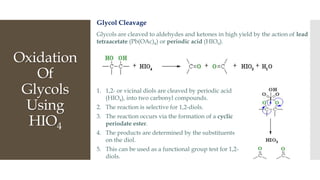
Glycol Cleavage
Glycols are cleaved to aldehydes and ketones in high yield by the action of lead
tetraacetate (Pb(OAc)4) or periodic acid (HIO4).
1. 1,2- or vicinal diols are cleaved by periodic acid
(HIO4), into two carbonyl compounds.
2. The reaction is selective for 1,2-diols.
3. The reaction occurs via the formation of a cyclic
periodate ester.
4. The products are determined by the substituents
on the diol.
5. This can be used as a functional group test for 1,2-
diols.
Oxidation
of Alkenes
using
CrO3
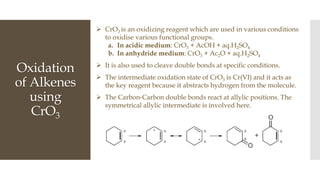
 CrO3 is an oxidizing reagent which are used in various conditions
to oxidise various functional groups.
a. In acidic medium: CrO3 + AcOH + aq.H2SO4
b. In anhydride medium: CrO3 + Ac2O + aq.H2SO4
 It is also used to cleave double bonds at specific conditions.
 The intermediate oxidation state of CrO3 is Cr(VI) and it acts as
the key reagent because it abstracts hydrogen from the molecule.
 The Carbon-Carbon double bonds react at allylic positions. The
symmetrical allylic intermediate is involved here.
Oxidation
of Alkenes
using
CrO3
Uses of CrO3
Chromium trioxide is mainly used in chrome plating. The trioxide reacts
with cadmium, zinc, and other metals to generate chromate films that
resists corrosion.
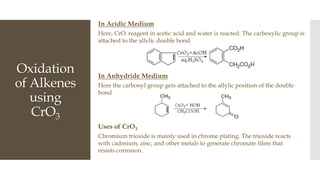
In Anhydride Medium
Here the carbonyl group gets attached to the allylic position of the double
bond
In Acidic Medium
Here, CrO3 reagent in acetic acid and water is reacted. The carboxylic group is
attached to the allylic double bond
Oxidation of
C-C
double
bonds using
ozone
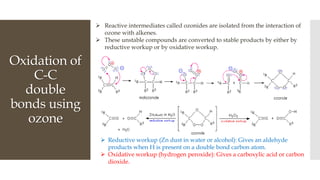
 Reductive workup (Zn dust in water or alcohol): Gives an aldehyde
products when H is present on a double bond carbon atom.
 Oxidative workup (hydrogen peroxide): Gives a carboxylic acid or carbon
dioxide.
 Reactive intermediates called ozonides are isolated from the interaction of
ozone with alkenes.
 These unstable compounds are converted to stable products by either by
reductive workup or by oxidative workup.
Oxidation of
C-C
bonds using
KMnO4
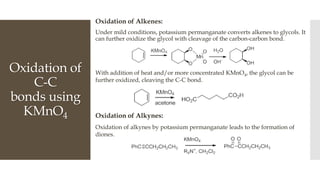
Oxidation of Alkenes:
Under mild conditions, potassium permanganate converts alkenes to glycols. It
can further oxidize the glycol with cleavage of the carbon-carbon bond.
With addition of heat and/or more concentrated KMnO4, the glycol can be
further oxidized, cleaving the C-C bond.
Oxidation of Alkynes:
Oxidation of alkynes by potassium permanganate leads to the formation of
diones.
Oxidation of
C-C
double bond
using
NaIO4
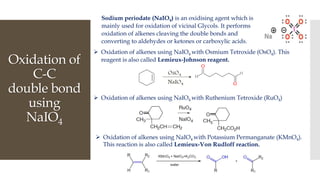
Sodium periodate (NaIO4) is an oxidising agent which is
mainly used for oxidation of vicinal Glycols. It performs
oxidation of alkenes cleaving the double bonds and
converting to aldehydes or ketones or carboxylic acids.
 Oxidation of alkenes using NaIO4 with Osmium Tetroxide (OsO4). This
reagent is also called Lemieux-Johnson reagent.
 Oxidation of alkenes using NaIO4 with Ruthenium Tetroxide (RuO4)
 Oxidation of alkenes using NaIO4 with Potassium Permanganate (KMnO4).
This reaction is also called Lemieux-Von Rudloff reaction.
Oxidation of
C-C
double bond
using
OsO4
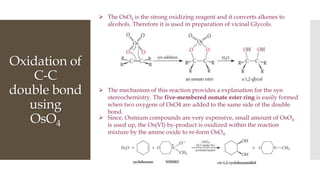
 The OsO4 is the strong oxidizing reagent and it converts alkenes to
alcohols. Therefore it is used in preparation of vicinal Glycols.
 Since, Osmium compounds are very expensive, small amount of OsO4
is used up, the Os(VI) by-product is oxidized within the reaction
mixture by the amine oxide to re-form OsO4.
 The mechanism of this reaction provides a explanation for the syn
stereochemistry. The five-membered osmate ester ring is easily formed
when two oxygens of OsO4 are added to the same side of the double
bond.
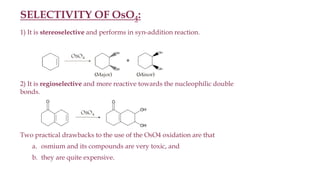
SELECTIVITY OF OsO4:
1) It is stereoselective and performs in syn-addition reaction.
2) It is regioselective and more reactive towards the nucleophilic double
bonds.
Two practical drawbacks to the use of the OsO4 oxidation are that
a. osmium and its compounds are very toxic, and
b. they are quite expensive.
Oxidation of
aromatic
rings
using
RuO4
&
NaIO4
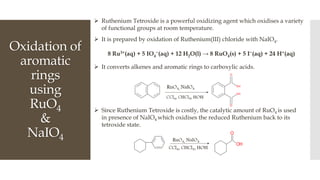
 Ruthenium Tetroxide is a powerful oxidizing agent which oxidises a variety
of functional groups at room temperature.
 It is prepared by oxidation of Ruthenium(III) chloride with NaIO4.
8 Ru3+(aq) + 5 IO4
−(aq) + 12 H2O(l) → 8 RuO4(s) + 5 I−(aq) + 24 H+(aq)
 It converts alkenes and aromatic rings to carboxylic acids.
 Since Ruthenium Tetroxide is costly, the catalytic amount of RuO4 is used
in presence of NaIO4 which oxidises the reduced Ruthenium back to its
tetroxide state.
Oxidation of
aromatic
rings
using
RuO4
&
NaIO4
USES OF RuO4
a. Ruthenium tetroxide is used as a potential staining agent. It is
used to expose latent fingerprints by turning to the
brown/black ruthenium dioxide when in contact with fatty
oils or fats contained in contaminants of the print.
b. Since RuO4 degrades the "double bonds" of arenes, it is also
useful as a "deprotection" reagent for carboxylic acids that are
masked as aryl groups.
References
Organic Chemistry; Carey and Sundberg B
Organic Chemistry; Clayden, Greeves, Warren and Wothers
Advanced Organic Chemistry; Jerry March
Oxidation Reagents Involving C-C Bond Cleavage

Oxidation Reagents Involving C-C Bond Cleavage

  • 1.
    Oxidation Involving C-C Bonds Cleavage ByPallavi Kumbhar MSc. Part-1
  • 2.
    CONTENTS  Oxidationof Glycols using HIO4  Oxidation of Alkenes using CrO3  Oxidation of C-C double bond using Ozone  Oxidation of C-C double bond using KMnO4  Oxidation of C-C double bond using NaIO4  Oxidation of C-C double bond using OsO4  Oxidation of Aromatic rings using RuO4 and NaIO4  References
  • 3.
    Oxidation Of Glycols Using HIO4 Glycol Cleavage Glycols arecleaved to aldehydes and ketones in high yield by the action of lead tetraacetate (Pb(OAc)4) or periodic acid (HIO4). 1. 1,2- or vicinal diols are cleaved by periodic acid (HIO4), into two carbonyl compounds. 2. The reaction is selective for 1,2-diols. 3. The reaction occurs via the formation of a cyclic periodate ester. 4. The products are determined by the substituents on the diol. 5. This can be used as a functional group test for 1,2- diols.
  • 4.
    Oxidation of Alkenes using CrO3  CrO3is an oxidizing reagent which are used in various conditions to oxidise various functional groups. a. In acidic medium: CrO3 + AcOH + aq.H2SO4 b. In anhydride medium: CrO3 + Ac2O + aq.H2SO4  It is also used to cleave double bonds at specific conditions.  The intermediate oxidation state of CrO3 is Cr(VI) and it acts as the key reagent because it abstracts hydrogen from the molecule.  The Carbon-Carbon double bonds react at allylic positions. The symmetrical allylic intermediate is involved here.
  • 5.
    Oxidation of Alkenes using CrO3 Uses ofCrO3 Chromium trioxide is mainly used in chrome plating. The trioxide reacts with cadmium, zinc, and other metals to generate chromate films that resists corrosion. In Anhydride Medium Here the carbonyl group gets attached to the allylic position of the double bond In Acidic Medium Here, CrO3 reagent in acetic acid and water is reacted. The carboxylic group is attached to the allylic double bond
  • 6.
    Oxidation of C-C double bonds using ozone Reductive workup (Zn dust in water or alcohol): Gives an aldehyde products when H is present on a double bond carbon atom.  Oxidative workup (hydrogen peroxide): Gives a carboxylic acid or carbon dioxide.  Reactive intermediates called ozonides are isolated from the interaction of ozone with alkenes.  These unstable compounds are converted to stable products by either by reductive workup or by oxidative workup.
  • 7.
    Oxidation of C-C bonds using KMnO4 Oxidationof Alkenes: Under mild conditions, potassium permanganate converts alkenes to glycols. It can further oxidize the glycol with cleavage of the carbon-carbon bond. With addition of heat and/or more concentrated KMnO4, the glycol can be further oxidized, cleaving the C-C bond. Oxidation of Alkynes: Oxidation of alkynes by potassium permanganate leads to the formation of diones.
  • 8.
    Oxidation of C-C double bond using NaIO4 Sodiumperiodate (NaIO4) is an oxidising agent which is mainly used for oxidation of vicinal Glycols. It performs oxidation of alkenes cleaving the double bonds and converting to aldehydes or ketones or carboxylic acids.  Oxidation of alkenes using NaIO4 with Osmium Tetroxide (OsO4). This reagent is also called Lemieux-Johnson reagent.  Oxidation of alkenes using NaIO4 with Ruthenium Tetroxide (RuO4)  Oxidation of alkenes using NaIO4 with Potassium Permanganate (KMnO4). This reaction is also called Lemieux-Von Rudloff reaction.
  • 9.
    Oxidation of C-C double bond using OsO4 The OsO4 is the strong oxidizing reagent and it converts alkenes to alcohols. Therefore it is used in preparation of vicinal Glycols.  Since, Osmium compounds are very expensive, small amount of OsO4 is used up, the Os(VI) by-product is oxidized within the reaction mixture by the amine oxide to re-form OsO4.  The mechanism of this reaction provides a explanation for the syn stereochemistry. The five-membered osmate ester ring is easily formed when two oxygens of OsO4 are added to the same side of the double bond.
  • 10.
    SELECTIVITY OF OsO4: 1)It is stereoselective and performs in syn-addition reaction. 2) It is regioselective and more reactive towards the nucleophilic double bonds. Two practical drawbacks to the use of the OsO4 oxidation are that a. osmium and its compounds are very toxic, and b. they are quite expensive.
  • 11.
    Oxidation of aromatic rings using RuO4 & NaIO4  RutheniumTetroxide is a powerful oxidizing agent which oxidises a variety of functional groups at room temperature.  It is prepared by oxidation of Ruthenium(III) chloride with NaIO4. 8 Ru3+(aq) + 5 IO4 −(aq) + 12 H2O(l) → 8 RuO4(s) + 5 I−(aq) + 24 H+(aq)  It converts alkenes and aromatic rings to carboxylic acids.  Since Ruthenium Tetroxide is costly, the catalytic amount of RuO4 is used in presence of NaIO4 which oxidises the reduced Ruthenium back to its tetroxide state.
  • 12.
    Oxidation of aromatic rings using RuO4 & NaIO4 USES OFRuO4 a. Ruthenium tetroxide is used as a potential staining agent. It is used to expose latent fingerprints by turning to the brown/black ruthenium dioxide when in contact with fatty oils or fats contained in contaminants of the print. b. Since RuO4 degrades the "double bonds" of arenes, it is also useful as a "deprotection" reagent for carboxylic acids that are masked as aryl groups.
  • 13.
    References Organic Chemistry; Careyand Sundberg B Organic Chemistry; Clayden, Greeves, Warren and Wothers Advanced Organic Chemistry; Jerry March