ALDEHYDE
AND
KETONES
Sixth Semester
Organic Chemistry II
Dr.S Sreelatha
Department of Chemistry
NSS Colllege Pandalam
 Aldehydes and ketones are compound containing carbonyl groups (>C=O)
 In aldehyde the CO group is linked either to two H atoms or to one H atom
and one alkyl or aryl group.
 In ketones CO group is linked to two alkyl or aryl group.
 General formula of aldehyde :
R-CHO
 General formula of ketones :
R-CO-R’
Structure of Carbonyl group
 Both carbon and oxygen in CO group are sp2 hybridized.
 The carbon atom forms three σ bond at 120o to each other.
 The double bond between carbon and oxygen contain a σ and a bond
 The ∏ electron cloud is displaced towards the oxygen atom. This causes
polarisation in the carbonyl group (2.3-2.8 D)
Acidity of α- Hydrogens
 α-Hydrogen of aldehyde and ketones are acidic.ie, they can be released as a
protons.
 This acidity is due to the fact that anion formed by the release of the α-
Hydrogen as a proton is stabilized by resonance.
Witting reaction
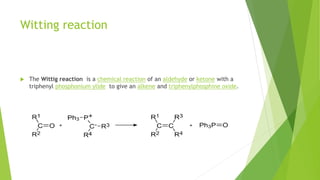
 The Wittig reaction is a chemical reaction of an aldehyde or ketone with a
triphenyl phosphonium ylide to give an alkene and triphenylphosphine oxide.
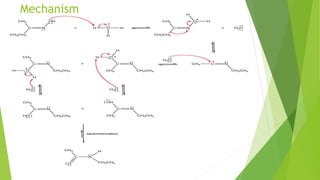
Mechanism
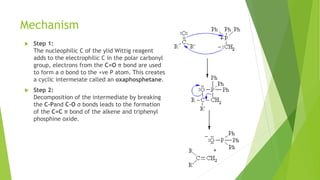
 Step 1:
The nucleophilic C of the ylid Wittig reagent
adds to the electrophilic C in the polar carbonyl
group, electrons from the C=O π bond are used
to form a σ bond to the +ve P atom. This creates
a cyclic intermeiate called an oxaphosphetane.
 Step 2:
Decomposition of the intermediate by breaking
the C-Pand C-O σ bonds leads to the formation
of the C=C π bond of the alkene and triphenyl
phosphine oxide.
+
Perkins reactions
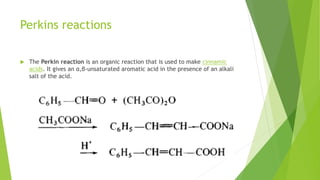
 The Perkin reaction is an organic reaction that is used to make cinnamic
acids. It gives an α,β-unsaturated aromatic acid in the presence of an alkali
salt of the acid.
Benzoin condensation
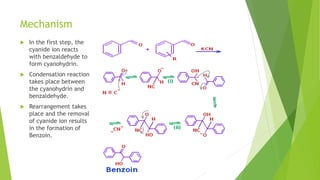
Mechanism
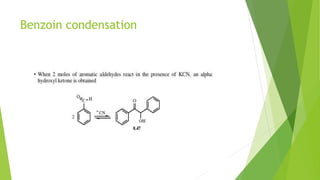
 In the first step, the
cyanide ion reacts
with benzaldehyde to
form cyanohydrin.
 Condensation reaction
takes place between
the cyanohydrin and
benzaldehyde.
 Rearrangement takes
place and the removal
of cyanide ion results
in the formation of
Benzoin.
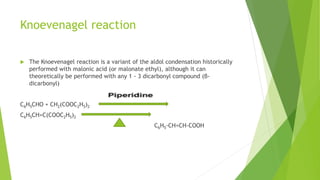
Knoevenagel reaction
 The Knoevenagel reaction is a variant of the aldol condensation historically
performed with malonic acid (or malonate ethyl), although it can
theoretically be performed with any 1 - 3 dicarbonyl compound (β-
dicarbonyl)
C6H5CHO + CH2(COOC2H5)2
C6H5CH=C(COOC2H5)2
C6H5-CH=CH-COOH
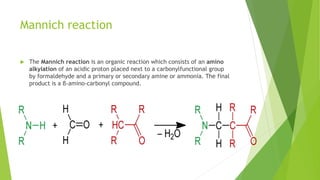
Mannich reaction
 The Mannich reaction is an organic reaction which consists of an amino
alkylation of an acidic proton placed next to a carbonylfunctional group
by formaldehyde and a primary or secondary amine or ammonia. The final
product is a β-amino-carbonyl compound.
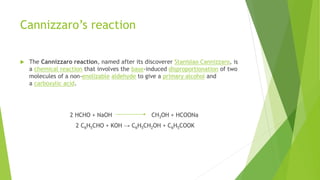
Cannizzaro’s reaction
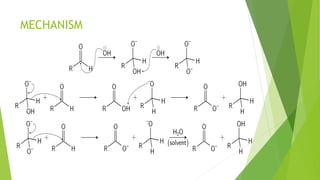
 The Cannizzaro reaction, named after its discoverer Stanislao Cannizzaro, is
a chemical reaction that involves the base-induced disproportionation of two
molecules of a non-enolizable aldehyde to give a primary alcohol and
a carboxylic acid.
2 HCHO + NaOH CH3OH + HCOONa
2 C6H5CHO + KOH → C6H5CH2OH + C6H5COOK
MECHANISM
The Baeyer- Villinger oxidation
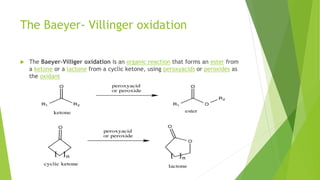
 The Baeyer–Villiger oxidation is an organic reaction that forms an ester from
a ketone or a lactone from a cyclic ketone, using peroxyacids or peroxides as
the oxidant
Clemmenson reduction
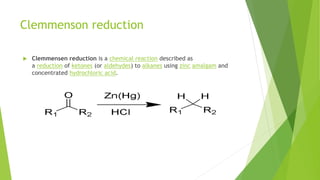
 Clemmensen reduction is a chemical reaction described as
a reduction of ketones (or aldehydes) to alkanes using zinc amalgam and
concentrated hydrochloric acid.
Wolf-Kishner reduction
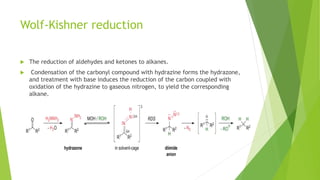
 The reduction of aldehydes and ketones to alkanes.
 Condensation of the carbonyl compound with hydrazine forms the hydrazone,
and treatment with base induces the reduction of the carbon coupled with
oxidation of the hydrazine to gaseous nitrogen, to yield the corresponding
alkane.
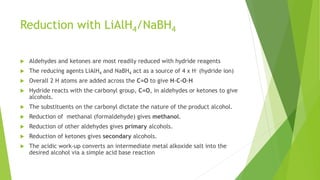
Reduction with LiAlH4/NaBH4
 Aldehydes and ketones are most readily reduced with hydride reagents
 The reducing agents LiAlH4 and NaBH4 act as a source of 4 x H- (hydride ion)
 Overall 2 H atoms are added across the C=O to give H-C-O-H
 Hydride reacts with the carbonyl group, C=O, in aldehydes or ketones to give
alcohols.
 The substituents on the carbonyl dictate the nature of the product alcohol.
 Reduction of methanal (formaldehyde) gives methanol.
 Reduction of other aldehydes gives primary alcohols.
 Reduction of ketones gives secondary alcohols.
 The acidic work-up converts an intermediate metal alkoxide salt into the
desired alcohol via a simple acid base reaction
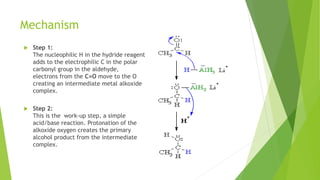
Mechanism
 Step 1:
The nucleophilic H in the hydride reagent
adds to the electrophilic C in the polar
carbonyl group in the aldehyde,
electrons from the C=O move to the O
creating an intermediate metal alkoxide
complex.
 Step 2:
This is the work-up step, a simple
acid/base reaction. Protonation of the
alkoxide oxygen creates the primary
alcohol product from the intermediate
complex.
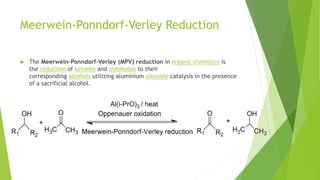
Meerwein-Ponndorf-Verley Reduction
 The Meerwein–Ponndorf–Verley (MPV) reduction in organic chemistry is
the reduction of ketones and aldehydes to their
corresponding alcohols utilizing aluminium alkoxide catalysis in the presence
of a sacrificial alcohol.
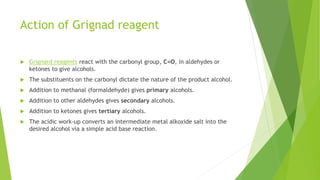
Action of Grignad reagent
 Grignard reagents react with the carbonyl group, C=O, in aldehydes or
ketones to give alcohols.
 The substituents on the carbonyl dictate the nature of the product alcohol.
 Addition to methanal (formaldehyde) gives primary alcohols.
 Addition to other aldehydes gives secondary alcohols.
 Addition to ketones gives tertiary alcohols.
 The acidic work-up converts an intermediate metal alkoxide salt into the
desired alcohol via a simple acid base reaction.
Mechanism
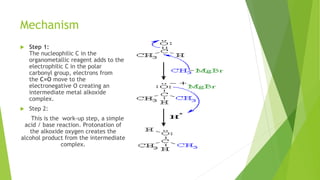
 Step 1:
The nucleophilic C in the
organometallic reagent adds to the
electrophilic C in the polar
carbonyl group, electrons from
the C=O move to the
electronegative O creating an
intermediate metal alkoxide
complex.
 Step 2:
This is the work-up step, a simple
acid / base reaction. Protonation of
the alkoxide oxygen creates the
alcohol product from the intermediate
complex.
Reimer-Tiemann Reaction
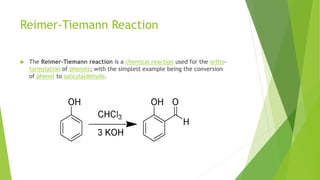
 The Reimer–Tiemann reaction is a chemical reaction used for the ortho-
formylation of phenols; with the simplest example being the conversion
of phenol to salicylaldehyde.
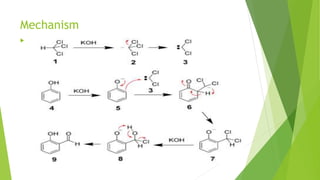
Mechanism

Beckmann Rearrangement
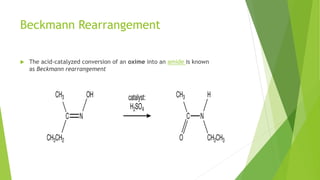
 The acid-catalyzed conversion of an oxime into an amide is known
as Beckmann rearrangement
Mechanism
Thank You
Dr S. Sreelatha,
Department of Chemistry

Latha Chemistry ppt.pptx

  • 1.
    ALDEHYDE AND KETONES Sixth Semester Organic ChemistryII Dr.S Sreelatha Department of Chemistry NSS Colllege Pandalam
  • 2.
     Aldehydes andketones are compound containing carbonyl groups (>C=O)  In aldehyde the CO group is linked either to two H atoms or to one H atom and one alkyl or aryl group.  In ketones CO group is linked to two alkyl or aryl group.  General formula of aldehyde : R-CHO  General formula of ketones : R-CO-R’
  • 3.
    Structure of Carbonylgroup  Both carbon and oxygen in CO group are sp2 hybridized.  The carbon atom forms three σ bond at 120o to each other.  The double bond between carbon and oxygen contain a σ and a bond  The ∏ electron cloud is displaced towards the oxygen atom. This causes polarisation in the carbonyl group (2.3-2.8 D)
  • 4.
    Acidity of α-Hydrogens  α-Hydrogen of aldehyde and ketones are acidic.ie, they can be released as a protons.  This acidity is due to the fact that anion formed by the release of the α- Hydrogen as a proton is stabilized by resonance.
  • 5.
    Witting reaction  TheWittig reaction is a chemical reaction of an aldehyde or ketone with a triphenyl phosphonium ylide to give an alkene and triphenylphosphine oxide.
  • 6.
    Mechanism  Step 1: Thenucleophilic C of the ylid Wittig reagent adds to the electrophilic C in the polar carbonyl group, electrons from the C=O π bond are used to form a σ bond to the +ve P atom. This creates a cyclic intermeiate called an oxaphosphetane.  Step 2: Decomposition of the intermediate by breaking the C-Pand C-O σ bonds leads to the formation of the C=C π bond of the alkene and triphenyl phosphine oxide. +
  • 7.
    Perkins reactions  ThePerkin reaction is an organic reaction that is used to make cinnamic acids. It gives an α,β-unsaturated aromatic acid in the presence of an alkali salt of the acid.
  • 8.
  • 9.
    Mechanism  In thefirst step, the cyanide ion reacts with benzaldehyde to form cyanohydrin.  Condensation reaction takes place between the cyanohydrin and benzaldehyde.  Rearrangement takes place and the removal of cyanide ion results in the formation of Benzoin.
  • 10.
    Knoevenagel reaction  TheKnoevenagel reaction is a variant of the aldol condensation historically performed with malonic acid (or malonate ethyl), although it can theoretically be performed with any 1 - 3 dicarbonyl compound (β- dicarbonyl) C6H5CHO + CH2(COOC2H5)2 C6H5CH=C(COOC2H5)2 C6H5-CH=CH-COOH
  • 11.
    Mannich reaction  TheMannich reaction is an organic reaction which consists of an amino alkylation of an acidic proton placed next to a carbonylfunctional group by formaldehyde and a primary or secondary amine or ammonia. The final product is a β-amino-carbonyl compound.
  • 12.
    Cannizzaro’s reaction  TheCannizzaro reaction, named after its discoverer Stanislao Cannizzaro, is a chemical reaction that involves the base-induced disproportionation of two molecules of a non-enolizable aldehyde to give a primary alcohol and a carboxylic acid. 2 HCHO + NaOH CH3OH + HCOONa 2 C6H5CHO + KOH → C6H5CH2OH + C6H5COOK
  • 13.
  • 14.
    The Baeyer- Villingeroxidation  The Baeyer–Villiger oxidation is an organic reaction that forms an ester from a ketone or a lactone from a cyclic ketone, using peroxyacids or peroxides as the oxidant
  • 15.
    Clemmenson reduction  Clemmensenreduction is a chemical reaction described as a reduction of ketones (or aldehydes) to alkanes using zinc amalgam and concentrated hydrochloric acid.
  • 16.
    Wolf-Kishner reduction  Thereduction of aldehydes and ketones to alkanes.  Condensation of the carbonyl compound with hydrazine forms the hydrazone, and treatment with base induces the reduction of the carbon coupled with oxidation of the hydrazine to gaseous nitrogen, to yield the corresponding alkane.
  • 17.
    Reduction with LiAlH4/NaBH4 Aldehydes and ketones are most readily reduced with hydride reagents  The reducing agents LiAlH4 and NaBH4 act as a source of 4 x H- (hydride ion)  Overall 2 H atoms are added across the C=O to give H-C-O-H  Hydride reacts with the carbonyl group, C=O, in aldehydes or ketones to give alcohols.  The substituents on the carbonyl dictate the nature of the product alcohol.  Reduction of methanal (formaldehyde) gives methanol.  Reduction of other aldehydes gives primary alcohols.  Reduction of ketones gives secondary alcohols.  The acidic work-up converts an intermediate metal alkoxide salt into the desired alcohol via a simple acid base reaction
  • 18.
    Mechanism  Step 1: Thenucleophilic H in the hydride reagent adds to the electrophilic C in the polar carbonyl group in the aldehyde, electrons from the C=O move to the O creating an intermediate metal alkoxide complex.  Step 2: This is the work-up step, a simple acid/base reaction. Protonation of the alkoxide oxygen creates the primary alcohol product from the intermediate complex.
  • 19.
    Meerwein-Ponndorf-Verley Reduction  TheMeerwein–Ponndorf–Verley (MPV) reduction in organic chemistry is the reduction of ketones and aldehydes to their corresponding alcohols utilizing aluminium alkoxide catalysis in the presence of a sacrificial alcohol.
  • 20.
    Action of Grignadreagent  Grignard reagents react with the carbonyl group, C=O, in aldehydes or ketones to give alcohols.  The substituents on the carbonyl dictate the nature of the product alcohol.  Addition to methanal (formaldehyde) gives primary alcohols.  Addition to other aldehydes gives secondary alcohols.  Addition to ketones gives tertiary alcohols.  The acidic work-up converts an intermediate metal alkoxide salt into the desired alcohol via a simple acid base reaction.
  • 21.
    Mechanism  Step 1: Thenucleophilic C in the organometallic reagent adds to the electrophilic C in the polar carbonyl group, electrons from the C=O move to the electronegative O creating an intermediate metal alkoxide complex.  Step 2: This is the work-up step, a simple acid / base reaction. Protonation of the alkoxide oxygen creates the alcohol product from the intermediate complex.
  • 22.
    Reimer-Tiemann Reaction  TheReimer–Tiemann reaction is a chemical reaction used for the ortho- formylation of phenols; with the simplest example being the conversion of phenol to salicylaldehyde.
  • 23.
  • 24.
    Beckmann Rearrangement  Theacid-catalyzed conversion of an oxime into an amide is known as Beckmann rearrangement
  • 25.
  • 26.
    Thank You Dr S.Sreelatha, Department of Chemistry