12. Perbenzoic acid
Dr. Shivendra Singh
UGC-NET-JRF, PhD- IIT Indore
Assistant Professor
shivendrasngh0@gmail.com
Webpage: https://sites.google.com/view/drshivendrasingh/home
Youtube: https://bit.ly/2YM0QG0
2
...Perbenzoic acid
Ø  A number of peracids having the general formula, RCO3H have been used
for the oxidation of organic compounds.
Ø  Some of the common peracids are:
ü  peracetic acid (CH3CO3H),
ü  perbenzoic acid (PhCO3H),
ü  trifluoroacetic acid (CF3CO3H) and
ü  m-chloroperbenzoic acid (m-ClC6H4CO3H).
Ø  Peracids are usually prepared in situ by the oxidation of carboxylic acid
with hydrogen peroxide.
3
...Perbenzoic acid
Applications:
1.  Epoxidation of Alkenes
2.  Oxidation of Amines
3.  Oxidation of Thioethers
4.  Oxidation of Ketones (Baeyer-Villiger Oxidation)
4
...Perbenzoic acid
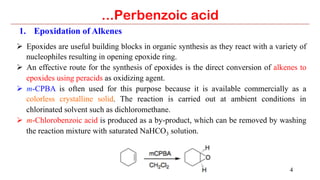
Ø  Epoxides are useful building blocks in organic synthesis as they react with a variety of
nucleophiles resulting in opening epoxide ring.
Ø  An effective route for the synthesis of epoxides is the direct conversion of alkenes to
epoxides using peracids as oxidizing agent.
Ø  m-CPBA is often used for this purpose because it is available commercially as a
colorless crystalline solid. The reaction is carried out at ambient conditions in
chlorinated solvent such as dichloromethane.
Ø  m-Chlorobenzoic acid is produced as a by-product, which can be removed by washing
the reaction mixture with saturated NaHCO3 solution.
1.  Epoxidation of Alkenes
5
...Perbenzoic acid
Mechanism
The reaction proceeds through a concerted pathway. The reaction involves
addition of an oxygen atom to the double bond with simultaneous proton
transfer from oxygen to carbonyl oxygen.
6
...Perbenzoic acid
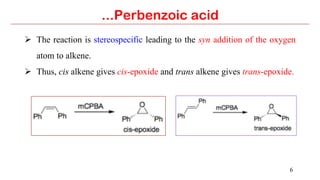
Ø  The reaction is stereospecific leading to the syn addition of the oxygen
atom to alkene.
Ø  Thus, cis alkene gives cis-epoxide and trans alkene gives trans-epoxide.
7
...Perbenzoic acid
Ø  The electron rich alkene shows greater reactivity compared to electron
deficient alkenes toward m-CPBA. Thus, terminal alkenes exhibit slower
reactivity compared alkyl substituted alkenes.
Ø  Peracid having electron withdrawing substituent exhibits greater reactivity
compared to that containing electron donating group. For an example, m-
CPBA is more reactive compared to PhCO3H.
8
...Perbenzoic acid
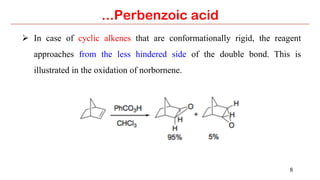
Ø  In case of cyclic alkenes that are conformationally rigid, the reagent
approaches from the less hindered side of the double bond. This is
illustrated in the oxidation of norbornene.
9
...Perbenzoic acid
Ø  The isolated alkenes undergo reaction before the conjugated double bond.
This is illustrated by the oxidation of β-myrcene.
10
...Perbenzoic acid
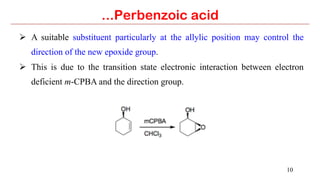
Ø  A suitable substituent particularly at the allylic position may control the
direction of the new epoxide group.
Ø  This is due to the transition state electronic interaction between electron
deficient m-CPBA and the direction group.
11
...Perbenzoic acid
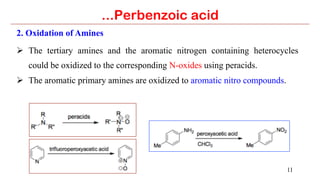
2. Oxidation of Amines
Ø  The tertiary amines and the aromatic nitrogen containing heterocycles
could be oxidized to the corresponding N-oxides using peracids.
Ø  The aromatic primary amines are oxidized to aromatic nitro compounds.
12
...Perbenzoic acid
3. Oxidation of Thioethers: The thioethers could be oxidized to the
corresponding sulfoxides and sulfones using peracids
13
...Perbenzoic acid
4. Oxidation of Ketones (Baeyer-Villiger Oxidation)
Ø  Ketones undergo reaction with peracids to give esters by insertion of
oxygen. The reaction is known as Baeyer-Villiger oxidation.
14
...Perbenzoic acid
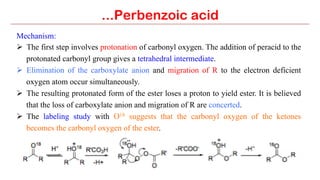
Mechanism:
Ø  The first step involves protonation of carbonyl oxygen. The addition of peracid to the
protonated carbonyl group gives a tetrahedral intermediate.
Ø  Elimination of the carboxylate anion and migration of R to the electron deficient
oxygen atom occur simultaneously.
Ø  The resulting protonated form of the ester loses a proton to yield ester. It is believed
that the loss of carboxylate anion and migration of R are concerted.
Ø  The labeling study with O18 suggests that the carbonyl oxygen of the ketones
becomes the carbonyl oxygen of the ester.
15
...Perbenzoic acid
Migratory Aptitude
ü  Aryl groups migrate in preference to methyl and primary alkyl groups.
ü  The order of preference for the migration of alkyl groups is 3◦ > 2◦ > 1◦ > methyl.
ü  The order of preference for the migration of aryl groups is;
p-OMeC6H4 > C6H5 > p-NO2C6H4
16
...Perbenzoic acid
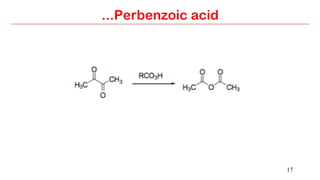
Ø  Baeyer-Villiger oxidation has great synthetic applications as the reaction
allows the conversion of ketones to esters. The reaction works well with
cyclic and acyclic ketones.
17
...Perbenzoic acid
18
...Perbenzoic acid
Applications:
1.  Epoxidation of Alkenes
2.  Oxidation of Amines
3.  Oxidation of Thioethers
4.  Oxidation of Ketones (Baeyer-Villiger Oxidation)

12. Perbenzoic acid

  • 1.
    12. Perbenzoic acid Dr.Shivendra Singh UGC-NET-JRF, PhD- IIT Indore Assistant Professor shivendrasngh0@gmail.com Webpage: https://sites.google.com/view/drshivendrasingh/home Youtube: https://bit.ly/2YM0QG0
  • 2.
    2 ...Perbenzoic acid Ø  Anumber of peracids having the general formula, RCO3H have been used for the oxidation of organic compounds. Ø  Some of the common peracids are: ü  peracetic acid (CH3CO3H), ü  perbenzoic acid (PhCO3H), ü  trifluoroacetic acid (CF3CO3H) and ü  m-chloroperbenzoic acid (m-ClC6H4CO3H). Ø  Peracids are usually prepared in situ by the oxidation of carboxylic acid with hydrogen peroxide.
  • 3.
    3 ...Perbenzoic acid Applications: 1.  Epoxidationof Alkenes 2.  Oxidation of Amines 3.  Oxidation of Thioethers 4.  Oxidation of Ketones (Baeyer-Villiger Oxidation)
  • 4.
    4 ...Perbenzoic acid Ø  Epoxidesare useful building blocks in organic synthesis as they react with a variety of nucleophiles resulting in opening epoxide ring. Ø  An effective route for the synthesis of epoxides is the direct conversion of alkenes to epoxides using peracids as oxidizing agent. Ø  m-CPBA is often used for this purpose because it is available commercially as a colorless crystalline solid. The reaction is carried out at ambient conditions in chlorinated solvent such as dichloromethane. Ø  m-Chlorobenzoic acid is produced as a by-product, which can be removed by washing the reaction mixture with saturated NaHCO3 solution. 1.  Epoxidation of Alkenes
  • 5.
    5 ...Perbenzoic acid Mechanism The reactionproceeds through a concerted pathway. The reaction involves addition of an oxygen atom to the double bond with simultaneous proton transfer from oxygen to carbonyl oxygen.
  • 6.
    6 ...Perbenzoic acid Ø  Thereaction is stereospecific leading to the syn addition of the oxygen atom to alkene. Ø  Thus, cis alkene gives cis-epoxide and trans alkene gives trans-epoxide.
  • 7.
    7 ...Perbenzoic acid Ø  Theelectron rich alkene shows greater reactivity compared to electron deficient alkenes toward m-CPBA. Thus, terminal alkenes exhibit slower reactivity compared alkyl substituted alkenes. Ø  Peracid having electron withdrawing substituent exhibits greater reactivity compared to that containing electron donating group. For an example, m- CPBA is more reactive compared to PhCO3H.
  • 8.
    8 ...Perbenzoic acid Ø  Incase of cyclic alkenes that are conformationally rigid, the reagent approaches from the less hindered side of the double bond. This is illustrated in the oxidation of norbornene.
  • 9.
    9 ...Perbenzoic acid Ø  Theisolated alkenes undergo reaction before the conjugated double bond. This is illustrated by the oxidation of β-myrcene.
  • 10.
    10 ...Perbenzoic acid Ø  Asuitable substituent particularly at the allylic position may control the direction of the new epoxide group. Ø  This is due to the transition state electronic interaction between electron deficient m-CPBA and the direction group.
  • 11.
    11 ...Perbenzoic acid 2. Oxidationof Amines Ø  The tertiary amines and the aromatic nitrogen containing heterocycles could be oxidized to the corresponding N-oxides using peracids. Ø  The aromatic primary amines are oxidized to aromatic nitro compounds.
  • 12.
    12 ...Perbenzoic acid 3. Oxidationof Thioethers: The thioethers could be oxidized to the corresponding sulfoxides and sulfones using peracids
  • 13.
    13 ...Perbenzoic acid 4. Oxidationof Ketones (Baeyer-Villiger Oxidation) Ø  Ketones undergo reaction with peracids to give esters by insertion of oxygen. The reaction is known as Baeyer-Villiger oxidation.
  • 14.
    14 ...Perbenzoic acid Mechanism: Ø  Thefirst step involves protonation of carbonyl oxygen. The addition of peracid to the protonated carbonyl group gives a tetrahedral intermediate. Ø  Elimination of the carboxylate anion and migration of R to the electron deficient oxygen atom occur simultaneously. Ø  The resulting protonated form of the ester loses a proton to yield ester. It is believed that the loss of carboxylate anion and migration of R are concerted. Ø  The labeling study with O18 suggests that the carbonyl oxygen of the ketones becomes the carbonyl oxygen of the ester.
  • 15.
    15 ...Perbenzoic acid Migratory Aptitude ü Aryl groups migrate in preference to methyl and primary alkyl groups. ü  The order of preference for the migration of alkyl groups is 3◦ > 2◦ > 1◦ > methyl. ü  The order of preference for the migration of aryl groups is; p-OMeC6H4 > C6H5 > p-NO2C6H4
  • 16.
    16 ...Perbenzoic acid Ø  Baeyer-Villigeroxidation has great synthetic applications as the reaction allows the conversion of ketones to esters. The reaction works well with cyclic and acyclic ketones.
  • 17.
  • 18.
    18 ...Perbenzoic acid Applications: 1.  Epoxidationof Alkenes 2.  Oxidation of Amines 3.  Oxidation of Thioethers 4.  Oxidation of Ketones (Baeyer-Villiger Oxidation)