STUDY OF VILSMEYER HAACK
REACTION
PRESENTED BY-
SUNNY MAURYA
M.PHARM 1ST SEM
DEPARTMENT OF PHARMACEUTICAL
CHEMISTRY CSJMU
CONTENT
› INTROUCTION
› WHAT IS VILSMEYER HAACK REACTION
› MECHANISM OF REACTION
› REAGENTS
› APPLICATION OF VILSMEYER HAACK REACTION
INTRODUCTION
› First reported by Adolf Von Baeyer & Victor
Villiger in 1899.
› Used for producing esters from ketones by
oxidation.
› It involves addition of oxygen atom to carbonyl
group of ketone by per oxy compounds in presence
of acid or base catalyst.
› Principle involved is oxidation & rearrangement
i.e. migration of alkyl group.
› Peroxy compounds/peroxides are used as the
oxidising agents.
WHAT IS BAEYER VILLIGER REACTION
› The treatment of ketones with per oxyacids, such
as per oxybenzoic or per oxyacetic acid, or with
other per oxy compounds in the presence of acid
catalysts, gives carboxylic esters by ‘‘insertion’’ of
oxygen and the carboxylic acid parent of the per
oxyacid as a by-product. The reaction is called the
Baeyer–Villiger rearrangement
MECHANISM OF REACTION
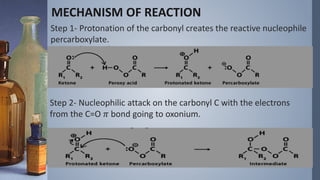
Step 1- Protonation of the carbonyl creates the reactive nucleophile
percarboxylate.
Step 2- Nucleophilic attack on the carbonyl C with the electrons
from the C=O 𝜋 bond going to oxonium.
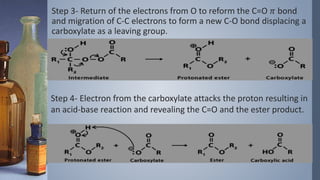
Step 3- Return of the electrons from O to reform the C=O 𝜋 bond
and migration of C-C electrons to form a new C-O bond displacing a
carboxylate as a leaving group.
Step 4- Electron from the carboxylate attacks the proton resulting in
an acid-base reaction and revealing the C=O and the ester product.
MIGRATORY APTITUDE
› When the reaction involves an unsymmetrical ketone, the
structure of the product depends on which group migrates. A
number of studies have been directed at ascertaining the basis
of migratory preference in the Baeyer-Villiger oxidation, and a
general order of migration has been established:-
› Order of migratory groups 3∘ alkyl >cyclo hexyl > 2∘alkyl >
benzyl= phenyl > vinyl >1∘ alkyl> methyl
REAGENTS
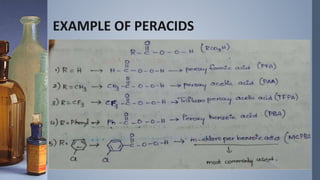
1. Peracids or peroxy acids (99% used)
2. Hydrogen peroxide ( H2O2) ( rarely used)
3. Bis trimethyl silyl peroxide ( rarely used)
EXAMPLE OF PERACIDS
APPLICATION OF BAEYER-VILLIGER OXIDATION
› Baeyer-Villiger oxidation is used in the synthesis of lactones,
which contribute significantly to the flavor of fruits, and
unfermented and fermented dairy products. Hence, they are
used for flavor and fragrance. Polycaprolactone is a
biodegradable polyester from which polyurethane is made.
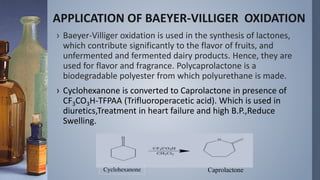
› Cyclohexanone is converted to Caprolactone in presence of
CF3CO3H-TFPAA (Trifluoroperacetic acid). Which is used in
diuretics,Treatment in heart failure and high B.P.,Reduce
Swelling.
Cyclohexanone Caprolactone

VILSMEYER HAACK REACTION (2).pptx

  • 1.
    STUDY OF VILSMEYERHAACK REACTION PRESENTED BY- SUNNY MAURYA M.PHARM 1ST SEM DEPARTMENT OF PHARMACEUTICAL CHEMISTRY CSJMU
  • 2.
    CONTENT › INTROUCTION › WHATIS VILSMEYER HAACK REACTION › MECHANISM OF REACTION › REAGENTS › APPLICATION OF VILSMEYER HAACK REACTION
  • 3.
    INTRODUCTION › First reportedby Adolf Von Baeyer & Victor Villiger in 1899. › Used for producing esters from ketones by oxidation. › It involves addition of oxygen atom to carbonyl group of ketone by per oxy compounds in presence of acid or base catalyst. › Principle involved is oxidation & rearrangement i.e. migration of alkyl group. › Peroxy compounds/peroxides are used as the oxidising agents.
  • 4.
    WHAT IS BAEYERVILLIGER REACTION › The treatment of ketones with per oxyacids, such as per oxybenzoic or per oxyacetic acid, or with other per oxy compounds in the presence of acid catalysts, gives carboxylic esters by ‘‘insertion’’ of oxygen and the carboxylic acid parent of the per oxyacid as a by-product. The reaction is called the Baeyer–Villiger rearrangement
  • 5.
    MECHANISM OF REACTION Step1- Protonation of the carbonyl creates the reactive nucleophile percarboxylate. Step 2- Nucleophilic attack on the carbonyl C with the electrons from the C=O 𝜋 bond going to oxonium.
  • 6.
    Step 3- Returnof the electrons from O to reform the C=O 𝜋 bond and migration of C-C electrons to form a new C-O bond displacing a carboxylate as a leaving group. Step 4- Electron from the carboxylate attacks the proton resulting in an acid-base reaction and revealing the C=O and the ester product.
  • 7.
    MIGRATORY APTITUDE › Whenthe reaction involves an unsymmetrical ketone, the structure of the product depends on which group migrates. A number of studies have been directed at ascertaining the basis of migratory preference in the Baeyer-Villiger oxidation, and a general order of migration has been established:- › Order of migratory groups 3∘ alkyl >cyclo hexyl > 2∘alkyl > benzyl= phenyl > vinyl >1∘ alkyl> methyl
  • 8.
    REAGENTS 1. Peracids orperoxy acids (99% used) 2. Hydrogen peroxide ( H2O2) ( rarely used) 3. Bis trimethyl silyl peroxide ( rarely used)
  • 9.
  • 10.
    APPLICATION OF BAEYER-VILLIGEROXIDATION › Baeyer-Villiger oxidation is used in the synthesis of lactones, which contribute significantly to the flavor of fruits, and unfermented and fermented dairy products. Hence, they are used for flavor and fragrance. Polycaprolactone is a biodegradable polyester from which polyurethane is made. › Cyclohexanone is converted to Caprolactone in presence of CF3CO3H-TFPAA (Trifluoroperacetic acid). Which is used in diuretics,Treatment in heart failure and high B.P.,Reduce Swelling. Cyclohexanone Caprolactone