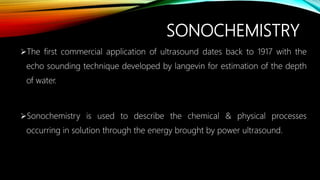
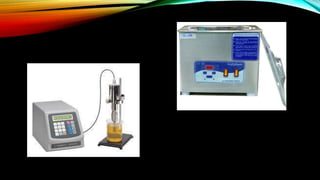
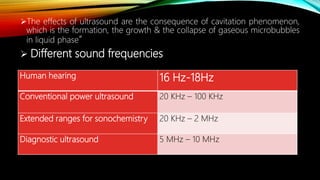
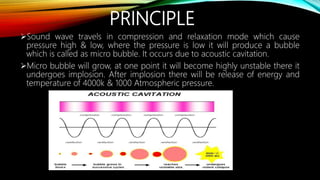
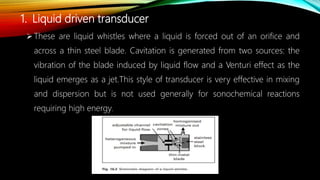
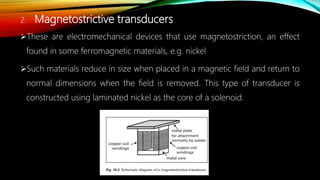
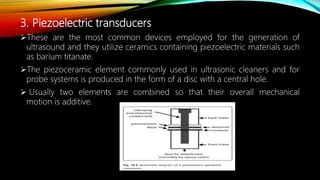
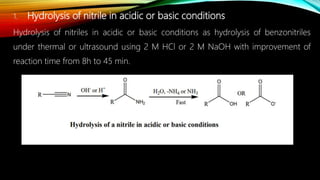
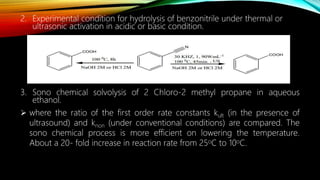
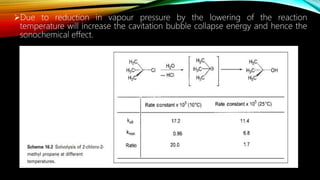
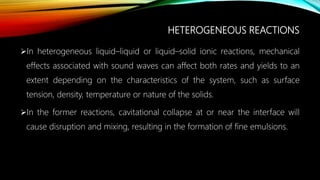
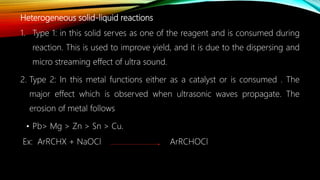
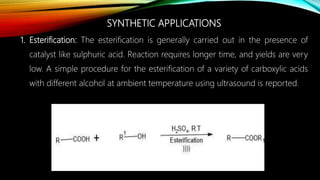
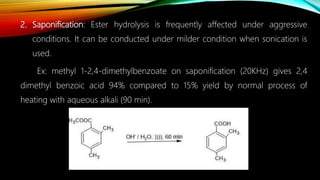
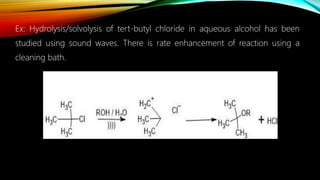
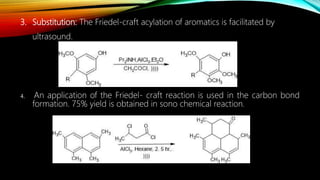
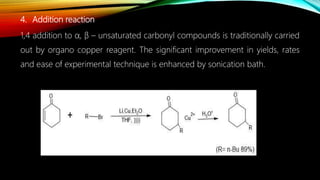
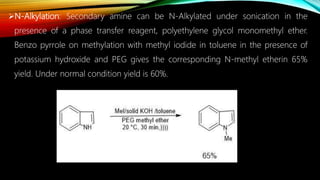
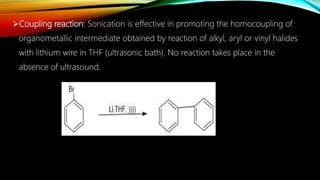
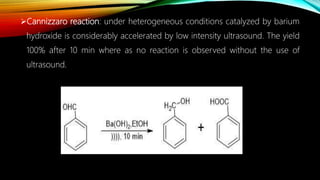
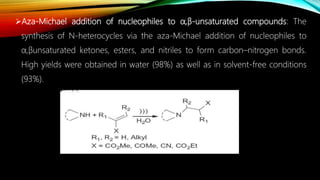
Ultrasound assisted reactions can enhance chemical synthesis through cavitation effects. Piezoelectric transducers are commonly used to generate ultrasound from 20 kHz to 2 MHz. Cavitation produces localized hot spots exceeding 4000K that can drive homogeneous and heterogeneous reactions. Homogeneous reactions involve single-phase systems and produce radicals from water sonolysis. Heterogeneous reactions involve multi-phase systems and benefit from improved mixing and mass transfer. Many reactions like esterification, hydrolysis, substitution, and addition have been achieved with higher yields and faster reaction times using ultrasound.






![CHEMISTRY OF PEPTIDES [M.PHARM, M.SC, BSC, B.PHARM]](https://cdn.slidesharecdn.com/ss_thumbnails/45-191219080659-thumbnail.jpg?width=640&height=640&fit=bounds)


![HETEROGENOUS CATALYSIS [CHEMISTRY IS LOVE]](https://cdn.slidesharecdn.com/ss_thumbnails/50-191219085938-thumbnail.jpg?width=640&height=640&fit=bounds)


