BY
Dr. M. T. Bachute
DEPARTMENT OF CHEMISTRY
K. B. P. Mahavidyalaya, Pandharpur
The rearrangement which converts an AMIDE to
an AMINE with one carbon atom less by the action of alkaline
hypohalite or bromine in alkali is known as Hofmann
rearrangement or reaction.
Amides which do not have a substitution on the
NITROGEN display molecular rearrangement to primary amines.
In this rearrangement, the carbonyl carbon
atom of the amide is lost and the R group of amide gets attached to
the nitrogen of the amine.
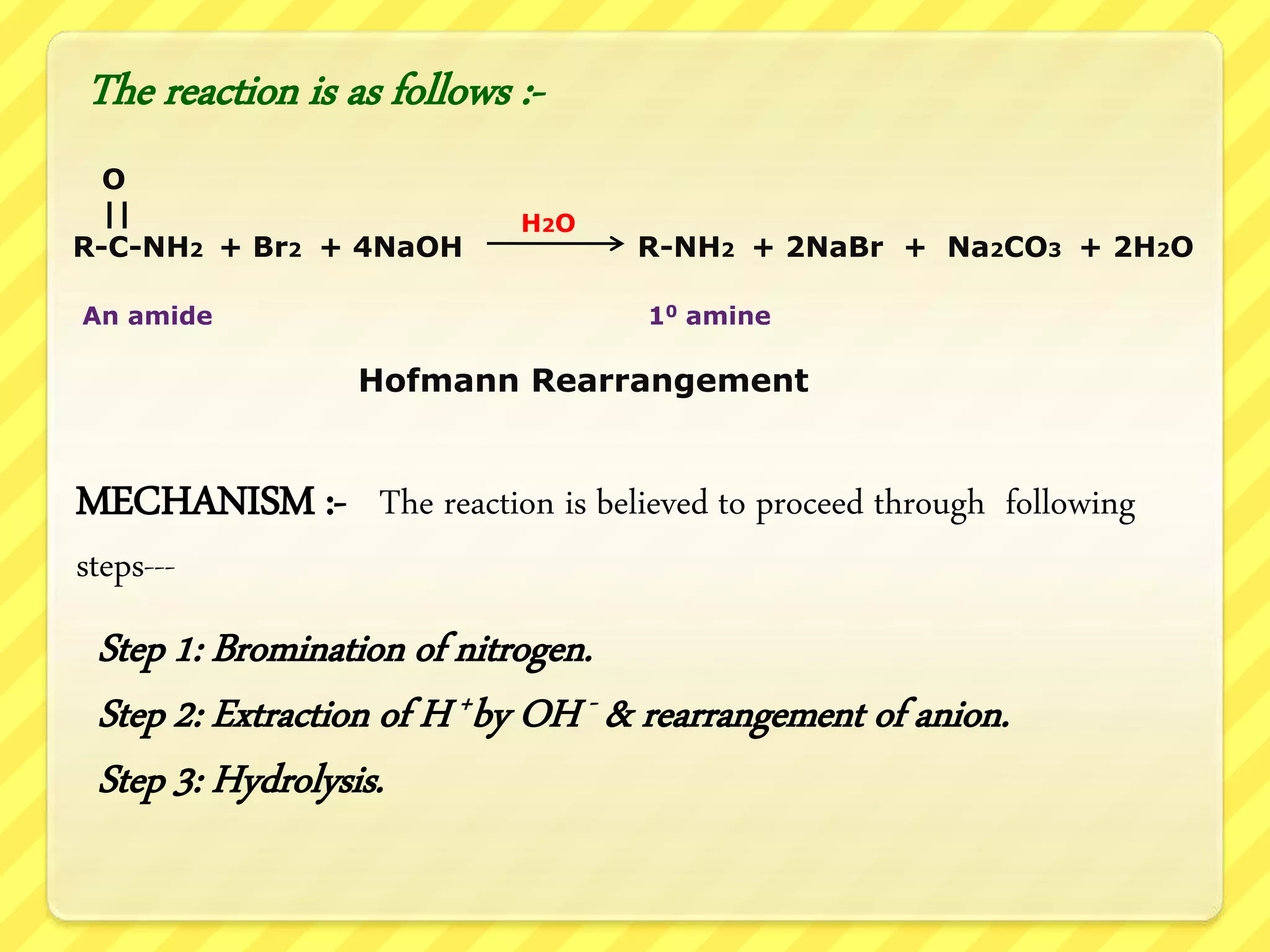
The reaction is as follows :-
O
||
R-C-NH2 + Br2 + 4NaOH R-NH2 + 2NaBr + Na2CO3 + 2H2O
An amide 10 amine
Hofmann Rearrangement
H2O
MECHANISM :- The reaction is believed to proceed through following
steps---
Step 1: Bromination of nitrogen.
Step 2: Extraction of H +by OH - & rearrangement of anion.
Step 3: Hydrolysis.
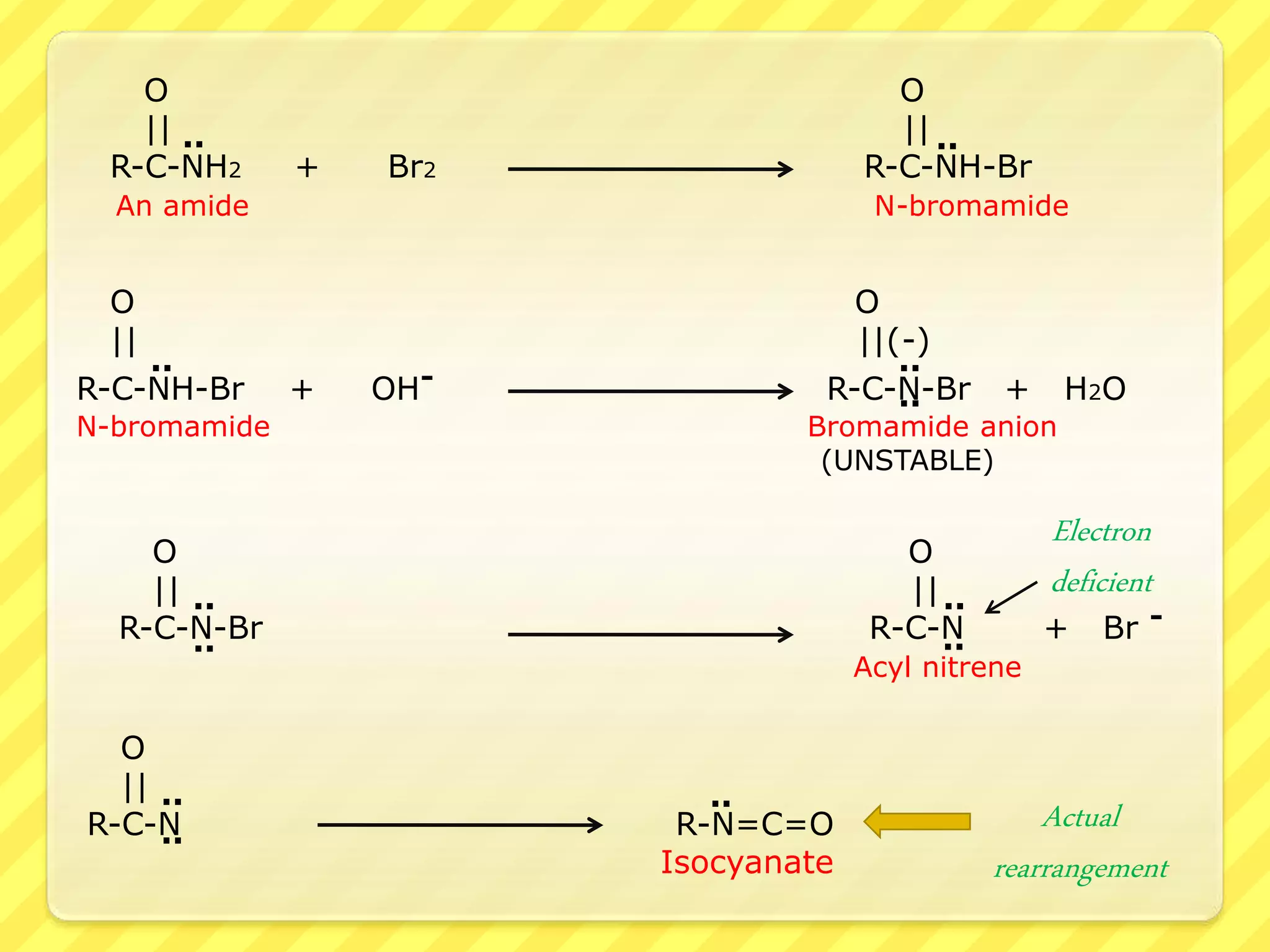
O O
|| ||
R-C-NH2 + Br2 R-C-NH-Br
An amide N-bromamide
..
O O
|| ||(-)
R-C-NH-Br + OH- R-C-N-Br + H2O
N-bromamide Bromamide anion
(UNSTABLE)
..
..
O O
|| ||
R-C-N-Br R-C-N + Br -
Acyl nitrene
..
..
..
..
O
||
R-C-N R-N=C=O
Isocyanate
..
.. ..
Actual
rearrangement
Electron
deficient
..
..
R-N=C=O + H2O R-NH2 + CO32-
Isocyanate Amine Carbonate
ion
.. ..2OH-
The Hofmann rearrangement involves a 1,2-shift of group with its
electron pair to an electron-deficient NITROGEN.
STEREOCHEMISTRY :-
An interesting stereochemical observation is that if
the migrating group (R) is chiral , its configuration is retained in the
product amine.
Thus this rearrangement is INTRAMOLECULAR ,
the migrating group does not become free , but remains attached with
the substrate in some way e.g. via bridged transition state.
That the rearrangement is intramolecular has been supported by following
evidences:--
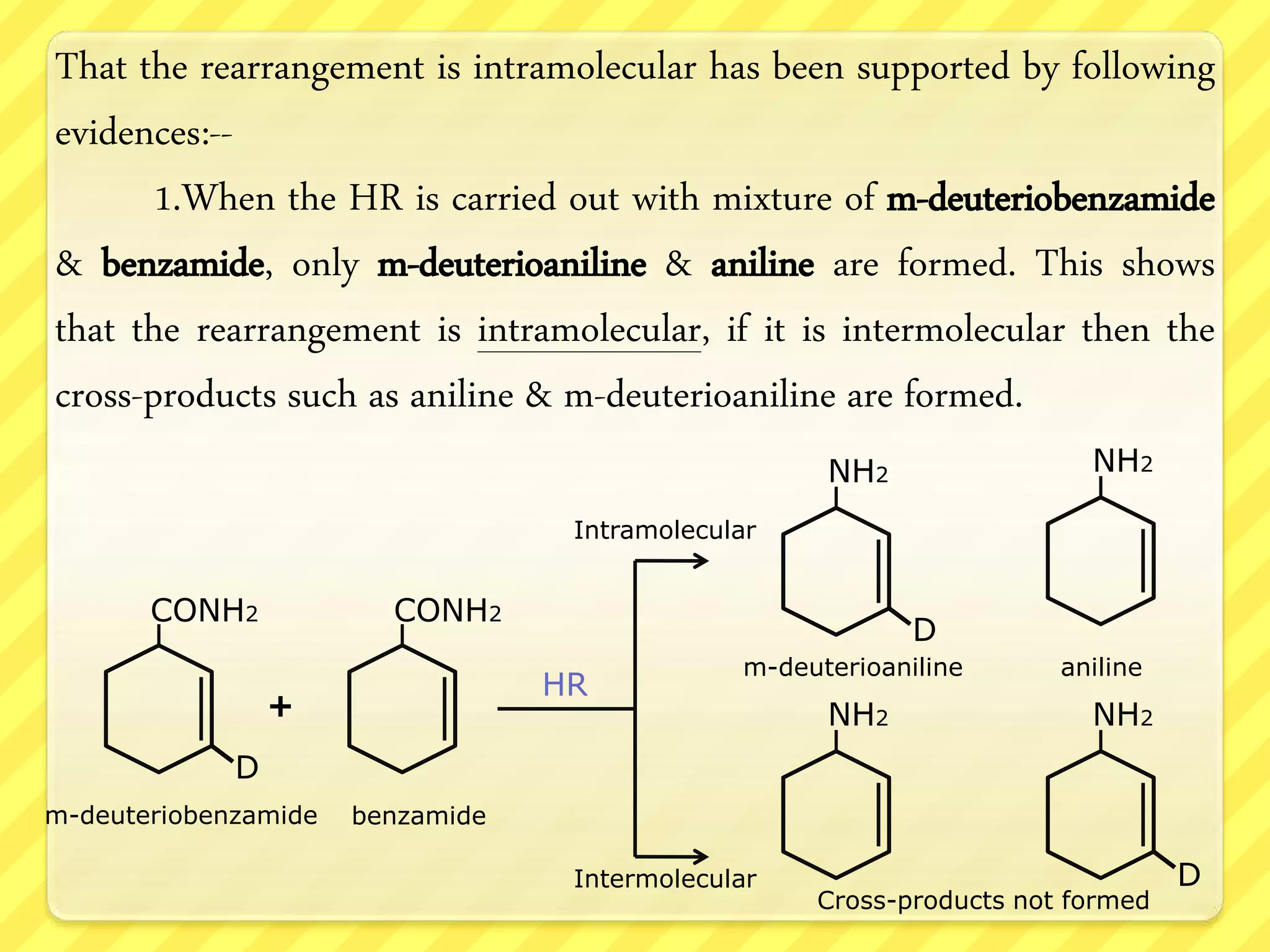
1.When the HR is carried out with mixture of m-deuteriobenzamide
& benzamide, only m-deuterioaniline & aniline are formed. This shows
that the rearrangement is intramolecular, if it is intermolecular then the
cross-products such as aniline & m-deuterioaniline are formed.
D
CONH2
+
CONH2
D
D
NH2
NH2 NH2
NH2
m-deuteriobenzamide benzamide
Intramolecular
Intermolecular
m-deuterioaniline aniline
Cross-products not formed
HR
2.When optically active α-phenylpropionamide undergoes HR, then
α-phenylethylamine having the same configuration is formed.
CH3 O CH3
||
H C C NH2 H C NH2
C6H5 C6H5
Br2
KOH
α-Phenylpropionamide α-Phenylethylamine
RATE OF HOFMANN REACTION:-
In Hofmann rearrangement, N-Bromamide rearranges to
isocyanate is one step with a loss of bromide ion.This is a slow step.
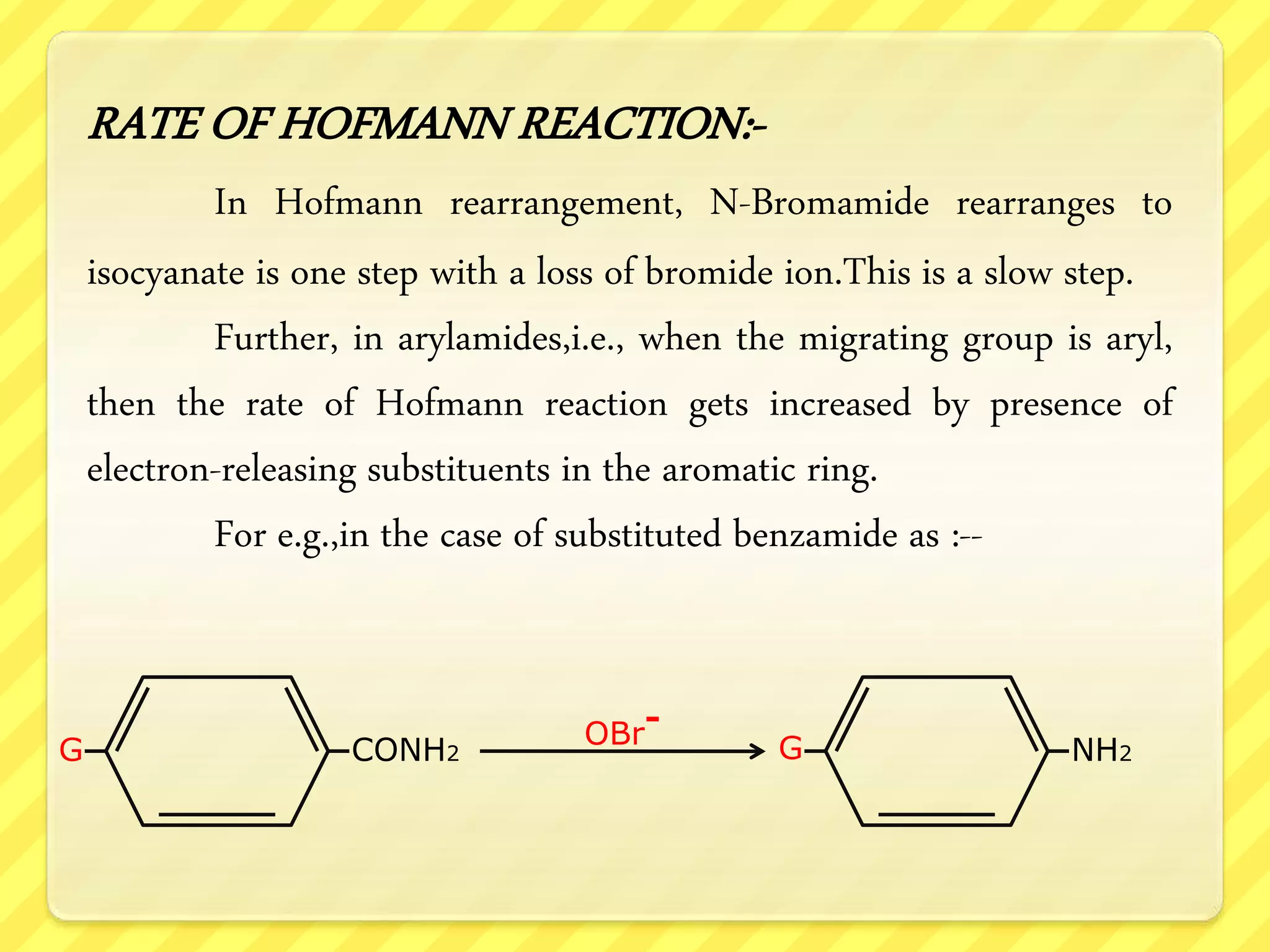
Further, in arylamides,i.e., when the migrating group is aryl,
then the rate of Hofmann reaction gets increased by presence of
electron-releasing substituents in the aromatic ring.
For e.g.,in the case of substituted benzamide as :--
CONH2G NH2GOBr-
The reactivity of G is of the following order :---
OCH3 > CH3 > H > Cl > NO2
3. In the preparation of anthranilic acid from phthalamide
2. Preparation of aldehyde
APPLICATIONS :-
1. Synthesis of 10 aliphatic & aromatic amines
APPLICATIONS:-
1. Synthesis of 10 aliphatic & aromatic amines:-
The HR is useful for conversion of carboxylic acids &
their derivatives into 10 amines having one carbon atom less than the
starting material.
COOH COOH
Br Br Br
CONH2 NH2
Benzoic acid P-Bromoaniline
Br2
FeBr3
i) SOcl2
ii) NH3
Br2
KOH
i) Preparation of methylamine, aniline, benzylamine, etc. :-
CH3CONH2 CH2NH2
C6H5CONH2 C6H5NH2
C6H5CH2CONH2 C6H5CH2NH2
H2N.CO.NH2 H2N-NH2
UREA HYDRAZINE
Br2/KOH
ii) Preparation of β-aminopyridine :-
It is prepared from the nicotinamide, because it
cannot be produced in good yield via the nitration of pyridine.
Br2 / KOH (65-70%)
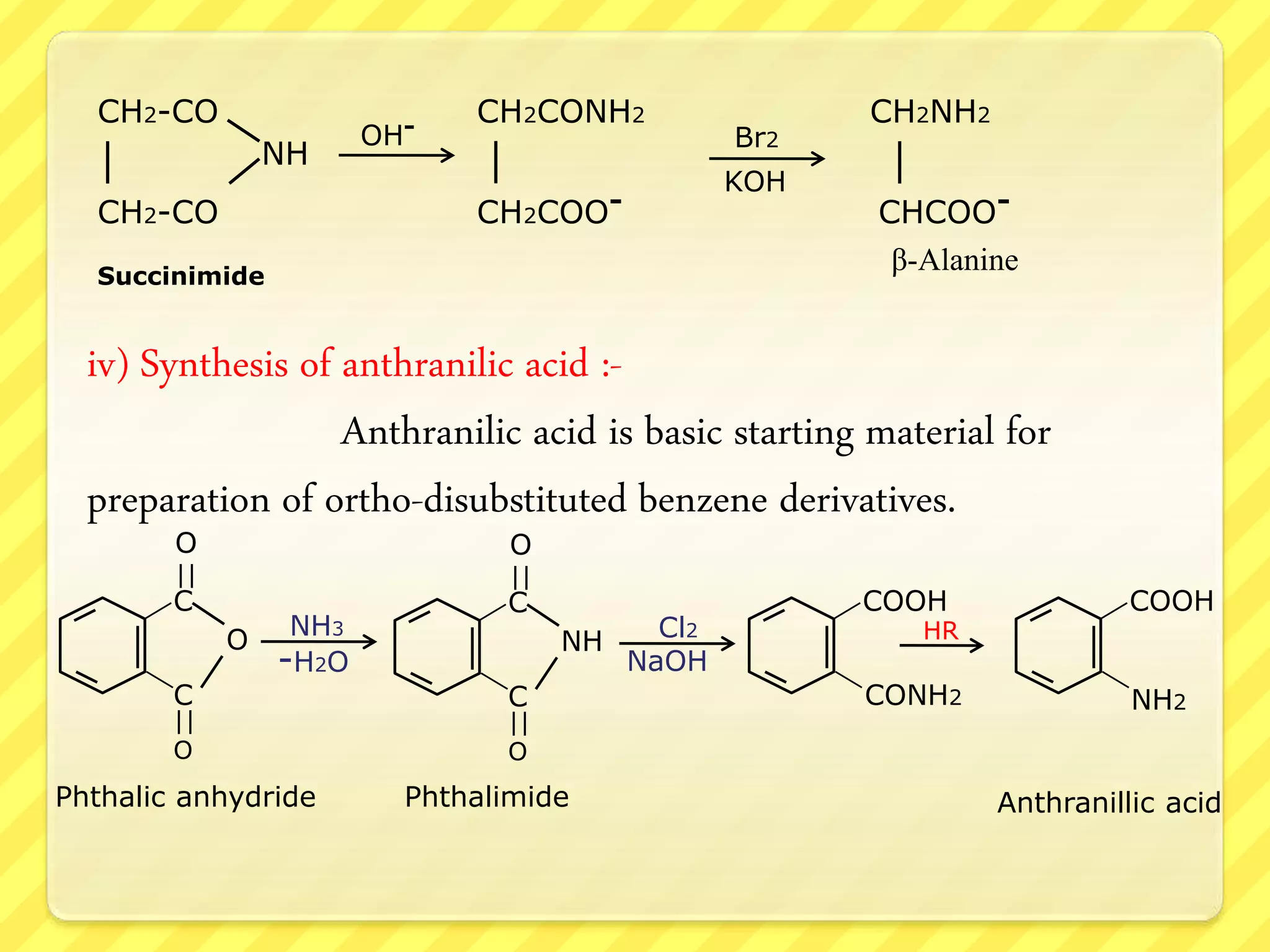
iii) Preparation of amino acids ;-
β-Alanine is prepared (45% yield) by treating
succinimide with bromine & aq.caustic potash, reaction takes place
through the haloamide of succinic acid.
CH2-CO CH2CONH2 CH2NH2
CH2-CO CH2COO- CHCOO-
NH
OH-
Br2
KOH
β-Alanine
iv) Synthesis of anthranilic acid :-
Anthranilic acid is basic starting material for
preparation of ortho-disubstituted benzene derivatives.
C
C
O
O
||
||
O
C
C
NH
||
O
COOH
CONH2
O
||
COOH
NH2
Phthalic anhydride Phthalimide Anthranillic acid
NH3
-H2O
Cl2
NaOH
HR
Succinimide
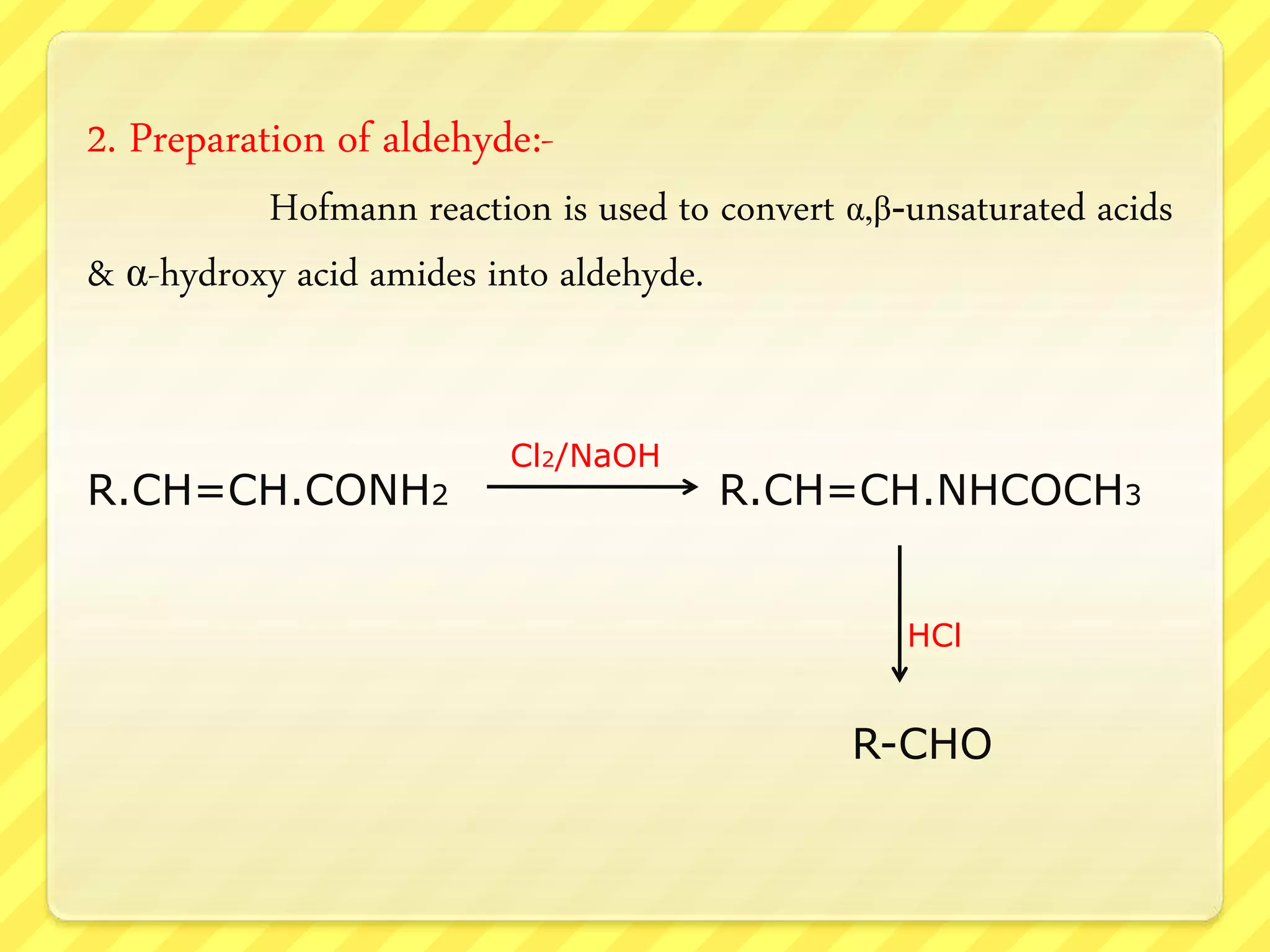
2. Preparation of aldehyde:-
Hofmann reaction is used to convert α,β-unsaturated acids
& α-hydroxy acid amides into aldehyde.
R.CH=CH.CONH2 R.CH=CH.NHCOCH3
R-CHO
Cl2/NaOH
HCl
REFERENCES:-
1. Organic chemistry by MORRISON & BOYD ; 6th edition ; 874-877.
2. Reaction mechanism & reagents in organic chemistry by
GURDEEP R.CHATWAL ; 725-729.
3. Advanced organic chemistry by JERRY MARCH ; 4th edition ; 1090-
1091.
4. Organic name reactions and molecular rearrangement by
GURDEEP RAJ .
Hofman rearrangement

Hofman rearrangement

  • 1.
    BY Dr. M. T.Bachute DEPARTMENT OF CHEMISTRY K. B. P. Mahavidyalaya, Pandharpur
  • 2.
    The rearrangement whichconverts an AMIDE to an AMINE with one carbon atom less by the action of alkaline hypohalite or bromine in alkali is known as Hofmann rearrangement or reaction. Amides which do not have a substitution on the NITROGEN display molecular rearrangement to primary amines. In this rearrangement, the carbonyl carbon atom of the amide is lost and the R group of amide gets attached to the nitrogen of the amine.
  • 3.
    The reaction isas follows :- O || R-C-NH2 + Br2 + 4NaOH R-NH2 + 2NaBr + Na2CO3 + 2H2O An amide 10 amine Hofmann Rearrangement H2O MECHANISM :- The reaction is believed to proceed through following steps--- Step 1: Bromination of nitrogen. Step 2: Extraction of H +by OH - & rearrangement of anion. Step 3: Hydrolysis.
  • 4.
    O O || || R-C-NH2+ Br2 R-C-NH-Br An amide N-bromamide .. O O || ||(-) R-C-NH-Br + OH- R-C-N-Br + H2O N-bromamide Bromamide anion (UNSTABLE) .. .. O O || || R-C-N-Br R-C-N + Br - Acyl nitrene .. .. .. .. O || R-C-N R-N=C=O Isocyanate .. .. .. Actual rearrangement Electron deficient .. ..
  • 5.
    R-N=C=O + H2OR-NH2 + CO32- Isocyanate Amine Carbonate ion .. ..2OH- The Hofmann rearrangement involves a 1,2-shift of group with its electron pair to an electron-deficient NITROGEN.
  • 6.
    STEREOCHEMISTRY :- An interestingstereochemical observation is that if the migrating group (R) is chiral , its configuration is retained in the product amine. Thus this rearrangement is INTRAMOLECULAR , the migrating group does not become free , but remains attached with the substrate in some way e.g. via bridged transition state.
  • 7.
    That the rearrangementis intramolecular has been supported by following evidences:-- 1.When the HR is carried out with mixture of m-deuteriobenzamide & benzamide, only m-deuterioaniline & aniline are formed. This shows that the rearrangement is intramolecular, if it is intermolecular then the cross-products such as aniline & m-deuterioaniline are formed. D CONH2 + CONH2 D D NH2 NH2 NH2 NH2 m-deuteriobenzamide benzamide Intramolecular Intermolecular m-deuterioaniline aniline Cross-products not formed HR
  • 8.
    2.When optically activeα-phenylpropionamide undergoes HR, then α-phenylethylamine having the same configuration is formed. CH3 O CH3 || H C C NH2 H C NH2 C6H5 C6H5 Br2 KOH α-Phenylpropionamide α-Phenylethylamine
  • 9.
    RATE OF HOFMANNREACTION:- In Hofmann rearrangement, N-Bromamide rearranges to isocyanate is one step with a loss of bromide ion.This is a slow step. Further, in arylamides,i.e., when the migrating group is aryl, then the rate of Hofmann reaction gets increased by presence of electron-releasing substituents in the aromatic ring. For e.g.,in the case of substituted benzamide as :-- CONH2G NH2GOBr-
  • 10.
    The reactivity ofG is of the following order :--- OCH3 > CH3 > H > Cl > NO2 3. In the preparation of anthranilic acid from phthalamide 2. Preparation of aldehyde APPLICATIONS :- 1. Synthesis of 10 aliphatic & aromatic amines
  • 11.
    APPLICATIONS:- 1. Synthesis of10 aliphatic & aromatic amines:- The HR is useful for conversion of carboxylic acids & their derivatives into 10 amines having one carbon atom less than the starting material. COOH COOH Br Br Br CONH2 NH2 Benzoic acid P-Bromoaniline Br2 FeBr3 i) SOcl2 ii) NH3 Br2 KOH
  • 12.
    i) Preparation ofmethylamine, aniline, benzylamine, etc. :- CH3CONH2 CH2NH2 C6H5CONH2 C6H5NH2 C6H5CH2CONH2 C6H5CH2NH2 H2N.CO.NH2 H2N-NH2 UREA HYDRAZINE Br2/KOH
  • 13.
    ii) Preparation ofβ-aminopyridine :- It is prepared from the nicotinamide, because it cannot be produced in good yield via the nitration of pyridine. Br2 / KOH (65-70%) iii) Preparation of amino acids ;- β-Alanine is prepared (45% yield) by treating succinimide with bromine & aq.caustic potash, reaction takes place through the haloamide of succinic acid.
  • 14.
    CH2-CO CH2CONH2 CH2NH2 CH2-COCH2COO- CHCOO- NH OH- Br2 KOH β-Alanine iv) Synthesis of anthranilic acid :- Anthranilic acid is basic starting material for preparation of ortho-disubstituted benzene derivatives. C C O O || || O C C NH || O COOH CONH2 O || COOH NH2 Phthalic anhydride Phthalimide Anthranillic acid NH3 -H2O Cl2 NaOH HR Succinimide
  • 15.
    2. Preparation ofaldehyde:- Hofmann reaction is used to convert α,β-unsaturated acids & α-hydroxy acid amides into aldehyde. R.CH=CH.CONH2 R.CH=CH.NHCOCH3 R-CHO Cl2/NaOH HCl
  • 16.
    REFERENCES:- 1. Organic chemistryby MORRISON & BOYD ; 6th edition ; 874-877. 2. Reaction mechanism & reagents in organic chemistry by GURDEEP R.CHATWAL ; 725-729. 3. Advanced organic chemistry by JERRY MARCH ; 4th edition ; 1090- 1091. 4. Organic name reactions and molecular rearrangement by GURDEEP RAJ .