Presented by: M Abdullah Akmal
Roll # : 908523
Rearrangement and Pericyclic Reactions
CONTENTS:
i. History of Baeyer-Villiger Rearrangement
ii. Introduction of Baeyer-Villiger Rearrangement
iii. Example of Baeyer-Villiger Rearrangement
iv. Characteristics of Baeyer-Villiger Rearrangement
v. Mechanism of Baeyer-Villiger Rearrangement
vi. Migratory Aptitude of Baeyer-Villiger Rearrangement
vii. Synthetic Applications of Baeyer-Villiger Rearrangement
viii. Reference
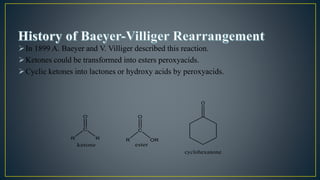
In 1899 A. Baeyer and V. Villiger described this reaction.
Ketones could be transformed into esters peroxyacids.
Cyclic ketones into lactones or hydroxy acids by peroxyacids.
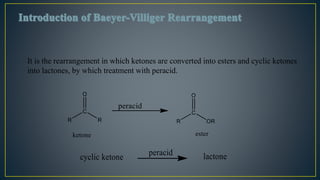
It is the rearrangement in which ketones are converted into esters and cyclic ketones
into lactones, by which treatment with peracid.
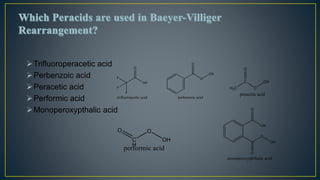
Trifluoroperacetic acid
Perbenzoic acid
Peracetic acid
Performic acid
Monoperoxypthalic acid
 Anionotropic rearrangement.
 Migration from Carbon to electron-deficient Oxygen.
 Electron donating group attached to migrating atom increase the rate of
reaction.
 A buffer Solution Disodium phosphate must be added to prevent trans
esterification.
 The activity of suitable oxidizing agents can be ranked in the following order:
Trifluoro peroxyacetic acid > monopermaleic acid > monoperphthalic acid > 3,5-
dinitroperbenzoic acid> p-nitroperbenzoic acid> meta chloroperoxybenzoic acid
(mCPBA)> performic acid > perbenzoic acid > peracetic acid > Hydrogen
peroxide and finally tert-Butyl hydroperoxide.
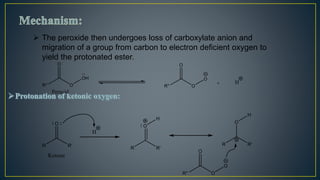
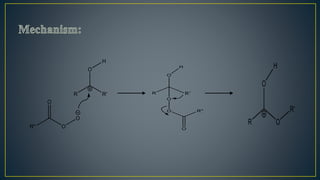
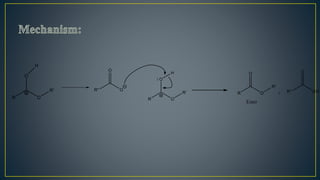
 The peroxide then undergoes loss of carboxylate anion and
migration of a group from carbon to electron deficient oxygen to
yield the protonated ester.
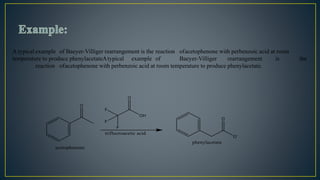
A typical example of Baeyer-Villiger rearrangement is the reaction ofacetophenone with perbenzoic acid at room
temperature to produce phenylacetateAtypical example of Baeyer-Villiger rearrangement is the
reaction ofacetophenone with perbenzoic acid at room temperature to produce phenylacetate.
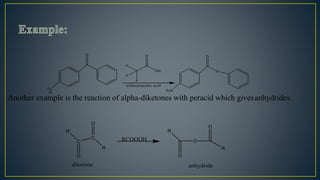
Another example is the reaction of alpha-diketones with peracid which givesanhydrides.
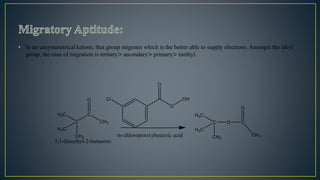
• In an unsymmetrical ketone, that group migrates which is the better able to supply electrons. Amongst the alkyl
group, the ease of migration is tertiary> secondary> primary> methyl.
Baeyer-Villiger rearrangement has great synthetic utility as it permits the transformation of ketones into esters i.e.
oxygen is inserted next to the carbonyl group.
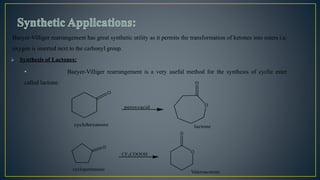
 Synthesis of Lactones:
• Baeyer-Villiger rearrangement is a very useful method for the synthesis of cyclic ester
called lactone.
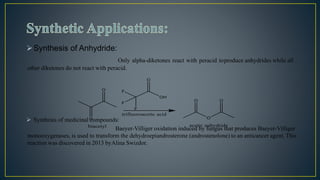
Synthesis of Anhydride:
Only alpha-diketones react with peracid toproduce anhydrides while all
other diketones do not react with peracid.
 Synthesis of medicinal compounds:
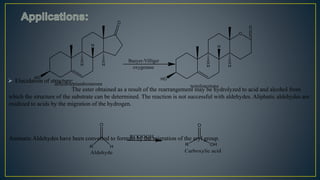
Baeyer-Villiger oxidation induced by fungus that produces Baeyer-Villiger
monooxygenases, is used to transform the dehydroepiandrosterone (androstenolone) to an anticancer agent. This
reaction was discovered in 2013 byAlina Swizdor.
 Elucidation of structure:
The ester obtained as a result of the rearrangement may be hydrolyzed to acid and alcohol from
which the structure of the substrate can be determined. The reaction is not successful with aldehydes. Aliphatic aldehydes are
oxidized to acids by the migration of the hydrogen.
Aromatic Aldehydes have been converted to formats by the migration of the aryl group.
The Baeyer–Villiger oxidation of cyclic ketones using aqueous hydrogen peroxide as an oxidant over transition
metal oxides yields the corresponding lactones.
 Silica-supported tricobalt tetra oxide catalysts have been employed for the Baeyer–Villiger oxidation of
cyclohexanone under Mukaiyama conditions.
 Submicrometer-sized tin-containing MCM-41 particles with a size of several hundred nanometers were reported
as selective catalysts for the Baeyer– Villiger oxidation of adamantanone with aqueous hydrogen peroxide.
 Chemoenzymatic Baeyer–Villiger oxidation of cyclic ketones catalyzed by Candida antarctica lipase B or
Novozyme-435 suspended in an ionic liquid has been studied.
 Kinetic resolution of racemic 2-substituted cyclopentanones has been achieved via highly regio- and
enantioselective Baeyer–Villiger oxidation.
 https://www.alfa.com/en/baeyer-villiger-
oxidation/#:~:text=While%20exploring%20the%20ring%20cleavage,as%20t
he%20Baeyer%2DVilliger%20oxidation.
 https://www.sigmaaldrich.com/PK/en/technical-documents/technical- article/chemistry-and-
synthesis/organic-reaction-toolbox/baeyer-villiger- oxidation-reaction.
 https://doi.org/10.1016/j.catcom.2014.04.017
 https://doi.org/10.1007/s11144-014-0687-1
 https://doi.org/10.1007/s40242-014-420
 4-xhttps://doi.org/10.1039/c4nj01976h
 https://doi.org/10.1021/ol501737a
 Reactions, Rearrangement and Reagents by S N Sanyal
 Rearrangement and Pericyclic Reactions by Dr. Muhammad Shoaib
BAEYER-VILLIGER REARRANGEMENT.pptx

BAEYER-VILLIGER REARRANGEMENT.pptx

  • 2.
    Presented by: MAbdullah Akmal Roll # : 908523 Rearrangement and Pericyclic Reactions
  • 3.
    CONTENTS: i. History ofBaeyer-Villiger Rearrangement ii. Introduction of Baeyer-Villiger Rearrangement iii. Example of Baeyer-Villiger Rearrangement iv. Characteristics of Baeyer-Villiger Rearrangement v. Mechanism of Baeyer-Villiger Rearrangement vi. Migratory Aptitude of Baeyer-Villiger Rearrangement vii. Synthetic Applications of Baeyer-Villiger Rearrangement viii. Reference
  • 4.
    In 1899 A.Baeyer and V. Villiger described this reaction. Ketones could be transformed into esters peroxyacids. Cyclic ketones into lactones or hydroxy acids by peroxyacids.
  • 5.
    It is therearrangement in which ketones are converted into esters and cyclic ketones into lactones, by which treatment with peracid.
  • 6.
    Trifluoroperacetic acid Perbenzoic acid Peraceticacid Performic acid Monoperoxypthalic acid
  • 7.
     Anionotropic rearrangement. Migration from Carbon to electron-deficient Oxygen.  Electron donating group attached to migrating atom increase the rate of reaction.  A buffer Solution Disodium phosphate must be added to prevent trans esterification.  The activity of suitable oxidizing agents can be ranked in the following order: Trifluoro peroxyacetic acid > monopermaleic acid > monoperphthalic acid > 3,5- dinitroperbenzoic acid> p-nitroperbenzoic acid> meta chloroperoxybenzoic acid (mCPBA)> performic acid > perbenzoic acid > peracetic acid > Hydrogen peroxide and finally tert-Butyl hydroperoxide.
  • 8.
     The peroxidethen undergoes loss of carboxylate anion and migration of a group from carbon to electron deficient oxygen to yield the protonated ester.
  • 11.
    A typical exampleof Baeyer-Villiger rearrangement is the reaction ofacetophenone with perbenzoic acid at room temperature to produce phenylacetateAtypical example of Baeyer-Villiger rearrangement is the reaction ofacetophenone with perbenzoic acid at room temperature to produce phenylacetate.
  • 12.
    Another example isthe reaction of alpha-diketones with peracid which givesanhydrides.
  • 13.
    • In anunsymmetrical ketone, that group migrates which is the better able to supply electrons. Amongst the alkyl group, the ease of migration is tertiary> secondary> primary> methyl.
  • 14.
    Baeyer-Villiger rearrangement hasgreat synthetic utility as it permits the transformation of ketones into esters i.e. oxygen is inserted next to the carbonyl group.  Synthesis of Lactones: • Baeyer-Villiger rearrangement is a very useful method for the synthesis of cyclic ester called lactone.
  • 15.
    Synthesis of Anhydride: Onlyalpha-diketones react with peracid toproduce anhydrides while all other diketones do not react with peracid.  Synthesis of medicinal compounds: Baeyer-Villiger oxidation induced by fungus that produces Baeyer-Villiger monooxygenases, is used to transform the dehydroepiandrosterone (androstenolone) to an anticancer agent. This reaction was discovered in 2013 byAlina Swizdor.
  • 16.
     Elucidation ofstructure: The ester obtained as a result of the rearrangement may be hydrolyzed to acid and alcohol from which the structure of the substrate can be determined. The reaction is not successful with aldehydes. Aliphatic aldehydes are oxidized to acids by the migration of the hydrogen. Aromatic Aldehydes have been converted to formats by the migration of the aryl group.
  • 17.
    The Baeyer–Villiger oxidationof cyclic ketones using aqueous hydrogen peroxide as an oxidant over transition metal oxides yields the corresponding lactones.  Silica-supported tricobalt tetra oxide catalysts have been employed for the Baeyer–Villiger oxidation of cyclohexanone under Mukaiyama conditions.  Submicrometer-sized tin-containing MCM-41 particles with a size of several hundred nanometers were reported as selective catalysts for the Baeyer– Villiger oxidation of adamantanone with aqueous hydrogen peroxide.  Chemoenzymatic Baeyer–Villiger oxidation of cyclic ketones catalyzed by Candida antarctica lipase B or Novozyme-435 suspended in an ionic liquid has been studied.  Kinetic resolution of racemic 2-substituted cyclopentanones has been achieved via highly regio- and enantioselective Baeyer–Villiger oxidation.
  • 18.
     https://www.alfa.com/en/baeyer-villiger- oxidation/#:~:text=While%20exploring%20the%20ring%20cleavage,as%20t he%20Baeyer%2DVilliger%20oxidation.  https://www.sigmaaldrich.com/PK/en/technical-documents/technical-article/chemistry-and- synthesis/organic-reaction-toolbox/baeyer-villiger- oxidation-reaction.  https://doi.org/10.1016/j.catcom.2014.04.017  https://doi.org/10.1007/s11144-014-0687-1  https://doi.org/10.1007/s40242-014-420  4-xhttps://doi.org/10.1039/c4nj01976h  https://doi.org/10.1021/ol501737a  Reactions, Rearrangement and Reagents by S N Sanyal  Rearrangement and Pericyclic Reactions by Dr. Muhammad Shoaib