11. Osmium tetroxide
Dr. Shivendra Singh
UGC-NET-JRF, PhD- IIT Indore
Assistant Professor
shivendrasngh0@gmail.com
Webpage: https://sites.google.com/view/drshivendrasingh/home
Youtube: https://bit.ly/2YM0QG0
2
…Osmium tetroxide
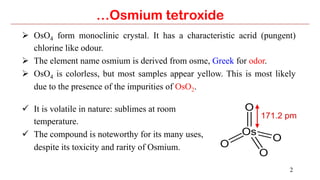
Ø  OsO4 form monoclinic crystal. It has a characteristic acrid (pungent)
chlorine like odour.
Ø  The element name osmium is derived from osme, Greek for odor.
Ø  OsO4 is colorless, but most samples appear yellow. This is most likely
due to the presence of the impurities of OsO2.
ü  It is volatile in nature: sublimes at room
temperature.
ü  The compound is noteworthy for its many uses,
despite its toxicity and rarity of Osmium.
3
http.chem.libretexts.org.
Crystal Systems
4
…OsO4: Physical properties
Ø  Soluble in wide range of organic solvents.
Ø  Moderately soluble in water (6.2 g/100 ml), with which it reacts reversibly to
form osmic acid.
Ø  It is tetrahedral and therefore non-polar.
Ø  Osmium is the densest (density 22.59 gcm-3) transition metal naturally
available.
Ø  M.P. 40 °C.
Ø  Sublimes at RT.
Ø  B.P. 130 °C.
5
…OsO4: Preparation
Ø  Formed slowly when osmium powder reacts with O2 at ambient temp.
Ø  Reaction of bulk solid requires heating to 400 C.
Os + 2O2 → OsO4
6
…OsO4: Application
1.  Dihydroxylation of alkenes
2.  Sharpless Asymmetric Dihydroxylation
3.  Lemieux-Johnson oxidation
4.  Reaction with Alkynes
7
…OsO4: Application
1. Dihydroxylation of alkenes: Alkenes add to OsO4 to give diolate
species that hydrolyze to cis-diols via [3+2] cycloaddition. The net process
is called dihydroxylation. The reaction proceeds through an intermediate
osmate ester which rapidly hydrolyses to yield the vicinal diol.
8
…OsO4: Application
NPTEL – Chemistry
9
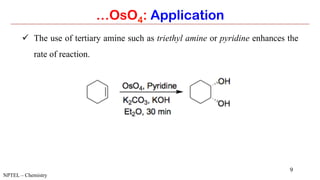
ü  The use of tertiary amine such as triethyl amine or pyridine enhances the
rate of reaction.
…OsO4: Application
NPTEL – Chemistry
10
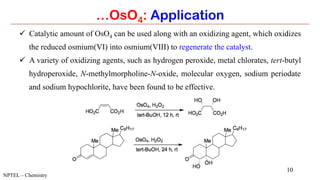
ü  Catalytic amount of OsO4 can be used along with an oxidizing agent, which oxidizes
the reduced osmium(VI) into osmium(VIII) to regenerate the catalyst.
ü  A variety of oxidizing agents, such as hydrogen peroxide, metal chlorates, tert-butyl
hydroperoxide, N-methylmorpholine-N-oxide, molecular oxygen, sodium periodate
and sodium hypochlorite, have been found to be effective.
…OsO4: Application
NPTEL – Chemistry
11
…OsO4: Application
NPTEL – Chemistry
12
…OsO4: Application
NPTEL – Chemistry
13
…OsO4: Application
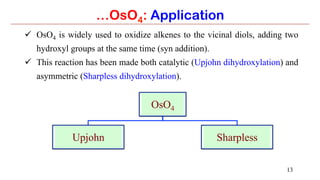
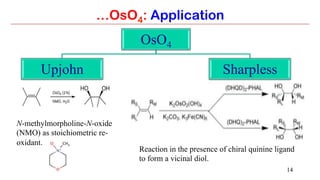
ü  OsO4 is widely used to oxidize alkenes to the vicinal diols, adding two
hydroxyl groups at the same time (syn addition).
ü  This reaction has been made both catalytic (Upjohn dihydroxylation) and
asymmetric (Sharpless dihydroxylation).
OsO4
Upjohn Sharpless
14
…OsO4: Application
OsO4
Upjohn Sharpless
N-methylmorpholine-N-oxide
(NMO) as stoichiometric re-
oxidant.
Reaction in the presence of chiral quinine ligand
to form a vicinal diol.
15
…OsO4: Application
2. Sharpless Asymmetric Dihydroxylation
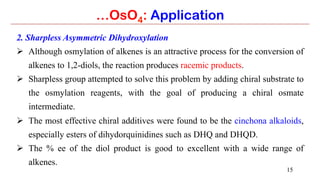
Ø  Although osmylation of alkenes is an attractive process for the conversion of
alkenes to 1,2-diols, the reaction produces racemic products.
Ø  Sharpless group attempted to solve this problem by adding chiral substrate to
the osmylation reagents, with the goal of producing a chiral osmate
intermediate.
Ø  The most effective chiral additives were found to be the cinchona alkaloids,
especially esters of dihydorquinidines such as DHQ and DHQD.
Ø  The % ee of the diol product is good to excellent with a wide range of
alkenes.
16
…OsO4: Application
NPTEL – Chemistry www.organic-chemistry.org/
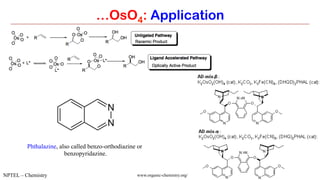
Phthalazine, also called benzo-orthodiazine or
benzopyridazine.
17
…OsO4: Application
ü  If the alkene is oriented as shown, the natural dihydroquinidine (DHQD) ester forces delivery of
the hydroxyls from the top face (β-attack).
ü  Conversely, dihydroquinine (DHQ) esters deliver hydroxyls from the bottom face (α-attack).
NPTEL – Chemistry
www.organic-chemistry.org/
18
…OsO4: Application
NPTEL – Chemistry
19
…OsO4: Application
Features:
i.  The reaction is stereospecific leading to 1,2-cis-addition of two OH groups
to the alkenes.
ii.  It typically proceeds with high chemoselectivity and enantioselectivity.
iii.  The reaction conditions are simple and the reaction can be easily scaled up.
iv.  The product is always a diol derived from cis-addition.
v.  It generally exhibits a high catalytic turnover number.
vi.  It has broad substrate scope without affecting the functional groups.
NPTEL – Chemistry
20
…OsO4: Application
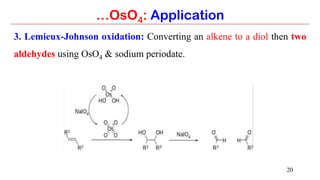
3. Lemieux-Johnson oxidation: Converting an alkene to a diol then two
aldehydes using OsO4 & sodium periodate.
21
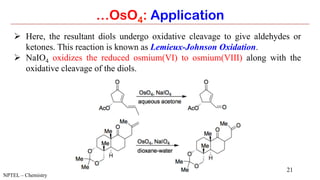
Ø  Here, the resultant diols undergo oxidative cleavage to give aldehydes or
ketones. This reaction is known as Lemieux-Johnson Oxidation.
Ø  NaIO4 oxidizes the reduced osmium(VI) to osmium(VIII) along with the
oxidative cleavage of the diols.
…OsO4: Application
NPTEL – Chemistry
22
…OsO4: Application
https://www.google.com/url?sa=i&url=https%3A%2F%2Fonlinelibrary.wiley.com
23
…OsO4: Application
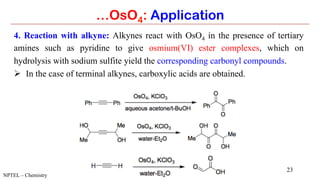
4. Reaction with alkyne: Alkynes react with OsO4 in the presence of tertiary
amines such as pyridine to give osmium(VI) ester complexes, which on
hydrolysis with sodium sulfite yield the corresponding carbonyl compounds.
Ø  In the case of terminal alkynes, carboxylic acids are obtained.
NPTEL – Chemistry
24
…OsO4: Application
NPTEL – Chemistry
25
…OsO4: Summary
1.  General Features
2.  Preparation
3.  Applications
1. Dihydroxylation of alkenes
2. Lemieux-Johnson oxidation
3. Sharpless Asymmetric Dihydroxylation
4. Reaction with Alkynes

11. Oso4

  • 1.
    11. Osmium tetroxide Dr.Shivendra Singh UGC-NET-JRF, PhD- IIT Indore Assistant Professor shivendrasngh0@gmail.com Webpage: https://sites.google.com/view/drshivendrasingh/home Youtube: https://bit.ly/2YM0QG0
  • 2.
    2 …Osmium tetroxide Ø  OsO4form monoclinic crystal. It has a characteristic acrid (pungent) chlorine like odour. Ø  The element name osmium is derived from osme, Greek for odor. Ø  OsO4 is colorless, but most samples appear yellow. This is most likely due to the presence of the impurities of OsO2. ü  It is volatile in nature: sublimes at room temperature. ü  The compound is noteworthy for its many uses, despite its toxicity and rarity of Osmium.
  • 3.
  • 4.
    4 …OsO4: Physical properties Ø Soluble in wide range of organic solvents. Ø  Moderately soluble in water (6.2 g/100 ml), with which it reacts reversibly to form osmic acid. Ø  It is tetrahedral and therefore non-polar. Ø  Osmium is the densest (density 22.59 gcm-3) transition metal naturally available. Ø  M.P. 40 °C. Ø  Sublimes at RT. Ø  B.P. 130 °C.
  • 5.
    5 …OsO4: Preparation Ø  Formedslowly when osmium powder reacts with O2 at ambient temp. Ø  Reaction of bulk solid requires heating to 400 C. Os + 2O2 → OsO4
  • 6.
    6 …OsO4: Application 1.  Dihydroxylationof alkenes 2.  Sharpless Asymmetric Dihydroxylation 3.  Lemieux-Johnson oxidation 4.  Reaction with Alkynes
  • 7.
    7 …OsO4: Application 1. Dihydroxylationof alkenes: Alkenes add to OsO4 to give diolate species that hydrolyze to cis-diols via [3+2] cycloaddition. The net process is called dihydroxylation. The reaction proceeds through an intermediate osmate ester which rapidly hydrolyses to yield the vicinal diol.
  • 8.
  • 9.
    9 ü  The useof tertiary amine such as triethyl amine or pyridine enhances the rate of reaction. …OsO4: Application NPTEL – Chemistry
  • 10.
    10 ü  Catalytic amountof OsO4 can be used along with an oxidizing agent, which oxidizes the reduced osmium(VI) into osmium(VIII) to regenerate the catalyst. ü  A variety of oxidizing agents, such as hydrogen peroxide, metal chlorates, tert-butyl hydroperoxide, N-methylmorpholine-N-oxide, molecular oxygen, sodium periodate and sodium hypochlorite, have been found to be effective. …OsO4: Application NPTEL – Chemistry
  • 11.
  • 12.
  • 13.
    13 …OsO4: Application ü  OsO4is widely used to oxidize alkenes to the vicinal diols, adding two hydroxyl groups at the same time (syn addition). ü  This reaction has been made both catalytic (Upjohn dihydroxylation) and asymmetric (Sharpless dihydroxylation). OsO4 Upjohn Sharpless
  • 14.
    14 …OsO4: Application OsO4 Upjohn Sharpless N-methylmorpholine-N-oxide (NMO)as stoichiometric re- oxidant. Reaction in the presence of chiral quinine ligand to form a vicinal diol.
  • 15.
    15 …OsO4: Application 2. SharplessAsymmetric Dihydroxylation Ø  Although osmylation of alkenes is an attractive process for the conversion of alkenes to 1,2-diols, the reaction produces racemic products. Ø  Sharpless group attempted to solve this problem by adding chiral substrate to the osmylation reagents, with the goal of producing a chiral osmate intermediate. Ø  The most effective chiral additives were found to be the cinchona alkaloids, especially esters of dihydorquinidines such as DHQ and DHQD. Ø  The % ee of the diol product is good to excellent with a wide range of alkenes.
  • 16.
    16 …OsO4: Application NPTEL –Chemistry www.organic-chemistry.org/ Phthalazine, also called benzo-orthodiazine or benzopyridazine.
  • 17.
    17 …OsO4: Application ü  Ifthe alkene is oriented as shown, the natural dihydroquinidine (DHQD) ester forces delivery of the hydroxyls from the top face (β-attack). ü  Conversely, dihydroquinine (DHQ) esters deliver hydroxyls from the bottom face (α-attack). NPTEL – Chemistry www.organic-chemistry.org/
  • 18.
  • 19.
    19 …OsO4: Application Features: i.  Thereaction is stereospecific leading to 1,2-cis-addition of two OH groups to the alkenes. ii.  It typically proceeds with high chemoselectivity and enantioselectivity. iii.  The reaction conditions are simple and the reaction can be easily scaled up. iv.  The product is always a diol derived from cis-addition. v.  It generally exhibits a high catalytic turnover number. vi.  It has broad substrate scope without affecting the functional groups. NPTEL – Chemistry
  • 20.
    20 …OsO4: Application 3. Lemieux-Johnsonoxidation: Converting an alkene to a diol then two aldehydes using OsO4 & sodium periodate.
  • 21.
    21 Ø  Here, theresultant diols undergo oxidative cleavage to give aldehydes or ketones. This reaction is known as Lemieux-Johnson Oxidation. Ø  NaIO4 oxidizes the reduced osmium(VI) to osmium(VIII) along with the oxidative cleavage of the diols. …OsO4: Application NPTEL – Chemistry
  • 22.
  • 23.
    23 …OsO4: Application 4. Reactionwith alkyne: Alkynes react with OsO4 in the presence of tertiary amines such as pyridine to give osmium(VI) ester complexes, which on hydrolysis with sodium sulfite yield the corresponding carbonyl compounds. Ø  In the case of terminal alkynes, carboxylic acids are obtained. NPTEL – Chemistry
  • 24.
  • 25.
    25 …OsO4: Summary 1.  GeneralFeatures 2.  Preparation 3.  Applications 1. Dihydroxylation of alkenes 2. Lemieux-Johnson oxidation 3. Sharpless Asymmetric Dihydroxylation 4. Reaction with Alkynes