OVER PRESSURE
LAYER
CHROMATOGRAPHY
(OPLC)
1
■ A forced flow technique, suitable for 50 - 100 mg
partially purified samples
■ In comparison to TLC, it has higher efficiency, increased
solute loading capacity, fast development, reduced
separation time, achieves high efficiency due to smaller
fine particles and longer plates
■ Resolution may be comparable with HPLC
■ Sorbent layer of chromatographic plate covered with an
elastic membrane under external pressure, no vapor
phase, plate is tightly sealed to give a closed system,
when forced by a pump, the mobile phase migrates
through the sorbent layer due to cushion system at over
pressure
2
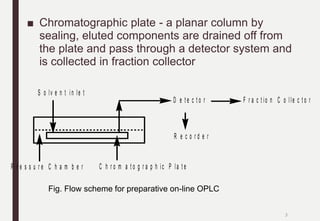
■ Chromatographic plate - a planar column by
sealing, eluted components are drained off from
the plate and pass through a detector system and
is collected in fraction collector
3
D e t e c t o r
C h r o m a t o g r a p h i c P la t e
P r e s s u r e C h a m b e r
S o lv e n t i n le t
R e c o r d e r
F r a c t io n C o l le c t o r
Fig. Flow scheme for preparative on-line OPLC
Preparation of Plates
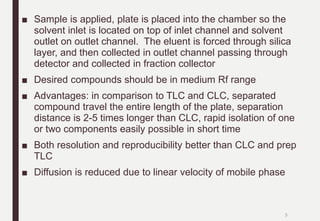
■ Special precoated plates (2 mm layer thickness),
edges obliquely scratched off, and impregnated
with polymer suspension - prevents leakage at
over pressure, two thin channels are scratched
(18 cm apart on a 20 x 20 cm plate)
4
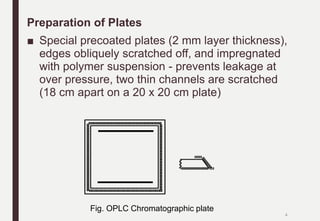
Fig. OPLC Chromatographic plate
■ Sample is applied, plate is placed into the chamber so the
solvent inlet is located on top of inlet channel and solvent
outlet on outlet channel. The eluent is forced through silica
layer, and then collected in outlet channel passing through
detector and collected in fraction collector
■ Desired compounds should be in medium Rf range
■ Advantages: in comparison to TLC and CLC, separated
compound travel the entire length of the plate, separation
distance is 2-5 times longer than CLC, rapid isolation of one
or two components easily possible in short time
■ Both resolution and reproducibility better than CLC and prep
TLC
■ Diffusion is reduced due to linear velocity of mobile phase
5
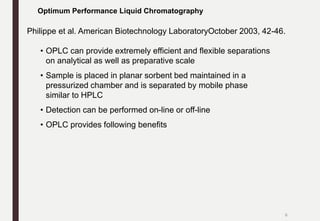
• OPLC can provide extremely efficient and flexible separations
on analytical as well as preparative scale
• Sample is placed in planar sorbent bed maintained in a
pressurized chamber and is separated by mobile phase
similar to HPLC
• Detection can be performed on-line or off-line
• OPLC provides following benefits
Optimum Performance Liquid Chromatography
Philippe et al. American Biotechnology LaboratoryOctober 2003, 42-46.
6
Optimum Performance Liquid Chromatography
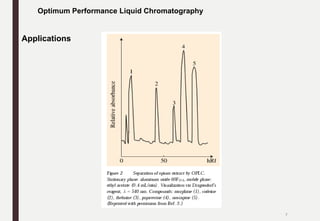
Applications
7
Optimum Performance Liquid Chromatography
Applications
8

Over Pressure Layer Chromatography.pptx

  • 1.
  • 2.
    ■ A forcedflow technique, suitable for 50 - 100 mg partially purified samples ■ In comparison to TLC, it has higher efficiency, increased solute loading capacity, fast development, reduced separation time, achieves high efficiency due to smaller fine particles and longer plates ■ Resolution may be comparable with HPLC ■ Sorbent layer of chromatographic plate covered with an elastic membrane under external pressure, no vapor phase, plate is tightly sealed to give a closed system, when forced by a pump, the mobile phase migrates through the sorbent layer due to cushion system at over pressure 2
  • 3.
    ■ Chromatographic plate- a planar column by sealing, eluted components are drained off from the plate and pass through a detector system and is collected in fraction collector 3 D e t e c t o r C h r o m a t o g r a p h i c P la t e P r e s s u r e C h a m b e r S o lv e n t i n le t R e c o r d e r F r a c t io n C o l le c t o r Fig. Flow scheme for preparative on-line OPLC
  • 4.
    Preparation of Plates ■Special precoated plates (2 mm layer thickness), edges obliquely scratched off, and impregnated with polymer suspension - prevents leakage at over pressure, two thin channels are scratched (18 cm apart on a 20 x 20 cm plate) 4 Fig. OPLC Chromatographic plate
  • 5.
    ■ Sample isapplied, plate is placed into the chamber so the solvent inlet is located on top of inlet channel and solvent outlet on outlet channel. The eluent is forced through silica layer, and then collected in outlet channel passing through detector and collected in fraction collector ■ Desired compounds should be in medium Rf range ■ Advantages: in comparison to TLC and CLC, separated compound travel the entire length of the plate, separation distance is 2-5 times longer than CLC, rapid isolation of one or two components easily possible in short time ■ Both resolution and reproducibility better than CLC and prep TLC ■ Diffusion is reduced due to linear velocity of mobile phase 5
  • 6.
    • OPLC canprovide extremely efficient and flexible separations on analytical as well as preparative scale • Sample is placed in planar sorbent bed maintained in a pressurized chamber and is separated by mobile phase similar to HPLC • Detection can be performed on-line or off-line • OPLC provides following benefits Optimum Performance Liquid Chromatography Philippe et al. American Biotechnology LaboratoryOctober 2003, 42-46. 6
  • 7.
    Optimum Performance LiquidChromatography Applications 7
  • 8.
    Optimum Performance LiquidChromatography Applications 8