TLC-HPTLC
1
HPTLC - Development
• Thin-layer chromatography differs from all other chromatographic techniques
in that a gas phase is present in addition to stationary and mobile phase
• This gas phase can significantly influence the result of the separation
• Place the plate in a chamber, which contains a sufficient amount of
developing solvent.
• The lower end of the plate should be immersed several millimeters.
• Driven by capillary action the developing solvent moves up the layer until the
desired running distance is reached and chromatography is stopped.
• TLC on silica gel can be described as adsorption chromatography.
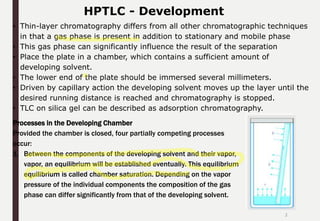
Processes in the Developing Chamber
Provided the chamber is closed, four partially competing processes
occur:
1. Between the components of the developing solvent and their vapor,
vapor, an equilibrium will be established eventually. This equilibrium
equilibrium is called chamber saturation. Depending on the vapor
pressure of the individual components the composition of the gas
phase can differ significantly from that of the developing solvent.
2
HPTLC - Development
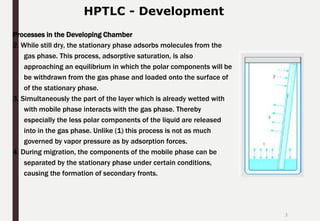
Processes in the Developing Chamber
2. While still dry, the stationary phase adsorbs molecules from the
gas phase. This process, adsorptive saturation, is also
approaching an equilibrium in which the polar components will be
be withdrawn from the gas phase and loaded onto the surface of
of the stationary phase.
3. Simultaneously the part of the layer which is already wetted with
with mobile phase interacts with the gas phase. Thereby
especially the less polar components of the liquid are released
into in the gas phase. Unlike (1) this process is not as much
governed by vapor pressure as by adsorption forces.
4. During migration, the components of the mobile phase can be
separated by the stationary phase under certain conditions,
causing the formation of secondary fronts.
3
HPTLC - Development
• With the exception of single component liquids (neat solvents), developing solvent and
mobile phase are not the same.
• Their composition changes with progressing chromatography.
• The terms ‘developing solvent’ and ‘mobile phase’ are often used as synonyms.
• In the true sense only the liquid in the chamber should be called developing solvent,
while the liquid moving through the layer constitutes the mobile phase.
• Only the composition of the developing solvent at the time when it is placed into the
chamber is positively known. The processes (1) and (2) can be experimentally affected
by:
Fitting the chamber more or less completely with filter paper soaked with developing
solvent.
Waiting a certain time between the introduction of developing solvent into the chamber and
beginning of chromatography – chamber saturation.
Allowing the plate to interact with the gas phase prior to chromatographic
development, i.e. without contact to the developing solvent – preconditioning. 4
An interaction according to (2) and (3) can be effectively prevented by placing a counter
plate at a distance of one or a few millimeters to the chromatographic layer. This is called
‘sandwich configuration’.
The further an equilibrium according to (1) and/or (2) has been established and the less
different the components of the mobile phase are in respect to their adsorption behavior,
the less pronounced is the formation of secondary fronts resulting from (4).
In well-saturated chambers and on preconditioned layers secondary fronts are often not
observed.
In sandwich configuration and particularly in OPLC secondary fronts are very prominent.
During chromatography, components of the developing solvent, which have been loaded
onto the dry layer via the gas phase according to (2), are pushed ahead of the true but
invisible solvent front.
Exceptions are very polar components such as water, methanol, acids, or bases. This
results in Rf values being lower in saturated chambers and particularly on pre-
conditioned layers, than in unsaturated chambers and sandwich configurations.
HPTLC - Development
5
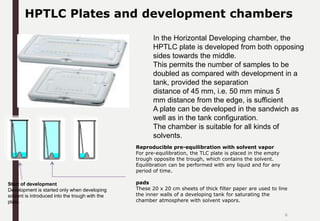
HPTLC Plates and development chambers
In the Horizontal Developing chamber, the
HPTLC plate is developed from both opposing
sides towards the middle.
This permits the number of samples to be
doubled as compared with development in a
tank, provided the separation
distance of 45 mm, i.e. 50 mm minus 5
mm distance from the edge, is sufficient
A plate can be developed in the sandwich as
well as in the tank configuration.
The chamber is suitable for all kinds of
solvents.
Reproducible pre-equilibration with solvent vapor
For pre-equilibration, the TLC plate is placed in the empty
trough opposite the trough, which contains the solvent.
Equilibration can be performed with any liquid and for any
period of time.
pads
These 20 x 20 cm sheets of thick filter paper are used to line
the inner walls of a developing tank for saturating the
chamber atmosphere with solvent vapors.
Start of development
Development is started only when developing
solvent is introduced into the trough with the
plate.
6
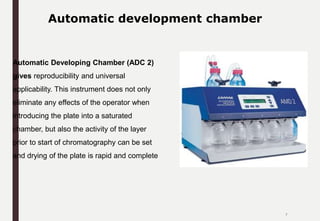
Automatic development chamber
Automatic Developing Chamber (ADC 2)
gives reproducibility and universal
applicability. This instrument does not only
eliminate any effects of the operator when
introducing the plate into a saturated
chamber, but also the activity of the layer
prior to start of chromatography can be set
and drying of the plate is rapid and complete
7
Thin-layer Chromatography in most cases proceeds in a non-equilibrium between stationary,
mobile, and gas phase. For this reason it is very difficult to correctly describe the conditions
in a developing chamber.
Reproducible chromatographic results can only be expected when all parameters are kept as
constant as possible. Chamber shape and saturation are important
This means that the chromatographic result is different in each chamber!
There are neither good nor poor chambers! However, in some chambers the parameters
can be better controlled, i.e. reproduced, than in others.
Choosing a developing chamber
Selection of the »proper« chamber is done during method development and generally follows
practical considerations such as
which chamber is available, which one must be used due to an SOP, or which one has
been used in the past if a results comparison is to be made.
Focus should also be on economical aspects such as time requirement and solvent
consumption.
HPTLC - Development
8
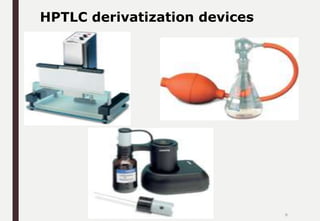
HPTLC derivatization devices
9
Detection of chromatogram
Non-destructive detection- UV light and Iodine vapour
Destructive detection- Derivatization reagents
Derivatization reagents can be applied using sprayer or by
dipping method
For quantitative purpose the reagent should be applied by
dipping method
10
Influence of activity (relative
humidity) on separation at
equal migration distance
Reproducible chromatogram
development
11
HPTLC scanner
12
Quantitative evaluation of a TLC/HPTLC plate is always performed
densitometrically, either in absorbance or fluorescence mode.
The signal of each substance zone is compared to the substance free plate
background.
For calibration and result calculation the obtained peak data of the unknowns
are compared against data obtained for standards on the same plate.
Quantitative evaluation can be performed with data from classical
densitometry
Densitometry uses monochromatic light and a slit of selectable length
and width to measure the diffusely reflected light. The CAMAG TLC Scanner
3 uses the entire spectral range from 190 to 800 nm with high spectral
selectivity for data acquisition. Absorption spectra for substance identification
and for selection of the most suitable measurement wavelength can be
recorded within this range.
HPTLC - Evaluation
13
Documentation
14

HPTLC method development.pptx

  • 1.
  • 2.
    HPTLC - Development •Thin-layer chromatography differs from all other chromatographic techniques in that a gas phase is present in addition to stationary and mobile phase • This gas phase can significantly influence the result of the separation • Place the plate in a chamber, which contains a sufficient amount of developing solvent. • The lower end of the plate should be immersed several millimeters. • Driven by capillary action the developing solvent moves up the layer until the desired running distance is reached and chromatography is stopped. • TLC on silica gel can be described as adsorption chromatography. Processes in the Developing Chamber Provided the chamber is closed, four partially competing processes occur: 1. Between the components of the developing solvent and their vapor, vapor, an equilibrium will be established eventually. This equilibrium equilibrium is called chamber saturation. Depending on the vapor pressure of the individual components the composition of the gas phase can differ significantly from that of the developing solvent. 2
  • 3.
    HPTLC - Development Processesin the Developing Chamber 2. While still dry, the stationary phase adsorbs molecules from the gas phase. This process, adsorptive saturation, is also approaching an equilibrium in which the polar components will be be withdrawn from the gas phase and loaded onto the surface of of the stationary phase. 3. Simultaneously the part of the layer which is already wetted with with mobile phase interacts with the gas phase. Thereby especially the less polar components of the liquid are released into in the gas phase. Unlike (1) this process is not as much governed by vapor pressure as by adsorption forces. 4. During migration, the components of the mobile phase can be separated by the stationary phase under certain conditions, causing the formation of secondary fronts. 3
  • 4.
    HPTLC - Development •With the exception of single component liquids (neat solvents), developing solvent and mobile phase are not the same. • Their composition changes with progressing chromatography. • The terms ‘developing solvent’ and ‘mobile phase’ are often used as synonyms. • In the true sense only the liquid in the chamber should be called developing solvent, while the liquid moving through the layer constitutes the mobile phase. • Only the composition of the developing solvent at the time when it is placed into the chamber is positively known. The processes (1) and (2) can be experimentally affected by: Fitting the chamber more or less completely with filter paper soaked with developing solvent. Waiting a certain time between the introduction of developing solvent into the chamber and beginning of chromatography – chamber saturation. Allowing the plate to interact with the gas phase prior to chromatographic development, i.e. without contact to the developing solvent – preconditioning. 4
  • 5.
    An interaction accordingto (2) and (3) can be effectively prevented by placing a counter plate at a distance of one or a few millimeters to the chromatographic layer. This is called ‘sandwich configuration’. The further an equilibrium according to (1) and/or (2) has been established and the less different the components of the mobile phase are in respect to their adsorption behavior, the less pronounced is the formation of secondary fronts resulting from (4). In well-saturated chambers and on preconditioned layers secondary fronts are often not observed. In sandwich configuration and particularly in OPLC secondary fronts are very prominent. During chromatography, components of the developing solvent, which have been loaded onto the dry layer via the gas phase according to (2), are pushed ahead of the true but invisible solvent front. Exceptions are very polar components such as water, methanol, acids, or bases. This results in Rf values being lower in saturated chambers and particularly on pre- conditioned layers, than in unsaturated chambers and sandwich configurations. HPTLC - Development 5
  • 6.
    HPTLC Plates anddevelopment chambers In the Horizontal Developing chamber, the HPTLC plate is developed from both opposing sides towards the middle. This permits the number of samples to be doubled as compared with development in a tank, provided the separation distance of 45 mm, i.e. 50 mm minus 5 mm distance from the edge, is sufficient A plate can be developed in the sandwich as well as in the tank configuration. The chamber is suitable for all kinds of solvents. Reproducible pre-equilibration with solvent vapor For pre-equilibration, the TLC plate is placed in the empty trough opposite the trough, which contains the solvent. Equilibration can be performed with any liquid and for any period of time. pads These 20 x 20 cm sheets of thick filter paper are used to line the inner walls of a developing tank for saturating the chamber atmosphere with solvent vapors. Start of development Development is started only when developing solvent is introduced into the trough with the plate. 6
  • 7.
    Automatic development chamber AutomaticDeveloping Chamber (ADC 2) gives reproducibility and universal applicability. This instrument does not only eliminate any effects of the operator when introducing the plate into a saturated chamber, but also the activity of the layer prior to start of chromatography can be set and drying of the plate is rapid and complete 7
  • 8.
    Thin-layer Chromatography inmost cases proceeds in a non-equilibrium between stationary, mobile, and gas phase. For this reason it is very difficult to correctly describe the conditions in a developing chamber. Reproducible chromatographic results can only be expected when all parameters are kept as constant as possible. Chamber shape and saturation are important This means that the chromatographic result is different in each chamber! There are neither good nor poor chambers! However, in some chambers the parameters can be better controlled, i.e. reproduced, than in others. Choosing a developing chamber Selection of the »proper« chamber is done during method development and generally follows practical considerations such as which chamber is available, which one must be used due to an SOP, or which one has been used in the past if a results comparison is to be made. Focus should also be on economical aspects such as time requirement and solvent consumption. HPTLC - Development 8
  • 9.
  • 10.
    Detection of chromatogram Non-destructivedetection- UV light and Iodine vapour Destructive detection- Derivatization reagents Derivatization reagents can be applied using sprayer or by dipping method For quantitative purpose the reagent should be applied by dipping method 10
  • 11.
    Influence of activity(relative humidity) on separation at equal migration distance Reproducible chromatogram development 11
  • 12.
  • 13.
    Quantitative evaluation ofa TLC/HPTLC plate is always performed densitometrically, either in absorbance or fluorescence mode. The signal of each substance zone is compared to the substance free plate background. For calibration and result calculation the obtained peak data of the unknowns are compared against data obtained for standards on the same plate. Quantitative evaluation can be performed with data from classical densitometry Densitometry uses monochromatic light and a slit of selectable length and width to measure the diffusely reflected light. The CAMAG TLC Scanner 3 uses the entire spectral range from 190 to 800 nm with high spectral selectivity for data acquisition. Absorption spectra for substance identification and for selection of the most suitable measurement wavelength can be recorded within this range. HPTLC - Evaluation 13
  • 14.