CHROMATOGRAPHYCHROMATOGRAPHY
PRESENTED BY:-
Patel Jinal R.
M.Sc.SEM-2 (BOTANY)
Paper CBO-406
Department of Life sciences,
H.N.G.U,Patan.
CONTENTS:-
 Introduction of chromatography
 Classification of chromatography
 Types of chromatography
 Paper chromatography
Principle, Procedure, Types, Application, Advantages &
disadvantages
 Thin layer chromatography
 Principle, Procedure, application, Advantages & disadvantages
 Comparison of paper chromatography & thin layer
chromatography
Introduction of chromatography
Definition:-Chromatography is a technique
employed for separation of the components of
mixture by continuous distribution of the
components between two phases. (mobile phase
and stationary phase).
Chromatography is relatively a new technique which
was first invented by Michael Tswett, a Russian
botanist in 1906.
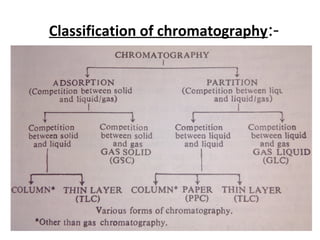
Classification of chromatography:-
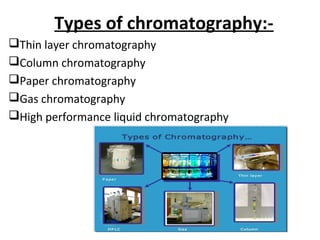
Types of chromatography:-
Thin layer chromatography
Column chromatography
Paper chromatography
Gas chromatography
High performance liquid chromatography
Paper chromatography
Paper chromatography(PC) was first introduced by
german scientist christian friedrich schonbein(1865)
principle:-this technique is a types of partition
chromatography in which the substances are
distributed between two liquids.
i.e., one is the stationary liquid (usually water)
which is held in the fibres of the paper and called
stationary phase; the other is the moving liquid or
developing and called the moving phase. The
components of the mixture to be separated migrate at
different rates and appear as spots at different points
on the paper.
 Procedure:-Procedure:-
 In this technique, a drop of the test solution is
applied as a small spot on a filter paper and
the spot is dried.
 The paper is kept in a close chamber and the
edge of the filter paper is dipped into a solvent
called developing solvent.
 As soon as filter paper gets the liquid through
its capillary axis and when it reaches the spot
of the test solution.
 The various substances are moved by solvent
system at various speeds. when solvent has
moved these substances to a suitable
height(15-18cm),the paper is dried and the
various spots are visualised by suitable
reagents called visualising reagents.
 The movement of substances relative to the
solvent is expressed in terms of Rf values.
i.e.,migration parameters.
Rf (Retention factor) valueRf (Retention factor) value:-
 The Rf(Retention factor) may be defined as the ratio of(Retention factor) may be defined as the ratio of
the distance traveled by the solvent.the distance traveled by the solvent.
 Rf value are usually expressed as a fraction of two decimalRf value are usually expressed as a fraction of two decimal
places.places.
 If Rf value of a solution is zero, the solute remains in theIf Rf value of a solution is zero, the solute remains in the
stationary phase and thus it is immobile.stationary phase and thus it is immobile.
 If Rf value=1 then the solute has no affinity for theIf Rf value=1 then the solute has no affinity for the
stationary phase and travels with the solvent front.stationary phase and travels with the solvent front.
 Rf=distance the solute(D1)moves divided by the distanceRf=distance the solute(D1)moves divided by the distance
traveled by the solvent front(D2)traveled by the solvent front(D2)
Rf=D1/D2Rf=D1/D2
Types of paper chromatography:-Types of paper chromatography:-
1. Descending chromatography:- in this type,
development of the chromatography is done by
allowing the solvent to travel down the paper.
2. Ascending chromatography:- Here the solvent
travel upward direction of the chromatography paper.
Both the descending and ascending chromatography
paper are used for separation of organic and inorganic
substances.
3. Ascending-descending chromatography paper
It is the hybrid of the above techniques. the upper part
of the ascending chromatography can be folded over a
rod and allowing the paper to become descending
after crossing the rod
4.Radial chromatography paper:
• It is also called a circular chromatography. Here a circular
filter paper is taken and the sample is given at the center
of the paper.
• After drying the spot the filter paper is tied horizontally
on a petridish containing solvent.so that wick and the
paper is dipped inside the solvent. the solvent rises
through the wick and the component get separated in
form of concentrate circular zone.
5.two-dimensional chromatography paper:-
• In this technique a square or rectangular paper is
used.here the sample is applied to one of the corners
and developments is performed at right angle to the
direction of first run.
Application of paper chromatography:-
Paper chromatography is more useful for the
analysis of polar compounds like amino
acid,natural products etc. the different types of
applications are listed below.
Separation of mixture of drugs of chemical or
biological origin,plant extracts etc.
Separation of
carbohydrates(sugars),vitamins,antibiotics,
proteins,alkaloids,glycosides,aminoacid etc.
Advantages & disadvantages of paper
chromatography:-
Advantages:-
 Paper chromatography requires very less quantitative material.
 Paper chromatography is cheaper compared to other
chromatography methods.
 Both unknown inorganic as well as organic compounds can be
identified by paper chromatography method.
 Disadvantages:-
 Large quantity of sample cannot be applied on paper
chromatography.in quantitative analysis paper chromatography is
not effective.
 Complex mixture cannot be separated by paper chromatography.
 Less accurate compared to HPLC or HPTLC.
Thin layer chromatography(TLC)
 Thin layer chromatography(TLC) can be defined as a method
of separation or identification of a mixture of components
into individual by using finely divided adsorbent solid/liquid
spread over a glass plate and liquid as a mobile phase
 Synonyms drop,strip,spread layer,surface chromatography
and open column chromatography.
• Principle:- adsorption or retention or both or any other
principle of a substance on the stationary phase.
• Separation of the adsorbed substances by the mobile phase
• Recovery of the separated substances by a countinuous flow
of the mobile phase.
Procedure:-
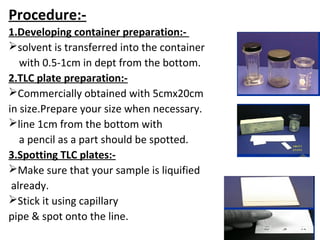
1.Developing container preparation:-
solvent is transferred into the container
with 0.5-1cm in dept from the bottom.
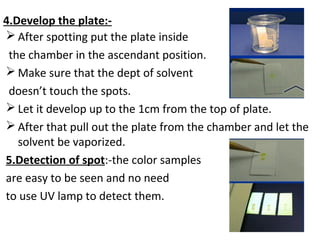
2.TLC plate preparation:-
Commercially obtained with 5cmx20cm
in size.Prepare your size when necessary.
line 1cm from the bottom with
a pencil as a part should be spotted.
3.Spotting TLC plates:-
Make sure that your sample is liquified
already.
Stick it using capillary
pipe & spot onto the line.
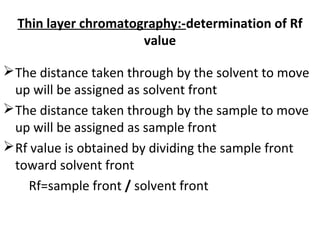
4.Develop the plate:-
 After spotting put the plate inside
the chamber in the ascendant position.
 Make sure that the dept of solvent
doesn’t touch the spots.
 Let it develop up to the 1cm from the top of plate.
 After that pull out the plate from the chamber and let the
solvent be vaporized.
5.Detection of spot:-the color samples
are easy to be seen and no need
to use UV lamp to detect them.
Thin layer chromatography:-determination of Rf
value
The distance taken through by the solvent to move
up will be assigned as solvent front
The distance taken through by the sample to move
up will be assigned as sample front
Rf value is obtained by dividing the sample front
toward solvent front
Rf=sample front / solvent front
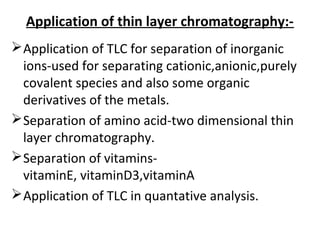
Application of thin layer chromatography:-
Application of TLC for separation of inorganic
ions-used for separating cationic,anionic,purely
covalent species and also some organic
derivatives of the metals.
Separation of amino acid-two dimensional thin
layer chromatography.
Separation of vitamins-
vitaminE, vitaminD3,vitaminA
Application of TLC in quantative analysis.
Advantages & disadvantages of thin layer
chromatography
Advantages:-
the components are separated in very little time as the
components will elute out very quickly.
The solvents for the TLC plate can be changes.
Disadvantages:-
in this method the plate length is limited and hence
separation takes place only up to certain length.
The separation takes place in an open system.
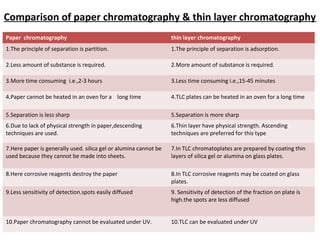
Comparison of paper chromatography & thin layer chromatography
Paper chromatography thin layer chromatography
1.The principle of separation is partition. 1.The principle of separation is adsorption.
2.Less amount of substance is required. 2.More amount of substance is required.
3.More time consuming i.e.,2-3 hours 3.Less time consuming i.e.,15-45 minutes
4.Paper cannot be heated in an oven for a long time 4.TLC plates can be heated in an oven for a long time
5.Separation is less sharp 5.Separation is more sharp
6.Due to lack of physical strength in paper,descending
techniques are used.
6.Thin layer have physical strength. Ascending
techniques are preferred for this type
7.Here paper is generally used. silica gel or alumina cannot be
used because they cannot be made into sheets.
7.In TLC chromatoplates are prepared by coating thin
layers of silica gel or alumina on glass plates.
8.Here corrosive reagents destroy the paper 8.In TLC corrosive reagents may be coated on glass
plates.
9.Less sensitivity of detection.spots easily diffused 9. Sensitivity of detection of the fraction on plate is
high.the spots are less diffused
10.Paper chromatography cannot be evaluated under UV. 10.TLC can be evaluated under UV
REFERENCES:-
• BIOCHEMISTRY
C.B.Power
G.R.Chatwal
• www.slideshare.net
• m.authorstream.com
• https:/en.m.wikipedia.org
THANK YOUTHANK YOU

Chromatography

  • 1.
    CHROMATOGRAPHYCHROMATOGRAPHY PRESENTED BY:- Patel JinalR. M.Sc.SEM-2 (BOTANY) Paper CBO-406 Department of Life sciences, H.N.G.U,Patan.
  • 2.
    CONTENTS:-  Introduction ofchromatography  Classification of chromatography  Types of chromatography  Paper chromatography Principle, Procedure, Types, Application, Advantages & disadvantages  Thin layer chromatography  Principle, Procedure, application, Advantages & disadvantages  Comparison of paper chromatography & thin layer chromatography
  • 3.
    Introduction of chromatography Definition:-Chromatographyis a technique employed for separation of the components of mixture by continuous distribution of the components between two phases. (mobile phase and stationary phase). Chromatography is relatively a new technique which was first invented by Michael Tswett, a Russian botanist in 1906.
  • 4.
  • 5.
    Types of chromatography:- Thinlayer chromatography Column chromatography Paper chromatography Gas chromatography High performance liquid chromatography
  • 6.
    Paper chromatography Paper chromatography(PC)was first introduced by german scientist christian friedrich schonbein(1865) principle:-this technique is a types of partition chromatography in which the substances are distributed between two liquids. i.e., one is the stationary liquid (usually water) which is held in the fibres of the paper and called stationary phase; the other is the moving liquid or developing and called the moving phase. The components of the mixture to be separated migrate at different rates and appear as spots at different points on the paper.
  • 7.
     Procedure:-Procedure:-  Inthis technique, a drop of the test solution is applied as a small spot on a filter paper and the spot is dried.  The paper is kept in a close chamber and the edge of the filter paper is dipped into a solvent called developing solvent.  As soon as filter paper gets the liquid through its capillary axis and when it reaches the spot of the test solution.  The various substances are moved by solvent system at various speeds. when solvent has moved these substances to a suitable height(15-18cm),the paper is dried and the various spots are visualised by suitable reagents called visualising reagents.  The movement of substances relative to the solvent is expressed in terms of Rf values. i.e.,migration parameters.
  • 8.
    Rf (Retention factor)valueRf (Retention factor) value:-  The Rf(Retention factor) may be defined as the ratio of(Retention factor) may be defined as the ratio of the distance traveled by the solvent.the distance traveled by the solvent.  Rf value are usually expressed as a fraction of two decimalRf value are usually expressed as a fraction of two decimal places.places.  If Rf value of a solution is zero, the solute remains in theIf Rf value of a solution is zero, the solute remains in the stationary phase and thus it is immobile.stationary phase and thus it is immobile.  If Rf value=1 then the solute has no affinity for theIf Rf value=1 then the solute has no affinity for the stationary phase and travels with the solvent front.stationary phase and travels with the solvent front.  Rf=distance the solute(D1)moves divided by the distanceRf=distance the solute(D1)moves divided by the distance traveled by the solvent front(D2)traveled by the solvent front(D2) Rf=D1/D2Rf=D1/D2
  • 9.
    Types of paperchromatography:-Types of paper chromatography:- 1. Descending chromatography:- in this type, development of the chromatography is done by allowing the solvent to travel down the paper. 2. Ascending chromatography:- Here the solvent travel upward direction of the chromatography paper. Both the descending and ascending chromatography paper are used for separation of organic and inorganic substances. 3. Ascending-descending chromatography paper It is the hybrid of the above techniques. the upper part of the ascending chromatography can be folded over a rod and allowing the paper to become descending after crossing the rod
  • 10.
    4.Radial chromatography paper: •It is also called a circular chromatography. Here a circular filter paper is taken and the sample is given at the center of the paper. • After drying the spot the filter paper is tied horizontally on a petridish containing solvent.so that wick and the paper is dipped inside the solvent. the solvent rises through the wick and the component get separated in form of concentrate circular zone. 5.two-dimensional chromatography paper:- • In this technique a square or rectangular paper is used.here the sample is applied to one of the corners and developments is performed at right angle to the direction of first run.
  • 11.
    Application of paperchromatography:- Paper chromatography is more useful for the analysis of polar compounds like amino acid,natural products etc. the different types of applications are listed below. Separation of mixture of drugs of chemical or biological origin,plant extracts etc. Separation of carbohydrates(sugars),vitamins,antibiotics, proteins,alkaloids,glycosides,aminoacid etc.
  • 12.
    Advantages & disadvantagesof paper chromatography:- Advantages:-  Paper chromatography requires very less quantitative material.  Paper chromatography is cheaper compared to other chromatography methods.  Both unknown inorganic as well as organic compounds can be identified by paper chromatography method.  Disadvantages:-  Large quantity of sample cannot be applied on paper chromatography.in quantitative analysis paper chromatography is not effective.  Complex mixture cannot be separated by paper chromatography.  Less accurate compared to HPLC or HPTLC.
  • 13.
    Thin layer chromatography(TLC) Thin layer chromatography(TLC) can be defined as a method of separation or identification of a mixture of components into individual by using finely divided adsorbent solid/liquid spread over a glass plate and liquid as a mobile phase  Synonyms drop,strip,spread layer,surface chromatography and open column chromatography. • Principle:- adsorption or retention or both or any other principle of a substance on the stationary phase. • Separation of the adsorbed substances by the mobile phase • Recovery of the separated substances by a countinuous flow of the mobile phase.
  • 14.
    Procedure:- 1.Developing container preparation:- solventis transferred into the container with 0.5-1cm in dept from the bottom. 2.TLC plate preparation:- Commercially obtained with 5cmx20cm in size.Prepare your size when necessary. line 1cm from the bottom with a pencil as a part should be spotted. 3.Spotting TLC plates:- Make sure that your sample is liquified already. Stick it using capillary pipe & spot onto the line.
  • 15.
    4.Develop the plate:- After spotting put the plate inside the chamber in the ascendant position.  Make sure that the dept of solvent doesn’t touch the spots.  Let it develop up to the 1cm from the top of plate.  After that pull out the plate from the chamber and let the solvent be vaporized. 5.Detection of spot:-the color samples are easy to be seen and no need to use UV lamp to detect them.
  • 16.
    Thin layer chromatography:-determinationof Rf value The distance taken through by the solvent to move up will be assigned as solvent front The distance taken through by the sample to move up will be assigned as sample front Rf value is obtained by dividing the sample front toward solvent front Rf=sample front / solvent front
  • 17.
    Application of thinlayer chromatography:- Application of TLC for separation of inorganic ions-used for separating cationic,anionic,purely covalent species and also some organic derivatives of the metals. Separation of amino acid-two dimensional thin layer chromatography. Separation of vitamins- vitaminE, vitaminD3,vitaminA Application of TLC in quantative analysis.
  • 18.
    Advantages & disadvantagesof thin layer chromatography Advantages:- the components are separated in very little time as the components will elute out very quickly. The solvents for the TLC plate can be changes. Disadvantages:- in this method the plate length is limited and hence separation takes place only up to certain length. The separation takes place in an open system.
  • 19.
    Comparison of paperchromatography & thin layer chromatography Paper chromatography thin layer chromatography 1.The principle of separation is partition. 1.The principle of separation is adsorption. 2.Less amount of substance is required. 2.More amount of substance is required. 3.More time consuming i.e.,2-3 hours 3.Less time consuming i.e.,15-45 minutes 4.Paper cannot be heated in an oven for a long time 4.TLC plates can be heated in an oven for a long time 5.Separation is less sharp 5.Separation is more sharp 6.Due to lack of physical strength in paper,descending techniques are used. 6.Thin layer have physical strength. Ascending techniques are preferred for this type 7.Here paper is generally used. silica gel or alumina cannot be used because they cannot be made into sheets. 7.In TLC chromatoplates are prepared by coating thin layers of silica gel or alumina on glass plates. 8.Here corrosive reagents destroy the paper 8.In TLC corrosive reagents may be coated on glass plates. 9.Less sensitivity of detection.spots easily diffused 9. Sensitivity of detection of the fraction on plate is high.the spots are less diffused 10.Paper chromatography cannot be evaluated under UV. 10.TLC can be evaluated under UV
  • 20.
  • 21.