Thin Layer Chromatography for Biotechnology & Botany Sem-2 Students
1.
Page | 1
Whatis Thin Layer Chromatography (TLC)?
Thin Layer Chromatography (TLC) is a chromatographic technique used to separate and identify
components of a mixture. It involves a stationary phase (a thin layer of adsorbent material like
silica gel or alumina) coated on a flat plate and a mobile phase (a solvent or solvent mixture). As
the mobile phase ascends the plate by capillary action, components of the sample move at different
rates, leading to their separation.
Or
Thin-layer chromatography is a commonly used technique for separating non-volatile mixtures.
The process of thin-layer chromatography is consists of two phases — the stationary phase as well
as mobile. Thin Layer Chromatography is usually conducted on a glass sheet, plastic or
aluminum foil on top of which the stationary phase like Silica Gel, Aluminium Oxide and Cellulose
is applied. Once the chromatography process begins, the different components of the mixture will
get absorbed at different levels depending on their polarity. The mobile phase is passed through a
vertical column containing the stationary phase and that is how the separation process is carried
out.
Principle of TLC
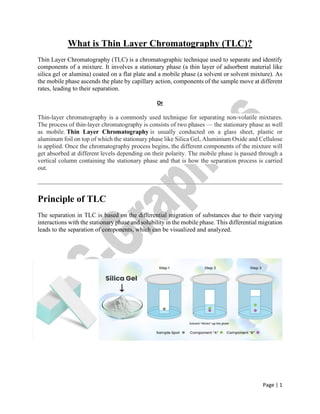
The separation in TLC is based on the differential migration of substances due to their varying
interactions with the stationary phase and solubility in the mobile phase. This differential migration
leads to the separation of components, which can be visualized and analyzed.
2.
Page | 2
Roleof Silica Gel in Thin-layer Chromatography
As mentioned earlier, Silica Gel Chromatography has a very important role to play in the
thin-layer chromatography process. The reason why out of all the adsorbents for thin-layer
chromatography, Silica Gel is the most preferred is very clear. Silica Gel has calcium sulfate
as a binder and this makes it the best adsorbent available in the market. Silica Gel is well-
known for its top-notch separation qualities and works as an excellent separation tool in the
thin-layer chromatography process. When the Silica Gel adsorbent is placed on top of
the thin-layer chromatography plate then it will speed up the separation and subsequent
purification process.
As mentioned above, Silica Gel is very important for the successful completion of the thin-layer
chromatography process. One must always use high-quality Silica Gel, which can absorb all the
compounds meant to be separated. Silica Gel 230–400 mesh and Silica Gel 200–400 Mesh are the
most commonly used types of Silica gel. (Mesh size, generally, refers to the pore size of the Silica
Gel desiccants. If one makes use of Silica Gel with higher mesh value then the separation process
becomes fast and simple. With Silica Gel 230–400 in use, one need not worry too much about the
separation process.
Methodology
1. Preparation of the TLC Plate
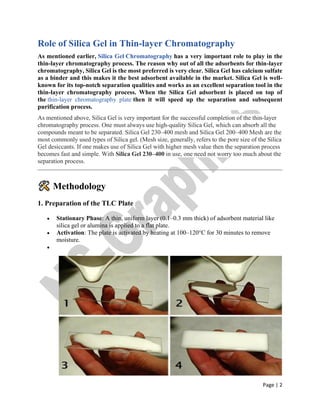
• Stationary Phase: A thin, uniform layer (0.1–0.3 mm thick) of adsorbent material like
silica gel or alumina is applied to a flat plate.
• Activation: The plate is activated by heating at 100–120°C for 30 minutes to remove
moisture.
•
3.
Page | 3
2.Sample Application
• Spotting: A small volume (1–10 μL) of the sample solution is applied as a small spot
near the bottom edge of the plate (baseline), usually 1–2 cm from the edge.
• Technique: Spotting is done using a capillary tube or micropipette. The spots should be
small to ensure better separation.
3. Development of the Chromatogram
• Setup: The plate is placed vertically in a development chamber containing the mobile
phase.
• Saturation: The chamber is pre-saturated with the mobile phase vapors to ensure even
migration.
• Migration: The mobile phase ascends the plate by capillary action, carrying the sample
components at varying rates.
4. Detection of Spots
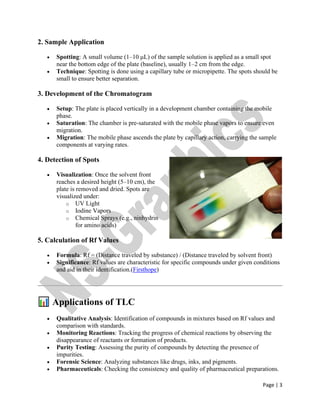
• Visualization: Once the solvent front
reaches a desired height (5–10 cm), the
plate is removed and dried. Spots are
visualized under:
o UV Light
o Iodine Vapors
o Chemical Sprays (e.g., ninhydrin
for amino acids)
5. Calculation of Rf Values
• Formula: Rf = (Distance traveled by substance) / (Distance traveled by solvent front)
• Significance: Rf values are characteristic for specific compounds under given conditions
and aid in their identification.(Firsthope)
Applications of TLC
• Qualitative Analysis: Identification of compounds in mixtures based on Rf values and
comparison with standards.
• Monitoring Reactions: Tracking the progress of chemical reactions by observing the
disappearance of reactants or formation of products.
• Purity Testing: Assessing the purity of compounds by detecting the presence of
impurities.
• Forensic Science: Analyzing substances like drugs, inks, and pigments.
• Pharmaceuticals: Checking the consistency and quality of pharmaceutical preparations.
4.
Page | 4
•Biochemical Analysis: Separation or isolation of biochemical metabolites from blood
plasma, urine, body fluids, serum, etc. (Firsthope, BYJU'S)
✅ Advantages of TLC
• Simplicity: Easy to set up and perform with minimal equipment.
• Speed: Provides rapid separation of components.
• Cost-effective: Inexpensive materials and reagents.
• Versatility: Suitable for a wide range of substances and applications.
• Qualitative Analysis: Provides clear visual results, allowing for straightforward
identification of compounds.
• No Need for Expensive Equipment: Unlike some other techniques, TLC does not
require costly machinery.(Bachem, Firsthope)
Limitations of TLC
• Resolution: May not separate very closely related compounds effectively.
• Detection: Visual detection of components may be limited for certain substances.
• Quantification: Less effective for precise quantification of components compared to
other methods.
• Size Limitation: Limited by the size of the plate, which can restrict the amount of
sample.
• Solvent Dependence: Separation efficiency can be highly dependent on the choice of
solvent.
• Sample Loading: Overloading the sample can lead to poor separation and overlapping
spots.
• Reproducibility Issues: Variability in plate preparation and solvent front can affect
results. (Bachem)
Rf Value Interpretation
• Definition: Rf (Retention Factor) is the ratio of the distance traveled by the compound to
the distance traveled by the solvent front.
• Calculation: Rf = (Distance traveled by substance) / (Distance traveled by solvent front)
• Range: Rf values range from 0 (no migration) to 1 (travels with the solvent front).
• Significance: Rf values are characteristic for specific compounds under given conditions
and aid in their identification.