1
Thin Layer Chromatography
PRESENTED BY,
Devdatt Jani
M-Pharm 1st year
Dept. of Pharmaceutics
2
Contents
 Introduction
 Principle
 Types
 Experimental details
 Applications
 References
3
Introduction :
 TLC is simple & rapid method carried out using
thin layer of adsorbents on plates.
 Principle :
 TLC has been included under both adsorption
& partition chromatography.
 Separation may result due to adsorption or
partition or both phenomenon depending upon
nature of adsorbents & solvent system used for
development.
PRINCIPLE :
The main principle of TLC is adsorption One or
more compounds are spotted on a thin
layer of adsorbent coated on a
chromatographic plate. The mobile phase
solvent flows through because of capillary
action (against gravitational force). The
component with less affinity towards the
stationary phase travels faster.
4
PRINCIPLE :
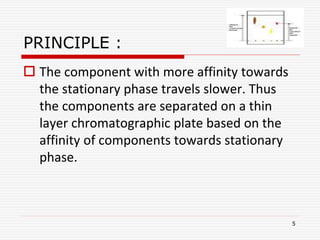
 The component with more affinity towards
the stationary phase travels slower. Thus
the components are separated on a thin
layer chromatographic plate based on the
affinity of components towards stationary
phase.
5
6
OUTLINE OF GENERAL PROCEDURE OF
TLC :-
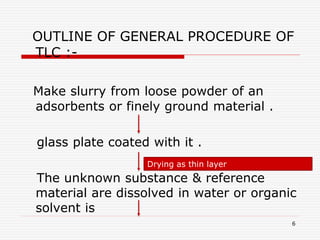
Make slurry from loose powder of an
adsorbents or finely ground material .
glass plate coated with it .
The unknown substance & reference
material are dissolved in water or organic
solvent is
Drying as thin layer
7
applied in a row of spots , 1-2 cm from
the edge of the with the help of capillary ,
micropipette or micro syringe .
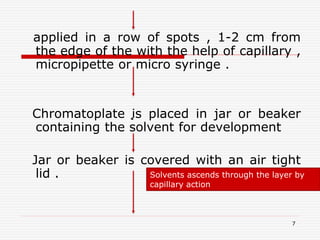
Chromatoplate is placed in jar or beaker
containing the solvent for development
Jar or beaker is covered with an air tight
lid . Solvents ascends through the layer by
capillary action
8
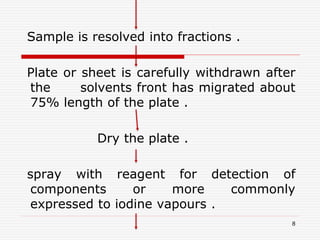
Sample is resolved into fractions .
Plate or sheet is carefully withdrawn after
the solvents front has migrated about
75% length of the plate .
Dry the plate .
spray with reagent for detection of
components or more commonly
expressed to iodine vapours .
9
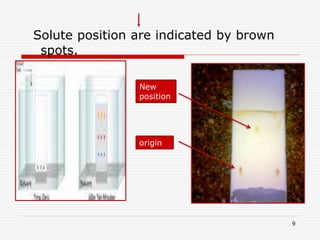
Solute position are indicated by brown
spots.
origin
New
position
10
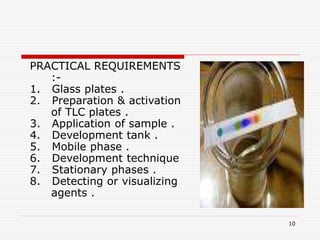
PRACTICAL REQUIREMENTS
:-
1. Glass plates .
2. Preparation & activation
of TLC plates .
3. Application of sample .
4. Development tank .
5. Mobile phase .
6. Development technique
7. Stationary phases .
8. Detecting or visualizing
agents .
Methods for application of
adsorbent.
 Pouring
 Dipping
 Spraying
 Spreading.
11
12
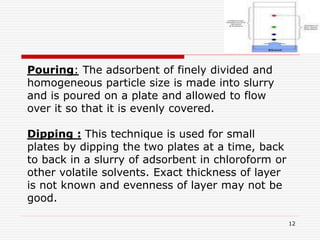
Pouring: The adsorbent of finely divided and
homogeneous particle size is made into slurry
and is poured on a plate and allowed to flow
over it so that it is evenly covered.
Dipping : This technique is used for small
plates by dipping the two plates at a time, back
to back in a slurry of adsorbent in chloroform or
other volatile solvents. Exact thickness of layer
is not known and evenness of layer may not be
good.
13
Spraying : Slurry is diluted further for the
operation of sprayer. But this technique is not
used now a days as it is difficult to get uniform
layer.
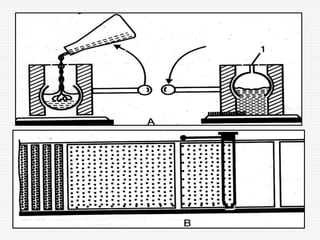
Spreading : All the above methods fail to give
thin and uniform layers. Modern methods utilize
the spreading devices for preparation of uniform
thin layers on glass plates. Commercial
spreaders are of two types (a) Moving spreader,
(b) Moving plate type.
It gives layer thickness from 0.2 to 2.0 mm.
14
15
Precoated plates of different adsorbents
either on glass or polymeric sheets are
available in uniform and optimal layer
thickness for intended purpose and are
abrasive resistant. They can be sprayed
with almost all spraying agents including
corrosive agents. But these are very
expensive. Also called as ready to use TLC
plates.
ACTIVATION OF PLATES
 After spreading plates are allowed to
dry in air and further dried and
activated by heating at about 100
0
c
for 30 mins.
 By removing the liquids associated
with layer completely, the adsorbent
layer is activated.
16
SOLVENT SYSTEM
 The choice of the mobile phase is depends
upon the following factors:-
1. Nature of the substance to be separated
2. Nature of the stationary phase used
3. Mode of chromatography ( Normal phase
or reverse phase)
4. Separation to be achieved- Analytical or
preparative.
17
18
The organic solvent mixture of low polarity is
used Highly polar solvents are avoided to
minimize adsorption of any components of the
solvent mixture. Use of water as a solvent is
avoided as it may loosen the adhesion of a layer
on a glass plate.
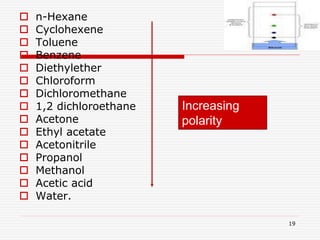
Solvents with an increasing degree of polarity are
used in liquid-solid or adsorption
chromatography. The solvents listed in elutropic
series are selected.
19
 n-Hexane
 Cyclohexene
 Toluene
 Benzene
 Diethylether
 Chloroform
 Dichloromethane
 1,2 dichloroethane
 Acetone
 Ethyl acetate
 Acetonitrile
 Propanol
 Methanol
 Acetic acid
 Water.
Increasing
polarity
APPLICATION OF SAMPLE
 Sample solution in a non polar solvent is applied.
 The concentration of a sample or standard
solution has to be minimum 2-5 ul of a 1% solution
of either standard or test sample is spotted using a
capillary tube or micropipette.
 The area of application should be kept as small as
possible for sharper and greater resolution.
20
DEVELOPMENT OF
CHROMATOGRAMS
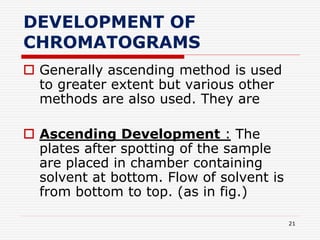
 Generally ascending method is used
to greater extent but various other
methods are also used. They are
 Ascending Development : The
plates after spotting of the sample
are placed in chamber containing
solvent at bottom. Flow of solvent is
from bottom to top. (as in fig.)
21
22
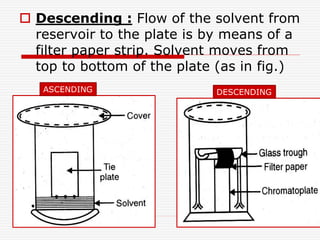
 Descending : Flow of the solvent from
reservoir to the plate is by means of a
filter paper strip. Solvent moves from
top to bottom of the plate (as in fig.)
ASCENDING DESCENDING
23
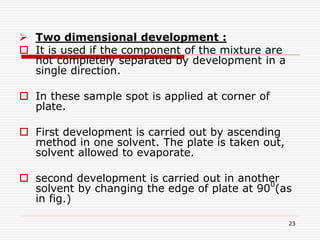
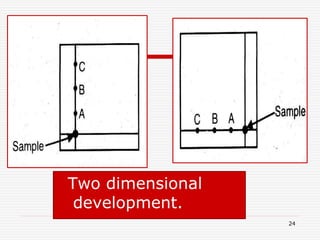
 Two dimensional development :
 It is used if the component of the mixture are
not completely separated by development in a
single direction.
 In these sample spot is applied at corner of
plate.
 First development is carried out by ascending
method in one solvent. The plate is taken out,
solvent allowed to evaporate.
 second development is carried out in another
solvent by changing the edge of plate at 90
0
(as
in fig.)
24
Two dimensional
development.
REVERSE PHASE TLC
 Here stationary phase is non polar in nature and mobile
phase is polar in nature.
 These chromatoplates are prepared by immersing the
adsorbent layer very slowly in 5-10% of paraffin, silicone
oil, undecane in petroleum ether or diethyl ether. After
removing the plate and evaporating the solvent , the plate
is ready for chromatography. Paraffin and silicon oil
provides the permanent impregnation whereas undecane
can be removed after development after heating the plate
at 120
0.
25
26
APPLICATIONS OF TLC :-
The application of TLC are wider & there
is no limitation to the compounds that can be
analysed by TLC . Anyhow different types of
application are listed below .
1. Separation of mixtures of drugs of chemical or
biological origin , plant extracts , etc .
2. Separation of carbohydrates , vitamins ,
antibiotics , proteins , alkaloids , glycosides ,
etc .
27
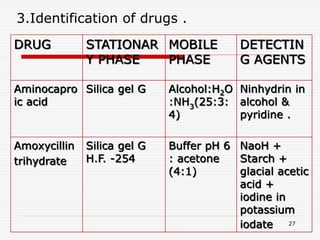
3.Identification of drugs .
DRUG STATIONAR
Y PHASE
MOBILE
PHASE
DETECTIN
G AGENTS
Aminocapro
ic acid
Silica gel G Alcohol:H2O
:NH3
(25:3:
4)
Ninhydrin in
alcohol &
pyridine .
Amoxycillin
trihydrate
Silica gel G
H.F. -254
Buffer pH 6
: acetone
(4:1)
NaoH +
Starch +
glacial acetic
acid +
iodine in
potassium
iodate
28
4.Identification of related compounds in
drugs :-
DRUGS NAME OF
RELATED
COMPOUND
STATIONARY
PHASE
MOBILE
PHASE
DETECTING
AGENTS
Allopurinol 3-amino
pyrazole -
4-carbonamide
hemisulphate
Cellulse powder
with flurescent
additive
n-butanol :
ammonia
UV 254 nm
Bethanidine
sulphate
Methylamine
benzylamine
trimethyl
guanidine
sulphate
Silica gel G Ethyl
acetate :
glacial
acetic acid :
water :
alcohol(25:
12:8:5)
1.Ninhydrin in
isopropanol
2. Potassium
iodobismuthate
29
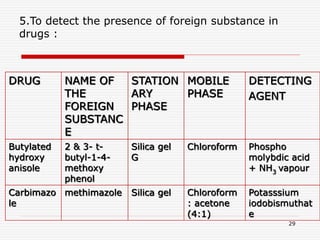
5.To detect the presence of foreign substance in
drugs :
DRUG NAME OF
THE
FOREIGN
SUBSTANC
E
STATION
ARY
PHASE
MOBILE
PHASE
DETECTING
AGENT
Butylated
hydroxy
anisole
2 & 3- t-
butyl-1-4-
methoxy
phenol
Silica gel
G
Chloroform Phospho
molybdic acid
+ NH3
vapour
Carbimazo
le
methimazole Silica gel Chloroform
: acetone
(4:1)
Potasssium
iodobismuthat
e
30
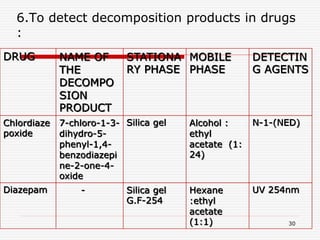
6.To detect decomposition products in drugs
:
DRUG NAME OF
THE
DECOMPO
SION
PRODUCT
STATIONA
RY PHASE
MOBILE
PHASE
DETECTIN
G AGENTS
Chlordiaze
poxide
7-chloro-1-3-
dihydro-5-
phenyl-1,4-
benzodiazepi
ne-2-one-4-
oxide
Silica gel Alcohol :
ethyl
acetate (1:
24)
N-1-(NED)
Diazepam - Silica gel
G.F-254
Hexane
:ethyl
acetate
(1:1)
UV 254nm
31
References
 “Instrumental Methods Of Chemical Analysis”, Gurdeep R.
Chatwal & Sham K.Anand....Himalaya publishing house.
 “Textbook of Pharmaceutical Analysis”, S. Ravi Shankar…RX
publications.
 “Pharmaceutical Analysis”, volume 2…Instrumental methods
by Dr.A V.Kasture. Dr. K R.Mahadik,
Dr.S G.Wadodkar,Dr.H N. More.
 www.google.com
32

Thin layer Chromatography and it's Techniques

  • 1.
    1 Thin Layer Chromatography PRESENTEDBY, Devdatt Jani M-Pharm 1st year Dept. of Pharmaceutics
  • 2.
    2 Contents  Introduction  Principle Types  Experimental details  Applications  References
  • 3.
    3 Introduction :  TLCis simple & rapid method carried out using thin layer of adsorbents on plates.  Principle :  TLC has been included under both adsorption & partition chromatography.  Separation may result due to adsorption or partition or both phenomenon depending upon nature of adsorbents & solvent system used for development.
  • 4.
    PRINCIPLE : The mainprinciple of TLC is adsorption One or more compounds are spotted on a thin layer of adsorbent coated on a chromatographic plate. The mobile phase solvent flows through because of capillary action (against gravitational force). The component with less affinity towards the stationary phase travels faster. 4
  • 5.
    PRINCIPLE :  Thecomponent with more affinity towards the stationary phase travels slower. Thus the components are separated on a thin layer chromatographic plate based on the affinity of components towards stationary phase. 5
  • 6.
    6 OUTLINE OF GENERALPROCEDURE OF TLC :- Make slurry from loose powder of an adsorbents or finely ground material . glass plate coated with it . The unknown substance & reference material are dissolved in water or organic solvent is Drying as thin layer
  • 7.
    7 applied in arow of spots , 1-2 cm from the edge of the with the help of capillary , micropipette or micro syringe . Chromatoplate is placed in jar or beaker containing the solvent for development Jar or beaker is covered with an air tight lid . Solvents ascends through the layer by capillary action
  • 8.
    8 Sample is resolvedinto fractions . Plate or sheet is carefully withdrawn after the solvents front has migrated about 75% length of the plate . Dry the plate . spray with reagent for detection of components or more commonly expressed to iodine vapours .
  • 9.
    9 Solute position areindicated by brown spots. origin New position
  • 10.
    10 PRACTICAL REQUIREMENTS :- 1. Glassplates . 2. Preparation & activation of TLC plates . 3. Application of sample . 4. Development tank . 5. Mobile phase . 6. Development technique 7. Stationary phases . 8. Detecting or visualizing agents .
  • 11.
    Methods for applicationof adsorbent.  Pouring  Dipping  Spraying  Spreading. 11
  • 12.
    12 Pouring: The adsorbentof finely divided and homogeneous particle size is made into slurry and is poured on a plate and allowed to flow over it so that it is evenly covered. Dipping : This technique is used for small plates by dipping the two plates at a time, back to back in a slurry of adsorbent in chloroform or other volatile solvents. Exact thickness of layer is not known and evenness of layer may not be good.
  • 13.
    13 Spraying : Slurryis diluted further for the operation of sprayer. But this technique is not used now a days as it is difficult to get uniform layer. Spreading : All the above methods fail to give thin and uniform layers. Modern methods utilize the spreading devices for preparation of uniform thin layers on glass plates. Commercial spreaders are of two types (a) Moving spreader, (b) Moving plate type. It gives layer thickness from 0.2 to 2.0 mm.
  • 14.
  • 15.
    15 Precoated plates ofdifferent adsorbents either on glass or polymeric sheets are available in uniform and optimal layer thickness for intended purpose and are abrasive resistant. They can be sprayed with almost all spraying agents including corrosive agents. But these are very expensive. Also called as ready to use TLC plates.
  • 16.
    ACTIVATION OF PLATES After spreading plates are allowed to dry in air and further dried and activated by heating at about 100 0 c for 30 mins.  By removing the liquids associated with layer completely, the adsorbent layer is activated. 16
  • 17.
    SOLVENT SYSTEM  Thechoice of the mobile phase is depends upon the following factors:- 1. Nature of the substance to be separated 2. Nature of the stationary phase used 3. Mode of chromatography ( Normal phase or reverse phase) 4. Separation to be achieved- Analytical or preparative. 17
  • 18.
    18 The organic solventmixture of low polarity is used Highly polar solvents are avoided to minimize adsorption of any components of the solvent mixture. Use of water as a solvent is avoided as it may loosen the adhesion of a layer on a glass plate. Solvents with an increasing degree of polarity are used in liquid-solid or adsorption chromatography. The solvents listed in elutropic series are selected.
  • 19.
    19  n-Hexane  Cyclohexene Toluene  Benzene  Diethylether  Chloroform  Dichloromethane  1,2 dichloroethane  Acetone  Ethyl acetate  Acetonitrile  Propanol  Methanol  Acetic acid  Water. Increasing polarity
  • 20.
    APPLICATION OF SAMPLE Sample solution in a non polar solvent is applied.  The concentration of a sample or standard solution has to be minimum 2-5 ul of a 1% solution of either standard or test sample is spotted using a capillary tube or micropipette.  The area of application should be kept as small as possible for sharper and greater resolution. 20
  • 21.
    DEVELOPMENT OF CHROMATOGRAMS  Generallyascending method is used to greater extent but various other methods are also used. They are  Ascending Development : The plates after spotting of the sample are placed in chamber containing solvent at bottom. Flow of solvent is from bottom to top. (as in fig.) 21
  • 22.
    22  Descending :Flow of the solvent from reservoir to the plate is by means of a filter paper strip. Solvent moves from top to bottom of the plate (as in fig.) ASCENDING DESCENDING
  • 23.
    23  Two dimensionaldevelopment :  It is used if the component of the mixture are not completely separated by development in a single direction.  In these sample spot is applied at corner of plate.  First development is carried out by ascending method in one solvent. The plate is taken out, solvent allowed to evaporate.  second development is carried out in another solvent by changing the edge of plate at 90 0 (as in fig.)
  • 24.
  • 25.
    REVERSE PHASE TLC Here stationary phase is non polar in nature and mobile phase is polar in nature.  These chromatoplates are prepared by immersing the adsorbent layer very slowly in 5-10% of paraffin, silicone oil, undecane in petroleum ether or diethyl ether. After removing the plate and evaporating the solvent , the plate is ready for chromatography. Paraffin and silicon oil provides the permanent impregnation whereas undecane can be removed after development after heating the plate at 120 0. 25
  • 26.
    26 APPLICATIONS OF TLC:- The application of TLC are wider & there is no limitation to the compounds that can be analysed by TLC . Anyhow different types of application are listed below . 1. Separation of mixtures of drugs of chemical or biological origin , plant extracts , etc . 2. Separation of carbohydrates , vitamins , antibiotics , proteins , alkaloids , glycosides , etc .
  • 27.
    27 3.Identification of drugs. DRUG STATIONAR Y PHASE MOBILE PHASE DETECTIN G AGENTS Aminocapro ic acid Silica gel G Alcohol:H2O :NH3 (25:3: 4) Ninhydrin in alcohol & pyridine . Amoxycillin trihydrate Silica gel G H.F. -254 Buffer pH 6 : acetone (4:1) NaoH + Starch + glacial acetic acid + iodine in potassium iodate
  • 28.
    28 4.Identification of relatedcompounds in drugs :- DRUGS NAME OF RELATED COMPOUND STATIONARY PHASE MOBILE PHASE DETECTING AGENTS Allopurinol 3-amino pyrazole - 4-carbonamide hemisulphate Cellulse powder with flurescent additive n-butanol : ammonia UV 254 nm Bethanidine sulphate Methylamine benzylamine trimethyl guanidine sulphate Silica gel G Ethyl acetate : glacial acetic acid : water : alcohol(25: 12:8:5) 1.Ninhydrin in isopropanol 2. Potassium iodobismuthate
  • 29.
    29 5.To detect thepresence of foreign substance in drugs : DRUG NAME OF THE FOREIGN SUBSTANC E STATION ARY PHASE MOBILE PHASE DETECTING AGENT Butylated hydroxy anisole 2 & 3- t- butyl-1-4- methoxy phenol Silica gel G Chloroform Phospho molybdic acid + NH3 vapour Carbimazo le methimazole Silica gel Chloroform : acetone (4:1) Potasssium iodobismuthat e
  • 30.
    30 6.To detect decompositionproducts in drugs : DRUG NAME OF THE DECOMPO SION PRODUCT STATIONA RY PHASE MOBILE PHASE DETECTIN G AGENTS Chlordiaze poxide 7-chloro-1-3- dihydro-5- phenyl-1,4- benzodiazepi ne-2-one-4- oxide Silica gel Alcohol : ethyl acetate (1: 24) N-1-(NED) Diazepam - Silica gel G.F-254 Hexane :ethyl acetate (1:1) UV 254nm
  • 31.
    31 References  “Instrumental MethodsOf Chemical Analysis”, Gurdeep R. Chatwal & Sham K.Anand....Himalaya publishing house.  “Textbook of Pharmaceutical Analysis”, S. Ravi Shankar…RX publications.  “Pharmaceutical Analysis”, volume 2…Instrumental methods by Dr.A V.Kasture. Dr. K R.Mahadik, Dr.S G.Wadodkar,Dr.H N. More.  www.google.com
  • 32.